Showing posts with label Hispanics. Show all posts

Friday, February 20, 2026

After a jarring ICE raid at a horse racing track, residents of a tiny Idaho town measure the aftermath

Agents outside La Catedral Arena, a horse track in Wilder, Idaho, 
Oct. 19, 2025. (Idaho Statesman photo via Mother Jones)
Some residents of Wilder, Idaho, say the town hasn't been the same since federal Immigration and Customs Enforcement agents descended on an off-the-beaten-path horse racing track and detained roughly 100 Latinos who were working or attending the races. 

The horse track, known as La Catedral Arena, had been a place where immigrant families gathered to enjoy food and racing together, reports Anna Griffin of The New York Times. Few whites ever attended the races or questioned track activities.

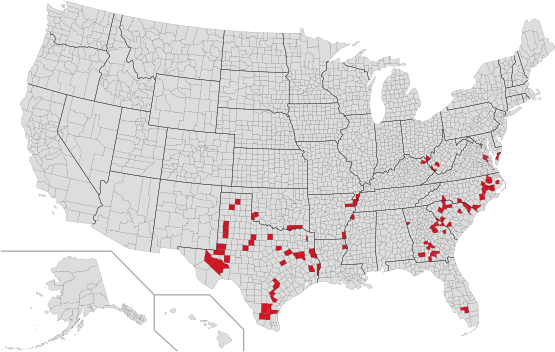
Wilder is located in Canyon
County, Idaho. (Wikipedia)
Sixty percent of Wilder's 1,725 residents are Latino, and most residents take pride in living in harmony. But on Oct. 19, things changed. ICE agents, including a swarm of gun-toting agents on the ground, a helicopter, and the agency's signature SUVs, descended on the track during the busiest time of day. Agents rounded up nearly 100 Latinos and later deported 75.

The raid did more than "crack an alleged gambling ring and increase deportation numbers," the Times reports. "It shattered Wilder’s innocent belief that its out-of-the-way location and deep-red politics could isolate the town from raids." 

Wilder resident Chris Gross, who farms sweet corn seed and mint, expressed concern about how the raid might limit immigrant farm workers. She told Griffin, "We rely on Hispanic labor." 

"The raid 'nearly destroyed' the community, said David Lincoln, a longtime Wilder resident and executive director of a nonprofit economic development agency serving rural towns in western Idaho," Griffen writes. Griffin adds, "Wilder won’t really know the impact until planting season begins this spring."

The day after the raid, at least half of Wilder's students didn't show up for class. Griffin reports, "Gross, who is white, said anyone who sees a black SUV roll through town, regardless of their race, 'freezes up.'" 

Still, the town's mayor, Steve Rhodes, claims the raid "has had 'zero effect' on the town," He told the Times, "These were not our people. What happened out at that track had nothing to do with Wilder.”

Tuesday, December 17, 2024

Rural communities struggle to find ways to communicate with growing non-native English-speaking population

Despite the ongoing growth of non-native English-speaking populations in rural communities, people in many counties and towns have failed to find effective ways to communicate with residents still learning English. The small town of Elko, Nevada, serves as an example. The town's "Hispanic or Latino population has grown to about 26%," reports Jazmin Orozco Rodriguez of KFF Health News. "The share of people age 5 or older who speak a language other than English at home increased to 18% as of 2022, while Spanish is the language spoken in nearly 15% of households."

With Elko's number of non-native English-speaking residents, the area needs translation support to ensure all residents understand vital information. Unfortunately, "state lawmakers in Nevada left out smaller counties from a recently enacted statewide language-access law," Rodriguez writes. "Not providing language access to people who need it is not only a violation of civil rights protected by Title VI of the Civil Rights Act, but it also can create public health and safety concerns said Jake Hofstetter, a policy analyst for the Migration Policy Institute, a think tank focused on immigration policy and research."

While much of rural America is white and English-speaking, its population has diversified, leaving smaller communities struggling to adapt to residents who aren't proficient in English. Rodriguez explains, "Implementing state and local language-access laws, however, is a challenge, researchers say, given standards can vary across state agencies and localities, making it difficult to ensure high-quality assistance is provided to speakers of various non-English languages."

The language-access challenges rural communities now face will continue to grow. "The number of white residents in rural parts of the nation decreased by about 2 million from 2010 to 2020, according to an analysis by the Carsey School of Public Policy at the University of New Hampshire," Rodriguez reports. "And the percentage of people who are members of a racial or ethnic minority living in rural areas increased from 20% in 2010 to 24% in 2020, with the largest share being Hispanic."

Language access services in metro and urban settings have grown; however, "Hofstetter said he doesn’t see many local policies that focus on the issue in rural areas," Rodriguez writes. "People living in rural areas may still benefit from a patchwork of resources through state agencies that provide services in their counties or local programs required to address language access because of federal funding."

Nonetheless, language barriers put non-native English speakers at a disadvantage. Rodriquez adds, "The degree to which local governments offer communications in languages other than English varies for several reasons, including enforcement of civil rights protections. That enforcement relies on civil rights complaints, which often must be filed by residents who may not know their rights related to language access."

Friday, June 02, 2023

News-media roundup: Unionized Gannett staffers walk out to protest CEO; company gets competition in New Mexico

Employes at 24 of the 50 unionized newsrooms of Gannett Co. will walk out Monday (and maybe also Tuesday in some cases) to protest how the company is handling its business, The Washington Post reports.

In a northwest New Mexico market where Gannett has cut back its Farmington Daily Times, the owners of the Durango Herald in southwest Colorado have started the Tri-City Record, a five-day-a-week free publication, Editor & Publisher reports

Writing for E&P, veteran marketer Bob Sillick lays out "membership models that create value for readers" of newspapers.

Sarabeth Berman, CEO of the American Journalism Project, discussses with the Observer how to generate philanthropic support for local journalism. John Palfrey, presiddnet of the MacArthur Foundation, says "there are hundreds of promising new and re-energized philanthropic investment opportunities in the field of journalism."

The school committee in Amherst, Mass., is looking for a new superintendent after the student newspaper at Amherst Regional High School, The Graphic, reported accusations that counselors at the school had mistreated LGBTQ+ students, WBUR reports.

Gordon Wolf, longtime editor of the Denison Bulletin-Review in western Iowa, lost his job in a Lee Enterprises cutback. Now he's with the recioal Hispanic paper, the Carroll Times Herald reports

"Strengthening rural journalism will save small towns, and our democracy," writes Willliam McKenzie, senior editorial adviser at the George W. Bush Institute, and contributing columnist and former staffer at the Dallas Morning News. He says "These public and private sector efforts would help:
  • Congress should consider tax laws that make it easier for struggling newspapers to become nonprofit publications.
  • Lawmakers could allow subscribers to deduct their subscriptions from their taxes, just as taxpayers can do for contributions to public broadcasting operations.
  • Rural papers could share back-office operations, perhaps with a larger news outlet, thereby allowing the smaller community papers to focus more of their resources on reporting.
  • Nonprofit funders could help create more collaboratives like the Nebraska Journalism Trust that allow news to be shared across local communities."

Wednesday, March 22, 2023

How a rural paper hits a target reader — over 60, Black, parent — when its staff has none of those characteristics

"Editors need to have a keen sense of news judgment, which requires a clear view of their publications’ target readers. But what if the target reader is over 60 years old, or African American, or a mother juggling the lives of her children and the reporting staff is young, white and single?"

So asks Buck Ryan, associate professor of journalism at the University of Kentucky, in his latest case study of the Chatham News + Record in Chatham County, North Carolina. He reports that Editor-Publisher Bill Horner III "has found a way to hurdle that challenge in award-winning fashion," getting more prizes "than any other newspaper its size from the North Carolina Press Association over the last three years."

Black History Month coverage included a story about a local woman
who had written a book about her family's white-supremacist history.

Chatham County, has a population of 75,070 people, with a Hispanic community (12%) about as large as its African American community (11%), Ryan notes. Horner has started, suspended, and revived a Spanish-language edition and talked with Ryan about appealing to Black and older residents. The county's average age is 47.

The paper has a “6 Over 60” feature in partnership with Chatham County’s Council on Aging. The paper has sponsored events for COA, which has used grant funds to buy subscriptions for senior citizens who didn’t already subscribe.

Ryan reports that the News + Record's front page "typically contains a photo or a story about someone in Chatham County’s African American community, and asked Horner to describe his approach to news coverage of that community. "We are intentional about it in part because when it comes to news—and recognition in the county—that’s an underserved population," Horner said, adding that it made  aspecial effort to make this year's Black History Month coverage better than last year's, when "in all honesty, we didn’t do a great job last year of highlighting Black history and stories."

Horner said that as the paper has reported the removal of a Confederate monument and the placing of a historical marker remembering local lynching victims, "reaction has been mixed. No question we’ve lost some readers, but we’ve gained others. But it’s news, it’s part of what’s happening in a growing and changing market, and it’s incumbent upon us to take the lead to say what’s happening and why."

Ryan's interview with Horner also touched on the paper's newsletters on parenting and other topics, its staffing, a grant-funded revival of the Spanish-language edition, and a final section titled "Literacy, Good Writing and Required Reading." Some exceprts from that:

"My best writers are those who have been the most devoted readers of books and of great reporting. I hope I can say that I push them to be better writers and reporters. There’s only so much you can teach; there has to be a willingness and a desire to get better on their part, and also the capacity to understand and instinctively know what’s really good when it comes to reporting and writing. So we talk a lot about writing and share 360-degree feedback.

"We talk about what we’re reading. I give my kids books about writing and reporting and recommend books on those subjects to them. For example, Verlyn Klinkenborg’s Several Short Sentences About Writing is one I’ve given everyone. . . . I ask my reporters a lot of questions about word choice and sentence structure. We don’t do it as much in person; it’s mostly often done through editing on our server. As I said, I try to push. I don’t mind telling them a lede stinks; I have them read my stuff, and if my lede stinks, I want to know! . . . 

"One thing I’ll never forget from my studies at the William Allen White j-school at the University of Kansas was one of my professors, Elmer Lower, telling us that the world will always, always need people who write well. If we, as journalists, could develop into strong writers, he said, there would always be a place for us." For Ryan's full report, click here.

Friday, January 06, 2023

264 of 304 persistent high-poverty counties are rural: Black Belt, Delta, Appalachia, Ozarks, Rio Grande, Native lands

Map by Economic Research Service, United States Department of Agriculture

A fresh review of data from the Economic Research Service of the U.S. Department of Agriculture shows counties with continuous high poverty since 1960 are largely rural, reports Jody Heemstra of Dakota Radio Group News

President Lyndon Johnson's War on Poverty and the Economic Opportunity Act of 1964 helped move many counties out of high-poverty status, but in more than 300 counties, most of them rural, high poverty has persisted: "In 1960, 78 percent of U.S. counties had poverty rates of 20 percent or more. Among them, 28 percent continued to have high poverty through 1980," Heemstra reports. "As of 2019, there were 304 counties—13 percent of the counties with high poverty in 1960—that consistently had poverty rates of 20 percent or more over the last 60 years."

Heemstra writes, "The majority—264 counties—are rural counties and are clustered in the Appalachian states; the Black Belt in the South; the Mississippi Delta; the Ozarks region of Missouri, Arkansas, Oklahoma, and southeast Kansas; the Southwest; and in counties with large American Indian and Alaska Native populations."

Wednesday, October 05, 2022

Linda Ronstadt can't sing now, but she has a cookbook that she calls 'a song' and tells the story of the Sonoran Desert

In the desert, Ronstadt is most at home in places like the tiny town of Canelo, Ariz. (Photo by Cassidy Arazia for NYT)

Linda Ronstadt can sing no more, due to Parkinson’s disease, but she can write, and may have completed her oeuvre with a different sort of composition. Her new cookbook, Feels Like Home: A Song of the Sonoran Borderlands, has only 20 recipes, but “is a way to explain why the arid land that starts in Arizona and stretches into Mexico’s west coast is her foothold in the world,” writes Kim Severson of the New York Times after spending two days with her in the Sonoran Desert. "It’s a story she has told through music, and now wants to tell — as much as she can — through food."

The book, co-written with former Timesman Lawrence Downes, is "a braid of stories about her family and the history, politics and music of the bicultural borderland that she loves," and recipes "like caldo de queso, with its clear broth and glistening cubes of cheese, and Sonoran enchiladas built from thick, fried corn tortillas," Seversn reports. "The book has recipes for ancient desert food, like long-simmered tepary beans, and some only-in-Tucson dishes, like cheese crisp. . . . albóndigas, the spiced meatballs poached in water, and a quirky, modern concoction called tunapeños — essentially jalapeño peppers halved and stuffed with tuna salad. The book devotes four pages to tortillas de agua: a Sonoran staple made with wheat flour, water, salt and a touch of lard or shortening spun into a flaky, nearly translucent tortilla larger than a steering wheel."

Severson's visit began with a dinner Ronstadt buddy Katya Peterson assembled with "food harvested at Mission Garden, a plot of land whose crops represent more than 4,000 years of continuous cultivation in the Tucson Basin," she reports. "A fig tree stewarded by the Ronstadt family grows there, as well as cactus samples collected from the land where Ms. Ronstadt’s grandfather was born." But for her, "Dinner parties are not easy," Severson writes, quoting her: “I’m finding it harder and harder as I get older and deafer to hold conversations.”

But Ronstadt, 76, had an interview with Jeffrey Brown of PBS NewsHour, who made it the focus of a story about her very varied singing career (she won a Grammy for Canciones de mi Padre, "Songs of My Father") and the book today. "Linda Ronstadt is a portrait of courage," host Judy Woodruff said.

Thursday, June 16, 2022

Rural residents, especially in South, likelier to have medical debt; most Americans have had some in the last five years


More than 100 million Americans, representing 41% of adults in the nation, have medical debt, and they are more likely to live in rural areas, according to a
new data analysis by the Urban Institute. The issue is a "critical challenge to Americans’ financial stability and well-being," says the report, since "people with medical debt are likely to forgo needed medical care, have difficulty meeting other basic needs, and face an increased risk of bankruptcy."

A Kaiser Health News and NPR investigation found that the problem of medical debt is "far more pervasive than previously reported," Noam Levey reports, "because much of the debt that patients accrue is hidden as credit-card balances, loans from family, or payment plans to hospitals and other medical providers." According to a recent Kaiser Family Foundation poll that informed the reporters' investigation, more than half of U.S. adults said they've gone into debt in the past five years because of medical or dental bills. About one in four with medical debt owe more than $5,000 and about one in five said they'll probably never pay it off.

Medical debt "is forcing families to cut spending on food and other essentials. Millions are being driven from their homes or into bankruptcy, the poll found," Levey reports. The issue is also deepening racial disparities, and is preventing many from saving for retirement, buying a home, affording college, and more. It's also making life harder for people already facing cancer and other chronic illnesses. 

The Urban Institute analysis found that people with medical debt in collections are more likely to live in the South; of the 100 counties with the highest levels of medical debt, 79 are in states that didn't expand Medicaid under the Patient Protection and Affordable Care Act. One-off medical emergencies aren't driving medical debt: The prevalence of chronic medical conditions among a county's residents was the strongest predictor of medical debt. Counties with higher shares of uninsured, low-income, younger, or Black or Hispanic residents also have higher rates of medical debt. 

The No Surprises Act, which took effect Jan. 1, aims to protect patients from out-of-network medical bills, but it has some limitations; ground ambulances, for example, can cost thousands of dollars but are not covered under the bill. About half of emergency ground ambulance rides result in out-of-network charges for people with private insurance, according to a recent KFF study.

Monday, June 13, 2022

A revenue-raising tale of two rural community newspapers from the National Summit on Journalism in Rural America

Sixth in a series of reports on the National Summit on Journalism in Rural America, held June 3-4 by the Institute for Rural Journalism and Community Issues and the College of Communication and Information at the University of Kentucky. Previous articles were on the state of rural journalism, the Summit-driven effort for sustainability in rural journalism, nonprofit modelshelp from higher-education journalism programs and philanthropic support for rural news media.

At the National Summit on Journalism in Rural America, journalism educator and researcher Clay Carey of Samford University said one way journalists in academia can help the news business is case studies of news outlets. For two and a half years, Buck Ryan of the University of Kentucky has been doing what he calls a "participatory case study" of the Chatham News+Record, a weekly paper in central North Carolina; at the summit, he moderated a discussion between Editor-Publisher Bill Horner and another innovative rural publisher, Terrence Williams of The Keene Sentinel, a daily in southwest New Hampshire. They have the same print circulation: 3,800.

In a report for The Rural Blog, Ryan notes that both are participants in the Knight-Lenfest Table Stakes program to master “the new essentials of sustainable journalism” and the Facebook Membership Accelerator grant program. "They generated ideas for changes in strategy, user experience ('UX'), product development and, mostly, increasing revenues," Ryan reports. "At the Sentinel, to reduce subscriber churn, staff members write letters thanking subscribers for their support and explaining how the paper published stories to help the community."

CHATHAM NEWS-RECORD REVENUE CHART
Horner's and Williams' presentations at the Summit showed some significant differences in the papers and their communities. Chatham County's population is up 17% since 2010 and is more than one-fourth minority; Cheshire County's went down about 1,000. The News+Record's revenue is dominated by advertising, with only 21% from circulation, while the Sentinel gets almost half its revenue from its audience.
KEENE SENTINEL REVENUE CHART

In a written Q and A with Ryan, Horner said his paper will "have to focus on new revenue streams and be reader-driven." It is raising prices and getting "blowback from some readers and even dealers, but it’s a value proposition: sometimes you support the value of your work with higher pricing."

A chronic problem with audience revenue is "churn," the constant addition and departure of subscribers. Williams said requiring six-month commitments and recurring credit-card payments for all new subscription starts that are part of a discount or gift program "significantly cut churn and increased print and digital reader revenue. Our percentage of these EZ-pay subscribers grew from 30% print in 2018 to more than 50% today; and from less than 10% online in 2018 to 82% today. Revenue growth that came with the resulting increased retention rate has been significant."

Asked what partnership has been the most lucrative or profitable, Horner said the News+Record's promotion of nonprofits helped prompt the local Council on Aging, "which is really a county department but mostly funded privately," to use two pandemic-relief grants "to give us $10,000 to provide subscriptions to senior citizens they serve who didn’t subscribe. We also got $18,000 in financial support from Mountaire Farms, a poultry processing company with Spanish-speaking employees, for our La Voz project to bring a Spanish-language publication, La Voz de Chatham (Voice of Chatham), to the community."

Williams noted the Sentinel's partnership with the local Hannah Grimes Center for Entrepreneurship on Radically Rural, a multi-track community development symposium that includes a track on community journalism. The other tracks are entrepreneurship, downtowns, land and community, arts and culture, clean energy and health care. "It has been profitable for both partners and a boost to the local community," Williams wrote We have won numerous regional and national awards for Radically Rural, including third place for Virtual Events from the Local Media Association in 2020. Feel free to join us Sept. 21 and 22, 2022, either virtually or in person."

Ryan's final question: "Now that you’ve gotten to know each other, what’s the best idea you plan to steal from your new friend?" Horner said of Williams, "I particularly like the direct personal appeals he and his staff do by email to readers and contacts; we have already built a plan to replicate that. And I loved his Community Impact Report. What a great way to tell your own story and demonstrate your value to your audience." Williams said, "Bill’s team produces a handsome, helpful community resource guide (Chatham 411) that is heavily supported by advertising. We are looking at producing something similar for our market, and Chatham News+Record’s product is an excellent model for us. It’s very well done."

Friday, April 29, 2022

Quick hits: Sterile super-Romeo trout may help curb invasive species; tools for rural electric co-ops transitioning to renewable energy; federal aid fuels pickleball boom

Brook trout have been outcompeting native trout for years.
(NPL photo by Nick Hawkins)
Here's a roundup of stories with rural resonance; if you do or see similar work that should be shared on The Rural Blog, email us at heather.chapman@uky.edu.

People of color and low-income communities are at a disproportionate risk of being harmed by pesticide exposure, according to a newly released study. Read more here.

A non-profit has a page full of tools and guidelines to help rural electric cooperatives transition to renewable energy. Read more here.

To save an underdog fish species out West, scientists are turning some invasive trout into sterile super-Romeos and setting them loose. Since they're taking the bulk of female trout's attention during mating season, that helps reduce births among the species. Read more here.

Federal Covid-19 aid is funding a pickleball court construction boom. Read more here.

Tick bites are causing an increasing number of people to become allergic to meat. Read more here.

Monday, April 18, 2022

Ex-census overseer: Skewed 2020 census meant 6 states wrongly lost a House seat, 6 more rural states gained one

The 2020 census was underfunded, understaffed, and cut short. This apparently affected some rural areas, but widespread undercounts of Blacks and Hispanics and overcounts of whites and Asians caused a malapportionment of U.S. House seats that benefited more rural states, Robert Shapiro writes for The Washington Monthly. Shapiro oversaw the 2000 census as President Clinton's commerce undersecretary for economic affairs, and chairs the economic policy think tank Sonecon.

"The large-scale errors in the census cost New York, Texas, Florida, Arizona, California, and New Jersey one seat each, and resulted in an extra representative for Minnesota, Pennsylvania, Oregon, Montana, Wisconsin, and Indiana," Shapiro writes. "Those wide-ranging errors are matters of public record, because the professionals at the Census Bureau obligingly report the decennial census undercount and overcount rates by race and ethnicity. Compared to 2010, undercounts in 2020 jumped from 2.06 to 3.3 percent for Blacks, from 1.54% to 4.99% for Hispanics, and from 0.15% to 0.91% for Native Americans on reservations and Alaskan Natives. Overcounts also shot up, increasing from 0.83% to 1.64% for whites and from virtually zero to 2.62% for Asians." Shapiro's crew calculated the effect on apportionment by applying the error rates to each state's racial and ethnic makeup.

"The debasement of the 2020 census did not have clear partisan effects. The more diverse states that lost out—states in which Black and Hispanic people account for between 33 percent and 52 percent of the population—include not only blue New York, California, and New Jersey but also red Texas and Florida and purple Arizona," Shapiro writes. "Similarly, the unwitting winners include not only red Montana and Indiana but also blue Minnesota and Oregon and purple Pennsylvania and Wisconsin—all states with populations that are 80 to 87 percent white and Asian."

Shapiro says the Trump administration didn't skew the census by overtly manipulating the results but by simply making it easier for serious errors to occur.

Tuesday, April 12, 2022

2/3 of U.S. drinking water systems have uranium; search new database to see how your county's water stacks up

Public water systems by uranium, concentration 2000-2011 (Columbia University map; click the image to enlarge it)

Uranium is present in two-thirds of the nation's community water systems, which may put many Americans at a higher risk of health problems such as cancer, heart disease, and kidney problems. That's according to an analysis of Environmental Protection Agency data from 2000-2011 published this month in The Lancet Planetary Health. Though only 2.1 percent of water systems had annual uranium levels that exceed EPA maximums, there has been little research about the health effects of chronic uranium exposure.

Semi-urban Hispanic communities had the highest average levels of uranium and other toxic metals such as arsenic, barium, chromium, and selenium, according to the researchers from Columbia University's Mailman School of Public Health. Because Hispanic communities tended to have those elevated levels regardless of location or region, the study's authors said a failure of regulatory policy and/or water-treatment infrastructure may be to blame rather than natural occurrence of the heavy metals in the groundwater.

Moreover, an interactive map and searchable database show that counties across the nation — many rural — have contaminated water too. How pure is the water in your county?

Wednesday, March 23, 2022

Rural hospital closures in the last decade affected Blacks and Hispanics more than in the two previous decades

"A new study found that over the last decade, rural counties that had a hospital shut its doors had a higher share of Black and Hispanic residents and greater shares of income inequality compared to prior decades," Robert King reports for Fierce Healthcare. "The study, recently released by the University of North Carolina Cecil G. Sheps Center for Health Services Research, explored socioeconomic, demographic and other health system characteristics for rural counties that had and did not have facility closures from 1990 to 2020. The research comes as the Biden administration is pressing to address sources of health equity gaps."

Between 1990 and 1999, rural counties whose hospital closed had an average Black population of 0.4%. From 2000 to 2009, that rose to 0.7%. From 2010 to 2020, it leaped to 5%. That suggests that hospital closures in the past decade were more likely to affect Black residents than in previous decades. "Researchers found that a higher share of Hispanic residents were also more impacted by hospital closures over the last decade," King reports. "From 2010 to 2020, the percentage of U.S. Hispanic residents in a county that faced a closure was 3.9% compared with 1.6% from 2000 to 2009 and 0.7% from 1990 to 1999."

Over the past three decades, rural counties whose hospital closed were increasingly likely to see shortages in primary-care providers and dentists first, King reports.

Drivers of the race-related trends "include the high clustering of rural hospital closures in the South from 2010 to 2020, a region where most of the states did not expand Medicaid after passage of the Affordable Care Act," King reports. "Another driver was the 'growing concentration of closures in rural counties that neighbor metro counties,' the study said."

The findings dovetail with a recent Chartis Group report on rural health-care systems, which it found were disproportionately shuttering in states that had not expanded Medicaid.

Wednesday, February 23, 2022

Rural U.S. lost population for first time ever in 2010-20, but some rural areas grew, mostly through adult people of color

Population change in nonmetropolitan counties from 2010 to 2020
(University of New Hampshire Carsey School map; click the image to enlarge it)

We've known that most rural areas lost population in the last decade, but a new analysis of Census data found that rural America overall lost population for the first time in history, and the trend could continue, according to new analysis of 2020 census data by the University of New Hampshire's Carsey School of Public Policy. But some rural areas are gaining population, mostly from adult people of color, according to an analysis by The Daily Yonder.

Nonmetropolitan counties lost 289,000 residents out of about 46 million from 2010 to 2020, Kenneth Johnson reports for the Carsey School. In the previous decade, rural America gained 1.5 million new residents and in the 1990s grew by nearly 3.4 million.

"If rural outmigration is ongoing, and deaths continue to exceed births in many rural areas due to low fertility and higher mortality among the aging rural population, then population losses are likely to continue in much of rural America," Johnson reports. "And the onset of Covid-19, which generated additional social, economic, and epidemiological turbulence, is likely to contribute to more rural population loss because it significantly increased rural deaths and discouraged births. Rural counties with sustained population loss face significant challenges maintaining critical infrastructure needed to provide quality health care, education, and a viable economy for the remaining residents."

Though rural America as a whole has fewer people, "Parts of rural America are adding population, and some segments of the rural population — especially adults, people of color, and Hispanics — are growing," Sarah Melotte reports for The Daily Yonder. "Rural America’s adult population (ages 18 and up) increased 1.2%, according to a Daily Yonder analysis. During the same period, the share of the adult rural population composed of people of color and Hispanics grew by 22%, from 17.1% in 2010 to 20.8% in 2020. Diversity in the adult population increased in over 95% of the nation's rural counties since the last census -- about the same percentage as urban counties."
Percentage change in non-white and Hispanic population by metro status, 2010-2020
(Daily Yonder map; click the image to enlarge it or click here for the interactive version)

Tuesday, November 30, 2021

Rural households are hurt more by inflation than urban ones

Inflation is at a 30-year high in the U.S., and rural households are some of the hardest hit. 

"Inflation has hurt lower-income families, families of color, and rural households more than other demographics, a Bank of America research report found last week," Jason Lalljee reports for Business Insider. "Breaking down demographics by race, geography, and income, the bank found that the 'inflation shock' of 2021 has disproportionately affected the marginalized: Households without college graduates, African American, Hispanic and Latino communities, and those not living in cities have been spending more of their post-tax income on goods and services."

Rural households are paying an average of 5.2 percent more of their post-tax income because of inflation, compared to 3.5% of households in metropolitan areas. "All of the high-inflation categories, particularly energy and new and used cars, make up a larger share of the consumption basket for rural households," researchers wrote. "They also earn and save less than urban households, and so inflation is a bigger drag on their income, and they have less buffer against the shock."

Inflation has been blamed on everything from corporate greed to President Biden, but it's mostly a function of reduced supply and increased demand.

Friday, October 15, 2021

Minority communities saw more hunger during pandemic

Percentage of food-insecure households by race and ethnicity
in 2020 and 2019 (Investigate Midwest chart)
"The Covid-19 pandemic was expected to drive many families into hunger as jobs were lost and supply chains were interrupted. The prediction held true, but mostly for minorities," reports The Midwest Center for Investigative Reporting. "The nation's overall food insecurity rate remained the same between 2019 and 2020, but Black and Hispanic households fared the worst, according to U.S. Department of Agriculture data released last month. Fewer white households' struggled with food insecurity last year than the year before. Experts attributed the steady rate to government programs, such as the Pandemic Electronic Benefit Transfer program (P-EBT), intended to fight hunger. However, some of these programs are slated to end next year, which has advocates worried about what could happen to families struggling to access food."

Minority households likely fared worse because of existing disparities at the beginning of the pandemic, such as a lower median income and higher poverty rate than other groups. Other groups more likely to suffer from food insecurity include seniors, people with disabilities, people experiencing homelessness, and families with children, the Midwest Center reports.

Hunger is also disproportionately rural, previous data show. And though federal aid helped overall rural hunger go down in 2020, more children went hungry, more people used food banks, and overall food insecurity rose in nine states.

Friday, October 01, 2021

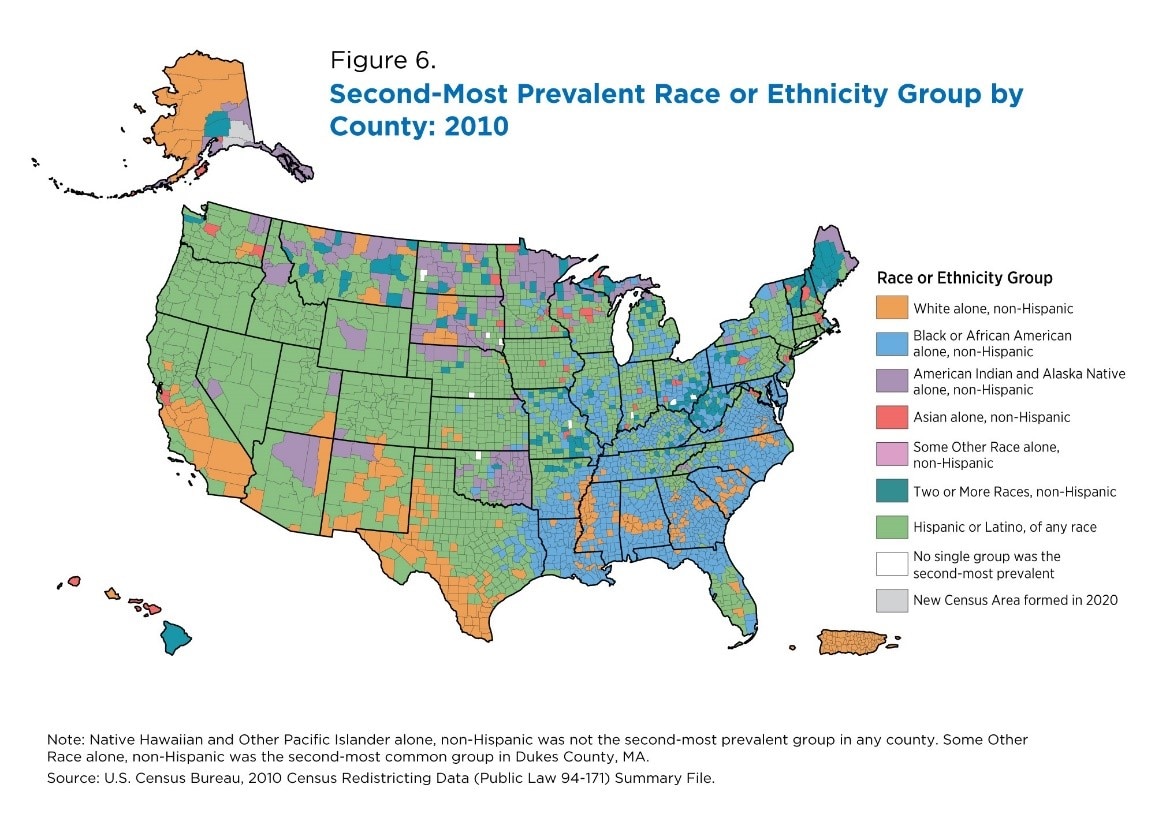
Census shows rural America becoming more racially diverse

Second-most prevalent race or ethnicity in U.S. counties, 2010 and 2020
Census Bureau maps for 2010 and 2020, adapted by The Rural Blog; click to enlarge.

Rural America is becoming more racially and ethnically diverse, and Latinx and multi-ethnic people drove almost all rural population growth, recently released Census Bureau data show.

"Traditionally, rural communities have not been as racially or ethnically diverse as the nation overall. The 2020 Census reported that approximately 74.8% of the rural population is White non-Hispanic, compared to 57.8% for the United States as a whole. Hispanics are the second most prevalent racial or ethnic group in rural America comprising 10.4% of the rural population. It is important to note that Hispanics may be of any race. With a population count of 4.5 million, Black residents make up 7.4% of the rural population, and are the third most prevalent racial or ethnic group in rural areas," Lance George, Natasha Moodie and Keith Wiley report for The Daily Yonder. "Both nationally and in rural areas, some of the largest growth among racial and ethnic groups were among residents who identified themselves as being of two or more races. In rural communities in 2020, approximately 2.4 million or four percent of the rural population were of two or more races. Persons of two or more races surpassed Native Americans as the fourth most prevalent racial or ethnic group in rural areas. Native Americans, identified as American Indians or Alaska Natives, comprised roughly two percent of the rural population in 2020 – which is more than twice the rate of Native Americans nationally."

Monday, July 26, 2021

Pandemic roundup: Medical groups seek vaccine mandate for health-care workers; some legislators want to ban such

Here's a roundup of recent news about the pandemic and immunization efforts:

More than 50 medical groups released a joint statement today calling for mandatory coronavirus vaccinations for health-care workers. Read more here.

Republican lawmakers across the nation are moving to limit public-health agencies' power to impose pandemic mitigation efforts, saying they want to protect individual freedoms. Read more here.

New Hampshire residents can't be required to get a coronavirus vaccine in order to access public facilities, according to a newly signed law. Read more here.

Louisiana hospitals are leery of mandating vaccines because there are so many vaccine-hesitant employees. Read more here.

Arkansas Gov. Asa Hutchinson blamed misinformation for "hardened" vaccine resistance, but defends his decision to approve a statewide ban on mask mandates. Read more here and here.

Alabama's governor, Republican Kay Ivey, said "It's time to start blaming the unvaccinated folk" as the pandemic worsens. Read more here.

An Alabama mother who lost her son to Covid-19 says not getting vaccinated is her biggest regret. Read more here.

Covid-related misinformation is still thriving on Facebook, YouTube and Twitter. Read more here.

A Baptist pastor in Tennessee has vowed to kick out anyone who attends his church wearing a mask. Read more here.

Hispanic and Black communities lag in vaccination rates; experts say it's because of mistrust and accessibility issues. Read more here.

Most coronavirus cases among children have been mild, but doctors are worried about a growing number of long-haul covid cases, and a rare but dangerous inflammatory disease particularly prevalent among Black and Latino children. Read more here.

Experts weigh in on the Wuhan lab experiment debated by Sen. Rand Paul, R-Ky., and top infectious disease expert Anthony Fauci. The verdict: Fauci was correct, but the reason is unlikely to reassure Americans concerned about the lab's risky work. Read more here.

Monday, April 26, 2021

Study: Closing of rural hospital delivery rooms puts Black and indigenous moms and babies at far higher risk of death

"A new study from the University of Minnesota Rural Health Research Center has found that when rural hospitals close their obstetrics units, it puts Black and indigenous mothers at a far greater risk," Liz Carey reports for The Daily Yonder. "That’s because the hospitals that close their obstetrics units are more likely to be located in counties where the majority of residents are non-white or Hispanic," and they're more likely to be small and/or critical access hospitals. 

Fewer than half of rural counties in the U.S. have hospitals that deliver babies. Obstetrics, which has high malpractice-insurance costs, is among the first to be cut when hospitals tighten their belts. 

But pregnant people still need obstetric services even when the local hospital doesn't offer them. In rural hospitals with shuttered obstetrics units, almost half had the same number of births as most rural hospitals that still had the service, Carey reports.

"What we see are issues with systemic racism. And we see general, overall health is poor among BiPOC communities particularly black and Indigenous moms," study co-author Julia Interrante told Carey. "And I think you have this combination then when you have an obstetrics unit closing in those same areas that need potentially more care for patients. It’s a compounding problem."

Health and Human Services Secretary Xavier Becerra said his department will provide $12 million over the next four years for the Rural Maternity and Obstetrics Management Strategies program. "The grants will be used to test models that address unmet needs for rural Black moms," Carey reports. "For the first time, HHS said, applicants are required to focus on populations that have historically suffered from poorer health outcomes, health disparities and other inequities."

Friday, March 05, 2021

Study examines why some LGBTQ+ Americans prefer rural; some say urban gay culture is too focused on sexuality

Pop culture portrays LGBTQ+ Americans as urban dwellers, but between 15 and 20 percent of them live in rural areas, a greater share than the rural population. A new study delves into why some choose to be ruralites and what life is like for them. Christopher T. Conner, assistant sociology professor at the University of Missouri-Columbia, has conducted in-depth interviews with 40 rural LGBTQ+ Americans since 2015 and analyzed various survey data to augment his research. 

Many view their sexual identity very differently than their urban counterparts and "question the merits of urban gay life," Conner writes for The Conversation, a site for academics to write journalistically about their research. The stereotype is that LGBTQ+ young adults who grow up in rural areas escape to large cities with thriving "gayborhoods" so they can feel normal and accepted, but research by Conner and others shows that many who flee to the cities ultimately return home. His interview subjects commonly downplayed their sexual or gender identities and focused on other parts of their lives such as sports, music, nature or games. They said they found urban gay culture to be shallow and too focused on sexuality as the defining characteristic of life. 

Rural LGBTQ+ Americans are often shown as lonely and less able to live openly, "but my analysis of a 2013 Pew survey of LGBTQ Americans – the latest available comprehensive national survey data on this population – showed that LGBTQ rural residents are actually more likely to be legally married than their urban counterparts: 24.8% compared with 18.6%. This aligns with what I’ve heard in interviews. The rural LGBTQ people I spoke with placed a high value on monogamy – on what many of them consider a 'normal' life," Conner writes. "Those who returned home from urban gayborhoods also told me they found gay city living rarely delivered on its promises of companionship and inclusion. Many said they had experienced rejection while trying to date or develop a social circle. And they had missed the charm of small-town life."

However, Conner notes, rural Black and Latino LGBTQ+ people tend to face more difficulties because, according to a 2019 report, "discrimination based on race and immigration status is compounded by discrimination based on sexual orientation, gender identity and gender expression."

Some interview subjects said they'd rather live in rural areas because they would face discrimination no matter where they are, and living in small towns allows them to focus on other parts of their lives they feel are more important. "For some LGBTQ Americans, then, rural life allows them to more fully express themselves. Given the variety of issues facing LGBTQ Americans, from health care access to work problems, the rural world is not an escape from discrimination," Conner writes. "But neither are urban areas."

Thursday, February 11, 2021

North Carolina weekly uses Facebook grant to bring in Latinx readers, offering valuable lessons for other papers

"Over the last nine months, the Chatham News + Record has leveraged a $30,300 Facebook grant to receive an $8,000 commitment from a local hospital by giving voice to a voiceless Latinx community on a health issue, namely the impact of the Covid-19 pandemic," University of Kentucky associate journalism professor Buck Ryan reports.

"As weekly community newspapers, suffering financially from the pandemic’s jolt to advertising revenues, struggle to stay afloat, the News + Record (3,800 paid circulation, about half from street sales) provides some valuable lessons on how to improve quality news coverage that gets recognized with financial support from a community institution," Ryan writes.