Showing posts with label debt. Show all posts

Tuesday, February 04, 2025

'Purchase nothing' is one way some Americans are fighting back inflation and paying off debts

No-buy challenges can help
reduce debt. (Adobe Stock graphic)
Faced with relentless inflation, some Americans have pledged to purchase nothing and plow what they might have spent into paying off debts. "The 'no buy 2025' trend encourages people to purchase as little new stuff as possible," reports Ann-Marie Alcántara of The Wall Street Journal. "Some people make lists of specific items they won’t purchase, while others vow not to buy any non-essentials."

While no buy isn't entirely new, this year it has gained momentum beyond social media popularity. "An idea like no-buy has trended before on TikTok," Alcántara explains. "Google searches for 'no buy challenge' are up 40% year-over-year, while 'no spend challenge' searches have hit an all-time high."

Families discovered that consciously reducing luxury items quickly stacked up funds to pay off debt. Rachel Holdsworth, a part-time nurse and stay-at-home mom, "wanted to pay off her family’s $10,000 credit-card debt," Alcántara writes. "Holdsworth is cutting out hair treatments and manicures. . . . They’ve paid down $2,000 of their debt through no-buy and Holdsworth’s side hustles."

Part of no buy's appeal is that it allows consumers to feel in charge of their money while pushing back against higher prices. Analyst and part-time grocery store worker, Donavan Harnage, told Alcántara, "If I can’t control what the stores do, I can control how I spend my money." Harnage plans to nix trips to Target and give less-used online streaming services the ax.

Other consumers opt to reduce purchases by using the products they have. "People also are adhering to 'project pan,' a similar trend to no-buy that spurs people to finish all their skincare, makeup or body-care products before buying replacements," Alcántara explains. "Some are even combining no-buy with project pan."

Wednesday, October 11, 2023

Aging populations and too few skilled workers has 42 states offering 'stay and we'll help you pay' student loan options

Mandy Dwinell opted to stay in Vermont.
(Photo by Oliver Parini, Hechinger)

States with aging populations are enticing skilled workers to stay in their state by paying down their student loans. "At least 42 states have enacted student loan repayment or forgiveness programs since 2018, according to the National Conference of State Legislatures," reports Jon Marcus for The Hechinger Report, which covers education. "Almost all of them are for professionals in specific areas of shortages — mostly teaching and healthcare — or who agree to work in underserved areas.

Jamie Kohn, senior research director for the human resources practice of the Gartner consulting firm, told Marcus: "Generally, there is a massive shortage of talent, particularly in certain skilled talent areas. Student loan repayment may be a way for states to mitigate some of the loss of wage growth that people are feeling, so they not only stay, but can afford to start families and buy houses."

Using student loan repayment options gives states latitude in targeting the types of skilled workers they need. For instance, in Utah, "Doctors, dentists and pharmacists who work for at least three years in underserved areas can get up to $75,000 of their student loans paid off," Marcus reports. "South Carolina will pay off up to $5,000 per year of student loans for teachers. Illinois will help repay the student loan debt of school social workers."

Maine and Vermont are states with some of the nation's oldest populations. Vermont has had a series of private colleges close that were once reliable conduits bringing in "young people there who put down roots and stayed," Marcus explains. "That leaves a smaller population of graduates, a decline that's beginning to happen nationwide and that can result in labor shortages, slower economic growth and declines in state tax revenues. Unemployment in Vermont is just 1.8 percent, third lowest in the country after New Hampshire and Maryland. Maine has projected a need for 75,000 more workers in the 10 years ending 2029."

"Two years didn't seem too much to ask from recent grad Mandy Dwinell, either — especially in exchange for help repaying the $20,000 student loan debt she racked up in a college career interrupted by family obligations. She now works for the Vermont Association of Snow Travelers. She told Marcus: "When I was in high school, I'm, like, as soon as I graduate, I'm out of here, I'm not looking back. . . . [But now] I absolutely love it here!"

Tuesday, November 29, 2022

Some local governments show the way to slaying medical debt with federal relief money, for pennies on the dollar

(Photo by Micheile dot com, Unsplash)
Do your local governments have some pandemic relief money that hasn’t been spent or appropriated? Perhaps they would be interested in helping to wipe out local residents’ medical debt for pennies on the dollar, as some have. "Local governments in Ohio and Illinois are using American Rescue Plan Act money to relieve residents struggling with medical debt by partnering with an organization that buys debt and wipes the slate clean for debtors. It’s a strategy advocates say could be duplicated across the country to help erase a multi-billion-dollar problem," reports Casey Quinlan of States Newsroom.

Toledo is an example where $800,000 of ARPA funds were used to erase eligible residents' medical debt and "Commissioners in Lucas County, of which Toledo is a part, also announced they would contribute $800,000 in ARPA funds," Quinlan writes. "The combined $1.6 million will go to RIP Medical Debt, a nonprofit based in New York, which buys medical debt from hospitals in bundles at a much lower price than the actual debt, allowing the money to go further." Michele Grim, a Toledo City Council member who pushed to have RIP Medical Debt help with the transactions, said, "This means that $190 million to $240 million of community members’ debt will be eliminated."

The sheer size of medical debt can be overwhelming for many Americans. "According to a Kaiser Family Foundation report published in June, 4 in 10 adults in the United States have some kind of medical debt, and 1 in 5 of those with health care debt don’t think they will ever be able to pay off their debt," Quinlan reports. "The Consumer Financial Protection Bureau estimates the total amount of medical debt in the U.S. at $81 billion, based on data from credit reporting agencies, but acknowledges its total is likely understated."

Allison Sesso, president of RIP Medical Debt, told Quinlan that more local governments have reached out to the group to use ARPA funds to wipe out medical debt after learning about Toledo's and Cook County’s efforts: “I think it was sort of a no-brainer for anyone that’s focused on health equity and the recovery, post-Covid, on their communities, to get rid of this medical debt burden from people as quickly as possible.”

Friday, November 25, 2022

Higher interest rates complicate life for many farmers

Spring wheat was harvested in Kentucky to make way for a soybean crop. (Photo by Amrira Karaoud, Reuters)
The short-term, variable-rate loans that most American farmers take out after fall harvest and before spring planting "to pay for everything from seeds and fertilizer to livestock and machinery" now carry higher interest rates, and "Producers are wrestling with how to pay for that debt," Reuters reports.

P. J. Huffstutter and Bianca Flowers interviewed 24 farmers and bankers and reviewed data from the U.S. Department of Agriculture and the Federal Reserve Bank of Kansas City. They found that some farmers are having to defer capital improvements because of higher interest rates.

"Montana farmer Sarah Degn had big plans to invest the healthy profits she gleaned for her soybeans and wheat this year into upgrading her planter or buying a new storage bin," they report. "Those plans have gone by the wayside. Everything Degn needs to farm is more expensive."

Some farmers try to get loans by the end of the year or early January "to take advantage of suppliers' early-pay discounts and to ensure they won't be caught short as global supplies of fertilizers and chemicals remain tight," Huffstutter and Flowers write. "This rising cost of credit is straining some producers' liquidity and prompting them to look at reducing fertilizer or chemical use, or plant fewer seeds next spring. That, in turn, could reduce crop yields, and place upward pressure on the cost of producing that food."

Tuesday, November 08, 2022

News-media roundup: Recession could be deadly for the newspaper industry; Alden drops its bid for Lee Enterprises

A recession, which most economists think is likely next year, "could threaten the embattled newspaper industry, whose two highest cost centers — labor and paper distribution — soared in the wake of the pandemic," Sara Fischer reports for Axios Media Trends.

A recession would create "almost a perfect storm for local news," Tim Franklin, senior associate dean at Northwestern University's Medill School of Journalism, told Fischer. He noted that in recessions, advertising is usually gets the first hit, followed by subscriptions.

Matt DeRienzo, editor-in-chief of the Center for Public Integrity, a nonprofit news organization, says a recession could be just as bad for news media as 2008's Great Recession, but for different reasons; he says many more newspapers are now owned by venture-capital firms that prioritize profits without much regard for long-term growth.

James McDonald of Access Global Advisors, a veteran newspaper transaction adviser, told Fischer, "I think the recession will be very damaging to smaller, under-capitalized papers and have similar consequences for groups carrying too much debt. Unlike the pandemic, there won’t be rescue funds flowing to prop up their balance sheets."

Alden drops Lee takeover bid: "The economic outlook for newspapers is giving pause to private equity investors that are typically eager to eat big chains," Fischer writes. "Alden Global Capital has abandoned its bid for Lee Enterprises, at least for now, in part due to rising interest rates and a tougher market to finance deals, sources told Axios. Alden quietly sold part of its stake in Lee in April, shortly after a Delaware judge upheld Lee's rejection of Alden's two board director nominees in February. . . . Alden's $24 bid, which was once challenged by Lee's management as too low, now looks attractive compared to Lee's current share price of $18."

Saturday, October 22, 2022

USDA gives debt-ridden farmers $800 million to make them current on debt payments or clear tax refunds from IRS

The Agriculture Department has given about $800 million in debt relief to more than 13,000 farmers as part of a $3.1 billion appropriation in the Inflation Reduction Act, Democrats' name for the last big spending bill they passed through Congress.

Payments were made Tuesday to farmers "who were facing the loss of their operations," reports Spencer Chase of Agri-Pulse. "Ag Secretary Tom Vilsack detailed a handful of investments he said would help make about 11,000 farmers current on their loans and help some 2,100 others facing Treasury Department action to direct tax refunds to debt repayment.

“The first order of business was to keep people on the land,” Vilsack told reporters. Chase notes, "USDA has had a foreclosure moratorium in place since the earliest days of the Biden administration in January 2021. That moratorium cites the national public health emergency due to Covid-19, and lifting of that emergency could also reinstate regular debt servicing protocols by the department."

USDA plans to use about $434 million to help producers that it expects "to have tough financial times," Chase reports. "A department release identified 1,600 'complex cases' where borrowers are on the brink of bankruptcy or foreclosure and another 14,000 cases where producers could receive help to 'avoid even becoming delinquent'." The cases will be worked by local Farm Service Agency loan officers.

"Vilsack said USDA is also working on a separate program, funded through a different IRA allocation, to help borrowers who feel they have faced discrimination from USDA," Chase reports. "A previous debt forgiveness program was challenged in the courts and was repealed in the IRA."

Thursday, September 01, 2022

News-media roundup: Standout Iowa weekly sold to small chain; Gannett says it laid off 400 and cut 400 open slots ...

Louie Mullen
One of America's standout weekly newspapers, The North Scott Press of Eldridge, Iowa, near Davenport, is being sold. Bill and Linda Tubbs announced this week that they have sold it and its two sister papers, the Wilton-Durant Advocate News and the West Liberty Index, to J. Louis "Louie" Mullen of Buffalo, Wyo., who owns more than 30 weeklies in Wyoming, Washington, Oregon, the Dakotas, Michigan and in southwest Iowa: the Harlan Tribune, the Red Oak Express and the Glenwood Opinion-Tribune.

Linda and Bill Tubbs
Bill Tubbs, who has been at the Press for 51 years, says he will continue to write for it. He said in his latest column, "We strived to find a succession plan that would be true to our values amidst a changing newspaper publishing environment: strong, independent newspapers staffed by individuals who advocate for the publishers, put the reader first, and want their communities to succeed. When looking for a buyer, this was more important to us than price." Mullen said, "The Tubbses have made it their life’s work to assure your community has a trusted voice in the newspaper, and I intend to honor that tradition."

One early testimony to the paper's impact was a comment by judges who gave it the Iowa State Education Association's 1977 education-coverage award: "North Scott is the only place in Iowa
where a community was formed by a newspaper." Tubbs explained to The Rural Blog: "Our 210-square-mile school district encompasses nine towns. Before the district was formed in 1958, kids went to high schools in six different neighboring cities. There was no local newspaper until 1968. Our focus from the start was creating unity, giving each town equal importance and telling stories in a way that created a whole which was rallied around the school district, now recognized among the best in the state."

UPDATE, Sept. 2: Mullen has also purchased the Gladwin County Record & Beaverton Clarion in Gladwin, Mich., from Adams Publishing Group.

In other news-media news:

After weeks of silence, Gannett Co. revealed that it laid off 400 employees and cut 400 open positions; the total was 3 percent of its workforce, The Poynter Institute reports.

Republicans have long feuded with mainstream news media; now some are shutting them out of events or putting conditions on admission, NPR reports.

A study shows people can be “inoculated” against misinformation, by giving them early warnings about the lies they’re likely to encounter: 

The Journalist’s Resource at Harvard University has tips for covering student-loan forgiveness. 

A study found that many journalists’ mental health is suffering from stresses of the past few years.

Wednesday, August 24, 2022

Biden issues student debt relief; legal challenges likely; rural areas have higher debt rates; see state-level statistics

President Biden announced today that he's canceling $10,000 in student loan debt for individuals who earn $125,000 or less per year or who live in households that earn $250,000 or less. He is also "extending a pause on payments for all borrowers until Dec. 31, capping months of anticipation over a campaign promise to provide economic relief to millions of people," The New York Times reports. Also, there is "$10,000 of debt forgiveness for students who received Pell grants in college, focusing the additional aid on people from lower-income backgrounds." Legal challenges are likely.

Though rural areas tend to have lower college-graduation rates than metro areas, student debt is a critical issue for many rural Americans. "Recent estimates indicate that 6.5 million people in rural areas across the country each owe an average of $35,000 in student loan debt, and that as many as 1.1 million rural student loan borrowers (nearly one-in-six rural borrowers) have fallen into delinquency or default (compared to roughly one-in-seven student-loan borrowers nationwide)," according to the Student Borrower Protection Center, a nonprofit that advocates debt relief. 

"Moreover, the student debt crisis is hitting rural states the hardest. For example, borrowers in the five states with the highest proportion of residents that live in rural areas (Wyoming, Vermont, Montana, Mississippi, and South Dakota, as defined by the U.S. Department of Agriculture) have a 3-year federal student loan cohort default rate that is over 25 percent higher than that of borrowers in other states (using an average weighted by the number of borrowers in the state, 12.3 percent v. 9.2 percent)." Here's a list of rural student debt data for each state, as of December 2020, from SBPC.

The Biden administration says that 90% of the announced debt relief will go to households that earn $75,000 a year or less. However, the move will likely face legal challenges, so it's unclear when or if it will go into effect, the Times reports: "On its face, the move could cost taxpayers about $300 billion or more in money they effectively lent out that will never be repaid. But the true cost is harder to calculate, and smaller, because much of that debt was unlikely to ever be repaid. More than 8 million people — one in five borrowers with a payment due — had defaulted on their loans before the coronavirus pandemic. Many of those people carried fairly small balances and will now be eligible to have their loans canceled."

The plan "reduces the maximum monthly payment amount from 10% of income to 5% and guarantees that individuals with incomes under 225% of the federal poverty level do not make a monthly payment," reports Ashley Spalding of the Kentucky Center for Economic Policy. "In addition, as long as those required to make payments do so every month, interest will not accrue."

The issue has been hotly argued for months; some oppose relief, saying it's unfair to those who have paid off loans or are current on them. Senate Minority Leader Mitch McConnell called it "a slap in the face to every family who sacrificed to save for college, every graduate who paid their debt, and every American who chose a certain career path or volunteered to serve in our armed forces in order to avoid taking on debt." Some moderate Democrats on the ballot this fall also came out against it, "a sign of fears that it could alienate swing voters in November," reports Josh Kraushaar of Axios.

Others say $10,000 isn't enough, and still others say it's more important to reduce or eliminate interest, noting that many have paid off the principal many times over, but still owe as much or more than they started with because of interest, the Times reports. Still, the measures will help many. Some 33% of Americans with student loan debt owe $10,000 or less, The Washington Post reports: "Economists at the Federal Reserve say borrowers with the least amount of debt often have difficulty repaying their loans, at times because they did not complete a degree. Conversely, people with the highest loan balances are often current on their payments likely because of their higher education levels and associated earning power."

Thursday, August 04, 2022

Many nursing homes sue residents' families, friends for debt

"Pursuing unpaid bills, nursing homes across this industrial city have been routinely suing not only residents but their friends and family," Noam Levey reports for Kaiser Health News. "The practice has ensnared scores of children, grandchildren, neighbors, and others, many with nearly no financial ties to residents or legal responsibility for their debts "The lawsuits illuminate a dark corner of America’s larger medical debt crisis, which a KHN-NPR investigation found has touched more than half of all U.S. adults in the past five years."

According to a Kaiser Family Foundation poll conducted for this project, about one in seven adults with health-care debt said they've been threatened with lawsuit or arrest, and 5 percent said they've been sued for debt. "The nursing-home industry has quietly developed what consumer attorneys and patient advocates say is a pernicious strategy of pursuing family and friends of patients despite federal law that was enacted to protect them from debt collection," Levey reports. "Nursing homes have gone after some families for tens of thousands of dollars. In a few cases, debts surpassed $100,000."

Nursing homes often justify the lawsuits with the admissions paperwork that friends and family sometimes sign without realizing they could be pursued for debt. Many people settle rather than go through costly, time-consuming court battles. "In most cases reviewed by KHN, the people sued didn’t have an attorney, which can be expensive," Levey reports. "In nearly a third, the nursing homes won default judgments because the defendants never responded, a common phenomenon in debt cases. In many cases, lawsuits sought interest rates as high as 18% on top of the debt." Nursing homes and their attorneys say they have to go through the courts to get bills paid, and that it's unfair to other residents and county taxpayers to allow residents who have assets to not pay what they owe. 

By federal law, nursing homes are prohibited from "requiring a resident’s relatives or friends to financially guarantee the resident’s bills," Levey reports. "Facilities cannot even request such guarantees. But consumer advocates say nursing homes slip the admissions agreements into papers that family members sign when an older parent or sick friend is admitted. Sometimes people are told they must sign, a violation of federal law. Sometimes there is barely any discussion."

Thursday, June 16, 2022

Rural residents, especially in South, likelier to have medical debt; most Americans have had some in the last five years


More than 100 million Americans, representing 41% of adults in the nation, have medical debt, and they are more likely to live in rural areas, according to a
new data analysis by the Urban Institute. The issue is a "critical challenge to Americans’ financial stability and well-being," says the report, since "people with medical debt are likely to forgo needed medical care, have difficulty meeting other basic needs, and face an increased risk of bankruptcy."

A Kaiser Health News and NPR investigation found that the problem of medical debt is "far more pervasive than previously reported," Noam Levey reports, "because much of the debt that patients accrue is hidden as credit-card balances, loans from family, or payment plans to hospitals and other medical providers." According to a recent Kaiser Family Foundation poll that informed the reporters' investigation, more than half of U.S. adults said they've gone into debt in the past five years because of medical or dental bills. About one in four with medical debt owe more than $5,000 and about one in five said they'll probably never pay it off.

Medical debt "is forcing families to cut spending on food and other essentials. Millions are being driven from their homes or into bankruptcy, the poll found," Levey reports. The issue is also deepening racial disparities, and is preventing many from saving for retirement, buying a home, affording college, and more. It's also making life harder for people already facing cancer and other chronic illnesses. 

The Urban Institute analysis found that people with medical debt in collections are more likely to live in the South; of the 100 counties with the highest levels of medical debt, 79 are in states that didn't expand Medicaid under the Patient Protection and Affordable Care Act. One-off medical emergencies aren't driving medical debt: The prevalence of chronic medical conditions among a county's residents was the strongest predictor of medical debt. Counties with higher shares of uninsured, low-income, younger, or Black or Hispanic residents also have higher rates of medical debt. 

The No Surprises Act, which took effect Jan. 1, aims to protect patients from out-of-network medical bills, but it has some limitations; ground ambulances, for example, can cost thousands of dollars but are not covered under the bill. About half of emergency ground ambulance rides result in out-of-network charges for people with private insurance, according to a recent KFF study.

Friday, May 27, 2022

Quick hits: Black farmers' debt-relief controversy illustrated; Sinclair boss says political division is good for his business; FCC chair: school buses should get pandemic funds for wi-fi

Daily Yonder illustration by Nhatt Nichols
Here's a roundup of stories with rural resonance; if you do or see similar work that should be shared on The Rural Blog, email us at heather.chapman@uky.edu.

The Daily Yonder illustrates the controversy around debt relief for Black farmers via a graphic novel-style illustration. Read it here.

Sinclair Broadcast Group CEO Chris Ripley remarked recently that, though he laments the "political environment we're in," a politically divided America is "very good for our business," referring to political candidates' outsized expenditures for television ads. Sinclair's audience is disproportionately rural. Read more here.

Rural students often lack the broadband access to complete homework, making it difficult to complete schoolwork during pandemic shutdowns, or homework in general. To help close the "homework gap," Federal Communications Commission Chair Jessica Rosenworcel has proposed that schools should be able to use federal broadband funding to outfit school buses with wi-fi hubs. Such bus rig-ups have helped many rural students access broadband during the pandemic. Read more here.

A recently published study found that rural counties were much less likely than metropolitan counties to have enough—or any—buprenorphine or methadone treatment programs available for opioid use disorder. Counties with large shares of people with disabilities or without insurance were especially likely to lack enough treatment options. Read more here.

Many municipalities, large and small, that have embraced cryptocurrency for payments and other local commerce are now reeling amid the cryptocurrency crash. Read more here.

Between 1995 and 2000, crop insurance payouts have increased between 300% and 400% for American farmers, and are expected to keep rising as disasters become more frequent and extreme. A thoughtful opinion piece from an environmental group posits that the federal crop insurance program encourages irresponsible environmental practices by insulating farmers from the consequences of climate change to their crops. Read more here.

Monday, March 21, 2022

Black farmers facing an under-researched mental-health crisis driven by debt, racism, and fear of displacement

Unpredictable natural forces, financial risks, and pure physical exertion make farming one of the most stressful occupations in the nation. "But Black farmers have to contend with an additional menace: the systemic racism that has long marred U.S. agriculture," Safiya Charles reports for The Counter, which defines itself as "a nonprofit, independent, nonpartisan newsroom investigating the forces shaping how and what America eats."

"These producers face down all the typical hardships while also navigating other hazards, including legal battles with the government, discriminatory lenders and opportunistic land grabbers," Charles reports. "These painful interactions tend to underscore the racist—and tragically long-standing—myth that Black people don’t belong in farming, and don’t deserve the tools required to succeed."

Louisiana sugar cane farmer Angie Provost told Charles that many Black farmers, including those in her and her husband's families, "have the same story: sitting there in a USDA office waiting to be serviced, and never being serviced properly; being told by local agents that you will not succeed," said Angie. "'You will fail.' 'You are not a farmer.' Those types of things are told to you directly." Only about 1% of farmers are Black, and advocates blame the declining percentage on decades of loan denials by the Agriculture Department and associated lenders.

"These grinding forms of discrimination take a deeply personal toll, contributing to a mental-health crisis among Black farmers that’s at once acute and yet hard to see," Charles writes. "Help is not exactly on the way. While programs do exist to help farmers handle the stress of the profession, many existing lifelines are geared toward the approximately 95 percent of U.S. farmers who are white, downplaying or outright ignoring the specific forms of distress that stem from race-based prejudice. Though a small but vital body of research points to the need for a more inclusive approach, and at least one advocacy group is working to better understand the scope of the problem, few efforts are being made to address the problem on the ground. For now, too many farmers still have nowhere to turn, their suffering largely rendered invisible within the support systems that exist."

Government programs meant to tackle farming stress don't generally tend to the unique needs of Black farmers. "In 2021, the USDA announced $25 million to state Farm and Ranch Stress Assistance Networks to build crisis hotlines, establish anti-suicide trainings, and offer free or low-cost counseling, among other services," Charles reports. "It was an important step toward recognizing the emotionally grueling, often isolating nature of farm work. But it did little to respond to the needs of Black farmers, who tend to operate smaller farms, face increased economic pressure, and are routinely exposed to racism in agriculture and beyond. Of the 50 FRSAN projects USDA funded in 2021, only seven—in Maine, Massachusetts, Minnesota, New Hampshire, New Mexico, North Carolina, and Rhode Island—pledge to make efforts to accommodate the specific needs of communities of color."

More researchers are beginning to examine racism in farming. "Kentucky State University economist and rural sociologist Marcus Bernard worked with farmers in Alabama’s Black Belt region as the former director of a rural training and research center for the Federation of Southern Cooperatives, a nonprofit association of about 20,000 mostly Black farmers and landowners," Charles reports. "While completing his Ph.D. at the University of Kentucky, Bernard examined how racism, institutional racism, and class conflict affected Black male farmers. His research identified high levels of acute stress in both African American men and women farmers," including farm wives.

Wednesday, November 10, 2021

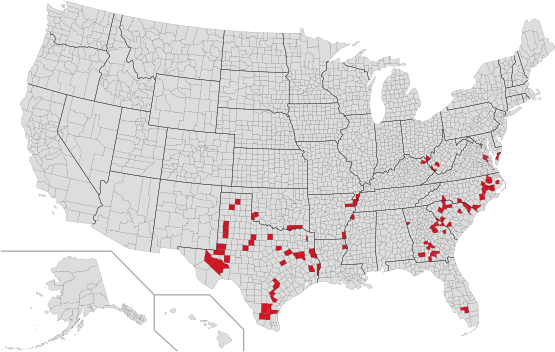
Studies show student debt can hurt communities, and averages 60% more in rural areas than the rest of the nation

Percentage of income going to student loan payments in 2016 (Map is from this study.)

A pair of new studies show how the burden of student-loan debt hurts rural communities.

Young adults from rural areas average about 60 percent more student-loan debt than their suburban and urban counterparts, and it's not because they're consistently borrowing more money, according to a study published in Rural Sociology. The trend is particularly pronounced among women. At age 25, about 48 percent of rural college attendees carry student debt, compared to 38% of suburban and 37% of urban attendees. Rural students also tend to have more debt: an average of $19,680, compared to $16,780 for urban and suburban attendees.

"Rural college-goers’ higher debt can be partly explained by their parents tending to have lower incomes, lower wealth, and less education compared to their non-rural counterparts. Rural college-goers’ higher rates of migration during college also plays a significant role," study author Alec P. Rhodes, a Ph.D. sociology candidate at Ohio State, told The Daily Yonder's Kristi Eaton.

Rhodes said women may have more debt because the best-paying rural jobs that don't require a college degree tend to be dominated by men. "As a result, rural women may feel greater pressure than rural men to take on debt to attend college," he said. "These combined 'penalties' of being a woman and having a rural background may contribute to especially high student debt levels among rural women."

Student-loan debt has a broad impact, argues a study in the International Journal of Community Well-Being. "Higher levels of student debt are generally related to lower levels of homeownership and higher levels of rental stress, or people that have trouble making rent payments," authors Jackson Parr and Steven Deller report in The Daily Yonder. "The problems created by too much student debt are two-fold, as people may not have any room to take on mortgage debt, driving them toward rent. With so many people driven to rent from a limited amount of available housing, rent goes up and squeezes the student debt payers even more."

In sum, student-loan debt remains smaller than Americans' $4.1 trillion of credit debt or $15.5 trillion mortgage debt, but it has grown significantly in the past two decades as tuition has increased. "From 2006, consumer-credit debt grew approximately 70% and mortgage debt grew by 24%, but student-loan debt grew by 232%," Parr and Deller write. "The Consumer Price Index increased only 21.1%. Although this may indicate more people attending college, the percentage of high-school graduates attending college grew by just four percentage points (65.8% in 2006 to 69.7% in 2016), an increase of 38% in terms of absolute number of students. Meanwhile, debt loads increased. Based on analysis by the Institute for College Access and Success (2018) of survey data from American four-year universities and colleges, the average student debt level increased from $18,650 in 2004 to $29,650 in 2016."

Rhodes, the author of the first study, speculated that cancellation of federal student debt, lately a hot-button political topic, would disproportionately benefit rural students. He told Eaton the nation should address long-term wage stagnation that has made college harder to pay for, and believes states should invest more in higher education to make college more affordable.

Thursday, June 24, 2021

Federal judge blocks USDA debt relief for minority farmers

A Florida federal court issued a preliminary injunction Wednesday blocking the Biden administration's program to forgive agricultural debts to farmers of color. 

"The program was already temporarily on hold, due to a separate restraining order in a case by a white farmer in Wisconsin. However, even if that Wisconsin order is reconsidered or even reversed in July, when a ruling is expected, this new nationwide injunction would still keep the program on hold for some time," Laura Reiley reports for The Washington Post. "The Florida case is considered the first nationwide preliminary injunction, said lawyers for the group Pacific Legal Foundation, which filed the lawsuit in May" for white Florida farmer Scott Wynn, who says he also needs debt relief and is being discriminated against him due to race.

U.S. District Judge Marcia Morales Howard wrote in her decision that Congress "must heed its obligation to do away with governmentally imposed discrimination based on race," but "also made clear that the Agriculture Department could continue to prepare to deliver the debt relief until the program is found to be “constitutionally permissible," Reiley reports. 

Friday, June 11, 2021

Federal judge in Wisconsin blocks debt relief for farmers of color; says specific, intentional bias must be shown

A federal judge in Wisconsin has issued a temporary restraining order blocking the Department of Agriculture from implementing the loan-forgiveness program for farmers of color, passed as part of the latest pandemic relief bill. 

District Judge William Griesbach noted that the relief bill said Congress had determined that the minority groups eligible for the debt write-off “had suffered discrimination in the USDA programs and that had been largely left out of recent agricultural funding and pandemic relief,” but he said USDA had not shown “that the loan-forgiveness program targets a specific episode of past or present discrimination,” a key standard. He said the program also doesn't meet the case-law rule that there be evidence of intentional discrimination, and that such programs be "narrowly tailored."

Griesbach, a George W. Bush appointee, gave USDA until Friday to respond to the motion for an injunction in a lawsuit filed by farmers from 12 states including Wisconsin. They are represented by the Wisconsin Institute for Law & Liberty, which says it favors conservatism and personal freedom.

The Rural Coalition, a liberal group, issued a statement saying in part, "No serious observer of USDA’s role in American agriculture can doubt that the Department has engaged in decades of intentional, and systematic, discrimination based on race and ethnicity. The results have been catastrophic and have completely reshaped farming by eliminating a wide swath of farmers. If ever there was a constitutional basis for taking race into account when making policy this is it. In its decision the Court appears oblivious to this history, and hostile to efforts to achieve true racial justice."

Democratic senators file bill to forgive up to $250,000 in USDA debt owed by farmers with incomes under $300,000

Resentment of the debt-relief measure for Black farmers could spur a new proposal by five Democratic senators that would forgive up to $250,000 in debts small farmers owe the federal government. The prime sponsor, Sen. Kirsten Gillibrand of New York, who had a similar bill last year, "said she would try to include debt relief in the upcoming infrastructure bill," Chuck Abbott reports for Successful Farming

"The proposal comes three months after Congress approved $4 billion to pay off money owed by socially disadvantaged farmers" to the Department of Agriculture or to banks with USDA loan guarantees," Abbott notes. "One of the cosponsors of the new debt relief bill, Sen. Cory Booker of New Jersey, was a leader in the push for loan forgiveness for minority farmers. Some white farmers have filed suit against that program, saying it is unconstitutional." Other sponsors are Bernie Sanders of Vermont, Jeff Merkley of Oregon, and Ron Wyden of Oregon.

About 40,000 farmers with USDA debt would meet the bill's criteria of an average adjusted gross income under $300,000, Abbott reports: "If all got the maximum relief of $250,000, the program would cost $10 billion. The debt relief would be nontaxable. Farmers would have one year to apply for forgiveness and would be obliged to stay in agriculture for two years if they receive relief."

Thursday, June 03, 2021

Federal Reserve reports, graphs show farm economy robust

Farm loan repayment rates (Federal Reserve charts)

Farm loan repayment rates, along with the U.S. agricultural economy in general, are improving rapidly, according to the latest Federal Reserve bank surveys on farm credit conditions in the first quarter of 2021.

Farm income 

"Following multiple years of weakness and growing financial stress, bankers reported that farm income was higher than a year ago for the second consecutive quarter and demand for farm loans was subdued," Nathan Kauffman and Ty Kreitman report for the Federal Reserve Bank of Kansas City. "Interest rates on farm loans remained at historic lows, and along with better financial conditions; supported widespread increases in farmland values."

The figures track with independent research from Creighton University agricultural economist Ernie Goss, whose Mainstreet Rural Index has found record economic confidence among Midwestern rural bankers in recent months. Booming farmland prices have also boosted the farming economy, Goss and the Federal Reserve agree.

Monday, May 24, 2021

White farmers resent U.S. debt relief for farmers of color

Shade Lewis (Photo by Needa Satam, NYT)
The $4 billion program to erase debts that farmers of color owe the federal government, created by congressional Democrats as a response to "generations of racial discrimination" by the Department of Agriculture against Blacks and others, has generated much resentment among white farmers.

“You can feel the tension,” Missouri farmer Shade Lewis told Jack Healy of The New York Times. “We’ve caught a lot of heat from the conservative Caucasian farmers.” Lewis, 29, is "the only Black farmer in his corner of northeastern Missouri," and with other farmers of color he is "in a new culture war over race, money and power in American farming."

The program, part of the latest federal relief act, is for “socially disadvantaged farmers” — Black, Hispanic, indigenous and other nonwhites, about 5 percent of the toal. They "have endured a long history of discrimination, from violence and land theft in the Jim Crow South to banks and federal farm offices that refused them loans or government benefits that went to white farmers," Healy reports. "Black farm advocacy groups say that nearly all the land, profit and subsidies go to the biggest, most powerful farm operations, leaving Black farmers with little.

"But in large portions of rural America, the payments threaten to further anger white conservative farmers. The plans have drawn thousands of enraged comments on farm forums and are being fought by banks worried about losing interest income. And some rural residents have rallied around a new slogan, cribbed from the conservative response to the Black Lives Matter movement: All Farmers Matter." some farmers and ranchers have sued to block the program, and a group run by former Trump aide Stephen Miller is backing a lawsuit by the Texas agriculture commissioner. Healy notes that the Supreme Court ruled in 1995 that programs to remedy past discrimination must be “narrowly tailored” to accomplish a “compelling governmental interest,” including such remedies.

Lewis lives in 94% white Lewis County, where grain farmer Jeffrey Lay is president of the county Farm Bureau. “They talk about they want to get rid of discrimination,” Lay told Healy. “But they’re not even thinking about the fact that they’re discriminating against us.” Lewis cites discrimination he has encountered and says, “You can sit here and talk about race and things you’ve been through. They don’t understand. They’ll never understand.”

Tuesday, February 09, 2021

2021 USDA farm income forecast: cash receipts to rise, but lower direct federal aid expected to drive drop in net income

The U.S. Department of Agriculture's Economic Research Service has published the first of three 2021 Farm Sector Income Forecasts. The forecast is updated three times a year, usually in February, August, and November. You can read the full report here, but below are the highlights. Click here for the December 2020 report for comparison.

  • Net farm income, a broad measure of profits, is forecast to decrease $9.8 billion (8.1 percent) to $111.4 billion in 2021.
  • In inflation-adjusted 2021 dollars, net farm income is forecast to decrease $12 billion (9.7%) in 2021 after increasing $37.8 billion (44.2%) in 2020 to its highest level since 2013.
  • Net cash farm income (a more precise measurement of profits) is forecast to decrease $7.9 billion (5.8%) to $128.3 billion in 2021.
  • Inflation-adjusted net cash farm income is forecast to decrease $10.4 billion (7.5%) from 2020 and would be 15.3% above its 2000-19 average ($111.3 billion).
  • Cash receipts are expected to increase in 2021, but lower direct government farm payments are predicted to drive most of the decline in both net income measurements.
  • Direct government farm payments are forecast at $25.3 billion in 2021, a decrease of $21 billion (45.3%) in nominal terms. The expected decrease is because of lower supplemental and ad-hoc disaster assistance for Covid-19 relief in 2021 relative to 2020.
  • Higher production expenses are also expected to contribute to the 2021 decline in net income. Total production expenses, including operator dwelling expenses, are forecast to increase $8.6 billion (2.5%) to $353.7 billion (in nominal terms) in 2021. Most of this reflects higher spending on feed, fertilizer, and labor.
  • Cash receipts for all commodities are forecast to increase $20.4 billion (5.5%) to $390.8 billion (in nominal terms) in 2021.
  • Total animal/animal product receipts are expected to increase $8.6 billion (5.2%) with increases in receipts for cattle/calves, hogs, and broilers.
  • Total crop receipts are expected to increase $11.8 billion (5.8%) from 2020 levels following higher receipts for soybeans and corn.
  • Farm business average net cash farm income is forecast to decrease $6,100 (6.2%) to $91,800 per farm in 2021. Farm businesses in all resource regions are forecast to see declines in net cash farm income except the Heartland. 
  • When farm businesses are categorized by commodity specialization, most see average net farm income fall in 2021. The exceptions are farms specializing in wheat, corn, soybeans, and hogs.
  • When adjusted for inflation, farm sector equity and assets in 2021 are relatively unchanged from 2020.
  • Farm debt is forecast to increase by $9.6 billion (2.2%) to $441.7 billion (in nominal terms), led by an expected 3.1% rise in real estate debt. 
  • The farm sector debt-to-asset ratio is expected to rise slightly from 13.84% in 2020 to 13.89% in 2021. 
  • Working capital, which measures the amount of cash available to fund operating expenses after paying off debt due within 12 months, is forecast to decrease 12% from 2020. 
  • Total median farm household income, forecast to increase to $86,086 in 2020, is expected to remain relatively flat in 2021 at $86,917. The income increases in 2019 and 2020, driven by direct government aid, bucked a trend of declining income from 2015 through 2018.
  • Economic relief programs such as the Paycheck Protection Program and the latest Covid-19 aid package are expected to boost income among those affected by the pandemic.
  • Many farmers rely on off-farm income. The average amount of off-farm income was expected to rise 1.5% to $69,784 in 2020 and to rise 2.3% in 2021 to $71, 407. If that prediction pans out, it will be the highest median off-farm income level since 2014.

Thursday, January 28, 2021

USDA temporarily suspends collections, garnishments, non-judicial foreclosures and other penalties on farm loans

The Department of Agriculture is temporarily suspending non-judicial foreclosures, debt offsets, wage garnishments and collections on past-due farm loans, citing the financial stresses of the coronavirus pandemic, a USDA news release said. The action applies to borrowers under the Farm Storage Facility Loan and the Direct Farm Loan programs, which are administered by the Farm Service Agency.

"Additionally, USDA has extended deadlines for producers to respond to loan servicing actions, including loan deferral consideration for financially distressed and delinquent borrowers. In addition, for the Guaranteed Loan program, flexibilities have been made available to lenders to assist in servicing their customers," the release said.

More than 12,000 farmers, ranchers and producers—about 10 percent of the more than 129,000 FSA borrowers nationwide—should be eligible for the new relief, according to USDA data, the agency said. The suspension will remain in place until further notice, and is expected to continue as long as the nationwide coronavirus disaster declaration is in place.