Showing posts with label films. Show all posts

Wednesday, October 25, 2023

Opinion: What does Martin Scorses's new film give back to the Osage Nation?

Filming on the set of Killers of the Flower Moon
(Photo courtesy of Shannon Shaw Duty, Osage News via ICJ)

The story of Oklahoma's Osage Nation is one of prosperity, greed, conspiracy, murder and loss. Its retelling in Martin Scorsese's new film Killers of the Flower Moon gives voice to that past. But even as audiences flock to the theaters, what does the Osage Nation have to show for their willingness to share their story of a people murdered for their land? 

Dennis McAuliffe Jr., an Osage tribal member and Washington Post Opinions copy editor, shares his answer to that question in his Opinion essay condensed here. His thoughts are penned from Fairfax, Oklahoma.

"Joe Conner, my cousin and closest friend, created a memorial to victims of the 'Osage Reign of Terror' about two years ago. In 10 panels illustrated with archival and family pictures, he described what came before and after the murders of possibly hundreds of Osages after one of the largest oil deposits in the United States was found on their land. Because each tribal member, including children, received an equal share of royalties, the Osage had become the richest people per capita in the world.

"Joe installed the posters in the storefront of the long-abandoned Tall Chief Theater in Fairfax, the reservation town where most of the murders took place. The potential viewers he had in mind included Martin Scorsese, Leonardo DiCaprio, Robert De Niro and a crew of hundreds who were there to film scenes for 'Killers of the Flower Moon' — an Apple Original movie about the killings based on David Grann’s book of the same name.

"Joe, a PhD psychologist, health researcher, local newspaper publisher and co-director of the Fairfax Community Foundation, hoped his posters would engage visitors in his mission to 'rebuild Fairfax and restore hope to our left-behind community … [which] today languishes in neglect and dereliction. . . . The restored theater would become a performing arts and event center; an adjoining former bank building would house a museum, restaurant, gift shop, art gallery, studio and, as Joe put it, a memorial 'that not only would honor what happened but serve as a venue for healing.'

"All it would take, architects told him, was $8 million, and work would begin with replacing the theater roof, four stories above the stage, which had been blown off by a tornado in 2018. . . . Enter Apple, Scorsese and the rest of the crew: Between April and October of 2021, they spent weeks filming around Fairfax, including a location not 50 yards from the Tall Chief. . . . Theater people would certainly take an interest in saving a historic theater — and could afford to. Combined, the cast and crew stood to make tens of millions of dollars. (DiCaprio was reportedly paid $25 million to $30 million.) Surely there was an angel investor in their midst.

"But what do moviemakers owe a community that they use and profit from? Not specific individuals but the community as a whole? Fairfax, which provided the tragic story without which no movie would have been made, was about to find out. . . . As the Hollywood crew finished filming, Joe wrote: 'It seems the movie will be another example of outsiders, even if well-intentioned, taking something from the Osage people for personal gain and leaving the community with nothing but movie images.'

McAuliffe Jr. has a personal connection to this story. Read the entire piece here.

For more on the Osage Nation's story and its broader impact on U.S. law enforcement, read

an independent, nonprofit news enterprise from IndiJ Public Media that honors their ancestors and future generations through stories that make Indigenous peoples come alive.

Thursday, August 10, 2023

When coal is no longer king in Appalachia, what's next? Symbolic funeral in new film has both pride and remorse

Elaine McMillion Sheldon's film depicts growing up
in the shadow of coal. (Sundance Film Festival Photo)
Not every place has a king, but in Appalachia, one lives, more humbly than ever: Coal. Film-maker Elaine McMillion Sheldon gives the world an enigmatic look at a fossil fuel's kingdom and its people in her movie, "King Coal."

Sheldon grew up "roving around West Virginia. Like many children of Appalachia, her world was shaped by coal – her father worked for a mining company, and the family moved to seven coal fields in 12 years for his job," reports Adrian Horton of The Guardian. "Her brother became a fourth-generation miner." Sheldon told Horton: "Everybody in my community worked in the coal mines. If you were going to stay there and work, if you weren't a doctor or a lawyer, that's what you did." Only when Sheldon left the region to study abroad, did she realize how much coal infiltrated Appalachian life. "Not everywhere has a king," she told Horton. "Not everywhere is completely dominated by this industry that controls everything from our rituals to the ways we live our life."

Sheldon's documentary "blooms in the resource's shadow," Horton writes. "It's a lyrical and visually lush ode to a region of immense richness, to mountains riven by extractive industry, to identity-shaping labor and unions, to the inheritance of coal culture. There are no location markers, no delineation between towns, states, mines, mountains." Sheldon told him, "We just define it as the kingdom," a common culture and economy without strict borders.

Sheldon shot all over the Appalachian coalfield, from Pennsylvania to Tennessee. She told Horton, "I'm very aware of how people perceive Appalachia. . . . . I grew up feeling that the place I was from was somewhere to be embarrassed of, and I don't want people to feel that. . . . I want people to see that it's a beautiful place, that there's actual hope here and resilience here." Sheldon says in the film, "Maybe you've heard a story about us. . . . This story is about what it's like to live under King Coal."

The film follows two Appalachian girls, one white and one black, through their lives under coal's reign. "The girls harken to Sheldon’s bygone youth and also point forward, to a life less molded by coal," Horton writes. "As Sheldon puts it in the film, coal has been leaving Appalachia for as long as she’s been alive – in barges downriver, in profits reaped elsewhere, in flattened mountaintops and contamination, in lost jobs." Sheldon told Horton: “If you just look at the facts and figures of mining employment, none of this makes any sense. . . . People just want to work. They’re happy to do other work if it pays the same and provides the same amount of stability, but the coal industry hasn’t provided that stability for many years. And so the question now is, what’s next?”

"To begin answering the question, Sheldon staged a symbolic funeral for King Coal, which serves as the film’s conclusion," Horton writes. "She invited real people with real connections to mining to send off the resource economy as they saw fit, in song or in prose." Sheldon told Horton: “To some people, King Coal is the greedy industrialists, and to some people, he’s the person that provided their jobs." Horton adds, "To Heather Hannah, a singer from Thomas, W.Va., who offered a gut punch of a coal eulogy, it was 'the paradox of pride and remorse. How my daddy was proud to do what needed to be done, to work the mines and provide for our family. I learned that you can be proud of your life, and want better for them that come after you.'”

Thursday, March 17, 2022

Texas J-school chief: Journalists should consider buying rural weeklies; university programs can show you the ropes

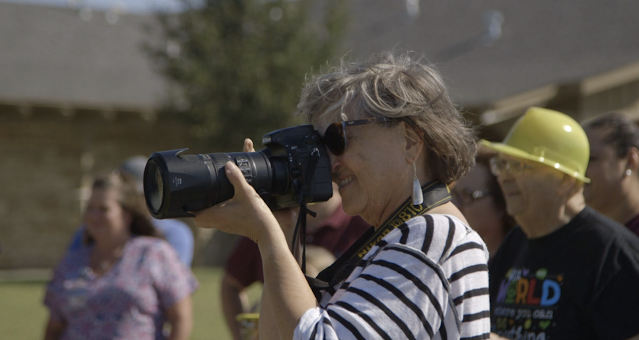
In a still image from a documentary in production about her paper, editor/publisher Laurie Ezzell Brown shoots photos for The Canadian Record in Canadian, Texas. Her award-winning paper is for sale.(Image courtesy of Heather Courtney)

Many journalists who consider striking out on their own think of a digital startup. But here's another idea: How about buying an rural weekly newspaper? More should consider it, and several university-based programs can teach you the ropes — possibly for free, Kathleen McElroy, professor and director of the journalism school at the University of Texas at Austinwrites for Poynter.

The benefits of owning an independent weekly are many, she writes: "Community engagement is a given," and the papers, some published for more than a century, come with high awareness in the community. And owners can make a good living. Jim Moser, president of Moser Community Media, estimates that a rural Texas weekly in a county of 15,000 can bring $450,000 a year in revenue, and "A publisher at a larger weekly can make $85,000 a year, plus bonuses," he told McElroy. "No one will get rich . . . but you can make a good living and be an important part of a community."

Plenty of papers are looking for new owners, too, such as The Canadian Record in the Texas Panhandle. Laurie Ezzell Brown's family has owned the paper since the 1940s, and she took over as editor/publisher in 1993. She wants to retire but her son doesn't want to follow in her footsteps, so she's looking for a buyer. The paper is in pretty good financial shape, and the new owner could look forward to other upsides. "Be your own boss, be a community leader," Brown told McElroy. "Own your own house and make a difference."

The Record's importance in the community spurred award-winning filmmaker Heather Courtney to make a documentary about the paper. Courtney grew up in a small town and was interested in the importance of rural papers even as many were shuttering. She approached Brown in 2017 about making the documentary. "After spending just a day at The Record, I knew I wanted to tell the story of Laurie’s tireless effort to keep the paper alive, and of a community that loves and depends on their paper even when they don’t always agree with its politics," Courtney told McElroy.

New rural-paper owners can get help, McElroy writes: "Two universities seek to identify and train the next generation of publishers. West Virginia’s NewStart initiative, funded by the John S. and James L. Knight Foundation and the Claude Worthington Benedum Foundation, launched in 2020. The University of Texas at Austin, where I teach, has just developed the Rural Journalism Pipeline Project, funded internally by the IC2 Institute." And she also mentions the University of Kentucky's Institute for Rural Journalism and Community Issues, publisher of The Rural Blog, as a resource.

If you're interested in buying The Record or another Texas paper, UT-Austin may fund your enrollment in NewStart. The program offers master's degrees and certificate programs, and will hold information sessions March 22, March 29 and April 5. To be considered, email the Rural Journalism Pipeline project at ruralpubpipeline@austin.utexas.edu.

Shasta County recall effort funded by former local who wanted revenge; other efforts can't count on such money

Reverge Anselmo in 2012 (Redding
Record Searchlight
photo by Greg Barnette)
In February, a far-right militia successfully ousted a Republican county supervisor in Shasta County, California. A Los Angeles Times deep dive profiles the man whose wealth funded their efforts: Reverge Anselmo, 59, "a quixotic Connecticut-bred cowboy with a grudge and bottomless pockets with which to fund his political revenge," Jessica Garrison reports.

Anselmo, a former U.S. Marine, novelist, and filmmaker, left Hollywood for Shasta County in 2005 after critics panned one of his movies. He started over as a rancher and vineyard owner, but left the county in 2014 after several land-use disputes with county authorities. When he learned in 2021 about the militia's efforts to oust three county supervisors, he decided to provide financial backing, Garrison reports.

The article notes that Anselmo's deep pockets were critical to the militia's success, and that he spent more than $550,000 into Shasta County races since 2020. He also admits to helping fund a documentary about the effort that aims to encourage far-right efforts elsewhere to replicate what happened in Shasta County.

The recalled supervisor warned others about copy-cat efforts in a recent CNN article, saying "Don't think this can't happen to you." However, the LA Times article insinuates that other efforts might not be as successful since they probably wouldn't have the kind of money Anselmo brought to the table.

Friday, September 10, 2021

Quick hits: Docuseries explores why people live in rural areas; Biden drops nominee to head ATF after pushback

Here's a roundup of stories with rural resonance; if you do or see similar work that should be shared on The Rural Blog, email heather.chapman@uky.edu.

A seven-part docuseries called "Rural by Choice" tells the story of why people choose to live in rural Minnesota. The first episode will premiere on Sept. 12, with the rest of the episodes premiering each week afterward. Click here for more details, including how to watch.

The White House has withdrawn David Chipman's nomination for director of the Bureau of Alcohol, Tobacco, Firearms and Explosives after sustained pushback over his record of gun-control advocacy. Read more here.

As cell-cultured meat gets ever closer to hitting store shelves, the Agriculture Department's Food Safety and Inspection Service is seeking consumer comments on how such products should be labeled. Suggestions will be accepted until Nov. 2. Read more here.

"In summer 2020, a federal court ruled the Environmental Protection Agency showed too much deference to Bayer when it approved the company’s dicamba herbicide. This invalidated the approval. But, weeks later, Bayer began working the EPA again, according to newly obtained emails," Jonathan Hettinger reports for the Midwest Center for Investigation. Read more here.

Mountain Valley Pipeline developers have filed a subpoena seeking to find out the names and phone numbers of the people who run a Facebook group critical of the project. Read more here.

Local food is all the rage, but what makes food local? Read more here.

A recently published study found that single rural residents with heart disease face more hopelessness. Read more here.

A tech business owner and Columbia University professor discusses why rural students need to learn about artificial intelligence in school and what kind of education and training is needed so they can compete with their suburban and urban peers for high-paying tech jobs. Read more here.

Registration is open for a symposium on sustainable ranching practices. The event will be held Oct. 14-15 in Kingsville, Texas, and online. Read more here.

Scientists are trying to control emerald ash borers with tiny parasitic wasps. The strategy will hopefully go better than previous attempts to kill pests by using other natural predators (see: cane toads) because the wasps they're testing can't sting people and only go after the borers. Read more here.

The Rural Health Information Hub has updated its guide to critical-access hospitals to include two new FAQs on 340B eligibility and Rural Emergency Hospitals. There is also updated info on reimbursement, eligibility, funding, legislation, and more. Read more here.

Thursday, July 08, 2021

This month, TCM spotlights films about small-town America

Meet Me in St. Louis, a 1944 Christmas film, features
classic Judy Garland hits such as "The Trolley Song."
Turner Classic Movies is celebrating films about small-town America in a special series airing each Wednesday in July. If you have a cable package that includes TCM, you can watch all the films in the series online. If you don't have a cable package with TCM, you can watch all the films listed with a subscription to Sling TV, Hulu, or YouTube TV.

The first Wednesday of the "From Hollywood to the Heartland" series was all about drama, with films such as Peyton Place, East of Eden, Picnic, and Our Town. The second week lightened things up with beloved small-town comedies such as The Miracle of Morgan's Creek, Mr. Deeds Goes to Town, and Theodora Goes Wild.

Next week's theme is "Small Town Musicals," featuring classics such as The Music Man, Bye Bye Birdie, and Meet Me in St. Louis. The final night of the series is five critically acclaimed films full of crime, drama and betrayal, with hits like Bonnie and Clyde, The Last Picture Show, and Paper Moon.

In a video made for TCM's series, singer John Mellencamp, a native of Seymour, Indiana, reflects on portrayals of small towns on the silver screen. Watch it here:

Wednesday, November 25, 2020

Quick hits: Purude Pharma pleads guilty to charges in opioid crisis; rural real estate searches up 235% from last October

Here's a roundup of stories with rural resonance; if you do or see similar work that should be shared on The Rural Blog, email us at heather.chapman@uky.edu.

Online searches for rural homes increased 235% from October 2019 to October 2020, according to a new report by real estate company RedfinRead more here.

Purdue Pharma pleads guilty in its role in the opioid crisis as part of a deal with the Justice DepartmentRead more here.

President Trump's appointee to lead the Voice of America acted unconstitutionally in investigating what he claimed was bias against Trump by his own journalists, a federal judge ruled. Read more here.

A federal appeals court upheld a 2018 jury verdict of damages to North Carolina plaintiffs who said the noise and smell of Smithfield Foods' hog operations were unbearable. Read more here.

Vulture suggests a list of things to read, watch and listen to instead of Hillbilly Elegy. Read more here.