Showing posts with label charity. Show all posts

Monday, April 03, 2023

Rural, under-served towns battle rising fentanyl addiction; N.M. town long troubled by drugs seeks new ways to cope

People in Española, N.M., wait to get inside Pathways homeless
shelter for the night. (Photo by Francine Orr, Los Angeles Times)
What does a town overwhelmed by fentanyl addiction look like? "In Española, New Mexico, shoppers and workers drive past addicts roaming Riverside Drive, the main drag in this town of 10,500. Kids played in trailer parks. . . . Cars came and went from a methadone clinic. . . . Men wearing hoodies and expectant gazes drifted toward a house with barred windows," reports Jeffrey Fleishman of the Los Angeles Times. "Rallying voices are trying to fix this community under siege. But it's unclear if the story of Española, where a quarter of the population is poor, will be a narrative about how to save a town from addiction — or lose it."

The data in Rio Arriba County, which has long been troubled by drugs, are startling. "Fifty residents died from drug overdoses during the one-year period ending in July 2022, among the highest totals ever recorded in the county, according to provisional data provided by the Centers for Disease Control," reports Kevin Deutsch of The Rio Grande Sun in Española. How did this happen? Fleishman writes, "Española is a troubling American tale. Its despair and suffering echo through cities large and small, from the pitched tents and open drug use in Los Angeles to the hamlets and hollows reeling from the opioid epidemic across Appalachia. The crisis is born from a decades-long misguided war on drugs, greed in the pharmaceutical industry, an ill-equipped prison system, failed treatment programs and a nation seemingly inured to the startling toll of addiction."

For Española, drug addiction came "after the Vietnam War as heroin, cocaine and other drugs flowed in from Mexico," Fleischman writes. "Heroin settled in hard for years. . . .But over the last two years, the market has been taken over by fentanyl. . . . The town has drawn addicts and the homeless from other states has too few detox and drug treatment centers. . . . . A 'baby box' has been built at the fire station to take in unwanted infants. . . . . Shoplifters haunt the aisles at Lowe's and Walmart. Syringes for heroin that once littered sidewalks and riverbanks have often been replaced by glints of tin foil used for smoking fentanyl."

Crime is addiction's partner. Cristian Madrid-Estrada, who runs the local homeless shelter Pathways with a gun on his hip, "spends much of his time at the shelter, giving addicts beds and warmth on frigid nights. But like others in this city, he contends with burglaries, robberies and thefts carried out by fentanyl addicts desperate to fuel their next high," Fleischman reports. "The state police and the county sheriff have been called in to help Española's understaffed police department, which reported 224 burglary calls last year, up from 155 in 2020."

Resident Nicko Zamora, who used drugs for over 40 years and now works to help addicts recover, told Fleischman, "A lot of us got sick on our secrets. Drugs were the Band-Aid. It goes with our heritage in a weird, crazy way. We've seen it happen to Great-grandpa, Grandpa, Dad and all the uncles. Drug use became normal." But fentanyl isn't a normal drug. Deutsch explains that the drug has a very short life. Addicts need it "all day, every day." Fentanyl's potency as addictive and short-lived is fueling the depth of this town's addiction crisis.

Some residents finding ways to create a future. "Madrid-Estrada and Pathways co-founders Ralph Martinez and former state Rep. Roger Montoya are working to change things. Martinez and Montoya helped get a $1.8 million grant for the property that houses the shelter, a Goodwill, a wellness center and a food pantry," Fleischman reports, "Martinez was once a man under a bridge, sleeping on the dirt, shooting heroin into a neck vein. . . . John Ramon Vigil, at 27, the youngest mayor in New Mexico, is proposing the state open a regional drug treatment center. And Jeramay Martinez, who sued OxyContin manufacturer Purdue Pharma, is raising the 4-year-old son of a fentanyl addict and plans to start an agency to help addicted mothers and children exposed to drugs in the womb."

Madrid-Estrada told Fleischman, "It does take a village. Everyone is just trying to figure out how to handle it all."

Wednesday, February 22, 2023

SNAP benefits will end in 32 states; food pantries aim to fill the gap; it may not be possible to meet the demand

Photo by Erin Schaff, The New York Times
Across 32 states, emergency Supplemental Nutrition Assistance Program benefits will end in March. The drop in assistance has local food pantries gearing up to feed more families and hoping they will have enough. "Food bank managers fear that demand will spike further in March, when officials roll back pandemic-era increases to SNAP benefits," reports Jazmin Orozco Rodriguez of Kaiser Health News. "The program, administered by the Department of Agriculture, provides monthly stipends to people with low incomes to spend on food. Before 2020, those payments averaged a little more than $200 and were hiked by a minimum of $95 during the pandemic."

"Friends in Service Helping food pantry is known in rural northeastern Nevada as FISH," writes Rodriguez. "The food pantry is one of a few in this city of about 20,000 people. In January, FISH provided food boxes to nearly 790 people. . . Officials estimate FISH families will see a 30% to 40% decrease in SNAP payments as emergency allotments tied to the public health emergency halt in 32 states, including Nevada." Georgia, Indiana, Montana, Kentucky, and South Dakota, have already ended the emergency allotments.

Andrew Cheyne, managing director of public policy for GRACE, a nonprofit run by the Daughters of Charity of St. Vincent de Paul, focused on reducing childhood hunger, told Rodriguez, "We have so many households who simply aren’t going to know that this is happening. They’re going to go to the grocery store and expect to have money in their account and not be able to buy the food they need to feed their families. . . .There’s just no comparing the scale of SNAP to the charitable food sector. It’s simply not possible to make up that difference.”

Rodriquez reports, "In Montana, the expanded SNAP benefits were cut in summer 2021. Brent Weisgram, vice president and chief operating officer of the Montana Food Bank Network, said that reporting from the network’s partners shows a 24% increase in the number of households seeking assistance from emergency food pantries from July 2021 to July 2022. Weisgram said food pantries are not prepared to absorb the impact of the cut to the largest federal nutrition assistance program and are strictly a supplemental resource."

Tammy King, a volunteer at FISH, told Rodriquez, “I feel that everybody who has the power to help is doing everything they can to help us. You just gotta look at your food and say, ‘OK, how long can I make this last and make a difference in someone’s life?’”

Monday, January 30, 2023

Farmer who grew up dirt poor secretly paid for neighbors' prescriptions; he's gone, but legacy of giving is spreading

Hody Childress and daughter Tania Nix (Photo by Ronald Nix)
The kindness of strangers, it seems like a fable . . . or so croon the lyrics of an old Susan Ashton melody.

In Geraldine, Alabama, pop. 910, this fable came to life: "Every month for more than a decade, a local farmer, Hody Childress, had made anonymous cash donations to the pharmacy, Geraldine Drugs, aiming to help neighbors struggling to pay for prescription medication," reports Emily Schmall of The New York Times. "The wider community learned of his good deed only after he died at 80 in January. Now, his family and donors from across the United States have vowed to continue his legacy."

Schmall shares a recent example: "When the doctor saw what a hornet sting had done to Eli Schlageter, 15, causing his mouth and throat to swell, his advice to Eli’s parents was unequivocal: Get an EpiPen. . . . But they were stunned to learn that a single dose of the lifesaving drug cost $800 . . . So, to help the family, the pharmacist, Brooke Walker, turned to an envelope full of carefully folded hundred-dollar bills from an anonymous donor."

Childress's giving often made a difference. "Over the years, Dr. Walker said, the fund had helped at least two people a month who didn’t have insurance or whose benefits didn’t cover their prescription medicine," Schmall reports. Eli Schlageter's mother, Bree Schlageter, told Schmall, “What he doesn’t know, now that he’s in heaven, is that he helped a kid that works on a farm that he started. Look at that circle.”

Geraldine and DeKalb County (Wikipedia)
Now it spawns other circles. "Ms. Nix and her family and Dr. Walker have received calls and messages on social media from people across the United States wanting to donate," Schmall reports. "Last week, Dr. Walker received a check from someone in Tennessee. On Monday, a person called from Miami. He told her that unless she needed the money, he was going to approach his local pharmacy and start his own Hody Childress account."

Childress "grew up poor, surviving with his family on subsistence farming and by hunting small game," Schmall reports. His son said the house had no electricity until his father was about 7. His daughter, Tania Nix, said, “Giving that way, that just got on his heart and he felt like he needed to do it.”

UPDATE, Feb. 3: Nix and her brother told Steve Hartman of CBS that their father was "nearly broke" at his death because he had spent $10,000 or more helping people pay for prescription drugs.

Monday, December 05, 2022

One quilt shop owner's calls on social media bring more than 1,000 quilts to Eastern Kentucky for flood victims

A bus from New York brought 32 quilts to Eastern Kentucky. (Photos by Evelyn Morgan via The Daily Yonder)

More than 1,000 quilts have piled into Evelyn Morgan's Quilt Heaven Quilt Shop in Grayson, Ky., from as far away as Colorado, in response to her social-media calls for donations to help victims of the historic July floods in Eastern Kentucky, Kim Kobersmith reports for The Daily Yonder.

“They had so much love in their hearts for people they didn’t know,” Morgan told Kobersmith. “Making a quilt takes many hours of work and a significant monetary expense. Each tiny piece is sewn in. The love and stories sewn into them make homemade quilts very special.”

Kobersmith writes, "One shop owner later brought 90 quilts made during the pandemic. They were crafted for charity and this seemed like the right project to give them a home. Another shop owner offered a friendly challenge to see which shop could gather the most quilts. When she posted it on the group Facebook page, donations exploded. Morgan was rendered speechless – a rare occurrence, according to her – when a bus from New York pulled into Quilt Heaven and gifted 32 quilts." One of the New Yorkers "said she was offering the first quilt she had ever made. She was so proud of it, but had made so many since then and wanted it to go to someone who really needs it," Kobersmith reports.

Quilts awaiting distribution at the Breathitt County Museum
The distribution was headed by Morgan's friend Paula Hensley, who was familiar with Letcher and Knott counties, two of the hardest hit. 'On a back road, Hensley came upon an older man who began to cry when she offered him a hand-made quilt. One quilt shop got a thank you note, written in a child’s hand with crayon, that melted the owner’s heart," Kobersmith writes. "So far, 923 gifts of warmth and love have been given away. Morgan has over 200 more to pass along to Hensley, with more on the way from other shops."

Tuesday, November 29, 2022

Some local governments show the way to slaying medical debt with federal relief money, for pennies on the dollar

(Photo by Micheile dot com, Unsplash)
Do your local governments have some pandemic relief money that hasn’t been spent or appropriated? Perhaps they would be interested in helping to wipe out local residents’ medical debt for pennies on the dollar, as some have. "Local governments in Ohio and Illinois are using American Rescue Plan Act money to relieve residents struggling with medical debt by partnering with an organization that buys debt and wipes the slate clean for debtors. It’s a strategy advocates say could be duplicated across the country to help erase a multi-billion-dollar problem," reports Casey Quinlan of States Newsroom.

Toledo is an example where $800,000 of ARPA funds were used to erase eligible residents' medical debt and "Commissioners in Lucas County, of which Toledo is a part, also announced they would contribute $800,000 in ARPA funds," Quinlan writes. "The combined $1.6 million will go to RIP Medical Debt, a nonprofit based in New York, which buys medical debt from hospitals in bundles at a much lower price than the actual debt, allowing the money to go further." Michele Grim, a Toledo City Council member who pushed to have RIP Medical Debt help with the transactions, said, "This means that $190 million to $240 million of community members’ debt will be eliminated."

The sheer size of medical debt can be overwhelming for many Americans. "According to a Kaiser Family Foundation report published in June, 4 in 10 adults in the United States have some kind of medical debt, and 1 in 5 of those with health care debt don’t think they will ever be able to pay off their debt," Quinlan reports. "The Consumer Financial Protection Bureau estimates the total amount of medical debt in the U.S. at $81 billion, based on data from credit reporting agencies, but acknowledges its total is likely understated."

Allison Sesso, president of RIP Medical Debt, told Quinlan that more local governments have reached out to the group to use ARPA funds to wipe out medical debt after learning about Toledo's and Cook County’s efforts: “I think it was sort of a no-brainer for anyone that’s focused on health equity and the recovery, post-Covid, on their communities, to get rid of this medical debt burden from people as quickly as possible.”

Monday, November 28, 2022

On Giving Tuesday, please consider a gift to the Institute for Rural Journalism, publisher of The Rural Blog

In the beginning, there was Thanksgiving. Then there was Black Friday, named by retailers for the positive ink it brings to their business ledgers. Then there was Small Business Saturday, Subscribe Sunday and Cyber Monday. And now, as a relief or antidote to all the getting, there is Giving Tuesday.

"It’s a simple idea," the organizers say. "Find a way for your family, your community, your company or your organization to join in acts of giving. Tell everyone you can about what you are doing and why it matters. Join a national celebration of our great tradition of generosity. And together we’ll create ways to give more, give better and give smarter."

The gifts can be of time, talents or money. If you're making monetary contributions, please consider supporting the publisher of The Rural Blog, the Institute for Rural Journalism and Community Issues at the University of Kentucky. The institute is supported by an endowment at the university, which accepts online donations. To make an online donation, click here. If you want to make a gift with more immediate impact, make out a check to the university, put "Rural Journalism, operating" on the memo line and mail it to us at BLD 217, University of Kentucky, Lexington KY 40506-0042.

Thanks for whatever you can do. At a time when audiences are being asked to pay more for journalism, so it can remain robust in the service of democracy, we hope you will find The Rural Blog and its publisher worthy of your support.

Saturday, November 12, 2022

How to celebrate a newspaper's anniversary: engage, help out, ask for advice, and keep producing good journalism

By Al Cross
Professor and Director, Institute for Rural Journalism and Community Issues, University of Kentucky

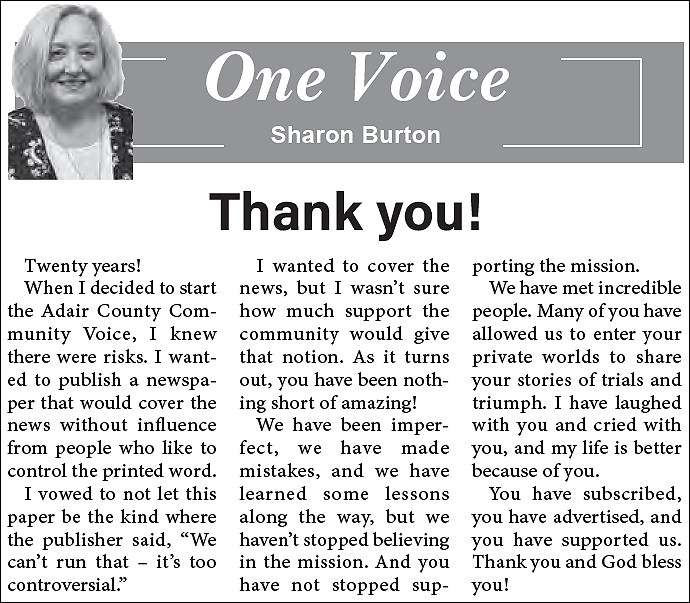
Twenty years ago, as smart people were beginning to predict the death of newspapers, Sharon Burton started one. In a county that had another one (and still does). In a county of only 18,000 people. In a county listed as "economically distressed" by the Appalachian Regional Commission.

Most of a recent Community Voice front page
Last week, the Adair County Community Voice celebrated its 20th anniversary, and its success may show the way for rural newspapers, which are in a lot more difficulty now than they were then.

Burton spoke at our National Summit on Journalism in Rural America in June because she is an example of the principle that good journalism is good business. Her weekly paper does investigative reporting, runs pages of official records, has a strong opinion page and is a force to reckon with. Here are several other examples.

To celebrate, the Community Voice is matching the first $1,500 in donations it receives for the local food pantry, and held an open house with soup and snacks, and invited readers to help it plan their future together: "We are also busy developing our strategy to bring you the timely news that you want, and the news that you need in the future," Burton wrote. "We want to hear form you about your news consumption and what you value the most, the least, and how you like to receive your news (print, phone, computer, etc.)."

Asked how the open house went, Burton told us, "We had one reader bring us some flowers with a note, 'To the ethical conscience of Columbia.' . . . Many of our elected officials dropped by. That tells me we can do our job, ask the tough questions and still gain their respect if we treat them with respect."

And the things that may seem small to the paper our outsiders can be really big for readers. "A woman came by and told us how much it meant to her that we ran a thank-you card for free back a few years ago (we cannot bring ourselves to charge for those)," Burton wrote. "She had been injured and was facing massive medical bills but she wanted to thank the emergency people who helped her through a very difficult situation. She said not having to pay for the thank you card meant the difference of her being able to eat." Burton had a message for her readers:

Wednesday, October 12, 2022

Benefit concert for Eastern Ky. flood victims raises $2 million

Chris Stapleton, who organized the concert, was its star.
(Photos by James Crisp for the Lexington Herald-Leader)
An all-star cast of country musicians from Eastern Kentucky raised $2 million last night at a concert for flood relief in the region, contributing critic Walter Tunis reports for the Lexington Herald-Leader.

Organized by Chris Stapleton, the "Kentucky Rising" concert at Rupp Arena also included Tyler Childers, Dwight Yoakam, Ricky Skaggs and Patty Loveless, the latter two not announced in advance. "It was an occasion where multiple generations of Eastern Kentucky artists gathered to honor their artistic and cultural heritage and, in the process, help out their neighbors in a time of unfathomable crisis," Tunis writes.

Tyler Childers was another headliner.
"On the surface, Yoakam’s performance – his first Rupp outing on over two decades – seemed devoted exclusively to the sleekness of the Bakersfield country sound of which he has so long been a torchbearer.  "Yet, more than any other artist playing Kentucky Rising, he offered the most detailed imagery of his Eastern Kentucky (specifically, Pikeville) roots . . . Stapleton’s concluding set was as solid as oak without the guests as it was with them. The inflection and, to a great degree, intent of his singing was used to color songs rich with vintage country narratives."

The concert had some touches of Western Kentucky, which has a separate coalfield that spawned one of the most popular coal songs. "With all performers and band members onstage in an assemblage worthy of The Band’s The Last Waltz, Stapleton and company performed 'Paradise' together on the evening after what would have been the 76th birthday of its late composer, John Prine," Tunis reports. (At Nashville's Ryman Auditorium that night, another great cast paid tribute to Prine, American Songwriter reports.)

The recovery from the flood has been slow, and the impact is felt every day. "A 97-year-old Letcher County woman who received national attention in July for a photo of her surrounded by water in her home when flooding devastated Eastern Kentucky has died," the Herald-Leader's Valarie Honeycutt Spears reports. "Missy Amburgey Crovetti said her grandmother Mae Amburgey died Saturday, not fully aware that a photo of her sitting on a bed surrounded by four feet of water in her Letcher County home, had gone viral and brought her national attention. 'I believe she died of a broken heart,' said Crovetti, noting her grandmother missed her home. Amburgey had been staying in Alabama with her son for about a week, unable to return to her flood-ravaged home."

Mae Amburgey in her flooded home
(Photo by Gregory Amburgey)

Wednesday, November 24, 2021

Texas weekly highlights helpers of the needy each Thanksgiving: 'The hands that give are never left empty'

The top of the first of four pages devoted to charities in this week's edition of The Canadian Record

For six years, The Canadian Record in the Texas Panhandle has published a Thanksgiving feature that reminds readers that many of their neighbors have a lot less to be thankful for, and how to help them. Editor-Publisher Laurie Ezzell Brown told The Rural Blog, "The nonprofit organizations that we mention are always appreciative of the light it shines on them, and I am always hopeful that it helps them continue the good work they do." Here's what she wrote for this week's feature:

"The hands that give are never left empty. There is no better time to be reminded of that than now, when we are awash in consumer-oriented Christmas messages urging us to spend our money—even as many in this community struggle to feed and clothe their children, care for the elderly and infirm, and pay for life’s basic necessities.

"As we each prepare our Thanksgiving meals and celebrate this great bounty in the company of friends and family, please remember—in thought, word, and deed—those for whom this day offers fewer blessings and far greater uncertainty. Those who have lost jobs, whose businesses are struggling, whose health is in jeopardy, or who care for one who is ill. Those who are alone, who live in fear, who wrestle with addiction, who are without hope in a season whose persistent message is one of great hope. Those who labor and are weary. Those whose children are hungry or cold. Those who have no home, and no family to offer them shelter and kindness.

"We live in a time of great promise, in a country that enjoys enormous wealth; and yet, there are many who have neither. We live in a community that has always given generously to those in need, but we can never take the generosity of others for granted. It is for each of us to give according to our ability. With these things in mind, we asked representatives of local nonprofit charities to describe each organization’s mission and to tell us how we can contribute.

"In the following pages, you will read about the daycare center that nurtures our youngest children; the hospice program that gives comfort to the dying, and to their families and loved ones; the food bank that delivers groceries to those who have fallen on hard times; the ministerial alliance that aids families and individuals in crisis; and the group of mothers whose efforts are focused on ensuring that children receive needed dental and medical care—even if their parents are not able to afford it.

"Your gifts, however small or large, offer comfort and sustenance. They send a much-needed message to all who suffer, that they are neither forgotten nor lost, and that this is a community that cares, even for the least of these. And in giving, we are reminded of all we have—the blessings that are ours—for which we give thanks, today and every day."

Thursday, July 25, 2019

Donors erase $10 million medical debt in Central Appalachia

Daily Yonder map
A nonprofit organization called RIP Medical Debt has paid off $10 million in medical debt for more than 10,000 people in mainly rural Appalachian counties of Kentucky, Virginia and West Virginia. The donations will wipe out most of the currently reported medical debt in the region. "The donations total $100,000, but paid off much more debt because the organization purchased the debts for pennies on the dollar on the debt market," Tim Marema reports for The Daily Yonder.

Jim and Sharen Branscome on Columbia Glacier in Canada
"The debt forgiveness was paid with donations from two families with ties to Central Appalachia: Jim and Sharen Branscome and Bill Bishop and Julie Ardery," $80,000 and $20,000, respectively, Marema reports. "Jim Branscome is a native of Southwest Virginia. He and Sharen Branscome met when they both worked for the Appalachian Regional Commission in Washington, D.C. Bishop and Ardery are from Kentucky."

Jim Branscome, of Montrose, Colo., and Bishop, of LaGrange, Texas, worked for The Mountain Eagle, the crusading weekly newspaper in Whitesburg, Ky., in the 1970s. Marema notes both families have donated to the Yonder; Bishop and Ardery are the founding editors.

Julie Ardery and Bill Bishop
Branscome and Bishop are on the advisory board of the Institute for Rural Journalism and Community Issues, which publishes The Rural Blog, and Bishop and Ardery were the 2014 winners of the institute's Al Smith Award for public service through community journalism by Kentuckians. Bishop is the author of The Big Sort: Why the Clustering of Like-Minded America is Tearing Us Apart, a 2008 book that remains current; Branscome was managing director of equity research for Standard and Poor's when it was part of McGraw-Hill.

RIP Medical Debt was founded in 2014 by some veterans of the debt-collection industry. Medical providers and others sell debts at deep discounts in hopes of getting back a portion of what they're owed. "When RIP Medical Debt purchases the debt, instead of attempting to make collections, they forgive it," Marema reports. "The organization sends notifications to the affected individuals and reports the erasure to credit bureaus, which improves credit scores."

About 300,000 people have had a combined debt of $800 million forgiven through the organization; the average person has $2,600 of debt forgiven. One of its founders, Craig Antico, "said the forgiveness can have special benefits for rural consumers, where there are fewer medical-care choices and those with insurance may be more likely to face out-of-network expenses," Marema reports. "Uninsured patients are another major source of medical debt. Medical debt contributes to 60 percent of all individual bankruptcies and can reduce access to health care, he said."

Friday, March 15, 2019

Series examines big role of volunteerism and nonprofits in rural life; story is a good example for other rural papers

Rappahannock County, Virginia
(Wikipedia map)
A nonprofit local news initiative in northern Virginia, the Foothills Forum, has produced with The Rappahannock News an excellent three-part series examining the outsized role nonprofits and volunteers play in rural Rappahannock County.

"Strange as it may sound, kindness can get complicated. That’s true especially in a community like Rappahannock, where many hope that if the bucolic views can survive, so can its rural soul. But that’s becoming more fanciful as the county goes through a demographic and economic transformation that has clearly made it older, but also has widened an income and culture gap," Randy Rieland reports for the News. "Which, in turn, can make doing good a touchy matter. There are insinuations that fancy fundraisers 'aren’t the Rappahannock way.' Concerns that 'Benevolent Fund' might sound 'too patronizing.' Worries that events can seem designed only for what’s been described as 'PLUs' — 'People Like Us.'"

Matthew Black, president of the Rappahannock Association for the Arts and Community, said there can be tension between longtime residents and newcomers. "There’s this uneasy alliance between people who have lived here a long time and folks who are coming in, people who have chosen this place," Black told Rieland. "They bring a lot of money. They generate taxes. They donate their time and energy. But how do you have that without attitudes starting to rub up against each other. Those are the fault lines."

"This is a story that could be done in any town or county in this country, regardles of migration patterns, and is an example to follow," said Al Cross, director of the Institute for Rural Journalism and Community Issues, which publishes The Rural Blog.

Monday, January 29, 2018

Fund redevelops rural and small-town properties to help fund nonprofits in Appalachian Kentucky

Community builder Lora Smith is working to help Eastern Kentucky with a first-of-its-kind fund to boost to nonprofits serving the area. The organization also invests directly in communities on Kentucky's 54 Appalachian counties through real-estate acquisition and development to improve dilapidated small-town downtowns.

Smith
"Smith co-founded the Appalachian Impact Fund with Louisville philanthropist Brook Smith (no relation) in 2016; the organization opened its doors in January 2017 in a former hardware store the fund purchased on Main Street in Hazard," Kathie Stamps reports for The Lane Report, a Kentucky business-news outlet. "The three-story building serves as headquarters for the Foundation for Appalachian Kentucky, Appalachian Food Summit, Appalachian Arts Alliance and other nonprofits." They offer lunchtime yoga on Mondays to locals, and will soon offer co-working space and venue rental space.

Smith formerly oversaw grants in Central Appalachia for the Mary Reynolds Babcock Foundation, and worked with three other organizers to found the annual Appalachian Food Summit in 2013, which focuses on sustainable agriculture and regional food systems. "Sustainable agriculture and local food businesses are incredibly important to creating a sense of place, supporting healthy communities with good food access, and can be a real economic driver in Kentucky," Smith told Stamps. "It’s community and culture that holds us together and sustains us during difficult times . .  . And it’s our unique natural and cultural assets that are creating an exciting and bright future in the mountains."

The Corbin native has family stretching back seven generations in Whitley County, on the Tennessee border. She studied anthropology at New York University and folklore and documentaries as a graduate student at the University of North Carolina, but came back home, saying she "could never stay away too long from Kentucky and the mountains." She, her husband and their two children live on a 120-acre organic farm in Jackson County, near the northwest salient of the East Kentucky Coalfield.

Wednesday, October 04, 2017

Traditional government measurements may underestimate the needs of remote rural areas

According to researchers at Indiana University Lilly Family School of Philanthropy and the Salvation Army, "persistent pockets of poverty in rural America may not be apparent from traditional government measures like unemployment data, SNAP [food stamps] usage and the U.S. Census Bureau’s Poverty Report." The two organizations have partnered since 2015 to create and update the Human Needs Index, a way of measuring human needs such as food and shelter that they say is more accurate than government tools.

The newest report, from September 2017, says that states with more remote rural areas -- such as Nevada, Colorado and Michigan -- have higher levels of need than indicated by government data-gathering measures. "One potential explanation for remote states' showing higher levels of need than those indicated by government measures is that households in remote areas may face challenges in accessing government services. If need in these states is not being identified or met by government services, it would be expected that these states would have higher HNI values, since The Salvation Army provides services to households located in remote areas," said Salvation Army spokesperson Kurt Watkins in a press release.

To read more about the Human Needs Index overall (including reports and downloadable infographics), click here.

Friday, September 29, 2017

Reporter rides along with food-bank delivery truck to examine one rural county's food insecurity

Food bank director Jeff England distributes food to residents. (Photo by Lisa Morehouse)
A great story from The Food & Environment Reporting Network zeroes in on tiny Trinity County in California to tell readers about why this rural area is struggling--and what one man is doing to help. Though more than 10 California counties have higher poverty rates, Trinity is still one of the state's most food insecure places. To find out why, reporter Lisa Morehouse rode along with Jeff England, the director of the Trinity County Food Bank as he began his monthly food distribution run around the mountainous northern California county.

She quickly discovered that the roads can be treacherous, and the nearest large grocery store is more than 100 miles away in Eureka or Redding. And Trinity County residents struggle with opioid addiction, as many places in rural America do (Trinity County, as we mentioned in a recent blog piece, has more opioid prescriptions than people). Some have criticized England's food bank, saying it only enables drug addicts. "We don’t judge people, and those druggies have kids. The kids might not get food normally," England told Morehouse. Besides, England says he struggled with addiction many years ago. "A lot of people don’t know what it is to be hungry,” he told Morehouse. "But if you’ve ever been hungry, it’s a horrible feeling. You’re weak. You can’t do anything. You don’t have any ambitions. I’m so happy to be able to turn the table and be able to help people that might have been in my shoes before."
Trinity County
(Wikipedia map)

Opioid addiction isn't the only cause of the food insecurity in Trinity County. At one food bank stop, Greg Raines told Morehouse he was frustrated because of the lack of senior housing, and that the influx of marijuana farmers have caused rents to increase. He worked in a now-closed sawmill in the town of Hayfork for 17 years until he broke his back; now he gets about $800 a month in social security.

Morehouse found that there are very few farmers in Trinity County. Sue Corrigan, the manager of the farmer's market in Weaverville, said only about 10 farmers sell produce there. Partly because the territory is so mountainous, but locals say the government flooded much of the county's arable land with a reservoir from the Trinity Dam. "We’ve had three different rushes: First the gold rush, second the timber rush, and now the marijuana rush which is called the green rush," Corrigan told Morehouse. "The focus has been on other industries and not a food sustainable industry."

"England says he and his team have more than doubled the amount of food they’re bringing into Trinity County in the last year. The Food Bank and Trinity County Food Assistance deliver one bag or box of food to 2,500 households each month. That’s 20 percent of the county. And they could do more, but their antiquated refrigerator and freezer are so small, sometimes they have to decline donations of perishable food," Morehouse reports.

Tuesday, June 06, 2017

Abuse of federal tax deduction for conservation easements is rising, tax-policy researcher says

A new analysis from the Brookings Institution's Tax Policy Center finds that abuse of a tax deduction meant to encourage conservation of important land and historic buildings is on the rise, and it's costing the federal government billions in lost revenue. For a national database of conservation easements, click here.

Conservation easement deductions tripled between 2012 and 2014, rising from $971 million in 2012 to $1.1 billion in 2013 to $3.2 billion in 2014, Brookings Senior Fellow Adam Looney found in the analysis.

"Created 40 years ago, the provision allows property owners to take a charitable deduction for donating qualified conservation easements—legal agreements that permanently limit the development or use of a property—to a charitable organization," he explains. "But some donors are abusing the provision by applying grossly inflated appraisals to the value of the easement to increase their charitable deduction or by taking donations for easements that do not fulfill bona fide conservation purposes. Some real estate developers exploit these vulnerabilities by selling the rights to claim charitable deductions to investors and using the proceeds to finance development, which costs taxpayers hundreds of millions of dollars per year and undermines the program’s conservation goals."

Looney cites a subdivision southwest of Watkinsville,
Ga., south of Athens, with the conservation easement
in blue: "Because the property is in a suburban area and
because the homes are likely to be valuable, the
valuation of the development rights could be high."
One problem, Looney writes, is that donations are concentrated in transactions unrelated to conservation benefits. "The dollar value of donations of conservation easements is highly concentrated in certain types of transactions, in certain geographic areas, and in a handful of donee organizations," he reports. Another problem is that just a few organizations are responsible for a disproportionate share of donations. Between 2010 and 2012, just 25 organizations (out of about 1,700 land trusts nationwide) received about half of all donations of easements, when measured in dollar value, Looney notes.

Additionally, "most organizations that receive donations of easements do not report them as gifts or revenues on their public tax returns," he writes. "The tax returns of charitable and tax exempt organizations are public to provide information about the activities of the charitable sector, to provide transparency and accountability, and to help reduce any abuse of tax-exempt status." However, transparency only works if organizations report charitable gifts on their public tax returns.

Read Looney's full report here.

Monday, August 29, 2016

One year after deadly on-air shooting, Virginia TV station staff keeps alive memories of co-workers

One year after a pair of Virginia television journalists were killed while reporting a story im a rural area, the station and its employees are still trying to cope with the tragedy, Ralph Berrier Jr. reports for The Roanoke Times. In August 2015 reporter Alison Parker and cameraman Adam Ward, of WDBJ-7, were shot and killed by a former newsroom employee during a live broadcast watched by thousands. The former employee later killed himself. (Times photo by Stephanie Klein-Davis: Memorial in front of WDBJ's offices)

"Chris Hurst still feels it, as do Parker’s and Ward’s families, their friends and co-workers," Berrier writes. "Hurst, a co-anchorman of WDBJ’s evening newscasts, has been sort of a public face of Channel 7’s grief, ever since he announced soon after the killings that he and Parker had been in love, living together and planning their future." He wrote in an email: “The Channel 7 family remains wounded. We cry, we question and we long for what used to be.”

Longtime anchorwoman Kimberly McBroom, who was part of the broadcast during the shootings, told Berrier, “I’m at the stage that, when I think about it, and what happened when the media was camping out on our doorstep, it seems like years and years ago. Other days, it feels like it just happened.” In addition to the shootings, "the station, home of the most-watched local newscasts for generations, was bought by a new corporate owner, which brought in new management and lost or let go several longtime news employees." Schurz Communications sold the station to Gray Television.

Hurst said the response from viewers has brought the station closer to its community, through charitable foundations, scholarships and other service to the local community, Berrier writes. Fully endowed scholarships in the names of Parker and Ward have been created at both of their respective schools, James Madison University and Virginia Tech.

The organization For Alison "raises money to allow children to experience the arts," Berrier writes. "WDBJ sponsored the Adam Ward and Alison Parker Memorial golf tournament last year, which raised $20,000" for a local high school and community college. A second tournament will be held Sept. 4. Also, a high school basketball tournament in Ward's name will be held Feb. 4, 2017. WDBJ also unveiled a memorial to Parker and Ward in front of the station’s broadcast center. (Read more)

Tuesday, August 25, 2015

Journalist's Resource offers tips for investigative reporters covering nonprofits and charities

Journalist's Resource offers some tips for investigative reporters on how to tackle corruption in nonprofit organizations and charities. "Nonprofits are some of the nation’s largest, most powerful organizations such as hospitals, foundations, universities and churches. Like any other set of institutions, they are susceptible to corruption, waste and abuse," John Wihbey reports for Journalist's Resource.

"Journalists should know that nonprofit groups are subject to government rules that regulate the activities, finances and operations that justify their ongoing receipt of tax-exempt, '501(c)(3)' status—effectively, a government-endorsed subsidy," Wihbey writes. "Further, many nonprofits depend on donations from the public, giving them a special obligation to allocate these collective resources efficiently and effectively and uphold the public’s trust, especially when money is designated to help vulnerable populations."

"So, what’s a good starting point for such an investigation?" Wihbey asks. "Often accountability stories begin with and rely on shoe-leather reporting and interviews with former employees or whistle blowers. But when collecting background material for a story, a key document to review is a 'Form 990,' which nonprofits must file with the IRS every year. This record, which is publicly available, can provide a strong, factual basis for understanding an organization and its operations."

Wihbey offers some places for reporters to being their research:
  • In August 2015, ProPublica updated its Nonprofit Explorer data to include filings through 2013. 
  • The Foundation Center has a good database of 990s.
  • GuideStar has long been a paid tool for many journalists seeking information on nonprofits.
"These public records provide crucial information about finances, assets, investments and expenditures," Wihbey writes. "The 990 form also will list an agency’s board members and the salaries of top employees. From schools to hospitals to religious institutions, it’s always worth checking out the internal details of organizations."

Thursday, July 23, 2015

Sundy Best telethon is latest fundraiser for Eastern Kentucky flood victims

People from all over Kentucky, including the state's economically distressed eastern region, are contributing to relief funds for people in an Eastern Kentucky county who were devastated by a July 13 flood that killed four people and destroyed nearly 70 homes.

The latest example was a Sunday night telethon on WYMT-TV in Hazard featuring Sundy Best, the country-music duo who are natives of Floyd County, just south of Johnson County, where the flood hit. It raised almost $50,000, the Foundation for Appalachian Kentucky said in a press release. "The television station mobilized their entire cast and crew to set the stage for a long, live, and flawless broadcast that would bring the realization of devastation to people’s living rooms across the region."

WYMT quotes Kris Bentley of Sundy Best: "To be here and see people's faces that have had to endure it right at their doorstep is heartbreaking. You hope you never see a disaster like this at home." He said in the news release, "You know, we all got each other’s back in this area; in this whole state. It's very Kentucky for Kentucky."

Tuesday, April 30, 2013

Donations for Boston victims far surpass those for victims of more damaging fertilizer blast in Texas

Donations for victims of the Boston bombings have surpassed $26 million, which shows the support of the nation when disaster strikes. Yet, the more damaging explosion at the West Fertilizer plant in rural Texas has generated far less support, with donations estimated at less than $1 million. The blast killed 14 people, injured 200, destroyed more than 100 homes, and has caused more than $100 million in property losses, reports Blake Ellis for CNN Money. (Getty Images photo by Chip Somodevilla: Damaged apartments in West, Tex.)

Residents of West are in dire need of food, shelter, transportation for displaced families, medical help, and will need assistance in rebuilding, Ellis writes. Dan Ford, a resident of nearby Waco, said that while he understands the support Boston has received, he said, "We've been greatly overshadowed by the Boston tragedy. We need help."

While the Boston bombings and the West explosion are both national tragedies, media attention has focused more on Boston and the emotions and fears raised by a terrorist attack. Ethan Austin, co-founder and president of GiveForward, told Ellis, "The explosion in Texas was an accident. The reaction was sadness. The bombings in Boston were a heinous and malicious act that brought back memories of 9/11. The reaction was anger. Stories inspiring high-energy emotions like anger have a much higher likelihood of going viral. Stories inspiring low-energy emotions like sadness do not tend to go viral."

Also, Boston is a major city, with 600,000 residents in the city limits and about 4.6 million in the metropolitan area. West is home to 2,800 people, and the closest big city is Waco, which has just over 200,000 residents. (Read more)

Tuesday, December 18, 2012

Newtown Bee editor warns of scams and skimmers, guides us to a bank-operated fund

An associate editor of The Newtown Bee, the locally owned daily newspaper in Newtown, Conn., is offering a warning and some guidance, through his newspaper colleagues, about donations to victims of the massacre at Sandy Hook Elementary School. (Photo via The Poynter Institute)

"The outpouring of support has been and continues to be overwhelming," John Voket writes. "But it has created opportunities for scams and legitimate organizations that are taking pass-through and/or processing expenses before delivering donations being made. Newtown Savings Bank has assured me through its president and CEO that its survivors fund will be distributing 100 percent of every donation to assure the immediate victims are being cared for - including any expenses related to specialized counselors and responders who need to be brought in and put up in close proximity to Newtown. I will be discussing with them in the near future ideas about how any future surplus from donations can continue to serve victims and especially children affected by this and other similar tragedies."

Voket says more information on the fund is available at www.nsbonline.com. "Having friends of my own who lost children, and many more who were immediate to the incident, I can't begin to articulate the horror this unwanted event has showered on us, but your thoughts and prayers will make a significant and positive difference."