Showing posts with label media literacy. Show all posts

Friday, July 05, 2024

Journalists may be wrong about why the American public has less trust in their reporting, new research finds

Profits, not biased storytelling, may be why Americans'
trust in the news is wavering. (Adobe Stock photo)
Many journalists think the American public does not trust the news because of perceived political biases in coverage. A new study suggests that view may be wrong, writes lead researcher Jacob L. Nelson for The Conversation, a journalistic platform for academics. "We found that people’s distrust of journalism does not stem from fears of ideological brainwashing. Instead, it stems from assumptions that the news industry as a whole values profits above truth or public service."

Study researchers conducted 34 Zoom-based interviews with adults representing a cross-section of age, political leaning, socioeconomic status and gender and discovered that money, not slanted information was the source of their distrust. Nelson explains, "The Americans we interviewed believe that news organizations report the news inaccurately not because they want to persuade their audiences to support specific political ideologies, candidates or causes, but rather because they simply want to generate larger audiences — and therefore larger profits."

It's easy to understand how the public might come to their conclusions. "The people we spoke with tended to assume that news organizations made money primarily through advertising instead of also from subscribers," Nelson writes. "Consequently, many of the people interviewed described journalists as being enlisted in an ongoing, never-ending struggle to capture public attention in an incredibly crowded media environment."

Even when interviewees believed that news organizations' support came from their audiences through subscriptions or donations instead of advertisers, "they still described deep distrust toward the news that stemmed from concerns about the news industry’s commercial interests," Nelson explains. "In light of these findings, it appears that journalists’ concerns that they must defend themselves against accusations of ideological bias might be misplaced."

If financial bias is a common root of journalistic distrust, "it might be more beneficial for newsroom managers to shift their energies to pushing back against perceptions of economic bias," Nelson adds. "The people we interviewed also often appeared to conflate television news with other forms of news production, such as print, digital and radio. And there is ample evidence that television news managers do indeed appear to privilege profits over journalistic integrity."

Thursday, May 11, 2023

To be healthy, teens need media literacy training; it's like 'learning to drive a car and should be a team effort'

Photo by Georgijevic, Getty Images via NBC News
Parents of youth have a lot of mental check-lists: Eighth-grade graduation? Check. Register for next-year's classes? Check. Media literacy training? Uh? What? For many parents, that might be a new one. The American Psychological Association released a set of 10 recommendations for adolescents' use of social media, "including training them in media literacy and limiting screen time so it does not interfere with sleep or physical activity," reports Kalhan Rosenblatt of NBC News. "The guidelines acknowledge that teenagers are going to use social media no matter what. . . . It aims to offer suggestions for adolescents and the parents, teachers and tech companies involved in their lives."

Social media's influence on adolescent development is often discussed, but not always presented with advice that stems science. Mitch Prinstein, a co-chair of the advisory panel that developed the recommendations, told Rosenblatt. "We are releasing this report now to offer a science-based and balanced perspective on this issue so all stakeholders can make decisions based on our expertise regarding benefits and potential risks associated with social media." Rosenblatt reports, "Prinstein compared teens' social media use to driving a car, in that keeping adolescents safe should be a team effort that includes policymaking, parental supervision and changes from the companies that make the products."

Here's an edited list of the APA's recommendations:

  • Youth using social media should be encouraged to use functions that create opportunities for social support, online companionship, and emotional intimacy that can promote healthy socialization.
  • Social media use, functionality, and permissions/consenting should be tailored to youths' developmental capabilities; designs created for adults may not be appropriate for children.
  • In early adolescence (i.e., typically 10–14 years), adult monitoring (i.e., ongoing review, discussion, and coaching around social media content) is advised for most youths' social media use. . . . Monitoring should be balanced with youths' appropriate needs for privacy.
  • To reduce the risks of psychological harm, adolescents' exposure to content on social media that depicts illegal or psychologically maladaptive behavior, including content that instructs or encourages youth to engage in health-risk behaviors, such as self-harm (e.g., cutting, suicide), harm to others, or those that encourage eating-disordered behavior (e.g., restrictive eating, purging, excessive exercise) should be minimized, reported, and removed.
  • To minimize psychological harm, adolescents' exposure to "cyberhate," including online discrimination, prejudice, hate, or cyberbullying especially directed toward a marginalized group (e.g., racial, ethnic, gender, sexual, religious, ability status),22 or an individual because of their identity or allyship with a marginalized group should be minimized.
  • Adolescents should be routinely screened for signs of "problematic social media use" that can impair their ability to engage in daily roles and routines and may present a risk for more serious psychological harm over time.
  • The use of social media should be limited so as to not interfere with adolescents' sleep and physical activity.
  • Adolescents should limit the use of social media for social comparison, particularly around beauty- or appearance-related content.
  • Adolescents' social media use should be preceded by training in social media literacy to ensure that users have developed psychologically-informed competencies and skills that will maximize the chances for balanced, safe, and meaningful social media use.
  • Substantial resources should be provided for continued scientific examination of the positive and negative effects of social media on adolescent development.

Sunday, October 23, 2022

As Media Literacy Week begins, consider this: U.S. sees mainstream media as more threat to democracy than Trump

By Al Cross
Director and Professor, Institute for Rural Journalism and Community Issues, University of Kentucky

This is Media Literacy Week, an observance established in 2015 to promote education in media literacy, which can be defined as an understanding of media, their role in society and the ability to analyze messages and the media outlets that produce them. It seems needed more than ever.

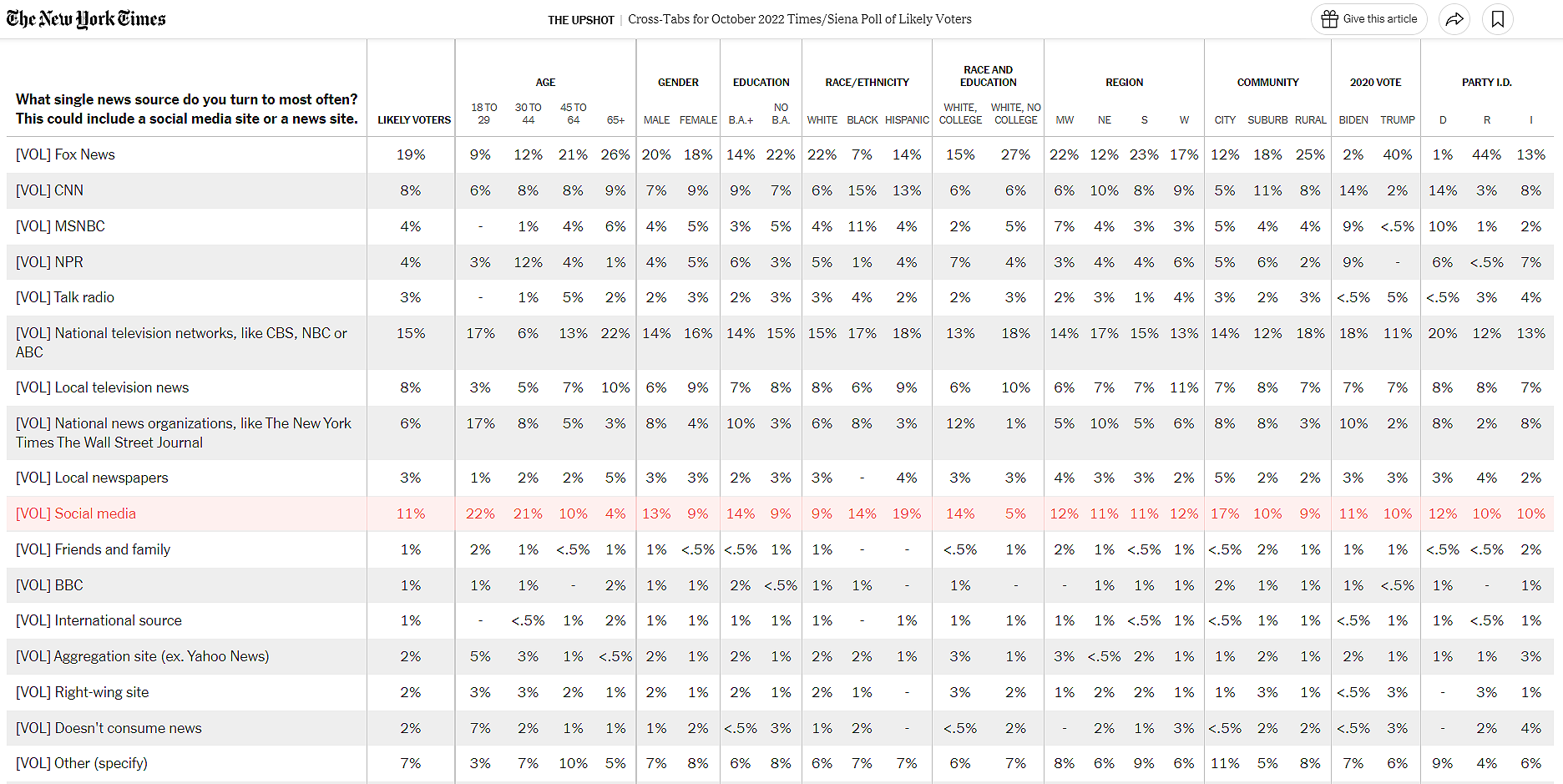
The latest evidence is The New York Times-Siena College poll of 792 registered voters Oct. 9-12. One of its main questions was, "Which comes closest to your views, even if neither is exactly right: American democracy is currently under threat, or American democracy is not currently under threat?"

The results: 74 percent said democracy is under threat and 20% said it isn't. Those who said it is under threat were asked, "What one or two words do you think summarize the current threat to democracy?" The leading response, from 13%, was "the government," "government corruption" and non-specific politicians or leaders; 10% said Donald Trump; 9% said societal divisions, political divisions or polarization; 6% or less named other politicians, political parties or movements such as nationalism, white nationalism or right-wing extremism, which collectively were named by 5%.

"The media" was named by less than half of 1%, but when asked, "Do you think each of the following is a major threat, minor threat or not a threat to democracy?" and given a list of choices, "the mainstream media" were identified as the leading major threat, by 59%; another 24% called them a minor threat, and only 16% said they are not a threat.

Rural Blog table, from New York Times-Siena College poll data
Perhaps those of us in the news media can take solace in the fact that hardly any voters first volunteered "media" as a threat, but media are not on top of voters' minds. When reminded of us, they reflect the concerns like those seen in the latest Gallup poll about trust and confidence in "the mass media, such as newspapers, TV and radio." It found that for the first time, a plurality of Americans say they have no confidence in the mass media "when it comes to reporting the news fully, accurately and fairly."

Rural news media might say, "This isn't about us," and to a limited extent that's true. A March poll of 1,000 adults for the National Newspaper Association, in ZIP codes where NNA members publish, asked "how much you trust" what various sources "say when it comes to learning about candidates for public office." On a scale of 1 to 10, local newspapers scored 7.38, TV stations 6.45, radio news 5.58, mail from candidates or parties 4.63 and social media 2.65. But how much do voters really discern among sources of information when they're not being asked questions about them? A lot less than we might hope, I suspect. Editors and publishers all over the nation have told me they're being tarred with the brushes that both ends of the political spectrum use to smear news media.

Notice I wrote "news media," not just "media," a distinction that too many news media fail to make (as well as failing to render the word as plural). In a saturated media environment, more and more people have difficulty distinguishing among types of media, and between fact and opinion, and news media need to remind them of some basic principles. It can be put pretty simply:

News media pay for journalism, which practices a discipline of verification; we tell you how we know something, or we attribute information to someone. We're mainly about fact, not opinion. Social media are mainly about opinion, not fact, and have little is any discipline or verification. Which do you trust?
Screenshot of New York Times-Siena College poll table, with social media line highlighted; to enlarge, click on it.

Wednesday, July 27, 2022

Misinformation undermines democracy; what to do about it?

"Democracy in the United States is in serious trouble," and in large measure because of misinformation, write two fellows and another researcher at the Brookings InstitutionGabriel R. Sanchez, Keesha Middlemass, and Aila Rodriguez cite several recent polls, including an NPR survey that found 64% of American adults believe that U.S. democracy is in crisis and is at risk of failing, a Quinnipiac University survey showing that 76% think political instability in the nation is a bigger danger than external adversaries. "Amazingly, this suggests that Americans recognize that we are a bigger threat to our own democracy than any other potential external threat," they write. "Sadly, according to this poll, over half of Americans (53%) expect political divisions in the country to worsen over their lifetime rather than get better."

Misinformation "deliberately aimed at disrupting the democratic process . . . confuses and overwhelms voters," they write. "Throughout the 2020 election cycle, Russia’s cyber efforts and online actors were able to influence public perceptions and sought to amplify mistrust in the electoral process by denigrating mail-in voting, highlighting alleged irregularities, and accusing the Democratic Party of engaging in voter fraud. The 'big lie' reinforced by President Trump about the 2020 election results amplified the Russian efforts and has lasting implications on voters’ trust in election outcomes."

One poll found that 57% of white Americans believe there was voter fraud in the 2020 election, and 
another found that only 20% felt "very confident" in the integrity of the election system. In another survey, 56% said they have "little or no confidence" that elections represent the will of the people. "The implications of this trend are huge, as decreased confidence in the system decreases civic engagement," the Brookings experts write.
 
They note that "the National Intelligence Council has found no indications that any foreign actor has interfered in the technical aspect of voting. Also, The Associated Press investigated all claims of vote fraud in the six states that decided the 2020 election and found far too little to make a difference. At the request of the Institute for Rural Journalism and Community Issues, publisher of The Rural Blog, AP allows non-subscriber weeklies to publish those stories, but few appear to have done so. 

"Darrell West, vice president and director of governance studies at Brookings, argues that the news media has a major role to play in combatting fake news and sophisticated disinformation campaigns," they write. "West argues that the government should invest in media literacy so that voters can identify false information and stop its spread. Brookings offers ways to tackle the problem, including:
  • Myth busting: Some states are moving forward in educating the public by providing specific fact-checks on election information: New MexicoNorth Carolina, Connecticut and California. Colorado has cybersecurity experts to monitor sites for misinformation about election processes.
  • Education: Digital Informers at Howard University "think the best way to combat misinformation is through community engagement and educational efforts, including using trusted sources in the community to talk to individuals about what they believe. Then, those perspectives, if false, can be countered with factual information from people with respect in their community.
  • News literacy: "More long-term efforts focus on the next generation of voters: middle-school and high-school students who are highly susceptible to misinformation given how much time they spend on social media platforms and given that they have not yet developed the ability to sort out misinformation from factual content on-line. . . . Illinois was the first state to require news literacy courses to be offered at every high school. . . . Colorado now requires media literacy standards in schools, and the state provides technical assistance.
"We are clearly at a critical point in our nation’s history, and without major efforts to increase confidence in our election system – voter registration, voting processes, and tabulating ballots – we might not be able to win back the public’s trust," the Brookings experts conclude.

Monday, May 02, 2022

Today is the deadline to apply for a project that will help journalists test-drive strategies to increase reader trust

Today is the deadline to apply for Trusting News' new Pluralism Network, a project in which journalists will learn and test new strategies to increase reader trust in the news media. Click here for more information and click here to apply.

Trusting News, a collaboration of the Donald W. Reynolds Journalism Institute and the American Press Institute, will explore five questions through the new Pluralism Network. Stipends for three of the projects are funded by George Mason University's Mercatus Center and cross-disciplinary, cross-idealogical collaborative the New Pluralists. From the project's website:
  • What strategies or tools could help editors assess whether individual stories are contributing to complexity and curiosity rather than overgeneralizations and polarization? Read more about our anti-polarization checklist, which comes with a $2,000 stipend for participating newsrooms.
  • How can newsrooms adopt practices around national wire-service content that help audiences differentiate it from local news? And what resources would be helpful for journalists writing headlines on those stories to avoid triggering polarized reactions and feedback? Read more about our wire news project, which comes with a $2,000 stipend for participating newsrooms.
  • How can newsrooms incorporate outreach efforts with maximum impact and efficiency to learn about the needs and perceptions of people with low trust in news? Read more about our outreach and listening project, which comes with a $500 stipend for individual participating journalists.
  • How can hiring editors and human-resources teams update interview practices to learn more about the "dimensions of difference" that job candidates could add to their staffs? Read more about our hiring project.
  • How can newsrooms talk to their audiences about their election coverage in a way that highlights shared goals and taps into a collective desire for understanding and curiosity? Read more about our election coverage messaging project.
Trusting News will publish what it's learned this summer, just in time for the midterm elections. In the meantime, participating journalists can share what they're learning with each other via a Slack channel. 

Tuesday, April 05, 2022

News media roundup: How to reach audiences that mistrust the news; media literacy podcast; a fact-checker's toolkit

Six cues used to make snap judgements about whether to trust a news source (Trust in News Project graphic)

Here's some recent news about media literacy, misinformation, and disinformation:

It's possible to reach people who mistrust the news, but you can't just relying on good reporting and writing, according to a recent Trust In News Project study by the Reuters Institute and the University of Oxford. Great headlines, graphics, photos, and more are essential too. The study also categorizes six cues audiences use to make snap judgements about which sources to trust (see graphic above). Here's a write-up about the study from Poynter and here's the study itself.

A fact-checker for Snopes discusses how she tells real news from fake and shares the toolkit she and colleagues use. Read more here.

Last year, Illinois became the first state to require all high school students to be taught media literacy skills. NPR podcast "In Case You Missed It" takes a deep dive into why media literacy is an essential skill today, as well as what people need to know who didn't learn about it in school. Listen to it here.

Here's a reminder to consider your source's motives and fact-check outrageous "trends" before reporting: Facebook parent company Meta hired GOP consulting firm Targeted Victory to help turn the public against social-media rival TikTok and draw attention away from Meta's privacy and antitrust issues. The nationwide media and lobbying campaign "includes placing op-eds and letters to the editor in major regional news outlets, promoting dubious stories about alleged TikTok trends that actually originated on Facebook, and pushing to draw political reporters and local politicians into helping take down its biggest competitor," Taylor Lorenz and Drew Harwell report for The Washington Post. Internal emails obtained by the Post show that the firm wanted to portray "the fast-growing app, owned by the Beijing-based company ByteDance, as a danger to American children and society." Facebook has already been under fire for engineering its algorithm to push users toward false and inflammatory news.

Tuesday, November 16, 2021

Pandemic roundup: Resources for teachers to identify misinformation; rural Covid patients in ICUs at greater risk

Here's a roundup of recent news stories about the pandemic and vaccination efforts:

The National Association for Media Literacy Education has teamed up with the Thomson Reuters Foundation to provide high-school and college educators with classroom resources on identifying pandemic misinformation. Read more here.

Rural Covid-19 patients in intensive care units are at a higher risk of dying than their urban counterparts, according to a West Virginia University researcher. Read more here.

If you're storing pesticides this winter, read these four safety tips first. Read more here.

It's no accident that Maine and Vermont, the states with the highest percentage of rural population, have some of the highest coronavirus vaccination rates in the country. Read more here.

A new study found that 78% of American adults either believe or are aren't sure about at least one of eight false statements about the pandemic or coronavirus vaccination. Unvaccinated adults and Republicans are the most likely to believe misconceptions. About 64% of unvaccinated adults believe or aren't sure about at least half of the eight false statements, compared to only 19% of vaccinated adults. Meanwhile, 46% of Republicans believe or are unsure about at least half of the statements, compared to 14% of Democrats. Read more here.

A recent study found that the incidence of rural Republican voters was the strongest variable correlating with higher per-capita Covid-19 cases. Read more here.

Rural residents exposed to big-city TV news are more likely to follow pandemic safety guidelines. Read more here.

Covid skeptics who organize online are increasingly driving public health professionals from their jobs. Read more here.

The pandemic has driven many teachers to quit. Seven of them talk about why. Read more here.

Tuesday, November 09, 2021

Illinois drafting required media-literacy course; high-school students' videos on the subject to be shown online tonight

Axios llustration by Aïda Amer
Illinois has become the first state to require students to take a course in media literacy, and tonight at 6 p.m. CT the Illinois Media Literacy Coalition will showcase award-winning videos by Illinois high school students about the importance of understanding media, reports Monica Eng of Axios.

The course will be required in the 2022-23 school year. The law says the course should help students analyze the purpose of media messages and how they are made, how media influences behavior, and the importance of digesting multiple media sources, Eng reports.

State Rep. Adam Niemerg, R-Teutopolis, said the law is "anti-Trump, anti-conservative" and a bid by liberals "to get into our school systems at a young age," according to the Illinois Radio Network. "Supporters of the law tell Axios it's not about politics, but giving students tools to develop their own BS detectors," Eng writes, quoting attorney Maaria Mozaffar, who helped write the law: "I would use the analogy of financial literacy classes."

Columbia College Chicago professor Yonty Friesem, who is co-writing the teaching framework, told Eng that Lessons in the course will be framed as discussions: "We don't want to dictate how it's going to be taught. Instead, we want to show the value of asking questions and reflecting on how the media impacts us. This is not about making the teacher the sage on the stage, but about facilitating discussions where people can have different opinions . . . civil debate and deliberation." Friesem invites comments and suggestions at YFriesem@colum.edu.