Showing posts with label public lands. Show all posts

Tuesday, August 12, 2025

'On the Front Porch' discussions return on Aug. 21. Pipa and Orrell begin with big change in northern Appalachia.

Tony Pipa (left) and Brent Orrell return on Aug. 21
After a summer of traveling to rural destinations, Tony Pipa from Reimagine Rural and Brent Orrell of the American Enterprise Institute are back 'on the front porch,' discussing the trials, successes and ongoing challenges of rural communities across the United States.

The new season dives in with Pennsylvania activist and author Tataboline Enos, who discusses her latest book, “Proudly Made: A Story of Reinvention in the Big Woods and Small Towns of the Pennsylvania Wilds.”

Set in northern Appalachia, Enos' memoir recounts the story of a region rich in public lands that was struggling to survive decades of depopulation and business decline. Through hard work, planning and collaboration, the community forged a new and brighter path forward by harnessing the spirit of the land and the people.
Enos will share details of how this community created change.

The group will share a blueprint for other rural communities looking to leverage outdoor recreation opportunities for economic development. Virtual participants can submit questions before the event via email to events@brookings.edu

Register here for the online event on Thursday, Aug. 21, at 3 p.m. E.T.

For more rural inspiration, Pipa's Reimagine Rural podcast returns for its third season beginning on Aug. 19. The podcast's first two stops are in western North Carolina, where residents and businesses are navigating post-Hurricane Helene recovery.

Season 3, Episode 1 focuses on a community working to restore outdoor recreation in Old Fort, N.C. Episode 2 explores how Canton, N.C., is maintaining its identity and resilience after multiple disasters.

New Reimagine Rural podcast episodes are released every three weeks throughout the fall and can be accessed on platforms such as Spotify and Apple.

Tuesday, July 08, 2025

Opinion: Public lands should not be sold. Open lands are our shared 'inheritance. . . and space of democracy'

Humpback whale joyfully feeding in the Kenai Fjords, Alaska. (NPS Photo by K. Thoresen)

Even though lawmakers ultimately rejected the sale of public lands as part of the federal budget bill called the Big Beautiful Bill, that doesn’t mean the idea won't come around again. In her opinion for The New York Times, Terry Tempest Williams explains what motivated Sen. Mike Lee of Utah and other like-minded Republicans to push for the provision and why so many Americans opposed it.

Had it passed, the provision would have facilitated the sale of more than one million acres of public lands; however, the loss of public property wouldn't be the only consequence. "Lee claimed in each of his many revisions of the proposal that disposing of our public lands was a way to address the housing crisis," Williams writes. "But that was a ruse; housing experts have said it wouldn’t have made a dent in the problem. What the senator wanted was to establish a precedent — to normalize selling off our public lands to generate cash to pay for tax cuts. Open that door, and the open space of democracy closes."
Porcupine caribou mothers go to Arctic National Wildlife Refuge in 
Alaska for calving season. (Photo by P. Maher, CPAWS) 

As lawmakers wrangled over the provision, a dramatic rejection of the idea came from "over 100 conservation groups and public lands advocates, as well as hunters, anglers, ranchers, recreationists and right-wing influencers," Williams explains. The sale legislation failed because "in addition to Democrats, four Republican senators from Montana and Idaho refused to vote for it. . . five Republican House representatives from Western states said it was a 'poison pill.' . . . America’s public lands are safe — for now."

Americans made it known to Congress that their lands were not for sale. "Members of Congress learned once again that if they don’t support public lands, they risk being voted out of office, especially in the American West," Williams writes. "What we saw was collective outrage fueled by love — energy we must nurture and draw on in the months and years to come."

Lee isn't the first politician to look at federal lands and see the money privatization could bring. According to Williams, Americans must remain stalwart protectors of their public "inheritance" that remains home to vastly different kinds of wildlife and broad expanses of landscapes found nowhere else on the planet. Williams writes, "What I feel more deeply now is that open lands inspire open minds. This is the open space of democracy." 

Friday, April 25, 2025

Opinion: Americans should be alarmed at the 'dangerous idea' Congress is floating, which could 'kill' rural America

A couple cares for fencing in Dark Sky, Oregon, an area
that is mostly comprised of public lands. (Instagram)
 
Inside a recent congressional budget reconciliation discussion, an alarming suggestion was made: Allow Congress to sell public lands to private investors, writes Tim David in his opinion for The Daily Yonder. Although lawmakers indicate sale proceeds would increase federal revenue, the loss of public lands would devastate some rural economies "where public lands aren’t just a backdrop, they’re the backbone of the economy and the way of life."

Even as lawmakers say they care about rural livelihoods, selling public assets would harm many rural communities, particularly those in the West. "From grazing and outfitting to hunting, fishing, and tourism, these lands sustain small businesses, support working families, and keep rural economies afloat," David explains. "If Congress truly wants to support rural America, it can start by investing in the agencies that manage these lands, not liquidating the lands themselves."

Congress has spent years asking the Bureau of Land Management "to do more with less," David writes. "Some of the loudest voices criticizing the BLM are the same ones voting to strip its funding. It’s a political double standard: criticize the agency for being slow or ineffective, then gut the very budget that allows it to function, and turn around and blame it again when things don’t get done."

Considering its ever-shrinking budget, it's unsurprising that "public lands and the rural communities that depend on them are feeling the strain," David adds. "Across the West, deteriorating roads, neglected infrastructure, and staff shortages are leaving public access routes impassable and economic opportunities squandered. Local businesses are losing revenue right when tourism and recreation seasons should be ramping up."

What those in Washington may see as a budget line that needs reduction, are real Americans working and serving in the communities where they live. "These are folks who know every rancher by name, who raise their families in the same towns, and who show up for volunteer projects and community events," David explains. "When Congress cuts funding, it’s not just abstract numbers. It’s fewer people to maintain campgrounds, issue grazing permits, support outfitters, and help prevent wildfires. It’s not the agency that suffers, it’s rural America."

Congress needs to seek out different solutions. "If Congress truly wants to help rural America, it starts with two things: fund the BLM like it matters, and keep our public lands public," David writes. "If Congress continues to underfund the BLM and entertains a wholesale sell-off of public lands, it won’t just hurt rural America. It will kill it."

Friday, September 27, 2024

Bound by a passion to protect a 'pristine corner of Colorado,' this 'ragtag organization' helped change government policy

A hiker enjoys the White River National Forest, which overlaps
with the Thompson Divide. (Adobe Stock photo)

A shared passion for protecting Colorado's Thompson Divide brought together a group of people with few other interests in common. "The drilling leases in a pristine corner of Colorado seemed like a done deal. But then an unlikely alliance of cowboys and environmentalists emerged. And things changed," reports Zoƫ Rom for The New York Times. "Their campaign could serve as a model for future environmental efforts."

Located in west-central Colorado, the Thompson Divide "overlaps with part of the White River National Forest, one of the most visited national forests in the U.S.," Rom explains. The area is also "home to endangered lynxes and one of the expansive organisms in the world: the state’s largest Aspen stand, a colony of trees connected by a lateral root system."

The region is beloved by hikers, conservationists, ranchers, cyclists and snowmobilers, some of whom formed "the self-described ragtag organization" now known as the Thompson Divide Coalition, Rom writes. The coalition added legal assistance from Peter Hart, legal director for Wilderness Workshop, a nonprofit environmental group in Carbondale, Colorado. Together the movement developed "a novel legal strategy that helped win a 20-year pause on new oil and gas development across the area."

Originally, the group tried and failed to buy back the 80-some oil and gas leases the Bush Administration had issued on the Thompson Divide. When leaseholders turned down the the coalition's offers, Hart's legal team scrutinized the sales. There they found "that the federal government’s haste to issue leases had left them with vulnerabilities," Rom reports. "For one thing, opportunities for public comment during the leasing process appeared to be inadequate, an apparent violation of the National Environmental Policy Act."

More legal digging led to "administrative challenges, which eventually sent one leaseholder to federal court against the Bureau of Land Management," Rom explains. With the lease's legal and administrative problems exposed, "leaseholders who had declined to sell were now eyeing the exits in light of potential legal complications and public discontent around drilling."

Tuesday, April 16, 2024

New rule increases royalties for oil and gas companies that drill on public lands; bond will be at least 15 times more

The Interior Department worked to bring oil and gas management
into the 21st century. Drillers are angry. (Photo by J. Evans, Unsplash)
 

For decades, companies that  drilled on public lands for oil paid the federal government small royalties and spent little on cleanup funding, but that era is about to change. "A suite of regulatory changes from the Bureau of Land Management will increase royalties on oil and stiffen cleanup requirements," reports Heather Richards of E & E News. "The rule caps a multiyear effort by the Interior Department to 'modernize' how the U.S. manages vast resources of oil and natural gas under public lands in states like Wyoming and New Mexico."

Initially, President Joe Biden planned to end drilling on public lands "to shrink the future footprint of the nation’s oil program. . . but he retreated due to legal setbacks early in office," Richards writes. "The rule requires a minimum bond for drilling a federal lease that's 15 times higher than the previous minimum of $10,000. Environmental groups and government watchdogs like the Government Accountability Office have asked BLM for years for stronger bonding requirements to cover decommissioning costs of wells and pipelines when they are abandoned."

The new rule angered drillers who "are already panning the rule as an attack on their industry and threatening to sue," Richards reports. "The final rule suggests the Bureau of Land Management will have a higher responsibility to limit oil and gas in areas that are considered valuable for wildlife or recreation by prioritizing leasing in areas with greater oil potential. Oil companies nominate lands for lease, but BLM decides what acres are ultimately offered for sale."

Environmental advocates praised the action as a good stewardship plan. Emily Olsen, vice president of the Rocky Mountain Region for Trout Unlimited, told Richards, "Energy development and conservation need not be mutually exclusive. The BLM is prioritizing energy development where it will have the fewest resource impacts."

Tuesday, December 12, 2023

Opinion: Sell this national treasure to the National Park Service, not the highest private bidder

Pronghorn migrate through the Kelly Parcel, Wyoming.
(Photo by Savannah Rose, Writers on the Range)
A potential public auction of a coveted piece of land within Grand Teton National Park has outraged some Wyoming residents who feel the pristine 640 acres should remain a public holding. "Simply put, this small inholding, known as the 'Kelly Parcel,' should never be privatized — never. It is one of the most awe-inspiring and important pieces of open space remaining in America," writes Savannah Rose in her opinion for Writers on the Range. "Its borders include the National Elk Refuge and Bridger-Teton National Forest. Its value was appraised in 2022 at $62.4 million. However, the director of the Office of State Lands and Investment just recommended a starting bid of $80 million."

The money aside, Rose insists that privatizing the Kelly Parcel threatens wildlife that has thrived there for centuries. '"The land is a vital migration corridor for elk, moose, big horn sheep antelope, pronghorn, and mule deer traveling into and out of the national park. It also hosts 87 other 'Species of Greatest Conservation Need'. . . . And the annual, 200-mile-long migration corridor known as the Path of the Pronghorn — from Grand Teton National Park to the upper Green River Basin — passes right through the Kelly Parcel at the crux of what’s recognized as the longest mammalian migration in the contiguous United States."

"Wyomingites have been resolute in their opposition to selling the state-owned parcel. The publicity generated by the Jackson Hole Conservation Alliance collected more than 2,600 comments from people opposed to an auction, and hundreds of opponents turned out at each of four public hearings in November. Many others contacted the state directly for a total of more than 10,000 people opposed to a state auction," Rose writes. 

Auctioning off the Kelly Parcel would provide $4 million a year for Wyoming public schools. But at what cost? Rose writes, "There is a better approach. Selling the parcel to the National Park Service — as Wyoming did with its other three parcels within the park — is projected to generate up to $120 million over 30 years."

State officials recently tabled the Kelly Parcel auction until 2024. "But the State Board of Land Commissioners didn't take the idea of an auction off the table," reports Billy Arnold of Jackson Hole News & Guide. "In the meantime, they will explore swapping the Kelly parcel for other federal lands in Wyoming specifically for oil and gas development."

Tuesday, November 21, 2023

Researchers share how climate change is altering Yellowstone; they hope education and science can help

Yellowstone and Grand Teton national parks attract millions of visitors from across the globe each year.
(Photo by Althea Dotzour, University of Wisconsin)

Iconic and awe-inspiring, Yellowstone and Grand Teton are a part of the Greater Yellowstone Ecosystem, which draws thousands of visitors each year. But climate change is gradually altering the parks' beloved expanses. To help people understand these changes, University of Wisconsin professor and ecologist Monica Turner and her team are finding ways to illustrate what global warming could look like in Yellowstone's future, reports Elise Mahon for UW News. "The shifts that result from a changing climate are often too subtle for any individual to see, and it can be difficult to fully understand. . . . Greater Yellowstone is just one ecosystem; however, studying how it responds as the climate heats up can help us understand what may happen in places around the world. . . . And since so many people love Yellowstone, it’s a great place to help the public appreciate the magnitude and tempo of climate change."

Turner and her team are "finding ways to help reveal tomorrow's Yellowstone in pictures based on the data. Using simulated images, they hope to show people landscapes that don't yet exist but might if the climate of the Greater Yellowstone Ecosystem continues to get warmer and drier," Mahon writes. 

Lodgepole pines have cones that release seeds during
a fire. (Photo by Althea Dotzour, UW)
Fire is the primary element propelling regional changes. "Fire has long been a natural part of the ecosystem. Lodgepole pines are one of the most common tree species in the Greater Yellowstone Ecosystem, and they’re well adapted to the historical cadence of fires in the area. . . . Once the trees are old enough, they produce cones designed to open in fire, helping the trees establish new stands," Mahon explains. "But a warmer, drier climate is increasing the frequency of fires and disrupting the forests’ ability to recover as trees can no longer effectively disperse their seeds. . . . [There will be] fewer of the trees visitors are used to seeing in these iconic landscapes. . . .That’s concerning because forests are the backbone of the Greater Yellowstone Ecosystem.

"Studying the landscape and including more perspectives on sustaining them is vital to ensuring people from all backgrounds can visit, learn, connect with the place. . ." Mahon reports. "While tomorrow’s Yellowstone will look different than today’s, the magnitude of that difference depends on the actions of all of us."

To read more about student researchers' unique lives and be inspired, click here.
To find out more about Turner's research, click here.

Thursday, September 14, 2023

Hardrock mining companies pay 'a pittance' for minerals mined from public lands. Some say taxpayers need more.

A copper mine shaft 1,100 feet below the surface near
Superior, Ariz. (Photo by Tamir Kalifa, The New York Times)
Since 1872, mining companies have taken stores of gold and other metals from public lands without paying royalty fees to the federal government. The Biden administration says lawmakers need to "fix the Gold Rush-era General Mining Law so it can better manage the mineral resources buried under millions of acres of public land," reports Lisa Friedman of The New York Times. "A top priority: require companies to pay something in exchange for what they take. Unlike companies that extract oil, gas and coal from federal lands, hardrock miners pay no royalties to the federal government."

Initial plans suggest a 4 to 8 percent fee of the net value of mined materials, which "could translate into as much as $97 million annually and drew sharp opposition from mining operators," Friedman writes. Tommy Beaudreau, the deputy secretary of the Interior Department, told Friedman: "The biggest takeaway from our report is that our 150-year-old-law, the 1872 mining law, needs to be reformed and brought into the 21st century."

Beaudreau heads up a "working group of officials across federal agencies who reviewed policies and regulations for hardrock mining," Friedman explains. "The group found the law did not do enough to steer mineral exploration away from sensitive resources or to promote 'early and meaningful' engagement with tribes or other affected communities. . . . And the law should require mining companies that take resources from public lands to pay something for that privilege. . . .The report stated, [the law] 'fails to provide the American taxpayer with any direct financial compensation for the value of hardrock minerals extracted from most publicly owned lands.'"

While mining operations pay state royalties and taxes, operators on federal land "only pay the U.S. government one-time claim processing fees totaling $60. Many companies also pay an annual $165 maintenance fee per site, according to the report," Friedman writes. Mining companies oppose the change. Rich Nolan, chief executive of the National Mining Association, told Friedman that the changes would "throw additional obstacles in the way of responsible domestic projects and would-be investment, forcing the U.S. to double-down on our already outsized import reliance from countries with questionable labor, safety and environmental practices."

Environmental groups praised the proposed change. Chris Wood, the president of Trout Unlimited, a conservation group, told Friedman, “It’s the only commodity produced off of our public lands where there is no tax or royalty." Friedman reports, "Wood added that money raised from federal royalties could help to clean up an estimated half a million abandoned mines scattered across the American West."

Thursday, August 31, 2023

Opinion: Backcountry access is a tangle of public lands, private property and people treading all over the place

Runners on the Gateway Loop Trail at the McDowell Sonoran
Preserve in Ariz. (Photo by Caitlin O'Hara, The Washington Post) 
America’s backcountry is a tangled mix of public lands and private property, and access battles over where one ends and another begins are "wildly complex," Maddy Butcher of Colorado writes in her opinion for The Washington Post.

The "this land is your land; this land is my land" ideal does not apply to private property, and violators who purposely or accidentally tread on private lands have faced criminal charges and civil suits. "Across the West, courts are reflecting the struggles that residents and visitors face in trying to balance public trust and private land ownership. Some cast it as simple battles of rich vs. poor, or of locals vs. out-of-towners." But an "us" vs. "them" approach is an oversimplification of a dynamic web.

"As outdoor recreation increasingly fuels economies here and as landowners assert their rights, the clashes — not just in courts but also across streams, fence lines and dirt paths — will continue. . . . Many of us here struggle to roll with the triple influx of transplants, second-home owners and visitors. Like the courts, when we consider the multifaceted impact of this population flow, we’re conflicted."

Having so many visitors can lead communities feeling "loved to death. . . . Cluelessness abounds. . . . I’ve seen young hikers in the woods, dressed in tan during hunting season, looking more like deer than they realize and unaware that hunting season is a thing. I’ve seen private lands treated like public lands and public lands treated like gift shops, with visitors taking home artifacts, plants and animals."

Western state laws vary widely, and visitors and new residents best learn about theirs. "When I moved to Colorado from Utah several years ago, someone handed me The Good Neighbor Guidebook for Colorado. Edited by two lawyers, the book helps readers navigate the laws and customs around fencing, water use, wildlife and livestock. In this state, your dogs can legally be shot for chasing deer; you can’t divert a stream even a little bit; you must mitigate your noxious weeds; and if you don’t want cattle grazing your land, you’ll have to fence them out."

Nature is also feeling the squeeze. "As we twist and turn around boundaries and rights, we might pause to consider also doing some problem-grappling on an ecosystem level: Elk, bear, marmots and coyotes move to places where there is less pressure from human presence. But lately, that pressure is coming at them from all sides."

Thursday, May 18, 2023

Feds want to allow leasing of federal land for conservation; critics call it a back-door attack on grazing, mining, drilling

Cattle graze along a section of the Missouri River in the Upper Missouri River Breaks National Monument near Fort Benton, Montana. Much federal land in the West is used for grazing. (Photo by Matthew Brown, The Associated Press)
The Biden administration's plan to sell leases of federal land for conservation, just like it does for "oil drilling, livestock grazing and other interests," has drawn "pushback from Republicans and ranchers," reports Matthew Brown of The Associated Press

"The proposal is stirring debate over the best use of public land, primarily in the West," Brown writes. "Opponents . . . are blasting it as a backdoor way to exclude mining, energy development and agriculture. Tracy Stone-Manning, director of the Bureau of Land Management, said the proposed changes address rising pressure from climate change and development. She said it would make conservation an 'equal' to grazing, drilling and other uses while not interfering with them."

The bureau, part of the Interior Department, "has a history of industry-friendly policies for the 380,000 square miles it oversees, an area more than twice the size of California," Brown writes. "Those holdings put the agency at the center of arguments over how much development should be allowed." At the first virtual public meeting about the proposal, "There was no opportunity for public comment, and the agency screened questions . . . Officials acknowledged receiving numerous queries about grazing and drilling potentially being excluded. Brian St. George, acting assistant director for the bureau, said the conservation leases would not 'lock up land in perpetuity'."

Stone-Manning said conservation-leased property could still be used for hunting or recreation. "Democratic U.S. Sen. Catherine Cortez Masto of Nevada — where the federal land bureau controls about two-thirds of the land — urged the administration to work with ranchers and farmers before finalizing the proposal."

Tuesday, January 24, 2023

Moving USDA research units from D.C. to K.C. made them less productive, cost them many veteran staff, GAO says

The General Accounting Office has found that the Trump administration damaged the research agencies of the Department of Agriculture by moving them out of Washington.

The number of journal articles by the Economic Research Service fell by more than half, and the National Institite of Food and Agriculture "took longer to process grants," GAO reports. By fall 2021, "productivity had largely recovered," but "the agencies’ workforce was composed mostly of new employees with less experience."

The moves of the agencies to Kansas City were also somewhat haphazard, GAO indicated, saying USDA did not follow some "leading practices for effective agency reforms and strategic human-capital management. For example, USDA minimally involved employees, Congress, and other key stakeholders in relocating the agencies. In addition, both agencies partially followed, or did not generally follow, many of the leading practices related to strategic workforce planning, training and development, and diversity management."

Then-Agriculture Sonny Perdue promised “a rigorous site selection process” that would lead to “attracting highly-qualified staff,” but GAO says the process “excluded estimated employee attrition rates” and “limited the ability of USDA leadership to ensure that it was making an appropriately informed decision on relocating.”

"Instead of attracting employees as Perdue promised, the move quickly decimated the workforce, trashed employee morale, shunned employee input and slashed the number of Black employees at the agencies," reports Joe Davidson of The Washington Post. The relocations “resulted in a significant loss of institutional knowledge, talent, and diversity on staff that will take time and intentionality to fully rebuild,” USDA press secretary Marissa Perry told Davidson.

"USDA officials told GAO auditors the relocation decision, which President Biden has not reversed, 'was the sole decision of the secretary'," Davidson reports. "Perdue, now chancellor of the University System of Georgia, and its media office did not respond to questions submitted by email."

Davidson notes, "During the Trump administration, the Interior Department also moved an agency headquarters west and received similarly negative reviews" from GAO. The Bureau of Land Management headquarters moved to Grand Junction, Colo., but is moving back to Washington, D.C.

Friday, November 11, 2022

Showdown in Wyoming may define the rights of public access to checkerboarded public lands in the Western U.S.

Elk Mountain is a hunter's paradise. The 11,000-foot peak in southern Wyoming is home to hundreds of elk, deer and antelope. But there's a catch: "You can't get there from here," writes Michael Allen of The Wall Street Journal. "The sprawling mountain is surrounded by private ranchland. While the prime hunting ground is checkerboarded with federal and state property, a pattern created when railroads and settlers came, access is limited by an age-old Western doctrine. Ranchers consider it unneighborly for outsiders to hopscotch through their land by crossing over public sections that meet only at a corner."

Allen writes about four hunters from Missouri who got inventive. "Using a special stepladder, they climbed between two parcels owned by the federal Bureau of Land Management, taking care not to set foot on the private property on either side," reports Allen. But then things got sticky. "The local sheriff got involved, and before long the four hunters found themselves facing criminal-trespassing charges in state court. The prosecutor argued that it wasn’t enough that the defendants didn’t physically touch the private property," because they were in its airspace, Allen explains. The case is still in litigation.

"The courtroom clash is drawing attention to an anomaly of Western land ownership dating back to the 19th century," Allen said. "The digital navigation company onX says it has identified more than 8 million acres of state and federal land in Western states that are blocked from public access due to the legal gray area around corner-crossing. . . .That doesn’t stop some eager hunters, who are resorting to ever-more-exotic lengths to get past the legal barriers."

Saturday, July 30, 2022

What Joe Manchin got in the climate bill for West Virginia, energy industries, sick coal miners, Toyota and himself

Manchin (Tom Williams, CQ-Roll Call, via Getty)
"Congress is suddenly poised to pass the most ambitious climate bill in United States history, largely written by a senator from a coal state who became a millionaire from his family coal business and who has taken more campaign cash from the oil and gas industry than any of his colleagues have," Brad Plumer and Lisa Friedman of The New York Times write of West Virginia Sen. Joe Manchin, a moderate-to-conservative Democrat who holds much power in the 50-50 Senate.

So what did Manchin get in his deal with Senate Majority Leader Chuck Schumer? The federal government would lease more public lands and waters for oil and gas drilling, forcing President Biden to break a campaign promise. Tax credits for carbon capture technology that "could allow coal or gas-burning power plants to keep operating with lower emissions" would be expanded, the Times reports. And Manchin got a vote on a separate bill "to speed up the process of issuing permits for energy infrastructure," such as a West Virginia gas pipeline, the Times reports.

There's more. The trust fund for coal miners with black-lung disease would become permanent; new incentives would be offered "to build wind and solar farms in areas where coal mines or coal plants have recently closed," and there would be "generous tax credits for nascent technologies like carbon capture and storage and low-emissions hydrogen fuels, which Mr. Manchin has supported."

“Those are his pet projects,” James Van Nostrand, a law professor at West Virginia University, told the Times. “I think he’s going to say, ‘I used my strategic position to bring back benefits for West Virginia.’ And he’ll probably do pretty well in the next election.” Some environmentalists complained about more oil and gas leasing, "but energy analysts and many of the country’s biggest environmental groups said that any additional emissions from fossil fuel leasing would be dwarfed by the clean-energy provisions in the bill," the Times reports.

The bill was a long time coming, and "At every step of the way, Mr. Manchin shaped the legislation," the Times reports. He killed a plan to pay utilities to replace fossil-fuel power with renewables and "bigger tax credits for consumers who bought union-made electric vehicles, a measure that was opposed by Toyota Motor, which operates a non-union plant in West Virginia. And he ensured that the tax credits for electric vehicles could not be used by the wealthiest Americans." He won a lower fee for leaks of methane and "ensured that longstanding tax breaks for the fossil fuel industry, which many Democrats wanted to repeal, went untouched."

Wednesday, July 27, 2022

Wild-horse advocacy group puts numbers on slaughter buys

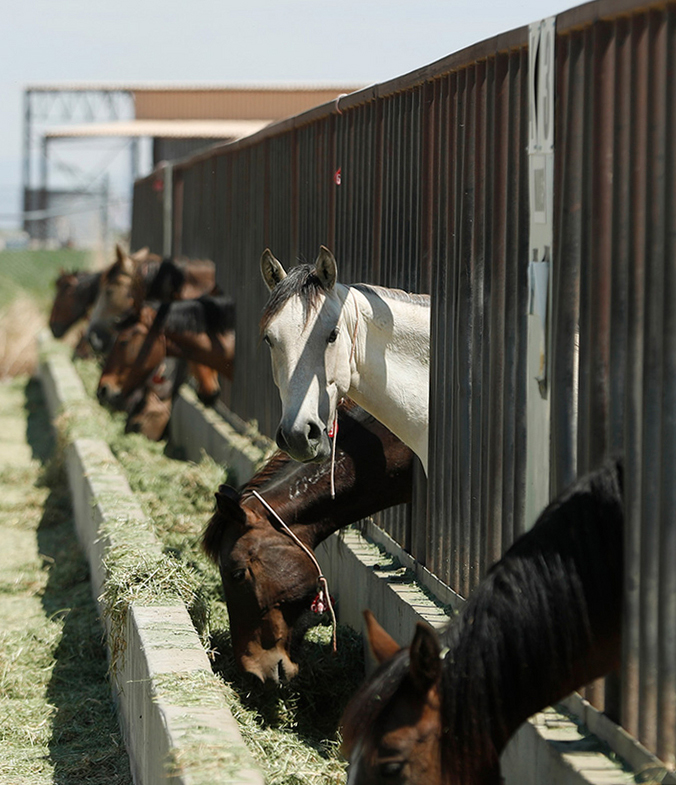
Wild horses in a holding/adoption yard in Delta, Utah
(Photo by George Frey, Getty Images, via Greenwire)
The American Wild Horse Campaign says that since 2019, at least 840 horses and burros adopted from federal rangelands were sold at auctions that included known buyers from slaughterhouses in Canada and Mexico, based on records it obtained through the Freedom of Information Act "and from affiliated wild horse rescue groups that attended the auctions," Scott Streater reports for Greenwire. It has long been presumed that foreign abattoirs were buying at U.S. auctions, but this appears to be the first documentation, with numbers of animals.

The federal Bureau of Land Management "offers $1,000 to people who adopt one of the nearly 60,000 wild horses and burros removed from federal rangelands and held in off-range holding corrals and pastures," Streater notes. "Participants receive $500 up front and an additional $500 per adopted animal a year later, after a follow-up review determines the adopter is properly caring for the horse or horses and title has been transferred to the private party. Since the program started in late 2019, it has helped adopt more than 8,200 wild horses and burros into private care."

The BLM declined to comment on the AWHC report. After complaints from wild-horse advocates, last year the agency added "steps to better screen adoption candidates and to help ensure that wild horses and burros transferred into private care through the adoption program are not later sold at auctions with known kill buyers in attendance," Streater reports. "BLM also visits adopted animals six months after adoption, instead of 12 months later."

AWHC reports says of the 840 “BLM-branded wild horses and burros identified in kill pens,” at least 312 were adopted through the incentive program. “The whereabouts of these animals remain unknown.” The group said it “identified 24 groups of related individuals” that it says have adopted multiple wild horses and burros “to the same address, then flipped all the animals to kill pens as a group after receiving the full incentive payments. . . . At least 130 BLM wild horses or burros were sent to kill pens as part of such coordinated schemes.” AWHC said the numbers “represent the tip of the iceberg, as many kill pens directly ship horses and burros to slaughter without advertising them.”

The BLM said last year that it adopted 7,369 wild horses and burros into private care in the fiscal year that ended Sept. 30, "the most in at least two decades," Streater reports, noting roundups aimed at making the range population "closer to the level BLM considers sustainable without damaging the rangelands, or placing the animals at risk of starvation or dying due to a lack of water — a growing concern as much of the West is experiencing extreme drought conditions. As of March 1, there are now an estimated 82,384 wild horses and burros roaming 27 million acres of federal herd management areas in 10 Western states — down from a record 95,114 in 2020."

Thursday, May 19, 2022

Apply for environmental reporting grants for projects covering public lands by May 31

Got an idea for a reporting project about public lands? The Society for Environmental Journalists has extended until May 31 its deadline to apply for a grant to cover such a project. 

Each grant is $5,000 maximum with individual stipends limited to $2,000. Recipients must use the funds within a year of payment to write a story or stories covering U.S. public lands (which are owned and/or managed by federal, state, local or tribal governments). Application is free for SEJ members or members of diversity journalism associations. Non-members can apply for $40 as long as they are otherwise eligible for SEJ membership. Click here for more information or to apply.

Monday, April 18, 2022

Interior opens federal land for new drilling but raises fees

"The Interior Department announced on Friday plans to hold its first onshore oil and gas lease sales since President Biden took office," Anna Phillips reports for The Washington Post. "The department said it plans to open roughly 144,000 acres up for lease next week and will charge oil and gas companies higher royalties to drill on federal land, raising the fees for the first time. Under the plans unveiled Friday, royalty rates would increase to 18.75 percent from 12.5 percent for oil and gas lease sales. The long-awaited announcement follows a report the department issued last fall, which called for royalty fees to be more in line with the higher rates charged by most private landowners and major oil- and gas-producing states."

Matthew Brown reports for The Associated Press, "Friday’s announcement comes amid pressure for Biden to expand U.S. crude production as the pandemic and war in Ukraine roil the global economy and fuel prices have spiked. The Democrat faces calls from within his own party to do more to curb emissions from fossil fuels that are driving climate change."
 
The announcement angered climate activists and violates a campaign promise not to allow any more drilling on federal lands. Biden tried to follow through on that promise, and suspended new leasing a week after taking office to give Interior time to create a report on the state of the leasing programs. But a federal judge in Louisiana ordered the administration to resume the sales, Brown reports.

"In opening new land for drilling, while at the same time requiring companies to pay more to drill, Biden appears to be trying to walk a line between trying to both lower gas prices and fight climate change," Coral Davenport reports for The New York Times. "While Biden came into office with the most ambitious climate-change agenda of any president in history, his climate policies have been largely stalled, stymied by inaction in Congress."

Wednesday, March 16, 2022

Fact-checking assertions about oil and gasoline prices

Who or what is to blame for the record-high price of gasoline, which does disproportionate harm to rural areas? A video ad by former Vice President Mike Pence's political group "falsely blames" President Biden for increased purchases of Russian oil, thus helping the invasion of Ukraine, Washington Post Fact Checker Glenn Kessler concluded March 9. A week later, Kessler produced a much longer fact check, headlined "The truth about gas prices and oil production." With his permission, we republish it.

By Glenn Kessler

In a moment of national unity against Russia’s attack on Ukraine, Democrats and Republicans are fighting passionately over the steep increase in the cost of gasoline. Prices have already risen sharply since Biden became president — and he acknowledged that his ban on Russian oil and gas exports could send them even higher.

Figuring out the root causes of inflation is subject to interpretation. Biden has been quick to claim that it’s mostly the result of Russian President Vladimir Putin’s invasion of Ukraine, tagging the latest inflation report as “Putin’s price hike.” But a credible case has also been made by some economists, including former treasury secretary Lawrence Summers and former Obama treasury official Steven Rattner, that the $1.9 trillion coronavirus relief plan passed by Congress helped spark the current rise in prices across the board.

A separate debate is taking place over U.S. oil production and whether Biden administration policies have played a role. Partisans on all sides, as is often the case, are misrepresenting the facts, obscuring the complicated truth about oil production, gas prices and the role of renewables. Here’s a guide to that issue.

Gasoline prices have soared overnight. How is that possible?

The war — and efforts by the United States and its allies to stem purchases of Russian energy products — sent the price of crude oil skyrocketing. Many gasoline stations have only two or three days of product in stock, and so price gasoline at what it will cost to refill those tanks underground. This is an economic term known as “replacement cost.”

Every $10 increase in the price of crude oil adds about 24 cents to the cost of each gallon of gasoline and is quickly reflected in what you pay at the pump. It’s not an example of price gouging. Still, the price of gasoline is nearing — or may exceed — previous inflation-adjusted highs reached in 1918, 1981 and 2008.

Is the United States ramping up its oil production, or holding it back?

The oil business in the United States is run by private companies, not the U.S. government. It’s also a cyclical business and oil prices have been low for some time and drilling has also been low.

During the initial stages of the coronavirus pandemic, when oil prices fell sharply, to about $23 a barrel, production plummeted because it was no longer as profitable. Now, with crude oil above $100 a barrel, there is more of an incentive to ramp up U.S. production, though it is still below the high reached in 2020 before the pandemic struck.

In February 2020, U.S. oil production reached 13.1 million barrels a day. Two years later, in February of this year, production was about 11 percent lower — 11.6 million barrels a day.

Gasoline prices have steadily risen in the United States since April 2020, when the weekly price dropped to as low $1.77 a gallon. It had already risen to $2.38 a gallon when Biden took office.

There’s little evidence that Biden’s policies have had any direct impact on oil production. However, the U.S. government can have an effect of shaping market perceptions that on the margins can affect prices.

As soon as he took office, Biden terminated the Keystone XL pipeline and signaled a hostility to the fossil fuel industry with a major push for clean energy, including a pledge to cut U.S. greenhouse gas emissions by at least 50 percent of 2005 levels by 2030.

Keystone XL still would not have been built by now even if Biden had permitted it to go forward — and even if it were in place, the impact in prices would be measured in pennies. Moreover, even without Keystone XL, imports from Canada have increased about 50 percent over the past decade. But Biden’s actions early in his tenure, some experts say, sent “yellow light” signals to the market that cost of drilling for oil might rise and so caution was warranted.

The reverse can also be true. The Trump’s administration’s opposite “green light” approach — few regulations and no restraints — led some oil drillers to invest in unprofitable wells.

Biden also issued an executive order that paused new oil and gas leases on government land, but within months a federal judge blocked it. After his first year, Biden had outpaced Donald Trump in issuing drilling permits on public lands.

Just because a company has received a permit to drill, it has no obligation to do so. One important metric is what is known as a DUC — a drilled but uncompleted oil or gas well. In other words, production equipment has not been installed and so the well cannot yet produce hydrocarbons. The number of DUCs reached a high of 6,340 in June 2020, and as of February had dropped to 4,372, according to EIA.

Can the U.S. truly change oil prices by encouraging more drilling and allowing pipelines?

Not really. The United States in 2020 was the biggest oil producer in the world and also the biggest consumer, but it is just one player in a global oil market. (“Oil” includes crude oil, all other petroleum liquids, and biofuels.) Much of what happens in the market is beyond the government’s control.

In 2021, the United States slipped to third place in oil production, behind Russia and Saudi Arabia. That’s mainly because large shale companies committed to Wall Street that they would continue to limit production and return more cash to shareholders — “an effort to win back investors who fled the industry after years of poor returns,” according to the Wall Street Journal. Scott Sheffield, chief executive of Pioneer Natural Resources, told investors in February: “$100 oil, $150 oil, we’re not going to change our growth rate.”

U.S. oil producers boosted output by more than 50 percent between 2016 and 2020, so it’s certainly possible for the United States to once again become the world’s biggest oil producer. But investors are demanding that companies do not overspend on new investments this time around.

If the United States is a top oil producer, why do we still need to import oil?

The United States actually exports more oil than it imports. In 2021, according to the Energy Information Administration, the United States imported about 8.47 million barrels per day of petroleum, compared to exports of 8.63 million barrels per days. Crude accounts for about 35 percent of those exports. One key reason is that foreign countries use more diesel than the United States and the United States uses more gasoline.

The boom in U.S. shale oil has certainly reduced reliance on foreign oil imports, but not all crude is the same. Refiners on the Gulf Coast, for instance, have been optimized for Venezuelan crude, which has a high sulfur content. When the Trump administration put sanctions on Venezuelan petroleum, refiners started imported Russian petroleum products because they are roughly similar. Now that Russia has been sanctioned, refiners probably will have to adjust to a cleaner type of crude.

In other words, the United States cannot be an island in the worldwide energy market. But it is more secure as a net exporter of petroleum.

Would funding more renewables help make the U.S. energy independent?

Not in the short run. Renewables replace natural gas or coal. You still need oil to drive cars and trucks and fly planes. At this point, the electric-vehicle market is not growing fast enough to make much of a difference in the current standoff with Russia. But long-run investments over time could begin to make a difference.

Monday, November 29, 2021

Interior may make make oil, gas companies pay more to drill on federal lands; wouldn't affect home energy costs much

The Interior Department announced plans Friday to make oil and gas companies pay more to drill public lands and waters. The federal leasing program is outdated, fails to serve taxpayers, and worsens climate change, said an18-page report from the department.

"The document calls for increasing the government’s royalty rate — the 12.5 percent of profits fossil-fuel developers must pay to the federal government in exchange for drilling on public lands — to be more in line with the higher rates charged by most private landowners and major oil- and gas-producing states," Sarah Kaplan reports for The Washington Post. "It also makes the case for raising the bond companies must set aside for cleanup before they begin new development." Raising the royalty rate could generate between $1 billion and $2 billion a year annually, and wouldn't significantly impact energy prices for American households.

The report focuses on fiscal rather than environmental benefits of updating the law, but "Interior officials say they will also consider how to incorporate the real-world toll of climate change into the price of permits for new fossil fuel extraction," Kaplan reports. "Economic analyses suggest the changes to royalty and bonding rates will increase revenue, but they will not significantly curb carbon emissions." That's because "Less than 10 percent of oil and gas produced in the United States comes from Interior-controlled land, and cuts to U.S. production will be partly offset by increases in other countries."

Interested parties on both sides of the issue expressed dissatisfaction with the proposal. A representative of the American Petroleum Institute said it would increase the cost of production, Kaplan reports. Meanwhile, a spokesperson for the Center for Biological Diversity noted that one-third of Americans experienced a disaster driven by climate change this summer, and called for the Biden administration to end drilling on public lands rather than reform it.

The administration is under pressure to deliver on President Biden's campaign promises to protect the environment, especially after the recent United Nations climate agreement. "Even as he has come under criticism for not moving quickly or boldly enough to reduce the country’s greenhouse gas emissions, create jobs in a greener economy and alleviate pollution impacting poor and minority communities, Biden has continued to pursue swaths of his climate agenda," Juliet Eilperin, Brady Dennis and John Muyskens note for the Post. "Less than a year after taking the oath of office, Biden has now targeted half of Donald Trump’s energy and environmental policies." Click here for the Post's frequently updated list of the Biden administration's environmental actions.

Monday, October 11, 2021

Biden restores Bears Ears and other national monuments to Obama-declared sizes and protections, reversing Trump

Bears Ears National Monument in Utah (Washington Post photo by Katherine Frey)
"President Biden on Friday restored full protections to three national monuments that had been slashed in size by former president Donald Trump, including Bears Ears and Grand Staircase-Escalante in Utah — known for their stunning desert landscapes and historical treasures of Native American art and settlements, as well as a rich fossil record," Joshua Partlow reports for The Washington Post.

Invoking the 1906 Antiquities Act, "Biden used an executive order to protect 1.36 million acres in Bears Ears — slightly larger than the original boundary that President Barack Obama established in 2016 — while also restoring the 1.87 million-acre Grand Staircase-Escalante monument," Partlow reports. "Biden also reimposed fishing restrictions in the Northeast Canyons and Seamounts Marine National Monument . . . off the coast of New England that Trump had opened to commercial fishing."

President Biden campaigned on restoring protection to the monuments, and in June Interior Secretary Deb Haaland recommended that Biden do so, but conservationists and tribal activists had become frustrated that he hadn't done it yet, Partlow reports.

"Biden’s decision on the monuments, while expected, remains controversial, particularly in Utah. Miners are interested in the area for its stores of uranium and other minerals. Ranchers also use the land for grazing cattle. The area is popular with tourists, RV campers and those who ride off-road vehicles," Partlow reports. "Utah Gov. Spencer Cox (R) and the state’s congressional delegation have argued that land use rules for the area should be established by legislation, rather than executive order, to avoid regular changes to the boundaries by future presidents."

Tuesday, October 05, 2021

Manning-Stone OKd to lead Bureau of Land Management

Tracy Stone-Manning during Senate testimony
(Associated Press photo by Graeme Sloan)
"The Senate narrowly approved Tracy Stone-Manning on Thursday to lead the Bureau of Land Management, capping months of efforts by Republican lawmakers to block her confirmation because of her connection to a decades-old tree spiking incident," Lisa Friedman reports for The New York Times. "Stone-Manning steps into an agency that has been stretched thin ever since the Trump administration moved the BLM headquarters to Colorado last year, and will soon be faced with decisions over the future of oil and gas leases on federal land in Western states."

As part of its mission to protect natural resources, the Interior Department agency manages grazing, logging, drilling and mineral rights on public lands. "It is responsible for balancing oil, gas and coal extraction with recreation and the protection of natural resources," Friedman reports. "It also is key to President Biden’s goal of phasing out oil and gas drilling on federal lands. That plan has been in limbo since a federal judge ruled in June that the administration did not have the authority to suspend leases."