Showing posts with label retailing. Show all posts

Friday, May 22, 2026

Walmart and Amazon are in a neck-and-neck race over online sales and delivery to rural Americans

Adobe Stock photo
America's biggest retail giants, Walmart and Amazon, are going head-to-head in a bid for online sales domination by delivering to rural areas "once deemed too remote or unprofitable," reports Anne d'Innocenzio of the Independent. "These sparsely populated regions, previously overlooked by major retailers, are now recognized as a significant source of untapped sales."

Walmart seems to have the upper hand because of the proximity of its brick-and-mortar stores to rural communities. D'Innocenzio explains, "Nearly half (45%) of its full-service Supercenters are located in towns with populations under 20,000."

Even with Walmart's edge, Amazon is betting speedy and accurate delivery will help it outperform the competition. D'Innocenzio reports, "Amazon last year invested $4 billion to bring same-day or next-day deliveries to 4,000 smaller cities, towns and rural communities."

Analysts at Morgan Stanley estimate the pot of money rural deliveries will generate rings in at $1 trillion in annual sales, d'Innocenzio explains. With that amount of revenue on the table, the race for the rural online consumer has "intensified."

Part of the reason rural and underserved delivery areas are now getting noticed is because of their changing demographics. D'Innocenzio adds, "This surge is partly driven by the increasing number of remote workers relocating to smaller towns and communities on the outskirts of metropolitan areas."

Until recently, delivering to a more remote address generally posed a problem for companies, who in turn relied on the U.S. Postal Service to go "the last mile" to reach the customer.

Now Walmart is using more delivery drones and robotics, paired with a new delivery mapping system to speed package fulfillment. D'Innocenzio reports, "The system replaced traditional service boundaries like ZIP codes, which can leave out small areas at the edges."

Amazon is taking a different approach by "setting up small delivery stations to serve a group of nearby communities based on travel drive time, customer demand, and delivery efficiency," d'Innocenzio adds.

Tuesday, October 28, 2025

Buc-ees debate tears apart a mountain-town community in Colorado, leading to cursing, 'mudslinging' and legal action

Palmer Lake is one of three communities in the Tri-Lakes region 
between Denver and Colorado Springs.
It may take years for the small mountain community of Palmer Lake, Colorado, to recover from the ongoing, scathing debate over whether a Buc-ees gas station should be built two miles outside of town.

Heated emotions both for and against the development have "led to cursing at packed town meetings, mudslinging on social media and texts, accusations of vandalism. . . and litigation," reports Karin Brulliard of The Washington Post. "Over the past year, the social fabric of this town of 2,500 has been torn apart."

Both sides insist they want what is best for the town, with some residents insisting Buc-ees will ruin the region's sublime views and quaint feel. Buc-ees proponents insist potential tax revenue from the colossal gas station would help the town pay for ailing infrastructure needs.

While the land Buc-ees proposed to develop wouldn't be seen by Palmer Lake residents, the company applied for the property to be annexed into Palmer Lake for access to its water supply. "At a heated board meeting, trustees considered whether the Buc-ee’s parcel was eligible for annexation," Brulliard writes. "Some commenters hailed the plan’s benefits. [Others] argued it wouldn’t bring the promised revenue and instead would attract traffic and crime."

Once Palmer Lake trustees agreed the parcel was eligible for annexation, townspeople who opposed Buc-ees filed suit "alleging First Amendment, due process and open meeting violations and arguing that the annexation was improper," Brulliard explains. "Opponents also initiated the recall of three trustees."

When it looked as though the opposition would prevail and Buc-ees would seek out a different site, the battle stalled, only to resume when Buc-ees "requested a public vote, which it would pay for," Brulliard reports. "The proposal is expected to go to a public vote this winter."

Tuesday, July 29, 2025

What happens to a mill town when the mill closes? Residents may have to accept change or move elsewhere.


Once known for its good-paying paper mill jobs and stinky smell, the small town of Canton, North Carolina, faced an uncertain future after the mill suddenly closed in March 2023. "Canton’s paper mill set the rhythm of life here for some 115 years," reports Emma Goldberg of The New York Times. Despite its sulfur-laden odor, "locals were proud of the mill, which employed hundreds in town and allowed its residents to build homes and send their children to college."

After the mill closed, residents weren't sure if the town could survive without the salaries the factory had provided for generations. "Canton lost its life source, and with it any sense of certainty about its economic future. It became one of more than 60,000 manufacturing hubs that have been wiped off America’s map since the late 1990s," Goldberg writes. "Just over a year after it closed, Hurricane Helene destroyed more than 30 homes and businesses in the area."

After its doors were shuttered, the mill sat vacant for two years until a developer from Missouri purchased it and worked to rally Canton residents to help reinvent the town. "Eric Spirtas closed the deal to buy the mill site," Goldberg reports. "He arrived in a flurry of ideas." 

Canton, N.C. is roughly 20 minutes from Asheville.
While Spirtas cheered for making Canton a must-see tourist destination, locals, including the town's mayor, Zeb Smathers, didn't see tourism jobs as a solution. Goldberg writes, "Smathers knows that many of the locals do not want hospitality jobs. They want high-paying manufacturing jobs. They talk excitedly about President Trump’s promises to make America once again a 'manufacturing superpower.'"

Now that the town's rotten-egg smell has disappeared, new residents and shops have moved in. "Canton’s main street has welcomed an apothecary, a record shop and a guitar store. Amanda Barta, who moved from Texas during the pandemic, opened a soap boutique weeks after Helene," Goldberg writes. 

Even as the town attracts new business, many former mill employees have taken jobs in nearby cities or moved away. At a recent Canton celebration, 77-year-old Gail Mull, a former mill worker who now serves as mayor pro tem, took a good look at the crowd and told Goldberg, "As my mother would say, these are not locals.”

Wednesday, May 28, 2025

Buying only U.S.A.-made goods can be 'next to impossible,' but some Americans find ways to get close to the goal

Many items are no longer made in the U.S.A. (Adobe Stock photo)

Even when consumers want to buy purely American-made products, it can be tough, if not impossible, to get everything on the list. "Many Americans say they want to buy domestic products, but global supply chains built over decades of outsourcing have made it challenging," report Natasha Khan and Rachel Louise Ensign of The Wall Street Journal. "No matter how committed these shoppers are, some products just aren’t made-in-U.S.A."

Domestic-only shoppers are tenacious about their choices and often face uphill battles to get U.S.A.-made products. "Dianna Huff has been on a decade-long quest to buy only 'Made in America' goods," Khan and Ensign write. "She recalls crawling inside her fridge in search of a manufacturer’s label only to see the tiny words 'Made in Mexico,' and returning a bathroom scale because, despite the assurance that the company made products in its U.S. facilities, it didn’t."

Huff was able to purchase linens and socks made in the U.S.; however, "for things such as her phone, glasses and weed whacker, it was next to impossible," the Journal reports. "Manufacturers moved production overseas where labor costs were much lower, spurred in part by free-trade agreements."

While many Americans would prefer to purchase U.S.A.-made products, their higher costs can be a deterrent. Khan and Ensign add, "In a May Morning Consult survey of about 1,000 U.S. adults, more than half said they intentionally bought domestically produced goods at least sometimes, but only 11% of those who were willing to pay more for U.S. goods could stomach a price increase greater than 15%."

Scouring for American-made goods has become hobby for some folks. "Anne Collins took up buying domestic after she retired," the Journal reports. To help others, she founded a Facebook group that promotes not shopping in China. She's taught group members how to sleuth for hard to find domestic products, such as, "mops, foil pans and artificial flowers."

Tuesday, January 07, 2025

A made in the USA bicycle is in the works; maker hopes tariffs on Chinese imports will spur American production.

Guardian's USA-made children's bike is
still evolving. (Guardian graphic via WSJ)
Children’s bike maker Guardian Bikes moved its production from China to the U.S. intending to build its bikes with as many American-made parts as possible, reports Natasha Khan of The Wall Street Journal. The company's founder, Brian Riley, hopes "steep tariffs" on Chinese imports pledged by President-elect Donald Trump will make American-made bikes and parts more competitive.

Moving bicycle component production to the United States will still be tough partially because China has dominated the sector for decades. Riley knows the challenges and is still moving in that direction. Khan explains, "For now, components from China represent about 90% of the total cost of Guardian’s parts. By the end of next year, Riley hopes that figure will be about 20%. Guardian is starting production of its own bike frames. . . . As a result of Guardian’s new manufacturing, American-made parts could represent about 60% of the cost."

One of the reasons Riley moved his company to the United States was to build a "safer bike that could prevent the kind of head-over-heels braking accident that had injured his grandfather years earlier," Khan reports. "Many bikes sold at retailers such as Walmart or Target aren’t fully assembled when they are shipped to the retailers from overseas, so manufacturers don’t have oversight on the final assembly. Riley told Khan, "By controlling every aspect of production, we can guarantee the quality of every bike that rolls off our assembly line."

Riley admits that opening a U.S. factory was expensive and time-consuming. "At first, workers were slow to build the bikes, putting together 100 a day. It took time and constant tweaking of the assembly line to improve their speed and efficiency," Khan writes. Riley told her, "We had to bite the bullet. We had to be willing to lose money for a while to get to the other side of the strategy.”

The creation of Guardian's USA-made bike is evolving. "Guardian plans to begin making bike frames at the factory this year, using American steel. . . . Guardian is also considering making rims itself," Khan reports. "The bike maker has approached U.S. suppliers that could provide grips and reflectors."

Riley told Khan, "Everyone says making bikes here is impossible." Kahn adds, "His factory shows it isn’t."

Tuesday, November 26, 2024

Yelloh, once known as Schwan's Home Delivery, closes due to 'insurmountable business challenges'

Yelloh started out as Schwan’s home delivery business
in 1952. (Yelloh photo via Twin Cities Business)

After years of decline, the frozen food delivery icon formerly called Schwan's closed its doors after 72 years of service. The company's direct-to-consumer delivery model increased its popularity among rural communities, where its signature yellow trucks became synonymous with good people and food. "At its peak, the company delivered meals and ice cream across 48 states," reports Aimee Ortiz of The New York Times. "But critics and experts said the company became frozen in time, ceding ground to competitors and modernity."

The company's setbacks began in the late 1980s, "with fewer people home as drivers came, the relationships between drivers and customers that had been built over decades began to diminish," Ortiz explains. "Then came membership stores like Costco, which could compete on frozen food price and quality, and on top of that regulatory changes added restrictions to their truck operations."

In 2019, Schwan's sold a group of its frozen food grocery store brands in a deal that forced the company to relinquish the "Schwan's" name and suppliers. The company renamed its service "Yelloh," but many loyal consumers were put off by the new name. "The 2022 rebranding was a failure on multiple levels, said Ken Moskowitz, who is the founder of Ad Zombies and has been a marketer for 40 years," Ortiz reports. "By changing the company’s name, decision-makers 'threw away all that history,' Mr. Moskowtiz said."

The loss of Yelloh's food suppliers also cut into its customer base. "The home delivery service carried Schwan’s items until early 2024, but soon enough customers lost access to many of their favorite entrees, snacks and desserts, including the Schwan’s ice cream that had made the company famous," Ortiz explains. Ed Johnson, a retail and consumer products expert, said "that he could not speak directly to what exactly caused Yelloh’s demise, but that it’s 'very hard to sustain that business in a world where there’s more choice.'"

Yelloh released a statement that explained the closure was due to “'multiple insurmountable business challenges,” including “economic and market forces, as well as changing consumer lifestyles,'” Ortiz reports. "The closure means that about 1,100 people across 13 states are out of a job."

Tuesday, October 22, 2024

Rural Main Street businesses have struggled, but some entrepreneurs have taken on the challenge with success

Over the past two decades, rural Main Street rehabs have proved challenging to create and sustain, but some entrepreneurs have seen "the blight as an enticement — not a deterrent," reports Lori Ioannou of The Wall Street Journal. "Many Main Streets are riddled with shuttered storefronts and struggling businesses. Here is a look at three entrepreneurs who challenged the odds on Main Street, and how they fared."
Harvey and his "Delta Dirt" family


Harvey Williams Jr. moved his family from the big city of Dallas to rural Helena-West Helena, Ark., where he grew up. Williams was an agricultural engineer, and as he explored business potentials in his hometown "he was inspired to create Delta Dirt Distillery at 430 Cherry St., making sweet-potato vodka from produce harvested on his family’s farm," Ioannou writes. "The distillery opened in April 2021, and locals began spreading the word on social media. . . . The distillery has become a tourist attraction, and many also take a tour of the Williams farm to learn about the history of Black farmers in America."

While on vacation, Jennifer Jones and her husband Brian fell in love with Big Stone Gap, a former coal town of about 5,300 people "nestled in the Appalachian Mountains," Ioannou reports. The couple closed their California business and moved to the western Virginia town. "In April 2022, they bought a struggling vegan pizzeria and its building on 215 Wood Avenue East. At the time, Wood Ave. East was a shadow of its former glory, lined with failed and struggling businesses."

The Jones family helped revive Big Stone Gap's
Main Street businesses.
The Jones' efforts were rewarded by an outpouring of community support. "The town manager and other local small-business owners and residents pitched in to help get the business up and running," Ioannou writes. "For their part, the Joneses have supported community events and hosted local festivals that have helped market the business. That pay-it-forward mentality among civic leaders and small-business owners has ignited a small-business revival in Big Stone Gap."

Not every Main Street venture is a success. For Bill Waterhouse and his partner, Sonja Olbert, being able to pursue their passions and help their small community meant adapting. Read their story here.

Tuesday, June 11, 2024

Modernizing the U.S. Postal Service is a huge undertaking; troubles at new processing center highlights the obstacles

The U.S. Postal service was once focused on moving
flat letters vs. packages. (Adobe Stock photo)
The opening of a new U.S. Postal Service mail and package-processing center near Atlanta exemplifies how difficult it will be to modernize the national carriers' network and delivery services. "Signs of trouble appeared days after the opening," reports Ester Fung of The Wall Street Journal. "Packages piled up on conveyor belts. . . .Trucks lined up for hours outside waiting for space at the loading docks."

Appointed Postmaster Louis DeJoy has said the work is "'simple stuff,' but union leaders are pushing against a rush to implement plans, insufficient training and poor management from inexperienced supervisors," Fung explains. "Employees said the new sorting machines were overwhelmed by the volume of mail and packages. . . . Dozens of workers didn't show up, saying work reassignments went against longstanding job-bidding processes established in collective-bargaining agreements."

Meanwhile, the U.S. Postal Service has lost money in 16 out of the past 17 years. DeJoy's overarching $40 billion plan is to update processing centers, cut costs and gain a greater market share of package shipping to turn profits. Executing those changes has been a rough route. Fung reports, "It is overhauling its vast network of sorting centers and truck routes that had long been focused on moving flat letters. [The plan] includes outfitting sorting centers with new equipment, purchasing electric vehicles to replace aging trucks, and consolidating processes and facilities."

Internal restrictions often prevent the Postal Service from recovering losses compared to its competitors, which can change prices to meet their costs. The Postal Regulatory Commission "limits what the Postal Service can charge customers," Fung reports. The Postal Service is also burdened with "a costly mandate to deliver to every address." Carriers such as FedEx and the United Parcel Service don't face those obstacles to profitability.

Because of the 2024 elections, the Postal Service is under increasing pressure to prove it can efficiently and consistently deliver mail on time. "It has to ensure it can handle mail-in ballots for coming elections as well as negotiations for new contracts with several labor unions," Fung writes. "The Postal Service currently has around 640,000 workers and it wants more flexibility to reassign employees to other positions as it restructures its network." Union leaders are concerned too many changes will hurt customer service.

Friday, May 31, 2024

Faced with ballooning grocery bills, many Americans have switched from national to private-label brands

Americans are still trying to find ways to combat
grocery store sticker shock. (Adobe Stock photo)
As Americans continue to battle their ever-increasing grocery store bills, some are cutting brand-name products and picking up lower-priced store brands, which are surging in popularity. "U.S. consumers are trying many tactics to cut their food spending: eating out less, buying less groceries and ditching name brands," report Jesse Newman and Stephanie Stamm of The Wall Street Journal. "That is boosting lower-cost store brands, which last year claimed 22 cents out of every dollar spent in grocery stores — the largest share ever for so-called private-label products."

While national brands still dominate the U.S. sales market, store brands made by companies such as TreeHouse Foods for Walmart and Kroger "are gaining ground, raising pressure on big food companies that have pushed their prices higher," Newman and Stamm write. "Sixty-five percent of shoppers say they choose private label over national brands because of store brands’ lower price, according to a Food Industry Association survey."

Over time, store brands have improved in quality, with some retailers expanding brand offerings. "Walmart, which owns the Great Value brand, is introducing a line of premium food called Bettergoods this year, with many items priced below $5," the Journal reports. "In many cases, retailers’ goal now isn’t just to emulate national brands, but to beat them, analysts said."

As inflation continues to reduce U.S. consumer spending power, the industry is leaning on store brands to increase sales. "More than half of retailers expect private-label goods to be their top driver of growth this year, according to a survey by NielsenIQ. Grocers that primarily offer store brands, such as Trader Joe’s and Aldi, are seeing more foot traffic in recent months," Newman and Stamm write. "Consumers’ views on private labels are improving, with millennials and Gen Z leading the pack, according to NIQ."

Wednesday, October 25, 2023

How can the local supermarket be saved? This rural Kansas town of 1,000 has some tips for Chicago.

The Erie Market sets an example of how local grocers
 might survive. (Photo by Joe Barrett, The Wall Street Journal)

Facing lower profits and increased crime, many Chicago supermarkets are closing their doors. But some local governments are not giving up, and they've found a unique partner to help them learn how to open and run a municipally-owned grocery store -- the Erie Market in rural Erie, Kansas, pop. 1000, reports Joe Barrett of The Wall Street Journal.

"At the moment, things aren't going especially well. Erie Market, which the city took over in 2021, is losing money almost every month amid stiff competition from a Walmart 15 miles away and a Dollar General across the street. The store has slashed prices, cleared the shelves of expired items and put in a salad bar to try to bring more people through the door. But leaders aren't giving up." Erie City Council member Jason Thompson, a Republican who owns a trash-hauling business, told Barrett, "Without a grocery store, what are we going to do? It would kill this small town and it's hard enough to keep it alive as it is."

While Erie is one of few small towns to move to town-owned supermarkets, larger, more metro areas are also considering the idea. "Last month, Chicago, population 2.7 million, launched a study on the feasibility of opening a municipally-owned grocer to get more fresh foods and spur economic development in a number of mostly low-income neighborhoods," Barrett explains. "Chicago, which has lost six groceries on its South and West sides in the past two years alone, aims to take advantage of a new $20 million state fund designed to address what are known as food deserts across Illinois. Studies show that lack of access to fresh foods can have big impacts on health outcomes and rob neighborhoods and entire towns of economic vitality."

Having a municipally-owned grocery stores means an area can keep its local market even if it operates at a loss -- especially in the beginning. Ameya Pawar is a former Chicago City Council member and now a senior adviser at Economic Security Project, which will be working with the city on the economic feasibility study, including a planned trip to places like Erie to see how things work. Pawar told Barrett, "Communities and people in those communities deserve to survive and thrive. And, you know, that might mean accepting an operating loss for a grocery store."

Grocery stores have low margins, so earning a profit can be hard, but it can be done. "Less than 10 miles away [from Erie], the even smaller city of St. Paul, pop. 600, has run a successful city-owned grocery for about 16 years," Barrett reports. "Rick Giefer, who was mayor when the grocery store opened in 2007, said the town hadn't had a grocery store for 20 years and was facing the threat of losing its high school. City leaders thought a grocery would help keep the population in town. They reasoned that if they could sell water through a municipal entity, they could also sell food. . . . James Voorhies, who has run St. Paul Supermarket with his wife, Kelly, for about 10 years, says the business supports itself, including paying for new equipment. The city, he says, 'really doesn't have to do anything — they just oversee it.'"

Thursday, October 12, 2023

Quick hits: Learning about guns the rural way; making 'pain-free' horseradish; inspiration from a farm girl; rugged art

Horseradish can have a mighty kick! "Making it from fresh roots is easy and rewarding, but the oil released during processing can be an assault on the senses if you're not careful," writes Eric Hurlock of Lancaster Farming. "Follow this quick guide to reap the pleasure of homemade horseradish. . . without melting your face."

Drawing by Navied Mahdavian, L.A. Times
When an urbanite cartoonist and writer moves to very rural Idaho, lessons about a different way of living and thinking abound in this Op-Comic, "What I learned about guns when I moved to rural America," by Navied Mahdavian of the Los Angeles Times. "Ironically, many people here expressed fear of cities because of perceived gun violence. . . . They view it as a city problem."

In rural Norway, the wool trade has thrived for centuries. "Viking life must have been like this — frigid, wild days in an open boat, constantly watching the waves and clouds to avoid disaster," writes Claire Eamer for Hakai magazine. "Wool was as much a part of that life as the sea and the ships. The Vikings were great sailors and fearsome warriors but couldn't have left port without wool. It provided the raw material for their clothes, their blankets, even the sails that harnessed the wind for their ships."

In the age of Amazon, it's good to see that some golden brick-and-mortar stores, such as Ranch-Land Western Store in the Sandhills of Nebraska, have managed to thrive, reports Natalia Alamdari of Flatwater Free Press. "Three generations of the McBride family have outfitted customers from Nebraska and beyond with boots and hats. . . . The store is filled to the brim with history and memories. It has survived a fire that threatened its existence, booms and busts in the cattle market, the economic strain of a global pandemic."
Brynn loves taking care of 'her' cows.
(Photo via DH)


"Sometimes the biggest inspiration comes in the smallest packages. This certainly holds true for Brynn Grewe from Cumberland, Wis. The pint-size dairy farm girl is not only well-known in the industry but also serves as a true inspiration, as she embodies strength, grit and perseverance," reports Karen Bohnert of Dairy Herd Management. When Brynn was 18 months old, she contracted an infection that went septic, and she eventually had to have amputations. But she has not lost her spunk. "Brynn is a true farm girl—she helps lead heifers, feed hay, and wash cattle as they prepare for shows. She has even called dibs on which heifers she wants to show in the future."


"Man With a Hoe" (1860-62) by Jean-François Millet
(The J. Paul Getty Museum photo via WSJ)
Rural life can be diverse, beautiful and brutal. Jean-François Millet's monumental "Man With a Hoe" (1860-62) "has enjoyed popular acclaim as an empathetic image of hardscrabble labor in a rugged, agrarian landscape," reports Mary Tompkins Lewis of The Wall Street Journal. Lewis offers inquiry and thoughts on the work and the artist who grew up in a small town. "Millet's painting of a beleaguered farmworker shocked viewers when it was first shown in 1863 Paris, but it has proved to be an enduring image of relentless toil."


Thursday, June 15, 2023

Rural challenges show repeated concerns and a glimmer of optimism by residents, a new survey indicates

Chart by The Daily Yonder from Save Your Town 2023 survey results
How do you feel about the future of your rural town? "Since 2015, two women, Becky McCray and Deb Brown, have been surveying rural communities on how they view their area's problems and future," reports Kristi Eaton of The Daily Yonder. The pair created Save Your Town, an Oklahoma-Mississippi-based effort that helps towns find affordable ways to address local problems.

Often survey results do not follow preconceived ideas, and 2023 results followed that pattern. Pollster Celinda Lake told Eaton, "Rural people were twice as likely to say they were optimistic about their community's future as were negative about their community's future. I was very happy to see how optimistic people were." Lake said she was "really pleased and surprised" to see events, education, tourism and arts and culture listed as top community assets.

The survey was taken online from Nov. 11 to Jan. 31 and got 315 responses from subscribers and visitors to SaveYour.Town and SmallBizSurvival.com, from news-media coverage and cooperating groups that publicized the survey. "Survey participation is voluntary and self-selected, not based on scientific polling methods, but the online survey does offer a range of responses from people who identify as rural," Eaton points out. "The self-selected participants were more optimistic about the economy than people who participated in the Daily Yonder’s 2022 scientific, randomized poll of rural voters. . . . nearly three-quarters of rural respondents said the economy was not working well for them. Half said they expected their financial situation would get worse in the next year."

Co-founder Becky Brown said the latest survey shows "big disconnects. . . between what rural people want and what services and assistance are commonly offered to them." She "said business owners and leaders said usable buildings are harder to find than loans, and they showed little interest in needing support with business plans or pitch competitions," Eaton reports. "This year’s survey found that in addition to housing and downtowns, other challenges were not enough volunteers, losing young people, and a lack of child care."

In 2019, Save Your Town survey respondents gave these top five concerns: Losing young people; downtown is dead; not enough good housing; need new residents; no one shops in town. In 2021, the top five were identical with the exception of "no one shops downtown" falling off the list and "not enough [residents] volunteer" being added. The latest survey mirrored much of the earlier results but added lack of child care. Although Americans have many divides, repeated concerns on rural responses highlight several issues such as not enough young people (or laborers), a lack of affordable housing and a severe lack of child care options, which are also problematic for urban and suburban areas.

Monday, March 20, 2023

Opinion: Loss of most mid-sized retail is a loss few mourn, but today's bigger department stores fail to offer real 'deals'

A Roses discount store in Hickory, North Carolina,
photographed in October 2018. (Photo via The Bulwark)
In 1985, the zealous hunt for a good deal could take you to Ames, Woolworth, Caldor or Szolds. Those stores don't exist anymore. "The loss of the regional mid-sized discount department store deprived us of 'deals' and left us with 'stuff,'" writes Addison Del Mastro for The Bulwark. "The period roughly from 1990 to 2005 was an absolute bloodbath for the discount department store world, as Walmart and Target aggressively expanded."

Mastro uses an unlikely find, a Roses discount store, as an example of an almost extinct business. "Roses is a living fossil: It’s one of the last remaining mid-sized regional discount department store chains in the United States. . . . Roses’ inventory and pricing are both impressive and distinct from that of Walmart or Target. . . . I got a sense that Roses employs some strategy and deliberation when it comes to what they buy and stock; they don’t compete solely on price, as Walmart does, or on a combination of price and style, as Target does. It’s not just bins of the same junk you’d find at every other discount store. Roses has a different stream of inventory that comes from different channels."

Mastro offers examples: "Thick, soft area rugs made of undetermined carpet remnants that have been professionally trimmed and finished. (Every single area rug I’ve seen in every other store is a thin imitation of real carpet.) . . . Big packages of cotton rags for pennies a piece (from a manufacturer called St. Mary’s, which has more presence on eBay than anywhere else online). . . . Roses is ultimately interesting because of the lost perspective it offers on the idea of a 'deal.' What I mean is: While we have no shortage of stores where cheap products are available, we have few that offer goods that could reasonably be sold for much higher prices in a different context—that specialize, in a word, in deals."

"Walmart caused us to lose a whole category of mid-sized, mid-scaled stores that had played a crucial role in the retail ecosystem—a role that has never fully been replaced," Mastro reports. "The demise of this retail category left many areas without a proper one-stop store, closed off opportunities for smaller suppliers . . . . Nobody really mourns this or even thinks about it. . . . But the regional discount department store chain that operated 50 or 100 or 200 stores, at 40,000-70,000 square feet each, in two or three or four states, in rural or small-town settings—when we lost those, we lost something important."

Wednesday, January 25, 2023

Walmart raising minimum hourly wage to $14 from $12; its pay scale influences those of many other rural employers

A Walmart checkout line (Photo from Walmart)
Walmart, which is the nation's largest employer and has a huge rural footprint, is raising wages for hourly workers in stores and warehouses. Starting pay next month will be at least $14 an hour, up from $12, the company said in a memo to staff Tuesday. 

"The company’s move could lead to wage pressure in lower-income areas where it is one of the main employers," Sarah Nassauer and Gabriel T. Rubin write for The Wall Street Journal. "Some economists have found that Walmart’s market power is a primary determinant of wage levels in local economies where they have a large presence, especially at other retailers and grocery stores."

Noting the company's more rural and Southeastern base, the Journal says "That means more of its 4,600 stores and warehouses are in states such as Texas, Mississippi and Georgia that haven’t adopted higher minimum wages in recent years. Twenty states don’t have a minimum wage higher than the federal minimum of $7.25 an hour, "which was last raised in 2009," the Journal notes. "More than half the states in the U.S. are set to lift their minimum wages in the coming year, although due to the tight labor market, employers have in many cases needed to offer pay significantly higher than the legal minimum in order to attract and retain employees."

Walmart's starting-pay hike is "the latest in a series of increases by the company to close the gap with rivals," the Journal reports. It "will push the company’s average hourly wages to over $17.50. Currently hourly workers at Walmart earn an average of around $17, a spokeswoman said." But its minimum will still be below the $15 minimum at its major rivals, Target and Amazon, which have a $15-an-hour minimum wage, and Costco's minimum is even higher, the Journal reports.

Tuesday, September 06, 2022

Walmart buys into planned meatpacking plant in effort to lower costs; move could presage vertical-integration trend

Walmart is getting into meatpacking, marking "a new shift of vertical integration for the country's largest big-box store and the cattle industry," Chris Clayton reports for DTN/The Progressive Farmer. "Walmart signed an agreement for a minority stake and board representation in Sustainable Beef LLC, a $325 million planned beef packing plant that will process 1,500 head a day in North Platte, Neb., where Walmart already operates a major distribution center."

A group of feedlot operators and ranchers created Sustainable Beef two years ago, early in the pandemic, out of concern about their access to processors. "With Walmart's backing, Sustainable Beef's project gets a leg up on a series of independent proposed packing plants looking to add capacity to process anywhere from 6,000 to 14,000 head a day — depending on which facilities can get off the ground," Clayton reports. "The investment from Walmart locks in Sustainable Beef's funding, allowing the project to start moving dirt this month and set a target date to open in late 2024, Walmart stated. For Walmart, the investment helps lock in beef supplies for some of their retail stores after facing tighter meat supplies and high boxed beef prices over the last two-plus years."

The move could presage a trend of retailers forming partnerships with midsized regional plants independent of the Big Four (Cargill, JBS, Marfrig and Tyson) that control about 85% of fed-cattle processing nationwide. "This is a dramatic shift in the beef industry, but I think it's completely inevitable," Chad Tentinger, developer of Cattlemen's Heritage Beef Co. in Iowa, told Clayton. "I've had my eye on this for a couple of years in the beef industry. We've seen it in the hog industry, and we've seen it in the poultry industry. So I think it was just a matter of time before it came up in the beef industry." Tentinger and other cattle producers and processors told Clayton they don't want a scenario where retailers control plants and feedlots, giving them too much control.

Walmart made a similar move in 2018 when it began bottling milk in Fort Wayne, Ind., for 500 stores in surrounding states. The move was meant to cut out middlemen to maximize profit, since milk is generally sold for little to no profit to lure shoppers into stores. The move hurt small dairy farmers.

Other efforts to break up the Big Four's power are afoot. The Agriculture Department announced last week "it was awarding $21.9 million in grants to 111 smaller livestock and poultry processors, boosting total awards to $54.6 million under the Meat and Poultry Inspection Readiness Grant Program," Clayton reports. USDA is also "expected to announce roughly $425 million in larger grant and loan awards sometime before the end of the year through multiple meat and poultry processing programs."

Friday, July 15, 2022

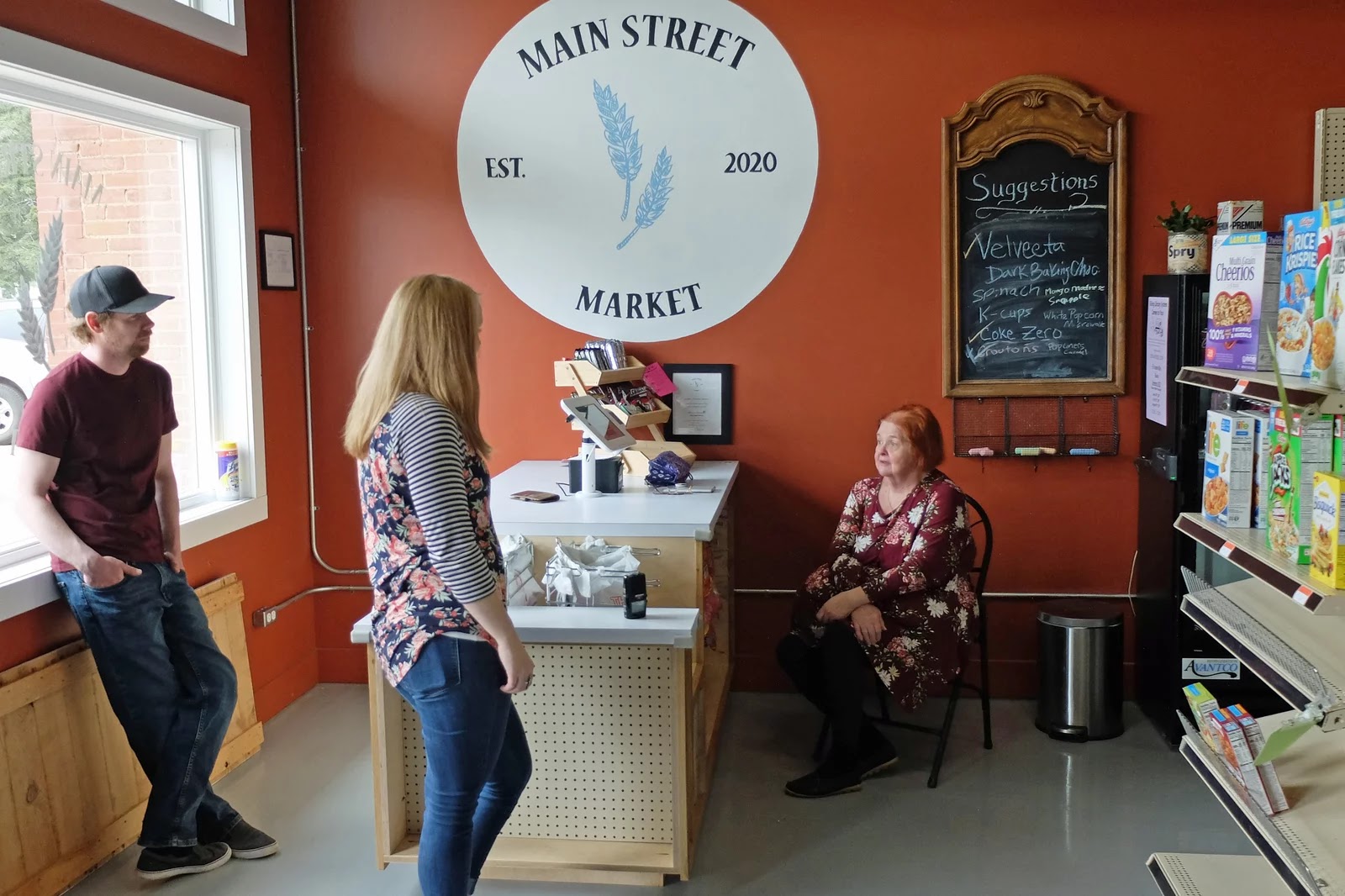
Self-serve grocery store in rural Minnesota town is a big hit

Owners Alex and Caileen Ostenson visit with a customer at their Main Street Market in Evansville, Minn. Customers of the self-serve establishment write suggestions on the chalk board for items they'd like to see on the shelves. (NPR photo)

Rural grocery stores continue to become scarcer, leaving many small-town residents without a nearby source of fresh, reasonably priced foods. Some towns have responded by opening cooperative groceries. Another innovative solution? The self-serve grocery store in Evansville, Minn., a community of about 600 two hours northwest of Minneapolis.

It's the brainchild of Alex and Caileen Ostenson, who moved from the Twin Cities five years ago to be
closer to family. The local grocery store closed just before they got to town, so locals had to go 20 miles away to get to the nearest supermarket, Dan Gunderson reports for NPR.

In 2020 the couple got some local donations and remodeled a vacant downtown storefront into the self-serve Main Street Market. "They believed the concept would save on staff costs, provide round the clock access, and convince the community to invest in a local grocery store," Gunderson reports.

Evansville, in Douglas County
(Wikipedia map)
It works like this: The store is manned three days a week, and anyone in town can shop there, but locals can also buy a $75 annual membership (or a shorter-term one) that allows them to access the store at any time. "Those members can use a phone app to open the door, scan grocery items and pay. There's also a key fob option and a scanner on a counter for those who aren't comfortable using their phone," Gunderson reports. "The technology logs everyone who comes to the store and tracks their purchases. The store also has security cameras, and theft has not been an issue, said Alex." The Ostensons hoped to sign up 50 members in the first year but got more than that in the first week.

The couple isn't taking a salary, but last year "Alex was awarded a fellowship through the West Central Initiative Foundation, and the accompanying $30,000 annual stipend allowed him to quit his full-time job to focus on developing and expanding the self-serve grocery model," Gunderson reports. "Alex has a vision for this concept. By next year he intends to be ready to open a second store in a nearby town, and he wants to create a way to share what he's learned, convincing others this idea can help a small town save or replace the local grocery store. . . . In rural communities, the self-serve concept could mean the difference between buying local groceries or driving miles to a regional center."

Monday, January 24, 2022

Practices of insurance companies, pharmacy benefit managers (middlemen) lead to closures of rural pharmacies

Rural residents depend on local pharmacies more than ever during the pandemic, seeking masks, home coronavirus tests and vaccinations. "But even with that increased business, retail pharmacies, big and small, are closing their doors ... straining small towns where options were already limited," April Ehrlich reports for NPR affiliate Oregon Public Broadcasting.

Two major factors are creating the trend, said Rick Chester, owner of Medicap Pharmacy in Talent, a town of 6,500 between the Cascades and the Coast Range near the California line. First, insurance companies are pushing people to get prescriptions by mail, taking business from already struggling rural pharmacies and, because of slower mail service, is often impractical for rural residents.

The other issue is profit-seeking policies from lightly regulated pharmacy benefit managers, the middlemen that stand between pharmacies and insurance companies. "Basically, when someone gets a prescription through an insurance or Medicare plan, the PBM is supposed to reimburse the pharmacy for the drug cost and some overhead. But in recent years, PBMs started decreasing the amount they reimburse when pharmacies don't meet certain sales markers," Ehrlich reports. "According to a report by the U.S. Centers for Medicare and Medicaid Services, PBMs have increased their fees for Medicare plans by more than 91,000% in the last two years. PBM reimbursements have gotten so low that sometimes pharmacies say they actually lose money when they fill prescriptions from certain insurers. And some pharmacies ... just can't make it work financially. The PBM Trade Association disputes that PBMs are the reason for rural pharmacy closures.

Some states, such as Kentucky, have cracked down on PBMs; one big one is owned by CVS Health, a pharmacy chain. Sen. Ron Wyden (D-Ore.) wants Congress to increase oversight of PBMs because he believes current laws are vague and inconsistent. "They can kind of decide, gee, we really weren't making enough money, but we'll say the pharmacy's inefficient and just throw some more costs at them," Wydeon told Ehrlich.

Meanwhile, rural residents are having a hard time getting pharmacy services, especially people with busy schedules or chronic illnesses. In Baker City, Ore., for example, one of the town's four pharmacies closed last year. The other three pharmacies are often overwhelmed now, with lines sometimes going out the door, Ehrlich reports. The lines are so long that some people bring dinner to eat in line, and store clerks bring out wheelchairs for old or sick people who can't stand in line for long.

Thursday, January 13, 2022

Rural America keeps gaining dollar stores, though some residents oppose them

Anderson's County Store in downtown Pittsgrove, N.J. (Philadelphia Inquirer photo by Alejandro Alvarez)

Dollar General Corp. is a rural juggernaut, with more than 18,000 stores in the United States. But some rural residents don't want its stores. Local organizers in Pittsgrove Township, N.J., have been fighting to keep a Dollar General from opening in the community of just under 9,000, Jason Nark reports for The Philadelphia Inquirer.

The town's organizing board recently gave Dollar General preliminary approval to open, but some residents say the store would be an eyesore. Nick Mesiano, a 27-year-old web developer, has spearheaded efforts to keep Pittsgrove retain its character. Last year he launched a website, Save Pittsgrove, that organized locals to successfully fight off a proposed industrial trash facility. He later used the site to rally opposition to Dollar General, but since the store's construction seems inevitable at this point, he's trying to at least make sure it fits in with the township's historic buildings.

Pittsgrove Township in Salem County
(Wikipedia map)

A Dollar General spokesperson said the stores fill a retail void in rural America, but there are two other Dollar General locations within five miles of the proposed store. It's also half a mile from Anderson's County Store, "a quintessential general store that dates back to the 1700s. The store features plank floors worn smooth over the centuries, hot coffee, and a deli that makes sandwiches, things you wouldn’t find at Dollar General," Nark reports. Dollar stores often hurt locally owned businesses.

Pittsgrover resident Erik Cagle told Nark he thinks Anderson's will thrive even though Dollar General offers cheaper merchandise. "I guess they’ve created a recipe for creating revenue," Cagle said of Dollar General, “but I think they might be underestimating the closeness of the community."

What's happening in Pittsgrove is happening all over rural America, as rural areas increasingly lose grocery stores and gain dollar stores and super centers. Recently published research from the Agriculture Department's Economic Research Service also found that "although single-location grocery stores outnumbered chains in 2015, they have been decreasing in share of food retailers," USDA reports.

"Results showed that of the 1,947 nonmetro counties in the contiguous United States, rural nonmetro counties had fewer of all five types of stores than large and small urban nonmetro counties. In 2015, there were 23 counties without food retailers of any type, and all of those were in rural nonmetro counties. Of the 44 counties with no grocery stores, 40 were rural nonmetro and 4 were urban nonmetro. There were 41 nonmetro counties with just one food retailer, and 115 with only one grocery store," according to the report. "Single-location grocery stores, as opposed to chain stores, made up a larger percentage of the grocery stores in rural counties than in nonmetro urban counties. In 2015, single-location grocery stores comprised about 82 percent of all food stores in rural counties, compared with about 70 percent in large urban nonmetro counties and 74 percent in small urban nonmetro counties."

Tuesday, September 21, 2021

'Sign war,' all in good fun, breaks out in Kentucky town as local businesses try to bring in more customers

A sign outside First United Bank and Trust Company
in Madisonville, Kentucky, pop. 20,000 (Photo provided)
Locally owned businesses—and at least one church—in Madisonville, Kentucky, population 20,000, are engaging in a goofy "sign war" to drum up more business and, hopefully, a few more smiles. 

The war consists of over-the-top sidewalk signs that often make fun of other businesses. "The war has been ongoing for over a week with no signs of slowing down. More than 70 businesses are partaking in the action," Christopher Leach reports for the Lexington Herald-Leader. "The Chamber of Commerce has served as the mediator for the war, sharing all the creative signs they see on their Facebook page. One of latest signs to be shared on the page came from Life Apostolic Church, which claimed its 'Sundays' were better than the sundaes offered at Dairy Queen."

Businesses report increased social-media traffic and profits since the sign war began. One local business owner told Leach the goal was to keep it going through the holidays. Click here for more examples.

Friday, April 02, 2021

Leading advocate of printed weekly newspapers says retailers are no longer their best source of ad revenue

Peter Wagner, still a believer in print
Iowa weekly newspaper publisher Peter Wagner, who has fought a rearguard action against the digital revolution and social-media advertising, knows the facts when he sees them.

"Publishers looking to reboot their markets following the pandemic need to recognize the retail sector is no longer their best revenue source," Wagner starts his latest column for state newspaper associations.

His object example is the late, lamented Warroad Pioneer of northern Minnesota, which died last year and was memorialized in The New York Times, The Rural Blog (including this commentary) and now Reader’s Digest. Wagner consulted publisher Rebecca Golden 21 years ago, and knows the market.

"Golden published a good paper. It was well written and nicely designed. But her dependence on retail advertising was her Achilles’ heel," Wagner writes, noting that many retailers depend on the area's tourist trade, the local grocery uses mass mailing and the car dealer's ads have gone mainly online.

Retailers "thought they didn’t need to advertise to locals they believed were already 'loyal' customers. Most didn’t understand how important a local paper is to holding a community together," Wagner writes. "All across America, newspapers and free-circulation publications are facing the same situation. Most national and regional chain stores, once a lucrative source of revenue, have deserted smaller communities. The small, local boutiques that replaced them are often poorly informed regarding the reach of digital advertising, too tightly financed to afford traditional advertising and are more of a hobby for the owner than a business."

Wagner reports that his rural markets in Northwest Iowa, "We’ve turned to the service providers, local manufacturing firms and once-overlooked professionals as fresh revenue sources. Locally owned banks and credit unions as well as full-service insurance agencies are good examples of service providers that continue to be excellent potential advertisers. Others include locally managed hospitals and medical facilities, home construction and sales organizations, privately owned colleges, universities and regional community colleges.

"The city itself, the local chamber of commerce, community celebrations and annual event organizations as well as the economic development director also are emerging sources for new advertising dollars. These are major-dollar advertisers who understand that the local newspaper is key to creating community and a spirit of consensus. Without a strong, united community those businesses have a limited future with a declining number of clients, students, employees and attendees. It also will lead to a diminishing tax base. These resources have the deep pockets and good reason to underwrite the future of their hometown paper."

Wagner maintains his proven belief in special projects and sections, and gives examples, saying they "have been well received and supported by local-minded businesses that appreciate sections that promote the history, fun and value of living in their town. . . . So, take a big breath and put a smile on your face. There continues to be a strong future for community papers. We simply need to direct our attention to the advertisers that believe in the community and the value of the hometown paper. It will require hard work and fresh thinking, but the survival of the printed paper is well worth the effort."