Showing posts with label farmers markets. Show all posts

Wednesday, September 20, 2023

National Farmer's Day is Oct. 12; recognizes U.S. farmers for the food and fiber they produce, and role in economy

National Farmer’s Day is Oct.12, a day set aside to honor and thank U.S. farmers who spend long days planning, fertilizing, plowing, planting and harvesting our food. While only 2% of our population are farmers, that 2% feeds America and countries far beyond its borders. Farmers’ contribution to the economy extends well beyond food --  farmers keep many other industries alive, including transportation, grocery services, pharmaceuticals, forestry and fisheries.

Paying tribute to your local farmer can be as simple as a personal thank you at your local orchard or farmers market, making a donation to your local Future Farmers of America chapter, or taking out a "Thank You" ad in your community newspaper.

Supporters of the event say where and how you shop can also help local farmers:

  • Buy fruits and vegetables from farmers markets. You may be able to meet the local farmers who grow your food while picking up the freshest produce, eggs, and meat. A farmers markets directory is here.
  • Visit pick-your-own farms. They offer everything from vegetables to apples to pumpkins. Pick-your-own flower farms are also popular in many towns. Find a pick-your-own farm in your area.
  • Consider joining a community-supported agriculture farm share next year. As a CSA member, you will receive a basket of freshly picked food every week for a true farm-to-table experience. Find a local CSA.
  • Look out for local small-town festivals. By attending everything from persimmon festivals to pawpaw festivals to garlic festivals, you’re supporting farming communities.

Monday, August 08, 2022

Farmers Market Week begins today; U.S. has over 8,000

This is National Farmers Market Week, an Agriculture Department celebration in its 23nd year.  

In his proclamation affirming the observation, Agriculture Secretary Tom Vilsack said the markets "continue to provide access to safe and nutritious food in the face of market disruptions while also shortening supply chains and reinforcing a competitive food system benefitting producers and consumers."

According to the 2019 National Farmers Market Managers survey, the U.S. has more than 8,000 farmers' markets.  Farm vendors benefit in a number of ways, including:

  • 67% increased overall production.
  • 33% increased the number of workers employed on the farm.
  • Nearly 40% were able to sell imperfect products that would otherwise go unsold.
  • 77% diversified the types of agricultural products they grew.
The Farmers Market Coalition has a toolkit and other resources with data you can use.

Friday, July 08, 2022

Quick hits: Gardening through a drought; Delta farmworkers claim discrimination; just how rural is your place?

Here's a roundup of stories with rural resonance; if you do or see similar work that should be shared on The Rural Blog, email us at heather.chapman@uky.edu.

Baby formula is coming back, but it's still harder to find in rural areas than cities. Read more here.

Here are tips for keeping your garden going during a drought. Read more here.

Demand for electric and hybrid-electric vehicles is growing faster in rural America than in metro areas (perhaps because there was more ground to make up). Ford is hoping its fully electric F-150 Lightning, comparably priced with its gasoline-powered cousin, will win over rural audiences. Read more here.

An investigation found that some farms in the Mississippi Delta paid their primarily Black local farmers less per hour than foreign workers with H-2A visas, who were most often white men from South Africa. Some Black farmworkers have filed suit, alleging racial discrimination. Read more here.

Determining just how rural a place is can be complicated, since federal agencies use different, often conflicting, definitions based on various criteria. The Rural Health Information Hub has an interesting interactive widget that allows you to see whether where you live is considered rural and by which federal standards. Read more here.

Farmers' markets have been around for a few millennia, and they continue to play an important role in communities today. Read more here.

Wednesday, April 06, 2022

New England subsidies help make community-supported agriculture programs accessible to low-income families

A CSA share from Red Fire Farm
(Photo submitted to The Daily Yonder)
Community-supported agriculture is a win-win for rural communities: Farmers get an extra avenue of income, and families who often live in food deserts can access fresh, local produce. But CSA programs typically require an up-front payment of several hundred dollars for the season, and low-income families often don't have the money. Some New England communities have innovative variations on CSAs that preserve the benefits to farmers while making the programs more accessible, Caroline Tremblay reports for The Daily Yonder.

For example, the Northeast Organic Farming Association operates twin Farm Share Programs in New Hampshire and Vermont, which aim to lower CSA costs for low-income residents. Initially funded by a grant, the New Hampshire program is now supported mainly through an annual fundraiser to which community partners contribute a portion of that day's sales, Tremblay reports. Such fundraising covers half the cost of the CSA for each low-income family, while the families themselves and participating organic farmers contribute the 25 percent each. Farmers are able to keep the same profit level because they solicit donations from other CSA members. NOFA has an Agriculture Department grant to establish similar programs in Connecticut, New York, New Jersey, and Rhode Island.

Red Fire Farm, which has two locations in Western Massachusetts, has a novel way of getting fresh organic produce to low-income families: since 2017 the farm has been a certified retailer for the USDA's Supplemental Nutrition Assistance Program, formerly known as food stamps. "It’s a streamlined structure to simplify the use of SNAP benefits that was launched by the Department of Transitional Assistance," Tremblay reports. Farms certified as SNAP CSA retailers don't need dedicated equipment to process payment, as they would if they were selling at a farmer's market. Instead, low-income CSA members send a form to DTA, then the monthly benefit funds are automatically sent directly to the farm each month.

Friday, August 06, 2021

Quick hits: plague chipmunks; farmers' markets importance; what ballads and science fiction tell us about Appalachia . . .

Adorable and, possibly, dangerous.
Alamy Stock Photo by Sam Judy
Here's a roundup of stories with rural resonance; if you do or see similar work that should be shared on The Rural Blog, email heather.chapman@uky.edu.

Hopefully not coming to a tree near you: the U.S. Forest Service has had to close several top hiking spots on Lake Tahoe because of chipmunks with the bubonic plague (most small-mammal infections are in the West.). A park ranger said wild rodents in the Sierra Nevada commonly carry the virus and advises people to keep their dogs on a leash. Read more here.

A small Black-majority town in Virginia is trying to keep a supermarket chain from building a warehouse there, worrying it could destroy the rural character of their town. Read more here.

To cap off National Farmers Market Week: The markets are growing in their role as essential sources of healthy food for the rich and poor, say two landscape architecture professors. Read more here.

What ballads and science fiction tell us about Appalachia's past, present and future. Read more here.

Rural communities should harness the once-in-a-generation windfall from the American Rescue Plan to invest in and improve school STEM programs, writes a rural education expert. Read more here.

The Agriculture Department is taking applications for loans and grants for rural start-ups, small businesses, non-profits, institutions of higher learning, and more. Read more here.

A new report provides a road map for expanding chestnut agri-forestry in the U.S. Read more here.

The Vera Institute of Justice is inviting applications for grants to rural organizations seeking alternative solutions to incarceration. Read more here.

Journalism chops and receptionist charm will get you a job and a home in West Virginia. Read more here.

Monday, August 02, 2021

National Farmers Market Week begins today

This is National Farmers Market Week, an Agriculture Department celebration in its 22nd year.  

In his proclamation affirming the observation, Agriculture Secretary Tom Vilsack noted that farmers' markets "serve as significant outlets for small-to-medium, new and beginning, socially disadvantaged, and veteran agricultural producers to market agricultural products, in turn generating revenue that supports the sustainability of family farms and the revitalization of rural communities nationwide."

According to the 2019 National Farmers Market Managers survey, there are more than 8,000 farmers markets in the U.S.  Farm vendors benefit in a number of ways, including:

  • 67% increased overall production.
  • 33% increased the number of workers employed on the farm.
  • Nearly 40% were able to sell imperfect products that would otherwise go unsold.
  • 77% diversified the types of agricultural products they grew.

A blog post from the USDA's Agricultural Marketing Service has links to farmers' markets data and programs meant to help them.

Tuesday, July 20, 2021

A portrait of one young farmer in drought-stricken California

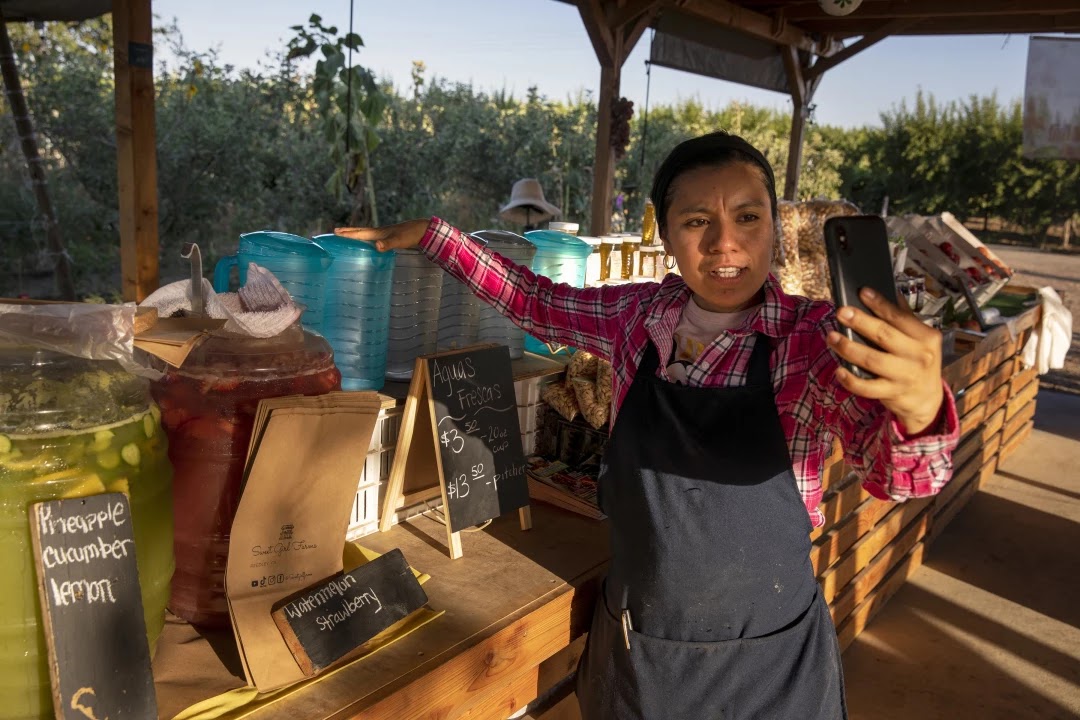
Liset Garcia posts an Instagram video announcing night hours at her farm stand. (LAT photo by Brian van der Brug)

In 2015, Diana Marcum won the Pulitzer Prize for narrative portraits of farm workers, farmers and others in California’s drought-stricken Central Valley. Here's her latest for The Los Angeles Times about how a young farmer outside of Fresno is coping with the drought.

Liset Garcia, 29, owns Sweet Girl Farms in Reedley, Calif., and things are tough right now. The house well went dry over a month ago, and drillers said there's a five-month wait to dig a new one—with no guarantee of success. "Her parents, who grew up in Oaxaca, told her the family would survive just fine without running water," Marcum reports. "At her parents’ farm, her father and brother pumped water from an agricultural well and hauled it down the street to fill a tank for household needs and Garcia’s small flower and vegetable farm."

Garcia, who grew up in L.A. and has a master's in public health, never expected to be a farmer, but after an accident a few years ago, she came home and took over her parents' farm stand, selling local flowers, fruits, vegetables and honey, Marcum reports. She keeps customers coming with a big smile, conveniently cooler night hours, and frequent updates on social media. Though the drought is worrisome and the hours are long, Garcia told Marcum that she finds peace in her work: "I sleep good at night. Every day I put my whole heart and soul into this and I leave it all here and then I can sleep."

Monday, August 10, 2020

Farms that sell locally doing better during pandemic than farms that depend on longer supply chains

"While farms that rely on other businesses to ferry their products to consumers have struggled, farms that sell directly to consumers have not, farmers and experts said," Marissa Plescia reports for the Midwest Center for Investigative Reporting. "The virus has upended supply chains: An Ohio Farm Bureau survey in April showed that about 45 percent of respondents experienced disruptions distributing their products. Dairy farmers dumped milk, and hog farmers euthanized piglets. But sellers in more local markets have, for the most part, been insulated, they said."

Many farmers are making the switch from wholesale to retail markets, according to Raghela Scavuzzo, associate director of food systems development at the Illinois Farm Bureau. "She’s also seen an increase in farms starting online stores and community supported agriculture, where consumers can become members of a farm, similar to becoming members of a grocery store, she said. There are also more partnerships between farms through vendor boxes, which combines products from several different farms into one package," Plescia reports.

Some corn and soybean farmers, who tend to rely more on long supply chains, are not faring so well, and that's on top of the pain already felt from the trade war with China and last year's record wet weather. Krista Swanson, a corn and soybean farmer in Illinois, told Pescia that there's only one planting season for soybeans in the spring, so she wasn't able to make big changes in her farm's production to respond to the market.

Monday, April 06, 2020

Agriculture supply chains weaker, shifting due to pandemic

The coronavirus pandemic has caused a massive shift in how agricultural producers get their products to consumers and has highlighted the weak links in the ag supply chain.

Many farmers are set up to sell their products to restaurants and other intermediaries, but the closure of restaurants nationwide "has left chefs and farmers with tons of produce and meat to dispose of in a hurry," Jesse Newman reports for The Wall Street Journal. Some restaurants are staying open and offering curb-side pickup, others are selling their supplies in open-air "farmer's markets" to consumers, and others are donating food that would otherwise spoil.

In March, the Food and Drug Administration "gave restaurants and manufacturers a greenlight to sell packaged foods to retailers without the usual nutrition labeling requirements," Ryan McCrimmon reports for Politico's Morning Agriculture. "Meanwhile, top grocers and foodservice distributors, like Kroger and Sysco, are teaming up to keep store shelves stocked and provide new job opportunities for furloughed workers."

Many producers, facing a sudden loss in demand for their products, are dumping out food to keep prices from going too low. For example, "a major vegetable producer that supplies restaurants such as Wendy’s Co. said plunging restaurant demand has spurred the company to plow under a few hundred acres of leafy greens in recent weeks," Newman reports. "The company, which also grows crops in Yuma, Ariz., and Salinas, Calif., has cut staff and reduced salaries for other employees. It is trying to collect money it is owed from distributors and determine whether it is eligible for federal assistance under the recent $2 trillion stimulus package."
Meanwhile, farmworkers have been declared "essential" workers by the federal government, even as many of them hide from Immigration and Customs Enforcement officials still arresting and deporting undocumented immigrants, Miriam Jordan reports for The New York Times.

Farmworkers and meatpackers are at an increased risk of contracting the virus, which could endanger the nation's food supply, Greg Asbed writes in an op-ed for the Times. Asbed, who founded the Coalition of Immokalee Workers, is a vocal proponent of farmer workers' rights. 

Thursday, December 12, 2019

Though new SNAP rules target able-bodied people without dependents, those with informal dependents could suffer

Changes to the Supplemental Nutrition Assistance Program could have a substantial ripple effect in a small town. In Letcher County, Kentucky, pop. 25,000, the new rules could cost up to 400 residents their SNAP benefits and could potentially affect their families, Sam Adams reports for The Mountain Eagle in Whitesburg, Ky. The piece is an excellent example of localizing a national story.

Letcher County, Kentucky (Wikipedia map)
The changes, set to take affect April 1, are expected to cost more than 3 million Americans their SNAP benefits. Rural areas could be disproportionately affected since rural households are more likely to use the program, formerly known as food stamps. In 2018, 85 of the 100 counties that relied most on SNAP were rural.

The changes have widespread support because they target able-bodied adults without dependents who are under 50 and don't work 20 hours a week. But many "ABAWDs" still have unofficial dependents, such as elderly parents, step-children, a spouse who's between jobs, or children who live with another parent, says Dustin Pugel, an analyst at the Kentucky Center for Economic Policy. "If you take SNAP away from one person, it affects the food budget for the entire family," he told Adams.

An article in The Atlantic affirms Pugel's observation on informal dependents, though in an urban setting. "The administration paints ABAWDs as a group of people who can justifiably be cut off from assistance because they ought to be working, Maggie Dickinson writes. "But taking people who are unemployed off SNAP often does harm to more than just those who directly receive food assistance. Many of these people share their benefits with their family and social networks, including children and elderly family members. The ripple effects of the planned cuts will hurt this larger group of people too."

Dickinson ran a hunger outreach program in New York City during the last recession; the city was one of the few places that enforced SNAP work requirements then, giving her an on-the-ground view of how ABAWDs often used their benefits. "I met lots of men who used their SNAP benefits to feed their children. Many of them lived with their kids, but many did not, and the government categorized this latter group as single adults without dependents," Dickinson writes. "Among the people I encountered, these men reported some of the most severe problems with hunger, because they used their meager benefits to fulfill family obligations that the welfare administration did not recognize."

In Letcher County, the impact of the changes is still unknown. Other state and local policies may help. The county has a waiver that lets it give benefits to people who qualify for other income-based benefits, and the local farmers' market allows SNAP recipients to buy up to $40 of food for $20 in SNAP money. "The market also participates in a 'Farmacy' program with Mountain Comprehensive Health Corp., through which people with certain illnesses who meet income requirements obtain vouchers from their doctors to buy fresh food at the farmers' market," Adams reports.

Friday, August 09, 2019

Rural California teen feathering his nest with egg business

Ayden Gartenlaub, 16, feeds his hens. (The Californian photo by Alex Horvath)
Many 16 year-olds have an after-school job, but Ayden Gartenlaub's is a little different. The teen, who lives on the outskirts of Bakersfield, California, has been running his own small business selling eggs for the past two years and is starting to see some big returns with Ayden's Eggs.

"The soon-to-be high school junior started his business two years ago as a freshman with 12 chickens and a few small coops on his school farm. Now he has 350 hens and is selling an average of 75 to 90 dozen eggs every Saturday at the East Hills Farmers Market in northeast Bakersfield," Steven Mayer reports for Bakersfield.com.

Ayden says the secret to his success is hard work, love for his chickens, and a better product. Grocery store eggs can be a month old before you buy them, but Ayden's are generally less than a week old. "I can definitely tell the difference. They're really good," customer Lori Clemmons told Mayer. Clemmons also said she likes supporting a young entrepreneur like Ayden who works so hard.

How hard does Ayden work? Every day, Ayden spends two hours a day feeding and watering his hens, gathering eggs and doing other related chores, and on Friday he spends five or six hours washing and packaging eggs (with help from his family). "Saturday is farmers market day, when the young farmer transforms into the salesman, engaging with customers, telling the story of why these eggs are not only white and brown, but robin's egg blue, light green, copper-colored and occasionally, even a blush-rose shade," Mayer reports.

When he's not chicken-wrangling, the young entrepreneur is an A-student who plays sousaphone in the marching band. He was once a defensive lineman for the football team at Highland High School, but gave it up to focus on his business. Amber Carter, a Future Farmers of America advisor and ag teacher at Highland, said Ayden's project was inspirational to other students. "A lot of students don't think they have anything to offer in ag. Ayden's project shows them what can be done," Carter told Mayer.

Monday, August 05, 2019

National Farmers Market Week runs through Saturday

Yesterday kicked off the 20th annual National Farmers Market Week. The celebration, which runs through August 10, is the brainchild of the U.S. Department of Agriculture and promoted by nationwide organization The Farmers Market Coalition.

This year's campaign highlights the important role farmers play in the nation's food system, and in fostering entrepreneurship.

"National Farmers Market Week is a chance to celebrate all that farmers markets do for communities," Farmers Market Coalition’s Executive Director Ben Feldman said in a press release. "This year we are focused on the role that farmers markets play in creating opportunities for entrepreneurs, particularly to those who may lack the capitol or connections necessary to start a more traditional business. Farmers market success stories include farms and businesses run by young people, immigrants, and the previously incarcerated. With low barriers to entry and a customer base that prioritizes the product over the packaging, farmers markets are the most democratic form of commerce around."

The campaign provides more than 8,600 farmers markets nationwide with tools, guides and materials to use in event promotion and community education. Members of the news media may also access a toolkit, webinars and other free resources

Monday, June 17, 2019

Wet weather leaves vegetable farmers in a tough spot

The historic flooding and rain in the Midwest has wreaked havoc on crops of all types, but vegetable farmers are in a particularly tough spot. Unlike corn and soybean farmers, vegetable growers don't get a piece of the $16 billion disaster aid package, and they can't get federally subsidized crop insurance.

"Although the lack of federal safety-net programs for farmers who grow everything from arugula to zucchini isn’t new, one of the wettest springs in U.S. history has focused attention on the special status of so-called commodity crops, primarily corn, soybeans, cotton, rice and wheat," Scott McFetridge reports for The Associated Press. "Growers of some of those crops received $11 billion in special aid last year and will get $16 billion more this year to offset losses caused by trade disputes that led to tariffs and resulting drops in demand."

Corn and soy growers are treated differently because their crops are commodities important to the national economy; most of the production is used for animal feed, ethanol and seed for future crops, and only 1 percent is for human consumption. "There isn’t a replacement for such crops, and a shortage would be painful, particularly to the livestock industry," McFetridge reports.

Consumers might rue the shortage of one at-risk crop come Thanksgiving: pumpkins. Farmers are about three weeks behind in planting because of the rain, but are sowing "from dawn to dusk and even during the night to catch up," according to Mohammad Babadoost, a professor at the University of Illinois and Urbana-Champaign. Jim Ackerman, agriculture manager for canned pumpkin giant Libby's, told McFetridge that the pumpkin crop should ripen in time and meet demand if the weather gets warmer and drier this summer.

Thursday, April 25, 2019

Apply for local food promotion program grants by June 18

This week the U.S. Department of Agriculture announced $23 million in competitive grant funding for programs that develop and expand local and regional food markets, businesses and producer-to-consumer marketing. The USDA release said, "Eligible applicants include agricultural businesses or cooperatives, producer networks or associations, community supported agriculture networks or associations, food councils, local governments, nonprofit corporations, public benefit corporations, economic development corporations, regional farmers market authorities, and tribal governments."

The Farmers Market Promotion Program and the Local Food Promotion Program were authorized in the 2018 Farm Bill under the Local Agricultural Marketing Program. The FMPP funds producer-to-consumer projects that go for three years and range from $50,000 to $500,000. The LFPP funds local and regional food business projects that go for 18 months or three years and range from $25,000 to $500,000. Both programs require matching funds equal to 25 percent of the total federal portion of the grant. Applications for both programs must be submitted electronically through www.grants.gov by 11:59 p.m. ET on June 18, 2019.

Friday, March 22, 2019

State cottage-food sales laws struggle to keep up with trend

Selling homemade food such as jams, baked goods and candies is a practice as old as civilization, but as the "eat local" movement gains in popularity, such "cottage-food" sales in the U.S. have increased from $5 billion annually in 2008 to a predicted $20 billion in 2019, Marsha Mercer reports for Stateline.

States have been trying to keep up with the trend by allowing cottage-food sellers to make their products at home rather than a commercial kitchen. State approval of a kitchen can be a time-consuming, expensive process that would put homemade-food sales out of reach for many, Mercer reports.

"Every state except New Jersey now allows home-kitchen cooks to make and sell non-hazardous foods with a low risk of causing foodborne illness such as baked goods, jams, jellies and other items that do not require time and temperature controls for food safety," Mercer reports. "Maine, North Dakota, Utah and Wyoming have gone further, enacting 'food freedom' laws that exempt home producers from food-safety rules that apply to grocery stores, restaurants and other food establishments."

Proponents of food-freedom laws see them as common-sense measures that preserve liberty with little risk, which the federal government seems willing to allow, to an extent: "when the Maine legislature passed a food sovereignty law in 2017 that allowed municipalities to set their own food-safety ordinances, the U.S. Department of Agriculture threatened to take over meat inspections in the state," Mercer reports. Meat inspections are required by federal law.

Thursday, April 26, 2018

New young farmers aiming to sell local produce at farmers markets; McConnell's push for hemp bill could help too

American small farms are in dire straights right now: more than 12,000 went out of business in 2017, net farm incomes have dropped 52 percent in the past five years, and bankruptcies are up 33 percent in the past two years. House Agriculture Committee Chairman Mike Conaway said last week at the Farm Bill markup that "two key universities informed us that two-thirds of the representative farms they use to model the economic conditions of agriculture are currently in marginal or poor financial condition," Doug McKelway and Kellieanne Jones report for Fox News.

But some farmers are finding hope in consumers' increasing desire to buy locally grown meat and produce. Thousands of young hopefuls, many who aren't from farming families, are going into farming with an emphasis in the kind of local, often organic product that people demand--coupled with modern social media savvy to market their products directly through farmer's markets or community supported agriculture programs.

"Congress is also intent on expanding opportunities for new young farmers," McKelway and Jones report. "One bill sponsored by Senate Majority Leader Mitch McConnell, The Hemp Farming Act of 2018, would remove industrial hemp, the non-psychoactive cousin of marijuana, from the Controlled Substances Act. With its soil replenishing qualities and uses in fabric, food, lotions, and anti-seizure oils, many farmers are convinced it's a potential replacement for a mostly bygone cash crop, tobacco."

New farmers are sorely needed in an industry where the average farmer is 58 years old and will retire soon. But the cost of land could deter aspiring farmers. Nearly 100 million acres of farmland is expected to change ownership over the next five years, so advocacy group The New Young Farmers Coalition say they hope Congress will do more to help young farmers afford land, McKelway and Jones report.

Monday, August 28, 2017

People in rural Nebraska (and probably other states) choose supermarkets over local groceries

Almost half of rural Nebraskans prefer to buy their groceries at supermarkets or big-box stores instead of local grocery stores, even in communities so small they don't have a supermarket, according to the 2017 Nebraska Rural Poll reported by Becky Vogt of the Institute of Agriculture and Natural Resources at the University of Nebraska-Lincoln.

There's little if any reason to believe that a similar trend is not playing out in rural areas all over the country, and could be problematic for small town economies. "This trend can be contributing to the decline of smaller towns. I don't know that we always think about the impact we are having on our local economies," says Vanessa Wielenga, Nebraska's assistant extension educator for food access and availability.

The poll also showed that rural Nebraskans liked the quality and selection they get from out-of-town supermarkets, and that's more of a priority to them than finding a store closer to home. It's not all bad news for rural food providers, though: 44 percent of those surveyed said they buy food from a farmers' market or community-supported agriculture, in which consumers sign up for regular deliveries from local farmers.

Monday, August 21, 2017

Virginia is the latest state to help military veterans promote their products with special logo

Virginia is the latest state where military veterans who are farmers can use a special logo to promote their products. The logo is a combination of the "Virginia Grown" label and the national "Homegrown by Heroes" logo. The state label has been used by farmers for 15 years to advertise locally-grown produce and products; the other logo "is the official farmer veteran brand image developed in 2013 by the national Farmer Veteran Coalition," reports the Bristol Herald Courier. Gov. Terry McAuliffe unveiled the joint logo July 26. Several states, including Arkansas and Kentucky, have also developed joint logos in the past few years.

Army Col. (Ret.) John Fant, a retired cattle rancher, is president of the new Virginia chapter of FVC. He says the logo may help encourage more young veterans to get started in farming. "From a food security perspective, the average age of a Virginia farmer is 58½ years. So as current farmers transition into retirement, we need to replace them," he says. "We think many veterans have the specific skill set to do that, and this marketing tool can help them. Anyone who’s ever sold something knows you can have a great product, but if you can’t sell, you won’t succeed."

Farmers who want to use the logo must be certified as former military personnel through FVC. The first training program for interested farmers will be Oct. 27 and 28 at Hudson Heritage Farms in Halifax County. For more information contact Rebekah Slabach of Virginia Cooperative Extension at rslabach@vt.edu or (434) 476-2147.

Monday, March 06, 2017

Industrial hemp produced in half of Kentucky's counties, farm interest increasing

There's a growing interest in industrial hemp production across Kentucky, drawing considerable crowd sizes to recent seminars in Christian, Clark and Shelby counties, Ryan Bowman reports The Farmer's Pride. Tom Keene, an agronomy specialist who focuses on hemp and forages for the University of Kentucky College of Agriculture, Food and Environment, told Bowman, "In 2016, according to Kentucky Department of Agriculture statistics, hemp was produced in 60 of the 120 counties and they pretty much stretched from east to west and north to south."

The meetings were put on by KDA, the Kentucky Hemp Industries Association, Kentucky Hemp Research Foundation and UK Cooperative Extension Service, Bowman writes. "Topics on the agenda included hemp marketing, hemp agronomics, the KDA’s Industrial Hemp Research Pilot Program and KDA policies."

Recent seminars in Kentucky on the basics of hemp production drew much interest.
(Farmstead Media photo)
Brent Burchett, director of the Kentucky Department of Agriculture’s Division of Value-Added Plant Production told Bowman, “We go through KDA’s rules, the hemp program operations, a little bit of the long-term aspects of the industry, some of the uncertainties we’re dealing with and some of the challenges of growing so fast, so quickly."

Prior to World War I, hemp was grown in Kentucky for products like rope and ship sail material, Bowman writes. "Following the second world war, availability of inexpensive synthetic fiber further discouraged the growth of the crop."

This year, KDA approved 12,800 acres for inclusion in the pilot program, up from 4,600 acres in 2016, Bowman writes. "Both Burchett and Keene stress that this is still a heavily regulated and monitored project. Not just anyone can go out and plant a field of hemp."

Industrial hemp is still on the same list as heroin, morphine, cocaine and other illicit drugs as a "one controlled substance," Burchett told Bowman. "It’s a serious undertaking to import seed and check it in with KDA before growers receive it. When planted, producers must submit the exact GPS coordinates for the crop," adding that 12,800 acres will have to be physically visited by KDA staff this year.

Thursday, June 23, 2016

Farmers markets aren't what they used to be

Photo: getrealmaine.com
Many growers who once earned a living selling fresh produce at farmers' markets have found it harder and harder to remain profitable as the culture at those markets changes.

Zach Lester, co-owner of Tree and Leaf Farm in Unionville, Va., has noticed a shift in recent years, especially at the Dupont Circle FreshFarm Market in Washington, where he once could expect to generate $200,000 or more a year in gross sales. “The customers have changed,” Lester told The Washington Post. “A lot of people that walk through markets are not shopping. They’re there to meet. They’re there to socialize.”

Such "customers" are there to eat and drink, not to buy produce, and they tend to be young. Lester says they hang out with friends, grab some pizza or booze and "window shop."

The change in market demographics, Lester says, has affected Tree and Leaf’s sales, which have plummeted by as much as $50,000 annually at the Dupont Cicle market compared with his peak years in the late 2000s and early 2010s.

The decline in sales is, arguably, one result of the contemporary farmers' market, which has evolved to meet the needs of a new generation of shoppers who view these urban markets as more a lifestyle choice than an opportunity to support local agriculture.

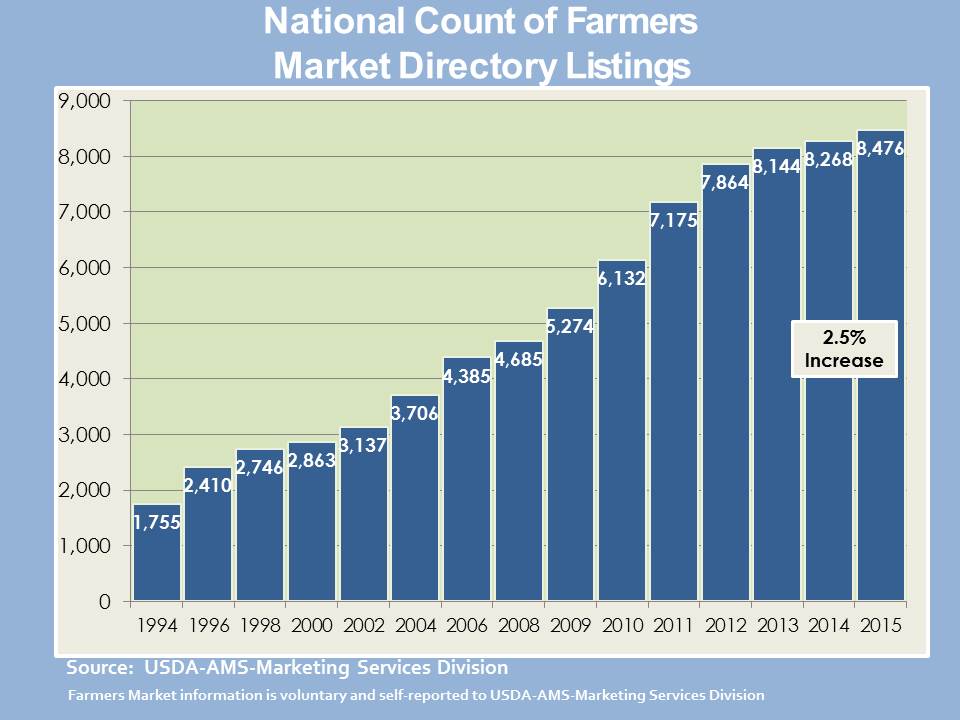
When farmers' markets first started springing up in the 1990s, local growers practically had the organic market to themselves. Now they face stiff competition from bricks-and-mortar retailers such as Glen’s Garden Market and Whole Foods, and from online delivery services such as Washington’s Green Grocer and AmazonFresh. As they increase in popularity, farmers markets have even begun competing with each other. The U.S. Department of Agriculture’s national directory lists 8,553 farmers' markets, almost double the 4,385 markets in 2006.

The markets have been forced to evolve. In Seattle, for example, organizers offer cooking demonstrations to show young techies how to prepare simple dishes with ingredients sold at the market. Organizers at other markets help prepare farmers for Good Agricultural Practices certification from the USDA. It’s a food-safety program that, once completed, allows growers to sell wholesale fruits and vegetables to retailers or restaurant chains.

But market managers say farmers must also help themselves if they want to survive and thrive in this new era. It’s not enough to show up at a market and expect consumers to buy all your fruits and vegetables. Farmers must be attuned to consumer demand and be better marketers and shopkeepers, even at their makeshift outdoor stands.