Showing posts with label carbon trading. Show all posts

Friday, February 13, 2026

Carbon credits create a way for farmers falling into debt to keep their land

Carbon credits can provide cattle farmers with a new
source of income. (Photo by Bernd Dittrich, Unsplash)
Farmers facing drought, inflation or labor shortages often sell their generational land rather than go into debt, reports Yusuf Khan of The Wall Street Journal. In some states, cattle producers are filling financial gaps by using regenerative farming techniques that generate farm income through carbon credit payments. 

Frates Seeligson, who farms outside of Nixon in south Texas, told Khan he has seen cash-strapped ranchers sell their land to developers rather than go into the red.

“If you look at the business model of agriculture it’s somewhat broken,” Seeligson told Khan. “It’s capital and labor intensive with a very small return, and then you’re subject to the whims of nature." Texas has been facing drought conditions in many regions since 2021.

To combat ranchers' ongoing financial struggles, a carbon credit developer Grassroots Carbon is paying cattle farmers like Seeligson to use regenerative agriculture techniques aimed at trapping carbon in their soil, Khan explains. Backed by companies like Microsoft, Nestle and Chevron, Grassroots sells carbon credits for between $40 and $65 per ton, which have a lifetime of 100 years. 

One of the techniques Grassroots promotes is rotational grazing to keep livestock from overgrazing, Khan explains. “Rotational grazing is a common practice in farming, but Grassroots suggests ranchers rotate more often, sometimes daily and on smaller properties, multiple times a day.” For example, Seeligson now uses 28 temporary pastures, as opposed to his previous nine permanent ones.

The benefits aren’t limited to just storing carbon, though, according to Allen Williams, a researcher and rancher studying regenerative agriculture. Healthier grasses also make for healthier herds, growing herd pregnancy rates. Additionally, a “1% increase in soil organic matter can help soils to hold up to roughly 20,000 additional gallons of water per acre, an important factor in avoiding flooding,” a study from 2021 shows.

Friday, December 20, 2024

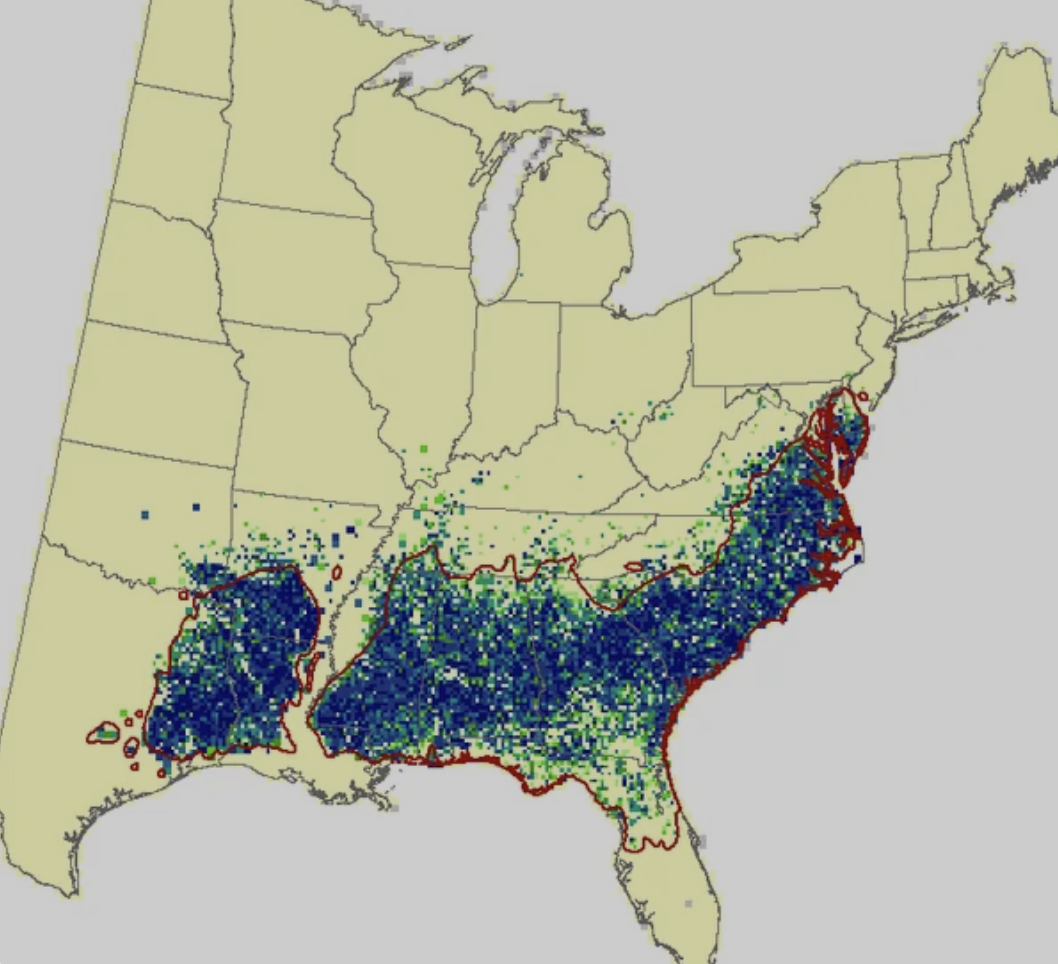
Southern timber owners could benefit from plan to create electricity and carbon credits by burning wood chips

The U.S. Pine Belt is filled with fast-growing Loblolly
pines. (Reddit map)
 
United Kingdom power producer Drax is scouting locations in America's Pine Belt to "build electricity generators fueled by burning wood chips," reports Ryan Dezember of The Wall Street Journal. "The plants’ exhaust will be piped underground instead of out of smokestacks, which generates lucrative carbon credits for which Drax is already lining up buyers." The company plans to sell its electricity to data center companies looking to fuel their artificial intelligence operations.

The plan could be an economic game changer for the U.S. South "where pulp and paper mills have closed and left timber growers without buyers for those trees unfit for making lumber or poles," Dezember explains. "Biomass power has long been dangled before Southern timberland owners as a potential solution to the glut of pine that has depressed prices and complicated harvests."

Drax's UK facility "burns pellets of compressed sawdust in a converted coal-fueled power plant," which fuels roughly 5% of the country's electricity. It already runs several U.S. pellet mills that fuel its UK operation, Dezember writes. The planned U.S. plant will be a BECCS, short for bioenergy with carbon capture and storage. The company plans to provide 24/7 renewable energy for AI data centers.

Drax is pinpointing locations that have all the elements it needs, which include a "confluence of carbon dioxide pipelines, pine plantations and a short wait to connect to the grid," Dezember reports. "It has options on properties and expects to announce a location for the first plant in 2025."

The company has sought timber managers who will manage forests without stressing their ecosystems, and it "plans to buy wood only from properties managed for timber production, not old-growth stands," Dezember explains. "Nor will the plants need the wood to be ground down to dust and pressed into pellets, which are made to facilitate ocean shipping. The U.S. power plants will only need the wood chipped into small pieces."

Monday, August 29, 2022

Carbon market opening up for smaller forest landowmners

Forester Sarah Hall-Bagdonas talks with Sara Velazquez and Dan
Nelson. (Reuters photo by Carey Biron via The Daily Yonder)
Major rural landowners and philanthropies such as The Nature Conservancy are active players in the carbon market, which pays them for not cutting trees, which use carbon dioxide, the leading greenhouse gas. That's been more difficult for small landowners, but now the American Forest Foundation has a landowners with as little as 30 acres, and such programs are likely to be boosted by the climate bill recently signed by President Biden, reports Carey Biron for the Thomson Reuters Foundation.

Two landowners in the Family Forest Carbon Program are Sara Velasquez and Dan Nelson, who bought 55 acres of forest in northeast Pennsylvania to build their home. "Just after they purchased the land in 2019, however, the pandemic forced them both out of work, raising concerns about how to pay the annual taxes on the land," Biron reports. Neighbors who see logging as "free money up in the woods" asked them about that, but "Now they think they have found a different solution."

The credits that Velasquez and Nelson get under a 20-year contract for preventing "climate-changing emissions will in turn be sold to help corporations such as outdoor outfitter REI move toward their 'net zero' emissions goals," Biron writes. "Velazquez and Nelson, in turn, receive cash that helps them cover their tax payments, plan for revitalizing the forest and, for now, stay away from logging."

Private companies are also in the game. "NCX, which uses satellite imagery and artificial intelligence to gauge carbon-storage potential on small land holdings. It then sells carbon credits," Biron reports. "Since last year, the company has enrolled nearly 2,500 U.S. landowners who hold over 4 million acres, with a median size of around 200 to 400 acres per landowner, it said."

The climate bill has "$450 million to push private landowners toward forest-management practices with climate benefits, according to the nonprofit American Forests. The bill includes a particular focus on underserved communities and family forest owners," Biron notes.