Showing posts with label renewable energy. Show all posts

Tuesday, April 28, 2026

Rural communities battle over massive solar installations on privately owned farmland

Massive solar installations have some rural communities
in an uproar. (Photo by Andres Siimon, Unsplash)
Some farmers believe leasing crop land for solar panel installations is a way to secure a steady income in a profession marked by unpredictability. But other farmers, landowners and community members see long stretches of solar panels on rich farmland as a wasteful tragedy worth fighting over.

In Richland, Michigan, more than 2,200 acres of farmland were leased to Consumers Energy by Liberty Farms without a word of input from the community, writes Chris Bennett of Farm Journal. But once neighbors were informed, an uproar ensued, and many community members are actively working to prevent the project from moving forward.

Kate Smit's farm sits adjacent to the land Liberty Farms leased to Consumers for its 461,000-solar-panel installation. She told Bennett, "We want to stall the Consumers’ solar project until we can get a bill passed in our state senate, so that townships and counties have to vote if a solar panel company wants in." 

Smit told Farm Journal that she believes that massive solar leases like the one she's fighting in Kalamazoo County are happening all over Michigan and the Midwest.

Bill Peter, who lives two miles from Smit, doesn't consider solar installations to be earth-friendly. He told Bennett, "There’s nothing green about this green energy. I’m not sitting quietly while 450,000 solar panels permanently replace the best farm soil around.”

For many residents in rural communities, resistance to industrial solar installations persists, despite their strong beliefs in private property rights. Ed Yelton, a cattle producer in Dearborn County, Indiana, said solar and AI data center projects belong in a separate category.

Consumers' proposed installation in Richland isn't a done deal yet. Bennett explains, "The Richland Township planning commission has not yet approved Consumer Energy’s application."

Tuesday, July 29, 2025

Opinion: As the Trump administration puts the brakes on clean energy support, many rural farmers will feel the loss

Solar panels can help cut energy costs for farm operations like dairies. 
(Photo by S. Patrick, Portland Herald, Getty via The Conversation CC)
Wind and solar power add grid support and help farmers maintain steady incomes when weather, bugs or market upheavals make farming less profitable. Particularly for rural communities, taxes generated by renewable energy help local budgets pay for schools, roads and health care. "But some of that opportunity is now at risk as the Trump administration cuts federal support for renewable energy," writes Paul Mwebaze in his opinion for The Conversation.

In areas with wind turbines, farmers lease their land in return for payments. "Those historically were around $3,000 to $5,000 per turbine per year, with some modern agreements $5,000 to $10,000 annually, secured through 20- to 30-year contracts," Mwebaze explains. Roughly a third of the $3.5 billion paid out on wind turbine leases goes to rural landowners.

Solar energy adds to a farmer's bottom line by providing cheaper electricity throughout an agricultural operation. "Farmers use rooftop panels on barns and ground-mounted systems to power irrigation pumps, grain dryers and cold storage facilities, cutting their power costs," Mwebaze writes. 

In some rural communities, renewable energy is the "largest new source of economic activity, helping stabilize local economies otherwise reliant on agriculture’s unpredictable income streams," Mwebaze adds. The Iowa turbine blade factory, TPI Composites, serves as an example of how clean energy stimulates rural manufacturing. TPI "just reopened its plant in Newton, Iowa. Tax benefits in the 2022 Inflation Reduction Act helped boost [the industry] and the jobs and local tax revenue they bring in."

The Trump administration has "rolled back many clean energy incentives. It phased down tax credits for distributed solar projects, particularly those under 1 megawatt, which include many farm‑scale installations, and sunsets them entirely by 2028," Mwebaze explains. "It also eliminates bonus credits that previously supported rural and low‑income areas."

Renewable energy is one way the federal government could continue to invest in rural America, providing energy for communities and generating a reliable income source for farmers and smaller municipal budgets. "I believe homegrown renewable energy offers a practical path forward," Mwebaze writes. "Wind and solar aren’t just fueling the grid; they’re helping keep farms and rural towns alive."

Tuesday, February 11, 2025

Some coal plants won't retire as planned, but dependence on the fossil fuel continues to decline

The Dave Johnson Mine in Glenrock, Wyo.  (Wyoming DOQ photo)
Coal's reign as king of American energy is over, but the fossil fuel still supplies about 15% of the U.S. energy grid, with some companies reversing plant retirement plans, report Austyn Gaffney and Mira Rojanasakul of The New York Times. "Utilities have extended the life of nearly a third of coal units with planned retirement dates, either through delays or by reversing course and canceling retirements entirely, between 2017 and today."

The need to power energy-hungry AI and government policy changes may explain some coal's extended life. According to Gaffney and Rojanasakul, "Utilities could be taking advantage of growth in energy demand and changes in environmental regulations to keep these plants operating."

Although recent studies show running and repairing old coal plants is more expensive than the price of building renewable stations, some utilities insist keeping them open is a needed temporary solution. The Times reports, "Utilities argue they need to keep coal units on the grid while they build out new sources of energy. . . . They’ve predicted a 20 percent increase in electricity demand by 2035."

Some energy experts point to renewables' ability to meet increased grid needs. Gaffney and Rojanasakul write, "Renewables could exceed the increase in power demand. . . . Since 2019, U.S. generation from wind and solar exceeded the growth in power demand by almost 100 million megawatt-hours. In 2024, renewables out-generated coal for more than 80% of the year."

As the energy sector diversifies, coal's continued decline seems inevitable. The Times reports, "Even the units that are kept open will continue to decline in capacity as more planned gas, nuclear, and renewables enter the grid. Seth Feaster, a data analyst at the Institute for Energy Economics and Financial Analysis, told the Times, "They’ll keep those units open to keep their options open, but it doesn’t mean they’re going to be used very much. . . . They’re just not competitive."

Friday, December 20, 2024

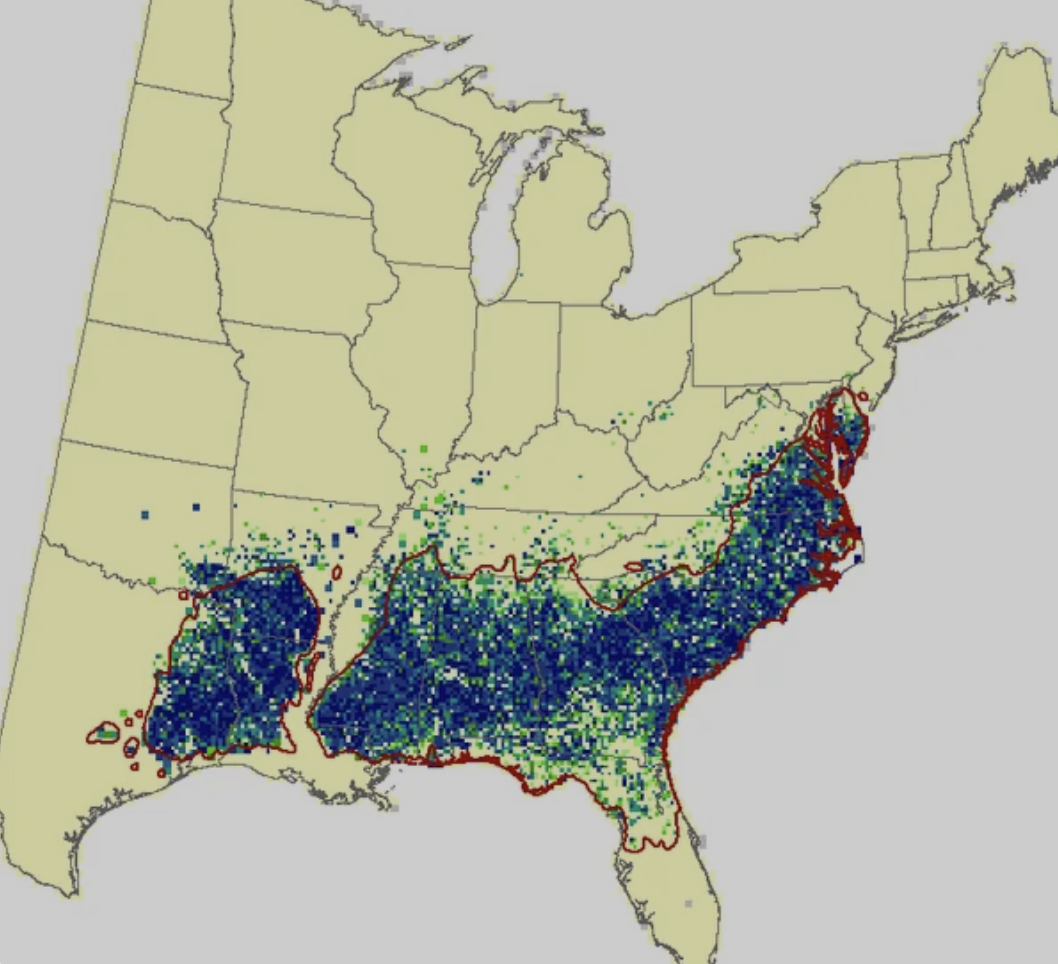
Southern timber owners could benefit from plan to create electricity and carbon credits by burning wood chips

The U.S. Pine Belt is filled with fast-growing Loblolly
pines. (Reddit map)
 
United Kingdom power producer Drax is scouting locations in America's Pine Belt to "build electricity generators fueled by burning wood chips," reports Ryan Dezember of The Wall Street Journal. "The plants’ exhaust will be piped underground instead of out of smokestacks, which generates lucrative carbon credits for which Drax is already lining up buyers." The company plans to sell its electricity to data center companies looking to fuel their artificial intelligence operations.

The plan could be an economic game changer for the U.S. South "where pulp and paper mills have closed and left timber growers without buyers for those trees unfit for making lumber or poles," Dezember explains. "Biomass power has long been dangled before Southern timberland owners as a potential solution to the glut of pine that has depressed prices and complicated harvests."

Drax's UK facility "burns pellets of compressed sawdust in a converted coal-fueled power plant," which fuels roughly 5% of the country's electricity. It already runs several U.S. pellet mills that fuel its UK operation, Dezember writes. The planned U.S. plant will be a BECCS, short for bioenergy with carbon capture and storage. The company plans to provide 24/7 renewable energy for AI data centers.

Drax is pinpointing locations that have all the elements it needs, which include a "confluence of carbon dioxide pipelines, pine plantations and a short wait to connect to the grid," Dezember reports. "It has options on properties and expects to announce a location for the first plant in 2025."

The company has sought timber managers who will manage forests without stressing their ecosystems, and it "plans to buy wood only from properties managed for timber production, not old-growth stands," Dezember explains. "Nor will the plants need the wood to be ground down to dust and pressed into pellets, which are made to facilitate ocean shipping. The U.S. power plants will only need the wood chipped into small pieces."

Tuesday, September 24, 2024

Renewables helped some states breeze through this summer's punishing heat and energy demands

Renewable energy has helped some states meet
or exceed energy needs. (Adobe Stock photo)
This summer's extreme heat forced energy operators to rely on solar and wind electricity to keep the U.S. grid humming, even as Americans "cranked their air conditioning," report Katherine Blunt and Jennifer Hiller of The Wall Street Journal. "Extreme heat pushed electricity demand to new highs . . . . States such as California and Texas that in recent years have bet big on renewable energy and battery storage easily met electricity demand."

California and Texas residents in some areas had "experienced rolling blackouts in 2020 and 2021, respectively. In 2022, grid operators in both states called on residents to conserve electricity during extremely hot weather and almost resorted to rolling blackouts as supply margins shrank," the Journal reports. "Since then, California. . . has built one of the world’s largest fleets of batteries that store solar power during the day and discharge it in the evening. Texas, meanwhile, now rivals California in storage capacity."

Even during this summer's extreme heat, the flow of energy in California was markedly different. "As extreme heat blanketed much of the West this summer, regional power demand reached a record high of nearly 168,000 megawatts on July 10," Blunt and Hiller explain. "Yet California, which has historically imported large amounts of electricity from other states during heat waves, had surplus to send elsewhere. . . . Temperatures also surged in Texas, [where] there was plenty of solar to meet peak demand around 4 p.m. to 5 p.m., and adequate wind power in the evening."

States that don't yet house the energy storage of Texas or California have tighter margins to manage. "Lanny Nickell, chief operating officer of the Southwest Power Pool, which operates part of the grid and a regional power market stretching from the Texas Panhandle to North Dakota, said his organization this summer had its smallest-ever seasonal cushion of electricity reserves," the Journal reports. "He said it is working to encourage investments in a range of new resources, as well as new means of importing power from other areas when supplies are tight."

Tuesday, September 17, 2024

Rural co-ops are slated for a $7.3B federal cash infusion to help them shift from coal to cleaner energy

Map indicating the wide geographic reach of the co-ops awarded funding.
(Map by Jeremy Fisher, Sierra Club Law)

Creating cleaner energy sources for communities in the more remote parts of the United States means helping rural co-ops afford the switch from coal to renewables. To help make the change possible, the Biden Administration "announced $7.3 billion in financing for 16 rural co-ops serving about 5 million households across 23 states, reports Jeff St. John of Canary Media. The Department of Agriculture will manage the funds, which "will also be matched by more than $29 billion in private investments."

The $7.3 billion infusion won't all go toward moving sparsely populated areas to renewables. Instead, some of it will cover the costs of closing coal plants, which are a "particularly thorny financial challenge for co-ops, which can’t raise financing the same way that investor-owned utilities can," St. John explains. For the Tri-State Generation and Transmission Association, [the funds] "will help accelerate the closing of 1,100 MW of coal-fired generation in Arizona, Colorado, and New Mexico."

The federal assistance means more rural cooperatives can afford to drastically shrink their energy reliance on coal. St. John reports, "A 2023 analysis by researchers at the Sierra Club, Energy Innovation, and the Department of Energy found that federal funding could help co-ops secure enough wind, solar, and battery resources to retire their entire coal capacity by 2032. . . . That would be a huge shift."

Much of the federal money deal-making is still in process. Of the 16 awards announced last week, "only one has been finalized by USDA — nearly $573 million to Dairyland Power Cooperative, which serves 24 distribution cooperatives and 27 municipal utilities in Wisconsin, Illinois, Iowa, and Minnesota. . . . Dairyland will use the funding to back a total investment of $2.1 billion to build and contract for 1,080 megawatts of clean power."

Tuesday, September 10, 2024

'On the Front Porch' conversation will explore rural clean energy transitions and how communities can benefit

Tony Pipa and Sarah Mills will discuss energy transitions
in rural America. (Brookings photos)
"On the Front Porch" host Tony Pipa will discuss the ways, means and challenges of energy transitions in rural America with Sarah Mills, an energy policy and land-use expert from the University of Michigan. The event is on Sept. 18 at 4 p.m., E.T. Register here to watch online.

To take an "on the ground look" at rural energy decisions in action, Pipa and Mills will examine the benefits and pitfalls of a wind farming venture led by a small group of farmers in rural Michigan. Their conversation also will examine:

  • The centrality of rural America in the country's transition to clean energy
  • Trade-offs rural communities face when considering energy projects
  • How community-centered approaches can help rural places maximize the community and economic development benefits

This event is a part of Election ’24: Issues at Stake, a Brookings initiative aimed to bring public attention to consequential policy issues confronting voters and policymakers in the run-up to the 2024 election.

Earlier conversations from On the Front Porch can be found here.  

Tuesday, September 03, 2024

In a global first, a nuclear power plant in tiny Covert Township, Michigan, will be restarted to produce energy

Holtec Palisades is an 800-megawatt facility that is being prepared for a second chance.
(Holtec Palisades photo)

Covert Township, Michigan, has a way to make more green electricity than most small towns could ever dream up. The quiet community of 2,510 people is home to the Palisades Nuclear Generating Plant, which was closed in 2022, but has been given the green light to reopen, reports Eric Niiler of The Wall Street Journal. "When it reopens, Palisades will become the first decommissioned nuclear plant anywhere to be put back to work."

The Palisades Nuclear plant may look like a 1970s relic, but the federal government and the state of Michigan are working together to finance the reactor's second life. The reasons to reignite the plant are simple: "Soaring demand . . . and billions on offer in state and federal loans and tax subsidies for nuclear energy in infrastructure and green power investment programs, "Niiler explains. "Nuclear-produced electricity is also seen as more consistent than wind or solar."

Wikipedia map
The residents of Covert and surrounding areas have had mixed responses to reopening plans. "Beyond Nuclear filed a petition last week asking the federal Nuclear Regulatory Commission for a hearing to make their case against the restart of the plant," reports Dustin Dwyer of Michigan Public Radio. "Despite the opposition. . . The plan to restart Palisades has gotten broad support from local leaders. . . .The Covert Township board passed a resolution supporting the restart, and so has the city council in nearby South Haven."

Meanwhile, the company in charge of the Palisades' return to power, Holtec, has "experience only in decommissioning nuclear reactors. Restarting and operating Palisades would be its first such job," Niiler reports. Adam Eastridge, a senior operations manager for Holtec, told Niiler, "Being the first to restart a decommissioned nuclear plant, everybody is looking at us. We don’t let that distract us.”

Friday, August 30, 2024

In a first, the Conservative Energy Network hosts a national conference to promote 'eco-right' agenda

Participants at this year's Conservative Energy Summit.
(CEN photo via USA Today)
These "going green" supporters aren't touting climate change as their reason for supporting renewable energy. Instead, they are making a case for solar, wind and nuclear power because they believe those energy sources will help make and save Americans money, reports Elizabeth Weise of USA Today. "Conservative voices have never been absent from discussions around clean energy, but the Conservative Energy Network is part of a new 'eco-right' that's emerged."

The CEN sponsored the Conservative Energy Summit in Houston, Texas, this month, which was the first time "it brought together more than 200 people from around the country to discuss how best to champion energy sources they believe will restore American energy leadership, save people money, create jobs and secure the power grid," Weise explains. "That doesn't necessarily mean believing in climate change, speakers said. Anyone who supports free markets can see that cheap, renewable energy is the future."

Pat Wood of the Hunt Energy Network in Dallas told Weise, "We need to get the politics out of the energy business." Weise reports, "Speaker after speaker argued that free market competition, consumer choice, private property rights and cutting government overregulation are fundamentally Republican values. If those principles prevail, clean energy will thrive in the U.S., they believe."

Marshall Conrad, vice president of government relations at Strata Clean Energy in North Carolina, told Weise, "In rural, red areas, we’ve got to repudiate the feeling that Democrats are trying to force clean energy projects down our throats." Weise adds, "The Conservative Energy Network came into existence to help provide an alternative view of renewable energy at the state and county level."

Some of the CEN and its offshoots efforts include "championing the property rights of farmers and ranchers to build solar or wind on their property, fighting over-regulation and getting power projects built that bring significant revenue to rural communities without raising taxes, said Bradley Pischea, national director of the Land & Liberty Coalition," Weise explains. "They also spend a lot of time fighting misinformation about new kinds of energy."

Friday, July 26, 2024

Rural Nevada leaders seek a voice in massive energy builds, but almost 80% of their land is federally managed

Across western federal lands, some renewable energy expansion is going at such a frenetic pace that rural county officials in Nevada can't keep up with the requests, reports Jeniffer Solis of the Nevada Current. "Several rural counties are now asking state lawmakers to establish a policy requiring federal agencies to coordinate all their land use planning and management decisions with state and county governments when considering massive utility-scale energy projects. . . . As of June, there are over 130 pending applications to build renewable energy projects across Nevada’s public lands. Most of those projects are in rural counties, where as much as 80% of land is federally managed."

NV Energy photo
Currently, Nevada lacks a statewide utility-scale solar plan, which exacerbates the problem for local governments.  In fact, county officials from Eureka and Lander County told state lawmakers that managing the sheer number of clean energy projects coming to their offices isn't workable because they lack staff and management capacity. Solis writes. "Rural governments told lawmakers that the intensity and scale of utility-scale energy proposals they are seeing in their counties will require targeted state policy to support and protect rural economies."

Eureka and Lander County lands are included in the "proposed Greenlink North Transmission Project — a 235-mile transmission line along Highway 50, which is expected to attract more solar projects in the coming years," Solis explains. And while the project is expected to bring thousands of good-paying jobs to the state, county officials want their offices and residents to have a say in local installations and time to prepare for the profound changes the builds are sure to bring.

Eureka County’s natural resources manager, Jake Tibbitts, "proposed amending state policy to clarify that federal agencies are expected to enter formal agreements with local governments in Nevada when considering projects on public land in their county," Solis reports. "Under the proposed amendment, those agreements would need to include a detailed coordination plan. . .especially when addressing conflicts between local land use plans and federal plans."

Solis adds, "But like Nevada as a whole, land in Eureka County is largely administered by the Bureau of Land Management and the Forest Service, leaving the county at the whims of federal land use policy."

Tuesday, June 25, 2024

Large rural cooperative is adding solar projects in Colorado in an effort to expand 'cleaner power' options

Tri-State service territory in blue (Tri-State photo)
Once a stalwart provider of coal-powered energy, Tri-State Generation and Transmission Association will purchase Axial Basin Solar, a 145-megawatt project in Moffat County, Colorado, and Dolores Canyon Solar, a 110-​megawatt project in Dolores County, Colorado, reports Julian Spector of Canary Media. The acquisitions are part of the company's new commitment to providing cleaner energy to its "massive western service territory."

Tri-State is one of the largest rural cooperative utilities in the United States, and it provides power to customers in Colorado, New Mexico, Wyoming and Nebraska. "The customer base spans 200,000 square miles, more land than the entirety of California," Spector writes. "Just a few years ago, two member cooperatives quit Tri-State to seek cheaper, cleaner power elsewhere. Since then, Tri-State has rolled out a series of clean energy commitments."

Benefit changes within the Inflation Reduction Act have made switching to renewable energy more financially doable for cooperatives. Spector explains, "Chief among them is a ​'direct pay' option that lets nonprofits access the same generous clean energy tax credits as their for-profit peers — even with little to no tax burden. Once Tri-State’s leadership saw clarity on the tax rules, they decided this was the time to strike."

Tri-State is working to provide a balance of energy that will be dependable, affordable and as clean as safely possible. "Now the utility sees ample savings and benefits for its customers in maximizing low-cost renewable generation while ensuring it has enough ​'firm' power — today provided by coal and fossil gas plants — to keep the lights on," Spector reports. "The utility recently hit a new record for instantaneous renewable production on May 24, when wind and solar delivered 87% of its generation for half an hour."

Tuesday, May 14, 2024

An aluminum smelter hasn't been built in the U.S. in 45 years; proposed sites are in Kentucky and Ohio

Smelting furnaces in an aluminum plant
(Adobe Stock photo)

Aluminum is versatile, abundant and light, and it is in hundreds of commercial items, including appliances, zippers, golf clubs and indoor furniture. Despite its excellent manufacturing properties, the raw material has production drawbacks — its smelters use loads of electricity and the fossil fuels used to create that electricity harm the environment, reports Maddie Stone of Grist. However, in the United States, the way aluminum is made may soon change. Century Aluminum Company, a global aluminum producer, is negotiating with the Department of Energy for up to $500 million in grant money to build a new aluminum smelter.

Promoted as the "green aluminum smelter," the facility would be "the nation's first new aluminum smelter in 45 years, which could double the amount of virgin, or primary, aluminum the country produces while emitting 75% less CO2 than older smelters, thanks to increased efficiency and the use of renewable electricity," Stone writes. "The grant, which is awaiting finalization, is a 'huge vote of confidence and a shot in the arm' for the industry, said Annie Sartor, the aluminum campaign director at Industrious Labs, a nonprofit focused on industrial decarbonization."

Protecting the environment while supplying the U.S. with tons more aluminum means the production process matters for aluminum, which requires extreme amounts of electricity. Rebecca Dell, an industrial decarbonization expert with the nonprofit ClimateWorks, told Stone, "We're talking about truly eye-watering amounts of electricity. . . . The first, most important thing to do is to use clean electricity."

Creating a climate-friendly smelter means Century Aluminum must find a site to support its clean energy demands. "According to the DOE, Century Aluminum's preferred site is in Kentucky, a state with lackluster clean energy credentials," Stone writes. "Sartor says she expects a plant of this size to require 'somewhere in the neighborhood of a gigawatt' of power.'" Sartor added, "The only way that will happen is if gargantuan amounts of clean energy get built in Kentucky. . . . There's no other way around this."

While Kentucky is the favored location, Century Aluminum hasn't decided. "Locations within the Ohio and Mississippi River basins are also reportedly under consideration," Stone reports. "Dell believes that brings an interesting political dimension to the project because Century Aluminum expects the smelter to create more than 1,000 full-time union jobs and another 5,500 construction jobs."

Tuesday, April 30, 2024

Union leader for mine workers says new EPA rule will put 'a nail in the coffin for coal mining'; critics vow to fight it

Cecil Roberts
A new rule by the Environmental Protection Agency could leave thousands of mine workers unemployed, say critics who have vowed to fight the change. "United Mine Workers President Cecil Roberts contends newly-final federal rules on power plants represent a nail in the coffin for coal mining," reports Brad McElhinny of MetroNews, which serves West Virginia. "Under the EPA rule, coal plants that plan to stay open beyond 2039 would have to cut or capture 90% of their carbon dioxide emissions by 2032."

Roberts told McElhinny, "At first glance, however, this rule looks to set the funeral date for thermal coal mining in America for 2032 – just seven and a half years away – along with the hundreds of thousands of jobs that are directly and indirectly associated with it." McElhinney reports, "EPA's rules come under the Clean Air Act, Clean Water Act, and Resource Conservation and Recovery Act. EPA described the announcement as providing regulatory certainty as the power sector makes long-term investments in the transition to a clean energy economy."

As the EPA pushes for renewable energy, people like Roberts are skeptical that the investments and technology are ready for transition. "Roberts expressed doubt that technological innovations like carbon capture and storage are truly feasible or affordable as a way of continuing to use fossil fuels," McElhinny writes. Roberts said, "Since we don't have the technology, it looks to us as if 2032, if this rule stands as us, coal power plants couldn't operate after 2032."

The region will face more joblessness and poverty without new jobs provided through energy investments into new technology. Robert told McElhinny: "I'm not trying to pick a fight with anybody, but I'm not going to mislead anybody either. Part of the understanding was there would be jobs come to Appalachia — anywhere coal is currently being mined where power plants might close, coal mines might close — there would be good-paying union jobs to take their place. That has not happened."

Several West Virginia lawmakers and leaders have vowed to work against the new rule, including U.S. Sen.  Shelley Moore Capito, ranking member of the Senate's Environment and Public Works Committee, U.S. Sen. Joe Manchin and West Virginia Attorney General Patrick Morrisey.

When smartly planned, windfarms can be adaptable, efficient and incorporate crops, a new study says

Wind turbines take up only 5% of the land.
(Adobe Stock photo)
Instead of hogging up large expanses of usable land, wind farms can "grow" among crops or infrastructure needs. "The huge structures topped with massive rotating blades only take up five percent of the land where they've been built," reports Allyson Chiu of The Washington Post. "The rest of the space can be used for other purposes, such as agriculture, according to a study published recently in the peer-reviewed journal Environmental Science and Technology. . . . .This means developers could fit turbines in places that are often perceived as unsuitable for a wind farm."

Intelligent planning can help wind turbines work with the land and regional needs. Sarah Jordaan, the study's principal investigator, told Chiu, "Use of existing infrastructure, multiple use of landscapes — all these things. . . can really contribute to solutions in areas where wind power is acceptable to the local people."

The study highlighted best practices for wind farm builds. Chiu reports, "Wind farms that piggybacked on existing infrastructure, such as roads, disrupted less land and were about seven times more efficient than projects constructed from the ground up, according to the study."

While many experts agree that improving wind turbine placement and integration into surrounding land needs is helpful, wind farms will still face opposition for other reasons, including visual impact on landscapes, noise, and bird and bat deaths.

Despite challenges, many U.S. citizens "appear to support renewable energy projects, including wind turbines," Chiu writes. "A Washington Post-University of Maryland poll conducted last year reported that large and bipartisan majorities of Americans said they wouldn't mind fields of solar panels and wind turbines being built in their community."

Tuesday, April 09, 2024

Many charging stations for electric vehicles are being built at gas stations and truck stops; rural areas might not benefit

EV charging gas stations may not be a win for rural
areas. (Photo by Oxana Melis, Unsplash)
A developing trend shows that one of the best ways to encourage cleaner energy use is to piggyback it with fossil fuel convenience. Despite this shift becoming a lifeline for fossil fuel-based gas stations, it may not help rural economies. "When Americans steer their electric vehicles off the highway and into shiny new charging stations — many paid for with federal tax dollars — they're likely to find them in a curiously familiar place: the gas station," reports David Ferris of E & E News. "More than half of the charging stations being built so far from the 2021 bipartisan infrastructure law are rising at truck stops and gasoline stations."

While the infrastructure development may be a positive for EV vehicle owners and gas stations, program restrictions and complex application processes can limit rural participation. "Because the National Electric Vehicle Infrastructure program rules require proximity to the highway and sites that operate 24/7, they could lead to EV drivers not stopping and spending money in rural downtowns, which are sleepy at night and distant from turnoffs," Ferris explains. "The extensive application processes that states have put in place to win the money may also create barriers to small-business owners, including mom-and-pop gas stations and convenience stores."

When EV charging stations first entered the energy market, fueling station owners pushed against the change, but the hybrid of both is gaining traction. "After initially resisting EVs and their charging needs, fueling centers are now using their lobbying strength and financial might to win federal dollars," Ferris writes. "Service stations have the upper hand in this first wave of subsidies because they occupy the very real estate where the federal government wants to build a charging backbone: at 50-mile intervals along the interstates and no more than a mile from highway exits."

Considering the cost and complexity of gaining NEVI funds, it's not surprising that "two of the nation's biggest truck stop chains, Love's and Pilot Flying J, are slated to host 39 charging plazas," Ferris reports. "As bidders, truck stops and gas station chains won $92.1 million, out of a total of $265 million awarded by the infrastructure law to date, according to the EVAdoption data. Gas stations and trucks stops together are hosts for almost 54 percent of NEVI-funded charging stalls."

Friday, January 19, 2024

Rural Tennessee communities want agreements to ensure that they will benefit from Ford's big electric vehicle complex

Ford and SK's mega EV complex in Tennessee is nearly six square miles.
(BlueOval City photo)

Named after Ford's iconic logo, Blue Oval City is a burgeoning electric vehicle development in Stanton, Tennessee, a rural town of 615 residents, many of whom are working to ensure the massive operation provides regional community advantages.

"The joint venture, between Ford and Korean company SK Innovation, promises 6,000 good-paying jobs for residents of the small, rural communities. . . . Development on such a large scale will, [residents] fear, change the community, suck up water and electricity, and prompt an influx of newcomers and development," reports Katie Myers of Grist. "The towns orbiting Stanton are sitting down with Ford and SK to negotiate a binding agreement that will ensure they benefit from Blue Oval City as much as the companies do."

Community advocates wanted residents to have a say in what benefits the companies provided, including youth facilities and support for road maintenance, alongside binding assurances for responsible plant waste disposal. To empower regional voices, they formed a coalition, which "drafted a list of stipulations, called a community benefits agreement, that it wants Ford/Blue Oval SK to abide by," Myers explains. "CBAs are a contract between a corporation and a coalition of local organizations that gives the community, through binding arbitration, leverage to ensure the commitments are kept."

In Los Angeles, the entertainment industry used CBAs to negotiate for a large sports arena, but a CBA's purpose and power can be broadly applied. Vonda McDaniel, the president of the Central Labor Council of Nashville and Middle Tennessee, "is helping to formulate Blue Oval agreement and plan town halls," Myers reports. "The process has been lively." McDaniel told her: "We haven't had a whole lot of wilting flowers that have shown up at our meetings. . . . The community is feeling a bit squeezed; there's heavy equipment up and down the road every day."

The "squeeze" is understandable. Blue Oval City is a 3,600-acre campus covering nearly six square miles. The complex is slated to open in 2025 and will employ at least 5,700 people. The surrounding towns of Covington, Brownsville and Stanton have an estimated population of 19,015.

Kathleen Mulltigan, who leads the National Labor Leadership Initiative at Cornell University, told Myers: "What we're really trying to do is bring real democracy into the economic realm, because a lot of the work of shaping the economy happens without workers having any voice in it."

The coalition will need Ford and SK to come to the negotiation table. The group plans to "take a complete draft of the agreement in hand early in the new year," Myers reports. "Even if the effort is not immediately successful, community members say, the relationships they've built with one another will only get stronger, leaving possibilities for further organizing open down the road."

Friday, January 12, 2024

Work is under way to create a 'significant' mountaintop renewable energy project in KY to power 170k homes

A BrightNight Starfire Renewable Power Simulation. The area is as big as Disney World.
(BrightNight image via YouTube)

As Appalachian coal production continues to decline, the region is looking at renewable energy production to fill the gap. For one mountaintop mining location, Eastern Kentucky's Starfire Mine, carefully repurposing its sprawling 27, 000 miles is already under way "with one of the most significant renewable energy projects in development in the eastern U.S," reports Kim Kobersmith of The Daily Yonder. "The success of the pilot project happening on the Starfire Mine site could change possibilities for these sorts of mines moving forward."

The pilot project offers significant promise in the short and long term. "BrightNight is a global integrated power company that designs, develops, owns, and operates large-scale renewable power projects," Kobersmith explains. "Its ambitious plan to create an 800-megawatt solar energy project, enough to power 170,000 homes annually, on a 7,000-acre brownfield could tip the scales toward future similar projects."

Developing an expanse the size of Disney World with the unique characteristics of mined land takes time, leaving BrightNight with a lot of work to complete before construction begins in 2026. "The challenges are three-fold: the physical characteristics of the site itself, the number of partners involved, and the complexity of the engineering," Kobersmith writes. BrightNight is collaborating with Rivian, a company that "designs, develops and manufactures electric vehicles and is working towards a net zero operation by 2040," and The Nature Conservancy."

Mindful of Eastern Kentuckians' history with extractive mining, BrightNight's leadership is working to connect the project to Star Mine's surrounding community. "The company is hoping to partner with area educational centers like Hazard Community and Technical College to provide training for the 250 construction jobs that will be created by the project," Kobersmith reports. "They hope to support electricity, road construction, and engineering needs for the Olive Branch Community, a state-supported flood recovery housing development slated to be built on the mine, adjacent to the renewable energy project."

Kobersmith writes, "In the case of Starfire Mine, the BrightNight Starfire Renewable Energy Center will create a taxable asset where there would not otherwise be one, generating an estimated $150 million tax revenue over the life of the project."

Adam Wells, Regional Director of Community and Economic Development for Appalachian Voices, told Kobersmith: "The narrative of renewable energy is powerful in an energy-producing region. It sends a positive message to people, not grasping at the past but looking to the future."

Thursday, January 11, 2024

Finally Friday quick hits: America's last lighthouse keeper; no electricity bills; some good things just keep going

Sally Snowman was America's last lighthouse keeper.
(Photo by Seth Szilagyi, CBS Boston)
America's last lighthouse keeper has left her post, closing the door on an era," reports Emilee Coblentz of USA Today. "Sally Snowman, 72, became the guardian of the historic Boston Light, constructed in 1716, in 2002. She is its 70th keeper. 'The first 69 were all men,' she proudly told CBS News. . . . In a quick-changing society where technology is projected to replace many jobs across industries, the disappearance of one so rooted in our country's founding deserves pause."

If you hate paying your electric bill and like warm weather, you may want to consider relocating to Hunters Point, Florida where "no one pays an electricity bill," reports Nicolás Rivero of The Washington Post. "Hunters Point is the first residential development in the world to get a LEED Zero Energy certification, according to the U.S. Green Building Council, which means the entire community produces more electricity than it consumes.

The original cash register at Rock Dell Cooperative
Creamery (Photo by Noah Fish, AgWeek)
Nothing good lasts forever -- or does it? In Bryon, Minnesota, the Rock Dell Cooperative Creamery just turned 135 years old and is still buying milk. "Times are different today, and the creamery that was buying milk from producers across five counties in 1889 is now only buying milk from a single farm," reports Noah Fish of AgWeek. "The creamery is still owned by the patrons who sell milk or have equity in the business." The Creamery sells animal feed, cheese, ice cream and butter to loyal customers.

Chuttersnap photo, Unsplash
When it comes to its transition to green energy, the United States is on the proverbial struggle bus. "The U.S. is racing to overhaul how it powers its cars, trucks, buildings and industries. It has a long way to go," reports Shane Shifflett of The Wall Street Journal. "Wind and solar energy production are ramping up, but fossil fuels still provide a majority of the country's power." Shifflett provides five charts that show where the transition is now compared to the target goals.

Congress put billions of dollars into a program to help state and local governments build electric vehicle charging stations. However, getting the stations built will take much more than funding. "There's not nearly enough understanding from federal, state or local policymakers on how dysfunctional municipal permitting systems and utility connection processes are today," reports Catherine Geanuracos of Route Fifty. "For a program that's already been slow to launch, it's about to slam into systems that are already struggling, even before we need to dramatically ramp up capacity."
Image by Mariano Pascual, The Economist

How would you describe America's health care system? Bizarre? Infuriating? Dysfunctional? "The country spends about $4.3 (trillion) a year on keeping citizens in good nick [health]. . . twice as much as the average in other rich economies. And yet American adults live shorter lives, and American infants die more often than in similarly affluent places," reports The Economist. "Pharmaceutical firms and hospitals attract much of the public ire for the inflated costs. Much less attention is paid to a small number of middlemen who extract far bigger rents from the system's complexity." Want to know "Who profits most from America's baffling health care system?" Read here.

Friday, December 15, 2023

At last, the first electric vehicle charging station built with federal infrastructure funds opens in Ohio

The charging equipment at the Pilot Travel Center in Ohio.
(Photo by Dan Gearino, Inside Climate News)
The promise of federal funding for electric vehicle charging stations has finally come to fruition. "On the western outskirts of Columbus, Ohio, two doors down from a Waffle House, is a truck stop that, as of last Friday, has the first electric vehicle charging station in the country to be financed in part by the 2021 federal infrastructure law," reports Dan Gearino of Inside Climate News. "The Pilot Travel Center at I-70 and U.S. 42 has four charging ports. They are part of a partnership between General Motors and Pilot that the companies say will lead to chargers being installed at 500 Pilot and Flying J locations."

It's a first step with many more installations to go. "Ohio was one of the leaders in securing a share of this money and stands to receive $140 million over five years to construct charging stations along major travel routes," Gearino writes. The federal government is "showing progress in turning $5 billion worth of charger funding into completed projects." Charger expansion is critical to moving U.S. transportation away from gasoline dependence.

Building EV charging stations at a national truck stop chain offers travelers off-road conveniences for travelers and helps dispel "concerns from some EV drivers that the nation's charging network isn't nearly robust enough," Gearino reports. 

Pilot has other chargers at 18 locations in nine states, with ongoing expansions throughout the country. "The Ohio location is the first of those to benefit from the federal program," Gearino adds. "The country had 141,714 public charging ports as of the end of June, according to the National Renewable Energy Laboratory. . . . Many more federally funded chargers will follow the one in Ohio." The National Electric Vehicle Infrastructure program lists projects in Alaska, Colorado, Hawaii, Kentucky, Maine and Pennsylvania.

California wants to use electric school buses statewide; leaders of rural schools don't think that's realistic

Students board a diesel school bus at Lassen High
School. (Photo by Irfan Khan, Los Angeles Times)

Electric school buses might be an environmentally friendly transportation solution for more urban California, but its rural education leaders don't think the technology is safe or reasonable. "In California's vast northern rural school districts, with their mountain passes and long, snowy winters, the typical electric bus' range is not nearly enough," reports Hailey Branson-Potts of the Los Angeles Times. "Yet California is pushing schools to get rid of their air-polluting diesel buses. Gov. Gavin Newsom signed legislation requiring all newly purchased or leased school buses in California to be zero-emission starting in 2035. Rural school districts can have up to 10 additional years to fulfill the requirement if they can prove the vehicles are impractical for their routes and terrain."

Wikipedia map
Rural educators do not think EV technology will match their needs even with the added 10 years. Lassen Union High School is located in Susanville, a remote town in corner of northeast California. District Superintendent Morgan Nugent told Branson-Potts: "The last thing we want to do is have kids stuck on the side of the road in a dead electric bus. Especially in the snow. We want to do our best for our environment. We live up here in the mountains. We want to see our resources protected. But we have to be realistic."

"In a state facing wildfires, droughts, extreme heat and other deadly consequences of the climate crisis, California lawmakers and air regulators have implemented some of the world's most aggressive electric-vehicle mandates, to be phased in over the next two decades," Branson-Potts reports. "But here in California's conservative northern reaches, residents say that urban Democrats like Newsom are failing to acknowledge the limitations of electric vehicles in rural areas. . . . Going electric will be tough for all rural residents, considering the long distances they drive on lonely roads. For the humble yellow school bus, the hurdles are even greater, as are the consequences of running out of juice in the middle of nowhere."

While rural California educators often support clean energy, they also accept that it may not be possible. Gabi Newman, a coach at Lassen High, told Branson-Potts, "I like that we're looking at ways to use renewable energy. I just don't know how practical it will be for us." Branson-Potts reports, "At the Lassen Union High School District, officials say their four battery-powered buses can go at most 93 miles on a full charge in peak weather conditions. The buses mostly stay parked."