Showing posts with label adventure tourism. Show all posts

Tuesday, April 12, 2022

Overall tourism in U.S. was down in 2020, but many people wanted to get out and explore rural areas close to home

Though overall U.S. tourism fell in the pandemic-plagued year of 2020, several travel companies and rural communities with tourism economies told a writer for The Daily Yonder that they saw a rise in domestic tourism, especially from locals wanting to get out of and explore nearby areas by car.

"Leigh Barnes, chief customer officer for operator Intrepid Travel, said that during the height of the pandemic they saw people wanting to stay close to home and get to know their own country and the cultures within it better," Kristi Eaton reports for the Yonder. "Although overall numbers were down, Barnes said Intrepid Travel has seen increased interest in outdoor activities" such as cycling trips, canoeing, and hiking. State and national parks were often overwhelmed with tourists.

"That’s fundamentally been a shift, I think, over Covid," Barnes told Eaton. "Everyone was wanting to travel and experience other peoples’ cultures – there has been that shift. What that means for rural travel is that people are going back to different parts of their own country. I think we’re seeing an increase of people traveling to connect to understand themselves, understand their own culture."

Many tourists in rural areas showed an interest in food, including the history of food systems and learning about where their own food comes from, Barnes told Eaton.

Wednesday, July 28, 2021

Rock climbing's Olympic debut boosts popularity, highlights pros and cons of it for rural areas where it happens

A woman climbs in Kentucky's Red River Gorge. Climbers spend $2.7
million at local businesses there annually. (Redrivergorge.com photo)
The Olympic debut of sport climbing this year will undoubtedly boost interest in the sport (much as gymnastics facilities see a rise in enrollment after each Summer Games). "The growth of the sport presents exciting opportunities, but there are also economic, environmental, and social concerns about climbing’s footprint on the rural communities that are home to the majority of the climbing sites," Haley Cush reports for The Daily Yonder. "At the forefront of these concerns is how to ensure that the growing number of climbers respect the communities they visit to climb, protect the natural environment and observe the cultural significance of the sites themselves."

Climbers typically spend a lot of money at businesses near rock climbing havens such as Red River Gorge in Kentucky's Daniel Boone National Forest or Yosemite National Park in California (here are some of the nation's top rock-climbing destinations). All that food, gas and hotel money adds up. "The climbing industry contributes approximately $12.45 billion to the national economy, according to the American Alpine Club," Cush reports. "Due to the remote location of many climbing sites, much of this revenue flows to rural communities through accommodation expenses."

The increased traffic would line the coffers of rural economies, but without proper management could threaten the environment, including climbing spots. According to climbing advocacy nonprofit Access Fund, "one-fifth of climbing areas in the U.S. are already under threat from private developments, degradation from over-climbing, and use by climbers who lack an understanding of each site’s sensitivities and do not follow the 'leave no trace' practices," Cush reports. "A research paper published in peer-reviewed scientific journal PLOS One found that the increased climbing traffic can disturb plants, animals, and the face of the rock. Over time, too much activity can render climbing sites unclimbable and damage the habitats species that live there."

Also, many rock climbing areas are spiritually significant to Native American tribes, and some told Cush the noise and traffic makes it more difficult for them to worship in peace. Overall, better education for climbers will help ensure climbers and rural areas can enjoy the benefits of outdoor climbing spots for years to come, said Access Fund policy director Erik Murdock.

Wednesday, June 10, 2020

In rural town, virus threatens vital summer tourist revenue

A rural tourist town in north-central Washington state illustrates the consequences of the pandemic and the controversy it can cause among locals trying to keep the town afloat while staying safe.

Winthrop, Washington, which has fewer than 500 residents, depends on an influx of summer tourists who use the town as a jumping off point for hiking, biking, and mountain climbing nearby, Bill Lucia reports for Route Fifty. At least two dozen counties in the state have been approved for lighter restrictions, but Gov. Jay Inslee has still advised people to limit non-essential travel, including to tourist towns.

"Despite recommendations like this, tourist traffic will likely continue to flow into towns like Winthrop as the state eases virus-related restrictions and people who’ve been cooped up venture out, seeking to take advantage of long days and beautiful summer weather," Lucia reports. "It’s a set of circumstances many rural tourist destinations are apt to face in the months ahead."

Tourists flocked to Winthrop on Memorial Day weekend, and while some locals told Lucia they were grateful for the increase in revenue, others said most tourists weren't social distancing or wearing masks, and they were worried about the pandemic spreading. The area had only five confirmed covid-19 cases since mid-April, but the mayor said a bump in cases could strain scarce local medical facilities.

Monday, March 30, 2020

Coronavirus slams rural areas that depend on skiing and hiking; some towns ask summer residents to stay away

Though the coronavirus pandemic has hit urban areas the hardest, rural cases are rising, especially in rural tourist meccas. Counties that have yet to report any coronavirus cases are mostly rural and poor, The Associated Press reports.

"Rural counties in Colorado, Utah and Idaho, where hordes of visitors flock each year to ski or hike, are ... experiencing some of the highest rates of coronavirus cases per capita in the nation, threatening to overwhelm local hospitals and challenging perceptions of the virus’ reach," Rick Jervis, Deborah Berry and Matt Wynn report for USA Today. "Four counties – Blaine County, Idaho; Summit County, Utah; and Eagle County and Gunnison County, Colorado – lead the nation in per-capita rates of confirmed cases, outside New York state and Louisiana, according to a USA Today analysis of coronavirus cases across the country." The analysis used numbers through March 26.

Many ski resorts nationwide shut down in mid-March after tourists brought the virus to town. But it's not just tourists being asked to stay home. Some small communities whose economies depend on an influx of summer residents are asking them to stay away.

"As the coronavirus quickly spreads across the nation’s urban centers, local leaders in some rural areas — who prize their independent, conservative values that tend toward a live-and-let-live attitude — are taking actions that contradict their ethos in order to keep the virus away," Dionne Searcey reports for The New York Times. "Some officials have anguished over their actions, chiefly because they go against the beliefs of their communities. In New York’s Catskills region, residents still complain about government moves decades ago to seize land surrounding a key watershed. Yet fearful of the virus’s spread, a handful of rural counties have issued bluntly worded orders for second homeowners to stay away."

In Florida, the opposite is happening. Snowbirds ready to migrate back north during warmer weather are being warned to stay put, for fear that they might spread the virus. Such efforts have been largely unsuccessful, Politico reports.

Friday, March 20, 2020

Coronavirus is hurting rural tourism, even though health experts say it shouldn't prevent outdoor recreation

Health experts say the coronavirus should't prevent outdoor recreation, and the time of year for that is arriving. However, the coronavirus pandemic is expected to hurt local economies that depend on tourism and leisure, according to a new analysis from The Brookings Institution. Towns that rely on oil and gas production will also likely be affected disproportionately, the analysis predicts.

The layoffs have already begun, The Washington Post reports. "We will definitely see an effect on jobs from the coronavirus, and it could be pretty large in leisure and hospitality,” Julia Pollak, a labor economist at ZipRecruiter, told the Post. "The first thing we’ll see is a reduction in hours. We hear many reports of employers canceling staff everywhere except in health care."

Over the past week, for example, ski resorts in Colorado, Utah, California, Vermont and more have shut down during one of the most popular months for ski trips, John Branch reports for The New York Times. State officials in Moab, Utah, barred any new tourists from staying in hotels, worried that the local hospital couldn't handle treating locals and tourists if there was a local outbreak, The Associated Press reports.

Friday, October 04, 2019

Some outdoor recreation guides bring urban dwellers to enjoy—and spend money in—rural areas

David Radditz (left) with a client. (Photo courtesy of Radditz)
For adventure tourism guides like Drake Radditz, one of the best parts of the job is helping urban residents appreciate rural areas. "Radditz, 38, was born and raised in Portland. But growing up, his family spent most weekends elsewhere in the rural Northwest — fishing, hunting and reveling in the natural world. Those were the places Radditz felt most at home," Tim Trainor reports for the Capital Press in Salem, Oregon.

As a teen, Radditz began leading rafting and other outdoor-tourism trips and learned how to help clients feel comfortable even in unfamiliar situations. Some rural residents have been less than pleased with the increased traffic: Over the past decade, Radditz says he's had vehicles vandalized and tires deflated. And some locals who might hang out with him now sometimes refuse to share advice about fishing or other outdoors tips, Trainor reports.

"They think that (the river) is theirs and I’m an outsider trying to take that away from them," Radditz told Trainor. But Radditz says he believes the guided trips help city dwellers learn to appreciate rural beauty and bring more money to rural areas, Trainor reports.

"We’re taking people who wouldn’t normally come to a rural place to spend money," Radditz told Trainor. "Sure, as a guide, we’re making money off of that. But it’s also being spread into the communities."

Friday, June 14, 2019

Quick hits: Cycling helps rural economies; Maine islands get health care by boat; rainbow tailgate goes viral

Here's a roundup of stories with rural resonance; if you do or see similar work that should be shared on The Rural Blog, email us at heather.chapman@uky.edu.

Health care comes by boat to Maine's most remote islands, Modern Healthcare reports.

Last week thousands of cyclists from all over the world "set off on a grueling 200-mile race across gravel roads in Emporia, Kansas. The sport has grown to such a level that there are now 600 such events across the country — and they're lifting rural economies," Jay Price reports for WUNC FM in North Carolina.

Check out "This Land," a true-crime podcast from journalist and Cherokee Nation citizen Rebecca Nagle, about a high-stakes murder investigation that triggered big questions about Native American land rights and sovereignty: https://deadline.com/2019/05/crooked-media-this-land-1202621176/

A group looks to mountain biking to give rural New England an economic boost:
https://bangordailynews.com/2019/05/27/news/new-england/group-looks-to-mountain-biking-to-give-rural-new-england-an-economic-boost/

Here's a viral social-media post from a rural Oklahoma man who decorated his truck's tailgate with a duct tape rainbow in honor of Pride Month:
https://journaltimes.com/news/national/how-a-duct-taped-tailgate-from-rural-oklahoma-touched-people/article_6ee011bf-2bbe-57e1-bdc7-ba7233ed6440.html

Could returning to sheep farming help the Appalachian economy? Read more here: https://www.saveur.com/appalachian-sheep-farmers-lamb/

Wednesday, June 05, 2019

Map of proposed first coast-to-coast bike trail is revealed; group raising money to secure remaining 48% of route

Proposed route for the Great American Rail-Trail. (Map by Rails-to-Trails Conservancy)
The Rails-to-Trails Conservancy, the nation's largest trails organization, has been planning an uninterrupted cross-country bicycle trail for the past year, and recently published the first map of it.

"The Great American Rail-Trail will stretch 3,700 miles across 12 states, from Washington, D.C., to Washington state. Collectively, the trail will connect more than 125 currently existing trails and 90 trail gaps," McKinley Corbley reports for the Good News Network.

About 52 percent of the trail is already open for public use; RTC has announced a funding campaign to help open the other 48%. The trail could be a popular trek for serious cyclists and bring tourist dollars to rural areas and small towns along the path. But history has shown that securing the best property for trails can be difficult.

"We have the chance to create from that vision a national treasure that unites millions of people over thousands of miles of trail," said Ryan Chao, president of RTC. "This trail is a once-in-a-lifetime opportunity to provide—together—an enduring gift to the nation that will bring joy for generations to come."

Friday, April 19, 2019

Rural population of U.S. creeps up for the second year in a row; county-level data are available

The population in non-metropolitan counties grew slightly for the second year in a row, mostly in rural counties near cities, according to Census Bureau data released Wednesday. From 2017 to 2018, rural counties added about 37,000 residents for a total of 46.1 million nationwide, Tim Marema reports for The Daily Yonder.

"That’s a gain of about 0.1 percent, according to a report from demographer Kenneth M. Johnson at the University of New Hampshire’s Carsey School of Public Policy. The rate of growth is roughly the same as the growth rate from 2016 to 2017, when nonmetropolitan counties added 33,000 residents," Marema reports. "While the gains for nonmetropolitan America were scant, they continue to reverse the historic drop in nonmetropolitan population that occurred from 2011-16."
Daily Yonder map using U.S. Census Bureau data; click the image to enlarge it.
Rural growth still lags behind metro areas' growth; the overall U.S. population grew by 0.6 percent from 2017 to 2018. About half of nonmetropolitan counties gained population, while about three quarters of metropolitan counties did, Marema reports.

The growth is largely a combination of net migration and more births than deaths. The report found that "The fastest growing counties have recreational and scenic amenities that attract migrants including retirees from elsewhere in the United States" and said farm counties generally had more people leave than move in, Marema reports.

Thursday, October 11, 2018

Adventure tourism and artsy charm revive W.Va. towns

The New River Gorge near Fayetteville, West Virginia. (New York Times photo by Tony Cenicola)
The rural mountains of eastern West Virginia are one of the largest undeveloped tracts in the eastern United States, Zach Montague notes for The New York Times as he reports on adventure tourism in the area: "While persistent poverty still weighs down many corners of the region, travelers coming to experience its natural gems have, in recent years, fueled a modest resurgence in the towns that lie near them. Joining an old guard of native residents, an influx of outsiders has helped resuscitate communities that were all but burned out after the near-collapse of the coal and logging industries in the earlier part of the 20th century."

Davis, in Tucker County (Wikipedia)
One example is Davis, a community of 660 on the edge of the Monongahela National Forest. The town's "upbeat cafes" and "quirky boutiques" lend the town an energetic vibe, Montague reports. The town's major draw for tourists is that it's a convenient way to access trails for mountain bikers, cross country skiers and hikers. Savvy locals run outdoors stores and festivals to cater to these tourists.

Three miles away, the town of Thomas, pop. 600, also attracts tourists.  Thomas is a bit artsier, boasting art galleries, coffee houses, breweries, and folk music festivals. And a bit larger at 3,000 people, nearby Fayetteville capitalizes on its proximity to the New River Gorge to bring in white-water rafting and kayaking enthusiasts.

Though the towns seem remote, they're only a few hours away from some of the most populous parts of the U.S. "For outdoor enthusiasts in this radius looking for a weekend trip, the hilly terrain around the towns is some of the best in the area," Montague writes.

Thursday, September 20, 2018

Towns pay cash-strapped U.S. Forest Service for more help managing public lands that bring tourism

Ethan Patterson, 5, explores Hanging Lake in Glenwood Canyon, Colorado. (Associated Press photo by Chelsea Self)
More people than ever are visiting public lands to ski, hike, camp, and more, but federal funds to maintain those areas have decreased, partly because more than half of the U.S. Forest Service's budget has been used for fighting wildfires in recent years. Because of that, many small towns and rural areas have been obliged to pay Forest Service employees to maintain the land they depend on for tourism and recreation income, Sophie Quinton reports for Stateline.

Communities in Eagle County, Colorado, for example, which includes the ski resort town of Vail, are planning to pay as much as $120,000 next summer for Forest Service employees to monitor trails and campgrounds and enforce park rules, Quinton reports. Eagle County leaders have asked their congressional representatives for more funding, but some work can't wait for the slow process of federal appropriations.

Some in Vail worry that it sets a bad precedent. "Of course, because we have to, it’s how we pay the bills around here," Vail Town Councilman Greg Moffet told Quinton. "Once we take this on, it will never get fixed in Washington. We’ve solved the problem for them."

That could be bad news for small towns that aren't wealthy enough to pay for increased Forest Service help. And though increased visits bring more money to local businesses, fees for resorts on Forest Service land go to the federal government, not local governments. "U.S. Rep. Scott Tipton, a Republican representing Colorado’s Third District, has sponsored a bill under which forest regions would keep half the rental fees they collect from ski resorts on federal lands, but similar bills have stalled in recent years," Quinton reports.

Thursday, October 12, 2017

Wildfires hit recreation spending in rural areas

Rangers keep track of a fire in Glacier National Park. (Photo by Lisa Jones)
The 2017 wildfire season is already the most expensive in history due to the cost of fire suppression. Meanwhile, reduced recreation spending is also hurting state and local budgets, and probably the federal budget in a small way. Recreation and adventure tourism accounts for $887 billion in the U.S. economy each year, and some rural communities depend on that money.

"Across the Northwest, businesses that rely on recreation and tourism dollars have faced one of the most disruptive wildfire seasons on record. For Cycle Oregon alone . . . 2,000 cyclists either changed plans or canceled their trips altogether because fire and smoke made conditions hazardous and unhealthy. Disruptions like that can have a big cumulative impact on recreation-dependent communities," Bryce Oates and Tim Marema report for The Daily Yonder.

For example, visits at Glacier National Park were down 14 percent in August from last year, while the main attraction, Going-to-the-Sun Road, was closed. The nearby town of Whitefish depends heavily on hotel revenues from park visitors; this summer "was the first time that lodging tax collections decreased during the summer since the economic recession of 2009," said Dylan Boyle, the executive director of the Whitefish Convention and Visitors Bureau.

But Whitefish recreation promoter Lisa Jones told the Yonder that it's not all bad news: The park had a record high number of visitors this summer. Part of that is because of social media, she says. Nervous would-be tourists can find out quickly whether conditions are clear at the park and plan accordingly. "In 2015, I sent a letter to all of the local media, and some national media, telling them basically to not scare people away. The wildfires are not going to shut down the whole region. We’ve built a community infrastructure of diverse activities in diverse places," Jones said.

Tuesday, August 15, 2017

Community sharply divided over proposed mine in Minnesota canoeing haven

Residents in a small Minnesota town near the Canadian border are embroiled in a tense debate over whether to support (and help greenlight) plans for a proposed mine that would bring jobs and income, but could threaten the town's tourism industry.

Just 20 miles from the Canadian border, Ely, Minn., is a popular last stop for fishers and canoers heading to the Boundary Waters Canoe Area Wilderness. The money local businesses make from tourists is critical to the town's economy, so some residents were concerned when Twin Metals Minnesota proposed a $1.7 billion plan to extract valuable metals and minerals from lands at or near the southern edge of the Boundary Waters. The company says that "the area south of the Boundary Waters holds one of the world's largest known reserves of copper, nickel, platinum and palladium, along with modest amounts of gold and silver," Daniel Cusick reports for Environment & Energy News. Another mine, proposed by PolyMet Mining Corp., would operate near Hoyt Lakes. Residents fear that copper-nickel mining from the sulfide-bearing rock would create acid waste runoff that could damage water and wildlife.
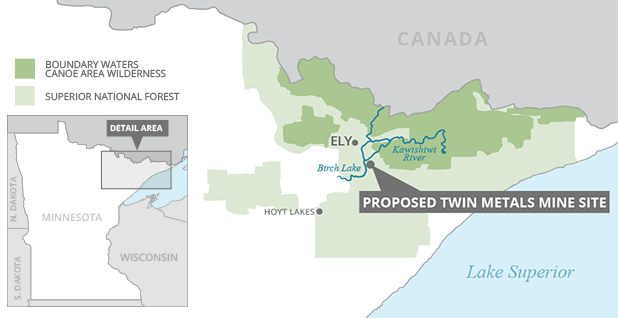
Map credit: Claudine Hellmuth/E&E News
Environment & Energy News map by Claudine Hellmuth
Both Twin Metals and PolyMet Mining complain that their permit applications aren't getting a fair review because of policies they say were influenced and written by environmentalists and lawmakers who don't live in northeastern Minnesota. Many residents in the area agree, expressing antipathy toward government overreach. "We are locals in a rural area being oppressed by the Twin Cities. And it has always been that way, and we're just fed up with it." Joe Baltich told Cusick. Baltich is the third-generation owner of Northwind Lodge and Red Rock Wilderness Store on Jasper Lake, 16 miles northeast of Ely. Baltich and others believe that the mining wouldn't hurt the Boundary Waters.

As it stands, in December the Minnesota Forest Service blocked the renewal of federal leases that would allow Twin Metals access to the Superior National Forest to explore mining opportunities. They also made about 234,000 acres of the forest off-limits for development for two years, and will use the time to study whether sulfide mining will hurt the area. "If the study shows unacceptable risk, the Superior Forest will be off-limits to mining for at least 20 years," Cusick reports. If the study is favorable to Twin Metals and the leases are renewed, mining would not begin until at least 2024.

Tuesday, July 18, 2017

Rural Kentucky hiking club is changing local attitudes about health and the community

The Breathitt County Hiking Club in the nearby Red River Gorge. (Photo by Josh Mauser)
Central Appalachia is the unhealthiest place in the country by most metrics, but 45-year-old librarian Stephen Bowling is trying to help Breathitt County buck the trend with a hiking club. An avid hiker, Bowling has been hosting monthly hiking trips one Sunday a month since the beginning of the year, Lyndsey Gilpin reports for Outside Online. His employer, the Breathitt County Public Library, sponsors the club and serves as a meeting place for members that range in age from 14 to 74.

Bowling says the monthly trips usually attract about 20 people, most of whom don't have much experience hiking. But he believes that even something as small as a hiking club can affect not just attitudes about fitness, but about the long-suffering community's ability to improve. “It’s a depressed area economically, but also emotionally and physiologically,” Bowling told Gilpin. “We’re told constantly that we’re the least healthy people, we are this, we are that, and people don’t feel empowered to change that. Some people aren’t willing, and some people aren’t able.”

Breathitt County, Kentucky
(Wikipedia map)
Appalachia is a prime example of the wellness divide between rural and urban America. Eight of the top 10 counties in the U.S. with the largest recent declines in life expectancy are in Kentucky, and one of them is Breathitt. About 14,000 people live in the county, most are white, and most are over 40. "Nearly half the population is obese, about a third smoke, and a third are physically inactive. The unemployment rate is almost 12 percent," Gilpin reports.

Most outdoor adventure spaces are under private control in rural areas, leaving people with far fewer options for outdoor recreation than residents of urban areas. "Most Southeastern states have less than 5 percent federal public land. In Kentucky, less than 4 percent of land is federally owned, and there are only a few state parks, most of them a half-day’s drive from Breathitt," Gilpin reports. "Only 17 percent of Breathitt County residents live within a half-mile of a park or within three miles of an accessible recreational facility; meanwhile, 98 percent of New York county [Manhattan] residents and 100 percent of San Francisco county residents have such access to a park within a half-mile or a recreational facility within just one mile."

Private landowners rarely create trails, and those that are created are mostly for all-terrain vehicles and aren't used by hikers and bikers, Gilpin reports. The area's walking trails are not often safe and well-marked, and local gyms are usually small with limited hours. Most exercise buffs instead rely on using local high schools' running tracks.

The rural South is studying how states like North Carolina and Colorado have boosted outdoor recreation to figure out how to make public lands accessible and profitable. "In July, legislation will go into effect to create the Kentucky Mountain Regional Recreation Authority, a group run by community members from around the state that will develop, maintain, monitor, and promote local trails," Gilpin reports. Republican State Rep. Chris Fugate introduced the bill, and says he wants to connect 17 counties through a walking trail system. "“Some of the most beautiful places are hidden away,” Fugate told Gilpin. “We haven’t done a good enough job of promoting and taking care of ourselves here.”

Monday, July 17, 2017

Yellowstone Park bobcat shows that ecotourism may make more money for rural areas than hunting

The bobcat prowls for water birds in Yellowstone
National Park, making it an object of wildlife
outfitters and photopgraphers. (Natl. Park Service)
A bobcat (well, at least one bobcat) is worth 1,000 times as much when you shoot it with a camera instead of a bullet, says one conservation expert. Mark Elbroch, lead scientist for the puma program of wild-cat conservation organization Panthera, researched the economic impact of one rare bobcat seen frequently in the Madison River area of Yellowstone National Park in recent years and came up with some surprising numbers, reports Jason Bittel for The Washington Post.

Wildlife outfitters and photographers frequently schedule expeditions in an effort to spot the elusive cat, because it preys on water birds. Elbroch contacted many of them and asked about their earnings (from sales of photos, for example) and expenses such as gas, guide fees and gear. He found that these ecotourists spent $308,105 on this one bobcat in one year. And Bittel reports that a 2012 study in British Columbia found that "bear viewing out-earned bear hunting by a margin of nearly $14 million."

Elbroch notes that states can also generate income from hunting licenses. In 39 states it is legal to hunt and trap bobcats. Considering the price of the pelt and the money the state makes from the hunting license, the value of the dead bobcat diminishes to a one-time profit of $315.17. Still, a famous bobcat is probably much more valuable than the average wild animal, writes Bittel. "It’s also not necessarily an either/or scenario. In the 2015-2016 season, close to 3,500 people bought trapping licenses in Wyoming, yielding $151,954 for the state, the study says. Just 284 of these licenses yielded bobcat pelts, none of which interfered with the ecotourism revenue created by the Madison River cat." He says there could be as many as 3.5 million bobcats in the U.S.

"Renowned biologist Stuart Pimm also sees value in these sorts of estimations," Bittel reports. "Pimm said there’s been a tendency on the part of some politicians to view the environment as an inconvenient hindrance to the success of American commerce. To which he says, and this is a direct quote: 'Poppycock.'"

Policies that harm ecotourism could hurt states like Wyoming, in which only mining brings in more money than tourism. Yellowstone National Park Superintendent Dan Wenk has expressed worry that the Interior Department's decision to remove Yellowstone-area grizzly bears from the endangered-species list could affect visitor experiences. Other legislation has been proposed to take gray wolves off the endangered species list as well.

"For his part, Elbroch said the study should not be viewed as a call to end hunting and trapping altogether," Bittel reports, "but instead an opportunity for further conversation about reforming hunting and trapping regulations based on the best science available."

Friday, May 19, 2017

Alaska town reinvents itself as cruise destination, some dislike the culture and commerce changes

Visit Ketchikan map
An Alaska town facing an economic collapse has reinvented itself as a tourist magnet, Melissa Block reports for NPR. When the timber industry moved away from Ketchikan, officials decided to take advantage of their natural resources, turning the town into a premier docking spot for cruise ships. They expect a million visitors this summer, and say the town of 13,000 often doubles in size from as many as six ships on any given day.

"Ketchikan sits on an island at the southernmost end of southeast Alaska, a prime spot for cruise ships navigating Alaska's Inside Passage," Block notes. "The landscape is spectacular: snow-capped mountains, glaciers descending into narrow fjords, and all around, the dense Tongass National Forest. At 17 million acres (bigger than West Virginia), the Tongass is the largest national forest in the U.S."

Cruise ship tourists in Ketchikan
(NPR photo by Elissa Nadwomy)
The town once relied almost exclusively on timber, Block writes. "For many decades, the spruce, hemlock and cedar trees of the Tongass have also been a source of timber for the logging industry. At its peak, logging camps dotted the islands of southeast Alaska, and pulp mills were robust economic drivers of the region. One by one, those pulp mills shut down, faced with global competition, new environmental regulations, lawsuits and fines for pollution violations," with the last one closing in 1997.

Ketchikian gift shop items (Nadwomy photo)
Not everyone in Ketchikan has enjoyed the town's transition, Block writes. Longtime Ketchikan resident Eric Collins told Block, "We don't know who we are anymore. We had shoe stores in Ketchikan. We had work clothes stores in Ketchikan. We had a Chevy dealer and a Ford dealer. They're all gone." Block writes, "What's replaced them? Lots of jewelry and watch stores, some of them owned by the cruise ship companies themselves. Also, souvenir and gift shops, as well as local tour operations."

Thursday, May 11, 2017

Scientists blame climate change for shrinking Montana glaciers, say they'll disappear soon

Climate change has reduced the 37 glaciers in Montana's Glacier National Park and two on nearby U.S. Forest Service land by 39 percent since 1966, with some glaciers having seen reductions as much as 85 percent, says a study by the U.S. Geological Survey and Portland State University.

Daniel Fagre, a research ecologist with the USGS's Northern Rocky Mountain Science Center, told CNN's Steve Almasy and Mayra Cuevas, "The trend right now is that they are inexorably going into their final demise. There is no chance they will go into rebirth. In several decades they will be mostly gone. They will grow so small that they will disappear. They will certainly be gone before the end of the century."

Perimeter of Sperry Glacier in Glacier
National Park in 1966, 1998, 2005 and 2015.

Click on photo for larger version.
Using digital maps from aerial photography and satellites, scientists measured the perimeters of the glaciers in late summer, when seasonal snow has melted to reveal the extent of the glacial ice, in 1966, 1998, 2005 and 2015/2016. They found that of the 39 glaciers, "only 26 glaciers are now larger than 25 acres, which is used as a guideline for deciding if bodies of ice are large enough to be considered glaciers."

Portland State geologist Andrew G. Fountain said, “While the shrinkage in Montana is more severe than some other places in the U.S., it is in line with trends that have been happening on a global scale." Fagre told CNN that "in the mid-1800s there were about 150 glaciers on the land, which was designated a national park in 1910. Rising temperatures caused the others to disappear."

Thursday, May 04, 2017

Smithsonian magazine names 20 best small towns to visit in 2017

Shenandoah River in Harpers Ferry, W.Va., pop. 293
While trying to decide where to take a vacation this year, you might consider traveling to an interesting or scenic rural town, perhaps one that Smithsonian magazine included in its sixth annual list of America's Best Small Towns.

"We once again consulted geographical information company Esri to identify tiny towns chock full of local culture, history and natural beauty," Jackie Mansky reports for Smithsonian. "We then narrowed down our list to pinpoint the destinations that are especially worth making the trip to this year—whether they’re celebrating a special birthday, commemorating a famous resident or happen to be smack on the path of the 'Great American Eclipse',” which will traverse the nation on Aug. 21.

The list of 20 towns includes: Talkeetna, Alaska; Harpers Ferry, W.Va.; Rockland, Maine; Kent, Conn.; Makanda, Ill.; Grand Marais, Minn.; Ojai, Calif.; Snowmass Village, Colo.; Abilene, Kan.; Spencer, Iowa; Mineral Point, Wis.; Hana, Hawaii; Bell Buckle, Tenn.; Oakland, Md.; Zoar Village, Ohio; Rincón, Puerto Rico; De Smet, S.D.; Cheraw, S.C.; Page, Ariz.; and Hill City, S.D.

The smallest town on the list is Zoar Village, pop. 178. It was founded by German religious separatists and became "one of the longest-running communal settlements in American history," Smithsonian reports. "After its dissolution in 1898, many tenants chose to stay behind. . . . Zoar still looks like a German village from the 1800s. It has over 50 of its original historic structures and buildings, not to mention its iconic garden, which takes up two acres in the center of the town," which was recently designated as a National Historic Landmark and is celebrating its bicentennial.

Thursday, April 20, 2017

Big crowds at national parks in recent years leading to an increase in emergency situations

Big crowds at Old Faithful at Yellowstone National Park
(National Park Service photo by Neal Herbert)
National parks in recent years have been overrun with large crowds, leading to an increase in emergency situations, David Erickson reports for the Billings Gazette. A sharp increase last year in visitors to Yellowstone National Park and Montana's Glacier National Park led to an increase in "arrests, car accidents, search and rescue operations, traffic headaches, full parking lots, long lines at overused bathrooms, crowds in scenic overlooks, full campgrounds and a myriad other problems."

Norma Nickerson, director of the Institute for Tourism and Recreation Research at the University of Montana, said "many park managers are now having to deal with the same emergency situations as cities that have a police force and other city departments to manage the problem," Erickson writes.

Nickerson, who recently published a report on overcrowding at national parks, said Glacier saw a 20 percent increase in visitors last year. Also, visitors were up 23 percent at Crater Lake National Park, 20 percent at Yosemite National Park, 18 percent at Zion National Park and 13 percent at Arches National Park. While two of the most popular national parks, the Grand Canyon National Park and Yellowstone only saw increases of eight and four percent in 2016, that's up from increases of 17 and 16 percent in 2015.

At Yellowstone, search and rescue incidents increased 61 percent in 2015, injuries were up 167 percent, emergency medical responses were up 37 percent and Life Flight evacuations were up 25 percent, Erickson notes. Last year nearly three million people visited Glacier, where it's not uncommon in July and August for some parking lots to be filled up by 11 a.m. and many campgrounds to be fully booked every day during those two months.

Tuesday, October 25, 2016

Growing agri-tourism and local-food industry boosts income for farmers and other landowners

Locavore Farm in Grant Park, Ill. has found success
through agri-tourism (Journal photo by Tiffany Blanchette)
Agri-tourism is booming. The U.S. Census of Agriculture reports that in 2012, the last year covered by the census, 13,334 farms grossed $674 million from agri-tourism, up from 3,000 farms grossing $128 million four years earlier, Mary Hall reports for the Daily Journal in Kankakee, Ill. Of those farms, one-quarter were in the Midwest.

Only 8 percent of Illinois farms "have some kind of recreational side business and most make less than $5,000 per year on it," Hall writes. But most of the participants are "small, family-owned farms that are opening their doors to tourists who want to pick their own apples, see where their beef is raised or simply wake up to a sunrise over a corn field. The biggest growth areas are those just outside of metropolitan areas. And it's often tied to the local food movement. While city populations get more dense, there's also a push to experience the natural—through local food, urban gardening or taking a short drive south to the country for the weekend."

For example, Locavore Farm in Grant Park, Ill. (Best Places map) puts together an Oktoberfest event that features food and music and draws 500 visitors, Hall writes. Dinners for the year, which sold out on July 1, will serve 2,400 people from June to November. The success of places like Locavore Farm, which has been featured in national magazines, "lets tourist get a taste of the rural life" and lets "farms take advantage of their unique nostalgic and family appeal."