Showing posts with label coastal issues. Show all posts

Wednesday, May 28, 2025

Hurricane season officially begins June 1. Experts are planning for an active Atlantic.

NOAA experts predict a busy hurricane season that isn't as extreme as 2024.
Hurricane season 2025 officially begins June 1 and forecasters expect another active season in the Atlantic. Current predictions estimate "a 60% chance of an 'above-normal' hurricane season, with between 13 to 19 named storms," reports Emily Mae Czachor of CBS News. "Six to 10 of those are expected to strengthen into hurricanes, and three to five could become major hurricanes."

While this year's season is marked by warm ocean temperatures, they aren't as warm as last year, so forecasters "don’t think it will be as chaotic as 2024, the third-costliest season on record as it spawned killer storms Beryl, Helene and Milton," reports Seth Borenstein of The Associated Press.

Atlantic hurricane seasons have been labeled as "above normal" since 1995, "with nearly half of those considered 'hyperactive,' according to NOAA," Borenstein writes. "Last year started with a record early Category 5 hurricane in Beryl but then had a lull during the early part of peak storm season from mid-August to mid-October. But then six storms, including Helene and Milton, formed in just two weeks."

Warmer ocean temperatures are the primary catalyst for hurricanes. Kristen Corbosiero, a University at Albany tropical meteorology professor, told Borenstein, "Warmer ocean water, warmer atmosphere above it can hold more moisture, more fuel for storms.” Even with a calmer season overall, one massively destructive storm can cause havoc across a region.

The National Oceanic and Atmospheric Administration has been hit by deep staffing cuts from the Department of Government Efficiency, but its acting administrator, Laura Grimm, told reporters, "The hurricane center is fully staffed up and we’re ready to go. We are making this a top priority for this administration."

The Atlantic hurricane season officially runs through Nov. 30.

Friday, April 11, 2025

Even with tariff pause, plans to increase costs for shrimp imports give small coastal communities hope

Last year most U.S. shrimpers lost money.
(Adobe Stock photo)

Despite shrimp's jumbo appeal to U.S. consumers, American shrimpers have struggled to compete with imported, farmed shrimp. Tariffs and renewed trade negotiations with foreign shrimp importers may help revive American shrimping.

As this week began, shrimpers in tiny Bayou La Batre, Alabama, celebrated President Trump’s new round of tariffs, which "included countries that export most of shrimp Americans consume," reports Rachel Wolfe of The Wall Street Journal. "That included rates of around 26% on India, 10% on Ecuador, 32% on Indonesia and 46% on Vietnam. . . . More than 90% of the millions of pounds of shrimp consumed annually in the U.S. is imported."

The decline of U.S. shrimping came bit by bit as more imported shrimp entered the U.S. market. "Fishermen unable to sell their shrimp to break even on gas, labor and supplies have had to tie up their boats," Wolfe explains. "Supply shops, seafood processors, marine technicians and others in the industry have suffered, too."

For small coastal communities like Bayou La Batre, the loss of shrimping incomes has "cratered" local economics. Wolfe reports, "Income and sales-tax revenue in Bayou La Batre plummeted around 40% between 2021 and 2024 alone, according to Mayor Henry D. Barnes." Barnes told her, "People were looking to me for answers, and I didn’t have them. The city can’t put tariffs on foreign seafood.”

Over the past 20 years, the wholesale price of shrimp in the U.S. declined, but American shrimpers were still able to eke out a small profit. "In 2021, that changed as import prices dropped sharply, making it much more difficult for domestic shrimpers to turn a profit," Wolfe explains. "In 2023, domestic shrimpers operated at a net 3.7% loss on average."

Although the tariffs may help some shrimpers clear profits again, U.S. levies on marine goods could present new challenges. "Shrimpers rely on imports for a lot of their supplies," Wolfe explains. "Jeremy Zirlott, a commercial shrimper from Bayou La Batre, buys some of the webbing for his nets from India — which runs around $22,000 each year for each of his boats."

Even as Trump set a 90-day pause on the sweeping tariffs, the Southern Shrimp Alliance's response was positive. SSA Executive Director John Williams, echoed the hope some smaller coastal towns now have: "It is encouraging that the Trump Administration’s tariffs have prompted countries to show a new willingness to address trade policies disadvantaging American producers."

Friday, February 07, 2025

Beachcombers find their treasure in washed-up items from the sea. Items include rubber ducks and diamond rings.

Man looks out over the shoreline. (Unsplash photo)
One man's trash is another's treasure and John Anderson’s trove is filled with items he has found along the Washington coastline.

Beachcombing for the majority of his life, “[Anderson] has curated 46 years’ of pickings in John’s Beachcombing Museum, a two-level warehouse on his Forks property (open summers only) that memorializes a family pastime he has taken to the extreme,” reports Elliott Almond at The Seattle Times.

Every time a ship goes down or a container goes overboard, its contents have to end up somewhere. Many things lost at sea eventually make their way to the Pacific coastline, carried by currents and in this case the North Pacific subtropical gyre, which according to Almond, is a vast circular system of ocean currents.

“The sandy, rocky outposts are a beachcomber’s paradise because the marine mosaic creates a natural seine to trap whatever happens to float past,” Almond said.

Some of the items spilled at sea include 28,800 bath toys and rubber ducks, 34,000 ice hockey gloves and 61,000 pairs of Nikes. Beachcombers found some of these items, as well as six diamond rings found by kids on a school trip, an 1896 silver dollar, the center spinner cone from a Boeing 747 jet engine, and remnants from tsunamis that hit Japan.

Deacon Ritterbush, who authored a book about beachcombing, told Almond, “It [beachcombing] is a portal to everything wonderful in life… It costs nothing, and you wear junk clothes. You’re just slopping it in nature.”

Beachcombing Washington’s 2,337 mile coastline isn’t always fun and games. Almond reports that Anderson has sustained multiple injuries trekking to and from the coast with his pack of treasures.

Anderson told Almond, “People always ask, ‘How many miles do you walk?’... I don’t count miles. I count two rebuilt ankles, two new hips and a back surgery.” 

Friday, July 19, 2024

Reviving a native coastal hay could be the solution for farmers experiencing saltwater intrusions on their land

Salt hay is naturally weed-free and rot resistant.
(Graphic by Adam Dixon, Ambrook Research)
As saltwater intrusion occurs more frequently along U.S. coasts, regional farmers are losing part of their livelihoods to ground that is too salty for many traditional crops. In seeking out a solution, some farmers are working to bring back a native hay species that thrives in salt. "Farms at the low, marshy edges of the East Coast are rapidly losing ground as rising sea levels push salty water further into the fields, reports Kate Morgan of Ambrook Research. "American growers are beginning to see their own opportunities in reviving a historic salt hay industry."

Spartina patens -- more commonly known as "salt hay" -- was grown along U.S. coastal borders beginning during colonial times through the end of the 1900s. The perennial cordgrass hay can be "used for animal fodder, as a building insulator, packing material, or turned into paper," Morgan explains. "It’s incredibly easy to grow, but equally difficult to harvest. It performs best in marshy areas close to the water, which meant farmers had to cut it by hand, using horses and oxen to haul it out, or loading it onto rafts. By 1945, tractors had officially overtaken horsepower on American farms, and marshes and machinery don’t mix."

While farmers love a crop that is naturally weed-free, self-seeding and rot resistant, not being able to harvest it with modern equipment presents a challenge. Atlantic-coast farmer John Zander, whose Cohansey Meadows Farms has some significantly salty soil, has been experimenting with salt hay production methods. "His fields, planted just a bit further inland than the grasses might typically grow, are producing prolifically," Morgan writes. "He cuts, bales, and sells some for mulch, bedding, and fodder, and he hopes increased supply will help reinvigorate the various markets for salt hay. But his main goal is to sell transplants to other coastal farmers."

Zander noticed his salt hay crops had added benefits. He told Morgan: “The root mass is just so dense and thick. It just really grips on. I think if we can get some of that into places where we’re having erosion problems, it might be pretty beneficial to some of these coastal farms and towns.” 

Wednesday, July 27, 2022

As warming waters drive lobster north, Mainers raise kelp

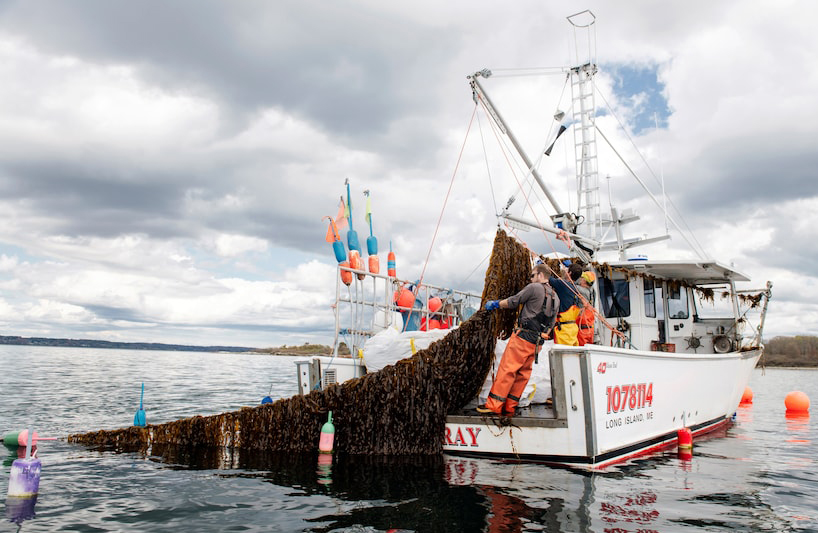
Justin Papkee, a partner farmer with Atlantic Sea Farms, hauls up kelp lines with the help of his crew, Jim Ranaghan and Chris Papkee, off Long Island, Maine, last year. (Photo by Nicole Wolf via The Washington Post)

"Seaweed is Maine's new cash crop," as the lobster industry adjusts to climate change, Kathy Gunst reports for The Washington Post. In the fall, lobster fishers "plant tiny kelp seeds on the 1,000-foot-long ropes, and by late spring, attached to each one is close to 6,000 pounds of fresh sugar kelp. The seaweed is harvested, flash frozen and used to make kelp cubes for smoothies, as well as seaweed salad, seaweed kraut and more."

The switch from lobster to kelp is the result of rising temperatures. "The Gulf of Maine is warming faster than 96 percent of the world’s oceans — increasing at a rate of 0.09 degrees per year," Gunst reports. "These warming temperatures have forced the lobster population to migrate north seeking colder waters, and the impact on Maine fishermen has been profound." The industry is also growing in Alaska.

The big player in Maine's kelp industry is Atlantic Sea Farms, which works with 27 partner farmers who brought in just under 1 million pounds this year. "The company’s products are now sold in more than 2,000 stores across the country, as well as in restaurants and college cafeterias," Gunst reports. "In 2021 the company was responsible for 85 percent of the line-produced seaweed in the country."

Kelp farming has environmental benefits, ASF President Briana Warner told Gunst: “There’s so much carbon in the air, and when carbon hits the ocean surface the ocean absorbs it and changes the pH and degrades shellfish. Seaweed absorbs the carbon and nitrogen in the water. When you harvest seaweed you are removing carbon with it and leaving behind a healthier body of water.” She said mussels planted on ropes after a kelp harvest have stronger shells thanks to the removal of excess carbon.

Thursday, July 27, 2017

In an unprecedented move, Commerce Secretary Wilbur Ross overrules a fish-catch limit

Summer flounder
(Boston Globe illustration)
Earlier this month, Commerce Secretary Wilbur Ross dismissed a report from the Atlantic States Marine Fisheries Commission that concluded that New Jersey was violating a conservation plan for summer flounder, also called fluke. "The decision, which effectively allows New Jersey to harvest more summer flounder, marked the first time the federal government had disregarded such a recommendation by the commission, and it drew a swift rebuke from state officials along the East Coast," David Abel reports for The Boston Globe.

Congress established the multi-state commission 75 years ago to manage fishing in order to maintain a sustainable supply. The commission lowered catch limits after it found that that summer flounder were being overfished, based on government surveys that found their population was down almost 25 percent since 2010. "If the population falls another 14 percent, reaching a critical threshold for the ability of the fishery to rebuild, commissioners will be required by their rules to reduce quotas drastically or implement a region-wide moratorium on catching fluke," Abel reports.

New Jersey, a member of the commission, proposed an alternative plan, but the commission rejected it after its scientists said that plan would result in nearly 94,000 more fish being caught. Ross, who oversees the National Oceanic and Atmospheric Administration, overruled the commission and allowed New Jersey to go ahead with its plan. Members of the commission, fishing officials, and regional NOAA officials were furious. "They said it was unprecedented for a commerce secretary to make a decision without seeking their input," Abel reports. "Such rulings are routinely vetted by NOAA’s regional officials and scientists, who review the commission’s recommendations and then prepare the agency’s response, they said."

New Jersey fishermen argue that the commission's recommended limits would have made it difficult to catch and keep any fluke other than the large females that replenish the flounder population.

The broader impact of the decision remains unknown. Some fishing officials worry that Ross' decision sets a precedent for states to reject the commission's findings and appeal to the federal government whenever they don't like what they're hearing. And if summer flounder are overfished to the point where the population can't rebuild itself, that could impact the marine ecosystem and the coastal economies that rely on it.

Wednesday, February 15, 2017

Privatized fishing rights mean the industry has less economic benefit for coastal towns

A national push to make seafood more sustainable is forcing small and independent fishing operations to compete with wealthy investors and large corporations, Kai Ryssdal and Daisy Palacios report for the radio program Marketplace. The problem is that the U.S. policy of "catch share," which limits how many fish can come out of the ocean, has become privatized. That means that having deep pockets buys you the rights to more pounds of fish.

Ryssdal, host of Marketplace, interviewed Lee van der Voo, whose book, The Fish Market: Inside the Big-Money Battle for the Ocean and Your Dinner Plate, details the issue. Van der Voo told Ryssdal, "The idea was give fishermen a stake in the ocean, and they'll become conservationists. But it was a bit of a gamble. It was like giving 100 people houses and betting everybody's going to cut their grass; you just don't really know. And the effect has been kind of mixed. Some people became the good stewards that conservationists envisioned when they pushed this policy in America, and a lot of people just became landlords."

Van der Voo told Ryssdal, "There are a lot of ways to enforce caps on the ocean, and I would say that private property rights have not been the best way to do it . . . It used to be, that if you were a fisherman and you wanted to grow in your industry, you would just get better at it. And you would, over time, be able to afford your own boat, afford your own equipment, afford the licenses to go fishing. Now you have to be able to afford the access to the ocean, which is tremendously expensive. And so, the next logical inheritor of the resource is no longer the fishermen, it’s investors, it’s corporations, it’s entities that are moving the economic benefits of fishing further and further away from coastal towns."

Van der Voo said, "People care about what they eat. Maybe not so much about the person that brings it to them, but maybe they should. You know, this is a pretty significant trend here in this nation. We've seen a lot in the last election, people talk an awful lot about what has happened to workers in the heartland, but we're not really talking about what's happening to workers in coastal communities. Right now, that halibut that's costing $28 to $30 a pound in the Whole Foods case, the guy that goes and catches that is paying up to 75 percent of the revenue of that trip to a landlord. That's a problem."

Wednesday, February 17, 2016

Conflicts of interest, lack of transparency trouble the California Coastal Commission

In a controversial and unpopular move, the California Coastal Commission last week held a closed-door meeting to fire executive director Charles Lester, Tony Barboza and Dan Weikel report for the Los Angeles Times. While the commission cited leadership issues, Lester's supporters say the commission was driven by a desire to increase coastal development. (Times photo by Allen J. Schaben: Places like Huntington Beach, Calif. could be the site of proposed development projects)

The closed-door meeting wasn't a surprise; the commission's history is steeped in a lack of transparency, columnist Steve Lopez writes for the Times. "Consultants representing developers don't have to register as lobbyists or reveal what they're paid. And critics, including former commissioners, say those consultants are way too cozy with the commissioners, who vote on their projects. For their part, commissioners often do not provide detailed descriptions of their communications with lobbyists and project backers. All of that information should be posted and available to the public."

Lester "knows more about the 40-year-old voter-approved Coastal Act that protects our 1,100-mile shoreline than anyone in the world," Lopez writes in another column. "At times during the meeting, Commissioners Wendy Mitchell and Dayna Bochco gabbed like school kids on the dais, and they cast seventh-grade smirks at press row when colleagues took turns bashing the news media. If California's media deserve a beating, in their diminished state, it's for not keeping a close enough watch on this all-powerful agency and the constant pressure applied by hired guns for billions of dollars' worth of development projects."

On Tuesday state legislators introduced a bill that "would require the hired guns who represent developers to register as lobbyists and play by the rules of full disclosure that apply to every other state agency," Lopez reports in yet another column. He says the basic problem with the commission is that the "commissioners are appointees, but half of them hold elective office, and their fundraisers are populated by lobbyists, developers and other politicians. It's all too cozy and too shady at the same time, and there's little or no cross-checking between local campaign donations and potential conflicts of interest."

Friday, August 08, 2014

Registration deadline approaching for free science journalist seminars on climate change

The Metcalf Institute for Marine and Environmental Reporting is offering journalists a pair of free science seminars on covering climate change. The seminars are scheduled for Sept. 18-19 in Chicago.

"Climate Change and the News: Seminar for News Editors" will focus on what news audiences need to know about climate change and how communities are tackling the issue. The registration deadline is Aug. 25.

"Climate Change and the News: Impact in the Great Lakes" will concentrate on the physical basis for climate change science; effects of climate change on water quality and supply in the Great Lakes region; relationships between climate change and extreme weather events; impacts of climate change upon Great Lake fisheries, forests and agriculture; public health challenges raised by climate change; and how climate change is driving policy and economic decisions in the region. The registration deadline is Aug. 18. (Read more)

Friday, April 11, 2014

April 16 deadline for journalists to register for free climate-change seminars April 23-25 in D.C.

Two free climate-change seminars for journalists are scheduled April 23 and April 24-25 in Washington, D.C. The seminars, sponsored by the Metcalf Institute for Marine & Environmental Reporting, the Woodrow Wilson Center and the Pulitzer Center on Crisis Reporting, will focus on economic and public-policy issues and the marine and coastal effects of climate change.

The first seminar, designed for political and business reporters, is described as "a top-level summary of the state of climate-change science, underscoring global and regional observations, predictions and social and economic impacts from the most recent Intergovernmental Panel on Climate Change reports, as well as an overview of domestic policy and politics related to climate change mitigation and adaptation."

The second seminar "is open to all journalists who want to improve their coverage of climate change and will provide a foundational understanding of the most critical climate change impacts affecting the ocean and coastal communities. This seminar will include an interactive session with award-winning environment reporters who will provide guidance on how to craft compelling stories for local and regional audiences out of globally significant climate change research, an extraordinarily challenging topic for both reporters and news audiences."

The registration deadline is April 16. For more information or to register, click here.