Showing posts with label animal control. Show all posts

Tuesday, December 10, 2024

Flora & Fauna: Joyrides for rats; feral pigs forage through Hawaii; serviceberry tree history; a unique "comeback" bird

Rats learned to love driving and would opt to take longer routes to get to their destination.
(Photo by Kelly Lambert, CC BY-ND)

People aren't the only ones who love to go for a drive. Rats do, too. "I’m a neuroscientist who taught rats to drive − their joy suggests how anticipating fun can enrich human life," writes Kelly Lambert for The Conversation. "My colleagues and I found that rats could learn to drive forward by grasping a small wire that acted like a gas pedal. Before long, they were steering with surprising precision to reach a Froot Loop treat. . . . Unexpectedly, we found that the rats had an intense motivation for their driving training, often jumping into the car and revving the 'lever engine' before their vehicle hit the road. Why was that?" Read the research here.

In the lowlands of Hawaii, things are going to pigs. Feral pigs have invaded six of the state's islands with shocking efficiency and left a path of overwhelmed ecosystems in their wake. "Their impact is profound on Kaua‘i. Its mountains are home to 255 unique native plant species and 208 native birds, including 11 found nowhere else on Earth," reports Brendan Borrell of Hakai magazine. "Their wallows breed mosquitoes that spread avian malaria, contributing to 10 of Kaua‘i’s 16 native honeycreepers [birds] going extinct. . . . Despite the damage that feral pigs are causing, you can’t just shoot them on sight . . ."

Serviceberry trees are smaller trees native to North
America. (The Spruce graphic)
Like humans, a tree species has a history. The serviceberry tree was once common in the United States, particularly in colonial New England, where its bloom cycle indicated when the soil was soft enough to begin digging graves for the many settlers who didn't make it through the winter. "Preachers then went from settlement to settlement to perform funeral services," writes Jessica Damiano of The Associated Press. "Because it’s one of the earliest spring bloomers, the serviceberry is an important food source for bees, butterflies and other pollinators. Later, its berries sustain dozens of bird species and mammals. . . .There are more than 20 species of the North American native tree, which is sadly underused." Here are four favorites.

Whether it's that hefty frozen turkey, a delectable ham or ground lamb ready to be transformed into meatballs, the holidays can be a special time to be thankful for the meat on our tables. As an act of gratefulness for farm animals, a donation to an animal charity that works to make the lives of factory animals better may be in order. "Animal Charity Evaluators, a California-based nonprofit, puts out an annual guide for recommended animal charities," report Sigal Samuel and Kenny Torrella of Vox. "ACE researches and promotes the most high-impact, effective ways to help animals." Find this year's list here.
Red-cockaded woodpeckers nest in family units.
(Adobe Stock photo)

Americans love a comeback, especially when the returning member is cute, social and unique. "The red-cockaded woodpecker, an iconic bird in southeastern forests, has recovered enough of its population to be downlisted from an endangered species to a threatened one," reports Christina Larson of The Associated Press. Will Harlan of the nonprofit Center for Biological Diversity, told Larson, "It’s an amazing bird that has an unusual communal nesting structure. All nests usually cluster in the same tree, and the birds stick together as a family unit.”

Hazelnut trees are poised to flourish where they once died by the thousands. "Bullied by blight, the filbert has long failed to find a home on farms in the eastern U.S.," reports Ben Seal of Ambrook Research. "All across the eastern United States, hazelnuts had been cut down by Eastern filbert blight, or EFB, an endemic disease that chokes life from a tree. . . .But now, after nearly three decades of developing a way for farmers to overcome EFB. . . . A collection of four cultivars, [was] released in 2020, that can withstand even the intense pressure on [a] New Jersey research farm, where numerous strains of the blight are present."
AI is helping wolf trackers without using radio collars.
(Photo by ML, Unsplash)

New AI tracking technology is making it easier for wolves and ranchers near Yellowstone Park to coexist. "After 30 years of using traditional boots-on-the-ground observations, researchers are collecting wolf calls in hopes of honing population estimates, tracking wolves without using radio collars, and reducing conflict between the animals and ranchers," reports Devin Farmiloe of The Washington Post. "Learning more about how wolves communicate from a young age can shed light on pack dynamics that wildlife managers can use to better track and protect the species."

Tuesday, February 28, 2023

Revenge of the tree rats: Some thoughts from rural Wisconsin on living too close to the Sciuridae family

Red squirrel (Photo by Geran de Klerk, Unsplash)
Be-bopping around your yard, planning raids on your bird feeders or gas grill and yelling at the dog, who lives closer to us than squirrels? But there is a point at which it becomes too close.

"A home should be a peaceful sanctuary for its inhabitants, a quiet place of comfort and solitude. But when you live in the country, sometimes your abode is sought after by critters other than humans," rural columnist Chris Hardie writes for the Wisconsin Newspaper Association. "A few weeks ago I wrote about how our power supply was cut off when a red squirrel came into contact with the electrical line on top of a transformer. The deceased – with an incriminating black scorch mark across its chest – was pulled down by the lineman’s fiberglass pole. . . . I discovered that squirrels are the top power grid attackers, with thousands of outages each year caused by the Sciuridae family."

The enemy is red, and has many aliases. "The most troublesome squirrels appear to be the red squirrel, also known as a pine squirrel or a chickaree. Recently they’ve been hanging out at our bird feeder and in the rafters of our garage. . . . When we first started spending weekends at our house in 2004 – two years before we moved permanently and fixed it up – the attic was a popular hangout for the critters. . . . At night the attic sounded like a bowling alley, with the squirrels scampering and rolling walnuts around. All you needed were a few cheers of someone getting hung in the beer frame and it would have been like league night."

Perhaps limiting their numbers would help. "I told my father about the prevalence of the pesky pine squirrels and suggested that if he had the time and inclination, he could perhaps become a scourge to the scurry, the latter being the preferred name for a group of squirrels. . . . Since Dad lived next door and needed something to do, he readily accepted the challenge. . . . he kept his .22-rifle close by. . . The porch overlooked their backyard bird feeder which hung in a maple tree. It was a popular hangout for squirrels. It became death row for the squirrels."

That escalated quickly. "His actions were totally legal in Wisconsin, where a landowner may hunt small game-like squirrels on their own land year-round without a license. Dad’s efforts paid off as the death toll topped a couple of dozen. The chatter amongst the squirrels was to stay away from death row. The bowling alley became quiet."

Not everyone will understand. "We moved to the farm in 2006 and opened an inn. But Dad was vigilant about keeping the squirrel population at bay. . . .One morning while we were serving breakfast, I saw a pine squirrel dashing around the corner of their house. It was soon followed by Dad – wearing his beaten-up straw hat, a t-shirt and cutoff shorts accented by his cowboy boots – carrying his gun while stalking the squirrel. . . . I hoped he would go unnoticed, but the look of shock on the face of the guests told me otherwise."

Squirrels believe in revenge. "Dad is gone, but I wonder if the squirrels remember and are now seeking their revenge. Last week we were in the middle of washing dishes and our power went out. Again. . . .The cause? Another red squirrel dancing death on top of our transformer. The Sciuridae family is everywhere."

Saturday, January 28, 2023

Flora and fauna: Bear under a deck, ants to smell cancer, a vaccine for bees, a mini-horse for joy, Huron microbes . . .

L: Appearing to sport a headdress, a Polish rooster stands tall for his portrait. R: Show chickens like this Polish hen, are bred for external attributes, such as color patterns and feather shapes. (Photos: Alex Ten Napel for National Geographic)

A "totally unfazed" black bear dozes underneath a
comfy deck. (Photo by Vinny Dashukewich)
Why did the chicken cross the road? To get to the catwalk. Eggsperts agree, chickens have it all; and the photographers say the models are much more agreeable to work with than their fussy human counterparts.

When you find a black bear hibernating under your deck, what do you do? A family in Plainville, Connecticut, decided to let the bear snooze on.

Thundersnow is mysterious and rare. It's also being studied as a reliable indicator that a windfall of snow is coming.

What's better than a horse? A mini horse! This 33-inch mini Appaloosa brings joy to children with life-threatening illnesses from rural York County, Pennsylvania, to "anywhere people need a lift."

Gas exploration, cruise ships, and military operations have all made the ocean a lot louder for dolphins. Researches look at how dolphins attempt "shout" to communicate, but it doesn't always work out.

Researcher Rosa Vásquez Espinoza deep dives into oligotrophic Lake Huron to understand how life on Earth evolved through studying microscopic life. She believes this data "is the missing key to better conservation of Earth."

Sea lion, seals and Washington's endangered salmon: What can be done to help salmon return to its once robust numbers?

One day ants may able to replace expensive testing to sniff out cancer tumors. This new study puts the keen-nosed ant to the test with some surprising results.

American honey bee pollination supports more than $18 billion in U.S. crops each year, but bee hives have been struggling. In a bit of good news, a vaccine aimed at protecting honeybees from American foulbrood is being developed.

Wednesday, January 25, 2023

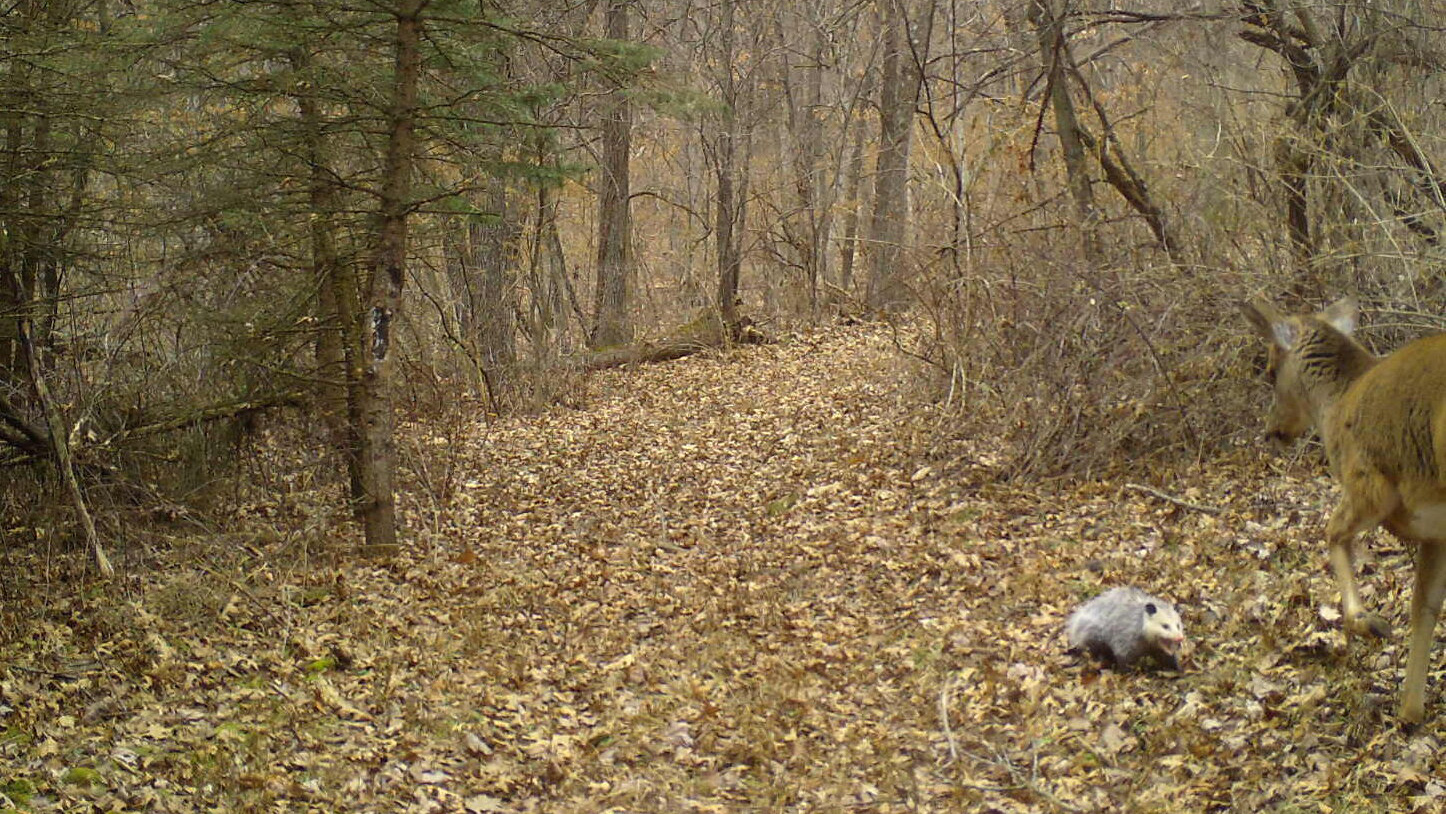
Close encounters of the critter kind: Wildlife cameras catch interspecies meetings, caused in part by human activities

An opossum confronts a deer in a surprise encounter. (Photo via DNR Snapshot Wisconsin)
A turkey and a fawn in a close encounter (DNR Snapshot Wisconsin)
Even in the forest, timing is everything: "Hours, minutes or even seconds can make the difference for an animal between stumbling upon a predator and avoiding one, between finding a bush loaded with berries and discovering branches that have already been gnawed bare," writes Emily Anthes of The New York Times. "Now, a new study reveals how humans might unwittingly rewrite these ecological scripts, altering how the characters interact and fueling more interspecies encounters."

Anthes explains: "Neil Gilbert, a postdoctoral researcher at Michigan State University, and his colleagues analyzed images captured by Snapshot Wisconsin, a citizen-science project run by the Wisconsin Department of Natural Resources. Since 2016, volunteers have deployed more than 2,000 wildlife cameras across the state . . . Wild animals of different species were more likely to lead overlapping lives — appearing at local camera sites in quicker succession — in human-altered landscapes, like farms, than in more undisturbed locations, such as national forests," researchers reported in Proceedings of the National Academy of Sciences.

Anthes notes that human land use
Not all meetings are interspecies. ((DNR Snapshot Wisconsin)

"can squeeze animals closer together, increasing the odds that they bump into each other . . . Although more research is needed, that interspecies squeeze could have effects such as making it harder for prey to evade predators, intensifying competition for resources or increasing the risk of interspecies disease transmission, the researchers say." Benjamin Zuckerberg, an ecologist at the University of Wisconsin-Madison and an author of the study, told Anthes in an email, “The compression of species niches will likely lead to new interactions among species with unknown consequences.”

"The cameras, which are triggered by motion and body heat, have captured a menagerie of animals going about their everyday lives: bald eagles scavenging in the snow, bear cubs climbing trees, a newborn fawn, a bevy of otters gamboling down a grassy trail," Athens reports. "The time intervals between detections varied enormously. Sometimes the cameras captured the odd animal couples in the same frame; other times, days or weeks might pass between their appearances. But overall, across all animal pairs, the trend was clear: In relatively pristine habitats, such as national forests, roughly six days elapsed, on average, between detections. In the most human-altered habitats, that interval dropped to an average of four days.

Jennifer Stenglein, a state research scientist, said the study illustrates the potential for using wildlife cameras to probe aspects of animal behavior that might otherwise be difficult to observe.

Turkeys keep close watch on a sandhill crane. (Photo via DNR Snapshot Wisconsin)

Tuesday, January 17, 2023

Sea otters have recovered from near-extinction, big time, but they're not charming to people who depend on shellfish

A raft of sea otters grooms and rests between bouts of vigorous foraging. (Photo by Kiliii Yuyan, National Geographic)

So cute! So cute!! So cute!!! Sea otters are cute, social and fascinating, but they are also bad for people who harvest shellfish for a living. Only Native Americans may hunt them legally. That could change as the otters, once near extinction, are reintroduced to places where their species once lived: "Now, in waters off the North American continent human intervention has been helping sea otters survive and spread once again," reports Cynthia Gorney of National Geographic. "Are they thriving? Touchy question. Is this a happy ending? Touchier question.  . . . It’s complicated, figuring out how tough, carnivorous predators fit into a world that changed while they were gone."

Research ecologist Tim Tinker, a University of California adjunct professor and one of the world’s leading sea otter experts, told Gorney, "Sea otters have huge effects. That’s why understanding them is so important. When they’re removed from an ecosystem or put back into an ecosystem, everything changes. And that’s disruptive. Some people are going to like the effects they have. And some people are not.”

Commercial dive fisherman Jeremy Leighton gave Gorney his take on the reintroduction of sea otters to Southeast Alaska: “Like setting off a nuclear bomb. Everything getting wiped out, in a radius, as they expand. Gorney writes, "Southeast Alaska, currently the global epicenter of people hostile to sea otters. It was here that I heard them described as 'an infestation' (a Haida tribal leader) and 'a disaster' (a commercial crabber, glaring at the water off his boat). Also this, from a man who’s fished the area for almost 40 years: 'Actually one of the most destructive things on the planet.' To be fair, that last description was prefaced by 'cute and fuzzy and cuddly and all that stuff, but actually.' . . . ."

The 1972 Marine Mammal Protection Act prohibits most people from killing marine mammals such as sea otters. It's a criminal offense. "You can’t 'harass' a marine mammal, either. There are a very few exemptions, including one that applies to Alaska’s Native people, who may hunt sea otters for 'subsistence' or for 'authentic Native articles of handicraft and clothing," Gorney notes. "This means that if you’re watching sea otters eat your family’s livelihood, the MMPA says there’s nothing you can do about it, Alaska Native or not."

Mike Miller, a Sitka Tribal Council member who chairs Alaska’s Indigenous People’s Council for Marine Mammals, told Gorney, “But if you look at their overall impact on ocean health, there’s a positive side to otters too. There’s got to be something close to balance someplace.” Miller is part of a group of "Southeast Alaska 'sea otter stakeholders,' as they label themselves—fish and game officials, tribal members, scientists, and commercial fishermen—all trying to work out a modern plan for sharing resources with a keystone animal that humans came so close to wiping out," Gorney reports. "No specific proposals have emerged from the Alaska discussions, but there are people watching closely from the western edge of the lower 48, especially around San Francisco Bay and the Oregon coast. Both regions are under serious study as reintroduction sites—shellfish-rich waters that once supported thousands of sea otters and could perhaps do so again. And in both places, healthy sea otter colonies might improve the water quality and plant life while delighting tourists."

The local dive industry and crab fisheries’ responses have remained guarded. Oregon Dungeness Crab Commission executive director Tim Novotny, who has joined ongoing talks with the Elakha Alliance, a group of conservationists, scientists, coastal experts, and tribal leaders exploring another attempt at returning sea otters to the state, told Gorney, “We are not necessarily dead set against sea otter reintroduction. The concern is, you don’t want to put a floating time bomb of furry crab-eaters in the water. Goats are cute, but nobody wants 5,000 of them in their backyard.'”

Tuesday, January 10, 2023

Iowa farmers want year-round raccoon hunting to lessen gnawed-down crops; population has tripled since 2006

(Photo by Peter Nuij, Unsplash)
Ethan Crow is an Iowa farmer with a gripe: raccoons. "Shine a light at any of the buildings on Ethan Crow’s central Iowa farm at night and you are likely to see several pairs of eyes staring back," Crow told Joe Barrett of The Wall Street Journal. "And piles of scat covering the floor—signs of what farmers are calling an out-of-control raccoon problem."

Crow told Barrett that he loses several thousand dollars in sweet corn to raccoon raids every year. “We do some trapping when we can. Otherwise, I mean legally, there’s not a lot that we are supposed to do.” The fine for hunting or trapping a raccoon outside the early-November-through-January season can be as much as $335, Barrett notes.

Farmers want year-round raccoon hunting, and the Iowa Department of Natural Resources, isplanning hearings on it. DNR biologist Vince Evelsizer noted that Iowa's raccoon population has tripled since 2006, and raccoons love sweet corn and grain corn, which both vital to Iowa agriculture.

Year-round hunting "won’t solve the problem overnight,” Evelsizer told Barrett. “But it will give people more flexibility to deal with nuisance situations.” He said the department would keep supporting nonlethal means of dealing with raccoons, such as putting electric wire around sweet-corn patches, installing a metal mesh to keep raccoons out of homes, and relocating problem raccoons.

Barrett writes, "Many farmers have clearly had enough of the crafty mammals, which typically weigh about 8 to 20 pounds, have distinctive bandit-mask facial markings, keen eyes, human-like forepaws that make them excellent climbers and a bushy, ringed tail."

Dean Fisher, a Republican Iowa state representative, told Barrett: “They may be cute and cuddly, but not here in farm country. They’re vermin and a nuisance.” Barrett reports, "Last year Fisher introduced a bill to extend raccoon hunting, which passed both chambers but was never reconciled," Fisher said he is waiting to decide whether to reintroduce his bill based on what happens with the state proposal.

Tuesday, January 03, 2023

Moving to the country can mean having to deal with snakes; the key seems to be eliminating their main prey: mice

A rattlesnake (Photo by Meg Jerrard, Unsplash)
If you move from the city to the country, there are fewer people and a lot more animals; your rural happiness may depend on the kind of animals that decide to live around and in your new country home. Columnist Dana Milbank of The Washington Post writes how he and his wife moved to rural Virginia and discovered the tenacity of snakes as roommates: "There were no two ways about it. We were dealing with some real snakes. We found six snakeskins in the basement. We found 23 snakeskins in the attic — including one that was 6 feet long. Worse, one of the skins in the attic had belonged to a copperhead, a venomous pit viper whose bite is certain to ruin your day. . . . As a political reporter, I’ve observed plenty of snakes over my career. But out in the country, people actually like the critters. My neighbors informed me that common black snakes were a sign of good fortune."

Getting used to more 'critters' was one thing, getting rid of the snakes was the sticky wicket. Milbank asked Daniel Frank, director of Virginia Tech’s pesticide programs, "what to do about his snakes, mice and sundry insects. The first step after identifying and monitoring the critters, Frank told Milbank is that of 'determining thresholds.' In other words, decide 'what amount of damage or pest population you can live with'."

That was easy for Milbank, who writes, "When it comes to venomous copperheads in my house, I have calculated my threshold tolerance, and it is exactly zero. When it comes to harmless but 6-foot-long black snakes in my house, my tolerance is not much higher than zero."

Frank told Milbank not to waste his time "with electronic deterrents or herbal remedies. It isn’t practical to trap them, and it isn’t humane to kill them. The way to make the snakes vacate was to evict the mice," Milbank reports.

Tony Sfreddo, a director of the Virginia Pest Management Association, toured Milbank's house and had this to share: “I’ve seen worse." Sfreddo also suggested how to take care of randomly roaming snakes by "putting a wet towel on the floor, wait for the snake to wrap itself in the towel and then remove it," Milbank writes. "If I find a snake in my bedroom, I will immediately sign the deed of trust over to the squatting reptile and flee to the city — never to leave its concrete cocoon again."

Monday, October 31, 2022

As number of hunters falls, number of deer rises, increasing disease threats and damage to crops and landscapes

Deer are becoming more familiar neighbors.
(Photo from LifeInMichigan.com)
The nation's population of deer is rising, and its population of hunters is falling. That's causing problems for people in rural areas and suburbs, reports Keith Matheny of the Detroit Free Press.

Matheny notes, "Michigan is the second-leading state for car-deer accidents in the U.S., trailing only Pennsylvania, and car-deer accidents have increased 6.6% in Michigan since 2012, with 115 of them causing human fatalities. Farmers and orchard growers are seeing rising problems as well. The number of special, out-of-season deer permits granted by the Michigan Department of Natural Resources to address significant crop damage increased 60% from 2014 to 2020."

Milder winters allow more deer to survive, but denser populations make them more vulnerable to chronic wasting disease and bovine tuberculosis, which they can give to or get from livestock. "That's a big worry for Michigan's beef and dairy industries," Matheny reports.

Hunting has kept deer populations in check, but less so these days because there are fewer hunters. "In the 1990s, driven by baby boomers, Michigan had 900,000 deer hunters in the woods. By 2030, the DNR expects about half as many. An age cliff looms where almost all of the hunters who have sustained the activity in Michigan for decades are just too old to do it anymore," Matheny reports. "In 2011, most deer-hunting licenses in Michigan were bought by men age 50. In 2021, most were bought by men age 60 -- as if it was the exact same hunters, just 10 years later."

Chad Stewart, deer-management specialist for DNR, asks, “How do you manage a deer herd when there are no longer as many hunters that you can depend on? Where the swell of new fawns in the summer is going to continue to dwarf the fall kill? That is something that is an ongoing discussion with deer biologists right now - not only in our region, but nationally.”

Local governments in more populated areas are responding to homeowners' complaints about deer damage. "In Southfield, residents are being asked on the general election ballot whether they would support a deer cull, a thinning of the local herd with the resulting meat donated to local food banks and similar organizations," Matheny reports.

Sunday, July 25, 2021

Exurbia, the housing beyond suburbia, is encroaching more on wilderness, and that means more animal-human conflict

By Mary Jane McKinney

Neighborhood Watch groups are typically on the lookout for crime. In my West Texas village, “If you see something, say something” has a different meaning.

The housing developments surrounding us on all sides have altered the environment and hunting grounds for thousands of animals we don’t usually see crossing our yards. We’re used to seeing deer, squirrels, rabbits, hawks, feral cats, and an occasional skunk or armadillo. Lately, it’s been like watching an episode of "Wild Kingdom."

Mary Jane McKinney
A few days ago, I spotted a large gray fox sniffing around a lantana bush 20 feet from my backdoor. I ran to the phone and called my cousin B.W. who lives on the property next door. A few hours later, he caught the fox in his chicken pen and shot it.

The phone alerts also work for nocturnal (possibly rabid animals) that appear in the daytime. A skunk or opossum spotted in the bright sunshine signals danger. At twilight, when nocturnal mammals emerge to hunt, we’ve seen a parade of porcupines, civets, and raccoons. The worst incident so far involves a rabid bobcat that squeezed through a small pet door in Currie Jones’s garage. The bobcat was chasing two dogs around the garage when sharpshooter Jones managed to kill the bobcat without shooting the dogs or plugging holes in his wife’s SUV, or his Ram pickup.

The collective sleep of our community is being disrupted by the nighttime screams of rabbits being carried off in the talons of owls. Some of the clever nocturnal creatures have managed to find a way under houses where they bed down for the night. How do we know they are there? We hear them, and many of them give off a musky odor, especially if they have been socializing with skunks.

All over Texas, residents in new developments have had to cope with coexisting with wild things. Exurbia, the housing beyond suburbia, is encroaching on more and more wilderness. Animals go where they can catch and kill food. A survival twist is that animals are acquiring a taste for human food. Why kill a small animal if you can eat garbage, pet food? When B.W. found the fox in the chicken pen, she wasn’t attacking the chickens yet. She was feasting on some leftover chicken casserole tossed in the pen for the chickens.

It could be worse. We haven’t seen coyotes, black bears, eagles, or feral hogs yet. And we don’t have to deal with alligators like Florida residents do. But the pastoral calm we enjoy has been disturbed. We’ve had to change our way of life. No more going away for the weekend and leaving pets enough food and water on the back porch. Now, we have a neighbor feed pets while we’re away, and put away the dog’s bowls when they are through. No more tossing scraps in the chicken yard, and no more leaving fruit and vegetables at a neighbor’s door. Now, we ring the bell and hand over the home-grown produce in person.

The irony in this situation is that the new homes being built on 2- to 5-acre lots in the wilderness are for people who want to live in the country, away from the stress of the city. We wonder how the new people will react to the new stress of dealing with wild animals. The city transplants often install swimming pools and ponds, both magnets for wild animals. Just as the natives here have a lot to learn about our wild reality, so do our new exurbanite neighbors. If the wild animals continue to multiply, we may have to fight fire with fire and invest in a few llamas and donkeys to guard our block. Now, that’s a Disney movie!

Mary Jane McKinney of Christoval, Texas, writes her "Plain English" column for Texas newspapers.

Thursday, October 24, 2019

BLM guesses shrinking wild horse numbers to cost $5 billion

Graphic by E&E News; click on the image to enlarge it.
The Bureau of Land Management estimates it will cost almost $5 billion over the next 15 years to bring the nation's population of wild horses and burros on public lands to a sustainable number. That will require shrinking the current population of about 88,000 to about 27,000, acting BLM Director William Pendley told reporters Wednesday, Miranda Green reports for The Hill. If the herds continue unchecked, they could hurt some grassland areas beyond repair, Pendley said.

"The federal government’s management of wild horses and burros has been the subject of criticism from public lands and animal rights activists. Critics have pushed back on a number of strategies the government utilizes to keep the herd population down, especially the practice of spaying wild mares," Green reports. "Pendley said the administration will continue to utilize the spaying practice and is looking to veterinarians and scientists to help devise other methods of fertility control. The agency also utilizes adoption and private corral leasing as a way to manage herd size."

Pendley would not say whether he supported euthanasia to bring down the herd population, but noted that Congress ruled against the practice and the BLM follows those guidelines. "Pointing to some positive news on the management front, BLM officials said the agency had successfully adopted out more than 7,000 wild horses last fiscal year, a 50-year record high. Pendley said the number was a 54 percent increase over the previous year’s total," Green reports.

Thursday, April 27, 2017

Texas 'hog apocalypse' on hold after maker of deadly pesticide withdraws registration request

The feral "hog apocalypse" in Texas has been shelved. "Citing the threat of lawsuits, Scimetrics, the company behind the only Environmental Protection Agency-approved pesticide for feral hogs, announced Tuesday it had withdrawn its request for registration in Texas," Morgan Smith reports for The Texas Tribune. Scimetrics said in a statement: "Under the threat of many lawsuits, our family-owned company cannot at this time risk the disruption of our business and continue to compete with special interests in Texas that have larger resources to sustain a lengthy legal battle."

Agriculture Commissioner Sid Miller in February "announced a rule change in the Texas Administrative Code that classifies a warfarin-based compound called 'Kaput Feral Hog Lure' as a state-limited-use pesticide" to combat the state's feral hog problem, which is estimated to cause more than $50 million in damage a year. Miller's decision led to protests that the pesticide is inhumane and that other species might eat it.

Miller, in a statement, called the decision by Scimetrics to pull its request for registration, "just another kick in the teeth for rural Texans," Smith writes. The decision "comes a week after a bill that would require state agency or university research before the use of lethal pesticides on wild pigs overwhelmingly passed the Texas House." 

Mark Loeffler, a spokesman for the Texas Agriculture Department, said "there are no restrictions on the company seeking re-registration in the future," Smith writes. He said "the department was honoring the company’s request to remove its application but would continue an already-in-motion process to establish rules governing the use of the poison in the state. The department held a public hearing on the rules in Waco on Monday."

Wolves in most of Wyoming can be shot on sight

A wolf at Yellowstone (Tribune photo)
Wolves in 85 percent of Wyoming are considered a predator and can now be shot on sight, Christine Peterson reports for the Casper Star Tribune. The Circuit Court of Appeals in Washington, D.C. on Tuesday upheld a state management plan that had been in place since 2012. A coalition of environmental groups sued in 2012 over the management plan.

Wyoming will now manage the 100 wolves and 10 breeding pairs outside of Yellowstone National Park and the Wind River Reservation, Peterson notes. Wolves "are classified as a trophy animal in the northwest corner of the state and subject to fall hunting seasons," which will be set by the Wyoming Game and Fish Commission after a public comment period.

Tyler Abbott, Wyoming field supervisor for the U.S. Fish and Wildlife Service, said "preliminary estimates showed Wyoming had about 240 wolves at the end of 2016," Peterson writes. "The feds killed about 115 wolves in 2016 because of livestock depredations, he said. In 2015, the service killed about 54 wolves. In 2012, 42 wolves were killed by hunters in the state’s trophy area and 25 were killed in the rest of the state. The next year, 24 wolves were shot in the trophy area and 39 taken in the rest of the state."

Wednesday, April 19, 2017

Texas lawmakers want more research conducted before pesticides used in 'hog apocalypse'

Feral hogs (U.S. Fish and Wildlife Service photo)
The "hog apocalypse" in Texas is under attack. The state House on Tuesday voted 127-12 to approve legislation "that would require state agency or university research before the use of lethal pesticides on wild pigs," Morgan Smith reports for The Texas Tribune. "A companion bill in the Senate has 10 co-sponsors." Under the House bill, "before approving a feral hog poison for use, the state would have to conduct a study on its potential negative impact on other wildlife."

Texas Agriculture Commissioner Sid Miller in February "announced an emergency state rule change allowing the use of the warfarin-based poison Kaput, which was recently approved by the Environmental Protection Agency to kill wild pigs," Smith writes. The state's feral hogs, which are blamed for eating newborn lambs, uprooting crops and trampling parks and highways, are estimated to cause $50 million in damage per year.

When pigs eat the pesticide, "it kills them slowly, often painfully and turns their innards blue. It’s already wiped out swine herds in Australia, which later banned the product as inhumane," Avi Selk reported in March for The Washington Post.

Declining wolf populations lead to explosion of moose on Isle Royale, posing possible problems

National Park Service map
The declining wolf population in Isle Royale National Park in Michigan's Upper Peninsula has led to a population explosion of moose, which could hurt the region's vegetation and cause starvation among moose, says a study by scientists at Michigan Technological University. Wolves are the island's top predator.

During their annual study, scientists counted only two wolves and 1,600 moose, Stefanie Sidortsova reports for Michigan Tech News. John Vucetich, a professor of ecology at Michigan Tech and co-author of the study, said a lack of wolves could lead the moose population to double over the next three to four years. He said more moose means more vegetation is eaten, which would deplete food supplies.

Scientists also fear that without predators cutting their numbers, moose are overeating the park's balsam fir trees, John Flesher reports for The Associated Press. Rolf Peterson, a research professor at Michigan Tech, said "balsam fir is the predominant tree of Isle Royale and has long characterized its landscape." He told AP, "It's a race between the slowly growing trees and the rapidly growing moose."

Wolf numbers have plummeted since 2009, from 24 to 2, Sidortsova writes. The decline is largely blamed on inbreeding. The two remaining wolves, which are believed to be father and daughter, have mated before, but are not expected to reproduce again. The National Park Service in 2016 published a proposal that includes reintroducing 20 to 30 wolves in the next three to five years. A final decision is expected in the fall.

Tuesday, March 14, 2017

Texas seeks feral 'hog apocalypse' with pesticide that some fear could harm other animals

Feral hogs (U.S. Fish and Wildlife Service photo)
Texas officials say they have found a way to eliminate the state's feral hog problem: pesticides. Last month Agriculture Commissioner Sid Miller "announced a rule change in the Texas Administrative Code that classifies a warfarin-based compound called "Kaput Feral Hog Lure" as a state-limited-use pesticide." Miller said in a statement: “This solution is long overdue. Wild hogs have caused extensive damage to Texas lands and loss of income for many, many years. With the introduction of this first hog lure, the ‘hog apocalypse' may finally be on the horizon.”

Miller said there are about two million feral hogs in Texas that eat newborn lambs, uproot crops and "entire city parks," trampling across highways and causing more than $50 million in damage a year, Avi Selk reports for The Washington Post. When pigs eat the pesticide "it kills them slowly, often painfully and turns their innards blue. It’s already wiped out swine herds in Australia, which later banned the product as inhumane." The Environmental Protection Agency in January approved it.

Miller's rule change has already led more than 3,000 people to sign the Texas Hog Hunters Association’s petition against Miller’s chemical war, Selk writes. One concern is that other species might eat the poison, said Tyler Campbell, a former researcher with the U.S. Deparment of Agriculture who led the agency’s feral-hog studies in Kingsville, Texas, when warfarin was first tested on pigs. Campbell said the poison can paralyze chickens, make rats vomit and kill all manner of animals.

"The EPA regulations—which Texas plans to strengthen by licensing warfarin’s use—requires hogs to be fed the poison out of bins with 10-pound lids," Selk writes. "The lid tactic won’t work, Campbell said. Before retiring from government research a few years ago, he saw a study in which raccoons lifted much heavier lids in search of food."

Monday, March 06, 2017

Appeals court says Wyoming wolves should be stripped of endangered status

U.S. Fish and Wildlife Service photo
A federal appeals court on Friday ruled that "wolves in Wyoming should be stripped of Endangered Species Act protections and management given to the state rather than the U.S. government," Laura Zuckerman reports for Reuters. The decision could open the door for hunting of wolves.

"U.S. wildlife managers in 2012 determined that wolves in Wyoming had rebounded from the threat of extinction and that the state plan to oversee the creatures was adequate to ensure their survival," Zuckerman writes. "But conservation groups sued, contending the U.S. Fish and Wildlife Service had acted in an arbitrary and unlawful fashion in finding Wyoming's plan acceptable. They argued the state would fail to maintain the animals at certain population levels and would subject a portion of them to being shot on sight."

"A U.S. district judge sided with environmentalists in a 2014 decision and the several hundred wolves in Wyoming were once again placed under federal safeguards," Zuckerman writes. "The state, U.S. Fish and Wildlife Agency and others appealed that ruling and, on Friday, the U.S. Court of Appeals in the District of Columbia reversed the lower court, finding that the U.S. Fish and Wildlife Service had indeed 'exercised its judgment in a reasonable way' in concluding that Wyoming's management plan would provide wolves with sufficient protections."

Monday, January 23, 2017

Killing of more than 11,000 feral swine in Oklahoma in 2016 just 'a drop in the bucket'

A trap for feral swine in Oklahoma County, Oklahoma
(Oklahoma Department of Agriculture, Food and Forestry photo)
Despite killing 11,206 feral swine in 2016—a 44 percent increase over 2015—Oklahoma officials said the problem still persists in the state's 77 counties, Kelly Bostian reports for Tulsa World. Scott Alls, assistant state director of the Wildlife Services Division of the Oklahoma Department of Agriculture, "acknowledged that, compared to the statewide population, the 11,000 killed by state agents are probably 'a drop in the bucket.'”

Feral swine are credited with damaging crops, personal property, yards, golf courses and wildlife habitat for native species, Bostian writes. There are no official population estimates for feral swine, which "are able to reproduce before they are 1 year old and might have two litters a year with up to 10 or 12 piglets in each litter." State and federal money funds about $500,000 per year to deal with nuisance animals, such as feral pigs, coyotes and beavers.

Alls said the increase in kills is "a good-news, bad-news scenario," because it "shows that more people are aware of the public services available to fight expanding feral swine problems, but it also probably means the pigs continue to be a growing problem as well," Bostian writes. Alls, who estimated that the number of feral swine killed in 2017 is likely to increase, told Bostian, “Word has gotten out that we have these services, one farmer talks to another. But it’s probably a situation where we have both more awareness and more pigs causing problems.”

Friday, December 02, 2016

Humans blamed for rising grizzly bear deaths at Yellowstone National Park

Humans are being blamed for an unusually high number of grizzly bear deaths in Yellowstone National Park, Laura Zuckerman reports for Reuters. This year 55 grizzly-bear carcasses have been found, with wildlife advocates expecting the number of dead to grow to at least 61 by the end of the year, compared to 28 in 2014 and 29 in 2013.

"Nearly half the grizzlies were killed by government bear managers for preying on cattle, sheep and the like," Zuckerman writes, but the increase in deaths is being blamed on a "growing number of the bruins harming livestock or challenging hunters over freshly killed game. ... The uptick in bear deaths comes as the Obama administration says the population of roughly 690 bears in and around Yellowstone has come back from the brink of extinction and should be stripped of U.S. Endangered Species Act protections. The plan, proposed by the U.S. Fish and Wildlife Service earlier this year, opens the way for hunting in Wyoming, Montana and Idaho, the Northern Rocky Mountain states that border the park."

Sportsmen and ranchers support the plan, claiming "the number of conflicts will diminish by targeting bears that bounce hunters off freshly shot game or which harm livestock," Zuckerman writes, Conservationists and Native Americans, who consider the grizzly to be sacred, oppose removing the bears from endangered status. (Read more)

Friday, October 14, 2016

Federal agency that killed 3.2 million animals last year reaches settlement with animal rights group

In 2015 Wildlife Services killed 380 gray
wolves (National Geographic photo)
A little known federal agency that kills about 4,000 animals per day, many of them invasive species, has reached a settlement with an animal rights group that "might one day dramatically lower these numbers," Darryl Fears reports for The Washington Post.

The agency, Wildlife Services, part of the U.S. Department of Agriculture, last year killed 3.2 million animals and has killed 35 million over the past 10 years, Fears writes. Conservationist claimed that the agency was not just killing invasive species, but also "native animals such as beavers, bears, wolves, bobcats, alligators, prairie dogs, otters and owls."

Animal rights group WildEarth Guardians filed a lawsuit against Wildlife Services arguing that the science "in the analysis used by Wildlife Services, which often kills animals such as coyotes and weasels at the request of farmers and ranchers, is 80 years old and does not reflect how foresters and biologists view wilderness today," Fears writes.

The settlement, reached in a Nevada federal court, will lead to Wildlife Services updating its policies, a move that could take two years, Fears writes."Until the new analysis is drafted, debated in public forms and finalized, Wildlife Services will not operate in 6 million acres of Nevada wilderness—remote areas where no roads exist."

Saturday, October 08, 2016

It's almost deer season, in two ways; here's how likely a vehicle-deer crash is in your state

Photo from Buffalo News via AP
Deer season is almost upon us. But many deer will be killed by motor vehicles, not by guns. And indirectly, they will kill some of the unfortunate motorists in front of which they jump. "They kill more Americans than any other animal," Karen Brulliard reports for The Washington Post. The danger time is "the next three months, when deer are friskily roaming around in search of mates to make fawns with." (Or, "with which to make fawns," if you follow the grammar, as we did at first.)

"Each year, deer in the United States are involved in more than more than 1 million collisions that cause more than 200 human deaths," Bulliard writes. "They also cost a lot of money, according to State Farm, the country’s top auto insurer, which says the average claim hovers around $4,000."

Each year, State Farm uses its claim data from the previous fiscal year to come up with rankings for the likeliest states for collisions with deer. "The most perilous state is West Virginia, whose drivers have a 1 in 41 chance," Bulliard notes. Here's the State Farm map (click on it for a larger version):