Showing posts with label supply chains. Show all posts

Friday, March 27, 2026

Report: Food and agriculture sector will contribute $10.4 trillion to U.S. economy in 2026

The U.S. food and agriculture industries will produce $10.4 trillion for the economy in 2026, backing 48.7 million jobs, reports Feed & Grain staff.

Despite rising inflation and global trade pressures, the sector makes up almost 20% of the national economy, increasing profits by $894 billion each year, according to data from the Feeding the Economy report.

Food manufacturing is the largest manufacturing sector in the country, from two million farms and ranches to 200,000 food manufacturing, processing and storage facilities. It also includes more than one million restaurants and foodservice establishments, and 200,000 retail food stores.

The economic impact of the food and agriculture sector in each state. (Interactive map via Feeding the Economy, Click here to choose your state.)

Some of the highlights from the report show the food and agriculture sector generating:

  • More than $177.3 billion worth of exports
  • More than $3 trillion in workers' wages
  • 6.5% growth in direct employment over the last decade
  • 4% yearly rise in wages and 13% rise over the last decade, surpassing inflation
  • $1.35 trillion in tax revenue for federal, state and local governments, increasing 7% each year

Many rural communities rely on food and agriculture revenue as the backbone of their local economy, with wages reinvested to support local housing, healthcare, education, small businesses and infrastructure, reports Feeding the Economy. “From farm to factory and truck to table, food and agriculture's impact sustains jobs, powers commerce, and strengthens communities across America."

Tuesday, March 17, 2026

Farming fertilizer stuck in the Strait of Hormuz leaves U.S. farmers roughly 25% short of needed supply

The U.S. fertilizer supply system doesn't have fertilizer 
reserves. China's does. (Photo by L. King, Unsplash)

As the U.S.-Israeli conflict in Iran continues into its third week, fertilizer supplies needed by U.S. and Canadian farmers remain strangled in the Straight of Hormuz. 

The loss of fertilizer imports in March catches farmers at a time when they are planning their spring planting rotations, reports Ed White of Reuters. "More than 30% of world nitrogen fertilizer exports, as well as fertilizer components like sulfur, pass through the now effectively closed Strait of Hormuz."

Besides delaying fertilizer supplies, the war has caused existing fertilizer prices to surge. White writes, "Any available [fertilizer] supplies have spiked more than a third since the war in Iran paralyzed global trade."

Farmers in both countries can scarcely afford the disruptions, since high input, labor and fuel costs already have many farms operating with razor-thin profits or at a loss. Unlike China, U.S. fertilizer suppliers "do not hold strategic reserves of fertilizer," White adds. The lack of reserves leaves American planters vulnerable to global supply chain shortages and price volatility.

Corn and wheat crops require liberal doses of synthetic urea to grow healthy yields. White reports, "The U.S., which in some years imports half of its urea fertilizer, is about 25% short of the usual supplies that farmers buy for spring planting, according to The Fertilizer Institute, which represents the U.S. fertilizer supply chain."

Even if the Strait of Hormuz opened today, some of the fertilizer bottle-necked there might be rerouted to countries willing to pay more. Josh Linville, a fertilizer market analyst at StoneX, told Reuters, "Not only am I worried about incoming vessels being turned around to other, better-paying destinations, there's ⁠an argument to be made, if somebody was willing to go and buy up (supply on) barges, to load them onto a vessel and export it."

"The American Farm Bureau Federation warned that fertilizer supply shortages could hit the ⁠U.S. food ​supply," White adds. "Most fertilizer needs to be applied before the crop starts growing, so any supplies arriving ​too late cannot be used ⁠for the 2026 crop."

Friday, December 12, 2025

After pandemic supply troubles left tribes without meat, some decided to invest in their own slaughterhouses

Workers cut steaks at Three Rivers Meat Company, whose majority 
owner is the Choctaw Nation. (Photo by Todd Price, Offrange)
U.S. meat supplies for Indian populations were unreliable during the pandemic, which led at least 18 Native American tribes to invest in building their own slaughterhouses, reports Todd Price for Offrange.

The Osage Nation in northern Oklahoma was one of the first tribes to decide that "they would build their own USDA-inspected meat processing plants," Price explains. Other Oklahoma tribes, including the Cherokee Nation, Choctaw Nation, Miami Nation, and Muscogee Nation, have also invested in their own meat plants.

Before the pandemic, many tribes owned land, raised livestock, or oversaw marine tracks. Following the pandemic-era slaughterhouse closures and meat supply bottlenecks, "Many tribes recognized the urgency of taking control of their food supply so they could always ensure their people would be fed," Price reports. "An estimated 18 tribes now operate plants that process meat and seafood."

Although slaughterhouses are expensive to build and have slim profit margins, Native tribes use "vertical integration" to leverage benefits. Price explains, "They own the animals and then sell the meat to their casinos or food assistance programs. And they do not always define success in dollars like a private business. Bringing good jobs to rural areas and meat to food deserts is part of the goal."

For tribes, being able to raise and process enough food to feed their people isn't just about making sure no one goes hungry. "It is also an important step towards food sovereignty — controlling the food supply and deciding what they will eat," Price reports. "And sovereignty, the power to govern themselves, is a right that tribes have long fought to preserve."

Tuesday, May 13, 2025

The bird flu helped this egg company's profits soar, and now its pricing practices are under investigation

Egg prices remain high as one producer sees its profits
and stock prices surge. (Adobe Stock photo)
U.S. top egg supplier Cal-Maine attributes its soaring profits and doubled stock price to hen shortages caused by bird flu, combined with savvy business practices. Lawmakers and regulators aren't buying that response as the full story. Patrick Thomas of The Wall Street Journal reports, "The Justice Department kicked off an investigation into the nationwide increase in the cost of eggs and is probing Cal-Maine’s and other companies’ pricing practices."

Cal-Maine explains its surging profits -- $508 million just in the first quarter of 2025 -- as the natural outcome of national egg shortages brought about by the severe avian flu outbreak, combined with its savvy production and investment strategy. The company's first-quarter profit was more than three times higher than the profit in its first quarter of 2024 -- $148 million. The company's chief executive, Sherman Miller, says, "He can’t ignore the rising animosity, and he’s ready to set the record straight," Thomas writes.

Miller told Thomas, “Someone has to get blamed for everything. They’re looking for a villain. . . . We’ve done absolutely everything we could do to supply every egg we could under circumstances we can’t control."

But what Cal-Maine can control matters because eggs aren't like other commodities. "The egg industry relies on contracts between a customer, like Walmart or Kroger, that wants to buy a certain amount of eggs from a supplier like Cal-Maine," Thomas explains. "Instead of producing all the eggs it sells in a year, Cal-Maine has historically handled spikes in demand by purchasing 10% to 25% from other suppliers on private exchanges such as the online Egg Clearinghouse."

Skeptics question Cal-Maine's private online exchange purchases. "Critics like Farm Action say that by buying eggs from rival producers on the Egg Clearinghouse, Cal-Maine contributes to limiting supply," Thomas reports. "This also can inflate prices because those purchases factor into the calculation for the industry benchmark prices, critics say."

Others wonder why Cal-Maine didn’t just "produce more eggs or decide to lower its prices during the avian-flu outbreak," Thomas writes. But company planners see the spike as temporary. "Historically, eggs tend to retail for $1 to $2 a dozen, and Cal-Maine executives say the sky-high prices probably won’t last."

Questioning Cal-Maine's pricing practices isn't new. "In 2023, a federal jury in Chicago decided that Cal-Maine and other big egg producers restricted supply in the early 2000s to raise prices, which inflated costs for companies that buy lots of eggs to make food products," Thomas adds. Several food companies were awarded $53 million in damages. Cal-Maine contested any claims of wrongdoing.

Tuesday, November 05, 2024

Smaller food makers and independent grocers bear brunt of distributors' fees. Bigger grocery stores have the advantage.

Unraveling why some grocery prices are high means
looking at little-known fees. (Adobe Stock photo)
 

As Americans continue to face stubbornly high grocery prices, many are searching for root causes. Turns out, mysterious add-on fees might be part of the problem. "The price of a bag of coconut-cashew granola jumped last year from $5.99 to $6.69," reports Jesse Newman of The Wall Street Journal. "The granola maker said the cost of making the cereal hasn’t gone up that much. . . It jacked up the price, it said, in large part to offset fees that piled up from a little-known link in the supply chain: grocery distributors."

Since the pandemic, bigger grocery chains have raised prices citing supply chain woes, high labor costs and ingredient price hikes. Newman explains, "Many small manufacturers that have raised their prices have another explanation. They say they also are being squeezed by the distributors who act as gatekeepers to many supermarkets."

Avoiding grocery store middlemen isn't easy for smaller food makers. George Milton, who runs a hot sauce business in Austin, Texas, used to deliver his product himself, but that model is no longer realistic. Newman reports. "These days, the chief executive of Yellowbird Foods relies on national distributors to ship his product to stores, a process he said is riddled with obscure costs that make it hard to know what, if anything, he’ll be paid." Milton told Newman, "That’s a really tough way to run a business. But what is the alternative, that I UPS it from one place to another?”

While distributors may look like the problem, it's not easy for them to make a profit either. "Distributors operate on razor-thin profit margins, with limited ability to offset rising operating costs," Newman writes. "The situation reflects a struggle for profit throughout the grocery sector. Big food manufacturers that account for the bulk of sales have pushed through hefty price increases and notched some of their biggest profits in years."

Distributor fees can harm independent grocery stores because larger chains can buy inventory directly and negotiate lower distribution fees. "Distributors’ rules and charges are a symptom of pressures rippling through the supply chain," Newman explains. "Grocers are competing with one another to win shoppers with lower prices. Big food sellers have gained market share, giving them more leverage in negotiations with distributors."

Friday, December 01, 2023

We got the milk, but where's the carton? Dairy farmers face an unexpected dilemma.

The USDA requires milk offerings at
breakfast and lunch. (American Dairy photo)
America's dairy industry has a new problem -- not enough 4 oz. cartons to put the milk in before shipping it to "care homes, hospitals, prisons, cruise ships and schools," reports The Economist. "School districts are scrambling." The Department of Agriculture "requires milk to be offered at school during breakfast and lunch. . . . For some pupils, school is the only place they receive dairy food. Districts are reimbursed for each half-pint of milk offered to pupils at low or no cost. Milk can arrive in schools as quickly as 72 hours after leaving the farm."

How did this happen? Dairy supplier Cream-O-Land and other dairy suppliers source their cartons from Pactiv Evergreen. The company "blames higher-than-usual demand. Dairies use the summer to stock up. This supposedly did not happen this year," The Economist reports. "Dairies disagree, seeing no changes in demand or inventory. Other packaging firms are busy because Pactiv Evergreen's customers are begging for cartons."

Because schools and other businesses are required to serve milk, the USDA and many states relaxed some of their requirements. "Schools can now serve milk out of jugs. Districts are stocking up on cups and lids. Some schools are offering juice," The Economist adds. "To fix things, Pactiv Evergreen says it has upped its output. It has also resurrected a defunct generic brand and will use its design for all cartons, rather than interrupting the line to change logos. This should speed production and increase capacity by 10%. Shipments are expected to begin in early December."

Meanwhile, the U.S. dairy industry is already facing declining sales due to competition from plant-based "milks." Not having enough cartons was yet another challenge. Danielle Wiener-Bronner of CNN reports, "To help ease the burden on schools — and dissuade them from turning to non-milk alternatives — the American Dairy Association North East issued tips to dairy suppliers, suggesting that they offer to help pour milk themselves, donate cups or spearhead a cup donation drive, among other solutions."

Monday, September 25, 2023

Opinion: Keeping meat plants running can hurt small towns' failing water systems; residents end up paying unfair share

Art Cullen
Meat processing plants use tremendous amounts of water, and in rural towns where water systems need an overhaul, that's a problem. When the Federal Emergency Management Agency doesn't have the funding to intervene, residents have to cover an unfair share of the water bill, Iowa editor Art Cullen writes in his Storm Lake Times Pilot opinion, "Storm Lake gets sucked dry so the world gets cheap meat."

"For the second time in two years, the city's application to the FEMA to rescue our failing water system was rejected," Cullen writes. "That means Storm Lakers are likely to pay a disproportionate share of more than $80 million in improvements — including a $15 million water line that runs to Tyson Foods' pork plant.

"Tyson just signed a water service agreement with Storm Lake under which it will pay for a new water tower. Other capital improvements, like that water main, will be shared by everyone. Residential users already pay a higher rate than industrial consumers. The city is hiking rates 7% on all classes, but the compounding effect is greater on the higher rate payers — the folks who take a shower after work.

"Storm Lake has huge water needs for a town its size. That's because it's a protein center for the world. The pork plant is one of the Top 10 in America. The turkey plant draws from three states. Our little town is expected to float the boat so the world gets cheap pork and abundant deli meat. . . . This summer, when RAGBRAI (Register's Annual Great Bike Ride Across Iowa) rolled through with 40,000 thirsty bikers, two of our wells failed.

"FEMA says it's out of cash from mounting climate casualties. Storm Lake is out in the cold. That's what it boils down to. FEMA is strapped — Maui is expensive. So is Florida. We get that. You would think that one of the helpful folks at the regional office in Kansas City could hook us up with someone friendly at the Department of Agriculture, where there might be some of that climate-smart ag money that could be routed through Tyson. We already are routing millions of climate-smart ag funds through Tyson so it can address the water needs of the beef industry. How about Storm Lake gets a little piece of that pie?

"All the money flows out of Storm Lake while we local yokels are expected to pull ourselves up by the bootstraps and not drink so much water. We will pay higher and higher rates . . . to feed the agri-industry. Could we get a thank-you, at least?"

Wednesday, March 01, 2023

America doesn't have enough truck drivers; the is job lonely, stressful and dangerous, so few of them stick with it

Truck drivers roll through swaths of lonely countryside.
(Photo by George Etheredge, The New York Times)
In his song "All I Do Is Drive," Johnny Cash sums up a lot of why there's a shortage of truck drivers: "All I do is drive, drive, drive/Try to stay alive/And keep my mind on my load/Keep my eye upon the road."

"In a world contending with the unrelenting impact of the Great Supply Chain Disruption, a shortage of truck drivers is frequently cited as an explanation for shortages of many other things — from construction supplies to electronics to clothing," reports Peter S. Goodman of The New York Times. "Last year, trucking companies in the United States suffered a record deficit of 80,000 drivers, according to the American Trucking Association, a trade association. Given that trucks move 72 percent of American freight, a lack of drivers spells substantial disruption."

To investigate truck driver life, Goodman joined seasoned truck driver Stephan Graves for three days riding shotgun, from Kansas City, Mo., to Fort Worth, Texas and back. Graves told Goodman, “The lifestyle probably is the first thing that smacks people in the face. You know what it does to you. You’re thinking about it all the time. We’re tired. Our bodies are starting to go. Our bladders have been put to the test. And no exercise. We end up with all types of heart and other health ailments. You can’t truly fathom what it’s done to you.” Goodman writes, "He is prone to rhapsodizing about the open road. But he does not struggle to explain why his industry is perpetually bemoaning a shortage of drivers. . . . It is a job full of stress, physical deprivation and loneliness."

Are there not enough workers, or is it something else? "Some experts counter that the very notion of too few drivers is bogus," Goodman reports. "The average trucking company has a turnover rate of roughly 95 percent. . . . As the trucking association itself noted, more than 10 million Americans held commercial driver’s licenses in 2019. That was nearly triple the 3.7 million trucks that required a driver holding that certification."

Steve Viscelli, a University of Pennsylvania labor expert who once worked as a truck driver, told Goodman, “There is no shortage of truck drivers. These are just really bad jobs. . . . Until the 1980s, truck driving was a lucrative pursuit in which one union — the Teamsters — wielded enough power to ensure favorable working conditions, Mr. Viscelli recounts in his book The Big Rig. But the Carter administration deregulated the industry in the name of fostering competition, clearing the way for an influx of new trucking companies that diminished pay and increased demands on truckers."

Goodman writes, "Graves is satisfied with his employer. . . . He earns what he describes as 'a comfortable living.' . . . He and his fellow drivers are now enjoying the upper hand. Trucking fleets are handing out across-the-board raises to retain drivers while offering $10,000 cash bonuses in a frantic effort to court new hires. . . . Still, a three-day run in Graves’s vehicle — from Kansas City, Mo., to Fort Worth and back — reveals the inherent pressures of a relentlessly stressful job. . . . Here is a life spent navigating the hazards of piloting a truck weighing 26,000 pounds and pulling a 53-foot trailer, while balancing the need to ingest caffeine against the imperative to limit bathroom breaks. . . . The hours pass, the towns recede, while the gnawing loneliness of the road is constant." 

As an over-the-road driver, "Graves typically does not make it home by nightfall. He drives roughly 9,000 miles a month, spending two and three weeks on the road at a time, before returning home to his condo in Kingsport, Tenn. . . This is Day 10 of a 19-day trip that has taken him from Texarkana, Ark., to Texarkana, Texas, with three separate runs through Chicago, a stop in Indianapolis and a drop in Spartanburg, S.C., before bringing him to Kansas City. . . . Mostly, he rolls through vast stretches of emptiness, the flat, largely treeless plains punctuated by distant herds of cattle. . . .One of the primary reasons young people tend not to stick as truck drivers, Graves explains, is the challenge of maintaining ties to the rest of the world."

Tuesday, December 20, 2022

Food prices will remain high through the holiday season; market analysts see chance of relief in about six months

(Photo by Alison Marras on Unsplash)
"Sticker shock" is one way to describe grocery shopping this past year. Shoppers are not imagining the pain: "The Consumer Price Index shows inflation cooling but food prices — particularly for some holiday staples — remain high," reports Casey Quinlan of States Newsroom. "The CPI increased 0.1% in November, which was lower than some economists expected. Over the last 12 months, it rose 7.1%. Food went up 0.5% last month after an increase of 0.6% in October. The food index climbed 10.6% over last year."

While U.S. inflation has dipped in general, grocery prices have not relented. David Ortega, associate professor at the department of agricultural food and resource economics at Michigan State University, told Quinlan, “Grocery prices are still 12% higher than they were a year ago. . . . The good news is that food price increases and grocery price increases peaked in August. They’re just slowly starting to come down."

The war in Ukraine, supply-chain backups, agricultural-output decreases due to climate change and the deadliest bird flu in U.S. history have all contributed to increased food prices, Quinlan reports. Ortega told Quinlan that although it’s hard to say when food prices will begin to come down, he expects that it could happen in the next six months or so.

Donna McCallister, an assistant professor at at Texas Tech, told Quinlan that prices always increase this time of year, compounding the problem. Quinlan notes, "According to Bankrate’s Nov. 23 analysis of the cost of holiday essentials, six of 10 of the most inflated prices were for food, including turkey, bakery items, eggs, flour and prepared mixes."

McCallister gave Quinlan some suggestions for trimming grocery costs by "cutting down on food waste by going to stores more frequently for specific meals, buying some items in bulk, or switching from name brand to store brand to save money this holiday season."

Tuesday, September 06, 2022

Walmart buys into planned meatpacking plant in effort to lower costs; move could presage vertical-integration trend

Walmart is getting into meatpacking, marking "a new shift of vertical integration for the country's largest big-box store and the cattle industry," Chris Clayton reports for DTN/The Progressive Farmer. "Walmart signed an agreement for a minority stake and board representation in Sustainable Beef LLC, a $325 million planned beef packing plant that will process 1,500 head a day in North Platte, Neb., where Walmart already operates a major distribution center."

A group of feedlot operators and ranchers created Sustainable Beef two years ago, early in the pandemic, out of concern about their access to processors. "With Walmart's backing, Sustainable Beef's project gets a leg up on a series of independent proposed packing plants looking to add capacity to process anywhere from 6,000 to 14,000 head a day — depending on which facilities can get off the ground," Clayton reports. "The investment from Walmart locks in Sustainable Beef's funding, allowing the project to start moving dirt this month and set a target date to open in late 2024, Walmart stated. For Walmart, the investment helps lock in beef supplies for some of their retail stores after facing tighter meat supplies and high boxed beef prices over the last two-plus years."

The move could presage a trend of retailers forming partnerships with midsized regional plants independent of the Big Four (Cargill, JBS, Marfrig and Tyson) that control about 85% of fed-cattle processing nationwide. "This is a dramatic shift in the beef industry, but I think it's completely inevitable," Chad Tentinger, developer of Cattlemen's Heritage Beef Co. in Iowa, told Clayton. "I've had my eye on this for a couple of years in the beef industry. We've seen it in the hog industry, and we've seen it in the poultry industry. So I think it was just a matter of time before it came up in the beef industry." Tentinger and other cattle producers and processors told Clayton they don't want a scenario where retailers control plants and feedlots, giving them too much control.

Walmart made a similar move in 2018 when it began bottling milk in Fort Wayne, Ind., for 500 stores in surrounding states. The move was meant to cut out middlemen to maximize profit, since milk is generally sold for little to no profit to lure shoppers into stores. The move hurt small dairy farmers.

Other efforts to break up the Big Four's power are afoot. The Agriculture Department announced last week "it was awarding $21.9 million in grants to 111 smaller livestock and poultry processors, boosting total awards to $54.6 million under the Meat and Poultry Inspection Readiness Grant Program," Clayton reports. USDA is also "expected to announce roughly $425 million in larger grant and loan awards sometime before the end of the year through multiple meat and poultry processing programs."

Thursday, August 25, 2022

Flood roundup: Supply-chain shortages hamper recovery; editorial blasts AT&T; lack of flood-proof building sites noted

It's been almost a month since the record flooding in Eastern Kentucky and surrounding areas, and recovery has been spotty and will take years. Here are some recent items of interest:

Supply-chain struggles with building materials that have plagued the nation since the beginning of the pandemic are making it harder—and more expensive—for Eastern Kentuckians to rebuild after the flood, Chad Hedrick of Hazard's WYMT-TV reports. Gov. Andy Beshear said Thursday that the rebuilding would be the most difficult ever in the U.S.

An editorial in The Mountain Eagle in Whitesburg rips into AT&T for not only failing to get most residents' phone service back up and running in Letcher County, but for the company's out-of-touch customer service. The paper's staff called AT&T in an attempt to get answers, and was told that flood victims who needed their service restored could contact the company online, call on their cell phones, or visit the nearest retail store. However, the editorial notes, many flood victims live where cell reception is impossible, meaning internet is also a no-go. And since many lost their vehicles in the flood, it's difficult to get to the nearest AT&T retail store 30 or more miles away. Read more here.

So many people were in harm's way during the floods because they live in flood-prone bottomlands. Landholding corporations and government agencies mostly own the higher ground, and they're not leasing it for commercial or residential development. In the case of reclaimed strip mines, their reclamation bonds may not have been released. Companies should be fairly compensated but obliged to allow some development to protect locals from future floods, writes Joe Childers in an op-ed for the Lexington Herald-Leader. Childers was Kentucky coordinator for the 1981 Appalachian Land Ownership Study.

Tuesday, August 09, 2022

CNBC ranks best, worst and so-so states for doing business

"North Carolina is the No. 1 state for doing business while Mississippi is ranked last, according to a recent study by CNBC," Jean Dimeo reports for Route Fifty. "North Carolina rose to first on the America’s Top States for Doing Business list from No. 2 last year because of its 'solid finances,' CNBC said. The state’s credit rating is 'pristine'; plus, its economic growth (6.7%) and job growth (3.6%) last year were among the strongest in the nation, the media organization added."

Mississippi is the lowest-ranked state. "While the state offers the lowest cost of living and the lowest wage costs, Mississippi’s workforce is among the nation’s least educated. It is also the least productive state in terms of economic output per job, CNBC said," Dimeo reports.

States were scored on 88 metrics in categories such as workforce, infrastructure, business-friendliness, health and inclusion, and quality of life. "The workforce category carried the most weight in the 2022 rankings, CNBC said, because so many employers are having a tough time retaining and recruiting workers," Dimeo reports. "Rebuilding the domestic supply chain made infrastructure the second most prominent category while worries about inflation put the cost of doing business into the third spot."

Thursday, July 14, 2022

Baby formula roundup: More robust shipments from other nations will boost supplies for low-income Americans

"New infant formula shipments landing this week from abroad will provide a small reprieve to the Biden administration and low-income Americans still struggling to find formula amid ongoing shortages," Meredith Lee reports for Politico.

Rural families enrolled in the Women with Infants and Children program are having a harder time finding formula. Read more here.

The formula shortage is also creating more stress for farmworker families. Read more here.

The Biden administration wants to permanently allow carefully vetted foreign suppliers to continue selling baby formula in the U.S. to prevent future formula shortages. Read more here.

The formula shortage highlights the fact that breastfeeding isn't an option for everyone, and that many workers don't receive the workplace support they need to do so, says one op-ed. Read more here.

A few weeks ago, Senate Republicans spiked a bill that would have protected more workers' right to breastfeed. Meanwhile, another bill that would increase job protections for pregnant workers was passed in the House in May, but has not advanced out of the Senate Committee on Health, Education, Labor and Pensions.

Tuesday, July 12, 2022

Beef and pork producers get less but consumers pay more

Percentage change in the Consumer Price Index (how much consumers pay) and the Producer Price Index (how much producers get) from May 2021 to May 2022 (Investigate Midwest chart)

"While consumers are paying high prices for beef and pork at grocery stores, farmers producing the meat are making less than they were a year ago, according to data collected by the U.S. Department of Agriculture," Kendall Little reports for the Midwest Center for Investigative Reporting. "The number of cattle and hogs have all fallen since 2021, according to the USDA, which may explain the increased consumer price. If the amount of product decreases but consumer demand stays the same, prices will increase for consumers."

Industry consolidation among meatpacking companies is also a major factor, since producers have to go through them instead of selling directly to consumers. In January the Biden administration announced an $800 million investment in smaller meatpackers to help spur competition.

Friday, July 01, 2022

Quick hits: Many fireworks displays canceled; fewer of us drink milk; rural Texas students fight local book bans

Here's a roundup of stories with rural resonance; if you do or see similar work that should be shared on The Rural Blog, email us at heather.chapman@uky.edu.

Communities across the nation are canceling their Independence Day fireworks displays because of wildfire hazards, supply-chain issues and worker shortages. Read more here.

In a town near Uvalde, Texas, teachers have carried weapons since 2013. Parents say they feel safer. Read more here.

An LGBTQ high school student in rural Texas organized students to fight the local school board's book bans. Read more here.

A recent study says that lack of water costs families, communities and the U.S. economy $8.58 billion each year. Read more here.

Bird-flu outbreaks are slowing down, but the U.S. Department of Agriculture is urging poultry farmers to be ready for a possible resurgence in the fall. Read more here.

Consumption of fluid cow's milk is continuing a downward trend that is proving difficult to reverse, according to a new USDA report. Read more here.

Tuesday, June 28, 2022

July 4 cookout may cost $10 more than last year's, biggest jump since Farm Bureau began tracking 10 years ago

American Farm Bureau Federation graphic
"The supermarket tally for an Independence Day cookout is a first-hand look at inflation — up by 17% from last summer, with the skyrocketing price of meat a leading reason," Chuck Abbott reports for the Food & Environment Reporting Network., citing the American Farm Bureau Federation's annual report. Volunteer price checkers' data showed that "The groceries to feed 10 people at a cookout would cost $69.68, almost $10 more than last year."

Though the cost increase is still affordable for most Americans, it's the largest jump since the organization began compiling the survey 10 years ago, AFBF chief economist Robert Cryan told Abbott.

"The AFBF shopping list included seven pounds of meat — ground beef, chicken breasts and pork chops — all of it costing at least 30% more than last summer. Meat accounted for half of the price tag for the cookout," Abbott reports. "Also on the shopping list were pork and beans, potato salad, potato chips, hamburger buns, sliced cheese, vanilla ice cream, strawberries and a bag of chocolate chip cookies. All cost more than last year except for the cheese, strawberries and potato chips."

The price of next year's cookout could be even higher. Cryan told Abbott he predicts "significant inflation, between 5 and 9% for the next couple of years." Better make it a pot-luck.

Friday, June 17, 2022

Abbott baby formula factory shuts down again after storm flooding; could start production again in a few weeks

Just weeks after the Abbott Nutrition baby formula plant in Sturgis, Mich., got back up and running, production has stalled again after a severe storm caused flooding in parts of the facility. "On Wednesday, the company said that it was assessing damage from the storm and cleaning the plant, which would delay production and distribution for a few weeks, but that it had sufficient supplies of EleCare and most of its specialty and metabolic formulas to meet demand until new formula is available," Christine Hauser reports for The New York Times. 

Food and Drug Administration Commissioner Robert M. Califf "said that the agency had been informed about the stoppage but that it was not expected to have much impact, given increased imports of formula as well as production by Abbott and other manufacturers," Hauser reports. The plant is expected to be up and running again in a few weeks. 


Friday, May 27, 2022

Fact Check explains why and how infant formula is being sent to children of undocumented immigrants at the border

"The baby formula shortage has caused a raft of misleading and false claims, but here's one that is true: The federal government feeds babies detained in immigration facilities at the southwest border," FactCheck.org reports in its latest newsletter. Some Republican politicians have claimed that the government is sending formula at the expense of American consumers and that the action is a result of Biden administration policies. This is not so, Saranac Hale Spencer reports.

A framework of federal laws and regulations, some of which FactCheck details, governs the treatment of detained immigrant minors. Essentially, U.S. Customs and Border Protection is required to give children and babies food and water, access to bathrooms, emergency medical services, and accommodations that are well-ventilated and temperature-controlled. CBP facilities also must have diapers, wipes, unexpired formula, and one to five safe bassinets for infants to sleep in. Every administration for the past quarter-century has followed those legal requirements, including the Trump administration.

FactCheck also notes that detainees aren't supposed to be held for more than 72 hours. "That 72-hour limit isn’t always followed. But to the extent that CBP is providing formula to detained infants, it’s likely not for an extended period of time, which suggests that the amount of formula at the facilities wouldn’t have a measurable impact on the national supply," Spencer reports.

Thursday, May 26, 2022

Federal Trade Commission probes whether formula makers and distributors illegally limited supplies in rural stores

At President Biden's request, the Federal Trade Commission began investigating formula manufacturers on Tuesday to discover their role in the nationwide shortage. The investigation will focus on whether corporate mergers contributed to the shortage by reducing competition, and whether manufacturers and distributors illegally kept formula from going to smaller retailers in inner-city and rural areas, Spencer Kimball reports for CNBC. "The FTC also asked the public to submit comments to a federal website about whether any state or federal agencies may have accidentally taken actions that contributed to the shortage."

"Discriminatory terms and conditions can exacerbate the inability of some grocers, pharmacies, and other stores to source products in short supply, impacting both rural and inner-city communities in particular," FTC Chair Lina Khan said in a statement Tuesday.

Low-income rural parents are having an especially difficult time with the shortage. "When there are only one or two grocery stores in town, and when filling up the tank to drive from store to store to find formula — as many parents have been doing for weeks — is an economic impossibility, the need reaches a degree of intensity that is potentially life-threatening, Chabeli Carrazana reports for The 19th. "In rural swaths of the country, families are more likely to be living in poverty, more likely to be on WIC, more likely to face transportation barriers and less likely to have access to the retailers that carry baby formula."

Formula maker Abbott is expected to reopen its Sturgis, Mich., plant on June 4 and have some formula ready to ship by June 20. It could take six to eight weeks for formula to reach store shelves after that, Christina Jewett reports for The New York Times. Abbott is working with the Food and Drug Administration to remedy unsanitary conditions that led the FDA to shutter the plant in February.

Friday, May 20, 2022

Rural Midwestern bankers report their local economies are slowing; inflation and supply-chain disruptions take a toll

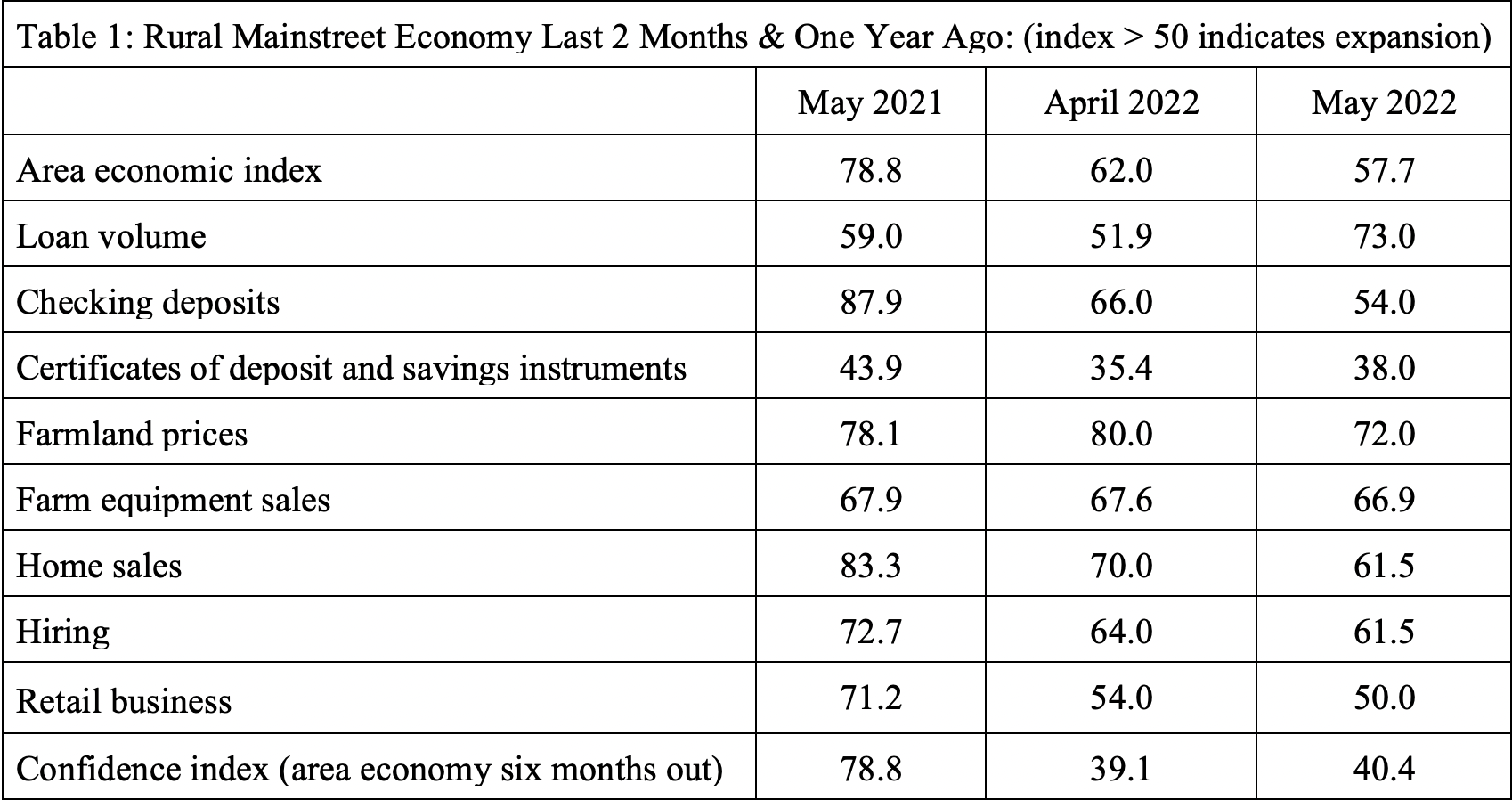
Creighton University chart compares current month to last month and year ago; click here to download it and chart below.

Rural bankers in 10 Midwestern states that rely on agriculture and energy report local economies that are still growing, but less than in recent months because of inflation and supply-chain problems, according to a monthly survey in May. The Rural Mainstreet Index polls bankers in about 200 rural places averaging 1,300 population in Colorado, Illinois, Iowa, Kansas, Minnesota, Missouri, Nebraska, North Dakota, South Dakota and Wyoming.

The overall index fell to 57.7 in May, down from April's 62. That's still growth-positive, but marks the index's lowest point since February 2021. "Much like the nation, the growth in the Rural Mainstreet economy is slowing. Supply chain disruptions from transportation bottlenecks and labor shortages continue to constrain growth. Farmers and bankers are bracing for escalating interest rates — both long-term and short-term," writes Creighton University economist Ernie Goss, who compiles the index.

Increased farming input costs have pushed borrowing to its highest reading since May 2020. Meanwhile, "the region’s farmland price index for May sank to a still strong 72.0 from 80.0 in April, marking the 20th straight month that the index has moved above growth neutral," Goss writes. "Over the past several months, the Creighton survey has registered the most consistent and strongest growth in farmland prices since the survey was launched in 2006."

Most bankers polled, 70.4%, said the Federal Reserve Open Market Committee should raise interest rates by 0.50% when it meets in mid-June. A plurality of 34.6% said that average local non-irrigated croplands (but not pasturelands) will fetch more than $300 cash rent per acre this year. And most predict that 2022 net farm income will be somewhat higher than last year's (33.4%) or about the same as last year's (37.0%). Only 3.7% believed it would be much higher.