Showing posts with label mass transit. Show all posts

Wednesday, November 16, 2022

As federal government considers first big Amtrak expansions in decades, southern Montana has a plan

An Amtrak trains passes Whitefish Mountain in northern
Montana. (Photo by Heath Korvolo, Getty Images)

In 1979, Congress enacted major cuts for Amtrak, which left southern Montana with no passenger train service. "More than a dozen Montana counties have banded together in an effort to bring Amtrak service back to the southern part of the state, hoping that the year-old federal infrastructure law will finally help them restore a train line lost decades ago," reports Daniel C. Vock of Route Fifty. "The one-of-a-kind effort might be unique to Montana, but it underscores the stakes for cities and local governments as the federal government considers major expansions to passenger rail service for the first time in decades."

“There’s a strong economic case to be made for passenger rail because trains are economic lifelines. They’re transportation lifelines,” Jason Stuart, vice chair of the Big Sky Passenger Rail Authority, told Vock. “All these communities in this part of the world here on the northern Plains are all in the same situation: We’re so far distant from anything.”

Dave Strohmaier, a Missoula County commissioner who lives more than 500 miles west of Stuart, is chair of the Big Sky authority. He told Vock, "Restoring an old Amtrak route would also link the state’s major urban centers – Billings, Bozeman, Helena and Missoula – while giving more options to rural communities and this provides transportation options to seniors, to veterans and to students."

Montana is almost as large as California and away from the Empire Builder route in its north, it has four options for travel: motorized vehicles, aurplanes, bicycles and horses. "Several cities have air service, but flights generally connect to out-of-state hubs making travel within Montana expensive and time-consuming. Montana’s landscape makes driving difficult, given the long distances between cities and treacherous winter weather. Montana regularly has one of the highest traffic fatality rates per mile driven of any state in the country," Vock reports.

Big Sky Passenger Rail Authority map of Montana and its counties; for a larger version, click on it.

Tuesday, May 31, 2022

Many seniors may still lack transport despite $2 billion investment; Rural Transit Fact Book has much local data

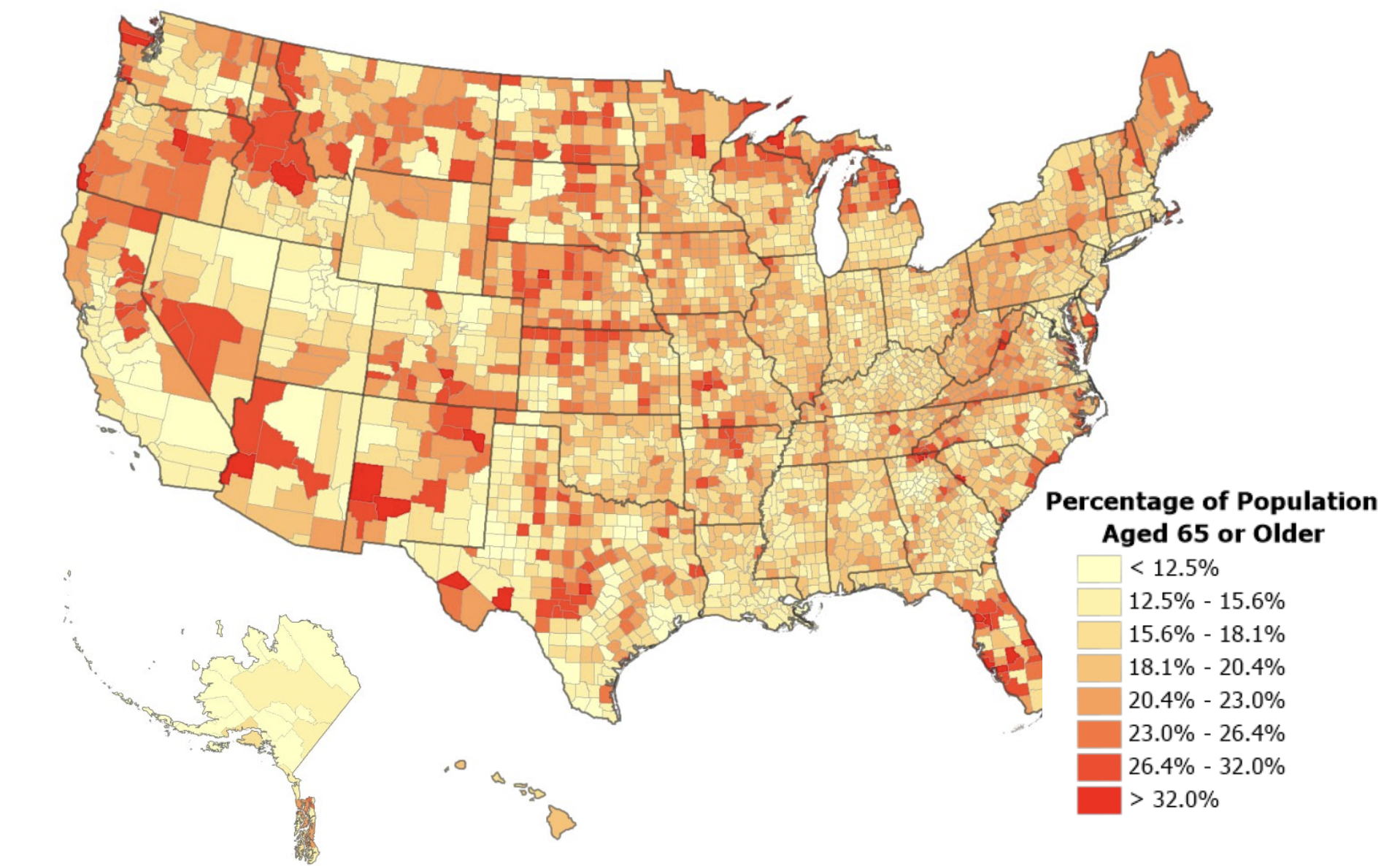
Estimated percentage of county population aged 65 or older in 2019
(Rural Transit Fact Book map from Census Bureau's American Community Survey data)

"Millions of older adults living in rural America no longer drive and don’t have adequate access to alternative transportation that can assist them with rides to banks, pharmacies and other important places, "Deon Hampton reports for NBC News. "President Joe Biden’s infrastructure law is set to unlock $2 billion in federal money for various rural transit projects. But it still may not be enough to solve the seemingly intractable problem of inadequate transportation for rural older adults."

An estimated 3 to 9 million rural Americans depend on transit programs to get around; they're disproportionately senior citizens, people with disabilities, Appalachians, and/or people living in low-income households, Hampton reports. Some can't drive anymore, some don't want to drive, and some can't afford their own vehicle, according to the Rural Transit Fact Book published earlier this year by the Upper Great Plains Transportation Institute's Small Urban and Rural Center on Mobility at North Dakota State University. (The report has a wealth of maps and county- and state-level data.)

Lack of access to mass transit can exacerbate food insecurity and make it harder for vulnerable populations to access health care, especially during the pandemic. Rather than the buses and subways that characterize urban mass-transit services, rural services tend to rely on volunteers driving vans or small buses that pick up riders on-demand rather than operating on a fixed route. Such rural transit services could get a share of the transportation funding, but much will likely go to infrastructure projects such as highways, bridges and dams. "The Transportation Department will award up to $300 million in grants this year and $2 billion over the next five years as part of the program," Hampton reports.

Friday, April 22, 2022

Pandemic roundup: Seniors, diabetics, and loved ones left behind reflect on disease that has killed 1 million in U.S.

Here's a roundup of recent news stories about the pandemic and vaccination efforts:

Older Americans reflect on what the pandemic has taken from them. Read more here.

According to the Centers for Disease Control and Prevention, 87% of U.S. children who were hospitalized with Covid-19 during the Omicron surge were unvaccinated. Read more here.

The long-term consequences of the coronavirus pandemic are starting to become clearer, writes the former editor of DTN/The Progressive Farmer. Read more here.

The U.S. death toll from Covid-19 will soon surpass 1 million if it hasn't already. The Atlantic's Ed Yong writes about how many Americans who have lost someone feel their grief has been "intensified, prolonged, and even denied by the politics of the pandemic." Read more here.

Kaiser Health News takes a snapshot of a rural Pennsylvania county with one of the highest Covid-19 death rates in the nation. Read more here.

Diabetics have been one of the hardest-hit groups by the coronavirus. Experts hope policymakers will notice and increase efforts to address the nation's diabetes crisis. Read more here.

The Food and Drug Administration has authorized the first breath test to detect the coronavirus. Read more here.

The recent ruling that vacated the Biden administration's mask mandate for public transportation has dealt another blow to the dozens of small mask factories scattered across the country. Read more here.

Thursday, March 31, 2022

Learn about impact of transportation on rural health care

The Rural Health Information Hub has a new information guide and toolkit on rural transportation.

The guide focuses on the importance of transportation in rural health care: "The availability of reliable transportation impacts a person’s ability to access appropriate and well-coordinated healthcare, purchase nutritious food, and otherwise care for themselves," says the RHIHub website. "This guide focuses on how communities can provide transportation services to support access to rural healthcare, which may also benefit healthcare providers by decreasing inappropriate use of EMS services, improving utilization of healthcare services, decreasing no-show rates, and increasing access to health-supporting services. The guide also highlights transportation as a community-based service that can allow the elderly and people with disabilities to live successfully in a community rather than entering a long-term care facility or leaving the community."

Rural residents most likely to need transportation services to maintain their health include seniors, people with disabilities, low-income individuals and families, veterans, and people with special health-care needs who often must travel long distances to access care, the guide notes.

The toolkit, meanwhile, "provides guidance, resources, and model programs to aid the development, implementation, and evaluation of transportation programs to support rural communities."

Friday, March 04, 2022

Quick hits: Appalachian businesses sought for local food guide; webinar covers public transit's role in rural health-care access; exposé prompts Ala. police chief resignation

Here's a roundup of stories with rural resonance; if you do or see similar work that should be shared on The Rural Blog, email us at heather.chapman@uky.edu.

The Agriculture Department has announced 11 regional positions, including three Farm Service Agency state executive directors and eight Rural Development state directors. Read more here.

Here's a great example of a metro paper doing due diligence in rural accountability reporting: In Brookside, Ala., pop. 1,253, a police chief hired in 2018 spearheaded an effort to bring in more revenue through fines and civil forfeitures. Revenue from such tactics increased by 640% from 2018 to 2020. Meanwhile, the town's part-time municipal judge and prosecutor also got outsized pay raises. The police chief resigned in January after AL.com published the first story about the issue. Read more here.

Appalachian Sustainable Development is seeking farmers, food producers, breweries, wineries, restaurants, farmer's markets, food pantries, small businesses, and more to add a free listing to its Local Food Guide. Read more here.

A recent Rural Health Information Hub webinar explored the role of public transportation in rural health-care access, especially for seniors and those with disabilities. Listen to the recording here.

Thursday, July 29, 2021

What's in the bipartisan infrastructure bill? How's it funded?

What's in the bipartisan infrastructure bill pending in the Senate? The Wall Street Journal reports:

"According to the White House, the bill will include $110 billion in funding for roads, bridges and major projects, as well as $39 billion to modernize and make public transit more accessible to the disabled and elderly. The deal also includes a $66 billion investment in rail maintenance, modernization and expansion. The legislation will provide $11 billion in funding for highway and pedestrian safety programs. A total of $7.5 billion will go to implementing a network of electric vehicle chargers, and another $7.5 billion will be used for zero-emission or low-emission buses and ferries. Ports and airports will be boosted with $42 billion in new spending."

The next paragraph of the WSJ story has more rural resonance: "$50 billion to bolster the country’s infrastructure generally against climate change and cyberattacks," which threaten rural water systems. "$55 billion will go toward clean drinking water and $65 billion will go toward broadband infrastructure and development. The deal invests $21 billion in removing pollution from soil and groundwater, job creation in energy communities and a focus on economic and environmental justice. The legislation will include $73 billion to update and expand the power grid," which will have much rural construction.

And how will it be paid for? "a variety of revenue streams, including more than $200 billion in repurposed funds originally intended for coronavirus relief but left unused; about $50 billion will come from delaying a Trump-era rule on Medicare rebates; and $50 billion from certain states returning unused unemployment insurance supplemental funds. The negotiators also expect about $30 billion will be generated from applying information-reporting requirements for cryptocurrency; nearly $60 billion will come from economic growth spurred by the spending; and $87 billion from past and future sales of wireless spectrum space. A series of smaller pay-fors are expected to make up the difference."

And what's next? "House Majority Leader Steny Hoyer of Maryland said Tuesday that House Democrats may want to tweak the bill to include more climate provisions. But he has also acknowledged such a move could put the bill’s chances in jeopardy in the Senate. If the House changes the bill and passes its own version, the Senate will need to vote on the House version. If they cannot pass the House version, the chambers could also go to a conference committee where they would try to bridge the gap."

Wednesday, July 28, 2021

Senators reach apparent deal on infrastructure package

"Senate Democrats and Republicans on Wednesday appeared to clinch a deal that would invest roughly $1 trillion into the nation’s infrastructure," reports Tony Romm of The Washington Post. "The political breakthrough appeared to put the Senate on track to hold a key procedural vote Wednesday that would allow the chamber to begin debating the infrastructure measure. Senate Majority Leader Charles E. Schumer (D-N.Y.) has said he hopes to pass the package before the August recess."

The apparent breakthrough was "announced separately by two of its lead negotiators, Sens. Rob Portman (R-Ohio) and Kyrsten Sinema (D-Ariz.)," Romm reports. "It came just days after talks appeared to have run aground. Lawmakers found themselves at a stalemate over how to spend money to improve the nation’s railways, water pipes and Internet connections, as well as the exact means by which to pay for it. The disagreements ultimately scuttled an attempt last week to open debate on the infrastructure proposal, which Republicans blocked unanimously since the proposal hadn’t yet been finished."

The Associated Press reports that Republican senators met this morning with their leader, Mitch McConnell of Kentucky, "who appears to have given his nod to proceed." Ohio Sen. Rob Portman, the lead GOP negotiator, "said McConnell 'all along has been encouraging our efforts'."

Even if the agreement proceeds, it is only the beginning of a battle "over a massive measure that would touch nearly every part of the economy," Romm writes. "To shepherd it through the Senate, Democratic leaders must ensure the measure remains attractive to those in their own party as well as Republicans, without whom they do not have the 60 votes to overcome a filibuster."

Also, the plan "is only one component of Biden’s broader economic agenda, and Democrats plan to try to move a second, roughly $3.5 trillion package essentially in tandem," Romm notes. "Party lawmakers plan to rely on a legislative maneuver known as reconciliation to adopt it using 51 votes, rather than the typical 60, allowing Democrats to bypass what is likely to be overwhelming GOP opposition to the budget deal."

Friday, February 26, 2021

Inequality-research organization says rural public transit needs more investment during pandemic

"With the pandemic taking a devastating toll on local budgets, the U.S. public transit system is battling to survive. For much of the country, this funding crisis jeopardizes an already withering lifeline," Kayla Soren writes for the Institute for Policy Studies, a nonprofit that studies structural inequalities. "For many Americans, public transit is the only option to get to work, school, the grocery store, or doctor’s appointments. But nearly half of us have no access to public transit. And those that do are now confronting limited routes, slashed service times, and limited disability accommodations."

More than a million rural households lack a vehicle and must depend on informal arrangements, ride-hailing services such as Uber, and/or public transit services to get around. The need is especially acute for rural residents who can't drive because they have a disability. "Over 80 percent of young adults with disabilities are prevented from doing daily activities due to a lack of transportation. And there aren’t enough resources to properly train transit workers for accommodating people with disabilities."

Rural public transit services are also critical for essential workers, the elderly and those who serve them, and survivors of domestic abuse. Dozens of transit riders and workers, many rural, testified at a recent two-day national community hearing about their needs for public transit. It's "unacceptable" that millions of rural Americans must get by with inadequate or no public transit, Soren writes.

"Congress can help. Public transit needs at least $39 billion in emergency relief to avoid service cuts and layoffs through 2023. But more broadly, we need to revise the '80-20' split that’s plagued federal transit funding since the Reagan era — with 80% going to highways and less than 20% to public transit," Soren writes. "Part of the justification for this disparity is that only people in dense, urban areas use transit. This is upside-down logic. The hearings reveal that when people don’t use transit, it’s because it is nonexistent, unreliable, or inaccessible."

Some inequalities go even farther than rural vs. urban: A new fact sheet published by the Appalachian Regional Commission illustrates disparities in public transit between not just rural and urban counties, but between rural counties outside of Appalachia vs. within Appalachia. As the report notes, only 7% of rural Appalachian counties served by fixed-route transit services have evening service, compared to 50% of non-Appalachian rural counties in Appalachian states.

Wednesday, February 17, 2021

Rural public transit agencies struggling in pandemic; advocate says drivers should be prioritized for vaccine

"In communities where the nearest hospital or supermarket may be an hour’s drive away, rural public transportation meets residents’ most basic needs. But at the start of the pandemic, ridership of public buses and vans—commonly ridden to crucial destinations like work, dialysis appointments, and the grocery store—declined by 90 percent in some rural areas," Olivia Weeks reports for The Daily Yonder. "According to a January survey of more than 100 rural and small-urban transit agencies by the Community Transportation Association of America, rural transit operations reported a 52.2% decrease in ridership since this time last year."

Loss of customers means a loss of revenue, which can make it difficult for transit agencies to stay open since they still must run routes and pay maintenance costs and salaries. "Maintaining staff is crucial even when ridership is low—a typical 16-passenger rural transit bus can safely fit only four people with proper social-distancing. Often it takes two buses to transport eight people when, prior to Covid-19, one bus could fit 16," Weeks reports. "The problems with restoring that ridership are plentiful: rural transit vehicles are small and social-distancing is difficult, drivers and riders are often high-risk for Covid-19, and vaccine availability varies widely from state to state."

CTAA director Barbara Cline said rural transit drivers must be prioritized as frontline workers and that rural America needs more access to vaccines, Weeks reports. The Federal Transit Administration has suggested that public transit providers facing low ridership should partner with local governments to provide essential community services during the pandemic such as meal delivery and vaccine distribution. CARES Act funding can assume the costs.

Friday, May 01, 2020

Quick hits: How to deal with conspiracy theories in the pandemic; a program to help rural sexual-assault survivors

Here's a roundup of stories with rural resonance; if you do or see similar work that should be shared on The Rural Blog, email us at heather.chapman@uky.edu.

How can local officials deal with conspiracy theories during the pandemic? Read it here.

Genetic engineering could bring back the American chestnut tree. Here's the latest update.

A Penn State program aims to better help rural sexual assault survivors through telehealth and more. Read about it here.

An energy analyst with the Union of Concerned Scientists discusses what coal communities need to recover from the pandemic. Read it here.

Pandemic hurts rural mass transit agencies. Read more here.

Friday, January 17, 2020

Quick hits: Washington community tries a creative solution for its shortage of mental-health-care providers

Here's a roundup of stories with rural resonance; if you do or see similar work that should be shared on The Rural Blog, email us at heather.chapman@uky.edu.

A rural town in Washington state is trying to mitigate mental health care provider shortage by weaving mental health into primary-care appointments. Read more here.

A new poll shows that rural and small-town voters in Vermont and along the Eastern seaboard believe their communities don't get their fair share of transportation funding, and most also want more environmentally friendly transportation and transit options, writes the Vermont director of The Nature Conservancy. Read more here.

A new book explores the offensive term "white trash" along with the place impoverished white people hold in American society. Read more here.

The Department of Agriculture is hosting a series of workshops about the Rural Development Broadband ReConnect Program. The first one will be in Denver, Feb. 12-13. Read more here.

The FBI says it will alert states when local election systems have been hacked. Read more here.

A federal judge has blocked state and local veto power over refugee resettlement. Read more here.

Wednesday, January 15, 2020

GAO report recommends rural transit improvements

The Government Accountability Office said in a recent report that the Federal Transit Agency must better coordinate with state and local governments to help rural transit services reduce costs, increase efficiency, and improve service, Bill Lucia reports for Route Fifty.

An FTA database lists about 1,500 rural transit providers. Such service can be critical for those who can't drive, such as seniors, the poor, or disabled. Coordination among rural areas is essential because passengers often need to travel long distances to access grocery stores or doctors, the report said.

But coordination can be challenging, so the report recommends that the FTA come up with a better plan for communicating with state agencies and local transit providers as well as best practices for carrying out the plan. "This might include taking steps like setting common drop-off points or schedules, or aligning service to ease access to places where people go for medical care," Lucia reports. The report notes that all of the rural transit providers interviewed for the report already coordinate with each other on a limited basis.

Rural transit providers often face obstacles that can limit transit or coordination, including "staff shortages, tight funding, limited technology and long distances between the places where they operate and the neighboring jurisdictions serviced by their counterparts," Lucia reports. In the past three years, "the FTA has allotted about $2.1 billion in grants to support public transit in rural areas, including tribal lands."

Thursday, October 31, 2019

Rural seniors face unique challenges; analyst says rural communities of faith can be important in helping them

A senior fellow at The Urban Institute who writes often about issues affecting senior citizens provides a cogent summary of major issues facing seniors who live in rural areas.

"According to a new report by the U.S. Census Bureau, about 10.6 million older adults live in rural communities—roughly one quarter of all seniors. But they represent a much larger fraction of their local populations than urban seniors," Howard Gleckman writes for Forbes. "About 17.5 percent of rural residents are over 65, while only about 14% of urban residents are older adults. Three-quarters of rural older adults live in the South and Midwest, but in states such as Maine and Vermont almost two-thirds of seniors live in rural communities." Gleckman also notes that the more rural a place is, the older average age its population is likely to have.

Here's a brief summary of Gleckman's points:
  • Rural seniors are, on average, poorer and sicker than their urban counterparts. They're more likely to be white and less educated, more likely to be male, less likely to be living in a nursing home, and more likely to be living in poverty. They're also more likely to suffer from chronic diseases. 
  • Transportation is a problem for seniors everywhere, but particularly for rural seniors with little to no public transportation, and especially in the winter.
  • Many rural seniors have a hard time accessing health care because their communities are less likely to have hospitals or full-time physicians.
  • Rural seniors are more likely to live in older, multi-story homes, which limits their ability to get around the house to take care of maintenance. 
  • Because of the mobility and transportation issues mentioned above, rural seniors often have a harder time maintaining social relationships, especially if their grown children have left town to work in a city.
"There are solutions," Gleckman writes. "For example, faith communities are especially important in rural areas, where they may be among the last remaining social institutions. They can work together to support congregants (or others) who need help. Local governments, fraternal organizations and other nonprofits—even with limited resources—can build programs that assist seniors aging at home. Programs such as Meals on Wheels or even postal workers can look in on homebound seniors."

Wednesday, July 10, 2019

1 in 5 rural seniors are insecure about getting enough to eat


One in five rural seniors has difficulty getting enough to eat, according to a new study from nonprofit organization Feeding America.

Study co-author James Ziliak of the Center for Poverty Research at the University of Kentucky notes that rural economies haven't recovered as quickly from the Great Recession. "Lack of jobs, lack of access to food and lack of income are hampering seniors’ ability to rest assured that they will have food when they want it," Liz Carey reports for The Daily Yonder.

Nine of the top 10 states for food insecurity among seniors are in the Southeast. Nearly a third of seniors living below the poverty line are food insecure, which means they don't know if they'll have enough to eat. And about half of those seniors have very low food security, meaning they worry about food access frequently, Carey reports.

"Despite an improving economy and financial markets, millions of seniors in the United States are going without enough food due to economic constraints," Ziliak wrote in the study. "This stubbornly high proportion of food-insecure seniors continues to impose a major health care challenge in the U.S. One group of practical concern is those seniors experiencing VLFS (very low food security), the ranks of which have especially swelled since 2001."

The study found that rural seniors are more likely to be hungry if they're divorced, widowed or separated; if they're sick, disabled or unemployed, or if they're renters, Carey reports. Lack of transportation can also be a factor: they can't get food if they can't get to the store or the food bank.

Seniors are less likely to take advantage of assistance like the Supplemental Nutrition Assistance Program because of pride, or because they don't know they qualify, says Michael Halligan, the CEO of God's Pantry, a food bank in Lexington, Kentucky. "I think we need to really think through how we’re going to take care of folks as our society ages," Halligan told Carey. "It’s great to say people need a larger nest egg to live on, but how do we ensure people are stable? How do we get services to where people live rather than where they aren’t? I think we really need to envision and reimagine solutions to the problems that I see as indicators of increased risk for all seniors."

Tuesday, February 12, 2019

In Maine, the most rural state, deaths outnumber births; the only other state with that demographic is West Virginia

In Maine, the nation's most rural state in population percentage (61.3%), seniors account for a rapidly increasing share of the population; demographers say the trend has reached a tipping point.

"As baby boomers head into retirement, and many young people move away in search of opportunity, Maine is one of only two states, along with West Virginia, where deaths now outnumber births," Brian MacQuarrie reports for The Boston Globe. "That gulf is reshaping life here in myriad ways, from shrinking the workforce to intensifying the demand for services for the elderly, and it will only widen in the coming years, demographers predict.

Maine already has more seniors than minors, partly because of rising life expectancy and falling fertility rates: the statewide median age is 44.7;  the national average is 38. By 2026 the number of seniors (65 and older) is expected to increase another 37 percent from the 2016 level, while all other age groups are forecast to decline, MacQuarrie reports.

Portland Press Herald chart
The state's lopsided demographics are already causing headaches for employers as they struggle to fill jobs from a labor pool that isn't growing -- especially in the health-care industry, a primary need of seniors. Local taxes are increasing, sometimes because of the need to fund programs for seniors, MacQuarrie reports. Because many seniors are no longer able to drive, figuring out transportation is an important issue for local leaders, as well as food, isolation, and access to cellphone and internet service.

"We’re definitely under the gun,” Jessica Maurer, executive director of the Maine Council on Aging, told MacQuarrie. "It’s a mixed bag, because there’s obviously really good news in that we’re living longer than ever. But we haven’t done a good job of planning for what’s next."

Monday, February 04, 2019

Report: Driverless cars can't solve rural transportation woes without broadband and better-marked roads

Scanty public transportation means rural residents already have a harder time getting around without a car than people in urban areas. That gap is likely to stay the same or widen once self-driving cars become more common, according to a recent report by the Berkshire County Selectmen's Association, which represents 30 towns in far western Massachusetts. The issues there are much the same as those facing rural areas across the nation.

"Hundreds of country roads in Berkshire County will be off-limits to autonomous vehicles, unless telecommunications gaps are plugged and roads themselves improved," Larry Parnass reports for The Berkshire Eagle.

Rural residents' difficulty in getting around hampers economic development, limits access to health care, and forces schools to spend too much money on transportation, according to BCSA president Andrew Hogeland. He served on the statewide Commission on the Future of Transportation, which issued a report in December with recommendations for improving rural transportation, Parnass reports.

Both the BCSA and CFT reports say school transportation needs a makeover. School buses are a huge expense for rural school districts and sit idle for most of the day, Hogeland said. The reports also agree that the lack of public transportation in rural areas makes aging in place more difficult for seniors and makes residents more vulnerable to food deserts, Parnass reports.

Thursday, January 24, 2019

Shutdown puts rural bus systems and riders in dire straits

The partial federal-government shutdown, now the longest in U.S. history at 34 days, is prompting some rural, small-town and mid-size public transit systems to reduce services and consider furloughs or shuttering completely.

"The trauma for crucial transportation lifelines in rural or small-town America, including in states President Donald Trump won in 2016, underscores the damage the 34-day shutdown is inflicting hundreds or thousands of miles from Washington, D.C.," Tanya Snyder reports for Politico. "While the loss of federal dollars is hitting transit systems large and small, including those inside the Beltway, the most vulnerable agencies are those that don’t get significant state support. And their riders are primarily low-income seniors, people with disabilities and veterans."

One operator told Snyder it might be easier to close down entirely until the shutdown ends, rather than closing some routes. Picking routes to close could provoke complaints under civil-rights laws or the Americans with Disabilities Act, he said. But even if a bus system closes for the duration of the shutdown, it must continue to pay some expenses, such as insurance premiums and utility bills. 

Another bus-system administrator voiced fears that, if furloughed drivers start quitting, it could be difficult to hire more, since they'd need to pass a drug screening and an extensive background check and have a commercial license. Also, if routes close temporarily, bus riders might find another way to get where they need to go and won't keep riding the bus after it resumes service, Snyder reports.

"Transit agencies are accustomed to continuing resolutions and short lapses in federal funding," Snyder reports. The Federal Transit Administration "normally waits until it has four or five months of funding before it begins to distribute it to states and transit agencies. But agency heads worry that even if a deal were reached today, it could take months to process all the funding requests from all 50 states that have languished for a month."

Tuesday, May 01, 2018

Research looks at rural attitudes about self-driving vehicles

Self-driving vehicles will mean big changes for America, including rural areas, but most research has focused on their impact in urban areas, Kali Katerberg reports for The Daily Mining Gazette in Houghton, Mich. A team of Michigan Technological University students studied possible impacts in rural areas as well as knowledge and attitudes of rural citizens about self-driving cars, using Houghton for a case study.

"The class was tasked with determining environmental, social and economic impacts of Level 4 autonomous vehicles, part of a competition known as the AutoDrive Challenge," Katerberg reports. "Level 4 refers to vehicles that are self-diving but unable to deal with every scenario."

Houghton was a desirable test subject because it has one dominant employer, and a median income and poverty rates that are about average for rural areas. Students asked parents and the elderly about what the environmental, economic and social impacts they believed self-driving vehicles would bring.

The results found a high number of neutral responses, between 20 and 30 percent. Participants also raised questions about unexpected topics such as land use and parking. Elderly participants were most excited about the idea of autonomous vehicles, but only 36 percent of young adults were comfortable with the idea of riding in one. Many were concerned about the high initial cost of the vehicles, and 60 percent said they wouldn't buy one. "After their research, the team felt a shared-use system would be the most feasible for a community like Houghton and help autonomous vehicle companies restore lost trust among consumers," Katerberg reports. The team also determined "there would need to be significant changes to infrastructure" to accommodate the vehicles.

Friday, January 22, 2016

After Minnesota official took office, his firm got disputed $64,000 for rural bus routes the firm ran

Zelle (StarTrib photo by Glen Stubbe)
"Minnesota’s top transportation official has asked for a review of steps he took to distance himself from his former bus company after the state paid the business $64,000 for work on a contract that had expired," reports Ricardo Lopez of the Minneapolis Star Tribune, who discovered the payment by going through 5,000 emails involving Charlie Zelle, commissioner of the state Department of Transportation. Zelle said he had been unaware of the payment or the request for it.

Zelle resigned as CEO of Jefferson Lines when Gov. Mark Dayton appointed him in 2012 but remains chairman of the family-owned company, which runs rural routes "that would likely go away without taxpayer subsidies," Lopez writes. "Both companies received nearly all of available state and federal grants, or $2.3 million, in 2013, according to a MnDOT report. Those funds accounted for nearly 60 percent of the companies’ budget to operate the subsidized routes that year."

The emails "reveal sometimes deep disagreement over the Jefferson Lines payment and highlight the potential conflicts that Dayton faced in selecting a transportation chief with close ties to a company that still does business with the agency," Lopez reports. "Two officials from MnDOT reviewed the request and rejected it, saying the claim was for work beyond the scope of two contracts that stretched from 2007 to 2011. Just a few weeks after Zelle took over as commissioner, Jefferson again asked the state to be paid for the old contract. This time, they got it, but with it came staff criticism of the unusual payment."

“None of this passes the smell test,” department Audit Director Daniel Kahnke told nine staff members, including an assistant commissioner. "Mike Schadauer, MnDOT’s Office of Transit director, said the situation was the result of an error that should have been caught sooner," Lopez reports.

Friday, September 11, 2015

Transportation Secretary pitches rural transit during closing session of National Rural Assembly

Anthony Foxx
Rural areas need more options for public transit, Secretary of Transportation Anthony Foxx said during a speech Thursday at the National Rural Assembly in Washington, D.C., Tim Marema reports for the Daily Yonder. Foxx said, "One of the myths I’m trying to dispel is that transit is an urban phenomenon and that all rural communities care about is roads. I’ve seen too much to believe that. I’ve heard from rural people who have said, ‘I’d still be unemployed if I didn’t have a van or bus to get to my new job.’ Or ‘I have an older person I couldn’t get to the doctor or the clinic if it weren’t for transit.'”

Foxx, who urged poeple to speak up about the vitality of transit in rural areas, said, “We as a nation—we cannot afford to have our rural communities disconnected because the fiber of this country is knitted together by every single place. Every community matters. . . . Transportation is something that we do together. I’ve never seen a ‘single-person’ road before. I’ve never seen a ‘Democrat-or-Republican’ road, a rural-or-suburban-or-urban road."

Foxx also discussed the difficulty in rural road repair projects, Marema writes. He said "rural areas—like the rest of the nation—face a backlog in basic repairs and maintenance to infrastructure like roads and bridges," Marema writes. "But DOT grants for local improvements can be a big problem for smaller communities because of 'match.' DOT grant programs like TIGER require local government to match federal dollars with their own spending. Small and poor communities can suffer, as a result, Foxx said. (Read more)