Showing posts with label environment. Show all posts

Sunday, July 12, 2026

A look back at fracking, from a leading reporter on the beat; environmental questions remain as industry shifts

Mike Soraghan started out with Energy and Environment News, which was bought by Politico, so now he writes for both. His latest opus is a look back at the history of horizontal hydraulic fracturing of deep shale, better known as "fracking," which has had a big impact on parts of rural America. Soragahn has covered it for more than a decade.

Mike Soraghan (Politico photo)
"Shale promised riches, and in some instances, it delivered, saving farms," he writes for Politico Magazine. "Fracking birthed tales of instant 'shale-ionnaires' and oilfield strippers tucking four-figure handfuls of cash in their garter belts for a night’s work. And it also fundamentally changed the United States’ position in the global energy economy, in ways that have been on prominent display over the first half of 2026.

"But a lot of the people you’d expect to profit from fracking . . . were instead crushed by it. And drilling wells could wreak environmental havoc, triggering earthquakes, ruining farmland, polluting airways and contaminating household water to the point it could catch fire. In short: Fracking rewrote the book on American energy, globally and domestically. . . . Today, even if you walk everywhere or drive an electric vehicle, fracking is responsible for keeping your grocery and electric bills down."

But now, "That tumultuous chapter is coming to an end, just as a war-driven energy crisis offers — or threatens — to rewrite the script once again. The irony is that the U.S. is outdoing the petro-kingdoms of the Middle East — just as the world is accelerating its turn toward renewable energy. The easy oil is getting harder to find. Even as production continues to climb, the rate of growth is slowing. Automation is replacing oil workers the way it did coal miners. Environmental protests have moved on to data centers. America’s wildcatters are again starting to scan the horizon for new discoveries abroad. Even Michael Steele, the former Republican Party chair who coined the term, 'Drill, Baby, Drill,' thinks the phrase has outlived its usefulness."

Environmental questions remain, especially "the long-term impact of pumping chemicals from the nearly 2 million fracked wells — questions that may not be answered for years or decades," Soraghan writes. Environmentalists are mostly against fracking shale, but Christopher Knittel, the associate dean for Climate and Stability at the Massachusetts Institute of Technology, told Soraghan that greenhouse-gas emissions have been cut mainly by power plants’ switch from coal to natural gas. More broadly, Knittel worries that the U.S. backoff from electric vehicles means the American industry could be “islanded off” from the rest of the world. "Perhaps the model for the United States’ energy future isn’t Saudi Arabia, but an actual island," Soragahn concludes.

Thursday, July 09, 2026

8 rural-related stories win Sigma Delta Chi awards, including reports on ICE, inequalities, firefighters, environment, etc.

Illustration from ProPublica story about Hurricane Helene and Yancey County, North Carolina

Eight rural-related stories were among winners of Sigma Delta Chi Awards for 2025, announced Thursday night by the Society of Professional Journalists (formerly Sigma Delta Chi) and the SPJ Foundation.

Investigate TV+, a unit of Gray Television, and KFF Health News won the award for broadcast coverage of inequalities in society with a package of three stories called "Dead Zone," explaining that millions of Americans "live sicker, shorter lives in hundreds of rural counties where doctor shortages are the worst and poor internet connections mean little or no access to telehealth services."

The award for public-service radio reporting in small markets went to North Country Public Radio of upstate New York for its report on the ICE raid on a dairy farm, which led to the release of a motherf and three children who were in a detention center awating deportation. "This issue is one that's forcing dairy farmers to sell their herds," the judges wrote. Here's the summary of the coverage and reaction.

Jennifer Berry Hawes, Cassandra Garibay and Mollie Simon of ProPublica won for "Helene's Unheard Warnings" in the category of non-deadline reporting in a publication with a print circulation of more than 40,000 or an online-only piublication. Their package of stories spotlighted the lack of evacuation orders, the hurricane's devastation and survival stories in Yancey County, North Carolina.

Hannah Dreier of The New York Times won the Public Service in Journalism award for her stories on the suffering of firefighters sent into fires by the U.S. Forest Service without warnings of toxic smoke and gases, and with a ban on wearing masks.

Dave Biscobing of KNXV in Phoenix won the large-market TV feature reporting award for his investigation of the sheriff in Prescott, Ariz., pop. 46,000, and "one man’s fight to prove self-defense against a top small-town fire official," as the report describes it.

The award for TV feature in small markets went to Kevin Kelly of KLRT in Little Rock for his story about a family in Vilonia, Ark., who saw their home and classic-car collection devastated by a tornado that killed nine people and injured dozens more in the town of 4,500. They restored the four cars a second time.  

Elise Plunk of the Louisiana Illuminator, Eva Tesfaye of WWNO in New Orleans and Chas Sisk of the Mississippi River Basin Ag and Water Desk won an award for a story on how an accidental delta taught scientists how to rebuilt wetlands. They won in the category for science or environment reporting in a publication with a print circulation up to 40,000 or an affiliated website.

The broadcast award in that category also went to a Louisiana story, "The True Cost of Fertilizer,"
by Garrett Hazelwood and Eric Schmid of "Sea Change" at WRKF in Baton Rouge and WWNO, with support from the Mississippi River Basin Ag and Water Desk, based at the University of Missouri.

The awards program also included announcement of the top Mark of Excellence Award for College Journalism, which went to a rural story: "Broadband’s broken promise: How federal failures and funding fights keep Native and Black farmers offline," done by Melissa Dai of Northwestern University during her summer internship with Investgate Midwest. The story had won the MOE award for investigative reporting, then was judged to be the top piece of college journalism in 2025.

Tuesday, May 19, 2026

Very rural New Mexico reaps millions in oil revenue

In the U.S., only Texas produces more oil than New Mexico.
(Photo by Laura Mann, Unsplash)
New Mexico's state treasury began reaping millions in oil revenue after global crude supplies were strangled in the Strait of Hormuz. 

Despite the predominantly rural state's dependence on fossil-fuel-generated revenue, the windfall has sparked mixed feelings for "Democrats who oppose the war and would rather reduce their reliance on fossil fuels," reports Morgan Lee of The Associated Press.

The Democratic-led "Land of Enchantment" is second only to Texas for oil production, and the "state’s revenue from taxes, royalties and lease sales helps cover the cost of college tuition, all school meals, health insurance and a new initiative for free universal child care," Lee explains.

Even seemingly small increases in crude oil prices can mean big money for the state. Lee reports, "For every $1 fluctuation in the average annual price of oil, New Mexico sees a roughly $59 million swing in state government income."

The state's treasury automatically channels increases in oil revenue "into a series of trust accounts designed to gradually reduce the state’s reliance on fossil fuels," Lee writes. Through investments, those trusts "underwrite Medicaid, early childhood education, infrastructure projects and an expansion of mental healthcare" in a very rural state that is "entrenched [with] swaths of extreme poverty and the nation’s highest enrollment rate in Medicaid."

New Mexico isn't the only rural state to see surges in state income because of the war with Iran. Lee adds, "In Alaska, the state forecast an additional $1.05 billion for the current fiscal year and the one beginning July 1."

Friday, March 13, 2026

Silicone wristbands can monitor exposure to 'forever chemicals' over time

Silicone wristbands could help scientists monitor for 
chemicals. (Venier Lab photo via The Conversation CC)
Silicone wristbands are a new noninvasive method to measure Americans’ exposure to "forever chemicals", or PFAS, reports Yaw Edu Essandoh for The Conversation.

These synthetic chemicals, often found in water systems, soils and consumer products, have been a growing public concern and become more prevalent in everyday environments, Essandoh explains.

Traditional monitoring tools for measuring their exposure have only used samples from a single point in time and can be invasive, like drawing someone’s blood or testing soil or water from one location on one day, reports Essandoh. However, Essandoh found from his environmental chemistry research that people or animals living in the same environment “showed very different chemical profiles.”

Since people are exposed continuously throughout the day, new noninvasive tools are becoming more popular to monitor exposure over a period of time, Essandoh reports. One such tool is the silicone wristbands, made of silicone polymer, which “absorb chemicals from the surrounding environment over time, similar to how skin or fur interacts with air, dust and surfaces." Researchers can then extract these compounds from the wristband and examine the pattern of exposure, once the wristband is worn for multiple days or weeks.

Other noninvasive methods scientists have started using to track exposure include “passive air samplers placed in homes or small wearable devices,” explains Essandoh. These types of devices can also be used for animals and wildlife, instead of drawing their blood, to better understand how PFAS affect their ecosystems and to identify emerging risks sooner.

Noninvasive monitoring tools aren’t meant to eliminate traditional monitoring, Essandoh explains, but to provide additional context to how exposure moves through time and space and to entice more volunteers to participate in studies. “They offer ways to better understand cumulative exposure, identify overlooked pathways and inform environmental health and conservation decisions.”

Tuesday, January 27, 2026

Spring is coming: Tips on exploring regional bird populations and what readers can do to help them rebound and thrive

The Kirtland's warbler was listed under the Endangered Species Act for more than 
50 years. (Photo by Joel Trick, Flickr Creative Commons, CC by 2.0 via SEJ)
Much of the steep decline in U.S bird populations since 1970 has been caused by human activity, which also means that human activity can reverse that trend. Local environmental journalists can uncover how people are harming birds and help readers learn how to help them recover. 

"If you look deeper into the causes of their decline, it will lead you to many other stories that are the bread and butter of environmental journalism: chemicals, land disturbance, local ecosystems and more. Also, insect decline," writes Joseph A. Davis for the Society for Environmental Journalists

As winter slowly slips into spring, bird populations will begin migrating again. Now is a good time to plan stories that explore how birds in your region are faring and provide readers with information that will help them enjoy the wonders of spring migration while supporting bird survival.

Davis provides the following information for journalists.   

Story ideas:

  • What were the findings of the Christmas Bird Count in your area? They’re just out — find them here. Talk to local experts about the reasons for the decline of favorite species.
  • Find out which migrating bird species go through your area. Where do they stop to rest or feed? What geographic features do they follow?
  • Do your bird migrants fly at night? Weather radar images of bird migrations at night make for cool graphics. BirdCast is one good place to find them.
  • What can homeowners do to help or hurt bird populations? Lawn chemicals? Native plants? Bird feeders (in my town, we call them cat feeders)?
  • What are the ecological features that offer the best habitat and food to birds flying through your area? Coastal wetlands? Prairie potholes?
  • How do birds sleep when they migrate? This Associated Press article is very suggestive.
  • Are H5N1 bird flu or other diseases hurting the population of migrating birds in your area? Talk to wildlife biologists.
  • What has the Trump administration done to strengthen or weaken the enforcement of the Migratory Bird Treaty Act?

Reporting resources:

  • Cornell Lab: Cornell University’s Ornithology Laboratory is a treasured resource for anyone who wants to know more about birds.
  • Merlin: This smartphone app goes anywhere with you and helps you identify birds, not only by their appearance but also by their songs and calls. Made by Cornell Lab. You need this app. Download it free here.
  • U.S. Fish & Wildlife Service: USFWS runs a fleet of some 570 wildlife refuges, many of which are rest stops for migrating birds. They often have interpretive staff or even bookstores.
  • American Birding Association: Another membership association with local chapters. A good way to meet local birders.
  • Local wildlife refuges: Beyond the national system, there are many state, local and private sector refuges which are open to the public. Talk to staff.
  • State wildlife agencies: A good way to zero in on your particular area.
  • Academic ornithology departments: The Wilson Ornithological Society has a nice list of serious ornithology programs.

For more about bird reporting, go to: TipSheets on how the simple backyard bird feeder can lift local environment reporting, and on declining bird populations, talking to birders and the problems of lead ammunition, plus a Reporter’s Toolbox on a bird migration explorer. Also, get the latest EJToday headlines about birds

Tuesday, September 09, 2025

Iowa's water is polluted with farming nitrates and pesticides, but a potential solution challenges the 'status quo'

Crop and animal farm runoff has polluted at least
four Iowa rivers. (Adobe Stock photo)
In agriculturally dominated Iowa, what's good for corn producers gets top billing while residents face a deluge of polluted water. "In Iowa, which by some measures has the most polluted water in the U.S., people who advocate for the environment are widely scorned as enemies of farming," reports Peter Waldman of Bloomberg.

In a state where farmers spread copious amounts of pesticides, nitrogen fertilizers and nitrogen-rich manure, towns like Remsen, which is surrounded by Iowa corn country, are "saturated with pollution," Waldman writes. "Researchers have linked trace exposures to nitrate in drinking water to cancers, birth defects and thyroid disease. Iowa has the second-highest cancer rate in the U.S., after Kentucky."

Although concerned citizens, including many farmers, have pushed for fewer pesticides and nitrates, most efforts failed. "The state government has crushed almost every effort to hold farmers and agribusinesses accountable for their increasingly dirty footprint," Waldman explains. Last year, the EPA ordered Iowa to "add parts of four rivers to the state’s list of impaired waters needing cleanup, including the drinking supply for about a fifth of Iowa’s population."

Even with some of the state's drinking water in question, the state complained about the EPA's sanction, which the Trump administration lifted. Waldman reports, "Now even the feds defer to Big Ag, led in Iowa by the industry’s undisputed champion in the state, the Iowa Farm Bureau Federation."

Remsen is located in eastern Plymouth County, 
in the heart of Iowa's corn belt. (Adobe Stock photo)
Without support, Remsen's water continued to be polluted. Despite investigations, area wells were allowed to fill with possibly toxic nitrates. "From 2016 to 2020, Remsen’s five-year rate of colorectal cancer, one of the cancers associated with nitrate exposure, was 19% higher than Iowa’s," Waldman adds. "By 2017, the shallow wells that supplied Remsen’s drinking water were so loaded with nitrates they had to be shut down."

Farming without so many nitrates and pesticides is possible. Matt Liebman, a retired agronomy professor at Iowa State, told Waldman, "What it takes to grow food with less pollution isn’t a mystery. . . .But the solution threatens the status quo. You can’t sell as much fertilizer, hybrid seeds or animal feed. For those companies, the solution is the problem.”

Tuesday, August 26, 2025

Green funerals are cheaper, easier on the planet and increasingly an end-of-life option

Shrouded body prepared for green burial.
(Larkspur Conservation photo)
Americans may not be able to choose how and when they die, but they can make arrangements for what happens to their body afterward. For many people, the challenges involved in creating and paying for interment have led them away from traditional funeral preparations such as embalming, a casket and a plot of land. "More Americans are choosing burials in which everything is biodegradable," reports Paula Span of The New York Times.

Although a consumer survey conducted by the National Funeral Directors Association "found that fewer than 10% of respondents would prefer a green burial (compared to 43% favoring cremation and 24% opting for conventional burial), more than 60% said they would be interested in exploring green and natural alternatives," Span writes.

While some survey participants wanted to be buried naturally because it's environmentally friendly, "many survey participants attributed their interest in green burial to its lower cost," Span explains. "The median price of a funeral with burial in 2023 was about $10,000, not including the cemetery plot or a monument." Cremation requires fossil fuels and costs roughly $6,300.

Green burial expenses do depend on location, but they are generally cheaper than traditional burial and cremation costs. Span reports, "About 40 miles outside Nashville, a green burial at Larkspur Conservation costs $4,000, including the gravesite and just about everything else, except, if the family wants one, a flat, engraved native stone."

As one might expect, a green funeral is held in the woods where family and friends "tend to walk the trail to the burial site wearing denim and hiking boots, not black suits," Span adds. In some cases, mourners help lower the body into the ground and help shovel dirt over the grave. 

John Christian Phifer, Larkspur’s founder, gave Span a list of green funeral benefits: "No chemical embalming, no steel casket, no concrete vault. . . . It’s what keeps forests from becoming subdivisions."

Friday, August 15, 2025

Analysis: Rural Coloradans feel ignored and 'looked down on.' A policy expert looks at how and why.

Colorado ranchers asked the state’s wildlife commission to delay wolf releases in 2024. 
Their petition was denied. (Photo by Hyoung Chang, Getty Images via The Conversation CC)

In a tale as old as the American West, farming and ranching Coloradans resent being ignored and dismissed as "dumb" by city folk. "Many rural Coloradans, especially in agricultural communities, feel looked down on by their urban counterparts," writes policy scholar Kayla Gabehart for The Conversation. "One cattle rancher I spoke to put it plainly: 'It’s an attitude. . .We are the idiots. . .We are the dumb farmers . . . We don’t really matter.'"

To help understand attitudes and cultural differences between rural and urban Coloradans, she began by looking at each group's response to certain policies. Gabehart explains, "A designated day to forgo eating meat. . . and the ongoing wolf reintroduction. . . .These policies, while specific to Colorado, are symptoms of something larger. Namely, an ever-urbanizing, globalized world that rural, agricultural citizens feel is leaving them behind."

The "MeatOut Day" was declared by Colorado's governor as a way to draw attention to the health and environmental impacts of farming food animals by abstaining from a day of eating meat. The day received minimal attention from more urban Coloradans, but those from rural areas were incensed. Gabehart writes, "Neighbors in Elbert County promptly responded with outrage, flying banners and flags declaring their support for agriculture and a carnivorous diet. . . . There are nearly 36,000 cattle in Elbert County. This is relatively typical of a rural Colorado county."

Wolves were hunted into extinction in Colorado during the 1940s. And yet, in 2020, urban voters, who were by geography unlikely to encounter or be economically impacted by wolves, voted for wolf reintroduction. "Rural residents voted decidedly against the initiative. Despite much legislative and grassroots action to oppose it, wolves were reintroduced in December 2023," Gabehart adds. "Several cattle have since been killed by wolves."

"Rural residents in Colorado have told me they feel excluded. This is not new or exclusive to Colorado, but a story as old as America itself,” Gabehart explains. The American caste system "is entirely constructed and designed by the American upper class to intentionally exploit resentment of working-class white people. . . .The result is what sociologist Michael M. Bell calls a 'spatial patriarchy' that characterizes rural America as dumb, incapable, racist, poor and degraded."

When it comes to who American rural voters support, maybe part of it is tied to which candidate mirrors some of the resentment and isolation of rural living. "Rural communities have the distinct feeling that urban America doesn’t care whether they fail or flourish," Gabehart writes. "Nearly 70% of rural voters supported Trump in the 2024 presidential election. He won 93% of rural counties. Rural Americans feel left behind, and for them, Trump might be their last hope."

Tuesday, July 29, 2025

Northwestern timber industry hopes to revive as Trump administration eyes tariffs, more logging in national forests

Northwestern timber looks for a comeback.
(Photo by Spurwing, Unsplash)
Despite decades of decline, the U.S. northwestern lumber industry is hoping that changes under the Trump administration will revive the industry. "Sawmills have been closing across the Pacific Northwest over the past 30 years," reports Ryan Dezember of The Wall Street Journal. "Owners of the remaining mills have high hopes that President Trump will deliver relief by increasing logging in national forests and raising trade protections against Canadian exports."

Historically, northwestern timber harvesting has been a boom or bust industry for more than a century, with the government stepping in at times to prevent overlogging. In 1994, President Bill Clinton helped pass the Northwest Forest Plan, which "reduced logging on federal lands. In practice, there has been even less logging than the plan prescribed," Dezember explains. "Owners of the remaining mills have high hopes that President Trump will deliver relief by increasing logging in national forests."

Along with harvesting restrictions, cheaper Canadian lumber imports added to the region's timber decline, which has the Trump administration considering timber tariffs. Even if those specific tariffs aren't levied, an ongoing trade dispute is expected to increase Canadian lumber duties to "more than double in the coming weeks to about 34% for most producers," Dezember explains. 

Location of Skamania County in 
Washington. (Wikipedia photo)
While the anticipated duties on Canadian timber or even additional tariffs on its imports can help the area's lumber companies over the next few months, changing federal logging restrictions will take time and planning. "Boosting the federal timber harvest could take years and be impeded by litigation and red tape," Dezember reports. "Regional Forest Service supervisors have been directed to map five-year plans to contribute to a 25% increase in the overall volume of timber harvested from national forests to satisfy Trump’s call for greater wood production."

The slow bleed of logging jobs from the region hasn't just meant lost incomes; it has translated into community budget cuts. Skamania County, Washington, serves as an example. The county is "80% federal forestland and a further 10% or so is controlled by the state," Dezember writes. "That means that the county earns tax revenue on most of its territory from timber receipts, which have slowed to a drip. Recent budget cuts forced the local school district to lay off teachers and close two of its four schools."

Friday, June 27, 2025

The Natural Resources Defense Council offers a new map of lead pipes, which are a problem in all 50 states

For investigative reporters tracking lead pipes that still deliver drinking water, the Natural Resources Defense Council’s new Lead Pipe Data Map Tool is a smart place to start exploring.

“Whether you want the local or the national perspective, this data map looks to be the most current and detailed available,” reports Joseph A. Davis of the Society of Environmental Journalists. “We care about lead in drinking water because it is a neurotoxin that robs children of IQ points and causes a host of other health problems, even in adults.”

The news about lead-tainted water in Flint, Michigan, may have sparked outrage, but “lead pipes in water systems are a serious problem in all 50 states,” Davis writes. “The Environmental Protection Agency updated its Lead and Copper Rule in October 2024. . . .The Bipartisan Infrastructure Law of November 2021, committed $15 billion to fund the replacement of lead service lines that take water from mains to individual buildings (the main source of the problem).”

Under the new Lead and Copper Rule, all drinking water systems must inventory their lead service lines and report their findings to the EPA. “Much of the data comes from the EPA as utilities report in,” Davis explains. “The map not only tallies known lead service lines — but also service lines whose metal composition is unknown or estimated.”

To use the data efficiently, focus on the NRDC’s mapping tools and remember that utility service areas can differ from municipal boundaries. Davis reports, “One of the nifty features NRDC gives you is the ability to add multiple overlays to the map as you use it.” 

Find the tiny icons in the top-left and top-right corners of the map to alter map layers. The mapping overlay feature can also show active lead pipes according to their congressional district.

While data and numbers don’t tell the full story, they provide a good foundation for a narrative to take shape. Davis also advises gathering information from your community:

  • Ask water customers about their awareness of lead pipes carrying drinking water. What's their ability to pay for service line replacement?
  • Talk to utilities about their plans and concerns regarding pipe replacement. 
  • Discuss drinking water safety and remaining lead pipes with state and EPA/state regulators.
  • Ask your congressperson how budget cuts could affect funding for this critical work.

Friday, June 20, 2025

Quick hits: Timely 'Star Wars' series; U.S.A.-made shoes; modern Appalachian cooking; incarcerated firefighters


The Star Wars franchise might begin and end in "a galaxy far, far away," but its newest series 'Andor' serves up some close-to-home conflicts. "Migrant farm workers sweating visa status amid amped-up immigration enforcement. Aggressive strip mining of the land without consideration of local communities.  … Rising disregard for due process and human rights," writes Adam B. Giorgi for The Daily Yonder. "Various installments in the franchise have been associated with or said to draw inspiration from then-contemporary concerns, including the Vietnam War, the Cold War, and the American invasions of Afghanistan and Iraq. But it’s arguably never been more timely or effective than it is in 'Andor.'"
Keen moved part of its production back to the U.S.
(Keen photo via BBC North America)

High tariffs are one tool the Trump administration has put in place to try to stimulate American manufacturing growth, but even as those costs hit the U.S. market, the question remains, "How can the U.S. reinvent its manufacturing sector in today's global economy?" While U.S. factories look different now than they did in the 1970s, it can be done. Family-owned Keen Footwear located outside of Louisville, Ky., is showing the way, reports Michelle Fleury of BBC North America. "With just 24 employees on site, the factory relies heavily on automation — sophisticated robots that fuse soles and trim materials — underscoring a transformation in how goods are made today."

If it feels like life needs a reset or even an "undo" button, heading outside may be the answer. "Nature can save us from a world gone mad," writes Dana Milbank of The Washington Post. "I hiked the Appalachian Trail, and it fixed my brain. … I wandered happily along the trail spotting the colors of the forest in spring: the red columbine, the lavender wild geranium, the lacy maple-leaf viburnum. … I found myself talking back to the birds that seemed to be following us."

Pharmacist Jan Brandenburg shares her
Appalachian roots in her new cookbook.
Sometimes sharing recipes from home is the best way to showcase what your region is all about. For Jan Brandenburg of Kentucky, home is Appalachia, where she learned to love cooking, baking and science. "Today, after nearly 40 years as a practicing pharmacist, Brandenburg has published The Modern Mountain Cookbook: A Plant-Based Celebration of Appalachia, a tribute to her Eastern Kentucky roots and a vibrant exploration of how food — like medicine — can nourish, heal and connect," report Dana Cox and Rosa Mejia-Cruz for UKnow. "Brandenburg often finds herself offering guidance to patients … not just on medications, but on food choices, too. And she's just as happy to share recipes."

Seeing and smelling my mom's homemade yeast rolls rising in a warm oven, getting a nose-full of Grandma's mildewy basement where I used to fetch canned tomatoes, hearing the old Gordon Lightfoot song my dad played until everyone had it memorized. Those are all distinct experiences with memories and feelings attached to them. According to social psychologist and researcher Chelsea Reid, that feeling — nostalgia — is good for us. Reid explains in her story for The Conversation, that "sentimental longing for treasured moments in our personal pasts is linked to our well-being and feelings of connection with others … triggered by sensory stimuli such as music, scents and foods, nostalgia has the power to mentally transport us back in time."

A line of ARC-supported firefighters head off to battle a blaze. 
(ARC photo via Civil Eats)
When people think of firefighters, they don't also think about prisoners, but that's what some firefighters are, and just like non-incarcerated firefighters, they need care, too. "As hurricane-force winds caused wildfires to raze entire neighborhoods in Los Angeles County, more than 7,500 firefighters risked their lives. … Among them were an estimated 1,100 inmates from the California Department of Corrections and Rehabilitation," reports Nadra Nittle of Civil Eats. "Sam Lewis of the Anti-Recidivism Coalition discusses why good meals, better pay, and post-release support could transform the future for incarcerated firefighters — and why society should see their humanity."

Friday, June 06, 2025

Green 'hackers' rescue, repost environmental research data tools for public use

A screenshot of a rescued EPA data mapping tool.  
(PEDA website image via SEJ Toolbox)
Green geeks deploy their techy-search-and-rescue powers to help environmental science research get back online.

"As environmental data goes missing, these are times when hackers can be heroes to journalists. Meet Public Environmental Data Partners," writes Joseph A. Davis of SEJ Toolbox. "It’s a loose coalition of programmers and developers who are reversing the Trump administration’s removal of politically inconvenient data from the internet. . . . Once the data is rescued, they put it into usable form — searchable, visible, map-formatted and downloadable."

Where did the data come from? The content was originally on the U.S. Environmental Protection Agency website, but a few months ago, it disappeared. That helpful EJScreen data tool? Gone. "Well, gone from the website of the but not from the web," Davis adds. "A group called the Environmental Data & Governance Initiative, better known as EDGI, preserved the data before it vanished, and Public Environmental Data Partners set up the interface for using it. Toolbox applauds."

Public Environmental Data Partners has worked on several data rescue missions. Their growing list is here. Davis writes, "The list includes lots of Energy Department data: the Energy Justice Dashboard, the Wind Energy Community Benefits Database, etc. It includes pipeline data from the Pipeline and Hazardous Materials Safety Administration. . . . And more. Not all are gone yet and not all are back online yet, but they are working on it."

Groups contributing to the Public Environmental Data Partners include:
The CAFE Research Coordinating Center at Harvard and Boston University
The Catalyst Cooperative
Earth Hacks
The End of Term Web Archive
Environmental Policy Innovation Center
Fulton Ring
Internet Archive (Wayback Machine)
Open Environmental Data Project
Rooted Futures Lab

"A lot of things containing the word climate are disappearing," Davis writes. "But they do not sleep silently with the fishes. Data wants to be free."

The cicadas are here. Their emergence is the 'biggest insect event on the planet.'

                  Emerging from underground, cicadas march toward metamorphosis. (BBC Video)

A familiar song of summer buzzes from trees, echos from backyards and reverberates through forests. It's cicada Brood XIV's emerging and living above-ground tune traveling across sound waves from "northern Georgia up into Indiana and Ohio and eastward through the mid-Atlantic, extending as far north as Long Island, N.Y. and Massachusetts," write Chris Simon and John Cooley for The Conversation.

As evolutionary ecologists, Simon and Cooley study periodical cicadas to "understand questions about the natural history, genetics and geographic distribution of life," they write. While each cicada species has a different "song," all their vibration-lad "singing" is part of the insect's mating ritual.

Female cicadas from Brood XIV "will lay hundreds of eggs inside small tree branches. Then the adult cicadas will die," they explain. "When the eggs hatch six weeks later, new cicada nymphs will fall from the trees and burrow back underground, starting the cycle again."

Each color on this map represents a different periodical cicada brood. Brood XIV is darker green extending from the Midwest to eastern Mass. (University of Connecticut map via Conversation, CC BY-ND)

Cicada brood documentation dates back to entomologists from the mid-1800s. Simon and Cooley have been tracking and "verifying periodical cicada records and updating maps since the late 1980s," they add. "We listen for species-specific songs and then record the cicada species identity on computers, with their GPS locations. Often we’ll stop to examine a patch of forest. If the cicadas are singing, we note whether the chorus is light, moderate, loud or distant."

Simon and Cooley think cicadas have information to share about our changing planet. They write, "Our research suggests that climate warming has resulted in more four-year-early straggling events that are increasingly dense, widespread and likely to leave offspring. . . . Understanding how these four-year shifts are encoded in cicadas’ genes is a mystery that remains to be solved."

Tuesday, May 20, 2025

Bayer considers Monsanto bankrupcy as one way to settle thousands of Roundup lawsuits

Roundup is used by farmers
around the world.
 
Despite being the most popular herbicide in the world, Roundup continues to be at the heart of thousands of lawsuits alleging the product's active ingredient, glyphosate, is linked to human cancers. Bayer, which owns Roundup, is working on resolving the lawsuits while "exploring a bankruptcy filing for its Monsanto agriculture business," report Andrew Scurria, Akiko Matsuda, Patrick Thomas and Alexander Gladstone of The Wall Street Journal.

Because Bayer has already attempted and failed to resolve much of its Roundup litigation, the "German drug and agriculture conglomerate is preparing a bankruptcy filing," intended to "cover the weedkiller’s U.S. manufacturer, Monsanto," the Journal reports. "A Chapter 11 filing by Monsanto would pause lawsuits against the division and open a path to settling its share of Roundup-related liability in bankruptcy court."

Roundup was developed by Monsanto and sold to U.S. farmers and gardeners beginning around 1974. The product was used for roughly 40 years before lawsuits against Monsanto began following a study published in 2013 that suggested glyphosate may cause human cancer. The Journal reports, "Lawsuits alleging a link between glyphosate — the key ingredient in Roundup — and cancer have dogged Bayer since its 2018 acquisition of Monsanto."

Roundup litigation, payouts and company stock slumps have cost Bayer billions and led the company to warn "farmers, suppliers and retailers that it may stop producing Roundup absent a resolution of the tort claims. . . . Bayer’s shares are down about 75% since it acquired Monsanto in 2018," according to the Wall Street Journal report. "The Roundup litigation has cost the company about $10 billion in legal payouts as part of the $16 billion it has so far set aside for settlements."

Nonetheless, the company said it "is committed to resolving its litigation headache in the next 12 to 18 months," the Journal reports. "About 67,000 cases alleging it caused plaintiffs’ cancer are pending. . . . U.S. farmers rely on Roundup to produce soybean, corn and cotton crops that are genetically modified to withstand the weedkiller."

To read how Bayer could use bankruptcy to carve out lawsuit resolutions, click here.

Friday, May 16, 2025

Opinion: The American wilderness is part of what makes Americans different

The Wet Beaver Wilderness in Coconino National Forest in Arizona is one of many designated wilderness areas in the United States. (Photo by Deborah Lee Soltesz via The Conversation)

U.S. state and federal parks are full of breathtaking views, unique plant life and animals roaming in their natural habitats. But their abundant wildness offers more to the country than fabulous hiking trails and jaw-dropping beauty; it's "crucial to American freedom and identity," write Leisl Carr Childers and Michael Childers in their opinion for The Conversation.

When Congress passed the Wilderness Act in 1965, it intended to protect and honor "places that evoked mystery and wonder, 'where the earth and its community of life are untrammeled by man, where man himself is a visitor who does not remain,'" the writers explain. "These are wild landscapes that present nature in its rawest form."

The law instructs the federal government to "protect these areas 'for the permanent good of the whole people,'" they write. "Wilderness areas are found in national parks, conservation land overseen by the U.S. Bureau of Land Management, national forests and U.S. Fish and Wildlife refuges."

How the Wilderness Act came to be is a part of our national history and illustrates how Americans planned to share the country's natural wealth with future generations and the world.

It began with the Outdoor Recreation Resources Review Commission, which was established by Congress in 1958, and a letter penned by the "noted Western writer Wallace Stegner about why he cared about preserving wildlands. [His] letter became known as the Wilderness Letter," Childers and Childers explain. The Wilderness Letter sat dormant until "its publication in The Washington Post on June 17, 1962. . . .Then the letter reached a national audience and captured the imagination of generations of Americans. . . . Stegner’s Wilderness Letter became a rallying cry to pass the Wilderness Act."

Wallace Stegner, right, with his son and wife, on a Yosemite National
Park hiking trail. (University of Utah photo via The Conversation)
With flair and an eloquent appeal, Stegner's letter "connected the idea of wilderness to a fundamental part of American identity. He called wilderness 'something that has helped form our character and that has certainly shaped our history as a people … the challenge against which our character as a people was formed … (and) the thing that has helped to make an American different,'" Childers and Childers write. "Without wild places, he argued, the U.S. would be just like every other over-industrialized place in the world."

Stegner’s letter and the spirit it imbues "still resonate as Americans head for their public lands and enjoy the beauty of the wild places protected by wilderness legislation this summer," they write. "With visitor numbers increasing annually and agency budgets at historic lows, we believe it is useful to remember how precious these places are for all Americans. . . . And we agree with Stegner that wilderness, public lands writ large, are more valuable to Americans’ collective identity and expression of freedom than they are as real estate that can be sold or commodities that can be extracted."

Wednesday, April 23, 2025

Many 'recycled' items go to a landfill instead; here's how to improve your recycling efforts, particularly involving plastics

Consumers who pay attention to recycling details can help their local program succeed.
(Photo by A.V. Loarca, Newsday RM, Getty Images via The Conversation)
Sometimes items Americans toss into recycling cans get a second life, but all too often, they end up in the landfill. In his column for The Conversation, Alex Jordan, an associate professor of Plastics Engineering at the University of Wisconsin, explains how single-stream recycling works, gives examples of which items work best for recycling, and details what U.S. consumers can do to improve their recycling habits. He includes a handy video that illustrates the single-stream recycling process from start to finish.

Single-stream recycling means that consumers can put all their recyclable items in one bin for pick up, which are taken to a facility that sorts and divides the items. "While single-stream recycling is convenient, it has downsides," Jordan explains. "Contamination, such as food residue, plastic bags and items that can’t be recycled, can degrade the quality of the remaining material, making it more difficult to reuse. That lowers its value."

While every recycling program has its own rules, there are some fairly universal guides regarding what can be recycled, which means many items tossed into recycling bins will never be repurposed. "A large percentage of material never gets a second life," Jordan notes. "Reports in recent years have found 15% to 25% of all the materials picked up from recycling bins end up in landfills instead. Plastics are among the biggest challenges."

Which plastics are recyclable? The recycling code stamp on the plastic next to the recycling icon will let you know. In general, products stamped with symbols 3, 4 or six are not recyclable. Jordan adds, "That leaves three plastics that can be recycled in many facilities." Those include:

  • Symbol 1 – Soda bottles are often made of Polyethylene terephthalate or PET.
  • Symbol 2 – This plastic, known as high-density polyethylene, or HDPE, is found in most milk jugs and laundry detergent bottles,
  • Symbol 5 – Polypropylene, PP, is used in products such as pill bottles, yogurt cups and plastic utensils.

Researchers are working on ways to make "recycled materials more versatile and valuable and move products closer to a goal of a circular economy without waste," Jordan explains. "However, improving recycling also requires better recycling habits. Consumers can help the recycling process by: 

  • Taking a few minutes to wash off food waste.
  • Avoiding putting plastic bags in your recycling bin.
  • Paying attention to what can and cannot be recycled in your area.

A single-stream recycling system. (Van Dyk Recycling Solutions video via The Conversation)
 

Tuesday, April 08, 2025

EPA cuts may leave rural towns with even fewer resources to combat extreme weather

Hills Creek Valley in Oakridge, Ore. EPA funds were
earmarked for wildfire smoke management. (Adobe Stock photo)

The Environmental Protection Agency cut $1.5 billion in DEI and Environmental Justice grants intended to help rural western communities combat ongoing extreme weather such as flooding, smog, drought and melting permafrost. Joshua Partlow and Amudalat Ajasa of The Washington Post report, "Residents and local organizations in these communities say the funding cuts undermine what little defense there is against growing climate threats."

The EPA initiated the cuts after President Trump "issued an executive order calling for federal grants to be terminated if they provide funding for programs that 'promote or take part in diversity, equity and inclusion initiatives' or 'environmental justice initiatives,'" Partlow and Ajasa explain. "The recipients include nonprofit organizations, Native American tribes, cities, counties and universities across the country."

Each community planned to use the funds to address a unique set of environmental challenges. Some Alaskan villages sought funding to deal with ongoing coastal flooding brought on by melting permafrost, while Native American tribes needed dollars to address pollution, and mountain towns in the Pacific Northwest looked to use the money to assist with wildfire smoke problems. The lost support means all of these regions will have fewer resources to plan for and work through climate events.

Sarah Altemus-Pope, executive director of South Willamette Solutions, a nonprofit that helps communities with forest management, told the Post, "These were dollars that were going to really make a difference to people who are financially without the means to do this work to protect their health."

South Willamette Solutions held part of a $1 million EPA grant that would have helped seal homes against wildfire smoke in tiny Oakridge, Oregon, but the grant money was terminated. The Post reports, "The money, stemming from the Inflation Reduction Act, was intended for work on about 30 homes. The work included installing grates on attic vents to keep embers out and sealing doors and windows to keep out smoke."

Tuesday, April 01, 2025

The physical presence of modern technology encroaches over farmland and behind homes

Power lines for Virginia data center may reach across 
Maryland farmland. (Photo by Gary Meulemans, Unsplash)
As the desire for "more" pushes technology to grow and advance, so does the need for electricity to supply its physical growth.

Institutions and businesses used to have their own data centers, but in the past 15 years they began using third parties to house them and warehouses (or computer hotels) followed in quick succession, said Jon Hukill, spokesperson for the Data Center Coalition, according to Stephanie Hanes.

Hanes explored the impact that data centers and their electricity needs are having on communities and farmers in Maryland and Virginia, in an article for The Christian Science Monitor. These data centers are now bumping up to residential areas and the power lines to supply them are proposed to come from New Jersey, through Maryland farms, to the centers in Virginia.

“The industrial scale of data centers makes them largely incompatible with residential uses… And industry trends make future residential impacts more likely,” said Mark Gribbin, chief legislative analyst for Virginia’s Joint Legislative Audit and Review Commission. Hanes said Gribbin's research found that a third of data centers were now located near homes.

The concerns of the residents affected vary, but they are worrying. Brent Hunsinger, a local river steward, expressed his fears to Hanes, “With data centers, the effects are more distributed…There’s water; there’s the electricity demand, also the transmission lines.” 

Tuesday, January 21, 2025

Trump declared a national 'energy emergency,' but what does that mean?

In one of his first acts as president, Donald Trump declared a national "energy emergency." But the order and its implementation is "a presidential first, and it's unclear what exactly it would entail," reports Camila Domonoske of NPR. Below is a brief synopsis of what Domonoske knows about the "unprecedented action."

A national emergency gives the president "additional powers," Domonoske explains. "A Trump administration official speaking on condition of anonymity said the 'national energy emergency will unlock a variety of different authorities that will enable our nation to quickly build again, to produce coal and natural resources, to create jobs, to create prosperity, and to strengthen our nation's national security.'"

According to the Brennan Center, "which has researched emergency powers, statutes grant the president the authority to suspend some environmental regulations or impose restrictions on crude oil exports," Domonoske writes. "No president has ever declared a national energy emergency.'"

The U.S. has plenty of fossil fuels available and a glut of global supply could depress energy prices. Domonoske reports, "The U.S. is a net exporter of fossil fuels, producing more oil and gas than any other country in the world. . . . Many analysts currently project that the world as a whole is facing a near-term oversupply of oil and natural gas."

However, the pressure on the U.S. electrical grid is a worry. "Trump dd not specifically focus on this concern in his speech, but he could use emergency authorities to try to keep open power plants that are slated to close for economic or environmental reasons," Domonoske adds. "He has historically expressed support for coal plants in particular."

During his inaugural speech, Trump said, "'We will bring prices down," Domonoske reports. "On the campaign trail he repeatedly promised to lower energy prices by 50%. . . . That's an improbable target, analysts say. . . . Policy changes can influence prices at the pump and electricity prices, and a smaller decrease in costs is certainly in the realm of possibility. But it's not simple."

Friday, January 10, 2025

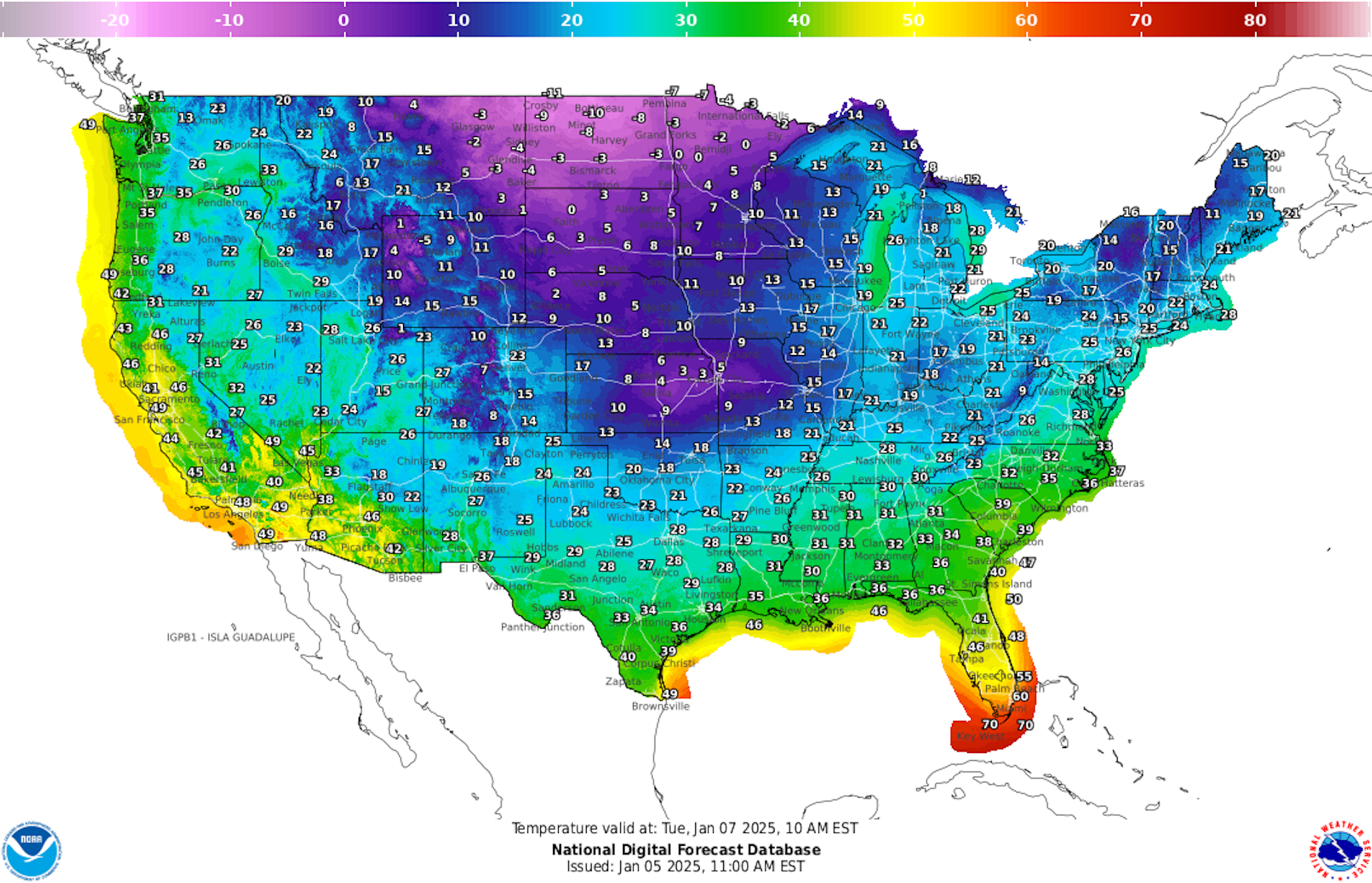
Is the weather really abnormally cold? That depends on which years are used as a baseline for 'normal.'

When winter fills the air with cold and bone-chilling gusts, and ice and snow bow down even the sturdiest looking of evergreen branches, it's easy to think that the weather is so much colder than normal. But is it? Using what's "normal" compared to what isn't normal can be confusing. "While temperature forecasts are important to help people stay safe, the comparison to normal can be quit misleading," writes Richard B. Rood for The Conversation. "That’s because what qualifies as normal in forecasts has been changing rapidly over the years as the planet warms."

Who determines what normal temperatures are? "One of the most used standards for defining a science-based normal is a 30-year average of temperature and precipitation," Rood explains. "Every 10 years, the National Center for Environmental Information updates these normals, most recently in 2021."

Over the past century, the planet's temperatures have increased. Rood writes, "Because global temperatures are warming, what’s considered normal is warming, too. So, when a 2025 cold snap is reported as the difference between the actual temperature and normal, it will appear to be colder and more extreme than if it were compared to an earlier 30-year average."

How U.S. temperatures considered normal have changed over the decades. Each 30-year period is compared to the 20th-century average. (NOAA Climate.gov graphic via The Conversation)
To get a better picture of our warming planet, "NASA scientists use 1951-1980 as a baseline," Rood explains, "The reason becomes evident when you compare maps. For example, January 1994 was brutally cold east of the Rocky Mountains. If we compare those 1994 temperatures to today’s normal – the 1991-2020 period – the U.S. looks a lot like maps of early January 2025’s temperatures: Large parts of the Midwest and eastern U.S. were more than 7 degrees Fahrenheit below normal, and some areas were much colder. . . . But if we compare January 1994 to the 1951-1980 baseline instead, that cold spot in the eastern U.S. isn’t quite as large or extreme."

Despite global warming, cold air outbreaks will continue, "but as the Arctic and the rest of the planet warm, the most frigid temperatures of the past will become less common," Rood adds.