Showing posts with label polls. Show all posts

Tuesday, August 13, 2024

Election officials face a sea of stresses and threats; many have retired and left new officials to face the fray

AI and deepfake election intrusions add another layer
to election officials' work. (Adobe Stock image)
In the not-so-distant past, county election officials could expect to register voters and repair voting machines. But in more recent election years, including 2024, their jobs have become overwhelming and at times, dangerous, reports Tiffany Hsu of The New York Times. "Elections officials must multitask as defenders against disinformation. They have been flooded with inane demands for details about their employees, faced harassment campaigns targeted at their female family members, received intimidating letters laced with fentanyl and been subjected to fake threats of bombings and break-ins."

For many long-time officials, the pressure cooker environment pushed them into retirement. The gap retirees left has been filled by officials new to the process at a time when the position is exponentially more complex. Hsu explains, "In Wisconsin alone, the state association of county clerks found that 31 of its 72 members had never administered a presidential election. . . .The remaining officials, many of them overwhelmed and very tired, are once again marshaling their limited resources . . ."

Jazmin Wingert
Despite ongoing struggles that range from budget cuts to poll worker shortages, "elections officials are doing what they can this year to shore up voter trust, setting up fact-checking websites (like in Pennsylvania) and posting refutations on social media (like a Mythbuster Mondays series in North Carolina)," the Times reports. "Jazmin Wingert, the Republican county clerk for Stephenson County in Illinois, took an elections certification course with lessons on combating false narratives and meets nearly monthly with other county clerks to share security resources."

Managing AI and deepfakes is also on election officials' to-do lists. "The technology could also supercharge harassment campaigns," Hsu adds. "Last week, a bipartisan group of secretaries of state wrote to the tech billionaire Elon Musk to urge him to fix his A.I.-powered search assistant, Grok chatbot, saying it provided inaccurate information about ballot deadlines and then failed to correct the mistake for 10 days."

Tuesday, March 19, 2024

The U.S. has 100,000 fewer polling locations, which can change who votes and who wins elections.

Lack of oversight and pandemic changes have reduced
on-site voting options. (Photo by Ernie Journeys, Unsplash)
A lack of places for Americans to cast their votes adds a new wrinkle to an already challenging U.S. election year. "During the 2022 midterms, voters cast their ballots at just under 95,000 polling places across the country — half the number of locations available four years prior," reports Chris Teale of Route 50. The downward trend began after the Supreme Court's 2013 ruling against the Voting Rights Act. "In particular, justices struck down Section 5 of the 1965 law, which required certain state and local governments to obtain federal pre-clearance before making any changes to their voting laws or practices."

Once some states were no longer required to obtain permission, local offices were able to close polling places, change voting hours and create other restrictions without oversight. Teale writes, "Fewer places to cast a ballot can be a barrier to voting for many people, especially low-income individuals who may lack transportation or time off to vote." The voting rights program at the nonprofit Leadership Conference on Civil and Human Rights "identified 868 polling places that were closed in jurisdictions that previously were subject to Section 5."

The 2013 ruling isn't the only reason polling places closed. The pandemic fundamentally changed American voting habits. "Amid stay-at-home orders, states were forced to rethink their voting procedures," Teale reports. "Some embraced vote-by-mail and absentee options that remain in place today. As a result, some states have less of a need for physical polling places and have consolidated them."

Regardless of why there are fewer voting locations, the lack of them can profoundly change who will vote. A 2020 study by Enrico Catoni in the American Economic Journal: Applied Economics "found that an increase of one mile in the distance someone must travel to a polling location reduces turnout from majority-minority districts by 19%, compared to a 5% reduction for majority-white districts," Teale adds. "What’s more, fewer polling places can mean longer lines at those still open, which can discourage people from voting."

Friday, June 30, 2023

Rural-journalism summit hotel deadline today; register by Tue. for free, hybrid conference July 7; research leads off

Research on rural journalism is in short supply. The National Summit on Journalism in Rural America, next Friday, aims to close the gap a bit with the latest figures on news deserts, digital news sites and ghost newspapers; an update on surveys of Great Plains newspaper publishers and readers; the rollout of a just-completed national pilot survey of rural publishers about their futures; and the first public report on a rare piece of interventional research at rural newspapers.

Nick Mathews
The last two presentations will come from Nick Mathews of the University of Missouri and Joey Young of Kansas Publishing Ventures, whose newspapers are experimenting with alternate forms of revenue as part of research by Mathews and his colleagues, Teri Fimmeman of the University of Kansas and Patrick Ferruci of the University of Colorado.

The academics surveyed publishers and readers in Oklahoma, Kansas, Nebraska and the Dakotas. At last year's summit, Finneman reported on North Dakota, saying that 40 percent of readers there said they are likely or very likely to donate to their local paper to keep it going. Kansas Publishing Ventures, which publishes four weeklies, has been testing alternative revenue sources for the last year, and Mathews and Young will report on that experiment.

Joey and Lindsey Young
Mathews will discuss focus groups the researchers did with publishers. Generally, "They’re thinking about the future but not acting on the future, either stuck in the day-to-day or content with where they are," or looking for a path of change thatg has been proven, he said this week. "We need to be more proactive about this and have a sense of urgency [and] understand how bad this is."

Young will report on the experiment from the publisher's point of view. Later in the day, his wife Lindsey Young will talk about "Earn Your Press Pass," a popular program to help publishers open up who they recruit into their newsrooms and hopefully make it easier to fill positions. The program is being implemented in 18 states.

Zach Metzger
Leading off the Summit will be a status report from the State of Local News Project at the Medill School of Journalism at Northwestern University, delivered by Zachary Metzger, the project's senior researcher and database manager. He works with Local News Initiative Director and Senior Associate Dean Tim Franklin and Professor Penelope Muse Abernathy, who began the research into news deserts and ghost newspapers. He will discuss the lack of digital news sites in rural areas, give examples of ghost papers and discuss how that term could be defined.

Ross McDuffie
Ross McDuffie, chief portfolio officer of the National Trust for Local News, will reveal the results of a survey taken this month of rural publishers, asking how they view the future of their newspapers. The survey was conducted with the help of the Institute for Rural Journalism and Community Issues at the University of Kentucky, publisher of The Rural Blog and sponsor of the Summit.

For the rest of the program, click here. For biographies of the presenters, click here.

The Summit will be a hybrid event, but most presenters will appear in person. Registration is free, and required; register here by Tuesday, July 3. The Summit will be held at the Campbell House Curio Hotel, 10 minutes from the Lexington airport. The room block expires today.

Thursday, June 15, 2023

Rural challenges show repeated concerns and a glimmer of optimism by residents, a new survey indicates

Chart by The Daily Yonder from Save Your Town 2023 survey results
How do you feel about the future of your rural town? "Since 2015, two women, Becky McCray and Deb Brown, have been surveying rural communities on how they view their area's problems and future," reports Kristi Eaton of The Daily Yonder. The pair created Save Your Town, an Oklahoma-Mississippi-based effort that helps towns find affordable ways to address local problems.

Often survey results do not follow preconceived ideas, and 2023 results followed that pattern. Pollster Celinda Lake told Eaton, "Rural people were twice as likely to say they were optimistic about their community's future as were negative about their community's future. I was very happy to see how optimistic people were." Lake said she was "really pleased and surprised" to see events, education, tourism and arts and culture listed as top community assets.

The survey was taken online from Nov. 11 to Jan. 31 and got 315 responses from subscribers and visitors to SaveYour.Town and SmallBizSurvival.com, from news-media coverage and cooperating groups that publicized the survey. "Survey participation is voluntary and self-selected, not based on scientific polling methods, but the online survey does offer a range of responses from people who identify as rural," Eaton points out. "The self-selected participants were more optimistic about the economy than people who participated in the Daily Yonder’s 2022 scientific, randomized poll of rural voters. . . . nearly three-quarters of rural respondents said the economy was not working well for them. Half said they expected their financial situation would get worse in the next year."

Co-founder Becky Brown said the latest survey shows "big disconnects. . . between what rural people want and what services and assistance are commonly offered to them." She "said business owners and leaders said usable buildings are harder to find than loans, and they showed little interest in needing support with business plans or pitch competitions," Eaton reports. "This year’s survey found that in addition to housing and downtowns, other challenges were not enough volunteers, losing young people, and a lack of child care."

In 2019, Save Your Town survey respondents gave these top five concerns: Losing young people; downtown is dead; not enough good housing; need new residents; no one shops in town. In 2021, the top five were identical with the exception of "no one shops downtown" falling off the list and "not enough [residents] volunteer" being added. The latest survey mirrored much of the earlier results but added lack of child care. Although Americans have many divides, repeated concerns on rural responses highlight several issues such as not enough young people (or laborers), a lack of affordable housing and a severe lack of child care options, which are also problematic for urban and suburban areas.

Wednesday, June 07, 2023

Fewer than 1/3 of U.S. adults say news media hold public officials accountable; TV, social media are their top sources

Graphs by the Local News Initiative, Medill School, Northwestern University, adapted by The Rural Blog; click to enlarge

Fewer than a third of Americans say local news media meet one of their primary missions, holding public officials accountable, according to a poll for the Medill School at Northwestern University. Here's report on it from Mark Caro of the school's Local News Initiative, edited for concision:

The survey asked 1,015 adults if they agreed or disagreed with the statement “My local news media hold public officials accountable.” Only 3.9% replied “strongly agree” and 26.5% replied “agree,” for a total of 30.4% in agreement. Almost as many disagreed; 11.3% responded “strongly disagree” while 18.8% responded “disagree,” a total of 30.1%. The other 38.7% replied “Neither.”

“There is a lack of trust in institutions in general, so that may be driving some of this,” said Tim Franklin, the Medill School's senior associate dean and John M. Mutz Chair in Local News. “But I think that given how critical this role is to democratic institutions and communities and to the state of our democracy, this is a red flare.”

Stephanie Edgerly, the Medill professor and associate dean of research who oversaw the survey, said the low percentage may also reflect news organizations’ ability—or inability—to inform readers about the work they’re doing. “The public just sees the story that’s written up but does not understand what role local journalists played in covering it,” she said. “In general, journalists have not been great at communicating the behind-the-scenes work of their reporting process to the public.”

Tom Rosenstiel, the University of Maryland’s Eleanor Merrill Visiting Professor on the Future of Journalism, said the poll's finding is a logical domino drop amid the shrinkage of newsrooms nationwide, particularly in smaller markets. Since watchdog reporting is more labor-intensive, he said, it follows that it has declined.

The poll found striking age differences in where people get their local news. 
But Rosenstiel noted that the poll's respondents said the most common way they get local news is through television (32% daily), followed by social media (31% daily), with radio (including podcasts) and newspapers (including print and digital readers) lagging behind at 20% and 15%, respectively. “Having studied local TV news extensively over the years, I can tell you that they don’t cover a lot of local government,” he said. He noted that TV-station consultants consider local government coverage a ratings loser and steer stations away from it.

Only 15% of respondents said they read local newspapers daily, while 29% said they read them weekly, and 39% said they never read them. The survey was conducted for the Medill School by the National Opinion Research Center at the University of Chicago from April 27 thgrough May 1.

Wednesday, May 03, 2023

Roundup for World Press Freedom Day: Americans think news media hurt democracy; journalists concerned about press freedoms; site picked for Fallen Journalists Memorial

Associated Press chart refers to "the news media" as singular, which is not helpful. --Al Cross, Institute for Rural Journalism

Most Americans think the news media are hurting democracy and driving political polarization in the United States, according to a poll by The Associated Press-NORC Center for Public Affairs Research. "Four in 10 say the press is doing more to hurt American democracy, while only about 2 in 10 say the press is doing more to protect it," AP reports. "Nearly three-quarters of U.S. adults say the news media is increasing political polarization in this country, and just under half say they have little to no trust in the media’s ability to report the news fairly and accurately. . . . That breakdown in trust may prompt many Americans to reject the mainstream news media, often in favor of social media and unreliable websites that spread misleading claims and that can become partisan echo chambers, leading to further polarization."

AP's David Klepper adds, "The survey reveals the complicated relationship many Americans have with the media: A majority rate in-depth and investigative reporting as very helpful or extremely helpful for understanding the issues they care about, but they are more likely to say they regularly scan the headlines than read an in-depth investigative article. And while overall trust in the media is low, a majority of respondents say the media is doing at least somewhat well in covering issues they care about." The poll of 1,002 adults was conducted March 30 through April 3 using a sample from NORC’s probability-based AmeriSpeak Panel, which is designed to be representative of the U.S. population. NORC stands for the former name of the National Opinion Research Center.

On the eve of World Press Freedom Day, May 3, United Nations Secretary-General Antonio Guterres warned that the news media are under attack all over the world and "urged all nations to stop the targeting of truth and those who report it," AP reports. "Guterres said the collapse of the media industry, which has led to closures of local news outlets and consolidation of media 'into the hands of the few' is threatening freedom of expression." World Press Freedom Day was first proclaimed by the U.N. General Assembly in December 1993.

Pew Research Center graph
"Most journalists in the United States are concerned about the future of press freedoms in the country, according to a 2022 Pew Research Center survey of nearly 12,000 working U.S.-based journalists," Pew reports. "These concerns come at a time when the U.S. ranks 42nd in the world in press freedom, according to a 2022 analysis by Reporters Without Borders, and as some journalists face harassment or threats of arrest." The poll found that concern increases with age and with experience in journalism.

A site on the National Mall in Washington, D.C., has been approved for "the capital’s first memorial dedicated to journalists who have died while reporting the news and to the role of the free press in a democracy," The Washington Post reports. The Fallen Journalists Memorial will be be built between the National Museum of the American Indian and the Voice of America building, at Independence and Maryland avenues and Third Street SW. "The site, which has a direct view of the Capitol, was chosen to evoke journalists’ role as government watchdogs," the Post reports. "The memorial is projected to open in 2028 and will cost as much as $50 million, which will be entirely funded by private donations. Officials said they have commitments to cover 40 percent of the cost so far."

Media mogul Robert Allbritton says he has committed $20 million to launch a non-profit educational newsroom that will train reporters in fact-based, non-partisan journalism on government and politics. The Allbritton Journalism Institute will offer a free, two-year fellowship, starting in September, and fellows will be paid $60,000 per year as they work with reporters and editors to produce a digital news publication launching this fall, a press release said. Allbritton, the founder of Politico, said “The path to a strong republic flows through reliable news and information, and that starts with the way journalists are recruited and trained.” AJI's executive director is Tim Grieve, the founding editor of Politico Pro and Protocol; editors include Richard Just, the former editor of The Washington Post Magazine, National Journal magazine and The New Republic. Instructors and mentors include Tim Alberta, a staff writer for The Atlantic and author of American Carnage: On the Front Lines of the Republican Civil War and the Rise of President Trump. Applicants may apply on the Institute’s website, www.aji.org. The deadline is May 31. Professional journalists interested in working with AJI should contact Grieve at tim@aji.org.

Thursday, March 30, 2023

America's defining values are changing; they paint a 'surprising portrait of a changing America,' new poll finds

Graphs by Wall Street Journal and NORC
How do you define "American"? Twenty-five years ago, you might have said, "patriotism, hard work, family and God," but those fundamental values are changing, a new poll taken in cooperation with the Wall Street Journal finds. "Some 38% of respondents said patriotism was very important to them, and 39% said religion was very important," reports Aaron Zitner of the Journal. "That was down sharply from when the Journal first asked the question in 1998, when 70% deemed patriotism to be very important, and 62% said so of religion. . . . Younger Americans in particular place low importance on these values, many of which were central to the lives of their parents."

Poll respondents' views shed some light on the changes. "Janet Boyer, a former Pentecostal minister who lives in southwestern Pennsylvania's coal country, patriotism has taken on a political sheen and is no longer important to her," Zitner reports. Boyer told him, "For me, patriotism has turned into right-wing nationalism." Zitner adds, "Elana Reiser, a university math teacher in New York, said that other countries rank higher on tests of math performance. She said longer vacations and maternal leaves in some European countries mean they have a better quality of life. Reiser said, "In America, you basically have to work your whole life, and you don't get breaks."

The study also found "the country sharply divided by political party over social trends such as the push for racial diversity in businesses and the use of gender-neutral pronouns," Zitner reports. "It asked whether society had gone far enough—or had gone too far—when it comes to businesses taking steps to promote racial and ethnic diversity. Just over half of Republicans said society had gone too far, compared with 7% of Democrats. Some 61% of Democrats said diversity efforts hadn't gone far enough, compared with 14% of Republicans."

It's not easy to explain the poll's results, which many may find distressing. "Bill McInturff, a pollster who worked on a previous Journal survey that measured these attitudes along with NBC News, said 'These differences are so dramatic, it paints a new and surprising portrait of a changing America.' He surmised that 'Perhaps the toll of our political division, Covid and the lowest economic confidence in decades is having a startling effect on our core values'," Zitner writes. "A number of events have shaken and in some ways fractured the nation since the Journal first asked about unifying values, among them the Sept. 11, 2001, terrorist attacks, the financial crisis of 2008 and subsequent economic downturn and the rise of former President Donald Trump."

The Journal partnered on the poll with NORC, a nonpartisan research organization at the University of Chicago that was once known as the National Opinion Research Center.

Thursday, March 09, 2023

News-media roundup: As 3 big Ala. papers stop printing, trade group reminds state it has plenty; Gannett has cut almost 1/2 its workers and 127 weekly papers, seeks bids

Screenshot of interview; for video, click here.
Kyle Hopkins of the Anchorage Daily News, who won a Pulitzer Prize with ProPublica for exposing failures of Alaska's criminal-justice system, including lack of attention to disappearance of Native women, inspired "Alaska Daily," ABC's Thursday-night series. Mike Blinder of Editor & Publisher interviews him.
 
When three major newspapers in Alabama (Birmingham, Huntsville and Mobile, owned by Advance Publications) stopped publishing print editions recently, it probably made many people in the state wonder about the future of their local papers. Felicia Mason, executive director of the Alabama Press Association, says in a column distributed to members, "Alabama newspapers are alive and printing. . . . Alabama has 109 paid circulation newspapers that have a print edition at least every week." She also cites "a recent market study, conducted by the independent research firm Coda Ventures, reports 3.2 million, or 81%, of Alabama adults rely on newspapers every month for local news and advertising [and] that among consumers who plan to shop for specific products and services, the targeted reach of newspapers is unrivaled." Mason also says community papers have "news you cannot get from any other news source," are focused on making communities "stronger and safer," hold governments accountable, and provide public forums. And she didn't even mention Sunshine Week!

Since GateHouse Media bought Gannett Co. and adopted its name, it has shed nearly half its workforce, report Sara Fischer and Kerry Flynn of Axios. They say that "underscores just how much pressure the country's largest newspaper company is facing as it tries to appease stockholders and remain independent. The company "also has pushed to reduce its number of markets. It dropped its number of local-focused websites by 117, and it decreased its number of weekly newspapers by 127, according to regulatory filings." CEO MIke Reed said in a call about last month's earnings report that Gannett "would entertain bids on any of our markets."

NiemanLab table from Alliance for Audited Media data
UPDATE:
"The scale of local-news destruction in Gannett's markets is astonishing," reads the NiemanLab headline over a story by Joshua Benton, who reports a higher job-cut figure: "Gannett has eliminated 59% of its jobs in four years. It’s as if, instead of merging America’s two largest newspaper chains, one of them was simply wiped off the face of the earth." And Gannett's big papers have lost substantially more circulation than similar papers, Benton reports, with some tables that show combined print and digital circulation. UPDATE, March 14: Gannett says the Benton misinterpreted the Alliance for Audited Media data and has requested a correction

Philanthropically funded States Newsroom, which has 37 state-based nonprofit news outlets, will be the new home for Stateline, the 25-year-old Pew Research Center news service that reports and analyzes trends in state policy. Stateline reporters will continue their work, a press release says.

Ralph Nader has pulled his financial backing for a printed newspaper in his hometown of Winsted, Connecticut, and it's the second time he's done that, Bob Sillick of Editor & Publisher reports.

The International Women's Media Foundation has published A Guide to Protecting Newsrooms and Journalists Against Online Violence, which recommends policies and best practices for newsrooms to protect staff members who are targeted simply for doing their jobs. The IWMF says, "Online violence poses a constant threat to journalists, resulting in serious implications for press freedom, including self-censorship. This abuse disproportionately affects women and diverse journalists who are often reluctant to speak out for fear of jeopardizing their careers." The guide includes case studies from "a wide range of newsrooms," IWMF says.

Thursday, February 16, 2023

Dismal report on public trust in news is not so bad for local news, but has many warning signs – and some guidance


By Al Cross
, Director and Professor
Institute for Rural Journalism and Community Issues, University of Kentucky

The national headline on stories about the latest poll on the news media and democracy were about its finding that half of Americans believe national news organizations deliberately "mislead, misinform or persuade the public to adopt a particular point of view through their reporting," as Associated Press media writer David Bauder put it. "In one small consolation," Bauder reports, "Americans had more trust in local news."

For people in local news, it's not a small consolation. The survey by Gallup and the Knight Foundation, of 5,593 Americans aged 18 and older between May 31 and July 21, 2022, shows a much higher level of trust in local news organizations, driven in large measure by a belief that they care about the impact of their reporting; 53% agreed with that statement and 19% disagreed with it. "The biggest differentiator is that the public feels local news organizations care about the impact of their reporting while national news does not," Knight says in its report.

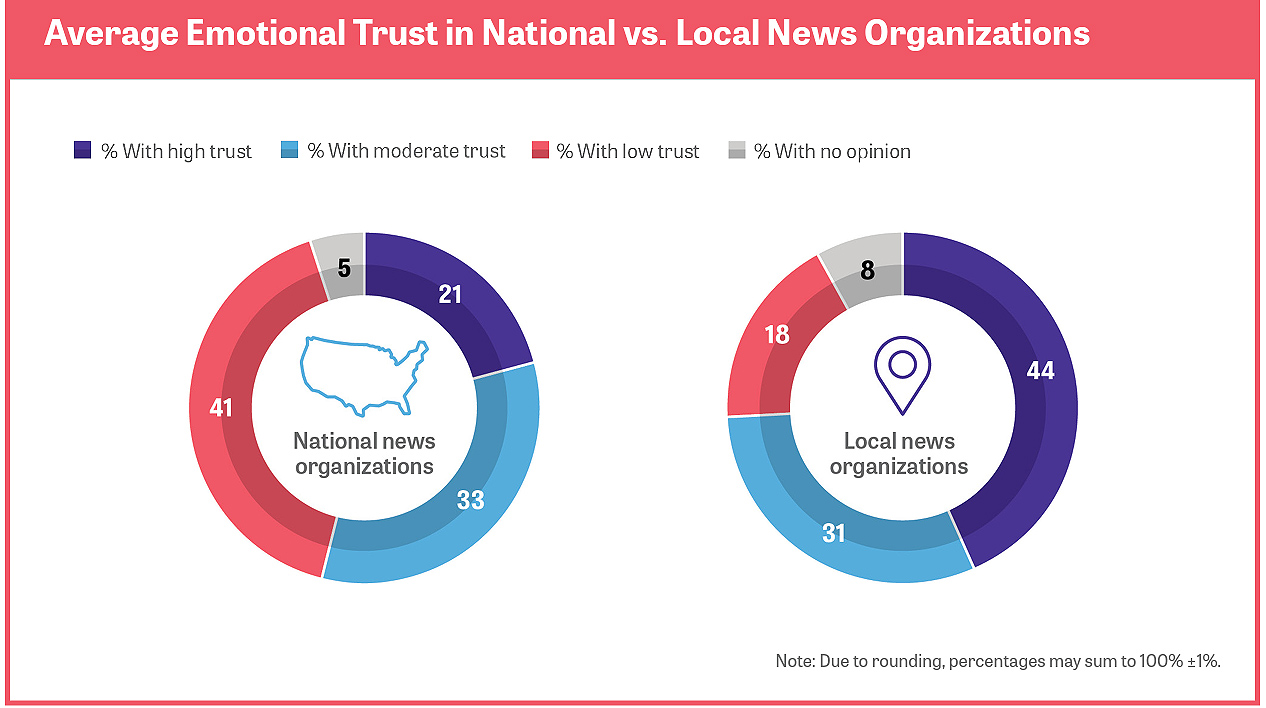
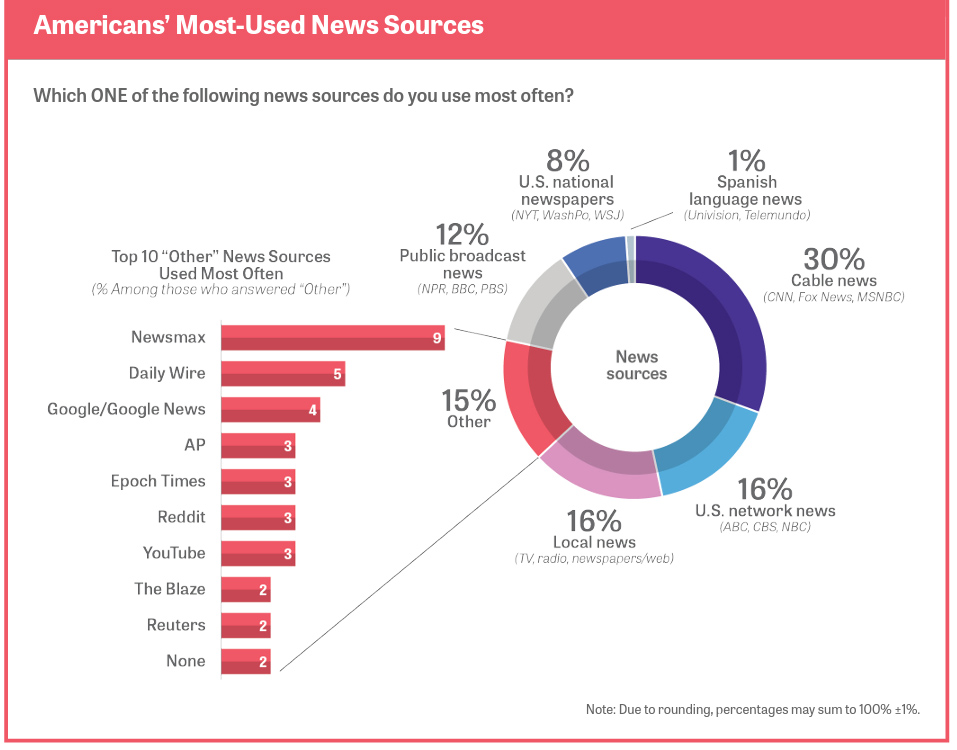
Graphs by Gallup Inc. from Knight Foundation report; click any image to enlarge
"While past investigation of trust in news has focused on issues of transparency and credibility, recent research has emphasized the affective or emotional aspects of trust — that is, how trust in news is related to how people feel about news outlets," Knight repots. "Emotional trust in news is driven by the belief that news organizations care, report with honest intentions and are reliable. More than twice as many Americans report high emotional trust in local news than in national news; 44% have high emotional trust in local news organizations, compared with 21% who have high emotional trust in national news organizations. . . . Greater emotional trust in local news is consistent across various demographic groups. Variation in levels of emotional trust in local news organizations is less pronounced across demographic groups. For example, 31% of Republicans and 58% of Democrats express high levels of emotional trust in local news — a narrower gap than with emotional trust in national news. This finding is consistent with findings from previous Gallup/Knight studies."

So, Americans trust their local news organizations, but do they really know them? The poll found that 65% agreed with the statement "In general. most local news organizations have the resources and opportunity to report the news accurately and fairly to the public," but the question left much to be desired. Most Americans are not familiar with "most local news organizations," and many if not most of those organizations are having difficulty reporting as much news as they once did or would like to do. Accuracy and fairness are essential, but audiences notice gaps in coverage, and that could have been measured, too.

Bauder describes one other hopeful finding: "If Americans believed local news organizations didn’t have the resources or opportunities to cover the news, they would be more likely to pay for it." Knight reports, "Americans who think local news organizations lack the resources and opportunity to report the news accurately and fairly are more likely to pay for news. . . . Among those who agree, 23% report having paid for news in the past. This percentage nearly doubles (45%) among those who disagree. Those who say local news organizations do not have the resources and opportunity to report the news accurately and fairly are more than twice as likely to be willing to pay for news in the future as those who agree (32% vs. 14%, respectively). These findings mirror previous Gallup/Knight research on local news, which found that Americans who are exposed to information about the financial challenges of local newspapers are more likely to donate to a nonprofit organization that supports local journalism."

Knight says journalists need to go beyond emphasizing transparency and accuracy to show the impact of their reporting on the public. That recommendation is directed to national news organizations, but it's good advice for local news organizations, too. And the study reaffirms that they need to do that online, because that's where most of the audience is. The poll found that 58% of Americans in mid-2022 reported getting most of their news online, up from 46% in 2019. Television was named by 31%, down 10 points from 2019. Only 3% named printed newspapers or magazines, down from 5%.

Another interesting finding, described by Bauder: "The ability of many people to instantly learn news from a device they hold in their hand, the rapid pace of the news cycle and an increased number of news sources would indicate that more Americans are on top of the news than ever before. Instead, an information overload appears to have had the opposite effect. The survey said 61% of Americans believe these factors make it harder to stay informed, while 37% said it’s easier." That finding doesn't differentiate between national and local news, but the poll seems to confirm a trend pointed out by many observers, that people are paying less attention to local news than they once did. Local news providers must give them reasons to seek it out, make it easy to do so, and make clear its value.

Monday, January 16, 2023

Church affiliation keeps falling, except nondenominational; if a denomination, it would be largest Protestant one in U.S.

Photo by Nicholas Smith, Getty Images, via Pew Research Center
Americans' "church membership, church attendance and belief in God all declined during the pandemic years," but the growing membership in nondenominational Christian churches gave that largely unorganized group its first plurality among U.S. believers, Daniel de Visé writes for The Hill's "Changing America" series. 

"At least one-fifth of Americans today embrace no religion at all," DeVisé notes, citing polls. "A similar share tell pollsters they do not believe in God, an all-time high. The lone, striking counter-trend is a steep rise in nondenominational Protestants." They became a plurality among U.S. Protestants in 2021, "signaling a new era of churches and clergies untethered from religious tradition."

DeVisé reports, "Since the 1970s, the share of Americans who identified as Baptists, Methodists and other Protestant denominations has slipped from more than 30 percent to around 10 percent. In the same span, the share of nondenominational Protestants has exploded. The 2020 U.S. Religion Census found 6.5 million more nondenominational congregants and thousands more churches than in 2010." DeVisé quotes Daniel Silliman, writing in Christianity Today: “If ‘nondenominational’ were a denomination, it would be the largest Protestant one, claiming more than 13 percent of churchgoers in America.”

This is a fundamental change in a key element of American society. DeVisé notes, "Multigenerational communities formed around the Baptist and Methodist churches that dominated town squares for generations. By contrast, nondenominational churches often thrive on their otherness, attracting congregants who mistrust ancient American institutions."

The pandemic spurred the decline of traditional church affiliation. "In-person church attendance plummeted by 45 percent in the pandemic, according to an ABC News analysis," DeVisé reports. "Most churches have reopened, but not all congregants have returned. . . . The share of Americans who belong to churches dipped below half in 2020, a historic low, according to Gallup polling."

At the same time, many of those who say they identify with no religion say they consider religion important in their lives, DeVisé reports.

Thursday, December 22, 2022

News-media roundup: 2022 opinion and research gems, predictions and advice for journalism; Alaska weeklies die

Nieman Reports has picked its five best opinion pieces of 2022: Gilbert Gaul on the need to cover land-use decisions that worsen disasters, and how arduous rebuilding after a disaster really is; Isaac Bailey's argument that objectivity is less important than transparency, accuracy and fairness; Gary Langer on the need for better vetting of poll data; Anne Garrels on the courage of Ukrainian journalists; and the argument by Mardi Link of the Traverse City Record-Eagle that media coverage of adoption (especially in the context of abortion) lacks voices of adoptees: “Adoption is a parenting decision and abortion is a reproductive decision,” wrote Link, an adoptee herself. “For reporters to equate one as a solution for the other provides nothing of value to readers and perpetuates a false equivalency.” NR also gives its 10 most-read stories of 2022.

NiemanLab collected several predictions and advice for journalism in 2023, including: Sarabeth Berman of the American Journalism Project says nonprofit news can work in smaller markets with a network model; Sue Cross of the Institute for Nonprofit News predicts more collective action among varied interests to "save the news;" Lisa Heyamoto of LION Publishers says the "independent news industry" has a roadmap to sustainability; Pia Frey and Torsten Schlegel of Opinionary say publishers should ask more questions of users as cookies die out; Kerri Hoffman of PRX says podcasting is going local; Ayala Panievsky of the University of Cambridge says "It's time for PR for journalism;" and Julia Beizer of Bloomberg says news and subscription fatigue should make publishers "focus on the value we provide our users. We must learn everything we can about who they are and what they need. And then we provide it through journalism that helps them navigate their world."

The Reuters Institute for the Study of Journalism at the University of Oxford, which does research in the U.K, the U.S. and other countries, says 22 of the findings from its research in 2022 are still relevant for 2023. They include: Many people see misinformation and harassment as big problems for digital platforms; they make snap judgments about trustworthiness of sources; people who know more about the news media use social media differently; young people increasingly use TikTok for news; and newsroom leaders are still betting on more revenue from readers.

Citing losses, Wick Communications has stopped printing the Anchorage Press and two other area weeklies, The Arctic Warrior and the Chugach Times. The anchoragepress.com website will continue, as will the Mat-Su Valley Frontiersman, a big weekly in an area north of Anchorage.

Thursday, December 15, 2022

Poll of rural adults finds them more aware of, and more willing to discuss, opioid problems; 47% still see stigma

Morning Consult graph compares 2017 and 2022 responses to question about access to care. Click it to enlarge.

Rural Americans say they are more aware of, and more willing to talk about, the opioid problem in the nation and their communities than they were five years ago, according to an online poll of rural adults sponsored by the American Farm Bureau Federation and the National Farmers Union.

Sixty percent said adults are more aware of the crisis than they were five years ago, and 77% said they would comfortable having a conversation about opioids, but 47% said there is stigma or shame associated with opioid abuse in their community.

Rural adults increasingly regard drug addiction as a disease. Asked if addiction to opioids is a disease or is due to a lack of will power or self-control, 57% said it's a disease and 21% said otherwise. In 2017, the numbers were 46% and 26%, respectively. Likewise, 78% said someone can accidentally or unintentionally get addicted to opioids; five years ago, 71% said that.

The poll found that more rural adults than five years ago believe there is a higher rate of opioid misuse in rural communities than in urban and suburban areas), and 48% said they know someone who is or has been addicted to opioids or prescription painkillers.

Asked if they had taken an opioid or prescription painkiller without a prescription, 5 percent said yes. The same percentage said they had abused opioids or prescription painkillers or been addicted to them. Asked how comfortable they would feel talking about that, 70% said they would feel very or somewhat comfortable discussing it with friends, 52% with siblings and 46% with parents. Beyond their immediate families, most said they would be not too comfortable, or not comfortable at all.

The margin of error for that subsample of 110 people is plus or minus 9.3 percentage points. The error margin for the whole sample of 2,010 rural adults is 2.2 percentage points. The poll was conducted online Oct. 6-13 by Morning Consult and the results were weighted to reflect gender, age, race, ethnicity, census region and education. The results are available from Farm Bureau here.

Farm Bureau and NFU, long rivals in representing farm interests, "have consistently worked to publicize and compile useful material to help address rural stress, mental health challenges and opioid misuse," they said in a press release. NFU President Rob Larew said, “We must continue to reduce the stigma to connect our loved ones with health care and treatment they may need. I thank AFBF for being a teammate on this project, and the survey results show what is possible when farm organizations work together.”

Friday, December 09, 2022

News-media roundup: Kansas' Hayneses sell their papers; Gannett sells Iowa paper that's challenged by a startup; Cherry Road sells editor paper it bought from Rust in March

Cynthia and Steve Haynes tell their staff about the sale of their newspapers in a video
conference call with one of the buyers, Jesse Mullen, at left. (Photo from The Oberlin Herald)

Brothers Jesse and Lloyd Mullen of Mullen Newspapers have bought six community newspapers in northwestern Kansas from Steve and Cynthia Haynes, longtime industry leaders who are retiring at 74: The Oberlin Herald, the Colby Free Press, the Bird City Times, The Goodland Star-News, The Norton Star-Telegram and The St. Francis Herald, as well as The Country Advocate shopper. Steve Haynes was a nephew of William Allen White, the renowned publisher of The Emporia Gazette. He and Cynthia reflect on 42 years of community newspapering here.

Gannett Co.
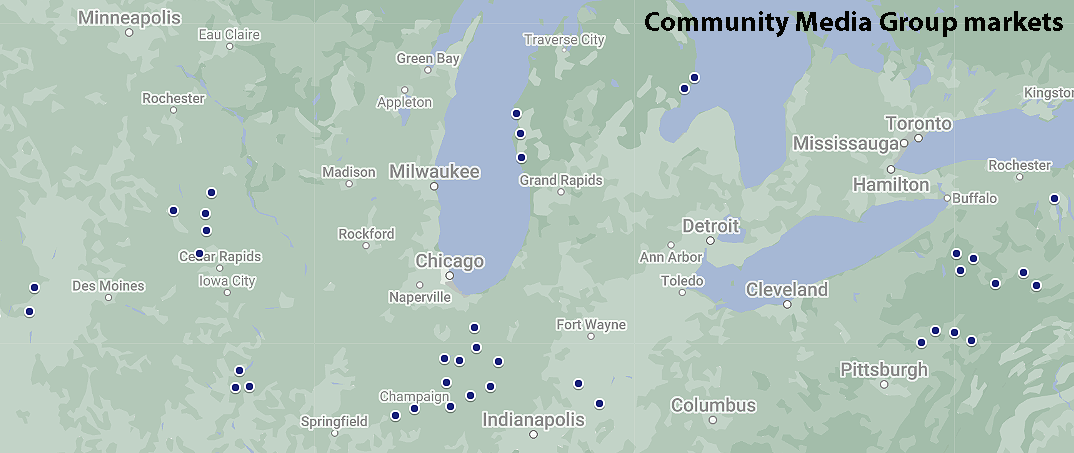
has sold the Burlington Hawk Eye to an affiliate of Community Media Group of West Frankfort, Ill., which has about 40 papers, stretching from Iowa to western New York, including nearby Fort Madison and Keokuk, Iowa, and Carthage, Ill. As the Hawk Eye declined under Gannett, the Burlington Beacon started up, and owner Jeff Allen tells The Rural Blog that its print circulation "is 2,500 and growing each week. We continue to sell out on the newsstand, and we're looking at adding days of publication." UPDATE, March 4: The Hawk Eye hawks itself.

Meanwhile, the decline continues at Gannett's St. Cloud Times, reports Axios Twin Cities: "As of Wednesday, the Times listed just three journalists — all reporters — on its staff page. As recently as 2014, the newsroom had 36 employees, and just a few months ago it listed nine staff." The St. Cloud metropolitan area has 200,000 people but no TV stations, limited radio news and two small weeklies, said St. Cloud University Department of Mass Communication Chair Dale Zacher, who called the Times a "ghost newspaper . . . a shell of its former self." He told Axios that there is little coverage of local government meetings and features about the community.

Kyle, Elizabeth, Olivia and Jordan Troutman (Prairie Photography)
Cherry Road Media
, which has bought several Gannett papers, is selling The Cassville Democrat in Missouri to its editor, Kyle Troutman, and his wife Jordan, a reporter and a native of the area. "The Cassville Democrat has been corporately owned since 2004, and on Jan. 1, 2023, the 151-year-old publication will once again be locally owned," it announced. Cape Girardeau-based Rust Communications had owned it until March, when it was sold to CherryRoad. CEO Jeremy Gulban, said that when heard a young couple in Nebraska describe buying their hometown paper, “I realized that local ownership, when possible, is really the right answer for small community newspapers. Traditionally, this had been the model but it has not been utilized lately because of a lack of motivated, younger people who are willing to take on the challenge. I looked around our portfolio of newspapers and saw that the Cassville Democrat was a good fit for this model with Kyle and Jordan.”

UPDATE, Dec. 29: Cherry Road sold two other former Rust papers in the Ozarks to local owners: the Carroll County News and the Lovely County Citizen in northern Arkansas. The latter will be online only. The buyers are Managing Editor Scott Loftis, photogtrapher David Bell and former Berryville Chamber of Commerce director Bruce Johnson.

Western Kentucky newspapers are publishing special editions to mark the one-year anniversary of the deadly tornadoes that devastated several towns, the Kentucky Press Association reports. And KPA has scheduled a session at its convention on Jan. 27 on planning for disasters.

Longtime Kentucky sportswriter Keith Taylor became news editor of The Berea Citizen, then the weekly's publisher, and now he's the local volunteer of the year. He reflects on his recent career

A survey in Great Britain suggests that people don't trust the news industry because they don't understand it. About half said they didn't trust the news media, and only 39% trusted journalists. But that result was correlated with ow levels of news literacy: the ability to critically process, analyze and evaluate news. Respondents were especially unsure about how decisions are made in newsrooms, how editorial standards are applied and how regulation works," Aisha Majid reports for the Press Gazette.

Also from the U.K.: Five tips for increasing reader engagement and loyalty.

Tuesday, October 25, 2022

Rural voters are the most enthusiastic about the midterms

"Interest in the midterms is at an all-time high, but Republicans and Rural America are more enthusiastic than Democrats and Urban America are," NBC News reports on its latest poll. The more rural a part of the poll sample was, the more enthusiasm voters showed; the more urban, the less.

"Urban voters prefer a Democratically-controlled Congress by 34 points (64%-30%), suburban voters prefer a GOP-controlled Congress by 4 points (48%-44%) and rural voters prefer a Republican-controlled Congress by a whopping 53 points (75%-22%)," Chuck Todd, Mark Murray, Ben Kamisar, Bridget Bowman and Alexandra Marquez of the NBC News Political Unit report.

They summarize major results of the poll: "Yes, Democrats had closed the enthusiasm gap in the recent months. Yes, rural voters make up a smaller share all of voters (about 15% in our poll). And, yes, the fight for Senate control remains a Toss Up. But that GOP/rural intensity, those GOP/rural margins and President Biden’s 45 percent job rating (it was 46 percent in the VA-GOV exit poll) sure look like what we saw a year ago." They conclude, "Democrats are fired up. It’s just that Republicans are fired up a lot more."

“This is what Virginia looked like,” said NBC's Republican pollster, Bill McInturff, referring to Virginia Gov. Glenn Youngkin’s overwhelming margins with rural Republicans that drove his Virginia gubernatorial win a year ago.

Sunday, October 23, 2022

As Media Literacy Week begins, consider this: U.S. sees mainstream media as more threat to democracy than Trump

By Al Cross
Director and Professor, Institute for Rural Journalism and Community Issues, University of Kentucky

This is Media Literacy Week, an observance established in 2015 to promote education in media literacy, which can be defined as an understanding of media, their role in society and the ability to analyze messages and the media outlets that produce them. It seems needed more than ever.

The latest evidence is The New York Times-Siena College poll of 792 registered voters Oct. 9-12. One of its main questions was, "Which comes closest to your views, even if neither is exactly right: American democracy is currently under threat, or American democracy is not currently under threat?"

The results: 74 percent said democracy is under threat and 20% said it isn't. Those who said it is under threat were asked, "What one or two words do you think summarize the current threat to democracy?" The leading response, from 13%, was "the government," "government corruption" and non-specific politicians or leaders; 10% said Donald Trump; 9% said societal divisions, political divisions or polarization; 6% or less named other politicians, political parties or movements such as nationalism, white nationalism or right-wing extremism, which collectively were named by 5%.

"The media" was named by less than half of 1%, but when asked, "Do you think each of the following is a major threat, minor threat or not a threat to democracy?" and given a list of choices, "the mainstream media" were identified as the leading major threat, by 59%; another 24% called them a minor threat, and only 16% said they are not a threat.

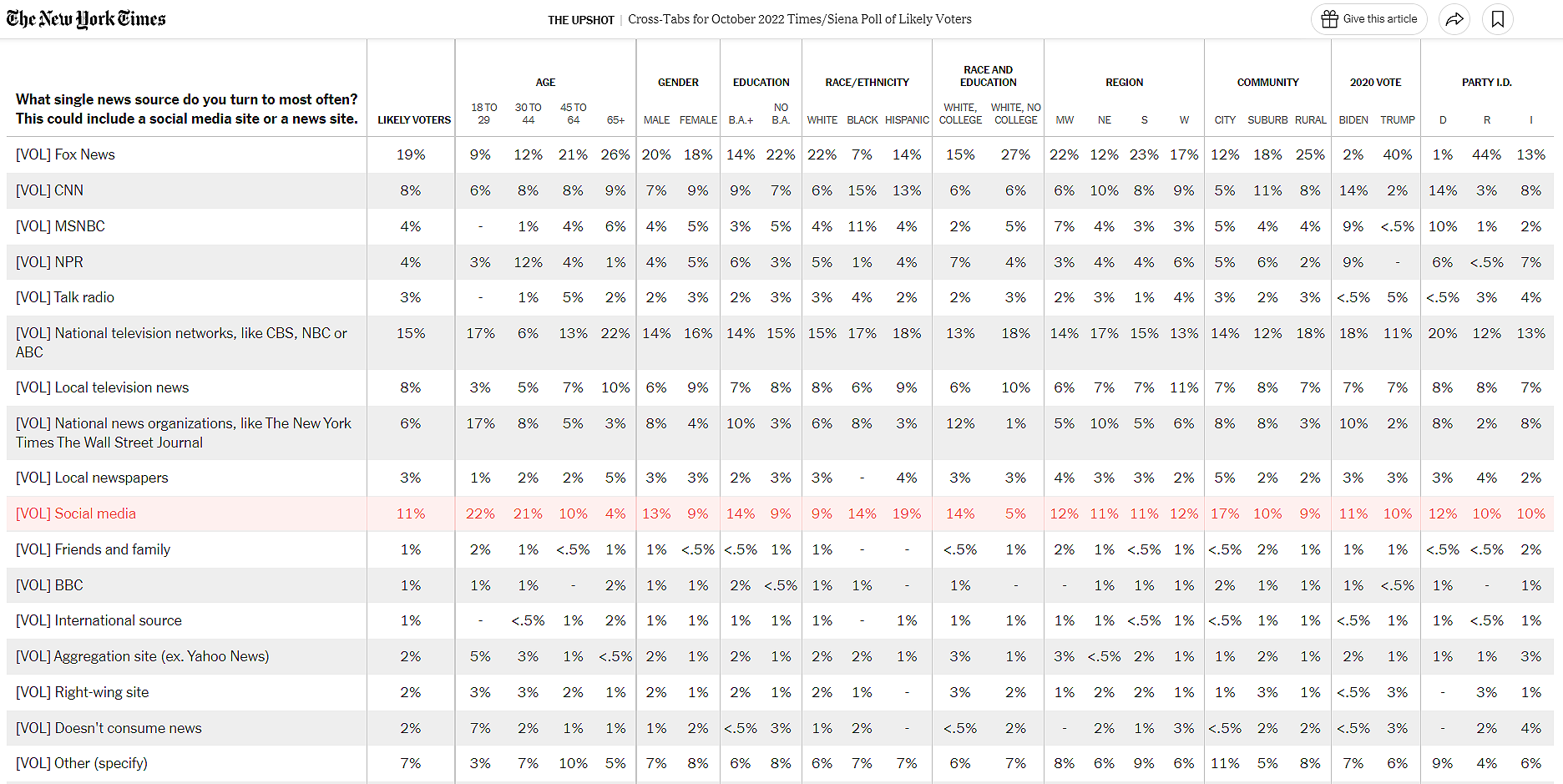
Rural Blog table, from New York Times-Siena College poll data
Perhaps those of us in the news media can take solace in the fact that hardly any voters first volunteered "media" as a threat, but media are not on top of voters' minds. When reminded of us, they reflect the concerns like those seen in the latest Gallup poll about trust and confidence in "the mass media, such as newspapers, TV and radio." It found that for the first time, a plurality of Americans say they have no confidence in the mass media "when it comes to reporting the news fully, accurately and fairly."

Rural news media might say, "This isn't about us," and to a limited extent that's true. A March poll of 1,000 adults for the National Newspaper Association, in ZIP codes where NNA members publish, asked "how much you trust" what various sources "say when it comes to learning about candidates for public office." On a scale of 1 to 10, local newspapers scored 7.38, TV stations 6.45, radio news 5.58, mail from candidates or parties 4.63 and social media 2.65. But how much do voters really discern among sources of information when they're not being asked questions about them? A lot less than we might hope, I suspect. Editors and publishers all over the nation have told me they're being tarred with the brushes that both ends of the political spectrum use to smear news media.

Notice I wrote "news media," not just "media," a distinction that too many news media fail to make (as well as failing to render the word as plural). In a saturated media environment, more and more people have difficulty distinguishing among types of media, and between fact and opinion, and news media need to remind them of some basic principles. It can be put pretty simply:

News media pay for journalism, which practices a discipline of verification; we tell you how we know something, or we attribute information to someone. We're mainly about fact, not opinion. Social media are mainly about opinion, not fact, and have little is any discipline or verification. Which do you trust?
Screenshot of New York Times-Siena College poll table, with social media line highlighted; to enlarge, click on it.

Wednesday, October 19, 2022

News-media roundup: 2/3 of Americans have no or 'not very much' trust in mass media to report fully, accurately, fairly

Gallup
For the first time, a plurality of Americans have told The Gallup Organization that they have no trust and confidence in the mass media to report the news fully, accurately and fairly. That was the response of 38 percent of those surveyed Sept. 1-16; 28% said they had "not very much" trust and confidence, for a net negative rating of 66%, virtually two-thirds of the sample. Only 34% said they had a great deal, or a fair amount, of trust and confidence. That is "just two points higher than the lowest that Gallup has recorded, in 2016 during the presidential campaign, Gallup's Megan Brennan writes. "Just 7% of Americans have 'a great deal' of trust and confidence in the media, and 27% have 'a fair amount'." The biggest decline in trust was among independent voters; opinions of those who identify with a major party were slightly more favorable than in 2021.

"There are some significant differences within several subgroups . . . based on aggregated data from 2020 through 2022," providing samples big enough for analysis, Brennan writes. "Older Democrats and independents are more trusting of the media than their younger counterparts. While liberal and moderate Democrats register roughly equal levels of trust in the media, independents' trust differs markedly, based on their political ideology: Those who describe themselves as liberal are the most confident, and conservatives are the least confident. . . . Independents with a college degree are more likely than those without a degree to express trust in the media, but there are no differences among Democrats or Republicans based on college education."

Collecting signatures on a petition to declare her town a "sanctuary city for the unborn" got the news director and co-anchor at a Gray Television station in North Platte, Neb., fired for violating KNOP's policy that says they can't “actively engage in any political activity for any candidate, party or ballot initiative.” Veteran Iowa broadcaster Dave Busiek writes about it.

Inflation is hurting newspapers' finances, reports Rick Edmonds of The Poynter Institute. "It has also been an off year for revenues in the hard-pressed sector, but expense increases have been truly terrible," especially for independently owned papers, with newsprint up 30% or more, fuel up 50% and production supplies and electricity up 10% to 15%.

Votebeat, which education publisher Chalkbeat started as a pop-up newsroom to cover election administration during the pandemic in 2020, is now a permanent nonprofit entity, thanks to $3.1 million in fundraising, Editor and Publisher reports. Its co-founder and general manager, Alison Go, told E&P, “A lot of people don’t have a lot of information on elections, and so that vacuum is filled with nonsense. It’s just filling a yawning gap in coverage that there really is a civic demand for.” Votebeat reporters are in Arizona, Pennsylvania, Michigan and Texas, where "they saw both urgent needs and significant opportunities to make an impact," E&P reports. 

The nation should spend $10 billion to revive local news, Washington Post political columnist Perry Bacon Jr. writes: "[It] isn’t much money . . . to spend on the collapse of local news, something that the nation defines as a crisis." But his plan doesn't take existing news outlets into account.

Keeping it local: The 23-year-old Eastern Shore Post in Virginia has been bought by Ted Shockley, the owner and editor of monthly lifestyle publication Eastern Shore First, and Jim Ritch, a Post photographer who was a newspaper leader in Maryland and Delaware.

Monday, October 10, 2022

Democratic and Republican voters in Washington state are split on more than just candidates, polls show

Voters on opposing sides of the political divide in Washington state's upcoming elections are split not just on candidates but on what they think are the most important public issues, writes Danny Westneat, a columnist for The Seattle Times. In a recent poll of 782 Washingtonians conducted by Emerson College, crime was a top issue for Republican voters while just four Democrats said they were focused on crime. A poll conducted by Seattle pollster Stuart Elway showed that environment and climate change are a top-five issue for Democrats while no Republicans in the survey cited it. “It’s as if there’s two different elections going on,” Elway told Westneat.

The divide may be more acute in Washington where the urban-rural divide is accentuated by geography — the Cascade Mountains runs north-south through the western end of the state, separating the more populated coast from the largely rural eastern portions. 

Elway's poll showed that Republicans and Democrats even measured their personal lives differently from one another. Nearly 70% of Republicans told Elway that they were doing worse financially this year than last, while 75% of Democrats said they were doing just as well or better. "There’s very little chance that that finding can actually be true,” Elway said. “People are putting themselves into tribal camps with their answers, even on questions that aren’t about issues or the state of the world."

Westneat writes that this divide could have a real impact on public issues. "Crime is clearly a major issue — last week, the Seattle police chief said the city has hit a 25-year high in violent crime. Tacoma and some suburban cities are also suffering unusually high crime rates," Westneat writes. 

"But the extreme partisanship has gotten to the point that if Republicans are going to be saying crime is a huge problem, then the Democrats are going to say it’s not. Even if it is," Elway said.

Tuesday, March 29, 2022

In poll, most (more Rs than Ds) say they've had coronavirus, but concern about serious illness in their family declines

Most Americans say they have contracted the coronavirus, and the infected are more likely to be Republicans, says a new poll by Monmouth University in New Jersey. "This appears to be the first poll to show a majority of Americans saying they’ve been infected at some point," reports Aaron Blake of The Washington Post. "Other polls from recent months have shown a sharp uptick in those who report testing positive — particularly during the rise of the omicron variant — but Monmouth’s poll brings in those who believe they’ve contracted the virus but lack a diagnosis."

In the March 10-14 telephone survey, 52 percent of respondents said they had contracted the virus, up from 40% in late January, and 57% percent of Republicans said they had been infected, but only 38% of Democrats said they had. In January, the numbers were 50% and 28%. "This tracks with polls that more narrowly surveyed self-reported positive tests. It also suggests the gap has grown since the pandemic began," Blake notes.

Blake casts a skeptical eye: "Is the gap really this big? Polls asking people to self-report things like an infection are prone to response bias. Democrats might be less willing to acknowledge falling ill: Given the emphasis on mitigation on their side of the political aisle, they might view infection as some kind of moral failing. Republicans, by contrast, have long been more likely to argue that mitigation efforts have gone overboard and the virus is overblown. What better way to prove that than to say you personally contracted the virus and lived to tell the tale?

"But if that were a major factor, you might expect the gap between Republicans and Democrats to be greater when it comes to one specific self-reported measure: non-diagnosed cases. This would seem a prime opportunity for Republicans to say they believe they’ve had the virus even if they might not have, and for Democrats to downplay their infection status. On both sides, though, about 1 in 5 who say they’ve had the virus lacked a diagnosis.

"Notably, this gap in self-reporting didn’t always exist. Early in the pandemic, the percentage of Republicans and Democrats reporting positive tests was roughly equal — and for much of 2021, the gaps weren’t nearly as wide as they are now. Of course, this difference may be inflated by self-reporting. But the fact that even that self-reporting gap has grown is important. And it provides even more evidence that, as the pandemic has progressed, the virus has hit Republicans harder."

Despite the greater prevalence of infection, "The number of people who are very concerned about a family member becoming seriously ill from the virus (23%) has dropped to its lowest point since last June (also 23%)," Monmouth reports. "This marks a 15-point decrease over the past two months." The biggest drop was among Democrats: 30% in March, compared with 61% in January,