Showing posts with label athletics. Show all posts

Thursday, April 29, 2021

Rural Colorado schools want their own athletic association, say state association doesn't adequately serve rural areas

Most rural school districts in Colorado are considering creating their own high school sports association because they believe the state association isn't adequately serving their interests. The move reflects growing nationwide rural-urban tensions in high-school athletics. 

"About 50 rural school districts have asked the Colorado High School Activities Association to address what they called inequities, including claims rural communities are not adequately represented and hold little influence over decision-making, The Associated Press reports. "The districts also said there were issues with the association’s communication, financial transparency and grievance procedures, only made worse by the coronavirus pandemic."

Rural districts said they hadn't been included in decision-making about changes to protocol, such as a recent incident where they say they weren't properly notified about mandatory coronavirus testing at the state wrestling tournament. "A dispute arose recently when the association made a decision to move all of the state title football games to one location without consulting rural or urban schools," AP reports. One rural superintendent "said rural schools were upset because their community-driven teams were not able to benefit from local attendance."

Rural superintendents met with the CHSAA board of directors earlier this month to share their grievances and present a preliminary plan that includes hiring a new commissioner and forming a separate advisory council and board of directors for rural schools, AP reports. The board balked at creating a rural subset of the association, but had other suggestions. Discussions are ongoing. If the groups can't come to an agreement, rural superintendents say they're prepared to move forward with a separate association.

Sunday, March 28, 2021

Who's that guy in the bleachers writing about a girls' high-school basketball team? One of our greatest sportswriters

Cheryl and Dave Kindred, before her stroke (Jim Benson photo)
Dave Kindred is one of our greatest sportswriters. He has been to "40-something" Super Bowls and 52 Masters golf tournaments, and was Muhammad Ali's hometown favorite when he worked for the Louisville Courier Journal. For the last decade, he has been the beat reporter for the girls' basketball team at Morton High School, between Peoria and Carlock, Ill., where he lives.

"I've written more than 300 games, probably more than 500,000 words. I've written more about that girls basketball team than I've written about anything, including Ali," Kindred told John Wertheim of CBS News for a "60 Minutes" story that told "how his decade-long reporting on Morton girls basketball has helped him navigate some of the most difficult times in his life," Randy Kindred (no relation) of the Bloomington Pantagraph wrote March 7.

"Included is the death of his 25-year-old grandson, Jared Kindred, in January 2014. Delving into the life Jared lived, hopping trains and suffering from alcohol addiction, is the subject of Kindred’s recently released book, Leave Out The Tragic Parts. It is gut-wrenching and glorious, exposing addiction for the monster it is and how beloved Jared Kindred was."

CBS gave the book one line. Kindred gave the Pantagraph a quote that best summed up what the high-school beat did for him after his mother's death, Jared's death and his wife's stroke, which left her a noncommunicative invalid: “In that darkness, writing about the girls basketball team was light. The first five years were fun. The last five years it’s been life-affirming, maybe even life-saving. It gave me a community, it gave me a schedule, it gave me things to do. I like to write, and it took me back to where I started … all of those small gyms around Bloomington.” He started at point guard for Atlanta High School, southwest of Bloomington.

When the Morton Potters resumed play after pandemic restrictions, Kindred wrote, "We've lost so much that was so long familiar. Then the Potters gave us a gift. They played a game. . . . The joy that high school athletes feel when every trip down the court is a trip toward possibility. Joy in these days. So long without joy." We're glad Dave Kindred still writes.

Google map of Central Illinois shows Morton, Atlanta, Bloomington and Carlock, where Kindred lives. Click to enlarge.

Friday, March 26, 2021

Quick hits: myths vs. realities of rural economies; kids' lungs particularly vulnerable to wildfire smoke; telehealth abortion?

Here's a roundup of stories with rural resonance; if you do or see similar work that should be shared on The Rural Blog, email us at heather.chapman@uky.edu.

Wildfire smoke is particularly harmful to kids' lungs, a new study says. Read more here.

Families say school bans would jeopardize the mental and physical health of transgender athletes in rural areas. Read more here.

A study examined the benefits and drawbacks for rural hospitals that affiliate with large health systems. The verdict: it's a mixed bag. Read more here.

An economist discusses the myths and realities of rural America's economies. Read more here.

A cost-cutting Medicare rule approved by the Trump administration will cut payments to hospitals for some surgeries and could raise costs and cause confusion for patients when it takes effect. Read more here.

Pressure is mounting on the Biden administration to allow providers to prescribe abortion pills via telehealth appointments. That would make abortions easier to access for rural residents who live far from abortion providers. Read more here.

Monday, July 06, 2020

As newspapers cut staff, university athletic coverage suffers

Mid-American Conference (colors denote divisions)
Staff declines in community newspapers have led to less coverage of athletic programs in the Mid-American Conference, Nicholas Piotrowicz reports for The Blade in Toledo.

"MAC schools rarely received national media attention, and some of the schools received little attention even from local media," Piotrowicz writes. "But as the years have gone on, the declines in media have only exacerbated the problem for MAC schools, most of which are in small and mid-sized markets that rely upon community journalism.
As those outlets began to struggle, the MAC started to turn into a news desert."

Consolidation of newspapers into regional entities has "almost always" led to less MAC coverage, he writes, quoting Al Cross, director of the Institute for Rural Journalism and Community Issues (and publisher of The Rural Blog): "Some stuff is going to get left behind, and unfortunately, coverage of the MAC is probably suffering because these papers see their truly local sports — high schools — as being more important than the colleges."

Here's Piotrowicz's scorecard: "In the past 18 months, the Cleveland Plain Dealer, Athens Messenger, and Bowling Green Sentinel-Tribune laid off full-time reporters covering the MAC. The Daily Chronicle in DeKalb, Ill., lost its Northern Illinois beat reporter, has not re-hired, and has furloughed additional staff."

Penny Abernathy, University of North Carolina professor and the leading researcher on news deserts, told Piotorwicz that ownership matters: "What we have found, given the consolidation in the industry, is there is less attachment to the community where the newspaper is located, especially if you are owned by a chain, particularly a large chain."

Thursday, February 02, 2017

Soccer players who regularly head the ball are 3 times more likely to suffer a concussion, says study

Players who regularly head the ball in soccer, a growing sport in urban and rural areas, are three times more likely than players who rarely head the ball to suffer a concussion, says a study published in the American Academy of Neurology. "Players whose heads were hit in a collision two or more times in a two-week period were six times more likely to have concussion symptoms than players who did not have any unintentional head trauma, such as a ball hitting the back of the head or a head colliding with another player’s knee."

The study of 222 adult amateur soccer players who played at least six months of the year on leagues or clubs in the New York city area, found that "of those with head impacts, 20 percent had moderate to severe symptoms. Seven people had very severe symptoms. Of those, six people had two or more unintentional head impacts during the two weeks; four were in the group that headed the ball the most and three were in the group with the second-most headers."

The risk of concussions and injuries is even greater for youth players. A 2016 study by researchers from the Center for Injury Research and Policy of The Research, found that youth soccer emergency room cases rose 78 percent from 1990 to 2014 and concussions went up almost 1,600 percent. Reports have found that youth are more at risk of head injuries. In 2015 a rural Kentucky paper ran a series looking at concussions on high school athletes. University of Kentucky researchers in 2014 looked at the impact of concussions on youth.

Monday, September 12, 2016

Youth soccer ER cases rose 78 percent from 1990 to 2014; concussions went up almost 1,600 percent

Doug Strickland, Chattanooga Times Free Press
Soccer is a growing sport, increasingly in rural areas, where the game can be played by children of all skill levels. It's also becoming an increasingly dangerous sport, says a study by researchers from the Center for Injury Research and Policy of The Research Institute at Nationwide Children’s Hospital published in Pediatrics.

The study found that among youth 7 to 17 years old, the number of soccer-related emergency-room cases increased 78 percent from 1990 to 2014 and the annual rate of all soccer injuries went up 111 percent. Also, the rate of concussions and closed-head injuries increased 1,596 percent, though concussions and other head injuries only accounted for just over 7 percent of all injuries. Most injuries were sprains or strains (35 percent) fractures (23 percent) and soft tissue injuries (22 percent). Thirty-nine percent of injuries were when a player was struck by the ball or another player and 29 percent from falls.

Huiyun Xiang, senior author of the study report and director of the research core at the Center for Injury Research and Policy at Nationwide Children's Hospital, said: "The sport of soccer has changed dramatically in the last 25 years. We’re seeing athletes play year-round now thanks to club, travel and rec leagues, and the intensity of play is higher than it ever has been. These factors combine to lead to more risk of injury.”

The U.S. Soccer Federation in November 2015 issued guidelines for youth heading, recommending that players 10 and under no longer be allowed to head the ball. Also, players 11-12 should be limited to heading the ball a maximum of 30 minutes per week, with no more than 15-20 headers per player, per week.

PA announcer at football game says those who don't stand for national anthem should be shot

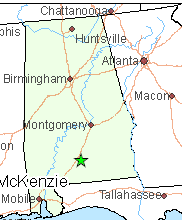
A public-address announcer at a high-school football game in rural Alabama is in hot water for saying people who don't stand for the national anthem should be shot, Erin Edgemon reports for The Huntsville Times. During a game Friday night in McKenzie, Ala. (Best Places map), announcer Pastor Allen Joyner said: "If you don't want to stand for the national anthem, you can line up over there by the fence and let our military personnel take a few shots at you since they're taking shots for you."

Controversy has swirled around the National Football League over African American players who have refused to stand for the national anthem as a protest against oppression in the U.S. McKenzie has a population of 514.

While reports say the comment was cheered by those in attendance, and Facebook posts applauded Joyner, Butler County Schools Superintendent Amy Bryan wasn't happy, Edgemon writes. She said in an email, "Patriotism should be a part of school events, but threats of shooting people who aren't patriotic, even in jest, have no place at a school. Threats of violence are a violation of school policy and certainly not condoned by the school board." No action against Joyner has been reported. (Read more)

Monday, October 19, 2015

Rural newspaper series localizes impact of concussions on high school athletes

Dr. Andy Gilliland, a sports medicine specialist who does baseline concussion tests for 26 local high school football teams in Eastern Kentucky, has diagnosed 43 concussions this season, Ben Nandy reports for The Daily Independent in Ashland as part of a series on concussions and high school athletes. "A baseline test measures a player’s mental processing, concentration and memory prior to the season. Following any hard impact to the player’s head during the season, the test is administered again and the results compared to baseline results from before the season. If the results of the latest test show a decline in brain function, the player may be diagnosed with a concussion and temporarily sidelined to avoid a second hit, which could do irreversible damage."

Gilliland said "he has seen a significant change in attitudes toward head injuries," Nandy writes. He told Nandy, “Two years ago, we were in the midst of the fight. Now, I don’t see any culture of negativity in schools around here. We sense a culture change is taking place . . . There was a reactive stance before. Everyone’s proactive now. What we started doing five years ago is becoming the standard worldwide.” (Biological Conclusions graphic)

It's not just full-contact sports like football that need to be more aware of concussions but all sports activities, Nandy writes in another story for the series. Last year Whitney Nicole Porter, a high school cheerleader in Ashland, suffered a concussion after a fall, leading to new rules this year requiring cheerleaders to go through "the same concussion testing and protocol that have been required of football players for the last four seasons."

During a basketball game, Porter "went into a backflip and snagged her foot on another cheerleader’s arm, causing Porter to fall about 5 feet with her face hitting the gym floor," Nandy writes. "Porter’s injury was difficult to treat since she did not take a comprehensive baseline concussion test before the season. She did not have baseline results for brain function, which could have been compared to results from a similar test taken after the injury. After the more obvious outward symptoms (vomiting, dizziness and slurred speech) of a concussion subsided, Porter was medically cleared to return to cheerleading. But soon after her return, it became frighteningly apparent to Porter and her family that her brain had not completely healed."

Her mother Eva Porter told Nandy that Whitney had "mood swings, difficulty sleeping and depression.” While Porter returned to the squad this fall and says she feels “normal” again, her mother hopes the school's "new baseline testing policy becomes the norm for cheerleaders nationwide."

Also see: Protecting teeth may prevent concussions

Thursday, May 07, 2015

Student-led investigation finds colleges charging thousands in hidden fees to support athletics

Many colleges and universities are charging students thousands of dollars in hidden fees that go to support athletic programs, while those same colleges continue to raise tuition and cut jobs, says an investigative report by University of Cincinnati students for CityBeat. Seven of Ohio's eight largest universities in 2013 charged students an athletic subsidy between $724 to $1,226 per student, totaling between $11,149,815 to $21,754,860 for all students.

At the current rate, a student like Kevin Leugers will pay the University of Cincinnati $4,096 in athletic subsidies during his four years of school, more than 20 percent of the $20,000 he plans to borrow in school loans, reports CityBeat. "Thomas Humes, UC’s board chair and a trustee since 2007, says the $127 million sports subsidy is a necessity to keep pace with other programs." He told reporters, "I think it is a requirement. There has been a decision that whatever that investment number is that it is a positive investment for the university. I don’t view it as a concern.”

Jeff Smith, a college sports subsidies expert who teaches management at the University of South Carolina Upstate, told reporters, “It’s Robin Hood in reverse. These schools are imposing a regressive tax on those students least able to afford it. If I were a student, I would be screaming about this.”

While charging students fees for athletics "many of these same schools are cutting faculty jobs and slashing academic spending," reports CityBeat. "Between 2005 and 2013, academic spending per full-time undergraduate student at UC, adjusted for inflation, dropped 24 percent, according to the Knight Commission on Intercollegiate Athletics, a national group of current and former college presidents seeking to reform college athletics using research studies and, more recently, online databases."

"In other words, over the past decade, UC leaders have used student fees and tuition to cover a nearly five-fold increase in the athletic department’s annual deficit while cutting academic spending per student by almost 25 percent," CityBeat reports. 

Of the eight largest schools, only Ohio State University does not charge an athletic subsidy, mainly because they don't have to. OSU, whose football team is the defending national champion and whose stadium seats 104,944, has one of the most profitable athletic programs in the nation. (Read more)

Wednesday, March 18, 2015

Poor, remote E.Ky. school penalized for recruiting; coach says he's giving opportunity to at-risk kids

As the Kentucky boys state high school basketball tournament begins today, a battle is brewing in a small Eastern Kentucky town over its school's basketball program coached by a former University of Kentucky player, Willie Davis reports for the Daily Yonder. Cordia School in Knott County is in a fight with the Kentucky High School Athletic Association, which claims coach Rodrick Rhodes, who became the boys basketball coach three years ago, is illegally recruiting players from out of state, or even outside the U.S. Rhodes says Cordia is not a basketball factory and he is giving at-risk students a chance to succeed. (Photo by John Flavell: Rhodes huddles with players before a game)

KHSAA disagrees. It has banned players, and initially banned the school from boys' basketball games this season and the 2015-16 postseason and fined the school $26,000. Rhodes and most of the imported players are black, with most players coming from violent homes in places such as New York, Canada and Mali, Davis writes. Cordia is largely white.

Rhodes told Davis, "Kids are wanting to go to Cordia. Their families want them to go. … Big schools have transfer students. I don’t even know who won [the] state this year, but I guarantee there were transfer students. The team they beat in the championship had transfer students. The teams those teams beat in the final four had transfer students. Every team those teams played in the sweet sixteen had transfer students. Why are we being picked on?"

Rhodes said, “We’re saving these kids’ lives. Two of the kids have been shot where they were from. …You can’t walk to school without being recruited to a gang. Who wants that? It’s not about basketball. Our players aren’t great players. They’re fragile, fractured kids. If they’re so great, these teams wouldn’t let them go. I’m not getting McDonald's All Americans. If I was, my records would be a lot better. We’re not getting great basketball players. We’re getting black kids, so people assume they’re phenomenal. But this isn’t about basketball. I promise you, it’s so much bigger than that.”

KHSAA has since reversed many of the sanctions against the school, Davis writes. "Although the board upheld 17 out of 27 of the convictions and maintained both the $26,000 fine and the two-year post-season ban, they modified the biggest ban. Cordia was allowed to play 12 games this season, going 8-4. Davis did not quote anyone from KHSAA in his story.

Friday, October 31, 2014

High cost of living in remote areas means some Alaska schools pay sports opponents to travel

High school sports are getting costly in remote rural areas of Alaska. Ketchikan, the state's southeasternmost city, not only has to raise thousands of dollars each year for travel costs for road games, but if it wants to host games against schools located far away, Ketchikan is forced to pay the other school's transportation costs, which includes airfare for players and coaches, Emily Files reports for KRBD 105.3 in Ketchikan. In one instance this year, Ketchikan had to dole out $8,700 to fly in a team of 20 football players from Seward.

A large portion of Ketchikan's $1.2 million budget goes toward travel, while the North Slope Borough School District budgets approximately $1.8 million each year just for activities travel, Files writes. During a recent assembly Ketchikan Superintendent Robert Boyle told concerned citizens, “We’re in awkward spot. People don’t have to come play us. . . . we’ll be on their schedule, but they won’t actually be required to come play us in Ketchikan. We couldn’t get home games if we didn’t do it.” (Experienceketchikan.com map)

Opposing schools in the region pay their own costs, but with a limited number of opponents to choose from, Ketchikan usually fills out its athletic schedules with teams from farther north, Files writes. While Ketchikan pays its own way to road games, getting other schools, especially ones in urban areas where there are plenty of opponents to fill the schedule, means adding extra incentives, such as paying the other team's way.

Billy Strickland, director of the Alaska School Activities Association and a former athletic director in rural remote Alaska, told Files, “Off the road system schools, we’re more used to that philosophy of we have to pay the money to go. The urban schools or on-the-road-system schools have options that don’t cost as much. If you’re Seward, you’d probably really like to go to Ketchikan and play that game. But you’re not going to spend money to do it when you could drive to Nikiski, Kenai, Soldotna.”

Strickland "says ASAA doesn’t and shouldn’t dictate who pays for travel to the games," Files writes. "He thinks the fact that outlying schools have to pay is just another aspect of living in a more remote part of the state." Strickland told Files, “Those of us that live in remote places—part of that remoteness is just the cost of everything’s higher. Whether it’s a gallon of milk in the store or what it costs to get a basketball game. There’s a high cost of living in remote areas.” (Read more)

Wednesday, October 09, 2013

State athletic group advises Ky. schools to stop organized post-game hand shakes, fearing fights

It's considered good sportsmanship at the end of a high school sporting event to line up and shake hands with the opponents, saying "nice game" or some other variation of a friendly gesture to let the other team know that no matter what happened during the event, you wish them the best as they continue with their season and their lives. But the Kentucky High School Athletic Association is advising schools to stop the ritual because it has led to fights and physical conflicts, Linda Blackford reports for the Lexington Herald-Leader.(H-L photo: Kentucky high-school softball teams shake hands after a game)

The KHSAA said "more than two dozen fights in the past three years in Kentucky have broken out at post-game ceremonies," Blackford writes. That seems like a high number until you consider that Kentucky has more than 200 high schools that participate in 16 different sports, many with boys' and girls' teams. The schedule on the KHSAA website today has 36 girls' soccer games, eight boys' soccer games and 23 volleyball matches; last Thursday and Friday, 176 Kentucky schools played in 92 football games (eight against out-of-state competition).

The KHSAA has already backed down from its plan to ban organized hand-shaking and is just advising against it, Blackford reports. The original directive stated: "It is hereby directed that teams and individuals do not participate in organized post-game handshake lines/ceremonies beyond that interaction that is required ..." But after receiving criticism, it was changed to: "It is prescribed that teams and individuals do not participate in organized post-game handshake lines/ceremonies beyond that interaction that is required ... and the individual, unorchestrated actions by individual competitors." Teams can still voluntarily shake hands, but KHSAA commissioner Julian Tackett told Blackford, "You're on notice; if you're going to do this, you're going to be accountable." (Read more)

Les Johns of the Kentucky New Era in Hopkinsville reports, "The Sept. 21 Fort Campbell football game at Caldwell County had two ejections during the game. When the teams exchanged pleasantries during handshakes, it wasn’t entirely pleasant. Coaches intervened and prevented the altercation from getting out of hand." Johns quotes Hopkinsville High School basketball coach Tim Haworth: “I know what I’m going to tell my team — we’re shaking hands. Period, end of statement. We’re going to shake hands, and if the other team doesn’t want to, then that’s on them.” (Read more)

Read more here: http://www.kentucky.com/2013/10/08/2866222/the-kentucky-high-school-athletic.html#storylink=cpy

Read more here: http://www.kentucky.com/2013/10/08/2866222/the-kentucky-high-school-athletic.html#storylink=cpy