Showing posts with label coronavirus. Show all posts

Friday, June 21, 2024

Bird flu continues to infect cattle, but national testing for humans is stymied; only about 45 people have been tested

So far, H5N1 has not spread from human to human.

Despite studies showing Americans have little to zero immunity to H5N1, the strain of bird flu that has infected more than 100 herds of dairy cows and at least three farm employees, the Centers for Disease Control and the Food and Drug Administration are distributing bird flu tests at a snail's pace. "The U.S. has tested only about 45 people across the country," reports Amy Maxmen of KFF Health News. Without more testing, knowing how many dairy workers are infected is impossible. "A lack of testing means the country might not notice if the virus begins to spread between people — the gateway to another pandemic."

The CDC has around 1 million tests available, but the channels for getting the tests aren't the norm. Nirav Shah, principal deputy director of the CDC, "is concerned because the CDC and public health labs aren't generally where doctors order tests from. That job tends to be done by major clinical laboratories run by companies and universities, which lack authorization for bird flu testing," Maxmen explains. "Researchers cite testing failures as a key reason the U.S. fared so poorly with Covid."

Testing is critical to stemming a pandemic, but the U.S. needs to include clinical laboratories in the testing supply chain. Alex Greninger, assistant director of the University of Washington Medicine Clinical Virology Laboratory, told KFF News, "Clinical labs are part of the nation's public health system. . . . Pull us into the game. We're stuck on the bench."

Meanwhile, H5N1 will continue to evolve, and the virus could begin to spread from person to person vs. cow to person, which is yet another reason "to involve clinical laboratories. . . so the nation can ramp up testing," Maxmen writes. "The fastest way to get clinical labs involved, Greninger said, is to allow them to use a test the FDA has already authorized: the CDC's bird flu test. . . . The CDC opened up that possibility by offering royalty-free licenses for components of its bird flu tests to accredited labs."

While several commercial labs requested those licenses, getting FDA approval has hampered progress. "The CDC has given seven companies licenses for its tests — although none have been cleared to use them by the FDA," Maxmen reports. "Greninger said the delays and confusion are reminiscent of the early months of Covid, when federal agencies prioritized caution over speed. Test accuracy is important, he said, but excessive vetting can cause harm in a fast-moving outbreak like this one."

To learn more about the evolution and transfer of viral zoonotic diseases, click here

Friday, March 15, 2024

More Americans are opting out of Covid-19 vaccinations; survey shows the choice can be based on political views

Pew Research Center graph
It has been four years since the U.S. rolled out lockdowns and mask mandates to slow the spread of Covid-19. Many Americans, both Republican and Democrat, received the country's first Covid-19 vaccine in fairly equal numbers. However, after that initial jump-off point, Covid-19 vaccines have become more partisan, and many Americans seem less concerned about the virus despite its continuing presence in the population.

"A new Pew Research Center survey finds that just 20% of Americans view the coronavirus as a major threat to the health of the U.S. population today, and only 10% are very concerned that they will get it and require hospitalization," report Alec Tyson and Giancarlo Pasquini for the Pew Research Center. "This data represents a low ebb of public concern about the virus that reached its height in the summer and fall of 2020, when as many as two-thirds of Americans viewed Covid-19 as a major threat to public health."

While it's hard to explain why so many U.S. citizens seem indifferent to the disease, vaccination numbers speak to an overall lack of public interest. "Just 28% of U.S. adults say they have received the updated Covid-19 vaccine, which the Centers for Disease Control and Prevention recommended last fall to protect against serious illness," Pew reports. "This stands in stark contrast to the spring and summer of 2021, when long lines and limited availability characterized the initial rollout of the first Covid-19 vaccines. A majority of U.S. adults (69%) had been fully vaccinated by August 2021."

Historically, political affiliation hasn't been a factor in vaccination status. A Pew survey from 2023 reported: "Robust public confidence in the value of childhood vaccines for MMR, with no decline in the large majority who say the benefits outweigh the risks compared with surveys conducted before the coronavirus outbreak." The Covid-19 vaccination does not have that kind of unilateral support, but instead vaccine choices fall along party lines. Tyson and Pasquini write, "Democrats and Democratic-leaning independents remain more likely than Republicans and GOP leaners to say they've received an updated Covid-19 vaccine (42% vs. 15%). This 27-point gap in recent vaccination is about the same as in January 2022."

The gap is even more distinctly party-affiliated among Americans 65 and older, who are ironically more at risk of dying from the disease. Pew reports, "In the current survey, 66% of Democrats ages 65 and older say they have received the updated Covid-19 vaccine, compared with 24% of Republicans ages 65 and older. This 42-point partisan gap is much wider now than at other points since the start of the outbreak."

Tyson and Pasquini add, "Still, the virus continues to circulate widely in the United States, with wastewater data suggesting that cases in the early part of 2024 were among the highest they have been since the first omicron wave in 2022."

Tuesday, December 20, 2022

Should you stay or should you go? How sick is too sick?

Image by NIAID on Unsplash
The dilemma: You have holiday dinner plans, but your nose starts to run and you have a shaggy cough. Now what? Even if your Covid-19 test is negative, what about the other 200 different viruses that are known to cause cold symptoms?

Situations like these have a lot of Americans asking, "How can we spend time together safely? How sick do you need to be to sit out the holidays a third year in a row?" writes Caroline Mimbs Nyce for The Atlantic.

She uses an episode to suggest an approach: "Paul Sax is a Harvard infectious-diseases specialist who likes to play poker. Every few weeks, he plays with friends in Boston. Recently, when it was Sax’s turn to host, one of the game’s regulars came down with a cold. The player tested negative for Covid but offered to stay home anyway. . . . Sax took him up on it. “Why go through the hassle of getting a cold?” he told Nyce, offering some practical advice: “If you’re going to the house of an infectious-disease doctor, don’t come with a cold.”

Flu season started early this year with Covid, the flu, and respiratory syncytial virus (RSV). And while testing can take out some of the guess work: "At-home Covid rapid tests are thought to be a good measure of infectiousness; some experts recommend that you can leave isolation by testing out," Nyse notes. "That’s not an option for the flu, RSV, or a cold."

Getting back to should you stay or go, Nyce writes, "For starters, pretty much everyone agrees that one symptom is an absolute no-go: fever. A temperature equals stay home, for at least 24 hours. (And no cheating with ibuprofen: You should be fever-free without pain meds.) Two other 'red flag' symptoms some experts mentioned are vomiting and diarrhea."

After fever and red flags, deciding how sick is too sick gets stickier. “Your individual health status is going to have an impact on how long you’re contagious,” Donald Milton of the University of Maryland told Nyce, citing flu data suggesting that children and people with obesity stay contagious for longer.

Sax told Nyse, “On average, a bad cold lasts 10 to 14 days. And yet people seem to have almost amnesia about that fact.”

Milton told her, “Basically, you need to ask people, ‘If you’ve got cold or flu symptoms, please stay home.’ If people who are recovering from a virus do come to the gathering, they should wear a mask.”

Then there's the curse of the lingering cough. "Once a person is past the initial phase of being sick, some coughs will continue to be caused by the virus, while others will be from irritation to the airways—almost asthma-like. And sorting out which is which is impossible," Sax told Nyse. Either way, “you’re not going to be very popular at a party if you're coughing a lot."

Tuesday, September 13, 2022

Hospital industry analysis: Problems that triggered 136 rural hospital closures in 2010-21 appear to be getting worse

"Low reimbursement, staffing shortages, low patient volumes, regulatory barriers, and Covid-19 disruptions all played a role in the shuttering of 136 rural hospitals between 2010 and 2021, including a record 19 closures in 2020," John Commins reports for HealthLeaders, citing a report from the American Hospital Association, And, the report says, "Those problems appear to be worsening as rural hospitals contend with rising costs for labor, drugs, supplies and equipment, threatening care access for rural Americans." Key takeaways from the report include:

  • 35 percent of all U.S. hospitals are rural. That includes critical-access hospitals, frontier hospitals, and sole community hospitals.
  • Rural hospitals are often their community's largest employer, and drive the local economy.
  • Rural hospitals support 1 in 12 rural jobs nationwide.
  • AHA wants Congress to extend subsidies under the Medicare-Dependent Hospital and Enhanced Low-volume Adjustment programs. Both programs are set to expire Sept. 30.

Friday, September 09, 2022

GAO: USDA pandemic farmer-assistance program lacked anti-fraud safeties; over 1/2 of audited claims lacked backup

In 2020 and 2021, the Agriculture Department's Farm Service Agency distributed $31 billion in aid through the Coronavirus Food Assistance Program to more than 950,000 farmers and ranchers to help offset losses and increased costs in the pandemic. But the FSA didn't adequately guard against fraudulent claims, according to a new report from the Government Accountability Office.

"We found problems in the process the Farm Service Agency used to review the claims the producers submitted for payment—potentially making it harder to identify payment errors and fraud," says the report from the auditing arm of Congress. "We reviewed the claims of 90 producers, and over half didn't provide support for their payments."

The report recommends the FSA do four things to better guard against fraudulent claims:

  • Conduct more spot checks of CFAP payments and try to focus more on claims for large payments and claims involving commodities FSA generally doesn't cover.
  • Issue guidance directing the agency to identify factors that county offices should consider when choosing producers for spot checks.
  • Direct agency officials who conduct spot checks to seek proof generated by third parties or, if that's not available, document why self-generated proof from the producer was acceptable.
  • Direct state offices to monitor the quality of county offices' spot checks to ensure their accuracy.

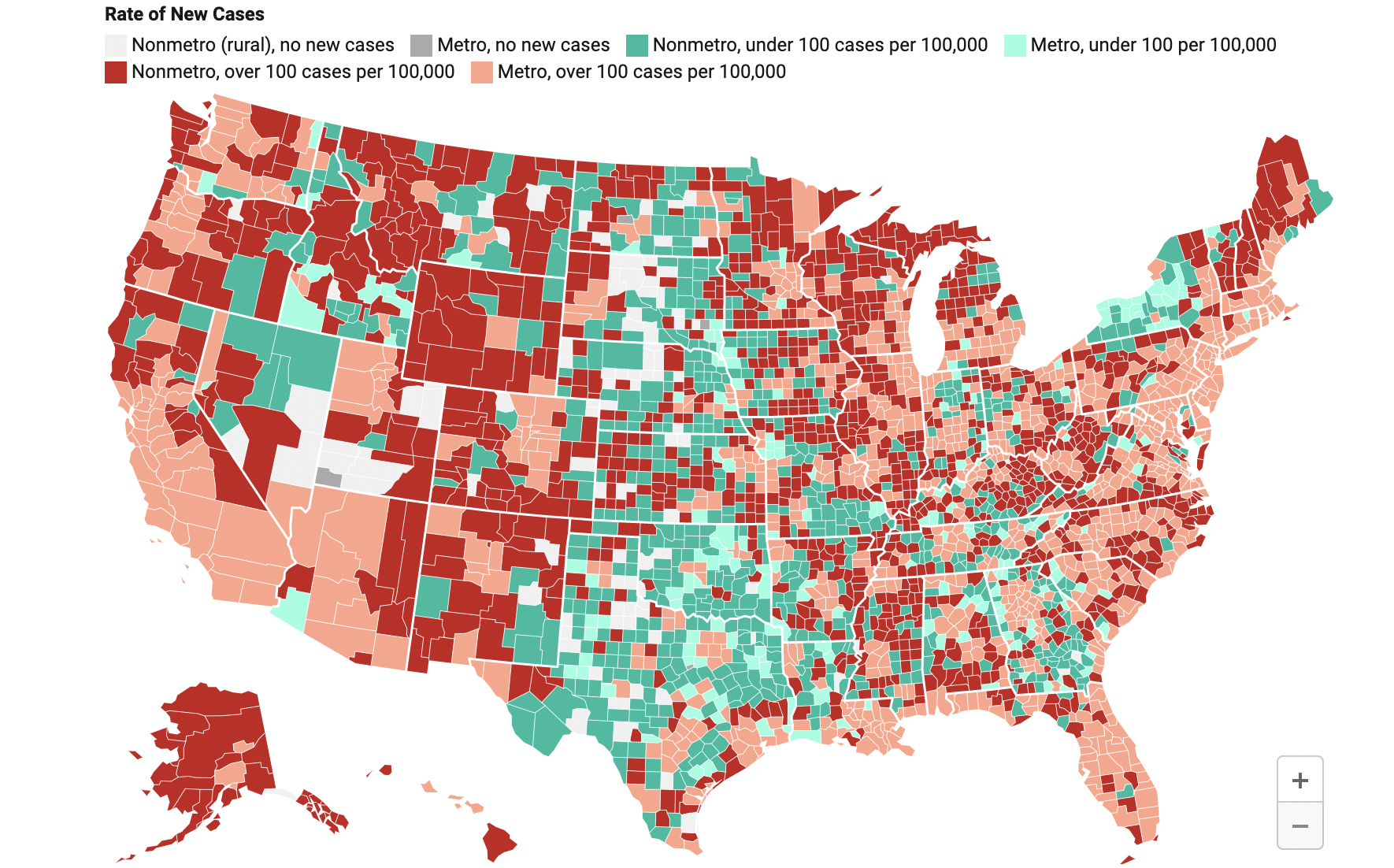
Rural Covid-19 death rate was over 1/3 higher than metros' last week, but rural infection rate fell about same as metros'

Newly reported coronavirus infections, in ranges by county, Aug. 23-30
Map by The Daily Yonder; click on the image to enlarge it or click here for the interactive version.

New coronavirus cases fell in metropolitan and rural counties from Aug. 30 to Sept. 5, but the impact of past infections was felt as death rates climbed, particularly in rural counties.

"Rural America had a 15% decline in infection rates after a 3.7% increase two weeks ago. Rural counties reported 89,689 new cases, dropping the rate from 228 two weeks ago to 194.7 new infections per 100,000 residents last week," Sarah Melotte reports for The Daily Yonder. "New infections in metropolitan counties fell for the fifth consecutive week, declining by about 14% compared to two weeks ago."

Meanwhile, "The rural death rate was 37% higher than the metropolitan death rate last week," Melotte reports. "Rural counties reported 632 Covid-related deaths last week, an increase of about 3% compared to two weeks ago. Deaths in metropolitan counties also climbed by about 3% last week, to 2,823 deaths. Cumulatively, the rural death rate remained about a third higher than the metropolitan death rate."

Quick hits: How the nation's most extreme anti-vaccine law hurt a Montana hospital; learning to live with beavers; housing market cools; gaps found in pesticide regulation

Here's a roundup of stories with rural resonance; if you do or see similar work that should be shared on The Rural Blog, email us at heather.chapman@uky.edu.

When a superintendent in a rural Michigan school district spoke up about systemic racism, some locals were supportive, but most of the response was hostile. Read more here.

Rural southwest Kansas has a growing population of Muslims, but the new Kansans are struggling to develop culturally relevant resources such as a cemetery and a mosque. Read more here.

In 2021, Republican lawmakers in Montana passed the nation's most extreme anti-vaccination law, banning all mandates, even for health-care workers. ProPublica takes a deep dive into the tragic fallout of that decision for a hospital as the Delta wave hit. Read more here.

Some farmers and ranchers destroy beaver dams on their property, believing they cause flooding and other damage. But a growing number of ranchers, scientists and others are coming to believe that beavers are not only helpful, but "furry weapons of climate resilience." Read more here.

The housing market is starting to cool off and prices are coming down. That's good news for rural areas near cities: high housing prices are a major reason people move to more rural areas, but the influx of city-dwellers makes rural housing scarcer and more expensive. Read more here.

A new report exposes key gaps in pesticide regulation enforcement and its impact on farmers. Read more here.

Funding from the climate-and-tax bill aims to bring more renewable-energy jobs to rural Appalachia. Read more here.

Friday, September 02, 2022

Rural Covid-19 infection rate keeps climbing above metro rate; now 27% higher; deaths up 10% after 2-week decline

Newly reported coronavirus infections, in ranges by county, Aug. 23-30
Map by The Daily Yonder; click on the image to enlarge it or click here for the interactive version.

The number of new coronavirus cases in rural counties rose "for the first time in three weeks last week. Meanwhile, new infections fell in metropolitan counties, increasing the gap between rural and metro infection rates for the third consecutive week," Sarah Melotte reports for The Daily Yonder. "The number of Covid-related deaths increased in both rural and metropolitan counties last week."

Non-metro counties reported more than 105,000 new infections during the week of Aug. 23-30 — a 3.7% increase from the week before. Metro counties reported about 500,000 new cases last week, 5.6% less than the previous week. "The rural infection rate was 27% higher than the metropolitan rate last week, compared to 16% higher two weeks ago and 7% three weeks ago," Melotte reports.

Meanwhile, "After decreasing for three weeks, rural deaths increased by nearly 10%. Rural counties reported 614 Covid-related deaths, increasing the death rate to 1.33 deaths per 100,000 residents," Melotte reports. "Metropolitan counties also saw an increase in death rates. The death rate in urban America increased 7.8% to .98 deaths per 100,000 residents. The weekly rural death rate is 36.6% higher than the metropolitan death rate." Click here for more charts and county-level interactive maps from the Yonder.

Tuesday, August 30, 2022

The remote work revolution is already reshaping America, but mainly in cities; remote and rural are not synonymous

Percentage of days worked from home, estimated by applying industry and remote-work trends from November 2021 through June 2022 to 2015-19 industry and occupation data, excluding agriculture. (Washington Post map)

A tsunami of city-dwellers decamped from America's largest cities in the early pandemic, enabled by lockdown work-from-home policies. It will be years before we can get a comprehensive picture of pandemic migration trends, but one thing seems clear: the remote- and hybrid-work trend is here to stay, and it's already reshaping American economic and demographic trends, Andrew Van Dam reports for The Washington Post.

Nearly two-thirds of work was done remotely during the pandemic lockdown in 2020; though many companies have reeled workers back to the office, remote work has stabilized at an "extraordinarily high level" since then, with about one-third of work being done remotely in the U.S. in 2021 and 2022. A Gallup poll "found 29 percent of remote-capable workers working from home full time in June — down from 39 percent in February — while the share working hybrid schedules rose a comparable amount," Van Dam reports.

The data suggest that remote- or hybrid-workers who move to rural areas tend to go for counties with a recreation-based economy. Such counties boast features attractive to urban workers such as natural beauty and good broadband.

Net domestic migration per 1,000 residents from July 1, 2020 to June 30, 2021
Business Insider map using Census Bureau data; click the image to enlarge it or click here for the interactive version.

However, Van Dam cautions, many remote workers did not move away from cities, and not all who moved went to rural areas. Some went to nearby suburbs or exurban enclaves. But Census Bureau data released in April found that in the year ending June 30, 2021, non-metropolitan counties did have the greatest annual population gain they had seen in over a decade.

Data scientists are starting to get a clearer picture of what type of worker left cities for greener pastures, though it's not clear whether those in particular industries were more likely to move to rural areas (as opposed to suburbs or exurbs). "The highest rates of remote work appear among technology, communications, professional services, and finance and insurance workers, according to data from more than 200,000 businesses using the payroll and benefits provider Gusto," Van Dam reports. Emerging data—and ancedotes—also indicate that many small- and mid-sized companies are sticking with remote and hybrid work because the greater flexibility is beneficial.

Thursday, August 25, 2022

New coronavirus infection rate fell just 0.5% in rural counties last week as metropolitan-county rates were falling 7.6%

Newly reported coronavirus infections, in ranges by county, Aug. 16-22
Map by The Daily Yonder; click on the image to enlarge it or click here for the interactive version.

The rate of new coronavirus infections remained stable in rural counties last week, falling only 0.5%, while the rate in metropolitan-area counties fell 7.6% from the previous week. Rural counties had a lower new infection rate than metro counties from March until last week; this week's figures widened the gap, Sarah Melotte reports for The Daily Yonder.

"A similar pattern emerged in Covid-19 related deaths last week. While rural counties saw a 0.4% drop in death rates, reporting 560 deaths last week, metropolitan counties saw an 8.5% drop compared to two weeks ago. Metropolitan America reported 2553 deaths last week." Melotte reports. Click here for more charts and and county-level interactive maps from the Yonder.

Monday, August 22, 2022

Rural Covid-19 infection rate above metro for first time since March, as rural cases fall more slowly than metro cases

Newly reported coronavirus infections, in ranges by county, Aug. 9-15
Map by The Daily Yonder; click on the image to enlarge it or click here for the interactive version.

The rate of new coronavirus infections in rural counties fell by 5 percent from Aug. 9-15 while the metro rate fell by 12%. "The relative difference in the decline in infections means that the rural infection rate exceeded the metro rate for the first time since mid-March, according to a Daily Yonder analysis," Sarah Melotte reports. During that time period, 84% of rural counties were in the red zone, defined as those with 100 or more new infections per 100,000 residents in a seven-day period. That's down slightly from 87% the previous week. However, Melotte notes that the actual infection rate is almost certainly much higher because many people test and treat at home without reporting their infection.

Rural counties reported 562 Covid-related deaths from Aug. 9-15, down 10% from the previous week. "But deaths in metropolitan counties increased 3.3% last week and totaled 2,791," Melotte reports. "The rural death rate was 1.22 per 100,000 residents. That’s 23% higher than the metropolitan death rate of 0.99 per 100,000 residents. The rural death rate has exceeded the metropolitan rate every week except one in the last year." Click here for more charts, regional analysis, and county-level interactive maps from the Yonder.

Wednesday, August 17, 2022

Pandemic influx of city-dwellers triggered housing shortages in many resort towns, pricing out the locals

Early in the pandemic, many city dwellers moved to rural areas. Communities with vibrant tourist economies were especially attractive for such people, according to a recent report from the Economic Innovation Group. Housing was frequently in short supply even before the pandemic in many small towns, but the new residents have triggered soaring housing prices that price out mid- and low-income workers critical to the local economy, Molly Bolan reports for Route Fifty.

Exclusive ski-resort town Sun Valley, Idaho, and surrounding communities offer an extreme example. "It is not just service workers struggling to hold on. A program director at the YMCA is living in a camper on a slice of land in Hailey," Mike Baker reports for The New York Times. "A high-school principal in Carey was living in a camper but then upgraded to a tiny apartment in an industrial building. A city-council member in Ketchum is bouncing between the homes of friends and family, unable to afford a place of his own. A small-business owner in Sun Valley spends each night driving dirt roads into the wilderness, parking his box truck under the trees and settling down for the night."

The housing shortage now threatens the once-thriving local economy in the area: "The hospital, school district and sheriff’s office have each seen prospective employees bail on job offers after realizing the cost of living was untenable. The fire department that covers Sun Valley has started a $2.75 million fund-raising campaign to build housing for their firefighters," Baker reports. "Already, restaurants unable to hire enough service workers are closing or shortening hours. And the problems are starting to spread to other businesses." However, when Ketchum officials sought a tax increase to build hundreds of affordable housing units over the next decade, voters wouldn't approve it.

Resort towns have long grappled with how to house their workers, but in places like Sun Valley those challenges have become a crisis as the chasm widens between those who have two homes and those who have two jobs. Fueled in part by a pandemic migration that has gobbled up the region’s limited housing supply, rents have soared over the last two years, leaving priced-out workers living in trucks, trailers or tents.

More than just housing prices are affected, Bolan reports: "Local officials in smaller communities that have seen an influx of residents are dealing not just with squeezed housing markets, but also added pressure on infrastructure like water systems, crowded backcountry destinations, and increased traffic congestion."

And Summit County, Colorado, another ski area with a booming pandemic population, "has had a lot of 'churn' in its schools, as new students enroll and others move away. As property values have increased, some families who can’t afford the higher prices are being pushed out," Bolan reports.

Friday, August 12, 2022

New rural coronavirus infections down last week; deaths up

New coronavirus infections, in ranges by county, Aug. 2-8
Map by The Daily Yonder; click on the image to enlarge it or click here for the interactive version.

The number of new coronavirus infections "fell significantly last week, resulting in rural and metropolitan counties have virtually the same rate of new infections over a seven-day period," Sarah Melotte reports for The Daily Yonder. "New infections in rural counties dropped by about 3% last week compared to two weeks ago, while the number of new infections in metropolitan counties fell by about 9%. Rural counties reported 107,000 new infections while metropolitan counties reported 664,000 new infections. The rate of new infections in metropolitan counties has been higher than the rural rate since early April."

Meanwhile, "Covid-related deaths, a trailing indicator, jumped by 26% in rural counties last week, while metropolitan counties reported a 1.4% rise in deaths. Rural counties reported 625 deaths, up 130 from two weeks ago. Metropolitan counties reported 2,700 deaths, up 38 from two weeks ago," Melotte reports. "The rural death rate was 42% higher than the metropolitan death rate last week. The weekly death rate has been higher in rural counties for all but one week in the last year. The cumulative rate of deaths from Covid-19 is about 37% higher in rural counties than metropolitan ones."

Tuesday, July 26, 2022

New rural coronavirus infections, deaths up for fourth week

New coronavirus infections, in ranges by county, July 12-18
Map by The Daily Yonder; click on the image to enlarge it or click here for the interactive version.

New coronavirus infections and deaths in counties outside metropolitan areas rose modestly during the week of July 12-18, marking the fourth straight week of rising rates, Tim Marema reports for The Daily Yonder. Rural counties reported 101,575 new coronavirus infections July 12-18, up 3.3% from 98,293 the week before. Metro counties reported 749,593 new infections in the same time period, up 4% from the previous week's 720,721.

The true number of cases is likely much higher than the official count, due to at-home testing and data-reporting gaps, but "even with a substantial undercount in new cases, 80% of all rural counties are in the red zone, defined as having 100 or more cases per 100,000 residents in a seven-day period," Marema reports. "The percentage of red-zone counties is even higher in metropolitan counties – over 90%."

The death rate remains fairly low in both rural and metro counties, likely because of higher immunity and/or milder dominant strains of the virus. "Rural counties reported 476 deaths from Covid-19 last week, up 14% from two weeks ago. Metropolitan counties reported 2,383 deaths, up 17% from two weeks ago," Marema reports. The Covid-related death rate has been higher in rural counties for all but one week in the past year, and the cumulative death rate is more than one-third higher in rural counties than in metro counties.

Thursday, July 14, 2022

Rural coronavirus infection rate up for third straight week; two-thirds of rural counties now in the red zone

New coronavirus infections, in ranges by county, July 5-11
Map by The Daily Yonder; click on the image to enlarge it or click here for the interactive version.

Last week marked the third consecutive week that new coronavirus infection rates rose in counties outside metropolitan areas. "Three-quarters of all rural counties were in the red zone last week, up from about two-thirds of all rural counties two weeks ago. The red zone is defined as having 100 or more new infections per 100,000 residents in a seven-day period," Tim Marema reports for The Daily Yonder. "The increase in new infections was more modest in metropolitan counties, but the metropolitan infection rate remained slightly higher than the rural infection rate."

Rural counties reported 98,293 new cases during the week of July 5-11, an increase of nearly 20 percent over the week before. Metro counties reported 720,721 new infections that week, up about 9% from the previous week, Marema reports. Rural counties reported 419 Covid-related deaths last week, up nearly 17% from the week before, while the 2,044 such deaths in metro counties, down nearly 3% from the week before. 

"The rural death rate of 0.91 per 100,000 residents was 26% higher than the metropolitan death rate of 0.71 per 100,000 residents. The rural death rate has been higher than the metropolitan rate every week except one for the last year," Marema reports. "The cumulative rate of deaths caused by Covid-19 is about a third higher in rural counties than in urban ones." Click here for more charts, regional analysis, and county-level interactive maps from the Yonder.

Tuesday, July 12, 2022

Rural Americans are hit hardest by inflation, especially because of higher fuel costs, Iowa State study indicates

Inflation is hitting the most rural Americans harder than their urban and suburban peers, according to preliminary estimates in a report from Iowa State University Extension. The report examines non-metro households in communities with fewer than 2,500 residents or those "in the open countryside."

Consumer prices in the U.S. rose by 8.6% between May 2021 and May 2022, the federal government reported in June. That inflation is caused by three main factors, reports Iowa State sociology professor and extension rural sociologist David J. Peters:
  • Strong, pent-up demand because of the pandemic. Households put off many purchases during the pandemic and saved up money because of reduced spending, higher wages and government aid. Now consumers are making those delayed purchases all at once and there isn't enough to go around.
  • A scarcity of goods because of the increased demand and supply chain disruptions.
  • Increased demand for housing and services.
  • Minor reasons for inflation include the inflationary impact of government pandemic relief and market uncertainty due to the Russian invasion of Ukraine.
"The current wave of inflation has made rural families more vulnerable than urban families due to rising gasoline prices, higher fuel oil costs to heat their homes, and the ability to purchase less expensive used cars," Peters reports. "In 2022, rural household expenses rose by 9.2% overall, but earnings also rose by 2.6%. The net effect cut rural disposable incomes by 38.0%. Expenses now consume 90% of rural take-home pay. Urban disposable income only dropped by 17% due to slower inflation rates (7.6%) and faster wage gains (4.3%)."

Thursday, June 30, 2022

Two-thirds of rural counties and three-fourths of metropolitan counties were in the Covid-19 red zone last week

New coronavirus infections, in ranges by county, June 21-27
Map by The Daily Yonder; click on the image to enlarge it or click here for the interactive version.

New coronavirus infections were stable in rural America last week, but nearly 1,300 of the nation's rural counties, about two-thirds, were in the federal red zone. Red-zone counties are those with at least 100 new infections per 100,000 people. The high proportion of red-zone rural counties indicates "that they were having difficulty containing the spread of the coronavirus," Tim Marema reports for The Daily Yonder. The number of red-zone rural counties last week was "10 times higher than the number of rural counties than were in the red zone at the end of the Omicron surge in late winter." In comparison, more than 80% of metro counties were in the red zone last week.

"Despite the growth in the number of red-zone counties, the overall infection rates in both rural and metropolitan counties have remained relatively stable. That could be an indication that vaccinations and mitigation practices are helping contain the virus," Marema reports. "Another factor could be a reduction in the reporting of infections because of more at-home testing for the virus." Click here for more charts, regional analysis, and county-level interactive maps from the Yonder.

Friday, June 24, 2022

Pandemic roundup: Publix won't vaccinate kids under 5; even asymptomatic coronavirus infection can hurt a fetus

Here's a roundup of recent news stories about the pandemic and vaccination efforts:

Coronavirus vaccines saved nearly 20 million lives worldwide over the first year they were available to the public, according to a newly published study. Read more here.

Use of at-home coronavirus tests has been difficult or impossible for blind and visually impaired people, especially those who live alone. The Biden administration announced Thursday it's rolling out free at-home tests that are designed to be more accessible. Read more here.

Rapid tests are more prone to false negatives, but those who get such results might be less contagious, because the tests seem to be more accurate if viral loads are higher. Read more here.

Publix, a big grocery chain in the South, says it won't administer coronavirus vaccines to children younger than 5, The Associated Press reports. The Florida-based chain offers other federally approved vaccinations to babies as young as 6 months. Last week Gov. Ron DeSantis said the state isn't pre-ordering doses of the under-5 vaccine, making Florida the only state not to do so. Publix has donated $150,000 to DeSantis since Nov. 2019 but hasn't donated any more since a "60 Minutes" report in April 2021 about it.

Covid-19 can harm a developing fetus even if the infected mother shows few or no symptoms of the virus, according to University of Kentucky researchers. Read more here.

Covid-19 patients who have taken the antiviral treatment Paxlovid may experience a rebound of the virus and test positive again two to eight days after their initial recovery, the Centers for Disease Control and Prevention warned. The CDC continues to recommend Paxlovid for patients at high risk of serious complications from Covid-19. Those who take the treatment and then test positive again or see a resurgence in symptoms should isolate again for at least five days and wear a mask for 10 days after the onset of rebound symptoms. Read more here.

Thursday, June 23, 2022

New rural Covid cases steady last week; metro death rate may be higher than rural for first time in over a year

New coronavirus infections, in ranges by county, June 14-20
Map by The Daily Yonder; click on the image to enlarge it or click here for the interactive version.

New coronavirus infections in counties outside metropolitan areas stayed relatively steady during the week of June 14-20 while Covid-related deaths in rural counties fell by about one-third. One noteworthy trend: For the first time in over a year, the weekly death rate in metro counties was higher than that in rural counties, Tim Marema reports for The Daily Yonder. However, data was missing for Mississippi, which could skew the results.

"Rural counties reported about 61,100 new infections last week, down about 7% from two weeks ago. Metropolitan counties reported a 15% reduction in new cases, from 647,000 two weeks ago to 554,000 last week," Marema reports. "An additional 277 rural Americans died from Covid-19 last week, down from 433 two weeks ago. In metropolitan counties, the number of Covid-related deaths fell by about 20%, from 2,184 two weeks ago to 1,728 last week." Click here for more charts, regional analysis, and county-level interactive maps from the Yonder.

Friday, June 17, 2022

Rate of new rural coronavirus infections remain steady; rural death rate higher than metro for 60th week straight

New coronavirus infections, in ranges by county, June 7-13
Map by The Daily Yonder; click on the image to enlarge it or click here for the interactive version.

The rate of new coronavirus infections in rural counties stayed nearly unchanged during the week of June 7-13 while deaths related to Covid-19 climbed slightly, Tim Marema reports for The Daily Yonder. Rural counties reported 65,346 new infections last week, 38 fewer than the week before. Meanwhile, 433 new Covid-related deaths were reported in rural counties, 67 more than the week before, or an 18 percent climb.

"In metropolitan counties, the number of new infections fell while deaths increased by more than 25% compared to two weeks ago," Marema reports. Metro counties reported 647,191 new infections last week, down 60,843, or 8%, from the week before. Covid-related deaths in metro counties totaled 2,184, an increase of 488 from two weeks ago, or nearly 28%.

"For the 60th consecutive week, the rate of Covid-related deaths was higher in rural counties than metropolitan counties last week," Marema reports. "Rural counties had a death rate of 0.94 per 100,000 last week, while metropolitan counties had a death rate of 0.77 per 100,000." Click here for more charts, regional analysis, and county-level interactive maps from the Yonder.