Showing posts with label banks. Show all posts

Friday, March 08, 2024

The growth of smaller banks and credit unions is outpacing the rest of the industry

Small banks often offer more personal service.
(Photo by Stoica Ionela, Unsplash)
As bigger banks consolidate into mega-banks, an opposing trend is emerging -- smaller banks are attracting new customers and deposits. "While the biggest banks are getting bigger, the smallest are growing too. Community banks, which typically have less than $10 billion in assets and a concentrated footprint, grew deposits by about 1% in the third quarter from a year earlier," reports Imani Moise of The Wall Street Journal. "Credit unions grew deposits by a similar amount. Their loan books grew by 10% and 9%, respectively. Both far outpaced the broader banking industry, according to federal data."

Bank customers opting for smaller banks or credit unions find that "making a switch not only gets them more face time with bankers, but they are also earning more and paying less," Moise explains. "People wanting a smaller bank have an ever-smaller number to choose from. Bank mergers are expected to accelerate this year as lenders seek safety in size after a series of regional bank failures in 2023."


The current market has been tough on mid-sized banks, but smaller banks offer local convenience and more personal customer service for consumers and small-business owners. "Even the biggest banks acknowledge that people like to do some banking in person," Moise reports. "PNC plans to add new branches this year after closing more than 200 last year."


Particularly if problems arise, smaller banks have staff available to solve problems in-person. "Laurie Matta, the chief financial officer for the city of Clarksville, Tenn., decided to move the city’s bank accounts from the U.S.’s fifth largest lender, U.S. Bank, after a mix-up during the pandemic," Moise adds. "It took six months and many unsuccessful attempts to get the bank to correct the error, even though it shared an office building with city hall. . . . She moved the accounts in 2022 to Legends Bank, which is down the street."

Friday, May 19, 2023

What's a community development financial institution? Knowing the answer could be key to a community's progress

The main obstacle to economic development in many rural areas is a shortage of capital for investment. One source of capital can be a community development financial instiution, one of the most important sources of venture capital in poor places. They invest federal and private-sector money in start-ups and other projects in economically disadvantaged communities.

The U.S. has more than 1,000 CDFIs, but “I don’t think they’re very well understood,” said Betsy Whaley, chief strategy officer the Mountain Association, a CDFI for Appalachian Kentucky. “Most projects couldn’t be funded by a traditional bank; banks won’t fund start-ups; they just won’t.”

The role of CDFIs in fighting rural poverty is being explored in a series of articles in Nonprofit Quarterly, co-produced by Partners for Rural Transformation, a coalition of six regional CDFIs in Appalachia, the rural West, Indian Country, South Texas, and the Mississippi Delta.

"CDFIs strengthen local economies, generate wealth that sticks, and foster agency and power among local people to determine their destinies. This is true in urban areas and, critically, rural communities," writes PRT President Jose Quinonez, who offers examples, starting with this one:

"In 2018, a nurse practitioner with over a decade’s experience opened an urgent care facility in her hometown of Clarksdale, Miss. When committing to opening the clinic, she was ready to invest her savings to open the facility, but she had no idea it would be so difficult to obtain the rest of the necessary financing. She had a strong business plan and the medical skills to succeed, but still faced difficulties getting banks or state agencies to back her. When she finally got a loan approved, the loan conditions included putting a second mortgage on her home, which she agreed to do. But home values in Clarksdale were so low that her house fell short of the minimum appraisal value, and the loan fell through. This is where Communities Unlimited stepped in, providing a small loan and technical assistance. Now, the urgent care center employs nine people and pays good wages in a community with low incomes and high unemployment. Moreover, the business provides critical services to an area with few health-care options."

Thursday, March 30, 2023

Interest-rate risks could sneak up on some community banks; regulators may need a stricter approach

Photo by Immimagery via stock.adobe.com
Big banks aren't the only ones that stocked up on bonds only later to regret it. "Dozens of other banks — most of them quite small — are deeply underwater on their bond investments and could hit trouble if they were unexpectedly forced to liquidate the investments. That's according to an American Banker analysis of regulatory filings by the country's more than 4,700 banks," reports Polo Rocha of American Banker. "The losses, a result of banks' bonds losing their value when interest rates rose, remain 'unrealized' and only theoretical. They would only cause trouble if a bank needed cash and was forced to sell the bonds early for less than it bought them, thus making the losses real."

"Bert Ely, a bank consultant, said it 'boggles the mind' that banks took on the same type of interest rate risk that brought down hundreds of savings and loan companies starting in the 1980s," Rocha adds. "Ely, who predicted what became the savings-and-loan crisis, said American Banker's analysis shows a need for regulators to take a stricter approach on the issue. Commenting on the large degree of risk many banks took on, Ely told Rocha, "It just absolutely astounds me that they can be in compliance with the regulations."

"Several bankers contacted for this story pushed back on any concern that they'd ever need to get rid of the bonds to raise cash. Those bankers said they have plenty of cash available. . . . The Federal Reserve Board launched a new program this month aimed specifically at helping banks with underwater bonds," Rocha reports. Still, "The review of call report data reveals how some banks appear to have misplanned for a scenario in which interest rates rose sharply. . . They effectively took the same position as Silicon Valley Bank, where executives thought interest rates would stay ultralow for years and were caught by surprise when the Fed raised rates aggressively." Cliff Rossi, a University of Maryland professor and former chief risk officer of Citigroup's consumer lending division, told Rocha, "It was Risk Management 101. They need to be all over that."

"The Federal Deposit Insurance Corp., whose chairman has warned about unrealized bond losses across the industry since at least May 2022, declined to comment," Rocha adds. "Bank lobbying groups, as well as several of the banks in question, said American Banker's analysis is incomplete and paints an inaccurate picture of those banks' health. . . .Hugh Carney, a top executive at the American Bankers Association, said a single metric such as unrealized bond losses 'does not accurately capture the risks or health of an individual bank.'"

Saturday, March 18, 2023

Ex-FDIC chair worries bank 'bailouts' could drive deposits out of community banks; they'd have less money to lend

Federal officials' determination that two bank collapses posed “systemic risk” to the banking system, justifying their guarantee of uninsured deposits at the banks, poses a threat to smaller banks, a former chair of the Federal Deposit Insurance Corp. told James Jacoby of PBS's "Frontline."

Ex-FDIC chair Sheila Bair (PBS image)
“I do worry about community banks, in particular,” said Sheila Bair, FDIC chair in 2006-2011. “For these larger institutions, $100 billion, $200 billion, that’s not huge. But if you’re a $1 billion community bank, it’s a big difference. And what happens to them if the market starts assuming anybody, say, over $100 billion is going to have their uninsured deposits protected? Then that money is going to start going out of the community banks into those institutions that are viewed as having favored status. So these one-off bailouts that are particularly just for a couple of institutions create a lot of distortions and competitive disadvantages for others.”

Referring to what she called "bailouts" of Silicon Valley Bank and Signature Bank, Bair said "It’s extraordinary that they’re singling out just a couple of midsized institutions to basically bail out all their uninsured depositors. That is extraordinary. I have never seen that before. And the systemic-risk exception itself, which is the legal mechanism they’re using, is very extraordinary to trigger. It is meant to be used very rarely when things are really dire. . . . If they think just a couple of these small institutions have to be bailed out, how resilient is the system, really?" Later, Bair said, "At this point, I still think these risks can be managed. I think that Silicon Valley Bank in particular was unusual, in that it had a lot of uninsured deposits. And it was a very concentrated group of depositors … Silicon Valley folks. And word spread very fast precipitating a bank run and that had a cascading effect on some other banks that had somewhat similar vulnerabilities though not as severe." That said, "The FDIC and the Fed have quietly bailed out most uninsured depositors since 2008," notes Los Angeles Times Washington columnist Doyle McManus.

What about us? "I would say, if you have your money in a traditional community bank or regional bank, one where you banked for a long time, that has lots of households and businesses that do business with them, have done business with them for a long time, most of their deposits were insured or with institutions that have loyalty and multiple relationships with them — that’s the vast majority of the regional banks and community banks in this country. Stay where you are, right? Don’t get scared. If you’re a household, make sure you’re under the insured deposit limits," $250,000 per depositor, per bank, in each account ownership category. "If you are, the FDIC has a perfect record. … Again, I think most banks are okay. What we need to guard against is just contagion: otherwise healthy banks starting to lose deposits just because everybody gets scared."

The threat to smaller banks is a threat to small busienss, report Justin Lahart and Telis Demos of The Wall Street Journal: "Even if any outflows are halted or reversed, small banks may now grow cautious, such as by simply sitting on more of their cash as a defensive measure. Doing so would effectively reduce their capacity to extend credit. For small and midsize businesses that rely on smaller banks, this would be worrisome, says Raghuram Rajan, an economist at the University of Chicago’s Booth School of Business and former governor of India’s central bank. Loans to them are often based on so-called soft information that local lenders have built up over years." Rajan told the Journal, “These are loans built on strength of character and a handshake.”

Tuesday, March 14, 2023

Rebuild Local News Coalition asks regulators to reward banks' support of local news with Reinvestment Act scores

The effort to shift government policies to help local news survive has a new tack: asking federal regulators to give banks better Community Reinvestment Act evaluations if they lend to news outlets.

The pitch is made in an opinion piece for American Banker by Steven Waldman, founder and CEO of the Rebuild Local News Coalition, and one of his board members, Julie Sandorf, president of the Charles H. Revson Foundation. They argue, "Community news organizations are often integral to the vitality of a community. Studies, and common sense, have indicated that communities that lack good local news have less civic involvement, more corruption, higher taxes and lower voter turnout. So, isn't it about time for the government to encourage banks to treat local news as an essential community service?"

Waldman and Sandorf note that banking regulators are considering changes to regulations governing the CRA, which Congress passed in 1977 to remedy the discriminaton against low- and moderate-income communities, and said a bank has an obligation to "meet the credit needs of its entire community." Regulations enacted in 1995 require CRA performance reviews to consider banks' responsiveness to needs for community investment and community development.

"CRA incentivized banks to join forces with the public sector and philanthropy to create new credit and investment products that have, in turn, leveraged tens of billions for such essential community infrastructure as affordable housing, small business development, primary health and day care centers and food markets. It has spurred the establishment of 'mission driven' lenders, such as community development financial institutions, which specialize in financing investment in the unique needs of underinvested communities and businesses.

"But these investments become far riskier when there are not good, reliable sources of information for residents and civic leaders — and reporting that holds politicians and institutions accountable. Banks might get CRA points for lending to a low-income housing project. But if the housing project becomes inefficient or corrupt because no one is watching it carefully, what has been gained? Banks might lend to small businesses, but if those businesses have few ways to reach customers, they may struggle. Yet right now, many of the small media businesses that serve low- and moderate-income communities are struggling mightily — and getting little help from local banks."

So, a coalition of local news organizations have asked the Federal Reserve Board, the Comptroller of the Currency and the Federal Deposit Insurance Corp. to make what they call "some relatively minor changes that could have a major impact on the health of community news." And right now, banks need encourgement to lend to news organizations, Waldman and Sandorf write.

"Many local newsrooms are so focused on keeping the lights on that they do not have the capital to invest in the revenue-producing steps that could help them survive or thrive," they write. "Many local newsrooms have trouble financing the changes they need to make. Big-time venture capitalists view local news as not 'scalable.' Hedge funds buy newspapers but end up gutting them instead of investing in them. Banks — especially those focused on serving low- and moderate-income communities — have been mostly on the sidelines. We desperately need them to step forward."

The news organizations made these specific recommendations to the banking regulators: Make clear that certain types of local news — provided by small businesses for low- and moderate-income communities — count as "community supportive services," just like "educational services" do now. "Regulators should make it clear that educating residents on civic matters through local news should count as educational services," Waldman and Sandorf write. Also, "Banks should advertise more in local news outlets. The law already requires that banks make their products and services known to residents of low- and moderate-income communities. Doing some of that marketing through local media will help them promote their services while simultaneously strengthening the local news that can, in turn, strengthen the community."

Monday, January 30, 2023

Inflation rates omit rural Americans, whom it may hurt more

Data from Bureau of Labor Statistics; chart by The Conversation (click it to enlarge)
This may surprise you: When the Federal Reserve Board meets this week to consider raising interest rates again to fight inflation, rural inflation will not be included in its analysis. "The main indicator of inflation, the Consumer Price Index, is compiled by looking at the changes in price specifically urban Americans pay for a set basket of goods. Those living in rural America are not surveyed," economists Stephan Weiler and Tessa Conroy report for The Conversation, a platform for journalistic writing by academics.

"We believe this poses a problem," Weiler and Conroy write. "People living outside America’s cities represent 14% of the U.S. population, or around 46 million people. They are likely to face different financial pressures and have different consumption habits than urbanites. . . . it may even be masking a rural-urban inflation gap." Weiler and Conroy did their own rural-urban inflation gap research, which outlined some distinctive differences:

Vehicle expenses: "Car ownership is integral to rural life, essential for getting from place to place . . .  Urban residents can more easily choose cheaper options like public transit, walking or bicycling. This has several implications for expenses in rural areas. . . . Longer journeys mean cars and trucks will wear out more quickly. As a result, rural residents have to devote more money to repairing and replacing cars and trucks. . . . Periods of high energy prices, such as the one the U.S. experienced through much of 2022, are likely to disproportionately affect rural residents given the necessity and greater distances of driving."

Food security: "Rural residents already spend a larger amount on eating at home, likely due in part to the slimmer choices available for eating out. This means they have less flexibility as food costs rise, particularly when it comes to essential grocery items for home preparation. And with the annual inflation of the price of groceries outpacing the cost eating out – 11.8% versus 8.3% – dining at home becomes comparably more expensive. . . . Rural Americans also do more driving to get groceries; the     median rural household travels 3.11 miles to go to the nearest grocery store, compared with 0.69 miles for city dwellers."

Health care: Rural residents trend older, "and older people spend more on health insurance and medical services. Medical services overall have been rising in cost too, so those older populations will be spending more for vital doctors visits. . . . On average, rural Americans travel 5 more miles to get to the nearest hospital than those living in cities. And specialists may be hundreds of miles away."

Home energy costs: "Poorer-quality housing leaves rural homeowners and renters vulnerable to rising heating and cooling costs, as well as additional maintenance costs."

Weiler and Conroy note, "While there is no conclusive official quantitative data that shows an urban-rural inflation gap, a review of rural life and consumption habits suggests that rural Americans suffer more as the cost of living goes up. . . . rural inflation may be more pernicious than urban inflation, with price increases likely lingering longer than in cities."

Friday, November 25, 2022

Higher interest rates complicate life for many farmers

Spring wheat was harvested in Kentucky to make way for a soybean crop. (Photo by Amrira Karaoud, Reuters)
The short-term, variable-rate loans that most American farmers take out after fall harvest and before spring planting "to pay for everything from seeds and fertilizer to livestock and machinery" now carry higher interest rates, and "Producers are wrestling with how to pay for that debt," Reuters reports.

P. J. Huffstutter and Bianca Flowers interviewed 24 farmers and bankers and reviewed data from the U.S. Department of Agriculture and the Federal Reserve Bank of Kansas City. They found that some farmers are having to defer capital improvements because of higher interest rates.

"Montana farmer Sarah Degn had big plans to invest the healthy profits she gleaned for her soybeans and wheat this year into upgrading her planter or buying a new storage bin," they report. "Those plans have gone by the wayside. Everything Degn needs to farm is more expensive."

Some farmers try to get loans by the end of the year or early January "to take advantage of suppliers' early-pay discounts and to ensure they won't be caught short as global supplies of fertilizers and chemicals remain tight," Huffstutter and Flowers write. "This rising cost of credit is straining some producers' liquidity and prompting them to look at reducing fertilizer or chemical use, or plant fewer seeds next spring. That, in turn, could reduce crop yields, and place upward pressure on the cost of producing that food."

Saturday, October 22, 2022

Rural Mainstreet Index falls for fifth month in a row; 3 of 4 small-town bankers in Ill.-Wyo. region see recession in 2023

An index of small-town economies in 10 heartland states that are dependent on agriculture and energy production remains below growth-neutral for the fifth month in a row.

Creighton University's Rural Mainstreet Index fell for the sixth time in the past seven months, sinking below growth neutral for a fifth consecutive month. The index is based on a survey of bank CEOs in about 200 rural communities with an average population of 1,300 in Colorado, Illinois, Iowa, Kansas, Minnesota, Missouri, Nebraska, North Dakota, South Dakota and Wyoming.

The October index fell to 44.2 from 46.3 in September. Its range is 0-100, with 50 representing growth neutral. “The rural mainstreet economy is now experiencing a downturn in economic activity,” said Ernie Goss, the Creighton professor who compiles the index. “Almost one in four bankers, or 23.1 percent, reported that the economy was already in a recession. Approximately, three of four bankers expect a recession to begin in 2023.”

Plymouth County, Iowa (Wikipedia base map)
The index includes state figures and looks at farmland prices and other agricultural inputs. The region’s farmland price index for October declined to 58 from September’s 61.1 but stayed above growth neutral for the 25th straight month. In Plymouth County, Iowa, 55.6 acres sold for $26,250 per acre, setting a new state record, according to Jim Rothermich of the Land Talker, Goss reports.

"Labor shortages continue to be a significant issue constraining growth for Rural Mainstreet businesses," Goss writes. "Despite labor shortages, Rural Mainstreet expanded non-farm employment by 2.9% over the past 12 months. This compares to 3.0% growth for urban areas of the same 10 states for the same period of time."

Monday, September 26, 2022

N.M. group pushes for a state public bank, citing N.D. example and touting benefits for small communities, farmers

Angela Merkert
Public banks – which are virtually non-existent in the U.S. – could be a major benefit to agriculture and other small, rural businesses, said Angela Merkert, the executive director of the Alliance For Local Economic Prosperity, in an interview with the Daily Yonder. The New Mexico-based alliance is working to push the state legislature to establish a public bank – a financial institution managed by the government in the public's interest.

North Dakota is the only state with a public bank, and that state had the lowest unemployment rate throughout the 2008 recession, a feat which Merkert said is creditable to an oil boom and programs of the bank. In New Mexico, one of the groups most interested in how a public bank could help small business is the New Mexico Food and Agriculture Policy Council. Lending programs from a public bank could help generate food processing businesses to keep the state's food production profits inside state lines.

"About 95 percent of our agricultural products go outside the state for processing and then we bring back 94 to 95 percent of those processed foods into the state," Merkert said. "A number of people involved in agriculture would like to see those percentages decreased."

Farmers relying on short-term loans that can be paid off "in the fall or early winter when the crops are in" could also benefit from a public bank, Merkert said. Fewer community banks support those types of short loans, but a public bank could step into that void. Opponents of the bank proposal, Merkert said, are often those who call for smaller government.

Monday, September 19, 2022

Inflation keeps small-town economic index in Ill.-Wyo. region below growth-neutral, but farmland prices continue to rise

Graphs from Farm Journal AgWeb
An index of small-town economies in 10 heartland states dependent on agriculture and energy remains below growth-neutral, as bank CEOs in the region said inflation is the top economic challenge.

The Creighton University Rural Mainstreet Index for September is 46.3, with 50 representing growth neutral. That was a slight improvement from the August index of 44, but rural economies in the region are “experiencing a downturn in economic activity,” said Ernie Goss, the Creighton economist who compiles the index. “Supply chain disruptions and inflationary pressures from higher farm input costs continue to constrain growth. Farmers and bankers are bracing for escalating interest rates, higher farm input costs, and drought below growth-neutral for the fourth straight month.”

The index report says, "Four of 10 bankers indicated that high and escalating farm input costs were the greatest economic challenge to their bank and area over the next 12 months." About two in 10 "reported drought impacts were the greatest economic challenge going forward."

Despite the current pressured, the region’s farmland-price index for September rose to 61.1 from August’s 60. It has been above growth-neutral for two years. "According to Jim Rothermich of the Land Talker, five farmland sales auctions between Aug. 27 and Sept. 2 yielded sales of greater than $20,000 per acre" in Ida, Dubuque and Sioux counties in Iowa.

"After falling below growth neutral in August, the farm equipment-sales index soared to 58 for September from 45.9 in August," the report said. "The index has risen above growth neutral for 21 of the last 22 months."

The index is based on a survey of bankers in about 200 rural communities with an average population of 1,300 in Colorado, Illinois, Iowa, Kansas, Minnesota, Missouri, Nebraska, North Dakota, South Dakota and Wyoming. Goss and Bill McQuillan, former chairman of the Independent Community Banks of America, launched the survey in January 2006.

Thursday, September 08, 2022

Consumer finances in rural Appalachia have fallen even farther behind the rest of the nation in the last 20 years

A new report from the Consumer Financial Protection Bureau examines the financial challenges faced by residents of rural counties in Appalachia. "On average, rural Appalachians earn less than other rural people across the country and significantly less than non-rural consumers," CFPB says.

Strikingly, the income gap is growing: "While the median rural Appalachian household income was 89% of the national median in 1999, it was only 69% of the national median in 2020." 

A possible contributing factor: "The share of rural Appalachians attending at least some college lies far below the national average—53% compared to 67% nationally."

Appalachians also have far less access to high-speed internet, says the report: "Only 76% of households in rural Appalachia have access to broadband, compared to 85% of households nationally. Eighteen counties—overwhelmingly in rural areas—lag with rates below 60%."

Consumer Financial Protection Bureau map, adapted by The Rural Blog
Credit-card statistics suggest that Appalachians from the poorest rural counties, those classified as "persistent poverty counties," are less likely to qualify for a card, and that those who do have a card are less likely to be able to pay it off, even though they tend to have lower than average balances on their cards. Appalachians in persistent-poverty counties were less likely to have a credit card and carried a lower average credit card balance than other rural Appalachians, other rural non-Appalachians, or the nationwide average. But those in rural persistent-poverty counties who did have a credit card were more likely to use it than those in other groups, and were more more likely to have delinquent debt on at least one credit card.

"Rural Appalachians are more likely to have a subprime or deep subprime credit score compared to all consumers nationally and consumers in the rest of rural America, which typically leads to a higher cost of credit," the report says. "Rural Appalachians are also more likely than consumers in other parts of the country to have medical debt collections on their credit record."

Friday, July 29, 2022

Quick hits: Why libraries are a boon to rural areas; rural opportunity in CHIPS bill; rural LGBTQ+ Americans face greater health care barriers; latest on flooding in Kentucky

Here's a roundup of stories with rural resonance; if you do or see similar work that should be shared on The Rural Blog, email us at heather.chapman@uky.edu.

At least 16 people have died from catastrophic flooding in Eastern Kentucky, and more deaths are likely to be confirmed, Gov. Andy Beshear says. Read more here.

Many cities and small towns see a huge economic opportunity in just-passed House bill that would create incentives for domestic manufacture of computer chips. Read more here.

Libraries are a boon to rural society, and more important than ever during the pandemic, retired journalist Keith Roysdon writes for The Daily Yonder.

LGBTQ+ Americans in rural Appalachia face greater barriers to accessing health care, according to a recent survey of providers. That's partly because of many providers may not be familiar with unique LGBTQ+ health concerns, or willing or able to address them. Some patients may be reluctant to seek care because of stigma. Read more here.

In the rural West, 'self-reliance' can take a heavy toll on mental health. Read more here.

West Virginia has blocked five major financial institutions, including Goldman Sachs and JPMorgan, from doing business with the state because they have stopped supporting the coal industry, which has become less profitable in recent years. Read more here.

Monday, April 25, 2022

Rural Midwestern bankers say local economies thrive, but predict economic downturn with little impact from E15 sales

Creighton University chart compares current month to last month and year ago; click here to download it and chart below.

An April survey of rural bankers in 10 Midwestern states that rely on agriculture and energy showed still-growing local economies amid deepening concerns about the near future. The index surveys bankers in about 200 rural communities with an average population of 1,300 in Colorado, Illinois, Iowa, Kansas, Minnesota, Missouri, Nebraska, North Dakota, South Dakota and Wyoming.

The overall area economic index fell to a still-positive 62.0 from 65.4 in March; above 50 is growth-positive. Farmland prices are still soaring, home sales are up, retail sales are growing and hiring is up, bankers said.

"The region recorded a 34% gain in farm commodity prices over the past 12 months, but low short-term interest rates and healthy farm income have underpinned the Rural Mainstreet Economy," writes Creighton University economist Ernie Goss, who compiles the index.

However, the loan-volume index fell from 61.9 in March to 51.9 in April, and the confidence index, which predicts the area economy six months from now, dropped from 54 in March to 39.1. Most bankers surveyed (56.5%) believed President Biden's decision to allow the sale of E15 fuel (which has more ethanol) this summer would have little or no impact on their economies, while 39.1% believed it would have a positive effect and 4.4% believed it would have a negative effect.

The vast majority of bankers (91.7%) predicted that the Federal Reserve's Open Market Committee will raise the interest rate by 0.5 percentage points at its next meeting, and 8.3% said the committee will raise the rate by 0.25 points. None predicted the rate would remain unchanged.

Friday, April 22, 2022

Consumer Financial Protection Bureau says rural areas face unique difficulties accessing banking services

The Consumer Financial Protection Bureau, an independent agency Congress created during the Great Recesssion, launched an initiative last month to focus on financial issues rural Americans disproportionately face. This week, CFPB issued a follow-up report detailing the banking disparities rural Americans often contend with.

"The report highlights that many of these communities lack access to physical bank branches, are more likely to seek credit from nonbanks, and are heavily affected by medical bills. The CFPB will be expanding its efforts to address these and other challenges facing the people and families of rural America," CFPB reports. "Local financial institutions, such as community banks and credit unions, often offer products and services that fit the local economic terrain. However, rural communities are experiencing a fast-paced exodus of in-person banking services, with rural communities 10 times more likely than urban communities to be located in banking deserts. In fact, the Federal Reserve has identified more than 2,100 existing and potential banking deserts across the country with more than 1,500 located in rural areas."

Other key findings of the report:

  • Rural Americans are more likely to depend on brick-and-mortar bank branches and smaller banks.
  • Rural Americans are less likely to have a credit history (i.e., have held and used a credit card). Lack of a credit card, or the credit history to get one, makes it more difficult to address short-term financial emergencies, seek new opportunities (such as moving or starting a business), or fill short-term income gaps.
  • Unpaid medical bills affect rural access to credit, housing, and unemployment. Also, health-care and insurance costs tend to be higher in rural communities than in suburban or urban areas.
As part of its Rural Initiative, CFPB is conducting more research to figure out root causes of rural financial disparities, and plans to conduct roundtables with rural stakeholders across the country, as well as work with federal partners to improve rural financial policy. Rural residents are encouraged to use the CFPB's complaint tool to bring attention to shady, inadequate or inaccessible financial services.

Monday, March 21, 2022

Black farmers facing an under-researched mental-health crisis driven by debt, racism, and fear of displacement

Unpredictable natural forces, financial risks, and pure physical exertion make farming one of the most stressful occupations in the nation. "But Black farmers have to contend with an additional menace: the systemic racism that has long marred U.S. agriculture," Safiya Charles reports for The Counter, which defines itself as "a nonprofit, independent, nonpartisan newsroom investigating the forces shaping how and what America eats."

"These producers face down all the typical hardships while also navigating other hazards, including legal battles with the government, discriminatory lenders and opportunistic land grabbers," Charles reports. "These painful interactions tend to underscore the racist—and tragically long-standing—myth that Black people don’t belong in farming, and don’t deserve the tools required to succeed."

Louisiana sugar cane farmer Angie Provost told Charles that many Black farmers, including those in her and her husband's families, "have the same story: sitting there in a USDA office waiting to be serviced, and never being serviced properly; being told by local agents that you will not succeed," said Angie. "'You will fail.' 'You are not a farmer.' Those types of things are told to you directly." Only about 1% of farmers are Black, and advocates blame the declining percentage on decades of loan denials by the Agriculture Department and associated lenders.

"These grinding forms of discrimination take a deeply personal toll, contributing to a mental-health crisis among Black farmers that’s at once acute and yet hard to see," Charles writes. "Help is not exactly on the way. While programs do exist to help farmers handle the stress of the profession, many existing lifelines are geared toward the approximately 95 percent of U.S. farmers who are white, downplaying or outright ignoring the specific forms of distress that stem from race-based prejudice. Though a small but vital body of research points to the need for a more inclusive approach, and at least one advocacy group is working to better understand the scope of the problem, few efforts are being made to address the problem on the ground. For now, too many farmers still have nowhere to turn, their suffering largely rendered invisible within the support systems that exist."

Government programs meant to tackle farming stress don't generally tend to the unique needs of Black farmers. "In 2021, the USDA announced $25 million to state Farm and Ranch Stress Assistance Networks to build crisis hotlines, establish anti-suicide trainings, and offer free or low-cost counseling, among other services," Charles reports. "It was an important step toward recognizing the emotionally grueling, often isolating nature of farm work. But it did little to respond to the needs of Black farmers, who tend to operate smaller farms, face increased economic pressure, and are routinely exposed to racism in agriculture and beyond. Of the 50 FRSAN projects USDA funded in 2021, only seven—in Maine, Massachusetts, Minnesota, New Hampshire, New Mexico, North Carolina, and Rhode Island—pledge to make efforts to accommodate the specific needs of communities of color."

More researchers are beginning to examine racism in farming. "Kentucky State University economist and rural sociologist Marcus Bernard worked with farmers in Alabama’s Black Belt region as the former director of a rural training and research center for the Federation of Southern Cooperatives, a nonprofit association of about 20,000 mostly Black farmers and landowners," Charles reports. "While completing his Ph.D. at the University of Kentucky, Bernard examined how racism, institutional racism, and class conflict affected Black male farmers. His research identified high levels of acute stress in both African American men and women farmers," including farm wives.

Wednesday, March 16, 2022

New federal effort targets financial issues facing rural areas; agency seeks advice from rural stakeholders

The Consumer Financial Protection Bureau, an independent agency Congress created during the Great Recesssion, is launching an initiative to focus on financial issues that rural Americans disproportionately face, Shawn Sebastian reports.

There is substantial need for intervention, since larger economic trends in the past few decades have disproportionately hurt rural areas, Sebastian writes: "The number of jobs in rural areas have still not fully recovered from the shock of the 2008 financial crash and job growth in rural areas has been less than a third of the rate of job growth in urban areas. Rural wages are lower , and rural poverty rates are higher than in non-rural areas and the gap is growing . Increasing corporate consolidation across the economy has hit rural areas particularly hard, suppressing wages and leaving rural people with fewer employment options . In addition, the effects of the Covid-19 pandemic on rural populations have been severe, with significant negative impacts on unemployment and the economic outlook."

The CFPB asked rural organizations about challenges to rural financial resiliency, and heard the same answers cropping up over and over. That includes expanding rural banking deserts; discriminatory and predatory practices from agricultural lenders; and a lack of quality, affordable housing.

It's unclear what actions the CFPB is taking to address these issues, but defining the scope of the problem seems to be a good first step. In the meantime, the agency is still seeking feedback if you want to tell them about other issues your rural area is facing.

Friday, December 17, 2021

Rural bankers report strong local economies and record farmland prices, grow more confident about next 6 months

Creighton University chart compares current month to last month and year ago; click here to download it and chart below.

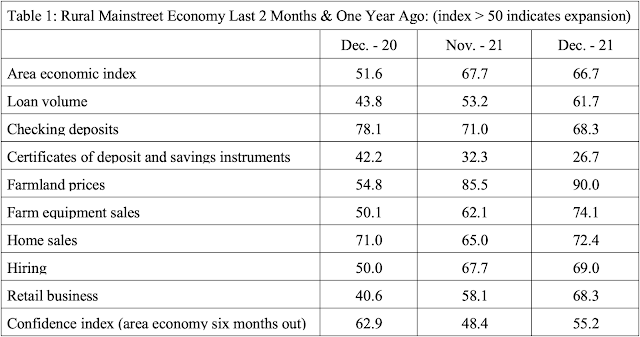
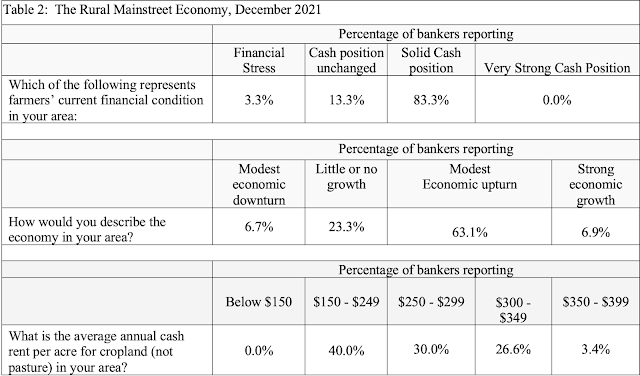
Rural bankers in 10 central states that rely on agriculture and energy reported strong local economies for the 12th straight month, along with record-high farmland prices, in a December survey. The Rural Mainstreet Index polls bankers in about 200 rural places averaging 1,300 population in Colorado, Illinois, Iowa, Kansas, Minnesota, Missouri, Nebraska, North Dakota, South Dakota and Wyoming.

The overall index fell slightly to 66.7 from November's 67.7; anything over 50.0 is growth-positive. The confidence index, which measures bankers' expectations for the economy six months from now, rose to a growth-positive 55.2 from November's 48.4 after declining for five consecutive months. Some bankers expressed concern about inflation and said it was affecting locals.

"Solid grain prices, the Federal Reserve’s record-low interest rates, and growing exports have underpinned the Rural Mainstreet Economy," wrote Creighton University economist Ernie Goss, who compiles the index. Agriculture Department "data show that 2021 year-to-date agriculture exports are more than 20.7% above that for the same period in 2020."

Though non-farm employment in Rural Mainstreet states remains 2.5% below pre-pandemic levels, the new hiring index rose to 72.4 from November's 67.7. And December's farm equipment sales index jumped to 74.1 from 62.1 in November, marking the 13th month straight above growth neutral and the strongest index recorded since April 2011.

Wednesday, December 08, 2021

Non-profit helps Black entrepreneurs in Mississippi Delta

Tim Lampkin (NPR photo by Kirk Siegler)
"The mostly rural Mississippi Delta has long been synonymous with racial and economic inequality. Yet today there are a growing number of small, economic bright spots, due in part to a grassroots effort that's trying to right some of the wrongs of the past," Kirk Siegler reports for NPR.

Though the Delta's population is mostly Black, relatively few Blacks own businesses, especially Black women. There are a number of reasons: distrust of banks, banks' reluctance to lend to Black entrepreneurs, lack of local role models and more, Siegler reports. But non-profits like Higher Purpose Co. are mentoring Black business owners, assisting with everything from securing grants and loans to navigating everyday operating issues.

Tim Lampkin, 35, founded Higher Purpose when he moved back to his hometown of Clarksdale after working in corporate America. He noticed that most local businesses were white-owned, even though more than 80% of the town's 15,000 residents are Black.

Ensuring that people of color can succeed as entrepreneurs is critical, according to Bill Bynum. He has worked to help Black entrepreneurs in the Delta since the 1990s, and has served as a White House economic advisor to Republicans and Democrats, including Joe Biden. "People of color are an emerging majority and if we leave the emerging majority of Americans on the outside of the economy, then we are really in for trouble," Bynum told Siegler.

Monday, November 29, 2021

Rural banker survey finds record-high farmland price index, 12 straight months of sunny local economic outlook

Creighton University chart compares current month to last month and year ago; click here to download it and chart below.

A November survey of rural bankers in 10 Midwestern states that rely on agriculture and energy marked 12 straight months of positive outlooks on economies in about 200 rural communities with an average population of 1,300 in Colorado, Illinois, Iowa, Kansas, Minnesota, Missouri, Nebraska, North Dakota, South Dakota and Wyoming.

The Rural Mainstreet Index rose to 67.7 from October's 66.1, and the farmland price index hit a record-high 85.5, up from 81.5. "Readings for farmland prices and equipment sales over the last several months represent the strongest consistent growth since 2012" writes Creighton University economist Ernie Goss, who compiles the index. "Solid grain prices, the Federal Reserve’s record-low interest rates, and growing exports have underpinned the Rural Mainstreet Economy."

However, labor shortages continue to plague rural businesses; Bureau of Labor Statistics data show nonfarm employment in Rural Mainstreet states remains 2.5% lower than before the pandemic. Some bankers also worry about the infrastructure bill; asked what parts of it would most help agriculture, 30% said it has too many negatives to help at all, while more than a fourth each said it would help most with broadband and waterways. 

Monday, August 23, 2021

Feds create portal to forgive PPP loans after banks drag feet; top banks opt out, leaving businesses at their mercy

Three major lenders participating in the Paycheck Protection Program have opted out of a new process that would allow the Small Business Administration to directly forgive businesses' loans. Lenders representing only half of all outstanding PPP loans have opted in. That leaves small businesses with no other recourse if their bank won't forgive the loan or drags out the process, Bryce Covert reports for The Intercept. Click here for a searchable database of PPP loan applications.

Small-business owners were urged to take out PPP loans early in the pandemic; the loans, the SBA promised, would be forgiven if spent mostly on payroll, and would essentially become grants. But many small-business owners have had a hard time getting their lenders to forgive their loans. "Banks were incentivized to issue PPP loans through the fees they generated, but they don’t receive any fees to push forgiveness through, and they’ve dragged their feet," Covert reports. "Of the total PPP loans that have been issued, less than half have been forgiven thus far."

The SBA announced in late July a portal that would allow some small-business owners to do an end-run around such banks and get direct government forgiveness of their loans. But the portal was opt-in, and "Bank of America, JPMorgan Chase, and PNC have all decided to opt out, according to emails shared with The Intercept," Covert reports. "As of the end of May, JPMorgan Chase was the top PPP lender, followed by Bank of America in the No. 2 spot; PNC is No. 11."

The three banks have touted their streamlined forgiveness processes and implied that the SBA portal was unnecessary. However, "for some business owners, being cut off from the SBA’s direct program could mean they can’t get some or all of their loans forgiven at all," Covert reports. "Some banks have been contacting small business owners in recent months and telling them that they shouldn’t have received the original amount they received — which the banks themselves approved — and requiring the owners to pay back the difference. But many told The Intercept that they used the money correctly and had fully expected to have their entire loans forgiven."