Showing posts with label rural-urban conflicts. Show all posts

Friday, January 23, 2026

Renee Good's death and the rural-urban divide

Many rural Minnesotas see the state's bigger cities as dangerous and 
'out of control.'
The shooting death of Renee Good by a U.S. Immigration and Customs Enforcement agent in Minneapolis, Minn., sparked outrage among the state's urban residents and precautionary warnings from the state's more rural citizens. The fissure between the two creates a "story about America’s urban-rural divide," report Sheila M. Eldred, Elizabeth A. Stawicki, Ann Hinga Klein, and Kurt Streeter of The New York Times.

In Nisswa, a rural, red-voting Minnesota town roughly 150 miles North of Minneapolis, residents at the local pub,"Ye Old Pickle Factory," acknowledge the tragedy of Good's death but still point to the care U.S. citizens should take with law enforcement. The Times reports, “'You obey the law officer,' a man in a veteran’s ball cap said, 'and question it later.'"

"This is the divide, in a single sentence," the Times reports. "In Minneapolis, protesters saw an innocent woman killed by a federal agent and took to the streets. At 'the Pickle,' the regulars saw a woman who should have complied."

Location of Nisswa, Minn., left, Minneapolis, right
The responses to Good's death highlighted another common and increasing difference between rural and urban Americans, where rural residents "see the city as dangerous, out of control and something to flee," Eldred explains.

Rural residents in Minnesota and across the country often see big cities as epicenters of power and money that care little for rural residents. The Times reports, "This sense of alienation is not new. But in recent years it has become tightly bound to Republican partisanship."

Not all of rural Minnesotans see Good's death as a horrible, but justified death of a U.S. citizen by an ICE agent. Trever DePoppe from Pine City, Minn., considers himself an ICE supporter and solid Republican, told the Times, "I think it’s great to start to get some of the illegal immigrants out of the state, [but] I think it’s bad how they are going about it.”

Tuesday, July 16, 2024

An Oregon Democrat won working-class votes in a 'red' U.S. House district; she wants more 'normal people' to be elected

Gluesenkamp Perez would like more 'normal people' elected
into Congress. (Marie Gluesenkamp Perez press photo)

As Democrats look for ways to regain footing with working-class voters, Rep. Marie Gluesenkamp Perez, a Democrat from a previously red district in Oregon, is a living example of changes her party may need to embrace if it wants to gain votes from people who "work for a living," writes Jason Zengerle for The New York Times. "Before she was elected to Congress, in 2022, Gluesenkamp Perez ran an auto-repair shop with her husband; her professional and personal acquaintances still largely consist of people who work in the trades — construction, carpentry, woodworking."

Gluesenkamp Perez doesn't think or act like many other politicians. Zengerle explains, "She hired her legislative director, in part, because the woman drove a Toyota Camry with 200,000 miles on it. 'That says a lot,' Gluesenkamp Perez explains. But what really sets her apart is the way she thinks about the federal government itself — which she believes is woefully out of touch with the needs of working-class Americans."

She has given voice to issues that reflect the needs of those who voted her into office. "While her opponent [Joe Kent] asserted that the 2020 election was stolen and that Dr. Anthony Fauci belonged in prison, she focused on the concerns of the community she knew," Zengerle adds. "Her biggest issue was pushing for 'right to repair' laws, which mandate that consumers have access to repair tools for everything from their smartphones and home medical devices to their cars and tractors." Gluesenkamp Perez told Zengerle: “We’re more and more surrounded by these black boxes that we have no influence over. I think it’s the American ethos that we know how to fix [expletive].”

While working-class connections got her into Congress, Gluesenkamp Perez found it hard to connect with her fellow politicians. "One of the few friendships she did strike up was with Jared Golden, a third-term Democratic representative from Maine," Zengerle writes. Golden's history included becoming leader of the Blue Dog Coalition when only seven members remained. "As the head of the Blue Dogs, he recruited Gluesenkamp Perez and Mary Peltola, who represents Alaska’s lone House district, to be his co-chairs. . . .The new Blue Dogs wanted to make it possible for more people like themselves ('normal people,' Gluesenkamp Perez calls them), from more districts like theirs, to get elected to Congress."

But standing up and speaking her mind has yet to have the legislative impact Gluesenkamp Perez wants. "The signature bills she has introduced or supported — table saws, right to repair, one to expand Pell grants to cover skills training at community colleges — are stuck in legislative purgatory," Zengerle explains. Her "biggest problem at the moment is Joe Kent, who is running again. This time, of course, Trump will also be on the ballot, which means Gluesenkamp Perez will need a good number of ticket-splitting voters to stay in office."

Some say she can't win re-election. To that end, she said: “All of the eggheads and all of the economists and all of the statisticians said we couldn’t do what we did. But you all showed up, and you believed it. Nobody saved us but us.”

Friday, March 15, 2024

Many retirees are moving to southern Appalachia, and local governments are struggling to cope with their needs

The Appalachian Mountains in Georgia.
(Photo by Jairph, Unsplash)

Once known for its rustic beauty, moonshine stills and impoverished residents, southern Appalachia's population is expanding as baby boomers from around the country relocate from more expensive regions. "The boomer migration to North Georgia, East Tennessee, the Carolinas and western Virginia is reshaping housing prices, traffic patterns, restaurant options and how local governments cope with something they haven't had to handle before: explosive growth," reports Cameron McWhirter of The Wall Street Journal. "Each year since 2020, an average of 328,000 people from other parts of the U.S. moved to the five-state region, according to Hamilton Lombard, a demographer at the University of Virginia.

Dawson County, Georgia, is the region's leader in population growth, which "saw a 12.5% increase from 2020 to 2022, reaching just over 30,000, according to estimates by the Census Bureau. . . . In Dawson, the population aged 65 or older reached 21% of the county in 2022, up from 14.1% in 2010. Many moving to the region are wealthier," McWhirter writes. "Dawson's home prices rose 46% compared with 39% nationally, according to Lombard's analysis of Zillow housing prices. Other Appalachian areas like Dawson saw similar spikes, the analysis showed."

In Dawson County, not everyone agrees on how to manage regional growing pains. McWhirter reports, "When Billy Thurmond was a boy, most roads here were made of dirt. Now 64, Thurmond, chairman of the Dawson County Board of Commissioners, said he is regularly stopped at the local Walmart and asked about development and traffic issues. There's a twist: Many of those complaining are people who moved to the county in recent years."

Northern Georgia isn't alone in facing conflicts stemming from exponential growth. McWhirter explains, "From April 2020 to July 2022, the population in counties in southern Appalachia designated retirement or recreational areas grew by 3.8% — more than six times the national average, according to Lombard." Expanding towns face constant change as their governments, medical and emergency services, and recreational and retail offerings work to accommodate newcomers. "The influx of wealthier, older Americans has created challenges for governments working to expand services, including broadband, water and wastewater services, roads, health services and housing."

To explore the southern Appalachian population growth graphed by the numbers or to learn why these baby boomers are known as "halfbacks," click here.

Friday, December 08, 2023

L.A. bans rodeos, becoming the latest city to limit or prohibit the shows; rodeo supporters call it an attack on their culture

Supporters of rodeos rally outside Los Angeles City Hall.
(Photo by Irfan Khan, Los Angeles Times)
Despite the role of rodeos in much of California's rural Western culture, certain show practices paired with documented animal injuries led the city of Los Angeles to ban rodeos, report Susanne Rust and Dakota Smith of the L.A. Times. "The Los Angeles City Council voted unanimously to ban rodeos in the city despite opposition by some in L.A.'s Latino equestrian community, who painted the crackdown as an attack on their culture. . . . Councilmember Bob Blumenfield led the council in passing the ban, describing in graphic detail the broken bones and pain endured by rodeo animals."

The ban carved out exceptions intended to "assuage concerns that the ban would prevent cultural events such as charrería, which is popular in Mexico, as well as the Bill Pickett Rodeo, a national event for Black riders scheduled for February in the City of Industry," Rust and Smith write. "More than 100 people signed up to speak in council chambers before the vote, many wearing cowboy hats and boots."

L.A. is one of many cities that have taken a deeper look at rodeo shows. "Other jurisdictions throughout the state and nation have put limits on or banned rodeos, including San Francisco, San Juan Capistrano and Pasadena, as well as Pittsburgh, Penn.; Baltimore County, Md.; Leesburg, Va.; and Fort Wayne, Ind.," the L.A. Times reports. "In response to concerns that a ban would be akin to an attack on Latino culture, Blumenfield said, 'This is not about culture. This is about animal cruelty. There are Black rodeos. There are Latino rodeos. There are gay rodeos. . . nobody is trying to go after a culture. We're saying that animal cruelty is something that we, in 2023, should not be supporting,' he said."

"Longtime equestrian Geronimo Bugarin said there are nine elements of charrería, including bull riding, mare riding and calf roping, and appeared dismayed at the prospect of not being able to continue those activities," Rust and Smith add. He said: "If we lose one of our key elements of charrería, it's like you don't have a charrería."

Tuesday, August 22, 2023

Opinion: When we listen carefully, the divisions of rural and urban fall away and a different picture emerges

The Daily Yonder graphic
by Nora R. Moosnick
The Daily Yonder

America is again segregated. Spaces where opponents divided by supposed geographic and political differences interact are increasingly rare. Since the 2016 election, the media’s infatuation with rifts between rural and urban voters has been ensconced into our cultural design. These developments overlook the promise of places such as university campuses to blur and overcome fissures. 

I have long been consumed with political and social divisions, but since 2016 my focus has centered on the rural/urban alignment in particular. From 2015-18 I was the faculty director of a University of Kentucky social justice living and learning community, in which students interested in social-justice issues voluntarily live together and explore topics as a group.  After the presidential election of 2016, racial hate speech occurred on our dorm floor. African American students accused White, rural Kentucky students, also in the learning community, of being responsible. 

Immediately afterwards, the residence life department of the university organized a session to address the situation, which quickly turned tense. Black students sat on one side of the room, and White rural kids sat on the floor. Students said things normally unspoken. A student from Chicago talked about family members who advised her against attending Kentucky, fearing for her safety, and women recalled being barred from white fraternity parties. The White rural students looked shell-shocked and unfamiliar with what they were hearing, because they came from communities with few minorities. 

In the years that followed, I committed to overcoming the rural/urban divide through oral histories. That goal eventually led me and 12 student interns to chronicle the lives of undergraduate students at the University of Kentucky, West Virginia University, University of Florida, and University of Mississippi. The themes of the work mirrored the lives of the student interns, who were Black, Brown, White and from rural, urban, and suburban communities.

Not until delving into the students’ stories did I realize that the rural/urban divide is too simplistic to apply to real lives. The students’ stories exposed complicated geographic identities, undermining myths that rural spaces are white, and revealing unexpected class similarities.

I had organized the oral history work around the rural/urban divide, but it became apparent that this was a flawed structure. Students’ geographic identities were not easily pigeonholed. “Can I interview them, they’re from Chicago but moved to small town Kentucky?” Student interviewers’ endless questions about whether an interviewee qualified as rural or urban revealed that the dichotomy was fraught. Students occupied multi-sided identities. Students also came from communities with garbled geographic delineations. It was clear, for instance, that the idea that urban spaces are Black ones ignores geographic realities.

Examples from the work include University of Florida student, “Alex,” who in the space of his interview addressed the complicated racial/geographic dynamics in his northern Florida community. Rural whites live in the city, while minorities are relegated to rural parts. 

… a lot of white rural people living in the city limits but when you go outside the city limits, that’s where the minorities live where we’re barred from voting for the mayor and we’re kind of considered this rural area outside the city limits… It’s kind of a way to keep us from voting.

His identity was rural/urban.

I consider myself rural/urban type because my city is different. If you stay close to the city, you’re still kind of in the urban area, go north and it’s actually one of the most racist cities in the state of Florida, a lot of KKK members. Black folks, we know not to go up to that area because it’s dangerous...

Geographic trickiness overlaid with racism informed his identity. 

Associating white students with rural parts and Black students with urban locations is inaccurate, especially in Mississippi. Rural students from the Delta mentioned never having been around Whites until they attended the University of Mississippi.  Meanwhile, some Black and Brown students from rural and urban communities showed no hint of geographic discord between them.

The interviews also exposed the significance of class in the face of geographic and even racial and cultural differences. When a student comes from a community defined by poverty, whether in Appalachia or Chicago, they encounter a campus that historically has not been oriented toward them. Flagships campuses, in particular, are status rich landscapes exuding wealth, accomplishment, and prominent sports teams, more familiar and comfortable to students who occupy middle class or better status. Multiple times we heard students say something like, “You have to have money to go here.” Students from struggling communities question whether they belong and may hide their class-based struggles, including food insecurity. There is shame in not being able to do things that other students take for granted like affording a meal out. That is despite the fact that these students, rural or urban, may come from communities where they represent the few who make it to the flagship campus.

Campus culture is not theirs also because they often come from communities familiar with trauma. Traumatic stories infused the interviews. A student from the Delta regularly ran home to speak at the funerals of her high school classmates, and an Eastern Kentucky student raced home for a multi-person funeral. These students, urban or rural, conceal their trauma on flagship campuses: Coming from trauma is not considered the lifeworld of a “normal” college student. 

College campuses offer possibilities. Living close to each other, opportunities exist for students to have honest conversations and to see likenesses hidden in complicated identities and class realities. What we learned is that geographic spaces are not easily delineated, that suburbia slides into both rural and urban locations, and that poverty exists in suburbia as it does in dense cities and remote counties. Poor students face parallel struggles with campus culture regardless of their backgrounds and crave spaces to unmask themselves. 

But the possibility of students seeing their likenesses usually goes unrealized. Nonetheless, flagships campuses, where students from a wide range of backgrounds meet, are unique settings to counter the segregation that is crippling America. Revealing students’ stories is a starting point for spurring empathy among students who may never imagined their resemblances.


Nora (Rosie) Moosnick is a native Kentuckian, sociologist, and author of Campus Candor:  Students’ Stories Unmasked (Cognella 2023)—written in collaboration with three former students, Tori Cruz-Falk, Emily Keaton, and Saturn Star-Shooter. She is also the author of Arab and Jewish Women in Kentucky:  Stories of Accommodation and Audacity, (University Press of Kentucky 2012, 2021), and Adopting Maternity:  White Women Who Adopt Transracially and/or Transnationally (Praeger 2004).

This article first appeared on The Daily Yonder and is republished here under a Creative Commons license.

Wednesday, August 16, 2023

How a town of 2,500 people is trying to hold onto its rural identity as it becomes 'inundated' with new residents

Pageland's  motto is "The Watermelon Capital of the World."
(Photo by David Yeazell, The Post and Courier)
It's not easy staying a quaint town when lots of people want to move in. "Pageland, a town of 2,500 people on the South Carolina-North Carolina state line, is changing. As the Charlotte metro area spills over the border, the community has become inundated with people looking for more affordable, convenient housing," reports Seth Taylor Staylor of The Post and Courier in Charleston, S.C. "Pageland's population will double by the end of the decade if development continues at the current pace."

That kind of growth provides smaller towns like Pageland economic opportunities, but can also change what was once a close-knit town into something much different. Pageland residents "worry about overcrowded schools, inadequate infrastructure, emergency services stretched thin and the rising cost of living. They worry that the town’s identity will be lost," Staylor reports. Tim Griffin, the town's Chamber of Commerce president, is worrying the town is losing its battle to hold onto its small-town vibe. He told Staylor: “We’ve got to manage our growth. And we’ve got to be very proud of who we are, so people want to be a part of that. . . . It’s scary because what’s coming is unknown to us.”

BestPlaces.net map, adapted
Some longtime residents say the change "isn't necessarily a bad change, but it's a noticeable one," Staylor reports. Robin Usher, a third-generation resident of Pageland, told Staylor, “In the community, just going to the grocery store and not knowing people is new because, for so long, we knew everybody at the grocery store when we shopped. We don’t know everyone now.” Staylor adds, "Officials said Pageland’s growth is largely driven by the housing market in Charlotte — an hour away — bursting at the seams."

Staylor reports, "For much of Pageland’s 115-year history, it’s been isolated by limited economic opportunities and its distance from other cities, Adam Foard, a Pageland attorney who has spent his life in the town said. . . . Now, Pageland’s destiny is very much out of its own hands. What’s more, many of the people moving to Pageland see it as a springboard to urban life in Charlotte rather than a place with a rural lifestyle all its own." Foard told Staylor: "It was not (that) people discovered Pageland and decided that Pageland was a nirvana seven miles across the state line. . . Pageland became acceptable when they could no longer get what they needed over the state line.”

As local services and government struggle to keep up, "Pageland officials voted to approve a substantial impact fee this spring . . . to pay for the numerous enhancements the city will need to keep up with growth," Staylor reports. "The cost to different developments depends on the type of building and the resources it will consume, according to an impact fee study produced for the town. A typical single-family home will be expected to pay more than $8,000 when the building permit is issued and almost $3,000 when the house connects to water and sewer." Shane Sligh, the town administrator, told Staylor, "At the end of the day, we’ve got to be able to provide new residences with the same services that we’re providing."

Tuesday, August 08, 2023

Nearly one in three election officials report being 'abused, harassed, or threatened;' some are ousted from their party

Marge Bostelmann at her home in Wisconsin
(Photo by Taylor Glascock, special to ProPublica)
Republican Margaret Rose Bostelmann of the Wisconsin Elections Commission refused to agree with other GOP members on the outcome of the 2020 presidential election. For that, she has been banished from the party, report Megan O'Matz and Mariam Elba of ProPublica, who cite her as an example of the harassment many local elections officials are facing.

"Fellow Republicans have exiled her and disparaged her, sought to upend her career. . . . Because she refuses to support false claims that Trump won the state in the 2020 presidential election," O'Matz and Elba report.

Green Lake County
(Wikipedia map)
For over 20 years, as Green Lake County's clerk, Bostelmann oversaw its elections "without controversy," ProPublica reports. "But two years into her term in a Republican slot on the Wisconsin Elections Commission, she became a target, denounced and disowned by the Republican Party of Green Lake County, which claimed she had failed to protect election integrity in the state. Now a suit filed in June by a Wisconsin man who promotes conspiracy theories about election fraud seeks her removal from the commission."

The hostility toward Bostelmann is being seen throughout the country, ProPublica notes: "In an April survey of local election officials nationwide, the Brennan Center for Justice, an independent, nonpartisan law and policy organization, found that nearly one in three reported being abused, harassed, or threatened because of their job."

Don Millis, the Republican who chairs the election commission, also "has expressed frustration with the election conspiracy theorists. He said he considered some of the agitators to be 'grifters' who are conning people of goodwill into thinking there is something wrong with the election system," ProPublica reports. He told reporters: "It's not about winning or preventing fraud. It's about getting publicity or attention. It's about grifting, convincing others to donate to their cause. . . . There are many people who believe them, who don't know any better."

Bostelmann is unsure how a system that once flowed smoothly is now steeped in tension, and why lawsuit plaintiff Peter Bernegger, grandson of the founders of Hillshire Farm, the Wisconsin deli meat and sausage company, has targeted her. "But she does know that things in Green Lake began to change in 2020, during Trump's reelection bid," O'Matz and Elba report.

Saturday, July 22, 2023

'Try that in a Small Town' a missed opportunity, small-towner writes; W. Post writer calls it 'a fantasy of violent retribution'

Jason Aldean in 'Try That in a Small Town' (YouTube)
Either from their lyrics, curious catchiness or infectious beat, some songs and accompanying videos can bring people together. Jason Aldean's latest song 'Try That in a Small Town" isn't that sort of tune, writes Skylar Baker-Jordan in an opinion piece for The Daily Yonder.

"Jason Aldean broke onto the country scene in 2005 with his top 10 hit 'Hicktown.' Subsequent songs, such as 'Amarillo Sky' (about the plight of farmers) and 'Flyover States' (an ode to the heartland) cemented his reputation as a preeminent troubadour for rural America," Bakr-Jordan writes. "So how did his latest offering, 'Try That in a Small Town,' get it so wrong?"

The song dropped quietly enough in May. The video followed on July 14. "The backlash was swift and severe, with Country Music Television pulling the video mere days after it debuted. . . . Lyrics like 'cuss out a cop, spit in his face/stomp on the flag and light it up, Yeah, ya think you're tough,' Aldean and the songwriters position big cities as crime-ridden hellholes where people 'Pull a gun on the owner of a liquor store.' In a small town, though, you can 'see how far ya make it down the road' because 'round here, we take care of our own.'" (The gun angle is explored here.)

Taking care of neighbors is great, but the lyric implies that rural areas are more kind, Baker-Jordan writes: "By pitting urban versus rural, he is not so much extolling the values he grew up with as he is exacerbating the divide already present in our nation. Rather than acknowledging that crime – which happens in rural communities too – is the problem, he blames cities." (Republican presidential candidates are playing the song at events, NBC News reports.)

The video's major location is "a courthouse where an infamous lynching occurred in 1927," but "the production company behind the video denies this was intentional," Baker-Jordan reports. But it "only adds to the problematic nature of the song," which "excludes people of color. . . . Black people live in small towns. Gay people live in small towns. Progressives live in small towns. They have never been the sole purview of conservative white men like Aldean." UPDATE, July 25: Black Lives Matter images in the video have been removed.

Columnist Paul Waldman of The Washington Post calls the video "a fantasy of violent retribution against outsiders — those who would bring the supposed lawlessness of the city to the small town. . . . Were it not for Aldean’s recent political feuds with other artists and the provocation in the video, the song might have simply been cast on the gigantic pile of country songs about small towns. There might be no theme more ubiquitous in the genre: what makes rural life worthwhile, what people in rural areas enjoy and how they live their lives. Some of this music is earnest — even sentimental — about finding pride and meaning in the place where you come from."

That's the sort of song Baker-Jordan wishes Aldean would write. She calls the song "a missed opportunity. . . . Aldean could have produced an anthem that extolled the values of neighborliness and collectivism, which I would agree our nation needs to return to. . . . [Instead] Aldean recorded an anthem dripping with disdain for half the country and filmed a music video at a site of a racist hate crime. . . . I don’t come away from that song feeling like he cares about me. I come away from it feeling like he’s attacking me. And I’m from a small town, too."

Sunday, July 09, 2023

Rural regions will gain influence on Oregon's wildlife panel

These water-panel regions will be the basis for appointments.
In Oregon, a state with a strong rural-urban divide, rural areas will get a larger voice in wildlife policy now that members of the state Fish and Wildlife Commission will be appointed from watershed areas, not one each from congressional districts and the regions east and west of the Cascade Mountains, the state's main politcal divide.

Northwest Oregon, the state's main urbanized area, will still have control of the commission but won't be so dominant, reports Mateusz Perkowski of Capital Press: "Members will be chosen from among five river basins," but two basins "that include the populous Willamette Valley will each get two representatives, while the remaining three basins will each get one representative."

Oregon's six congressional districts
The much-amended bill passed the House unanimously and the Senate 23-2. "Tribes, farmers, ranchers and hunters claimed urban representatives disproportionately steer fish and wildlife policies, which should instead take into account expertise from across the state’s varied geography," Perkowski reports. The river basins will be those defined by the law for the state Water Resources Commission.

Lauren Poor, the Oregon Farm Bureau’s vice president of government and legal affairs, told Perkowski, “Consideration of how wildlife policies affect rural communities is something we feel has been lacking under the current commission structure.” If so, that won't change right away, since current commission members will be allowed to serve out their terms. But "giving southern and eastern Oregon greater influence on decisions, such as the looming update of the state’s wolf management plan . . . is a step in the right direction, she said."

Monday, June 19, 2023

Kingsolver 'internalized shame' of her rural roots, delaying Appalachian novel; now an 'ambassador between worlds'

Barbara Kingsolver (Guardian photo by Jessica Tezak)
Now that she has won this year's Pulitzer Prize for fiction, and the UK's Women's Prize for Fiction for Demon Copperhead, Barbara Kingsolver tells Lisa Allardice, chief books writer for The Guardian, “I understand that my whole life I’ve been wanting to write the great Appalachian novel.”

But Kingsolver says it took her some time to get around to it, partly because she had “internalized the shame” of her rural Kentucky upbringing that preceded graduating Phi Beta Kappa at DePauw University in Indiana and many years in Tucson before she amd her second husband moved to southwest Virginia, Allardice reports. "Now she feels she has not 'just the right but the duty' to represent her community. Kingsolver said, “The news, the movies, TV, it’s all manufactured in cities about city people. We’re nothing. We don’t see ourselves at all. And if we do show up, it’s as a joke, the hillbillies. We are the last demographic that progressive people still mock with impunity.”

Allardice cites "one memorable passage" in which Demon Copperhead lists the insults thrown at Appalachians: “Hillbilly, rednecks, moonshiners, ridge runners, hicks. Deplorables.” The last one refers to a 2016 comment by her friend Hillary Clinton, referring to half of Donald Trump supporters as “a basket of deplorables” because they were “racist, sexist, homophobic, xenophobic, Islamophobic.” Clinton apologized the next day for what she said was an exaggeration; Kingsolver's "agent and editor, both based in New York, questioned whether she should include it," Allardice reports, giving her answer: “I decided, yes, I’m leaving it in because I want this to make the reader uncomfortable.” Kingsolver said she sees bumper stickers in Washington County, Virginia, saying "I'm a deplorable." 

“I understand why rural people are so mad they want to blow up the system,” she told Allardice. “That contempt of urban culture for half the country. I feel like I’m an ambassador between these worlds, trying to explain that if you want to have a conversation you don’t start it with the words, ‘You idiot’.”

Monday, May 22, 2023

In upstate N.Y., people favor solar power but see influx of solar farms as another case of downstate domination

This photo of a solar farm accompanied The Altamont Enterprise's story about the study.

"Upstate New Yorkers, who are otherwise broadly in favor of renewable energy development," oppose utility-scale solar developments in their own communities, reports Noah Zweifel of The Altamont Enterprise, citing a study by the state's Cornell University. The study was published in the journal Rural Sociology.

A survey of more than 400 Upstate residents found that "The factors most correlated with stance on solar development were those that related in some way to sense of place, such as how secure people felt in their own community, how strongly they identify with an upstate point-of-view, and whether they feel their area can compete fairly against other areas for its own interests," Zweifel reports. "In other words, people — in this case mostly older, politically moderate, rural residents — were most reactive to a sense that upstate New York wasn’t getting a fair shake, and that the proliferation of solar facilities in their area is yet another example of upstaters shouldering the burden of downstaters’ needs."

The award-winning Albany County weekly followed up last week with an editorial headlined "Urban and rural: We are one state and must find common ground." After noting the long history of conflicts between Upstate and New York City, it notes, "There is little local benefit from utility-scale solar facilities as they are designed to feed directly into a centralized grid, rather than being redistributed locally to lower local energy bills. The usual benefit a municipality receives from a utility — through tax payments — is circumvented for solar facilities because the state, wanting to encourage solar, has lifted that requirement, letting developers pay far less in payments in lieu of taxes." But the editorial points out that some local governments have required "full tax payments, as they would for any other facility. Further, and more importantly, municipalities can gauge the desires of their own residents to see what resources — whether it be rich farmland or scenic vistas — are commonly viewed as worth preserving and zone accordingly, thus dictating the most suitable places for solar facilities to be built."

Saturday, March 04, 2023

W.Va., Ky. legislators still embrace coal, but not as tightly; Ky. bill to help coal plants stay open shows rural-urban split

Coal was loaded at Cumberland, Ky., near Virginia, in 2019. (Photo by Scott Olson, Getty Images, via Kentucky Lantern)
Most policymakers in the two Eastern states with the biggest stakes in coal, West Virginia and Kentucky, remain "Friends of Coal," following the industry's bi-state slogan, but as the black rock is increasingly disadvantaged in the energy market, some no longer embrace it.

Thursday, the Kentucky state Senate passed a bill to help coal-fired plants keep operating, partly at the behest of coal-reliant rural electric cooperatives. "The bill is opposed by the state’s investor-owned utilities, who say it would prevent them from retiring uneconomical fossil fuel-fired generators and burden consumers with unnecessary costs," reports Jamie Lucke of Kentucky Lantern.

The bill passed 25-8, with all "no" votes coming from senators who represent cities and suburbs; half of them were Republicans, whose party controls the legislature. The state should be "fuel-agnostic," said freshman Sen. Shelley Funke Frommeyer, R-Alexandria, a Cincinnati exurb.

In West Virginia, "Several pro-coal lawmakers support clean-energy startups and alternative electricity sources," and the Legislature repealed the state's ban on nuclear power last year, reports Lee Harris of The American Prospect, a neoliberal magazine. Sean O’Leary, a senior researcher at the Ohio River Valley Institute, told Harris, “To the degree West Virginia is trying to diversify its energy portfolio, its principal focus is on [natural] gas. But folks are still worried and on particular projects and bills, some are starting to wander a little ways off the coal reservation.”

Market forces, and out-of-state politics, are at work. "In 2021, the state’s industry-compliant Public Service Commission approved upgrades at three aging coal-fired power plants, which are expected to keep them operational through 2040," Harris notes. "Kentucky and Virginia refused to impose the costs of those upgrades on their own ratepayers, meaning West Virginia residents will shoulder the full $448 million cost of the upgrades."

This year, West Virginia lawmakers selved a manufacturers-backed bill to encourage developent of gas-fired power plants in favor one directing the state to accelerate coal-fiered power projects, and "the Office of Coalfield Community Development, which was originally set up to help West Virginia transition away from coal, is now being called in to help revive the industry," Harris reports.

Last year, the legislature created a commission "to match grants that former coalfield communities receive, but Gov. Jim Justice hasen't appointed any members, Alexa Beyer of Mountain State Spotlight reports. "Justice owns multiple coal companies, and other lawmakers, including Democratic Sen. Joe Manchin, have deep ties to the industry," Harris notes. "The two may square off in Manchin’s 2024 Senate re-election race."

Friday, February 03, 2023

Quick hits Friday: Why we love Pigpen, drone images we might rather not see, a book for Black History Month . . .

Illustration by Ivan Brunetti, Astra

“I can tell just where you’ve been all week from the dirt on your clothes,” Charlie Brown tells a consternated Pigpen proceeding to rattle off a series of dusty locations. Why do some of us love Pigpen so much? Here's the dirt.

An Opinion from Claire Carlson: "What The New York Times Got Wrong About 'Rural Rage'" from The Daily Yonder.

Drones let us see some things maybe we would rather not see. Like how close that great white shark is to your kick board. “Sometimes they’ll swim right under a surfer, but they don’t circle back." How reassuring.

Getting deeper into Black History Month with an almost 100-year-old book.

It's still winter and SAD is a real thing. Add some cheer to your week by helping Tulsa Zoo name their super-sweet African penguin. "The Good Stuff" is a newsletter; you might want to subscribe.

Spring Break offers rest, rejuvenation, and perhaps travel to some rural locations.

A Marine Mammal Program dolphin

In her youth, Blue was a standout mine-hunter for the U.S. military. But at 57, Blue is one of the oldest dolphins in the U.S. Navy Marine Mammal Program. Navy scientists are now delving into geriatric marine mammal medicine. The pursuit may help not only the Navy’s animals but also wild ones — and, perhaps, even for people.

Words matter. When marketing your farm to consumers, keep all the good things in mind

Deception Pass in Washington State ranked fifth most beautiful U.S. state park. Go beyond the bridge: bays, lakes, and beaches.

The James Webb Space Telescope is discovering distant clusters of stars that formed surprisingly early—presenting new mysteries about how the universe evolved.

Tuesday, January 31, 2023

The rural Republican shift is a big deal, partly because it reflects a deep cultural divide and place-based resentment

"The anger and resentment felt by rural voters toward the Democratic Party are driving a regional realignment similar to the upheaval in the white South after Democrats, led by President Lyndon Johnson, won approval of the Civil Rights Act of 1964," retired reporter Thomas B. Edsall writes for The New York Times in his latest compilation of research about political trends. They go deep, to the point that rural and urban Americans sometimes seem to inhabit different nations.

Rural America's shift to the right "is one side of a two-part geographic transformation of the electorate," Edsall writes, citing a 2022 paper by Jacob R. Brown of Princeton University, Enrico Cantoni of the University of Bologna, Ryan D. Enos of Harvard University, Vincent Pons of Harvard Business School and Emilie Sartre of Brown University.

Thomas B. Edsall
Edsall notes the stagnant rural population and quotes Brown: "Rural Republican areas are becoming more Republican predominantly due to voters in these places switching their partisanship to Republican. This is in contrast to urban areas becoming increasingly more Democratic largely due to the high levels of Democratic partisanship in these areas among new voters entering the electorate. These new voters include young voters registering once they become eligible and other new voters registering for the first time."

The state providing the best example is Wisconsin, where Katherine Cramer of the University of Wisconsin has documented the rural resentment of urban and governing elites, which helped re-elect U.S. Sen. Ron Johnson last year. Cramer said, “It had three elements: (1) a belief that rural areas are ignored by decision makers, including policymakers, (2) a perception that rural areas do not get their fair share of resources and (3) a sense that rural folks have fundamentally distinct values and lifestyles, which are misunderstood and disrespected by city folks.”

Cultural and racial controversies that began in the late 1980s created the urban-rural partisan divide, says David Hopkins, a political scientist at Boston College, in his book Red Fighting Blue: How Geography and Electoral Rules Polarize American Politics. "These controversies included two Supreme Court abortion decisions . . . the 1989 appointment of Ralph Reed as executive director of the Christian Coalition; the fire-breathing speeches of Pat Robertson and Pat Buchanan at the 1992 Republican Convention (Buchanan: 'There is a religious war going on in this country. It is a cultural war for the soul of America'); and the 1993 debate about gays in the military, to name just a few," Edsall writes.

"Justin Gest, a political scientist at George Mason University whose research — presented in The White Working Class and Majority Minority — focuses on cultural and class tensions, has a different but complementary take, writing by email that the rising salience of cultural conflicts 'was accelerated when the Clinton administration embraced corporate neoliberalism, free trade and moved Democrats toward the economic center. Many differences persisted, but the so-called third way made it harder to distinguish between the economic approaches of Democrats and Republicans.'"

That fuzziness accentuated "the very cultural differences that Gingrich-era Republicans sought to emphasize — on issues like homosexuality, immigration, public religion, gun rights and minority politics. These issues are more galvanizing to the Upper Midwest regions adjacent to the South (West Virginia, Ohio and Indiana) — which are trending more conservative," Gest told Edsall. The Upper Midwest, he said, is "a region unto itself — defined by manufacturing, unions and social conservatism. As the manufacturing industry has moved offshore, union power declined, and one of the richest, most stable parts of America became uniquely precarious inside a single generation. It is now subject to severe depopulation and aging, as younger people who have upskilled are more likely to move to cities like Chicago or New York. They have total whiplash. And Trump’s nostalgic populism has resonated with the white population that remains."

Gest is also highly critical of Democrats' rural approach: "Democrats have effectively redlined rural America. In some corners of the Democratic Party, activists don’t even want rural and white working-class people in their coalition; they may even deride them. Rural and white working-class Americans sense this." And such place-based resentment is “only consistently predictive of vote choice for rural voters,” say Nicholas Jacobs and Kal Munis, political scientists at Colby College and Utah Valley University, in a 2022 paper Edsall cites.

As the "stark material divisions" between rural and urban increase, Jacobs and Munis write, "Individuals increasingly live in places that are politically homogeneous. A consequence of this is that, as Bill Bishop concludes, Americans 'have become so ideologically inbred that we don’t know, can’t understand and can barely conceive of "those people" who live just a few miles away.'"  James Gimpel, a political scientist at the University of Maryland, told Esdall, "The disrespect is felt most acutely by the fact that dominant cultural institutions, including mass media, are predominantly urban in location and orientation. Smaller towns and outlying areas see themselves as misunderstood and mischaracterized by these media, as well as dismissed as out of touch and retrograde by urban populations. There is a considerable amount of truth in their perceptions."

Edsall writes, "The belief that rural communities have a distinct set of values that are denigrated by urban dwellers" is a stronger electoral factor than economics, according to research by Kristin Lunz Trujillo, a postdoctoral research fellow at Harvard’s Kennedy School, and Zack Crowley, a Ph.D. candidate in political science at the University of Minnesota. That view is reinforced by Maria Kefalas, a sociologist at Saint Joseph’s University and co-author of Hollowing Out the Middle: The Rural Brain Drain and What It Means for America.

Kefalas told Edsall, "My best guess would be that it comes down to brain drain and college-educated voters. It has always been about the mobility of the college educated and the folks getting left behind without that college diploma. Not one high school dropout we encountered back when we wrote about Iowa managed to leave the county (unless they got sent to prison), and the kids with degrees were leaving in droves. . . . You see a striking concentration/segregation of folks on both sides who are just immersed in MAGA world or not. . . . People who live in rural America are surrounded by folks who play along with a particular worldview, yet my friends from Brooklyn and Boston will tell you they don’t know anyone who supports Trump or won’t get vaccinated. It’s not open warfare. It’s more like apartheid.”

That brings Edsall to a grim colclusion: "Urban-rural 'apartheid' further reinforces ideological and affective polarization. The geographic separation of Republicans and Democrats makes partisan crosscutting experiences at work, in friendships, in community gatherings, at school or in local government — all key to reducing polarization — increasingly unlikely to occur. Geographic barriers between Republicans and Democrats — of those holding traditional values and those choosing to reject or reinterpret those values — reinforce what scholars now call the calcification of difference. As conflict and hostility become embedded in the structure of where people live, the likelihood increases of seeing adversaries as less than fully human."

U.S. partisan divide now runs along rural-urban lines, and that has worsened rural-urban conflict in state legislatures

"The relationships between big cities and rural-dominated legislatures have often been hostile. But a rift between Nashville and the Tennessee Legislature suggests the nation’s partisan divide is making things worse," and there are examples in other states, The New York Times reports.

Michael Wines writes, "For most of American history, the rivalry has played out in state politics more so as a matter of parochial divisions than national ones. Now, a dispute in Nashville raises the question of whether the nation’s barbed political divide — which splinters along the rural-urban axis as well — is infusing old local antagonisms with contemporary partisan acrimony. It’s not just in Tennessee. In Wisconsin, North Carolina, Kentucky and elsewhere, old city-country political tensions have taken on a harder edge as Democratic-leaning urban areas become ever more isolated islands in an ever-redder, rural-dominated sea."

Music City Center (John Greim/LightRocket via Getty Images)
In Tennessee, the Legislature split Nashville among three congressional districts, eliminating a Democratic seat. Then the city council's Democratic majority, citing security concerns, killed Republican leaders' bid to bring the party's 2024 national convention to Nashville, and the GOPers vowed revenge. The House floor leader has filed a bill to limit municipal legislaitve bodies to 20 members; only Nashville, with 40, exceeds the limit, and its voters rejected shrinkage seven years ago. The Senate president, Lt. Gov. Randy McNally, "is proposing to defund the largest civic project in the city's history," Nate Rau of Axios Nashville reports. His bill would repeal "tourism-related taxes dedicated for the $623 million Music City Center." A McNally spokesperson told Rau, "Metro has made it clear they are no longer interested in aggressively recruiting top-tier conventions to Nashville." Councilmember Bob Mendes, who opposed the convention, told Rau he expects the flogging will continue: "There's a massive culture war going on in this country, and the state of Tennessee's leadership doesn't like the culture of Nashville and is going to keep coming after us."

A 2020 study found that Tennessee "led the nation in overruling local laws and policies," Wines reports. "State laws that override city ordinances and policies have mushroomed over the last decade, especially in states where Republicans controlled both the governor’s office and the legislature." He cites examples, such as Missouri laws that keep St. Louis from banning plastic grocery bags and Kansas City from raising the minimum wage, the North Carolina House speaker's bid to block a local sales tax to finance mass transit in Charlotte and so-called "war on Louisville" laws in Kentucky "that sapped the authority of the elected board running the metro area’s 100,000-student public school system, weakened the ground rules of a city-county merger approved by voters two decades ago and limited the city’s mayor to two terms."

The study "found that such laws were more common in states with a Republican government, a strong conservative bent and a higher share of Black residents," Wines reports, quoting Professor Thad Kousser of the University of California, San Diego, who tracks the urban-rural divide: “A hundred or even fifty years ago, Democrats in Atlanta may have wanted different things than the Democrats who were governing the state of Georgia, but they were in the same party. Now they both have different legislative interests and different political interests, too.”

Wines notes, "The dynamic can work the opposite way, too: In New Mexico, the Democrat-controlled State Legislature has drafted legislation to overturn local ordinances passed in conservative towns that restrict access to abortion clinics and abortion pills. The state attorney general on Jan. 23 sued New Mexico cities and counties to overturn the ordinances."

Tuesday, January 10, 2023

Reconsidering the divisions between rural and urban, and Lincoln's maxim: 'A house divided ... cannot stand'

(Photo by Kelly Sikkema, Unsplash)
Considering the political division in America today, it seems hard to see how the country will get through it together, but recalling U.S. history can offer context. "Many consider the oft-quoted phrase by Abraham Lincoln, 'A house divided against itself cannot stand,” as almost cliché. But in reality, it may contain nearly as much relevance and be as applicable today as in Lincoln’s time," writes John Rukhus Jr. of Southside Pride, in southern Minneapolis. "Taking into account the social upheaval and political events in just the last several years alone, one detects shades of a societal climate that existed in the late 1850s and later during Reconstruction. The racially charged discourses of the abolitionists versus their Southern counterparts and later Jim Crow are reflected in today’s actions and reactions regarding the Black Lives Matter movement and the passage of laws in several states to restrict voter access to the polls."

In that discussion, "There is one demographic that is often overlooked, that is, until the most recent presidential election. We are talking about rural America, a segment of the political and societal map whose attitudes and shifts in political leanings can have far-reaching implications nationally," Rukhus writes. "There is a long history, of course, of rural dwellers being written off with the help of stereotypes as being rubes, rustic, ignorant, unsophisticated and isolated. But with the development of better schools in rural areas and the proliferation of public media, rural citizens have become much more connected and savvier than they were, say, 70 years ago."

The divides between rural and urban have led more alienation between Americans, and rural dwellers have had to bear a disproportionate amount of community loss: "There is an underlying current of frustration and fear that is as much economic as political. Insurance companies and other large corporations buy up the farmland and create 'megafarms,' pushing out the family farmer," Rukhus notes. "Retail giants like Dollar General and Kwik Trip and Walmart shut down existing small businesses, while fast food corporations like A&W and McDonald's spring up to replace mom and pop cafes. People who once had economic freedom are forced to work long hours at low wages to support their families. It is like living in economic jail."

Rukhus opines, "Once a bastion of Democratic political leanings, in the last presidential election they threw their support at then-President Donald Trump. Emboldened by the demagoguery of the former president, they found a voice to their frustrations where previously they felt marginalized, disenfranchised and left behind by the American dream. Lest the Democratic party make the fateful mistake of losing this large bloc of American voters forever, they had best find a way to speak to these independent-minded citizens and address their particular issues and concerns."

Monday, December 05, 2022

Opinion: Partisan 'pink slime' publications have outsize impact in rural areas due to shortage of reliable local news

By Vivian Schiller and Bonita Robertson-Hardy
The Aspen Institute

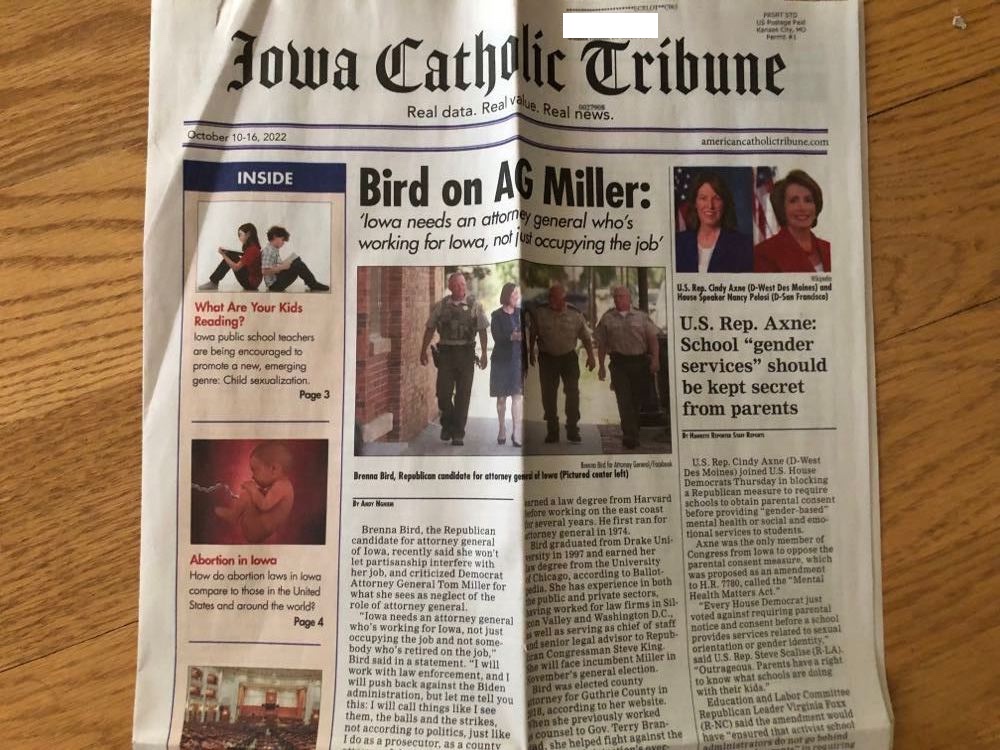
In late October 2022, two weeks before Election Day, voters in Iowa woke up to the Iowa Catholic Tribune in their mailbox.

Under the masthead read “Real data. Real value. Real news.” But the Iowa Catholic Tribune was not a real newspaper from the Catholic Diocese of Des Moines, as some voters thought at first glance. In fact, it was not a newspaper at all. It was the product of Metric Media, a conservative organization that produces countless fake news publications like the Iowa Catholic Tribune around the country.

Image, with address redacted, from BleedingHeartlaand.com
The front page articles warned of teachers pushing books in schools about “child sexualization” and assailed Iowa Attorney General Tom Miller and U.S. Rep. Cindy Axne, two Democrats embroiled in competitive campaigns, on their records in office. Both ended up narrowly losing reelection.

Similar newspapers popped up in other battleground states and sowed confusion among voters. In Arizona, Nevada, Pennsylvania, Michigan and Iowa, Catholic organizations rushed to make clear that they were not publications from the Catholic Church.

"Pink slime," partisan propaganda masquerading as legitimate news outlets, is proliferating around the United States. Driven by ideologically motivated operatives, pink slime exploits our flailing trust in media for political gain. Private Facebook groups and other social media then amplify the false claims, filling the gap of reliable information with websites that often walk a fine line between something resembling reality and conspiracy theory.

Pink slime worsens our trust in information and poisons our democracy. While we know independent fact-based local news is its antidote, it is unfortunately in shorter supply. In the last two decades, 25 percent of all newspapers have shuttered, and one in five Americans live in a “news desert” with little access to reliable local news. Nowhere is this more pronounced than in rural America.

News deserts, pink slime and social media all contribute to a growing crisis of trust – in each other, in institutions and especially in journalism. Last month, a Gallup poll found that only a third of Americans trust the mass media to report the news “fully, accurately and fairly.” Confidence in newspapers and television news has fallen to record lows. This is even more pronounced in rural areas, where 57 percent say that when they do receive local news, whether on television or online, it does not cover where they live.

Rural communities have suffered the most from these trends. While national news organizations have made earnest attempts to fill the void in stories covering rural America, they often fall flat and report on these communities as if the reporters ventured into a foreign land. The 2016 presidential election was the prime example. After Donald Trump was declared the victor, national reporters swarmed small towns hunting for the “missing” voters who eluded their coverage. But according to a study from the Aspen Institute’s Community Strategies Group, their well-intentioned overcorrection exacerbated existing distrust between rural communities and the national news.

The researchers found that when national reporters reached out to rural journalists and community leaders to write on politics and rural life after the election, they often sought preconceived avatars to feature in their coverage, like the “out-of-work coal miner” or “the Trump voters who regretted their decision.” Even when local voices tried to push them in a more authentic and nuanced direction, the national media kept coming back to these narrow identities to advance a reductive, pre-baked narrative.

Quick-turnaround “parachute journalism” like this earned the skepticism that rural people have toward national news media. Without a robust local news source or trust in national reporters, pink slime often finds a more receptive audience in these communities online.

We need to change course. For the sake of democracy, we must all prioritize restoring a robust local media that serves the needs of every community – and all of those communities’ citizens, especially Black, brown, and indigenous people. There is no silver bullet, and this will need to be a long-term effort. As the Aspen Institute’s Commission on Information Disorder found, the solutions must come from every sector of society.

Promising initiatives are budding around the country, but we need more of them. Philanthropy-fueled initiatives like Report for America and the American Journalism Project can help rebuild newsrooms. Civic and media literacy courses led by schools and libraries can prepare the next generation to decipher fact from fiction. Communities that have seen their news downsized can collaborate to establish nonprofit outlets as the Ohio Local Information Initiative has. Businesses can fund and sustain these efforts at the local level. National media organizations can partner with homegrown news efforts to tell national stories from the local perspective, as public radio often does.

Most importantly, we need local news written by people from the community, for the community.

Our ability to solve the biggest societal challenges, and the very preservation of democracy, is predicated on our ability to rebuild a news ecosystem that earns our trust. Each of us has a role to play, and we urge everyone to work with your neighbors to build your own community-driven solution to it.

Vivian Schiller is executive director of Aspen Digital, the Aspen Institute project aimed at empowering policymakers, civic organizations, companies, and the public to be responsible stewards of technology and media in the service of an informed, just, and equitable world. Schiller has been president and CEO of NPR, global chair of news at Twitter, general manager of NYTimes.com and chief digital officer of NBC News. Bonita A. Robertson-Hardy is co-executive director of the Aspen Institute’s Community Strategies Group.

Thursday, October 20, 2022

Theory of resentment driving rural Republican votes is firmed up by analyzing national polls, researchers write

Rural Americans increasingly vote Republican because they resent urban elites who overlook or disrespect them and who they think get a disproportionate share of economic opportunity, two political scientists in Maine and Utah say in a new peer-reviewed research paper and in The Washington Post.

"Unlike Republican voters in suburbs and the cities, rural voters care about what we might call 'geographic inequity' — the idea that rural areas receive less than their fair share from the government, are ignored by politicians, and are mocked and derided in popular culture. Without these beliefs, the urban-rural political divide would not be as vast as it is today," Nicholas Jacobs of Colby College and Kal Munis of Utah Valley University write in a Post op-ed.

This ground has been plowed before, most notably by Katherine Cramer of the University of Wisconsin, and the authors build on her research and interviews with 27 groups of rural residents of Wisconsin. The news study firms up the theory with data from polls in 2018, 2019 and 2020 that take the research beyond "a relatively small number of communities in a handful of states," they write. "We find that rural beliefs about geographic inequity, or what we and others call rural resentment, are widespread across the country. . . . For example, in 2020, we found that voters harboring high levels of rural resentment were 35 percent less likely to say they would vote for the Democratic U.S. House candidates than non-resentful rural voters, all else equal. In other words, rural resentment was among the most powerful factors in pushing respondents to vote for Republicans."

The authors write, "Is this resentment justified? Certainly, rural areas are sicker and poorer than nonrural America. And rural areas have undoubtedly lost many sources of meaning, money and respect over the past three decades. Still, some Democrats may want to dismiss resentment as unjustified white anger. After all, rural states have more power than their numbers would warrant in institutions like the U.S. Senate and the Electoral College. At least in politics, rural voices are already amplified. But voters form judgments based on what they believe to be true. And most rural voters resent what they perceive to be real geographic inequity. Perceptions, not facts, drive political behavior."