Showing posts with label youth. Show all posts

Friday, September 26, 2025

How to talk to your kids about current events

Finding out what a child knows about an event can 
help parents know where to start. (Adobe Stock photo)
The frequency and extremes of today's news and online media can leave parents and guardians wondering how to help their children process what's happening in the world. Eepti Hajela of The Associated Press outlines how to talk to your kids about "what’s going on."

First, be willing to talk about it. "It’s a basic parental impulse to want to protect kids from harsh realities or complicated situations," Hajela explains. But when it comes to national or world events, "information is EVERYWHERE." Shielding children is not realistic.

When approaching difficult or violent events, it's helpful to gauge how much your children or young adults know. "Don't assume they know everything," Hajela writes. To help kids process news or visuals, it's best to know what they know or might have consumed on social media before jumping into a conversation.

Parents and guardians who have processed their own responses first can better help younger people interpret events. They are their children's role model, so if possible, getting to a level of calm about any situation helps kids feel safer, even when discussing disturbing events or images. 

Make it an ongoing conversation, rather than a one-time discussion. Parents and guardians can't stop the world from turning to protect their kids, but they can provide a safe space where kids can ask questions and learn tools to process their emotions.

Wednesday, September 20, 2023

Young heavy drinkers are more likely to carry handguns

Photo by Tom Def, Unsplash
A young person in rural America who drinks heavily is 43% more likely to carry a handgun in the following year, according to a study conducted in seven states over 15 years and published in The Journal of Rural Health.

The study defined "heavy drinking" as consumption of five or more alcoholic drinks in a row at least once in the two weeks before the question was asked of 2,002 youth, aged 12 to 26, from 12 rural communities in Colorado, Illinois, Kansas, Maine, Oregon, Utah and Washington. Survey responses were collected annually from 2004 to 2019 starting with children who were in fifth or sixth grade, as part of the university's national Community Youth Development Study (CYDS).

Lead author Alice Ellyson, an acting assistant professor of pediatrics at the University of Washington, told The Rural Blog that no Southern states were included in the study because the Southern communities that participated in the survey consortium that helped develop the CYDS "chose not to continue as part of the community-randomized trial portion where we obtained our data for this study."

The university says, "Recent evidence suggests that rural adolescents may start carrying a handgun earlier and carry with a higher frequency and duration than their urban counterparts. Handgun-carrying is associated with bullying, physical violence, and other risk factors for violence. Understanding youth behaviors associated with carrying a firearm has significant safety implications. In 2020, suicide and homicide were among the leading causes of death among U.S. individuals ages 12-26 years. About 91% of homicides and 52% of suicides among this age group involved a firearm."

Communities That Care is a program for preventing these behaviors and their consequences in rural areas. It has no communities in Southern states, "but they would be very willing for that to change," Ellyson told The Rural Blog.

Sunday, August 27, 2023

Chronic absenteeism in schools in 2021-22 was nearly twice as high in 2018-19, the last year before the pandemic

Chronic absenteeism in U.S. schools in the 2021-22 academic year was 91 percent higher than it was in 2018-19, the last year that was not affected by the Covid-19 pandemic, according to a national study done at Stanford University with the help of The Associated Press.

"The large and broad increases in chronic absenteeism suggest many students are failing to re-engage in schooling as in-person instruction returned," writes Thomas Dee, the Stanford education professor who conducted the study.

"The data from 40 states and Washington, D.C., provides the most comprehensive accounting of absenteeism nationwide," AP reports. However, Dee's statistical analyses of the data were unable to find a pattern that explained the wide differences among the states. He found little if any correlation between chronic-absenteeism growth and a state's infection rate, its classroom masking policies, enrollment losses or differences in how "chronic absemteeism" is defined.

The Economist has some notions: "Having experienced remote learning, some students—and perhaps their parents—no longer think it essential or even worthwhile to sit in a classroom. 'It’s the same thing as in the workplace,' says a teacher in New Orleans. 'Once you’ve gone down to only being there two or three days a week, coming back all five is hard.' His classrooms are especially empty on Fridays, he says, so he avoids scheduling the most important lessons then. After the pandemic, people 'started catering to their mental-health needs,' says Tieshia Robinson, a principal at Chicago Collegiate, a public charter school in the city. For parents, that might mean allowing children who are unhappy at school to skip days. Pupils have also grown used to staying at home at the slightest sign of physical illness, says Greg Frostad of New Mexico’s education department."

The highest 2021-22 chronic-absentee rates, 49% and 48%, were found in Alaska and the District of Columbia, which also had the highest rates in 2018-19, 30% and 29%, respectively. The third-highest rate, 40%, was in New Mexico; that was more than double its 2018-19 rate of 18%. Arizona's rate also more than doubled, from 13% to 34%, the eighth highest in 2021-22. Most of those places have high shares of miniority populations. "The pandemic growth in chronic absenteeism exacerbated pre-existing inequalities," Dee writes, noting that the increases were larger "among economically disadvantaged students as well as Black students and Hispanic students."

Other states where the rate doubled or more than doubled: Washington, 15% to 33%; California, 12% to 30%; Mississippi and Massachusetts, 13% to 28%; Texas, 11% to 26%; Iowa, 13% to 26%; and Connecticut, 10% to 24%. Dee reports that figures for 2022-23 from Massachusetts and Connecticut show continued high absenteeism, and The Economist reports a like pattern in England and Australia.
Graph adapted by The Rural Blog from "Higher Chronic Absenteeism Threatens Academic Recovery from the Covid-19 Pandemic," research paper published by OSF Preprints, Center for Open Science

Thursday, August 17, 2023

Judge rules in favor of Montana young people in a first-of-its-kind win for climate activists; decision is being appealed

Plaintiffs in Held v. Montana celebrate in Helena, the state capital.
(Photo by Thom Bridge of The Associated Press)

In a landmark decision, a Montana judge ruled in favor of young people who claimed the state's fossil fuel emissions violated their right to a "clean and healthful environment," reports Kate Selig of The Washington Post. "The court determined that a provision in the Montana Environmental Policy Act has harmed the state's environment and the young plaintiffs by preventing Montana from considering the climate impacts of energy projects. The provision is accordingly unconstitutional, the court said."

The ruling came as a surprise to some and "represents a rare victory for climate activists who have tried to use the courts to push back against government policies and industrial activities they say are harming the planet," Selig writes. "In this case, it involved 16 young Montanans, ranging in age from 5 to 22, who brought the nation's first constitutional and first youth-led climate lawsuit to go to trial. Those youths are elated by the decision, according to Our Children's Trust, which brought Held v. Montana."

The case will be appealed to the state Supreme Court, "Emily Flower, a spokesperson for Montana Attorney General Austin Knudsen (R), decried the ruling as 'absurd' and said Montanans cannot be blamed for changing the climate," Selig reports. "Despite the track record of dismissals for youth-led climate cases in the United States, experts said the Montana youths had an advantage in the state's constitution, which guarantees a right to a 'clean and healthful environment.' Montana, a major coal producer, is home to the largest recoverable coal reserves in the country. The plaintiff's attorneys say the state has never denied a permit for a fossil fuel project."

In an unexpected choice, the state did not use a debunking-climate-change defense, but focused on arguing that the legislature, not the courts, should decide what the law means. Michael Gerrard, the founder of Columbia University's Sabin Center for Climate Change Law, told her: "Everyone expected them to put on a more vigorous defense. And they may have concluded that the underlying science of climate change was so strong that they didn't want to contest it." Selig reports, "The state’s defense was unsuccessful. Judge Kathy Seeley determined that the state’s emissions could be fairly traced to the legal provision blocking Montana from reviewing the climate impacts of energy projects. She further wrote that the state’s emissions and climate change have caused harm to the environment and the youth plaintiffs."

"Republican state lawmakers and a petroleum industry representative said that while they are hopeful the state's appeal will be successful. . . . Seeley's decision could result in fewer energy projects being permitted or subject permitting decisions to cumbersome litigation," Selig reports. "Though it remains to be seen whether the Montana Supreme Court will uphold Seeley's findings, experts said the favorable verdict for the youths could influence how judges approach similar cases in other states and prompt them to apply 'judicial courage' in addressing climate change."

Wednesday, August 02, 2023

'Troubled teen' camps have a history of deceptive marketing and risky practices, and most remain unregulated

Deaths include wilderness-therapy camps, boot camps, religious boarding schools,
reform schools and teen ranches. (Daily Yonder chart, from Unsilenced data)

Out of options and desperate, many parents turn to youth wilderness camps to "cure" their troubled teens, but the multi-billion dollar industry is generally unregulated, riddled with corruption and risky practices, reports Sam Myers of The Daily Yonder. "In the United States, thousands of pre-teens and teens have their rights signed over to 'therapy camps' in the troubled-teen sector. . . aimed at rehabilitating youth labeled as 'troubled or 'delinquent' by parents, guardians, psychiatrists, or school officials."

Wilderness camps are marketed as "tough love" where nature and military-like discipline root out problems, but research shows the opposite. Myers reports, "There is no evidence that wilderness-therapy camps effectively rehabilitate troubled youth. In 2006, Maia Szalavitz, a journalist who covers drugs, addiction, and public policy, published her book Help at Any Cost: How the Troubled Teen Industry Cons Parents and Hurts Kids. In an interview with the San Diego Union-Tribune, Szalavitz went as far as to say that the practices used by these programs would be violations of the Geneva Convention [provisions] for prisoners of war."

Kayla Muzquiz, who was sent to the School of Urban and Wilderness Survival, a wilderness-therapy program in rural North Carolina, is Myers' object example. She told him: "I was out in wilderness therapy for 72 days. . . . We would wake up every day and hike 10 miles with almost a 60-pound pack on our backs. It was excruciating because I had an undiagnosed autoimmune disorder. . . .While I was hiking, I was constantly in pain. . . . I woke up next to a snake, a copperhead, twice."

The programs' costs can be excessive, and parents are often lied to about the care and supervision provided. "A survey of 28 wilderness camps conducted by All Kinds of Therapy found that sending a child to one of these programs for 30 days costs, on average, $19,934," Myers reports. "In 2008, the Government Accountability Office reported that many programs employ deceptive marketing, including false statements and misleading representations of practices and policies. . . The report covered several deaths at wilderness-therapy camps. In one instance, a 14-year-old at a Texas wilderness-therapy program died of cardiopulmonary arrest after his hiking group got lost for hours in temperatures with a heat index near 105 degrees."

Meg Applegate, CEO of Unsilenced, an organization that raises awareness of institutionalized child abuse in the troubled-teen industry, told Myers: "Let's say a case of sexual abuse happens. What they'll do is just fire that person and then tell the authorities they took care of it … but that facility isn't held accountable. . . . So, that person will go and work at a different facility. . . . Let's say the whole facility did something terrible, and they shut down. Well, what they usually do is rebrand under a new LLC – even if they're in the same building and do the exact same things." Myers reports, "According to research done by the organization Breaking Code Silence, a mother accused a therapist at the facility of assaulting and sodomizing her 14-year-old daughter in 1991. The therapist was fired, but it's unclear if they were criminally charged."

Lawsuits used to be the only way to close a program, but in some states, "momentum for governmental regulation" is growing, Myers reports: "In March, Applegate testified in front of the Montana State Senate to support HB218," which the legislature passed to "revise program practices and provide additional licensing requirements."

Wednesday, July 19, 2023

Helping kids disconnect from social media means setting limits collaboratively; parents need to stick to a plan

Shutterstock image via Brookings Institution
When approaching your children about social-media limitations, the best place to plant your parental flag is to begin by asking for their own reduction ideas, advises Catherine Pearson of The New York Times. The American Academy of Pediatrics offers a free family media plan tool, which is a good conversation starter. Dr. Nina Vasan, founder of Brainstorm, Stanford University's lab for mental health innovation, "has collaborated on a social media safety plan with her colleagues. . . . The plan emphasizes the importance of making such decisions collaboratively."

Begin with discussing boundaries and ask your child what feels realistic. "Maybe your teen feels OK with paring down the number of platforms they use. Or perhaps your children are more open to the idea of establishing a maximum amount of time they're allowed to spend every day on social media platforms or screens altogether," Pearson writes."Installing apps that allow parents to block certain websites and set time limits on devices can help you enforce these boundaries, according to the Stanford social-media safety plan."

Suggesting a screen or social-media "vacation" can help a chiled deal with fear of missing out, especially if their tech time is starting to look obsessive. Pearson explains, "If your child is showing signs of problematic social media use, you may consider instituting a complete break to recalibrate your child's behavior. For some teens, that recalibration might take a few weeks; for others, it might take a few months, Dr. Vasan said." Taking a major break might mean collaborating with other parents and having a group of teens 'take a break' together. While to succeed, a family media plan needs input from teens; parents need to anticipate roadblocks and stick to their position. Dr. Vasan told Pearson: "Tell [your teen] they need to cut down, but they can choose how they will cut down."

Jean Twenge, a psychologist who has studied the effects of social media on teenagers' mental health, advised that parents "guard" sleeping time. Pearson writes, "Parents should explain to their children why smartphones cannot be in the bedroom, Dr. Twenge said. . . . She recommends sticking with a consistent strategy, like having a charging station where all family members — adults included — keep their phone overnight."

The Times article focuses on teenagers, but a 2021 survey by Common Sense Media found that nearly 40% of U.S. children aged 8 to 12  use social media," note Sophia Espinoza, Charlotte Wright and Kathy Hirsh-Pasek for the Brookings Institution. "Because the average child in the U.S. has a smartphone by age 10, it is not surprising that children in primary school are already experimenting with social media content. A survey carried out by the University of Michigan’s C.S. Mott Children’s Hospital reports that even children as young as 7 are themselves in social media apps."

Surgeon General Vivek Murthy recently issued an extraordinary public warning about the risks that social media may pose to young people's mental health and well-being. Despite the warning, researchers and teenagers say that social media can be a "lifeline," providing a sense of identity and belonging for LGBTQ youth. The devil is in the data: Parents, scientists and the surgeon general are worried. But there is little research to prove that social media is harmful — or to indicate which apps or features are problematic. More research is needed, especially with pre-teens, the Brookings writers say.

Tuesday, January 31, 2023

The rural Republican shift is a big deal, partly because it reflects a deep cultural divide and place-based resentment

"The anger and resentment felt by rural voters toward the Democratic Party are driving a regional realignment similar to the upheaval in the white South after Democrats, led by President Lyndon Johnson, won approval of the Civil Rights Act of 1964," retired reporter Thomas B. Edsall writes for The New York Times in his latest compilation of research about political trends. They go deep, to the point that rural and urban Americans sometimes seem to inhabit different nations.

Rural America's shift to the right "is one side of a two-part geographic transformation of the electorate," Edsall writes, citing a 2022 paper by Jacob R. Brown of Princeton University, Enrico Cantoni of the University of Bologna, Ryan D. Enos of Harvard University, Vincent Pons of Harvard Business School and Emilie Sartre of Brown University.

Thomas B. Edsall
Edsall notes the stagnant rural population and quotes Brown: "Rural Republican areas are becoming more Republican predominantly due to voters in these places switching their partisanship to Republican. This is in contrast to urban areas becoming increasingly more Democratic largely due to the high levels of Democratic partisanship in these areas among new voters entering the electorate. These new voters include young voters registering once they become eligible and other new voters registering for the first time."

The state providing the best example is Wisconsin, where Katherine Cramer of the University of Wisconsin has documented the rural resentment of urban and governing elites, which helped re-elect U.S. Sen. Ron Johnson last year. Cramer said, “It had three elements: (1) a belief that rural areas are ignored by decision makers, including policymakers, (2) a perception that rural areas do not get their fair share of resources and (3) a sense that rural folks have fundamentally distinct values and lifestyles, which are misunderstood and disrespected by city folks.”

Cultural and racial controversies that began in the late 1980s created the urban-rural partisan divide, says David Hopkins, a political scientist at Boston College, in his book Red Fighting Blue: How Geography and Electoral Rules Polarize American Politics. "These controversies included two Supreme Court abortion decisions . . . the 1989 appointment of Ralph Reed as executive director of the Christian Coalition; the fire-breathing speeches of Pat Robertson and Pat Buchanan at the 1992 Republican Convention (Buchanan: 'There is a religious war going on in this country. It is a cultural war for the soul of America'); and the 1993 debate about gays in the military, to name just a few," Edsall writes.

"Justin Gest, a political scientist at George Mason University whose research — presented in The White Working Class and Majority Minority — focuses on cultural and class tensions, has a different but complementary take, writing by email that the rising salience of cultural conflicts 'was accelerated when the Clinton administration embraced corporate neoliberalism, free trade and moved Democrats toward the economic center. Many differences persisted, but the so-called third way made it harder to distinguish between the economic approaches of Democrats and Republicans.'"

That fuzziness accentuated "the very cultural differences that Gingrich-era Republicans sought to emphasize — on issues like homosexuality, immigration, public religion, gun rights and minority politics. These issues are more galvanizing to the Upper Midwest regions adjacent to the South (West Virginia, Ohio and Indiana) — which are trending more conservative," Gest told Edsall. The Upper Midwest, he said, is "a region unto itself — defined by manufacturing, unions and social conservatism. As the manufacturing industry has moved offshore, union power declined, and one of the richest, most stable parts of America became uniquely precarious inside a single generation. It is now subject to severe depopulation and aging, as younger people who have upskilled are more likely to move to cities like Chicago or New York. They have total whiplash. And Trump’s nostalgic populism has resonated with the white population that remains."

Gest is also highly critical of Democrats' rural approach: "Democrats have effectively redlined rural America. In some corners of the Democratic Party, activists don’t even want rural and white working-class people in their coalition; they may even deride them. Rural and white working-class Americans sense this." And such place-based resentment is “only consistently predictive of vote choice for rural voters,” say Nicholas Jacobs and Kal Munis, political scientists at Colby College and Utah Valley University, in a 2022 paper Edsall cites.

As the "stark material divisions" between rural and urban increase, Jacobs and Munis write, "Individuals increasingly live in places that are politically homogeneous. A consequence of this is that, as Bill Bishop concludes, Americans 'have become so ideologically inbred that we don’t know, can’t understand and can barely conceive of "those people" who live just a few miles away.'"  James Gimpel, a political scientist at the University of Maryland, told Esdall, "The disrespect is felt most acutely by the fact that dominant cultural institutions, including mass media, are predominantly urban in location and orientation. Smaller towns and outlying areas see themselves as misunderstood and mischaracterized by these media, as well as dismissed as out of touch and retrograde by urban populations. There is a considerable amount of truth in their perceptions."

Edsall writes, "The belief that rural communities have a distinct set of values that are denigrated by urban dwellers" is a stronger electoral factor than economics, according to research by Kristin Lunz Trujillo, a postdoctoral research fellow at Harvard’s Kennedy School, and Zack Crowley, a Ph.D. candidate in political science at the University of Minnesota. That view is reinforced by Maria Kefalas, a sociologist at Saint Joseph’s University and co-author of Hollowing Out the Middle: The Rural Brain Drain and What It Means for America.

Kefalas told Edsall, "My best guess would be that it comes down to brain drain and college-educated voters. It has always been about the mobility of the college educated and the folks getting left behind without that college diploma. Not one high school dropout we encountered back when we wrote about Iowa managed to leave the county (unless they got sent to prison), and the kids with degrees were leaving in droves. . . . You see a striking concentration/segregation of folks on both sides who are just immersed in MAGA world or not. . . . People who live in rural America are surrounded by folks who play along with a particular worldview, yet my friends from Brooklyn and Boston will tell you they don’t know anyone who supports Trump or won’t get vaccinated. It’s not open warfare. It’s more like apartheid.”

That brings Edsall to a grim colclusion: "Urban-rural 'apartheid' further reinforces ideological and affective polarization. The geographic separation of Republicans and Democrats makes partisan crosscutting experiences at work, in friendships, in community gatherings, at school or in local government — all key to reducing polarization — increasingly unlikely to occur. Geographic barriers between Republicans and Democrats — of those holding traditional values and those choosing to reject or reinterpret those values — reinforce what scholars now call the calcification of difference. As conflict and hostility become embedded in the structure of where people live, the likelihood increases of seeing adversaries as less than fully human."

Sunday, November 27, 2022

As viruses spread, parents send sick kids to school, citing need to work, learning concerns and pandemic weariness

Schools across the nation have been hit hard by a slew of respiratory viruses, and some parents are sending their children to school sick or sending them back to school while still infected. They cite an inability to take more time off work, concern about their children missing in-class instruction and a weariness from dealing with the pandemic, Alex Janin reports for the Wall Street Journal.

In a typical year, Jackie Follansbee, a school nurse in Yakima County, Washington, would send two to three children a week home for returning to school sick, she told Janin. Now, it’s two to three “repeat offenders” a day, she says. In Kentucky, the Pike County school board has amended its attendance policy to increase the number of parent notes that can be used for excused absences from school from five to 10, Kristi Strouth reports for the Appalachian News-Express.

Schools across the country are sending notes to parents urging them to not send their children back to school until their child is fever-free for 24 hours without medication and symptoms are improving, Janin reports. And in some cases, nurses are calling families to remind them that symptoms of viral illnesses can last for a week or more.

One is respiratory syncytial virus, which is hardest on infants and seniors. As of Nov. 19, about 16% of PCR tests for RSV in the U.S. were positive, more than double the 7.5% at the same time last year, according to voluntary lab reports to the Centers for Disease Control and Prevention. Then there's flu. As of the first week of November, the flu-hospitalization rate among U.S. children was the highest rate since 2009, the CDC says.

Increased infection and the need for school-aged children to stay home until they are well is also affecting workplaces, Abha Bhattarai reports for The Washington Post.

"A new round of viral infections — flu, RSV, Covid-19 and the common cold — is colliding with staffing shortages at schools and day-care centers to create unprecedented challenges for parents and teachers," the Post reports. "More than 100,000 Americans missed work last month because of child-care problems, an all-time high that’s surprisingly even greater than during the height of the pandemic, according to new data from the Bureau of Labor Statistics." 

Youth suicide rates are higher in areas with shortages of mental-health professionals, study of all U.S. counties finds

U.S. Health Resources and Services Administration map, adapted by The Rural Blog; click on it to enlarge.

Counties that have shortages of mental-health providers tend to have seen their rates of youth suicide increase in recent years, a study has found.

The study, published in JAMA Pediatrics, found that after adjusting for demographic and socioeconomic characteristics, counties with a mental-health workforce shortage were associated with an increased youth suicide rate, and an increased youth firearm suicide rate, when compared to counties with no or partial mental health shortage designations.

Suicide is the second leading cause of death among U.S. adolescents, with rates rising over the last decade.  Using youth suicide data from every U.S. county, the researchers found that among all the counties where a youth suicide occurred, more than two-thirds, or 67.6%, were designated as mental-health workforce-shortage areas. The designation is made by the U.S. Health Resources and Services Administration, which assigns a score between 0 and 25, with higher scores indicating greater shortages. The study found that the adjusted youth-suicide rate increased 4% for every 1-point increase in the score. It also found that there were geographic disparities, with higher suicide rates in rural and high-poverty areas, where mental-health professionals are scarce. 

Dr. Aaron Carroll of the Indiana University School of Medicine and Denise Hayes of the university's School of Public Health, argued in an accompanying editorial that money directed at hiring more mental-health care professionals alone will not solve this problem.

Help is available for anyone who is thinking about suicide or knows someone who is considering it. To get help, dial 988, which is the new suicide and crisis lifeline. The three-digit mental health crisis hotline offers free, confidential support and is available 24 hours a day. (Read more)

Wednesday, November 16, 2022

New school-masking research helps define best practices

(Photo by Kelly Sikkema, Unsplashed)
School masking policies remain topics of tension, but studies like a new one in the New England Journal of Medicine may help inform the debate, reports Donna St. George of The Washington Post: "Public schools that kept universal masking requirements in place last year had significantly fewer coronavirus cases than their counterparts that lifted mandates as state policies changed. . . This new study from Boston and Chelsa, Mass., has shed some light on what might work as the best protection."

"The study, which followed schools in the Boston region during the 2021-22 academic year, found that the end of mask requirements was associated with an additional 45 coronavirus cases per 1,000 students and staff members — or nearly 12,000 cases during a 15-week period from March to June. . . The findings support on-ramps and off-ramps for mask mandates," St. George writes.

The study by researchers from Harvard University, Boston University and the Boston Public Health Commission found that masking was just one strategy for avoiding virus transmission. "Universal masking helped most when the levels of virus were highest, suggesting that the safety measure is most useful just before or throughout periods of high transmission," St. George reports.

Jennifer Kates, a senior vice president of the Kaiser Family Foundation, a nonprofit focused on health issues, told St. George the study demonstrated a “sizable” effect of universal masking — a finding that could be useful to efforts to control a future coronavirus variant or another infectious disease: “This is a very low-cost, highly effective intervention.”

When it comes to avoiding RSV, influenza, and Covid-19, Meagan Fitzpatrick, an epidemiologist and infectious-disease transmission modeler at the University of Maryland School of Medicine, told St. George, “Masking is one of the rare tools that can combat all of these.”

Monday, November 14, 2022

Rural schools are especially short of teachers who can prepare students who want education beyond high school

The small town of Campo, Colo. (Photo by Camilla Forte, The Hechinger Report)
The need for rural teachers, especially those who can prepare students for post-secondary education, is dire. Some teachers who fit that bill are driving long distances to help them, reports Nichole Dobo of The Hechinger Report, which reports exclusively on innovation and inequality in education.

"Rural students tend to do well in elementary school, but something changes as they get older," Dobo writes. "These students are still less likely than their suburban and urban peers to successfully continue their education after high school . . . they need to prepare their students to thrive in an economy that demands more than a high school education." 

Traveling teachers like Robert Mitchell can help prepare students for careers. Debo caught up with Mitchell, who started making the four-hour drive to Campo, Colorado (home to 103 residents and 46 K-12 students), once a week for the past five years. "In Campo, where it seems like everyone in the school takes on multiple jobs, Mitchell fit right in, helping with college applications and talking to students about their futures," Dobo reports.

Recruitment for any teaching position is difficult for Campo schools. "One applicant from Boston dropped out of consideration for a job after the superintendent explained that a car, not a bike, would be needed to survive, as the closest Walmart is about an hour away," Nikki Johnson, the Campo superintendent, told Debo.

Rural areas do not have the access to hiring pools with STEM-educated graduates like those of urban schools, Dobo points out: "There hasn’t been a math teacher who is 'comfortable' teaching beyond Algebra I for nearly six years, Johnson said. . . . For the current school year, there were zero applications for Campo’s open math teacher job."

More than 9.3 million students go to public schools in rural areas, which can range from a corner in Ohio to the open spaces of Montana.

Thursday, November 03, 2022

Rural areas learning how to bring young people back home; start by listening to them, University of Georgia finds

Grady County, Georgia (Photo by UGA College of Agricultural Sciences Extension, creative commons/flickr.com)

A rural high school graduate goes off to college, gets a degree and is never seen or heard of in those parts again. Rural areas have long lost their young adult populations, and they need them. "In rural areas of Georgia, like Grady County, losing young adults to schools and jobs in other cities and states can break the succession of community leaders, which is vital to future success," writes Margaret Blanchard of the University of Georgia Extension Service.

As part of the university's PROPEL (Planning Rural Opportunities for Prosperity and Economic Leadership) program, Grady County, on the Florida border, was able to dig into why students may not come back home. A survey of students at Cairo High School asked what young people "would like to see in their hometown, how much they knew about job opportunities in the area, and if they planned on staying close to home after graduation," Blanchard writes.

Whitney Brannen, a work-based learning coordinator for the university, was able to use knowledge from the survey in her work. "I was really surprised at the number of students who didn’t know what they wanted to do after school and if they wanted to leave or stay,” she told Blanchard. “It’s an opportunity for the community to take a look at that and say, ‘Hey, Jane Doe doesn’t know what she wants to do, but she has an interest in this, so why don’t we bring her into our job and let her see what we have here?’”

Blanchard writes, "Job shadowing is just one idea to come out of the information-gathering process for the southwestern Georgia county. The community is also planning to highlight existing career pathways and invite students to industry roundtables where local businesses gather and network."

Brannen told Blanchard, “Most people think the only job opportunities we have here are working for a restaurant — specifically a chicken restaurant — and that’s not the case.” She pointed out other nearby industries such as the 240-acre plant nursery, a ball-bearing factory and a plant that makes materials for all-terrain vehicles. Youth migration "isn’t a new problem for rural communities participating in PROPEL," Blanchard writes. "But survey results from high school students in Grady County indicate the problem may be due to a lack of awareness rather than discontent with the rural lifestyle."

Saralyn Stafford, rural development manager for the Vinson Institute of Govrrnment at UGAtold Blanchard, “If you get good community participation, it allows those who are responsible for developing and implementing the plan to know that they will have some support for the efforts underway.”

Opinion: End Daylight Saving Time, for the children's sake

Illustration by Paige Vickers for The Washington Post

As the U.S. prepares to end daylight saving time at 2 a.m. Sunday, until March 12, the nation should think about ending its biennial clock-changing routine, Heather Turgeon and Julie Wright write in The Washington Post.

Many Americans want year-round daylight time, and the Senate passed a bill to do that (hurriedly and without debate). The better change would be permanent standard time, write Turgeon and Wright, the authors of Generation Sleepless: Why Tweens and Teens Aren’t Sleeping Enough and How We Can Help Them. "Eternal daylight saving time is not the answer. Especially if we want to protect young people."

"Humans evolved outside, in nature, and our brain clocks are exquisitely attuned to the sun. Standard time is an approximation of the solar day and is more or less in line with the rising and setting sun. Decades of research shows we’re at our best when we live harmoniously this way," they argue. "Daylight saving time, on the other hand, is essentially mandated jet lag. Permanent daylight time would leave us perpetually out of sync with our powerful internal clocks and would deny us the sun’s rays when our brains and bodies need them most: in the mornings."

They note that the sun "would rise unnaturally late, particularly in the northwestern part of every time zone: 9 a.m. in parts of Texas, 9:15 a.m. in Indiana, 9:45 a.m. in parts of Michigan. Students wouldn’t see the sun until well into their school day. This experiment happened in the United States in 1974. People found it so painful, it was abandoned after one winter."

Teens and tweens would be affected most, they say: "Because of the later biological pacing of the teenage brain, waking at 7 a.m. already feels to young people like waking at 5 a.m. With permanent daylight saving time, it would feel like 4 a.m. This would put a serious strain on teen mental health. The result would be, among other things, shortened sleep for a population that is already severely sleep deprived and a potential uptick in rates of depression, when teens are already struggling with elevated levels of depressive symptoms and suicidal thinking. And let’s not forget: A policy that’s bad for teens is bad for the rest of us. Sleep-deprived teens are driving next to us on the freeway. Sleep-deprived teens are twice as likely to experience mental health symptoms, which affect families, schools and health-care systems."

The sun is part of our biology, Wright and Turgeon write: "Morning sun tells every cell and organ in the body to start its daily work; in our repertoire of daily habits, morning sun is the slam dunk. Daylight saving time takes this from us. . . . Daylight saving time in winter would make every morning a dark, dreary struggle — and people’s health and moods would unravel."

Monday, October 17, 2022

Growing up on a farm teaches children valuable life skills; don't hesitate to tout them when seeking scholarships

One of the writer's sons
working with a calf.
"Young people often don’t think of farm work as valuable experience, but it is. It shows they understand the value of hard work and responsibility," writes Lisa Foust Prater for Successful Farming, paraphrasing a neighbor who advised her three farming sons, to get her boys to talk about their farm duties as they applied for scholarships.

"When it came time for our older boys to apply for scholarships and jobs, they talked about managing their cattle herds, from doing daily chores to making business decisions," she writes.

In another Successful Farming piece praising childhood on a farm, Emma Henning details 15 things you learn growing up on a farm. Here are the first five:

  1. You have endless opportunities for fun outside.
  2. You learn responsibility at a young age.
  3. You develop a strong work ethic.
  4. Your siblings become your best friends. 
  5. You come to understand life and death.

Tuesday, October 04, 2022

Poor oral health in children isn't just from too much sugary food; education, income and environment play a role

CDC photo
While brushing your teeth is important to maintaining good oral health, dental-health experts say it's not the only thing responsible for poor oral health, especially when it comes to children in Appalachia, where sugar is usually blamed.

"It’s a common misconception that consuming sugary foods and beverages is the only cause of tooth decay. While that is undoubtedly a problem, there’s much more to good oral health," Daniel W. McNeil and Mary L Marazita write for The Conversation, a site for journalistic writing by academics. "It includes consistent brushing and flossing; eating healthy foods, like fresh fruits and vegetables; avoiding tobacco products; and wearing mouth guards while playing certain sports. Regular visits for dental care are also critical, as they provide an opportunity for cleanings and preventive care." 

McNeil and Marazita, who run the University of Pittsburgh's Center for Oral Health Research in Appalachia, say the region's poor oral health stems from a combination of factors beyond tooth brushing and other personal hygiene.

Poor oral health, they write, is more common among "people who have less formal education or lower incomes, marginalized ethnic and racial groups and those living in more rural areas, such as Appalachia," which has one of the highest rates of oral health problems in the nation. And among these groups, oral health issues tend to show up at younger ages. 

Other than education, behavioral and social influences, reasons for poor oral health can include genetic influences that dictate a preference for sweet foods, mouth bacteria that can lead to oral diseases, environmental factors such as air quality, access to healthy foods, the cost of dental care, access to transportation to and from the dentist, access to school-based programs, water quality and whether one lives in a community with fluoridated water, which can keep cavities from forming.

McNeil and Marazita note that cavities are the most common chronic disease in children, despite being preventable and that "more than 40% of children have tooth decay when they start kindergarten. . . . Dental problems in kids can lead to missed school, pain and embarrassment about visible decay, and missing or crooked teeth." 

They write that parental and caregiver role modeling can greatly influence children's oral health habits. Examples include drinking water instead of sugary beverages, eating a healthy diet, practicing good dental hygiene habits and expressing a positive attitude about going to the dentist. 

The article offers several other suggestions to improve oral health, saying one of the best things parents or caregivers can do is to take their child to the dentist.  

"The American Academy of Pediatric Dentistry and other professional health organizations recommend that children see an oral health care provider before age 1 or at the emergence of the first tooth," they write. "Access to dental treatment, especially preventive care, has been shown to improve oral health in families and their communities."

McNeil and Marazita also call for system-level changes that ensure routine dental care is affordable and accessible to everyone. They also call for integrating oral health practices into schools and educational programs, saying this will benefit all children regardless of their family's socioeconomic status.

Friday, September 23, 2022

National, regional groups help drive book bans across the country; more than 1,600 titles were banned last school year

PEN America map, not adjusted for population; for a larger version, click on it.
The drive to ban certain books in public schools is not simply fueled by small pockets of disconcerted parents but is also driven by organized groups that operate at national, state and local levels, says a recent report from PEN America, a nonprofit for writers committed to protecting free expression.  

PEN America identified 50 groups nationwide involved in pushing for book bans and of "those 50 groups, eight have local or regional chapters that, between them, number at least 300 in total; some of these operate predominantly through social media," the report says. More than 70 percent of these regional groups were formed since 2021 and those regional groups played a role in at least half of the 2,532 book bans that the nonprofit recorded during the 2021-2022 school year. 

"These groups share lists of books to challenge, and they employ tactics such as swarming school board meetings, demanding newfangled rating systems for libraries, using inflammatory language about 'grooming' and 'pornography,' and even filing criminal complaints against school officials, teachers, and librarians," the report says.

The report cites Moms for Liberty, a nonprofit with more than 200 chapters aimed at banning specific literature, and MassResistance, designated as a hate group by the Southern Poverty Law Center, which also claims nationwide membership and has taken credit for book bans around the country.

State legislators have also applied pressure to local school districts. PEN America says a Republican lawmaker in Texas sent a list of 850 books to school districts across the state and asked them to report which of the titles they had in their libraries and classrooms. 

The book bans spanned 32 states and more than 5,000 schools. Texas led the way with 801 bans across 22 school districts, while PEN America recorded 566 bans in Florida.

The nonprofit's index of banned books includes 1,648 unique titles 41% of which addressed LGBTQ+ themes and 40% included prominent characters of color. Three-fourths of the banned titles are fiction.

Graph by PEN America; for a larger version, click on it.

Tuesday, August 23, 2022

In post-Roe America, some teenagers are stepping up to get and give sex education when their schools are hamstrung

Chart compares states by their required emphasis on abstinence in sex education and the availability of abortion, with squares sized for each state's population of women of reproductive age. (New York Times chart)

A growing number of teenagers nationwide "are stepping up to demand more comprehensive lessons on reproduction, contraception and abortion — and . . . if the adults refuse, are teaching each other instead," Hannah Natanson reports for The Washington Post.

Pregnancy prevention has become more important since the Supreme Court overturned Roe v. Wade, but only 29 states require schools to teach sex education; 30 states require schools to emphasize abstinence as a method of contraception; and 16 states only teach abstinence. But abstinence doesn't work on a broad scale, and many states that have restricted or outlawed abortion are the same ones that emphasize abstinence. That's a problem when about 79% of girls and and 77% of boys have had sex by age 20, and 75% of teen pregnancies are unplanned.

Sex education in the classroom is often "too little, too late," says Rutgers University public-health professor Laura Lindberg, an expert on it. Her research indicates that fewer than half of U.S. teens are told where to get birth control before they have sex for the first time, "and she noted that the teen birthrate in the United States — 16.7 births per 1,000 females in 2019 — is consistently among the highest in the developed world, though it has been declining in recent years," Natanson reports.

Social conservatives have been trying to restrict or remove sex ed for decades, Natanson reports. "And they’re especially fired up now, post-Roe and amid raging education culture wars that have delivered new laws restricting what teachers can say about race, racism, sexuality, gender identity and LGBTQ issues." Tiffany Justice, co-founder of parent group Moms for Liberty, told Natanson that teenagers advocating for better sex ed "are being pushed by activist organizations, whose purpose is making children politically literate rather than actually literate so they can become social justice warriors."

But most teens are "starved for information" and "intensely curious," according to a Utah teen who educates others. Some teens create their own programs, while others work through existing initiatives such as the Planned Parenthood Teen Council program. "The initiative, begun in 1989 in Washington state, trains teens to teach other schoolchildren sex education, then partners with willing private schools, school districts or community groups to host peer-led lessons on topics ranging from consent to contraception, depending on state law and school policy. Since its founding, it has expanded to 15 states, and last year 300 teens volunteered on 31 councils," Natanson reports. "The end of Roe appears to have driven more interest in the Teen Council program, which is poised to expand." One community health educator in Utah's Planned Parenthood chapter said they have had unprecedented interest from rural parts of the state.

Tuesday, August 09, 2022

Kids Count Data Book has data on factors that influence children's well-being; state-level books have county data

The Kids Count Data Book, an annual report on American children's well-being, has just been released; this year's edition focuses this year on the nation's growing mental-health crisis. The coronavirus pandemic has contributed to that crisis, but many factors that make children's lives harder have been an issue since long before the pandemic, the report says.

"In the 2000s, experts estimated that 14% to 20% of young people in America were experiencing a mental, emotional or behavioral disorder at any given time. Conditions for the current generation appear to be worse," writes Lisa L. Hamilton, president and chief executive officer of the Annie E. Casey Foundation, which does the study. Racial and ethnic disparities disproportionately contribute to and result in worsened mental health among children, the report notes. And though data is limited, it indicates that LGBTQ+ youth are also underserved.

The report ranks children's overall well-being at the state level through 16 measures in health, education, economic security and a category called "family and community" — all of which affect mental health. Though the report doesn't break the data down by rurality, rural areas usually rank low in such measures, including access to health care, quality child care, and adequate nutrition.

The Kids Count project publishes state data books with county-by-county information. Kentucky Health News reports on one here. Kentucky and other states in Appalachia, the Southeast and the Southwest, plus Alaska, comprise the bottom 17 in overall child well-being. The report primarily uses data from the U.S. Census Bureau's American Community Survey, a continuing national poll, and the National Assessment of Educational Progress. The project's partner organizations are listed on Page 44 of the report. You can view the interactive version of the report here, overall interactive data here, and past years' reports here.

Thursday, July 07, 2022

Report: 33 minors are seriously hurt on farms every day, and one dies from ag-related injuries about every three days

Farming remains the deadliest job for minors in the U.S., according to a newly released fact sheet on childhood farming injuries from the National Children's Center for Rural and Agricultural Health and Safety. Here are some highlights from the report:

  • Fatalities among youth working on farms outnumber those from all other industries combined.
  • Between 2001 and 2015, 48% of all occupational fatalities to minors were agriculture-related.
  • At least 33 minors (those under age 18) are seriously hurt in an agricultural setting every day.
  • One minor dies in an ag-related accident about every three days.
  • The leading source of such fatalities involve transportation (47%) such as all-terrain vehicles and tractors.
  • Another 20% of farming fatalities for youth involve contact with machinery such as skid steers, and 13% involve violent contact with animals and other humans.
  • Youth under age 16 are 12 times more likely to sustain an ATV injury (fatal or nonfatal) than adults.
The organization's website has materials on ATV safety, a youth farm safety checklist, and work guidelines for all ages.

Tuesday, May 24, 2022

Fentanyl drove record number of drug-related deaths in 2020; teens often score the pills on social media

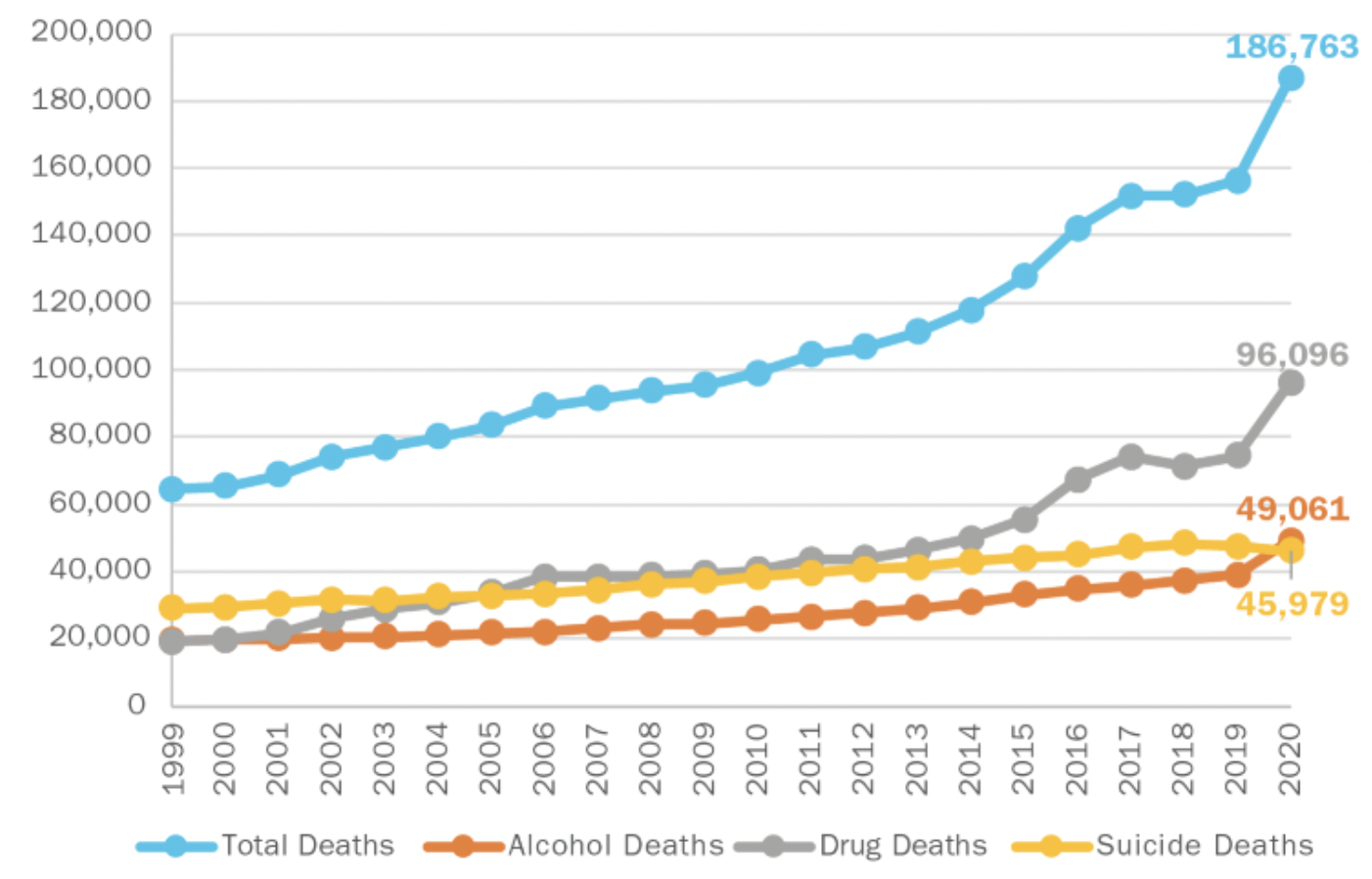
Annual deaths from alcohol, drugs and suicide in the United States, 1999-2020
(Chart by Trust for America's Health and Well Being Trust; click on the image to enlarge it.)

So-called deaths of despair—those related to alcohol, drugs, and suicide—hit an all-time high in 2020, claiming the lives of nearly 182,000 Americans, according to the Trust for America's Health and Well Being Trust. The 2020 total is 20 percent more than 2019, and mark the highest number of substance-misuse-related deaths recorded in any year; 2020 was dominated by the pandemic.

"While alcohol, drug, and suicide deaths have been increasing for decades, the 2020 increase was unprecedented and driven by a 30 percent increase in the rate of drug-induced deaths and a 27 percent increase in the rate of alcohol-induced deaths," Rhea Farberman and Amy Shields report for the Trust. "Combined rates of alcohol, drug, and suicide deaths increased in all 50 states except New Hampshire, and for the first time two states – West Virginia and New Mexico – surpassed 100 deaths per 100,000 state residents from alcohol, drugs, and suicide combined in a single year."

Synthetic opioids such as fentanyl and psychostimulants drove the increase in substance-misuse deaths. Rates for such deaths increased among all population groups except for people over age 75. People of color, youth aged 17 and under, and people 18-34 years old saw particularly high increases, as well as people who live in the South and West, the report says.

Fentanyl-related deaths have at least doubled in every state in the nation during the pandemic, and the report projects that such deaths will continue to rise. One big problem is that most people who overdose from fentanyl had no intention of taking it. Street drugs are often cut with fentanyl to stretch them further and make dealers more money, but the synthetic opioid is so potent that even adding a tiny bit more to a pill can be lethal. Teens often score fentanyl-laced drugs on social media.

The report calls for a comprehensive nationwide strategy that focuses on prevention, early identification of mitigating factors, harm reduction, and effective treatment.