Showing posts with label reclamation. Show all posts

Tuesday, July 01, 2025

West Virginia's waterway 'reclamation' yields cleaner water, rare earth metals and a growing outdoor industry

Deckers Creek is flowing with fresh water and 
wildlife again. (Wikipedia photo)
Coal mines left waterways across West Virginia polluted by sulfuric acid and metals, but that’s not the end of their story. "Set on a quiet hillside, a series of cascading ponds are doing their small part to fix a big problem," reports Mira Rojanasakul of The New York Times. The three-pond system slowly "reclaims" the state's waterways for wildlife and people to enjoy once again, and it comes with a side benefit of rare earth elements.

The three-pond system works to reduce water acid and then remove metals. The first pond allows water to "percolate through limestone and organic matter," Rojanasakul explains. The second pond completes more filtration, allowing the aluminum to drop out. By the time the water flows from the third pond, the iron has dropped out. "Fish and sensitive species like salamanders and frogs are returning to Deckers Creek, which for decades flowed rust-orange and lifeless from iron and other pollution."

Deckers Creeks is "one of dozens of cleanup sites being installed across West Virginia, helping the state make progress on a global environmental issue: waterways poisoned from coal mining," Rojanasakul reports. "A few miles downstream, a new, higher-tech version of this cleanup process is yielding an unexpected bonus: 'Rare earth' elements, essential for clean energy technologies and military equipment, are being recovered from the pollution."

Decreasing water acidity and removing metals isn’t just helpful for wildlife and biodiversity -- acid mine drainage "can corrode pipes and threaten drinking water for many residents of rural West Virginia who rely on backyard wells," Rojanasakul writes. 

Federal and state officials help guide West Virginia's waterway reclamation efforts, but the "boots on the ground" are often small nonprofits. Rojanasakul adds, "They monitor sprawling watersheds and build relationships within communities, even talking private landowners into opening up their backyards for cleanup work."

Many locals view their reclaimed waterways as a potential path to a new revenue source for residents and the state. Rojanasakul reports, "Employment in the state’s outdoor recreation economy is starting to rival other industries, with 20,300 jobs in 2023 compared with 17,700 workers in mining and support activities that same year."

Thursday, August 22, 2024

Flora & Fauna: World's oldest whale; all about potatoes; farming extracted land; everlasting lice; why play?

The humpback whale Old Timer in Frederick Sound in southeast Alaska.
(Photo by Adam Pack, NOAA Research Permit 26953 via NYT)

Sometimes seeing an old friend can warm the heart and encourage the spirit. "When Adam A. Pack, a marine mammal researcher, was photographing whales in Alaska’s Frederick Sound this July, he instantly recognized the flukes of an old friend," writes Emily Anthes of The New York Times. "The tail — mostly black, with a wash of white speckles near the edge — belongs to a whale named Old Timer. First spotted in 1972, Old Timer is now a male of at least 53 years, making him “the oldest known humpback whale in the world. . . The last time he had seen the whale, in 2015, was in the middle of a record-breaking, yearslong heat wave. . ."

Where would this country be without potatoes? It's a loaded question. Fluffed, whipped, baked, fried, scalloped, mashed, au gratin. . . Americans do love their taters. But U.S. scientists said, "It's not enough. . . Potatoes deserve more!" Jacob Bunge and Victor Stefanescu of The Wall Street Journal report, "Agriculture companies are applying cutting-edge genetic technology to the dusty brown tubers, aiming to grow bigger piles of spuds that could make for healthier potato chips and french fries. . .while grappling with storage and shelf life."
Ashford Farm has been cultivating lavender for five
years. (Photo by K. Thacker, Ambrook Research)

Not long ago, a coal mine sat on a blown-off mountaintop in West Virginia. The mine extracted that land's wealth and left it barren, but that is not the story's end. "The prospect of putting a farm on a former coal site is highly ambitious and pretty rare — at least in the mountainous Central Appalachian Coal Basin," report Even Andrew and Kristian Thacker of Ambrook Research. "Lavender, however, is a good match for mined terrain because it’s a relatively low-maintenance crop that thrives in dry, rocky soils. . . . But growing something, especially on reclaimed mine land, is a significant challenge."

What's grosser than gross? Lice. "We are in peak lice season, and the lice seem to arrive, always, at the moment when we are least equipped to deal with them. If you’ve endured them even once, odds are you still have at least a touch of lingering paranoia and phantom itching," reports Caitlin Gibson of The Washington Post. "They were there when Hannibal and his army crossed the Alps. They were there when both World Wars were fought. Now it is 2024, and we have Mars rovers and artificial intelligence and, still, lice. We can’t change the reality of them. Should we try to change the way we think about them?"

Like everything Mother Nature imbues, play has purpose.
(Adobe Stock photo)
It's the Puppy Bowl! The Kitten Bowl! The Turtle Bowl. OK. May there's no turtle bowl -- yet. But humans do love to watch animals play. Why? As David Toomey writes for The Conversation, "Play has a role in Darwin’s theory of natural selection. As I explain in my new book, Kingdom of Play: What Ball-bouncing Octopuses, Belly-flopping Monkeys, and Mud-sliding Elephants Reveal about Life Itself, there are many similarities – so many that if you could distill the processes of natural selection into a single behavior, that behavior would be play, Animals forage and hunt in specific ways that don’t typically change. But an animal at play is far more likely to innovate – and some of its innovations may in time be adapted into new ways to forage and hunt."

While the Florida Everglades are home to an abundance of animal diversity, including 360 different species of birds and countless insect species, Burmese pythons are not a welcome addition. The state has battled to control the invasive, nonnative snake's spread with multiple approaches, including capture and kill contests. The state just wrapped up its annual Florida Python Challenge "during which time participants caught and killed the nonvenomous constrictors, which feed on the state's native fauna," reports Joe Hernandez of NPR. Florida offers more opportunities to remove pythons year-round.

Wednesday, April 26, 2023

In the coal industry's bankruptcy game of musical mines, preventing environmental damage takes a back seat

Unreclaimed strip mine on the Kentucky-Virginia border, 2014 (Associated Press photo by David Goldman via ProPublica)
If your industry is declining, bankruptcy can be a business strategy. And if you're in the business of strip-mining coal, bankruptcy can relieve you of many of your environmental obligations. That's the upshot of a deep dive into the surface coal mining industry by Ken Ward Jr. of Mountain State Spotlight and Scott Pham and Alex Mierjeski of ProPublica.

Their object example is Blackjewel Mining, which became the nation's sixth-largest coal producer "partly by accumulating mines ... that had gone bankrupt," they report. "By 2018, it boasted more than 500 mining permits in Kentucky, Virginia, West Virginia and Wyoming. Then, in July 2019, Blackjewel stunned the industry by declaring bankruptcy, with claims against it later estimated at $7.5 billion." Other companies have followed a similar strategy, they report.

Environmental groups and state regulators "warned the bankruptcy judge that, while he was focusing on what they called the company’s 'significant financial mismanagement,' he should also be aware of 'severe environmental mismanagement problems'," including reclamation of mines that were causing damage downstream, the story says. "But, citing longstanding case law, the judge rejected their request. Instead, bankruptcy trustees began divvying up the company’s assets among preferred creditors such as banks and hedge funds. . . . By mid-2020, there were more than 600 outstanding violations of state mining and reclamation standards at the company’s mines in Kentucky, including 450 since the bankruptcy filing."

Bankrupt coal companies have long been bad environmental actors, but ProPublica and Mountain State Spotlight say they have documented for the first time "that mines that have gone through multiple bankruptcies also tend to create more environmental damage," based on bankruptcy court filings and state regulatory records. "We found that the median number of environmental violations for surface and underground mines that had been through multiple bankruptcies between 2012 and 2022 in Kentucky was almost twice the median number for mines that had not, and almost 40% higher in West Virginia."

Federal and state laws require coal companies to buy reclamation bonds, insurance that will cover the cost if the government has to clean them up. "But the required bond amounts often aren’t enough to cover all potential costs," Ward, Pham and Mierjeski note. "Cleanup costs have soared, partly due to larger surface mines that blew up or chopped off entire mountaintops, and partly because modern studies have increasingly identified water pollutants requiring lengthy and expensive treatment. According to a 2021 legislative audit, West Virginia’s reclamation bonds have covered only one-tenth of cleanup costs. . . . State officials are reluctant to revoke permits and take on the financial responsibility for cleanup. What often ensues instead is a game of musical mines. Knowing that they won’t end up on the hook for reclamation, other coal companies buy mines out of bankruptcy — and then often go bankrupt themselves."

Tuesday, October 18, 2022

Large coal firms shed mine-cleanup responsibilities by selling old mines to smaller firms less able to do reclamation

Some mines owned by Lexington Coal (Bloomberg)
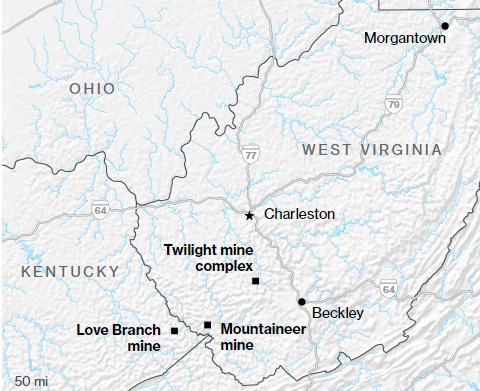
Facing bankruptcy and looking to avoid the cost of mine cleanup, larger coal companies offload older mines in need of reclamation onto smaller companies with little resources, reports an investigation by Bloomberg and NPR. Those smaller companies often can't foot the bill for reclaiming the old mine land, "raising the risk that taxpayers, rather than industry, will eventually be stuck with the cost."

The unreclaimed mines are also hazards to the environment and local communities. A man who lived near the Love Branch mine near the Kentucky border with West Virginia told the news organizations that red water running off from the mine flooded his property, causing him to fall through his floor and ruining his septic system. Lexington Coal Co., the company that owns the mine some in West Virginia, has the second-most violations of any coal operator in the country this year. Lexington acquired the mines from Alpha Metallurgical Resources, one of the largest coal companies in the U.S. 

Since 2015, when an industry-wide downturn pushed Alpha and other large coal companies into bankruptcy, the company has transferred more than 300 mining permits to smaller companies like Lexington. It also shed its pension and health-care obligations, went through bankruptcy, and saw its share price increase over 700% since 2016, Bloomberg and NPR report. 

Bloomberg graph
Of the 232 mostly idle mining permits that Alpha transferred to Lexington Coal, only 41 have been cleaned up, the investigation found. The company has also only authorized the release of about 13% of the reclamation bonding needed to pay for restoring the mines.

Monday, August 29, 2022

Southeastern Ky. is 'Climate Zero,' forest hydrologist says

The forks of Troublesome Creek gather at Hindman, Ky. It flows into the North Fork of the Kentucky River near Haddix and Lost Creek. Google Maps image shows much surface mining; the Mine Made Adventure Park is a reclaimed mine. 

America has eight creeks named Troublesome, none as troublesome lately as the one that flows into the North Fork of the Kentucky River. Those two streams and many others rose far out of their banks last month, killing 39 people and leaving thousands homeless. The catastrophe has often defied description, and now journalism must look forward, to what can and should be done. Austin Horn does both today in the Lexington Herald-Leader.

Trouble along Troublesome Creek (Herald-Leader photo)
He starts in Fisty, where Clear Creek flows into Troublesome and the only business on Google Maps is Smith's Scrap Yard, one of several businesses owned by Kelly Smith “I’ve lost 50 years here,” Smith, 67, told Horn. “The flood destroyed everything I got.” Horn sums it up: "A little kingdom in Fisty, mostly gone because of a flood that far exceeded any he’d ever seen. Smith had no insurance. . . . You’ll see dozens more patches of bottomland like Smith’s. Little communities cut off from the road because a bridge washed out, a baseball field whose fences are completely caked."

And the cause? Torrential rains (Including four inches in five hours), likely fueled by climate change; hillsides that couldn't absorb any more water; surface mining and inadequate reclamation, which abound in the watershed; and streams filled with silt and debris from earlier floods. It's too early to quantify each of those, which will take study, but Nicolas Zegre, an associate professor of forest hydrology at the University of West Virginia, points to climate change, in two ways.

"Zegre called Appalachia 'climate zero,' like Patient Zero, or the first person to get a disease in a pandemic," Horn reports. "The region is among the first to face the consequences of a carbon-extractive economy, he said, and that economy fueled by coal in this region fed many families and lined many wallets before suffering a downturn in recent decades." Zegre said, “It’s climate zero because we’re not only the source of part of the carbon, but we’re also disproportionately vulnerable to the impacts of more carbon in the atmosphere because our people live in mountainous watersheds. Our entire built environment is within reach of a stream.”

Zegre and Chris Barton, a professor of forest hydrology and watershed management at the University of Kentucky, said the impact of surface mining is uncertain because it leaves flat land that can absorb water instead of flowing down a slope, but reclamation usually compacts rock and soil, limiting absorption. Barton is part of a project that is trying to reforest the Star Fire mine site, midway along the length of Troublesome. Residents of one community in the area have sued a coal company "for the alleged failure of its silt ponds, which they claim led to mass destruction in their community and contamination of their drinking water," Horn reports.

Some officials have called for dredging to clear the streams, "but rules around when groups can dredge are stringent" and the two hydrologists are skeptical, Horn reports: "Natural streams in general have a way of regulating themselves more efficiently than humans, they said. Barton said that it simply isn’t an option in many creeks like Troublesome. Very often, the bottom of those streams aren’t far from bedrock as is. 'The streams are going to naturally cut in floods. When they cut down and get to bedrock, then they start to widen, and that means you’re losing even more of that precious floodplain,' Barton said. 'In a system like this – a mountainous stream system – that wouldn’t be an option. Nature’s taking care of that one.' Zegre said that in certain instances, dredging could be beneficial, but the larger problem is land use – surface mining, road building, tree removal and farming – that changes the natural equilibrium of the watershed."

Tuesday, March 15, 2022

Nature Conservancy says it will build six solar power plants on old coal-mine sites it owns in southwest Virginia

Site of one of the proposed solar farms (Photo from the Nature Conservancy)
Six former surface coal mines in Southwest Virginia "are being transformed into solar installations that will be large enough to contribute renewable energy to the electric grid," Zoeann Murphy reports for The Washington Post. The sites "owned by The Nature Conservancy will be some of the first utility-scale solar farms in the region — and the nonprofit group hopes it’s creating a model that can be replicated" at other sites in Appalachia and nationwide.

Several thousand acres of old mines came with 253,000 acres of forest the Conservancy acquired in 2019, which it calls the Cumberland Forest Project. Why develop solar on an old coal mine? It's not just for the irony. Murphy reports: "Solar developers partnering with the Nature Conservancy, such as Dominion Energy and Sun Tribe, say the mine sites have vast flat areas exposed to sunlight that are a rarity in the mountains, and the sites offer advantages like being close to transmission lines." Sun Tribe and Sol Systems are partnering on the first two, the Conservancy announced last year.

Solar farms need a lot of ground, and "It would be better to build on a lot of these mine sites than some prime farmland or some areas that maybe don't want solar in their community," said Daniel Kestner, innovative reclamation manager for the Virginia Department of Energy.

Most of the project area is in Wise County, on the Kentucky border, The Coalfield Progress in Norton reported last year; some is in Dickenson County, to the northeast; some is Russell County, to the southeast. “We’re very proud to be an energy-producing community,” said Lou Wallace, chair of the Russell County Board of Supervisors. “This is helping us to reimagine how we produce the energy. So we’re still able to say we’re keeping the lights on somewhere.”

Tuesday, December 14, 2021

Biden recently nominated a mine-safety chief, but still no one to run Interior Department's Office of Surface Mining

"Congress approved $11.3 billion to clean up abandoned mine lands in the $1.2 trillion infrastructure bill, but environmental groups are worried that President Biden hasn’t chosen anyone to oversee how that money is spent on coal mines," Jael Holzman reports for Energy & Environment News.

President Biden hasn't nominated anyone to run the Office of Surface Mining Reclamation and Enforcement, which hasn't even had an acting director, Holzman concludes from the website of the agency, part of the Interior Department.

Tuesday, the Sierra Club and other activists, mainly from Appalachian states, urged Biden to nominate an OSM director to see that the money is “carefully administered.” They also asked, among other things, that the new money be spent on mines that closed before 1977. That's when Congress passed the federal strip-mine law, which included a severance tax on coal to fund reclamation of abandoned mines.

"This letter comes after Biden recently made picks for posts at other mining-related government agencies, including Christopher Williamson, a labor attorney and former staffer for West Virginia Democratic Sen. Joe Manchin, to run the Mine Safety and Health Administration," a Labor Department agency, Holzman reports, without making the departmental distinction.

Monday, May 17, 2021

Abandoned mine cleanup in Appalachia might be twice as expensive as thought, but little federal money is left to do it

Cleaning up abandoned mine lands in Appalachia might be twice as expensive as previously thought, but there's little federal money available to do it. 

"The federal AML inventory estimates that the cost of cleaning up all abandoned mine land – land that was mined before the passage of the Surface Mine Control and Reclamation Act in 1977 – is $11 billion," Anya Slepyan reports for The Daily Yonder. "But a new report from the Ohio River Valley Institute shows the cost is more than double what the federal inventory previously claimed: $26 billion."

The 1977 law was the first major federal effort to regulate environmental impacts of coal mining. It "required that coal companies set aside money to pay for the restoration of all land permitted after the law’s implementation. The law also designated any land mined prior to 1977 as abandoned mine land, and set up a fund to reclaim these sites by collecting a small fee on each new ton of coal produced," Slepyan reports. "The AML fund has collected a total of $11.496 billion, of which only $2.23 billion remains." 

The new report shows that's not enough. "According to the report, of the 1.2 million acres designated as abandoned mine land, only 27% has been cleaned up since the 1970s," Slepyan reports. "The cost of reclaiming the remaining 850,000 acres is an estimated $26.3 billion, a price that will only increase if sites are left to degrade for decades more." Unreclaimed mine lands pose a significant environmental and financial threat to local communities, she writes.

Monday, January 27, 2020

Ky. may have to pay millions to fix environmental violations after bankrupt coal companies posted inadequate bonds

Coal company Blackjewel made nationwide headlines last year when laid-off miners in Harlan County, Kentucky, blocked a coal train from leaving for months because the bankrupt company had not paid them for their last weeks of work. New court documents show that the company and affiliate Revelation Energy may have hurt Kentucky in other ways too.

The two companies "have failed to make progress on scores of environmental obligations and might leave Kentucky taxpayers on the hook for tens of millions of dollars in reclamation costs, state officials contended during a bankruptcy hearing this week," Will Wright reports for the Lexington Herald-Leader. "Filings in federal bankruptcy court show that Blackjewel’s violations alone account for 30 percent of all outstanding non-compliance notices sent by the Kentucky Department of Natural Resources as of Dec. 31. The state warned the court that the company has made little or no progress in addressing those violations."

Adding to the problem, it appears that the companies posted far too little in bonds to cover reclamation costs. "Kentucky has had longstanding problems with coal companies posting inadequate bonds to cover reclamation," Wright reports. The KDNR reviewed 20 percent of the permits held by Blackjewel and Revelation, and wrote in a Jan. 13 court filing that reclamation costs would exceed the bond amounts for those permits by about $38 million.

Tuesday, April 30, 2019

Elk introduced in former surface mined land in Central Appalachia to help restore ecosystems and local economies

A relocated Rocky Mountain elk roams a former strip mine in Buchanan County, Virginia. (Photo by Leon Boyd)
Elk were once native to the Appalachian Mountains, were driven out by overhunting and loss of habitat. But these days, elk are making a comeback in Central Appalachia because of strip mining, Mason Adams reports for Yes!

When a company has stopped mining, it's required to do some restoration. That usually means covering the area with topsoil and seeding it with grass and shrubs to prevent erosion. It turns out that such terrain, flat and scrubby with pockets of forests, is the perfect habitat for elk, Adams reports. Almost 2,000 have been relocated to the region from the Rocky Mountains with the help of local volunteers and the Rocky Mountain Elk Foundation. In the Eastern Kentucky Coal Field, where they were first released, their number has grown to more than 10,000.

"Central Appalachian communities are burdened with more than a million acres of these flattened mountains, many of which have been restored on the cheap," Adams reports. "Faced with the quandary of what to do with these problematic lands, several states have used them as reintroduction sites for elk in hopes of enriching the habitat for diverse animal species. And the hopes that follow involve some economic revival in coal country from tourist dollars spent by wildlife watchers and, eventually, hunters."

Tuesday, May 29, 2018

Plan to put huge array of solar panels on a mined mountaintop could depend on more mining

Plans by EDF Renewables to put the largest solar farm ever built in Kentucky on a mined mountaintop are in limbo because a coal company years behind in the cleanup that must come first, is dragging its feet. The $150 million project was proposed a year ago, and would be located on Bent Mountain in the state's easternmost county, James Bruggers reports for Inside Climate News.

If the project is not ready to go in 2019 or 2020, the federal tax breaks for renewable energy projects begin to decrease, making it less economically feasible. "If Kentucky Fuel would do what they said they would do there wouldn't be a problem," Ryan Johns told Bruggers. Johns is one of the farm's developers and the vice president of Ross Harris Group, which comprises more than 30 companies that focus on coal, oil, gas, timber and real estate. One of those, Berkeley Energy Group, is a coal mining company that wants to diversify into renewable energy. Berkeley is getting the land ready in conjunction with Adam Edelen, a former state auditor who had the original idea and is handling finance and marketing, and EDF, an international solar and wind energy developer.

"Four years ago, settling one of the largest enforcement actions in Kentucky's recent history, the coal company's owners promised state officials that they would compete a tangle of reclamation work spread over several counties by September 2015," reports Bruggers, former environmental reporter for the Louisville Courier Journal. "But the case has dragged on in court. It's a fight that involves one of the most powerful families in the region, headed by Jim Justice, the billionaire coal baron who is now governor of West Virginia."

The cost of reclaiming a poorly reclaimed mine site is often subsidized by extra coal mined during the reclamation, and "Kentucky Fuel wants more mining to help pay for the work," Bruggers reports. "But it is not clear whether valid leases are in place for that approach. That, too, may have to be sorted out; if not, the state could issue a permit for reclamation only, but the work would be more expensive. It's unclear whether the costs of additional reclamation, and the possibility of paying for it with more mining, would materially affect the solar farm's construction costs."

Thursday, April 06, 2017

Interior's inspector general says agency isn't ensuring coal reclamation projects get priority

A report by the inspector general at the Department of the Interior found that its Office of Surface Mining Reclamation and Enforcement is failing to make sure states give coal reclamation projects priority over non-coal projects: "As a result, non-coal reclamation is completed while coal-related hazards persist."

The report said the agency is failing to crack down on five of the 25 states—Mississippi, Louisiana, Montana, Texas and Wyoming—"that get grants from the Abandoned Mine Land fund," Dylan Brown reports for Greenwire. "The fund comprises fees charged on every ton of U.S. coal for cleaning up mine sites abandoned by companies before the law was signed in 1977."

The five states keep getting grants though regulators have determined that all their eligible coal sites have been reclaimed. That leaves less money for states like Wyoming, the biggest coal state, which "has an inventory of $90 million in unfunded reclamation," Brown writes. But Wyoming is also part of the problem, he notes: "Its inventory is growing as the state spends on non-coal projects. From 2013 to 2016, Wyoming spent $214 million on non-coal projects and $166 million on reclamation."

Thursday, March 09, 2017

$50 million greenhouse on reclaimed mining land in Ky. could help boost Appalachia economy

Efforts have been made in Appalachian to revitalize local economies through means other than coal. One such project is a planned $50 million high-tech greenhouse on 70 acres of reclaimed mining land in Eastern Kentucky that could provide up to 130 full-time jobs, Jere Downs reports for The Courier-Journal in Louisville. The greenhouse would be located in Pikeville, Ky. (Best Places map) which has an unemployment rate of 8.7 percent, well above the state average of 4.5 percent.

The greenhouse "would grow tomatoes, bell peppers and other vegetables under glass," said AppHarvet CEO Jonathan Webb, who said he is raising funding from angel investors and expects to break ground in June, Downs writes. The project would include a 45-acre hydroponic greenhouse. "Covering two million square feet, the greenhouse can produce 2.6 million pounds of vegetables annually."

AppHarvest CEO Jonathan Webb scouts
land for the greenhouse (AppHarvest photo)
The greenhouse has gotten the support of Republican Gov. Matt Bevin, who said, "This project presents a fantastic opportunity to help our Appalachian region continue its rejuvenation," Downs writes. The project also has received "preliminary approval for $2.5 million in state tax incentives from the Kentucky Economic Development Finance Authority."

Thursday, December 01, 2016

Top strip-mine regulator says Trump should see abandoned-mine damage before making promises

President-elect Donald Trump, who promised to revive coal, needs to see first-hand the negative effects of abandoned coal mines in Appalachia before continuing to make promises, the director of the Office of Surface Mining Reclamation and Enforcement told Bloomberg News.

Joseph Pizarchik told reporter Stephen Lee, “He doesn’t have to go far. Just go from New York City to northeastern Pennsylvania. He can see thousands of acres of dangerous mines, polluted mine water, destroyed lands, destroyed communities, communities that were abandoned by companies after they destroyed the land and water.”

While Trump says "lifting regulations on the coal sector will bring back jobs and revive struggling communities," experts say the industry's main problem isn't regulations, but cheaper natural gas, Lee writes. Pizarchik told Lee, “I can appreciate his desire to want to help people. But if you mine more coal, you have to have a market for it. Just mining it is not going to create jobs in the long run.”

Not everyone agrees with Pizarchik, Lee writes. Christian Palich, president of the Ohio Coal Association, "said those who question coal’s future 'might be the same people who predicted Trump wouldn’t have a path to 270' votes in the electoral college." Palich told Lee, "With a president that supports coal, I think you definitely could see a rally. Create the right atmosphere and the market will do what the market does. Once you have a president not picking winners and losers, I think coal is going to be in a very good position to thrive.” (Read more)

Thursday, June 02, 2016

W.Va. coal baron and gubernatorial nominee runs behind on reclaiming Kentucky strip mines

Justice owns The Greenbrier.
UPDATE JUNE 8: "Kentucky environmental regulators spent the weekend and Monday investigating a mudslide at a Pike County surface mine owned by West Virginia coal baron Jim Justice that they say contributed to local, damaging flooding last week," James Bruggers reports for the Louisville Courier Journal. "State officials Monday confirmed their investigation was centered on Justice's Bent Mountain mining operations, which had significant reclamation deadlines last year and are the subject of ongoing enforcement activities."

"U.S. Office of Surface Mining and Reclamation spokesman Chris Holmes said the company contacted the federal agency Monday – in Tennessee, not Kentucky, and not to let it know about the problem but to say the company was moving people out of Tennessee to help people in Kentucky with a flooding problem," Bruggers writes. "The Justice-owned company, Kentucky Fuel Corp., was cited by state regulators for having an overflowing diversion ditch that sent mud and water down a hill, damaging six homes, officials said. Citations included alleged violations involving sediment control, off-permit disturbance, failure to notify, failure to pass water quality and a diversion ditch failure. Multiple other homes had mud and debris on their property, and a county road was also muddied."

West Virginia coal and hotel operator Jim Justice, the state's Democratic nominee for governor, is asking a Kentucky judge for more time to reclaim strip mines in eight Eastern Kentucky counties.

"I am OK with what they are proposing," state Natural Resources Commissioner Allen Luttrell told Franklin Circuit Court Judge Thomas Wingate yesterday. But he said Justice's mines "have been out of time for months, and months, and months," and steady progress is needed. Another hearing will be held July 13.

Wingate told Justice representative Billy Shelton that the court needs progress reports every two weeks on their progress. "Shelton balked," reports James Bruggers of The Courier-Journal. "He had suggested monthly reports, according to state officials, who said past reports by the company were misleading: One company would start a bulldozer and let it idle in place, not doing any work, and they'd report that as reclamation activity." Wingate told Shelton, "All you have to do is take a picture. I could do that with my iPhone."

One of the highwalls that need reclaiming
State lawyer Anna Girard Fletcher told Wingate that the Justice companies "have quite a bit of work to do to come into compliance." Bruggers writes, "Justice has proposed a new compliance plan, but Fletcher declined to make that immediately available. The Courier-Journal reported on Monday that of the nine miles of surface-mining highwall  that were supposed to be reclaimed by Sept. 1, barely over a half-mile has been completed. State officials have called the matter one of their largest mining enforcement actions in more than 15 years. The companies are accused in court documents of falling behind restoration goals that were agreed upon in August 2014."

Tuesday, January 19, 2016

Government watchdog objects to bankrupt Alpha's plan to give executives up to $11.9M in bonuses

A government watchdog has filed objections to a proposal by Alpha Natural Resources—which earlier this month filed for bankruptcy protection—to pay executive bonuses of up to $11.9 million in 2016, Benjamin Storrow reports for the Casper Star Tribune. The U.S. Trustee, a division of the Justice Department, argues that "the bankrupt coal company cannot justify the additional pay at a time when it has recorded steep losses and sought to cut retiree benefits. A hearing on Alpha’s proposals to pay executive bonuses and cut medical and life insurance benefits for 4,580 nonunion miners and their spouses is scheduled for Thursday."

Alpha, which last recorded a profit in 2011, "has argued the bonuses are necessary to retain key executives during its Chapter 11 proceedings," Storrow writes. "But in court filings submitted Friday, the trustee’s office challenged that argument. The government noted Alpha’s request to pay bonuses coincided with a $1.3 billion loss in 2015 and a plan to save $3 million annually by cutting retiree benefits."

The watchdog wrote, “According to Alpha, these executives need these bonuses as an incentive to do the very jobs they were hired to do, that they are already highly compensated for with generous salaries, and which their fiduciary duties compel them to do. Such bonuses cannot be justified under the facts and circumstances of this case.”

Storrow writes, "Executives will receive a total of $3.4 million if they meet a 'threshold' performance level, $6.8 million if they meet a so-called 'target' level and as much as $11.9 million if they exceed expectations. The government questioned the size of those bonuses, noting they exceeded what Alpha executives received in the years leading up to its bankruptcy filing." (Read more)

Monday, January 11, 2016

Arch Coal files for bankruptcy protection, says it will keep operating as usual

Arch's Black Thunder Mine, 2007 (Photo by Matthew Brown, AP)
Arch Coal Inc., "the holder of the second-largest reserve of coal in the U.S., filed for creditor protection Monday" in St. Louis, Bloomberg News reports. "The company said it has an agreement with a majority of its senior lenders to erase $4.5 billion in debt from its balance sheet and allow it to keep operating without interruption. Arch has been losing money since 2012."

In a statement filed with Arch's Chapter 11 bankruptcy petition, Chief Financial Officer John T. Drexler said “A confluence of economic challenges and regulatory hurdles has hobbled the coal industry.” Less Chinese demand, Australian competition and cheap natural gas "pushed competitors Patriot Coal Corp., Walter Energy Inc. and Alpha Natural Resources Inc. into bankruptcy last year," Bloomberg notes, also citing "high pension costs and the threat of stricter environmental regulation."

Arch said environmental rules have made it more expensive for companies to use coal. "It blamed Environmental Protection Agency rules for causing more than 400 coal-fired generators to close," Bloomberg reports. "Overall, 23 percent of the generating units are expected to retire or convert by 2025, Arch said." For more from the company on its reorganization, click here.

The company has 11 mines in seven states. An environmental group in Wyoming's Powder River Basin, where Arch has more than 90 square miles of mines, including the nation's second-largest, Black Thunder, said the bankruptcy should not reduce the company's responsibility to reclaim its strip mines. "Arch has a $458 million reclamation liability. State and federal taxpayers must not be left with the bill," said Bob LeResche, president of the Powder River Basin Resource Council. (Read more)

Thursday, November 19, 2015

Horses abandoned on Eastern Kentucky reclaimed coal mines leading to safety, health concerns

A growing number of horses abandoned on reclaimed coal mines in Eastern Kentucky has led to safety concerns involving horses wandering into traffic and a lack of food and health care for the wild animals, Bill Estep reports for the Lexington Herald-Leader. An official count in March 2014 reported 500 wild horses in nine Eastern Kentucky counties, but animal rights activists say estimates are more likely to be between 3,000 and 5,000. Advocates also say some of the horses are not abandoned but have owners who are trying to take advantage of free grazing. (Kentucky Humane Society photo: Wild horses near a road in Eastern Kentucky)

Karen Gustin, head of the Kentucky Equine Humane Center, "estimated 30 percent of the horses she has seen on reclaimed mines don’t look to be in good shape," Estep writes. She said that "even some of the ones that look good could have damaging parasites." She said "some of the free-roaming horses are emaciated and many lack vaccinations and proper care for their teeth and feet."

Safety concerns are elevated during the winter, when the horses, starved for salt, wander onto roads to lick salt distributed for snow and ice removal, Estep writes. Last month three men were arrested on charges of stealing four horses from a reclaimed mine, and "there also have been reports of the free-roaming horses being shot." Horses have also been blamed for damaging property, such as chewing siding from a house. And more horses means more breeding, which leads to even more horses. Lori Redmon, head of the Kentucky Humane Society, told Estep, “There’s a problem that is growing. There are some sites that are currently not able to sustain the horse population.” (Read more)

Monday, July 20, 2015

Horses abandoned on reclaimed coal land in Eastern Kentucky creating safety concerns

Horse owners in coal-depressed Eastern Kentucky have been abandoning horses on "land owned or leased by coal companies that was in various stages of being reclaimed," Sarah Coleman reports for Horse Channel. The result is that hundreds of domesticated horses are now roaming wild and new generations of horses that have never been handled by humans have been born on these lands. (Kentucky Humane Society photo)

Lori Redmon, president and CEO of the Kentucky Humane Society, said that in March 2014 she led a group of volunteers that counted 438 horses on reclaimed land in five Eastern Kentucky counties, Coleman writes. "The vast majority of the mares appeared to be pregnant or have foals by their side. When she returned in June, her assumption of mares being in foal was validated with an increased number of foals. In fact, one of the largest herds observed consisted of 120 horses and roughly 30 foals."

Turning out the horses isn't anything new, Coleman writes. "For the past 20 years or so, local citizens, many of them miners, would release their horses out onto the land that was being reclaimed by the coal mining companies.The horses could then be caught and brought back to homes and farms when the owners wanted to ride them."

"When the recession came in 2008, more and more horses were being turned out onto the mining lands (for reference, mine sites can up as large as 20,000 to 40,000 acres of land) increasing grazing stress onto the limited grass lands," Coleman writes. "Additionally, fewer horses were being gathered at the end of summer to go back to their homes. People began to travel from farther away to dump horses on the mine’s land. Some left stallions that bred the mares, leading to unplanned and unwanted foals that were feral because of their lack of human contact. The population of these free-roaming horses began to outgrow the ability of the habitat to sustain them."

One problem is that when the horses run out of food on reclaimed land, they often wander into residential areas looking for something to eat, Coleman writes. The best solution to reduce the populations has been increased adoption efforts. (Read more)

Tuesday, May 03, 2011

Coal firms, insurers pay residents for flood damage worsened by mining (and lax regulation?)

Faced with an engineerng study that one expert said was "groundbreaking" for the area, four coal companies settled with 91 residents near Quicksand Creek in Breathitt County, Kentucky, over flood damage the residents said was worsened by the companies' strip mines. They filed a lawsuit against Miller Brothers Coal, Appalachian Fuels, Lexington Coal and International Coal Group sayign they "exacerbated flooding after heavy rains in May 2009," Dori Hjalmarson of the Lexington Herald-Leader reports.

A Virginia engineering firm compared the Quicksand Creek watershed to a predicted watershed if no mining had never been done and "found that peak flows in the creek increased 77 percent to 81 percent during a rain like the soaking that occurred May 8 and 9, 2009," Hjalmarson reports. Jack Spadaro, the plaintiffs' reclamation and hydrology expert and former federal inspector, told Hjalmarson, "This is the best engineering study that I've seen on this issue. It certainly is groundbreaking in Kentucky."

The details of the settlement are confidential but plaintiffs' attorney Ned Pillersdorf of Prestonsburg did tell Hjalmarson that due to bankruptcies of Miller Brothers and Appalachian "much of the negotiation was done with insurance companies." The case was set to go to trial next Monday, two years after the start of the flood.

Also mentioned in the lawsuit was the state Department for Surface Mine Reclamation and Enforcement for what the plantiffs criticized as "lax inspections and too many variances given to companies mining in the watershed," Hjalmarson reports. (Read more)