Showing posts with label bankruptcy. Show all posts

Tuesday, July 02, 2024

Supreme Court blocks Purdue Pharma opioid settlement; agreement 'broke a basic tenet of bankruptcy law'

OxyContin's success made the Sacklers billionaires
and sparked the U.S. opioid crisis. (A.S. photo)
The U.S. Supreme Court rejected the Purdue Pharma opioid bankruptcy agreement that would have safeguarded Sackler family members from civil liability suits related to the opioid crisis.

"In a 5-to-4 decision, the justices found that the deal, carefully negotiated over years with states, tribes, local governments and individuals, had broken a basic tenet of bankruptcy law by shielding members of the Sackler family from lawsuits without the consent of those who might sue," reports Abbie Van Sickle of the New York Times. Purdue Pharma, which was owned by the Sackler family who developed and marketed the prescription painkiller OxyContin, is "largely considered to have ignited the [opioid] crisis."

Meanwhile, there are more than 100,000 opioid victim families waiting for financial restitution from Purdue Pharma. For some, the ruling is considered a setback. Other family members welcomed the decision. Van Sickle writes, "Although most creditors who voted on the proposed plan supported it, Justice Gorsuch wrote, 'fewer than 20 percent of eligible creditors participated' and 'thousands of opioid victims voted against the plan, too, and many pleaded with the bankruptcy court not to wipe out their claims against the Sacklers without their consent.'"

As Van Sickle reports, the court's majority "homed in on the method the Sacklers used to insulate themselves from opioid-related lawsuits, finding that a third party could not use the bankruptcy system to shield themselves from litigation, binding others without their consent. . . . This approach, Justice Gorsuch wrote, allowed them to win relief 'without securing the consent of those affected or placing anything approaching their total assets on the table for their creditors.'"

The proposed deal would have required the Sacklers to pay up to $6 billion over 18 years, but its building blocks demonstrate the tightrope negotiators are trying to walk between getting family members, states and tribes money now, even if the agreement shielded the Sacklers' personal wealth. "In a strongly worded dissent, Justice Brett M. Kavanaugh, "warned of the consequences for the tens of thousands of families seeking compensation," Van Sickle reports. "Justice Kavanaugh wrote that upending the settlement to prevent the Sacklers from escaping future litigation would only add to the pain of opioid victims and their families."

Within the deal's bankruptcy reorganization, Purdue Pharma "would become a 'public benefit' company with a mission focused on opioid education and abatement," Van Sickle reports. "The company, with the help of the Sacklers’ planned contributions, offered individual victims payments from a base amount of $3,500 up to a ceiling of $48,000." Purdue Pharma has committed to working toward a new settlement deal.

Wednesday, April 26, 2023

In the coal industry's bankruptcy game of musical mines, preventing environmental damage takes a back seat

Unreclaimed strip mine on the Kentucky-Virginia border, 2014 (Associated Press photo by David Goldman via ProPublica)
If your industry is declining, bankruptcy can be a business strategy. And if you're in the business of strip-mining coal, bankruptcy can relieve you of many of your environmental obligations. That's the upshot of a deep dive into the surface coal mining industry by Ken Ward Jr. of Mountain State Spotlight and Scott Pham and Alex Mierjeski of ProPublica.

Their object example is Blackjewel Mining, which became the nation's sixth-largest coal producer "partly by accumulating mines ... that had gone bankrupt," they report. "By 2018, it boasted more than 500 mining permits in Kentucky, Virginia, West Virginia and Wyoming. Then, in July 2019, Blackjewel stunned the industry by declaring bankruptcy, with claims against it later estimated at $7.5 billion." Other companies have followed a similar strategy, they report.

Environmental groups and state regulators "warned the bankruptcy judge that, while he was focusing on what they called the company’s 'significant financial mismanagement,' he should also be aware of 'severe environmental mismanagement problems'," including reclamation of mines that were causing damage downstream, the story says. "But, citing longstanding case law, the judge rejected their request. Instead, bankruptcy trustees began divvying up the company’s assets among preferred creditors such as banks and hedge funds. . . . By mid-2020, there were more than 600 outstanding violations of state mining and reclamation standards at the company’s mines in Kentucky, including 450 since the bankruptcy filing."

Bankrupt coal companies have long been bad environmental actors, but ProPublica and Mountain State Spotlight say they have documented for the first time "that mines that have gone through multiple bankruptcies also tend to create more environmental damage," based on bankruptcy court filings and state regulatory records. "We found that the median number of environmental violations for surface and underground mines that had been through multiple bankruptcies between 2012 and 2022 in Kentucky was almost twice the median number for mines that had not, and almost 40% higher in West Virginia."

Federal and state laws require coal companies to buy reclamation bonds, insurance that will cover the cost if the government has to clean them up. "But the required bond amounts often aren’t enough to cover all potential costs," Ward, Pham and Mierjeski note. "Cleanup costs have soared, partly due to larger surface mines that blew up or chopped off entire mountaintops, and partly because modern studies have increasingly identified water pollutants requiring lengthy and expensive treatment. According to a 2021 legislative audit, West Virginia’s reclamation bonds have covered only one-tenth of cleanup costs. . . . State officials are reluctant to revoke permits and take on the financial responsibility for cleanup. What often ensues instead is a game of musical mines. Knowing that they won’t end up on the hook for reclamation, other coal companies buy mines out of bankruptcy — and then often go bankrupt themselves."

Thursday, June 16, 2022

Rural residents, especially in South, likelier to have medical debt; most Americans have had some in the last five years


More than 100 million Americans, representing 41% of adults in the nation, have medical debt, and they are more likely to live in rural areas, according to a
new data analysis by the Urban Institute. The issue is a "critical challenge to Americans’ financial stability and well-being," says the report, since "people with medical debt are likely to forgo needed medical care, have difficulty meeting other basic needs, and face an increased risk of bankruptcy."

A Kaiser Health News and NPR investigation found that the problem of medical debt is "far more pervasive than previously reported," Noam Levey reports, "because much of the debt that patients accrue is hidden as credit-card balances, loans from family, or payment plans to hospitals and other medical providers." According to a recent Kaiser Family Foundation poll that informed the reporters' investigation, more than half of U.S. adults said they've gone into debt in the past five years because of medical or dental bills. About one in four with medical debt owe more than $5,000 and about one in five said they'll probably never pay it off.

Medical debt "is forcing families to cut spending on food and other essentials. Millions are being driven from their homes or into bankruptcy, the poll found," Levey reports. The issue is also deepening racial disparities, and is preventing many from saving for retirement, buying a home, affording college, and more. It's also making life harder for people already facing cancer and other chronic illnesses. 

The Urban Institute analysis found that people with medical debt in collections are more likely to live in the South; of the 100 counties with the highest levels of medical debt, 79 are in states that didn't expand Medicaid under the Patient Protection and Affordable Care Act. One-off medical emergencies aren't driving medical debt: The prevalence of chronic medical conditions among a county's residents was the strongest predictor of medical debt. Counties with higher shares of uninsured, low-income, younger, or Black or Hispanic residents also have higher rates of medical debt. 

The No Surprises Act, which took effect Jan. 1, aims to protect patients from out-of-network medical bills, but it has some limitations; ground ambulances, for example, can cost thousands of dollars but are not covered under the bill. About half of emergency ground ambulance rides result in out-of-network charges for people with private insurance, according to a recent KFF study.

Friday, December 17, 2021

Judge overturns $4.5B Purdue Pharma opioid settlement because it shields Sacklers from liability in civil cases

"A federal judge on Thursday evening unraveled a painstakingly negotiated settlement between Purdue Pharma and thousands of state, local and tribal governments that had sued the maker of the prescription painkiller OxyContin for the company’s role in the opioid epidemic, saying that the plan was flawed in one critical area," Jan Hoffman reports for The New York Times. The judge "said that the settlement, part of a restructuring plan for Purdue approved in September by a bankruptcy judge, should not go forward because it releases the company’s owners, members of the billionaire Sackler family, from liability in civil opioid-related cases."

The Sacklers had agreed to pay $4.5 billion and forfeit membership in Purdue in exchange for immunity, Hoffman reports. Though the settlement would bring much-needed funding to state, local and tribal governments to address the harms of the opioid epidemic, the settlement has been criticized because it allows the Sacklers to remain wealthy and avoid other legal consequences.

U.S. District Judge Colleen McMahon noted that the Sacklers put $10 billion in Purdue money in offshore accounts to keep it away from U.S. authorities. Those withdrawals sped up after top Purdue executives pleaded guilty in 2007 on criminal and civil charges related to its opioid marketing. That left the company unable to resolve thousands of opioid lawsuits and forced it to declare bankruptcy.

The judge essentially invited a federal appeals court to weigh in on the ruling, writing in her opinion that appellate courts disagree on the issue and lower courts need clarity, Hoffman reports. Attorney General Merrick Garland agreed with McMahon Thursday night, saying "The bankruptcy court did not have the authority to deprive victims of the opioid crisis of their right to sue the Sackler family."

Monday, September 27, 2021

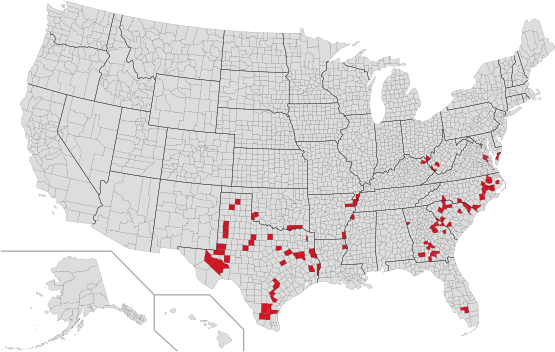
Farm roundup: Bankruptcy map; anti-consolidation campaign; trafficking in farmworkers; suit targeting paraquat

Total Chapter 12 bankruptcy filings by county, 2013-2020
(Midwest Center for Investigative Reporting map; click on the image to enlarge it)

Here's a six-pack of farm news:

The nation's second-largest farm group, the National Farmers Union, is launching a campaign to expose how consolidation in agriculture hurts family farms and rural towns. "The campaign, which it said will include a public relations blitz and lobbying, is part of an effort to push Washington to crack down on monopolistic behavior in the industry as lawmakers propose legislation to bring more price and market transparency to highly consolidated farm markets," Reuters reports. Read more here.

Farm bankruptcies have been on the rise over the past decade, Sky Chadde reports for The Midwest Center for Investigative Reporting. Many factors contribute: climate change, increasing production costs, decreasing income, the trade war, high debt levels and suicide. Chapter 12 of the bankruptcy law is used to reorganize debts and save family farms through debt reorganization, but research shows it may be harder to reorganize debts under Chapter 12 than under other bankruptcy types. Read more here.

Farmworker and environmental groups have sued the Environmental Protection Agency for reapproving the weed killer paraquat, which they say puts farmworkers at an increased risk of developing Parkinson's disease. Read more here.

Farmworkers are trafficked by employers using the H-2A program, which "provides scaffolding for the agricultural system, allowing farms to bring in enough labor to pick fruits and vegetables Americans rely on," according to experts and activists, Amanda Perez Pintado reports for the Midwest Center. They "fear the Covid-19 pandemic has allowed the situation to grow."  Read more here.

A newly published study showed farmworkers in California's Salinas Valley had coronavirus infection rates four times higher than the rest of the local population. Read more here.

The Agriculture Department is launching an Equity Commission to address racial discrimination within the USDA and its programs. Read more here.

Friday, September 17, 2021

Opioid op-eds rail against drug laws, lack of access to treatment, and a legal system that let the Sacklers walk

Two recent opinion pieces examine different aspects of the opioid crisis.

The first concerns the recent bankruptcy case of OxyContin maker Purdue Pharma, which reached a settlement Sept. 1 after two years. Opioid victims were poorly served in the lawsuit, since the Sackler family was able to walk away from the bankruptcy still free and still wealthy, Ryan Hampton writes for The New York Times. Hampton is a recovering opioid addict who co-chaired the committee that represented plaintiffs in the case. He believes the legal system is devised to "protect extreme wealth and perpetuate social disparity," and that it must be reformed.

The settlement "comes at a pivotal time for the U.S. overdose crisis: 2020 was the worst year on record, with over 93,000 Americans losing their lives to fatal drug overdose," writes College of the Holy Cross sociology professor Emily B. Campbell for The Conversation. "The drug-overdose epidemic, now more than two decades long, has claimed the lives of more than 840,000 people since 1999. Current estimates suggest that some 2.3 million people in the U.S. use heroin and 1.7 million people use pharmaceutical opioids without a prescription."

Campbell, a sociologist who has studied the issue since 2016, writes that two major factors fuel the epidemic: drug-prohibition laws and lack of access to addiction treatment. Laws prohibiting drugs make the crisis worse by increasing demand, she writes, which causes illegal drugs to become cheaper and more potent over time.

Those who want to recover from addiction are often can't or are discouraged from getting help: "Roughly 70 percent of people who seek treatment are unable to access it. Barriers to treatment include health care costs, lack of available treatment options and social stigma. Research also demonstrates that some people are not ready for treatment or do not want to be sober," Campbell writes. "It is also well documented that fear of arrest and shame encourages people to hide their drug use in ways that increase their risk of a fatal overdose. This is because when people use alone, there is no one there to call 911 or perform CPR should an overdose occur."

Friday, August 27, 2021

Quick hits: Reaching rural students with school breakfast; mental health-care assistance hard to find in rural areas

Here's a roundup of stories with rural resonance; if you do or see similar work that should be shared on The Rural Blog, email heather.chapman@uky.edu.

A webinar discusses how to help mitigate rural hunger with school breakfast. Read more here.

Alabama's rural electric co-ops are way behind on the solar curve, says a new report. Read more here.

A podcast discusses how mental-health care is often difficult to access in rural areas, with a focus on Missouri. Read more here.

Journalist reports that the Sackler family took $10 billion out of Purdue Pharma before the company declared bankruptcy. Read more here.

Rolling Stone has a feature on high-tech Kentucky greenhouse company AppHarvest, which has lost $28.5 million so far. Read more here.

Rural residents with head and neck cancer are significantly more likely to die by suicide, a study has found. Read more here.

Wednesday, July 14, 2021

Report: Appalachia needs billions to clean up old mines

Unreclaimed and partially reclaimed acreage for all current
mine permits in Appalachia (Appalachian Voices map)
A new report found that it will cost Appalachian states billions to clean up abandoned coal mines, much more than the now-bankrupt coal companies were required to provide for the purpose.

"It will cost from $7.5 billion to $9.8 billion to reclaim 633,000 acres of just coal mines that have been closed or idled since 1977 across seven Appalachian states, according to the report from environmental nonprofit Appalachian Voices," Mike Tony reports for the Charleston Gazette-Mail. "That’s twice as much as the $3.8 billion in total bonds available to those states, according to the report."

"The report’s author, Appalachian Voices senior program manager Erin Savage, said in a teleconference Wednesday that Appalachian state environmental regulators need to do far more to address the shortfall poised to grow as more coal companies declare bankruptcy, ditch their reclamation obligations and leave state bonding systems on the hook," Tony reports.

"Lack of reclamation can be a burden and hazard to coal communities, Savage said [during the teleconference]. They pointed to Blackjewel, a bankrupt coal company that was once the nation’s sixth-largest coal producer," Liz Moomey reports for the Lexington Herald-Leader. "In March, a bankruptcy judge approved Blackjewel’s plan to abandon or transfer its mining permits, but the majority of their Kentucky permits have either not been transferred to other coal companies or have no interested buyer and are likely to be abandoned."

After the Blackjewel ruling, Sierra Club senior attorney Peter Morgan said he feared the case might signal a trend in which bankrupt coal companies "dump their coal mine cleanup obligations onto communities and taxpayers who simply don’t have the money to pick up the tab."

Rebecca Shelton, policy director at the Appalachian Citizens' Law Center, echoed Morgan, Moomey reports. "We are really worried that this bankruptcy is a harbinger of what’s to come if no action is taken to ensure that bonding is sufficient to cover reclamation cost in all currently permitted mine sites," she said when presenting the report to state lawmakers last week.

During the teleconference, Savage said state agencies haven't taken bond shortfalls seriously enough, but said Blackjewel's bankruptcy might serve as a warning to other states, especially as the coal industry continues declining and more companies go bankrupt, Moomey reports.

Monday, March 22, 2021

Bankruptcy judge lets coal firm walk away from reclamation costs for abandoned surface mines; could signal a trend

"The Blackjewel coal mining company can walk away from cleaning up and reclaiming coal mines covered by more than 30 permits in Kentucky under a liquidation agreement that was reached Friday in federal bankruptcy court in Charleston, West Virginia, attorneys participating in the case said," James Bruggers reports for Inside Climate News. Blackjewel made national news when Kentucky miners blocked a coal train in 2019 after the firm abruptly declared bankruptcy and their paychecks bounced. 

The ruling means rural counties with shuttered Blackjewel surface mines could have to pay for those costs or expose nearby residents to safety and environmental hazards. "In court testimony, residents and state regulators described mines with unstable slopes presenting landslide risks, and clogged pipes putting retention ponds containing polluted water at risk of overflowing," Bruggers reports.

Coal companies must post bonds to guarantee reclamation, and are supposed to reclaim abandoned mines as they go, but Blackjewel and affiliate Revelation Energy posted inadequate bonds, according to court documents. That's a longstanding problem in Kentucky.

Peter Morgan, a senior attorney for the Sierra Club, which is participating in the case, said he worries the Blackjewel ruling may foretell similar cases. "Unfortunately, this is likely the start of a trend where bankrupt coal companies dump their coal mine cleanup obligations onto communities and taxpayers who simply don’t have the money to pick up the tab," Morgan told Bruggers. "This should be a wake-up call to state regulators across the country to immediately hold coal mining companies accountable and to put miners to work cleaning up coal mines before all the burden falls on taxpayers and underfunded surety bonds."

It's unclear what will happen to the 170 or so other Blackjewel permits in Kentucky, Tennessee and West Virginia. They "will be placed into legal limbo for six months while Blackjewel attempts to sell them to other coal mining companies. Any permits that are unable to be transferred can then also be abandoned by the company, once the nation’s sixth-largest coal producer," Bruggers reports. "The judge required coal mining companies that might purchase the permits to take reclamation responsibility should they eventually go bankrupt, she said. But their financial condition in a weakened coal industry makes that also uncertain."

Tuesday, January 26, 2021

Rising grain prices usher in surprising farm recovery, but could lead to higher prices in the grocery store

"A crop glut that battered American farmers is subsiding, fueling an unexpected recovery in the U.S. Farm Belt following a yearslong agricultural recession. Prices for corn, soybeans and wheat have soared to their highest levels in more than six years as dry weather and strong export demand from China drain U.S. stockpiles," Jesse Newman reports for The Wall Street Journal. "The rising commodity prices are rippling through the food chain, helping drive a sharp increase in U.S. farm income and lifting the prospects for a swath of rural businesses, from grain traders to equipment manufacturers and fertilizer suppliers."

The surge will probably increase food prices for consumers, as well as increasing costs and squeezing profit margins for the food and fuel producers that rely on corn and soybean purchases. 

The booming commodity prices are "a dramatic reversal from recent years in which bumper harvests swelled U.S. grain supplies, pushing prices lower and slashing farmers’ incomes. A wave of bankruptcies swept Midwestern farms, followed by trade disputes and the coronavirus pandemic, which deepened farmers’ struggles," Newman reports. "Now, China’s push to increase pork production and fulfill recent trade commitments are propelling huge volumes of U.S. crops overseas. American food processors and manufacturers also are racing to ensure they have adequate grain and oilseed supplies to meet burgeoning consumer demand. Inventories of corn, soybeans and wheat are on track this season to hit their lowest in at least six years, according to U.S. Agriculture Department forecasts."

Monday, January 25, 2021

Rural Midwest banker survey sees rising economic confidence amid concerns about inflation and interest rates

Creighton University chart compares current month to last month and year ago; click here to download the full report.

A January Creighton University survey of rural bankers in 10 Midwest states that rely on farming and energy showed overall increasing confidence in the economy amid concerns about excessive inflation, low loan demand and higher long-term interest rates. The index is a survey of bankers in about 200 rural communities with an average population of 1,300 in Colorado, Illinois, Iowa, Kansas, Minnesota, Missouri, Nebraska, North Dakota, South Dakota and Wyoming.

"Recent sharp improvements in agriculture commodity prices, federal farm support payments, and Federal Reserve’s record-low short-term interest rates have underpinned the Rural Mainstreet Economy in a solid and positive growth range. However, the rural economy remains well below pre-pandemic levels," writes Creighton economist Ernie Goss, who compiles the index.

The overall Rural Mainstreet Index climbed above growth neutral for the third time in the past four months, and the farm equipment sales index rose to its highest reading since April 2013. Moreover, for the first time since 2013, Creighton recorded four straight months of above growth-neutral farmland prices. 

However, bankers reported "anemic" loan volumes, and a plurality, 44 percent, said they expected low loan demand to be the biggest issue their banks will face in 2021. Only 4% said rising loan defaults and bankruptcies was the biggest issue. That's a near flip-flop from last January, when only 7% said low loan demand was their greatest concern, and 32% said rising loan defaults and bankruptcies were their biggest worry.

The new hiring index fell below growth neutral, and data from the U.S. Bureau of Labor Statistics says non-farm employment levels in the Rural Mainstreet economy are down by 3.3%, or 145,000 from pre-pandemic levels, and down by 5.6%, or 251,000, from last January.

Monday, December 21, 2020

Blackjewel bankruptcy motion, apparently denied, would dodge mine cleanup laws, abandon miners' medical claims

A judge has apparently denied a proposal to shift Blackjewel, LLC's bankruptcy from reorganization to liquidation, a shift that would have allowed the coal company to dodge its responsibility to clean up abandoned mines and pay workers' compensation for medical bills. On Nov. 25, Blackjewel lawyers motioned to convert the bankruptcy from Chapter 11 to Chapter 7. "That would mean that instead of exiting bankruptcy as a new company with less debt, Blackjewel L.L.C. would effectively cease to exist," Sydney Boles reports for Ohio Valley ReSource.

"Blackjewel had 1,100 employees at its Appalachian mines and about 600 at surface-mining operations in Wyoming," The Lane Report reports. "At the time of its bankruptcy filing, Blackjewel owed about $146 million in unpaid taxes and also owed workers unpaid wages and retirement funding." The company made national headlines in 2019 after laid-off miners in Harlan County, Kentucky, blocked a coal train from leaving for months because the bankrupt company had not paid them for recent work.

Dec. 17 was the deadline to file objections to the company's plan to liquidate. A wide range of environmental and community groups did so, along with the Kentucky Energy and Environment Cabinet, the U.S. Internal Revenue Service and federal creditors, Matt Hepler and Molly Moore report for The Appalachian Voice. At a hearing that day, Judge Benjamin Kahn denied Blackjewel's motion to shift to Chapter 7. 

It's "pretty common" for companies to shift to Chapter 7 "when they're struggling like Blackjewel is," University of Chicago School of Law assistant professor and coal bankruptcy expert Joshua Macey told Boles.

One reason Blackjewel may have been struggling so much: its former CEO, Jeff Hoops, was allegedly defrauding the company. Blackjewel lawyers filed a civil suit against Hoops on Dec. 10, accusing Hoops of making tens of millions of dollars in fraudulent transactions, Boles reports.

Tuesday, December 15, 2020

Jump in net farm income driven by government payments, at a level that is unsustainable, agricultural economists write

The Agriculture Department's final 2020 Farm Sector Income Forecast predicted an increase in net farm income from $83.6 billion in 2019 to $119.6 billion in 2020. That's the good news. The bad news: that increase "did not come from the market. Instead, it took a $24.0 billion increase in federal- government direct farm-program payments to achieve this result," Harwood D. Schaffer and Daryll E. Ray of the University of Tennessee write in their latest "Policy Pennings" column.

The payments came mainly from pandemic relief programs (the Coronavirus Food Assistance Programs and the Paycheck Protection Program) as well as Market Facilitation Program payments meant to help farmers hurt by the trade war with China. "In this context, what is important is the near certainty that ad-hoc and disaster-assistance payments of this magnitude ($32.4 billion) will not continue very far into the future. It is also important to note that despite these large payments, 2020 farm debt increased by $16.6 billion (4.0 percent) between 2019 and 2020," Schaffer and Ray write. "This represents the continued increase in farm debt totaling $119.8 billion since 2013 and is relatively unrelated to the coronavirus."

It's noteworthy that farm debt is rising. "In 2013 the farm debt-to-equity ratio was 12.86 percent reaching a forecast 16.20% in 2020. Similarly, the debt-to-asset ratio increased from 11.39% to 13.95% over the same period," Schaffer and Ray write. "While this level of debt is not catastrophic for any given farm operation, it is not the farm at the average that is of critical concern, but rather the farm on the upper end of the debt spectrum where an event like the coronavirus and a spouse’s resulting loss of an off-farm income and health insurance could be enough to push a farm family into bankruptcy."

American farming families will be at risk until the government adopts policies that help farmers prosper without so much direct aid, Schaffer and Ray write.

Wednesday, August 05, 2020

Poll: farmers and ranchers expect to make less money this year than last

"An unusually large portion of U.S. farmers and ranchers expects worse financial performance on their farms this year than last, said a Purdue University poll released on Tuesday. And although producers are less worried by the coronavirus pandemic than in the spring, they are calling for President Trump and Congress to provide more money," Chuck Abbott reports for Successful Farming. "The monthly Ag Economy Barometer, based on a survey of 400 large-scale producers, said 43 percent of respondents expected a worse year financially, sharply higher than 30% at the end of 2019 or 22% in April 2018. Farmers are a famously dour group. In Purdue polling, few expect a better year and the majority routinely says things will be 'about the same,' with a sizable vote for 'worse.'"

Respondents were slightly less worried about the impact of the pandemic on their farm's profitability than they were earlier this year. "In May, 71% said they worried about the coronavirus’ impact on their farm’s profitability and 54% said they expected a worse financial performance this year," Abbott reports. "In the latest poll, 61% said they worried about the coronavirus and 43% expected worse financial results." However, two-thirds of respondents said, then and now, that Congress should pass another bill providing economic support to farmers because of the pandemic.

Congress will likely give farmers more money in the next stimulus bill, Senate Finance chairman Chuck Grassley (R-Iowa) said in a recent press conference. "The USDA has paid $6.8 billion in coronavirus aid to farmers so far this year," Abbott reports. "The House has voted for an additional $16.5 billion for payments to producers and Senate Republicans have proposed $20 billion for Agriculture Secretary Sonny Perdue to distribute. But there was a chance of a 'skinny' bill that would handle urgent issues such as unemployment compensation, with agriculture and other sectors left for action in September," Grassley said.

Tuesday, July 28, 2020

New nonprofit argues that Trump has hurt rural America

Chris Gibbs
A new political non-profit launched Monday, Rural 2020, plans to advertise in battleground states to advocate policies it believes will benefit agriculture and rural Americans, and attempt to convince voters that the Trump administration has hurt rural America. It plans to build community coalitions in battleground states, and has a radio ad.

Chris Gibbs, an Ohio soybean farmer and former official of the Farm Service Agency of the U.S. Department of Agriculture, founded the organization and chairs it. Gibbs says he is a former Trump voter and former Republican who unsuccessfully ran as an independent against Rep. Jim Jordan, a Trump acolyte. "I knew we were in trouble when the president said trade wars are good and easy to win," Gibbs said in a statement. "Lost trade opportunities, dwindling health-care providers, rural hospital closures, below cost of production prices for commodities and livestock, collapse of the biofuel market, bankruptcies, and suicides all plagued rural America well before covid-19. The uncoordinated response of the Trump administration to the pandemic has upended traditional food supply chains and only made things worse for our dairy, livestock, and fresh produce farmers."

Friday, July 24, 2020

Quick hits: Appalachian New Deal offered; rural homelessness could rise after federal pandemic aid runs out

Here's a roundup of stories with rural resonance; if you do or see similar work that should be shared on The Rural Blog, email us at heather.chapman@uky.edu.

A coalition of left-leaning environmental and economic policy groups have published an "Appalachian New Deal" meant to give federal lawmakers ideas on how to bring more jobs and clean energy to the region as they consider the next stimulus bill. Read more here.

Drillers are increasingly declaring bankruptcy and sticking taxpayers with the cleanup costs, while executives pocket millions and workers lose jobs. Read more here.

Will rural homelessness hit after benefits and eviction moratoriums end? Read more here.

Because rural physicians are older on average, they could be at an increased risk of severe outcomes if they catch covid-19. Read more here.

Thursday, July 16, 2020

As frackers hurtle toward bankruptcy, some fear taxpayers could be stuck with cleanup costs and pollution

"Oil and gas companies in the United States are hurtling toward bankruptcy at a pace not seen in years, driven under by a global price war and a pandemic that has slashed demand. And in the wake of this economic carnage is a potential environmental disaster — unprofitable wells that will be abandoned or left untended, even as they continue leaking planet-warming pollutants, and a costly bill for taxpayers to clean it all up," Hiroko Tabuchi reports for The New York Times.

There's little incentive for executives to steer companies clear of the cliff, if past examples are to judge, since many ensure that executives are paid millions with golden parachutes in the form of bonuses or consulting fees, Tabuchi reports. 

For instance, in the months before Texas-based oil company MDC Energy filed for bankruptcy eight months ago, the company paid its CEO $8.5 million in consulting fees, a debtor alleged in court. The company's debts exceed its assets by more than $180 million, and it would cost more than $40 million to clean up its wells if they were permanently closed. But "as of last week, dangerous, invisible gases were still spewing into the air," Tabuchi reports.

Tuesday, July 14, 2020

Poynter offers primer for covering accelerating business bankruptcies during the pandemic

More than a hundred major businesses of all sizes, from J.C. Penney to J. Crew, have declared bankruptcy in recent weeks, citing the economic pressures of the pandemic as the underlying cause. But the phenomenon is much farther-reaching than that, and local journalists have much to cover.

To that end, Poynter offers a primer on bankruptcies, including what the different types mean and other important background information, a link to a frequently-updated Bloomberg database of larger business bankruptcies, and tips and tools to help journalists navigate court records and cover bankruptcy stories. Read more here.

Monday, July 06, 2020

80 groups plan economic transition for coal communities

Eighty national, regional and local groups have proposed a "National Economic Transition Platform to support struggling coal mining cities and towns, some facing severe poverty, in Appalachia, the Illinois Basin, Montana, Wyoming, Arizona and elsewhere," James Bruggers reports for Inside Climate News.

The plan funded by the Just Transition Fund "stresses support for small businesses and payments for workers while transitioning to family-sustaining jobs," Bruggers writes. "It calls for reclamation and reuse of coal sites and new community infrastructure, including public health facilities and schools. Coal companies, under the plan, would be held accountable during bankruptcies."

Some of the groups aren't for the Green New Deal, "the proposed massive shift in federal spending to create jobs and hasten a transition to clean energy that's divided Republicans and Democrats," Bruggers notes, but Just Transition Fund Executive Director Heidi Binko told him they agree on principles of community-based economic development for coalfield communities and their plan could be used as a template for any legislative initiatives aimed at helping them.

Wednesday, July 01, 2020

Chesapeake Energy declares bankruptcy, others may follow since 1/3 of U.S. shale-oil producers 'technically insolvent'

Horizontal hydraulic fracturing pioneer Chesapeake Energy filed for Chapter 11 bankruptcy to eliminate $7 billion in debt, and others could follow soon, Alexandra Scraggs reports for Barron's.

Lower demand during the pandemic triggered an oil crash that's hitting the fracking industry hard. The U.S. became a top oil producer recently because of the fracking boom, but keeping up with that boom means most fracking companies are heavily leveraged and can't afford a downturn.

But bond yields for Chesapeake have been distressed since August 2019, long before the pandemic, Scraggs reports. She lists 10 other oil and gas companies that could also declare bankruptcy, including drilling equipment maker Forum Energy Technologies.

According to a Deloitte study, one-third of U.S. shale-oil producers are "technically insolvent," with crude oil prices so low, meaning they will have trouble repaying debts. Oil prices have gone up a bit since April, "but the rebound will do little to prevent 15 years of debt-fueled production growth catching up with many shale producers,"  Kevin Crowley reports for Bloomberg.