Showing posts with label loans. Show all posts

Friday, May 19, 2023

What's a community development financial institution? Knowing the answer could be key to a community's progress

The main obstacle to economic development in many rural areas is a shortage of capital for investment. One source of capital can be a community development financial instiution, one of the most important sources of venture capital in poor places. They invest federal and private-sector money in start-ups and other projects in economically disadvantaged communities.

The U.S. has more than 1,000 CDFIs, but “I don’t think they’re very well understood,” said Betsy Whaley, chief strategy officer the Mountain Association, a CDFI for Appalachian Kentucky. “Most projects couldn’t be funded by a traditional bank; banks won’t fund start-ups; they just won’t.”

The role of CDFIs in fighting rural poverty is being explored in a series of articles in Nonprofit Quarterly, co-produced by Partners for Rural Transformation, a coalition of six regional CDFIs in Appalachia, the rural West, Indian Country, South Texas, and the Mississippi Delta.

"CDFIs strengthen local economies, generate wealth that sticks, and foster agency and power among local people to determine their destinies. This is true in urban areas and, critically, rural communities," writes PRT President Jose Quinonez, who offers examples, starting with this one:

"In 2018, a nurse practitioner with over a decade’s experience opened an urgent care facility in her hometown of Clarksdale, Miss. When committing to opening the clinic, she was ready to invest her savings to open the facility, but she had no idea it would be so difficult to obtain the rest of the necessary financing. She had a strong business plan and the medical skills to succeed, but still faced difficulties getting banks or state agencies to back her. When she finally got a loan approved, the loan conditions included putting a second mortgage on her home, which she agreed to do. But home values in Clarksdale were so low that her house fell short of the minimum appraisal value, and the loan fell through. This is where Communities Unlimited stepped in, providing a small loan and technical assistance. Now, the urgent care center employs nine people and pays good wages in a community with low incomes and high unemployment. Moreover, the business provides critical services to an area with few health-care options."

Tuesday, August 30, 2022

Rural Development gets $121 million for climate work; see what's going on in your state and how to apply for funds

The recently signed climate-and-tax bill has $121 million for the Agriculture Department to fight climate change; its Rural Development arm will use that to fund 289 projects in socially vulnerable rural communities in almost every state through grants and loans, according to a recent press release. 

The funds will be distributed through three programs designed to help rural people and businesses: Community Facilities Disaster Grants, Rural Energy for America Program — Renewable Energy Systems & Energy Efficiency Improvement Guaranteed Loans & Grants, and Rural Energy for America Program Energy Audits and Renewable Energy Development Grants. Click on each to see eligibility requirements and information on how to apply for funding.

The money will fund projects of all sizes. Arthur, for example, a community of 206 in Iowa, will get a $2,100 grant to install an early-warning storm siren. The University of Alabama will get $100,000 to help farmers, ranchers, and rural businesses improve operations with renewable energy. In Kentucky, Appharvest will get a $25 million loan to buy energy-efficient equipment for one of its hydroponic greenhouses.

USDA Rural Development has a spreadsheet listing every project that received grants, including the amount of the grant, the recipient, and what the money will be used for. See the list here.

Friday, May 27, 2022

USDA to invest $770 million to help rural businesses in 36 states with job training, technical assistance and more

Agriculture Secretary Tom Vilsack announced that the USDA "is investing $770 million to help create new and better market opportunities for rural businesses and people in 36 states and Puerto Rico. The investments include $640 million for 122 projects to help people living in socially vulnerable communities," Successful Farming reports. "The funding will help a diverse rural America keep resources and wealth right at home through job training, business expansion and technical assistance. It will help companies hire more workers and reach new customers. It will open the door to new economic opportunities for communities and people who historically have lacked access to critical resources and financing. It will also help entrepreneurs and business cooperatives create jobs, grow businesses, and find new and better markets for the items they produce."

The funding will be routed through three programs: the Business and Industry Loan Guarantee Program, the Rural Economic Development Loan and Grant Programs, and the Rural Microentrepreneur Assistance Program. Here's the complete list. Projects receiving the funding are in Alabama, Alaska, Arkansas, Arizona, California, Colorado, Delaware, Florida, Georgia, Idaho, Illinois, Iowa, Kentucky, Louisiana, Michigan, Mississippi, Missouri, Montana, Nebraska, Nevada, New Hampshire, New Mexico, New York, North Carolina, Ohio, Oklahoma, Oregon, South Carolina, South Dakota, Texas, Utah, Vermont, Virginia, Washington, West Virginia, Wyoming and Puerto Rico.

Friday, May 20, 2022

Rural Midwestern bankers report their local economies are slowing; inflation and supply-chain disruptions take a toll

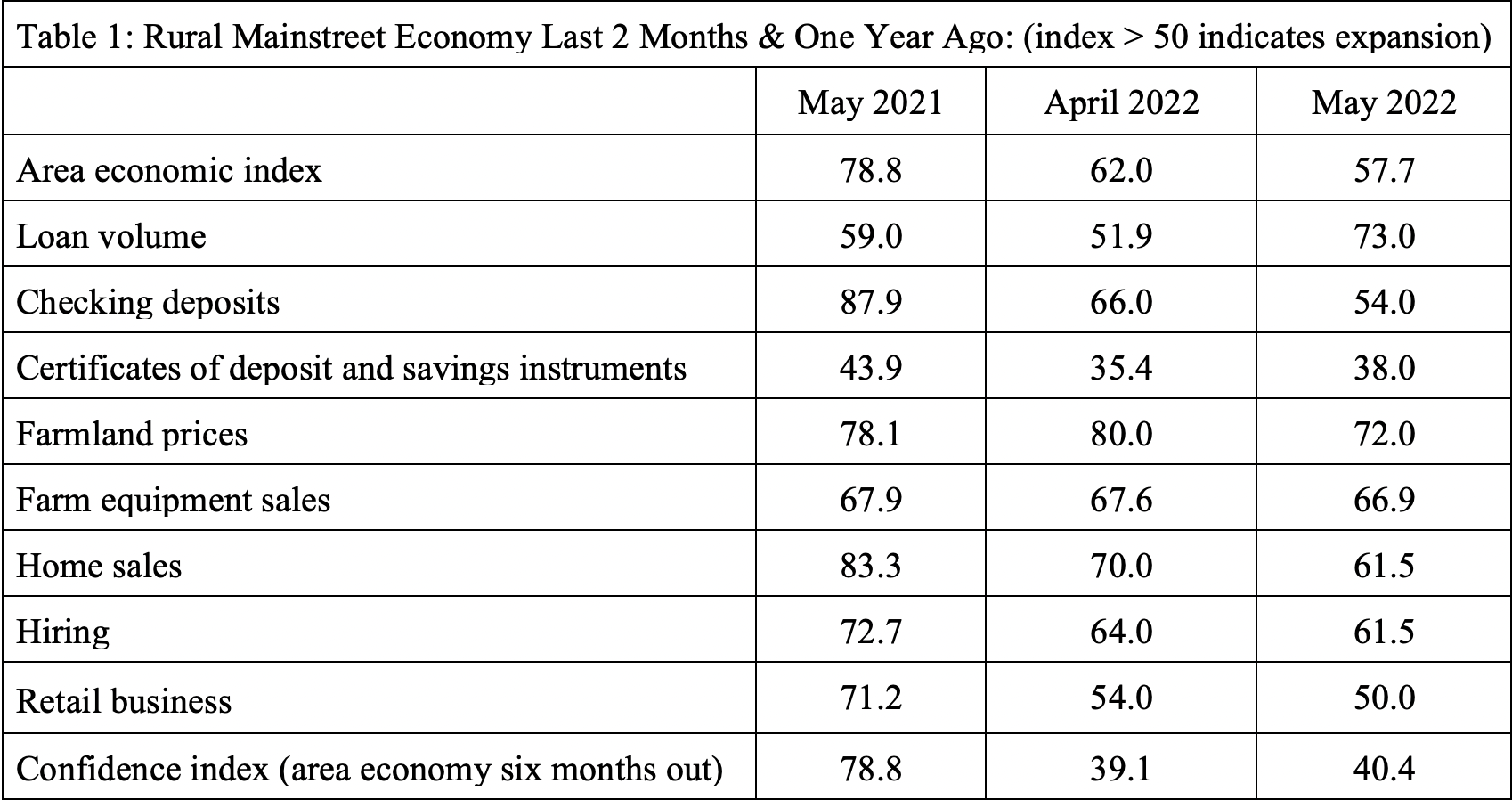
Creighton University chart compares current month to last month and year ago; click here to download it and chart below.

Rural bankers in 10 Midwestern states that rely on agriculture and energy report local economies that are still growing, but less than in recent months because of inflation and supply-chain problems, according to a monthly survey in May. The Rural Mainstreet Index polls bankers in about 200 rural places averaging 1,300 population in Colorado, Illinois, Iowa, Kansas, Minnesota, Missouri, Nebraska, North Dakota, South Dakota and Wyoming.

The overall index fell to 57.7 in May, down from April's 62. That's still growth-positive, but marks the index's lowest point since February 2021. "Much like the nation, the growth in the Rural Mainstreet economy is slowing. Supply chain disruptions from transportation bottlenecks and labor shortages continue to constrain growth. Farmers and bankers are bracing for escalating interest rates — both long-term and short-term," writes Creighton University economist Ernie Goss, who compiles the index.

Increased farming input costs have pushed borrowing to its highest reading since May 2020. Meanwhile, "the region’s farmland price index for May sank to a still strong 72.0 from 80.0 in April, marking the 20th straight month that the index has moved above growth neutral," Goss writes. "Over the past several months, the Creighton survey has registered the most consistent and strongest growth in farmland prices since the survey was launched in 2006."

Most bankers polled, 70.4%, said the Federal Reserve Open Market Committee should raise interest rates by 0.50% when it meets in mid-June. A plurality of 34.6% said that average local non-irrigated croplands (but not pasturelands) will fetch more than $300 cash rent per acre this year. And most predict that 2022 net farm income will be somewhat higher than last year's (33.4%) or about the same as last year's (37.0%). Only 3.7% believed it would be much higher.

Thursday, May 12, 2022

Feds' resource guide and May 23-24 virtual meeting on placemaking aim to boost rural economic development

The Agriculture Department's Rural Development and the Commerce Department's Economic Development Administration have released a joint resource guide meant to help rural communities create and execute economic-development strategies.

The guide lists RD and EDA programs under four broad categories to help rural stakeholders get started: Infrastructure and Broadband Expansion, Entrepreneurship and Business Assistance, Planning and Technical Assistance, and Workforce Development and Livability.

Entries for each program provide a summary of its purpose, links to learn more and apply, the type of assistance offered (grants, loans, cooperative agreements, or technical assistance, for example), and who is eligible.

Another good resource for rural stakeholders is the Placemaking in Small and Rural Communities Conference, held May 23-24. The free, virtual conference is presented by Rural Development and by the University of Kentucky's Community and Economic Development Initiative of Kentucky. Xochitl Torres Small, USDA undersecretary for Rural Development, will be the keynote speaker.

From the website: "Placemaking is a collaborative process among public, private, philanthropic and community partners to strategically improve the social, cultural, and economic structure of a community. The 2022 Rural Placemaking Conference aims to showcase effective placemaking strategies for rural areas, introduce attendees to placemaking resources and tools, and connect them to placemaking experts and potential funders."

The conference will offer online tracks on the following topics:
  • Initiating Place
  • Public Spaces & Gathering Places
  • Community Cultural Planning & Assessments
  • Cross-Sector Engagement

Click here for more information and click here to register.

Friday, May 06, 2022

Mich. town is an example of neglected rural water systems, and why more don't seek government loans for upgrades

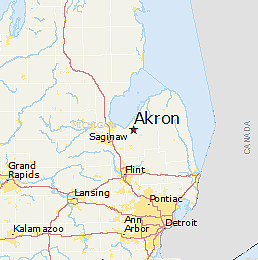
Many rural areas have substandard, long-neglected drinking-water systems. A small farming community in Michigan shows how that can happen and what it looks like at the local level. In Akron, which once had more than 500 people and fell to 366 by the 2020 census, "Shrinking populations, growing poverty, and diminished state and federal assistance have fueled a crisis of underfunded drinking water infrastructure," Lester Graham reports for NPR affiliate Michigan Radio. "Those problems often are compounded by a lack of qualified staff to keep up with water system operations and little to no expertise in applying for grants and loans that could help bolster utility budgets."

Best Places map
The specific problems in Akron are that families use much more water than they did seventy years ago, when the water system was built, and locals also can't afford to maintain a too-big distribution system or replace a water tower at the end of its lifespan, Graham reports. Another problem is that Akron must now spend more money to executive state-required testing for lead, PFAs, and other toxic substances. 

Though there are state and federal loan programs meant to help communities afford water system upgrades, many communities don't apply for them. "They might not be able to afford the debt. Also, it takes a lot of money to hire contractors to determine a system’s assets," Graham reports. "That’s needed in order to apply for the loans. A lot of these small towns don’t have the expertise needed to fill out an application on their own. It’s a big expense and there’s no guarantee the town will get a loan or grant."

Wednesday, April 27, 2022

Housing shortage triggers skyrocketing rents, but construction costs slow affordable housing projects

A housing shortage is fueling skyrocketing housing costs in rural areas and elsewhere. But rising construction costs—especially for lumber and petroleum-based products such as asphalt—make it difficult to build more housing and ease the crunch, and federal laws make it hard to apply pandemic aid to the problem, Kristian Hernandez reports for Stateline.

"For developers of market-rate apartments, [cost increases mean] charging higher rents. For those building rent-restricted projects using tax credits or other government aid, the rising costs could quash an entire project. And the construction slowdown is coming at a time when there is a desperate need to increase the nation’s supply of affordable housing," Hernandez reports. "The stock of low-cost rentals has been shrinking for some time: In 2019, there were 3.9 million fewer units renting for less than $600 than there were in 2011, according to the Joint Center for Housing Studies at Harvard University. The overall rental vacancy rate in the fourth quarter of 2021 was just 5.6%—the lowest figure since the mid-1980s—evidence that there is an extremely tight supply."

Average rents have gone up more than 17% in the past year, and tenants' income hasn't kept pace, and neither have government housing programs, Hernandez reports. About half of the nation's renters are paying more than the recommended limit of 30% of their income in rent, but government rental assistance has remained essentially flat for the past 20 years, according to Ingrid Ellen, director of New York University's Furman Center for Real Estate and Urban Policy.

Though the federal government has allotted billions in aid for the pandemic, its rules bar the money from being used for the Low-Income Housing Tax Credit program. LIHTC is the largest source of affordable housing financing, and has an outsized impact in poverty-stricken rural areas. "The problem is that, under the current rules, recovery funds must be spent by the end of 2026. That means the money can’t be used for long-term loans to help finance LIHTC developments," Hernandez reports. "Some state housing agencies have found a way around the restriction by mixing federal coronavirus aid and other funds ... Some agencies have been able to use recovery funds to cover up to 75% of the cost of a loan with these workarounds, but the process is complicated and adds costs to a project." A bipartisan bill would let states loan pandemic aid for LIHTC sites.

Monday, April 25, 2022

Rural Midwestern bankers say local economies thrive, but predict economic downturn with little impact from E15 sales

Creighton University chart compares current month to last month and year ago; click here to download it and chart below.

An April survey of rural bankers in 10 Midwestern states that rely on agriculture and energy showed still-growing local economies amid deepening concerns about the near future. The index surveys bankers in about 200 rural communities with an average population of 1,300 in Colorado, Illinois, Iowa, Kansas, Minnesota, Missouri, Nebraska, North Dakota, South Dakota and Wyoming.

The overall area economic index fell to a still-positive 62.0 from 65.4 in March; above 50 is growth-positive. Farmland prices are still soaring, home sales are up, retail sales are growing and hiring is up, bankers said.

"The region recorded a 34% gain in farm commodity prices over the past 12 months, but low short-term interest rates and healthy farm income have underpinned the Rural Mainstreet Economy," writes Creighton University economist Ernie Goss, who compiles the index.

However, the loan-volume index fell from 61.9 in March to 51.9 in April, and the confidence index, which predicts the area economy six months from now, dropped from 54 in March to 39.1. Most bankers surveyed (56.5%) believed President Biden's decision to allow the sale of E15 fuel (which has more ethanol) this summer would have little or no impact on their economies, while 39.1% believed it would have a positive effect and 4.4% believed it would have a negative effect.

The vast majority of bankers (91.7%) predicted that the Federal Reserve's Open Market Committee will raise the interest rate by 0.5 percentage points at its next meeting, and 8.3% said the committee will raise the rate by 0.25 points. None predicted the rate would remain unchanged.

Friday, January 07, 2022

Quick hits: Get used to winter tornadoes; U.S. beats Canada in first trade case under USMCA, over dairy subsidies . . .

Here's a roundup of stories with rural resonance; if you do or see similar work that should be shared on The Rural Blog, email heather.chapman@uky.edu.

An international trade dispute panel ruled for the United States in a conflict over Canada's dairy import limits, the first trade dispute brought under the United States-Mexico-Canada Agreement. The panel agreed with the U.S. that Canada isn't meeting its commitments under the treaty because it set up tariff-rate quotas for dairy products in such a way that only helped Canadian processors. Read more here.

A study says winter tornadoes are going to become more frequent and more powerful. Read more here.

Women in rural areas are less likely to be treated for certain cancers, a study shows. Read more here.

Climate change is making it harder to provide clean drinking water in farm country. Read more here.

The Rural Health Information Hub will host a free webinar Thursday, Jan. 13, to discuss a newly expanded program that allows rural medical providers to qualify for loan repayment. Read more here.

Climate change is a big factor in the increasingly large and deadly wildfires, but a century of poor forest-management policies didn't help. Government and non-profit organizations have been studying fire behavior to improve such policies, and they have some recommendations. Read more here.

A growing movement of LGBTQ+ farmers is working to build community and support in rural spaces. Read more here.

Friday, December 10, 2021

Quick hits: farmers brace for inflation; bipartisan bill to help rural opioid crisis passes Senate; food supply-chain loans

Here's a roundup of stories with rural resonance; if you do or see similar work that should be shared on The Rural Blog, email heather.chapman@uky.edu.

The Senate has passed a bipartisan bill targeting the rural opioid epidemic. The bill now goes to the House. Read more here.

A Purdue University poll found that more than half of farmers are bracing for inflation-triggered production cost increases over the next year. Read more here.

The Biden administration is providing up to $1 billion in loan guarantees to expand food supply-chain capacity; the program is mean to result in fairer prices for farmers and greater consumer access to healthier foods. The application window opened Thursday and will remain open until Feb. 7. Read more here.

A new stem-cell study paves the way for manufacturing cultured meat. Read more here.

Friday, July 30, 2021

Loan program to help Black farmers keep land they inherited informally, authorized in 2018 Farm Bill, is finally starting

The Agriculture Department will implement a loan program for farmers who inherited their land informally to resolve ownership issues so they can hold onto their land. Heirs' property issues have particularly threatened Black farmers in the South.

"The Heirs’ Property Relending Program will provide $67 million for loans to resolve property issues that have long kept some producers and landowners from being able to access USDA programs and services," Ximena Bustillo reports for Politico. "The program’s provisions were included in the 2018 Farm Bill, but it wasn’t implemented during the Trump administration."

Under the program, landowners can borrow up to $600,000 to "buy out other people with claims to land, consolidate a title and clear the titles on the ground. Those farms would then become eligible for other USDA agricultural programs as well," Chris Clayton reports for DTN/The Progressive Farmer. "Lenders such as cooperatives and credit unions can apply for up to $5 million at 1 percent interest when a two-month sign up window begins in late August. USDA will loan the money to those intermediate lenders who will then loan out the funds to the farmers."

About one-third of Black-owned land in the South is considered "heirs' property," or property passed down without a will or other clear documentation. Black families have often lost land to speculators and developers because they couldn't prove ownership, Clayton reports.

"The rising frequency and severity of natural disasters also poses a threat to heirs’ farms and other rural property. The Federal Emergency Management Agency more commonly denies disaster aid requests because of title issues in the South in counties that are majority Black," Bustillo reports.

Monday, July 19, 2021

Economic outlook remains high among small-town heartland bankers, tempered by concern over drought and land prices

A July survey of rural bankers in 10 Midwest states that rely on agriculture and energy found continued optimism for local economies amid concerns about employment, drought, and more. 

July's Rural Mainstreet Index fell to 65.6 from June's 70, and May's record 78.8, remaining above growth-neutral for the eighth straight month. The index is a survey of bankers in about 200 rural communities with an average population of 1,300 in Colorado, Illinois, Iowa, Kansas, Minnesota, Missouri, Nebraska, North Dakota, South Dakota and Wyoming.

Solid, but somewhat weaker, grain prices, along with the Federal Reserve’s record-low interest rates, and growing exports have underpinned the Rural Mainstreet Economy. Even so, current rural employment remains below pre-pandemic levels," reports Creighton University economist Ernie Goss, who compiles the index.

Farmland prices remained strong, staying above growth-neutral for a record tenth straight month. For July, the farmland index fell to 71 from June's 75.9. Surveyed bankers worry the trend won't last; the average CEO surveyed projected farmland price growth for the next 12 months at 2.4%.

Weather remains a significant concern; 47% of bankers reported damaging drought conditions for farmers. Jobs are another issue; despite recent gains, U.S. Bureau of Labor Statistics data show that nonfarm employment for the Rural Mainstreet economy is 1.3%, or 55,000 jobs, below pre-pandemic levels.

Wednesday, July 07, 2021

Black farmers the least likely to get USDA direct loans over past three years, also got lower share of pandemic relief

Black farmers were denied USDA loans at higher rates than
other groups in 2020 (Politico chart; click to enlarge it)
"Not only have Black farmers received the least amount of direct loans of any ethnic and racial group over the past three years, but also that the number and share of direct loans hit a 10-year low last year," Ximena Bustillo reports for Politico's Weekly Agriculture. That matters because Agriculture Department direct loans "are supposed to be a sort of last resort for farmers who cannot get credit elsewhere. Yet, white farmers have an acceptance rate that is nearly twice as high."

The issue goes beyond loans. Also, though farmers of color represent about 5 percent of American farmers, they got less than 1% of Coronavirus Food Assistance Program funding, according to Agriculture Secretary Tom Vilsack, Bustillo reports.

"The department continues to fight legal battles in multiple courts to ensure that a congressionally authorized program to provide about $4 billion in debt relief to farmers of color is carried out," Bustillo reports. "But advocates for Black farmers say USDA needs to take steps beyond debt relief to address barriers at the Farm Service Agency level including racial bias, inexperienced personnel and lack of bandwidth to help with applications. Farmers recalled FSA agents misleading them about available loan applications and being overall absent to help guide the process."

White farmers have voiced widespread resentment of the program, who say they are also suffering during the pandemic. Under the plan, a farmer who meets the 1990 Farm Bill's definition of "socially disadvantaged" could be paid 120% of the amount owed on a USDA loan (the extra to cover taxes on the money) without having to prove discrimination.

"USDA is conducting internal and external investigations, which are supposed to review all programs and agencies of the department to pinpoint where access may be lacking not just for Black farmers, but all producers including beginning farmers and other socially disadvantaged producers and ranchers," Bustillo reports. "USDA has previously said it plans to start reviews with the consumer-facing branches, which includes FSA. The external review is not expected to start until the fall, but the internal one is underway and is expected to wrap up over the summer."

Tuesday, June 22, 2021

Former U.S. Rep. Xochitl Torres Small of New Mexico nominated for USDA undersecretary of rural development

Xochitl Torres Small
Xochitl Torres Small of New Mexico has been nominated as the Agriculture Department's undersecretary of rural development.

When President Biden announced her nomination on Friday, he cited her previous work in economic development in rural communities New Mexico, Algernon D'Ammassa reports for the Las Cruces Sun News.

"Throughout her career, Torres Small has employed her experience organizing in vulnerable, rural communities to achieve lasting investments that combat persistent poverty," said a White House statement.

The granddaughter of migrant farmworkers, she eventually became an attorney focused on water issues before winning a seat in Congress on her first run for public office. She served on the agriculture committee during her single term from 2019 to 2021.

"If confirmed, Torres Small would be in charge of a mission area with wide-ranging responsibilities, including rural electric cooperative loans, broadband expansion, community development and infrastructure funding, value-added producer grants, and funding for renewable energy and biofuel projects," Jacqui Fatka reports for National Hog Farmer. "The rural development undersecretary position was previously eliminated under a restructuring of USDA when establishing the trade undersecretary but re-established under authority in the 2018 Farm Bill."

Monday, February 22, 2021

What's in the House relief-and-stimulus bill

The House Budget Committee began marking up the $1.9 trillion economic aid bill today at 1 p.m. Markups are expected to be minor, so here's some of what's in the bill as of now:
  • $4 billion for the Agriculture Department to buy and distribute agricultural products to those in need, to extend grants and loans to smaller producers, to improve agricultural supply-chain resiliency, and help pay for necessary expenses related to crop losses (including weather-related losses).
  • $100 million from the overall USDA funding to reduce the amount of overtime inspection costs borne by small and very small federally inspected meat, poultry or egg processors. 
  • $500 million from the overall USDA funding for need-based grants to help rural health-care providers with pandemic-related expenses.
  • $1,400 in direct aid for people earning up to $75,000 per year, with declining amounts on a sliding scale to a hard cut-off at $100,000.
  • An increase of the child tax credit from the current $2,000 per child to $3,000 for each child 6 to 17 and $3,600 for those under age 6. The credit would have the same income thresholds as the stimulus checks, and it would become fully refundable so more low-income parents could take advantage, Payments would be distributed monthly rather than as a lump sum once a year.
  • Continuation of tax credits through Oct. 1 to employers who choose to offer paid family leave and sick leave. The mandatory leave approved in a previous relief package would not be reinstated.
  • A 15% increase in Supplemental Nutrition Assistance Program benefits (formerly food stamps) would continue through September, instead of expiring at the end of June.
  • $880 million for the Women, Infants and Children nutrition program.
  • States would be allowed to continue the Pandemic-EBT program, which provides families whose children's schools are closed with funding to replace free- and reduced-price meals that the kids would have received, through the summer.
  • $195.3 billion to state governments, including the District of Columbia. 
  • $130.2 billion to local governments, to be divided evenly among cities and counties. 
  • $20 billion to tribal governments and $4.5 billion to territorial governments.
  • $19.1 billion to state and local governments to help low-income households cover back rent, rent assistance, and utility bills.
  • About $10 billion to help struggling homeowners pay their mortgages, utilities and property taxes.
  • $5 billion to help state and local governments help the homeless.
  • $14 billion for coronavirus vaccine research, development, distribution, and compliance outreach efforts. 
  • $46 billion for coronavirus testing, contact tracing and mitigation, including laboratory capacity, community-based testing sites, and mobile testing units, especially in medically underserved areas.
  • $7.6 billion to hire 100,000 public-health workers to support the coronavirus response.
  • $128.5 billion for K-12 schools to make them safer to reopen by reducing class sizes, modifying classrooms to enhance social distancing, installing ventilation systems, buying personal protective equipment, and hiring more nurses and counselors.
  • Nearly $40 billion for colleges and universities to defray pandemic-related expenses and provide emergency aid to students for expenses such as food, housing, and computer equipment. 
  • $39 billion to help child-care providers with operating expenses.
  • $25 billion for a new program benefiting restaurants and bars hurt by the pandemic. The grants would provide up to $10 million per business with a limit of $5 million per physical location.
  • $7.25 billion for the Paycheck Protection Program. The bill would also make more non-profit organizations eligible for PPP funds.
  • $175 million for outreach and promotion to help target businesses eligible for PPP funds.
  • Expanded federal unemployment benefits would be extended, with an increase from $300 a week to $400 a week through Aug. 29.
  • The federal minimum wage would gradually rise to $15 per hour by June 2025, and then be adjusted to increase at the same rate as median hourly wages. This provision may violate the parliamentary rules being used to pass the bill.
  • Federal premium subsidies for Affordable Care Act policies would be made more generous, and the maximum income cap would be eliminated for two years. Enrollees would pay no more than 8.5% of their income towards coverage, down from nearly 10% now. And those earning more than the current cap of 400% of the federal poverty level (about $51,000 for an individual and $104,800 for a family of four) would become eligible.
  • Federal subsidies for lower-income ACA enrollees would be eliminated completely, as would those for people collect unemployment benefits in 2021.
  • Laid-off workers who want to remain on their employer's health-insurance plans would have to pay only 15% of the premium through the end of September.
  • Federal matching funds for states that that expand Medicaid to low-income adults would be boosted by 5 percentage points for two years.
  • $15 billion for the Emergency Injury Disaster Loan program, which provides long-term, low-interest loans through the Small Business Administration. Severely impacted businesses with fewer than 10 workers will be given priority for some of the money.

Thursday, February 18, 2021

Rural heartland banker survey shows highest economic outlook since 2011, but hiring and retail sales are still down

Creighton University chart compares current month to last month and year ago; click here to download the full report.

A February Creighton University survey of rural bankers in 10 Midwest states that rely on farming and energy showed sunny economic predictions for six months from now, with the highest confidence index since 2011. Still, hiring and retail sales remain weak, and low loan volume is still a concern. The index is a survey of bankers in about 200 rural communities with an average population of 1,300 in Colorado, Illinois, Iowa, Kansas, Minnesota, Missouri, Nebraska, North Dakota, South Dakota and Wyoming.

Though current economic activity is still below pre-pandemic levels, "sharp gains in grain prices, federal farm support, and the Federal Reserve’s record-low interest rates have underpinned the Rural Mainstreet Economy. Only 8 percent of bank CEOs indicated economic conditions worsened from the previous month," Creighton economist Ernie Goss writes.

Farmland prices, farm equipment sales, home sales and checking deposits were all up a little from last month and a lot from last February. The land price index is the highest since May 2013, has recorded five straight months above growth-neutral in that category for the first time since 2013, Goss reports. Equipment sales, likewise, have been above growth-neutral for the past three months after 86 consecutive months below growth-neutral. Half the bankers said they expect equipment dealers to see a 1-4% increase in sales over the next 12 months, and 23% said they expect to see a 5-10% increase. 

Thursday, February 04, 2021

Tuesday webinar to discuss Rural Development grants, introduce viewers to one-stop shop for rural grants, loans

The U.S. Department of Agriculture will host a free webinar at 1 p.m. ET Feb. 9 to discuss strategic economic and community-development funding opportunities and introduce viewers to the new USDA Innovation Center, a one-stop shop for grant and loan programs and guidelines. It will last about an hour.

The program, authorized in the 2018 Farm Bill, prioritizes projects that support the implementation of regional economic development plans through several Rural Development funding programs. Organizations, non-profits, and local leaders are encouraged to attend. Click here to register and get info.

Tuesday, February 02, 2021

Friday webinar to discuss first USDA Farm Income Forecast of 2021; keep an eye out for predictions on farm loans

The Agriculture Department's Economic Research Service will release the first Farm Income Forecast for 2021 on Friday, Feb. 5. That same day, ERS economist Carrie Litkowski will host a webinar at 1 p.m. ET to discuss the contents of the report. Click here to register for the webinar.

The most recently published farm income forecast, in December 2020, noted that net farm income likely rose from 2019 to 2020, but mainly because of direct federal relief. The report also found that farm debt and the average debt-to-asset ratio were increasing, raising concerns about the farming economy's sustainability.

One thing to keep an eye on? Increasing concerns about farm loans. A survey of rural Midwestern bankers in January found that, though their confidence in the economy was increasing, their top worry is lower lending activity. And a recent report from the Federal Reserve Bank of Kansas City found that, though the average size of farm loans grew for the last two quarters of 2020, smaller loan volumes were driven by a lower number of new loans to farmers."

The ERS releases the farm income forecast three times a year, usually in February, August and November. From the webinar page: "These core statistical indicators provide guidance to policymakers, lenders, commodity organizations, farmers, and others interested in the financial status of the farm economy. ERS' farm income statistics also inform the computation of agriculture's contribution to the U.S. economy's gross domestic product."

Thursday, January 28, 2021

USDA temporarily suspends collections, garnishments, non-judicial foreclosures and other penalties on farm loans

The Department of Agriculture is temporarily suspending non-judicial foreclosures, debt offsets, wage garnishments and collections on past-due farm loans, citing the financial stresses of the coronavirus pandemic, a USDA news release said. The action applies to borrowers under the Farm Storage Facility Loan and the Direct Farm Loan programs, which are administered by the Farm Service Agency.

"Additionally, USDA has extended deadlines for producers to respond to loan servicing actions, including loan deferral consideration for financially distressed and delinquent borrowers. In addition, for the Guaranteed Loan program, flexibilities have been made available to lenders to assist in servicing their customers," the release said.

More than 12,000 farmers, ranchers and producers—about 10 percent of the more than 129,000 FSA borrowers nationwide—should be eligible for the new relief, according to USDA data, the agency said. The suspension will remain in place until further notice, and is expected to continue as long as the nationwide coronavirus disaster declaration is in place.

Monday, January 25, 2021

Rural Midwest banker survey sees rising economic confidence amid concerns about inflation and interest rates

Creighton University chart compares current month to last month and year ago; click here to download the full report.

A January Creighton University survey of rural bankers in 10 Midwest states that rely on farming and energy showed overall increasing confidence in the economy amid concerns about excessive inflation, low loan demand and higher long-term interest rates. The index is a survey of bankers in about 200 rural communities with an average population of 1,300 in Colorado, Illinois, Iowa, Kansas, Minnesota, Missouri, Nebraska, North Dakota, South Dakota and Wyoming.

"Recent sharp improvements in agriculture commodity prices, federal farm support payments, and Federal Reserve’s record-low short-term interest rates have underpinned the Rural Mainstreet Economy in a solid and positive growth range. However, the rural economy remains well below pre-pandemic levels," writes Creighton economist Ernie Goss, who compiles the index.

The overall Rural Mainstreet Index climbed above growth neutral for the third time in the past four months, and the farm equipment sales index rose to its highest reading since April 2013. Moreover, for the first time since 2013, Creighton recorded four straight months of above growth-neutral farmland prices. 

However, bankers reported "anemic" loan volumes, and a plurality, 44 percent, said they expected low loan demand to be the biggest issue their banks will face in 2021. Only 4% said rising loan defaults and bankruptcies was the biggest issue. That's a near flip-flop from last January, when only 7% said low loan demand was their greatest concern, and 32% said rising loan defaults and bankruptcies were their biggest worry.

The new hiring index fell below growth neutral, and data from the U.S. Bureau of Labor Statistics says non-farm employment levels in the Rural Mainstreet economy are down by 3.3%, or 145,000 from pre-pandemic levels, and down by 5.6%, or 251,000, from last January.