Showing posts with label weather. Show all posts

Friday, June 05, 2026

Quick hits: Tick app; Northeast rice crops; health benefits of dancing; moon farms; meteorologists get to Hollywood


As spring turns into summer, more ticks are hitching rides on socks, shoes, pant legs and hairdos. The tiny vectors bite thousands of people each year and spread diseases such as alpha-gal syndrome, Lyme disease, babesiosis and Rocky Mountain spotted fever. But there is hope. Researchers are asking people to share their tick bites and discoveries on The Tick App so that their habits can be better understood and more effective preventive practices can be developed. The Tick App also gives tips for identifying and removing ticks.

The Northeast isn't known as a rice-growing mecca, but as the region's climate changes, some farmers are giving the crop a try. "Around New York and beyond, weather has shifted to become more extreme, bringing intense rainfall and hailstorms that could damage crops," reports Alice Sun for Offrange. Rice paddies are flood-resistant, able to withstand extreme weather, and the crop fetches a good price. Researchers at Cornell University, along with some "pioneering farmers are working to make it a more common crop in the Northeast, as a buffer for farmers to adapt to increasingly unpredictable weather."
Maria isn't sure about Elmo's reasoning. (Sesame Street photo)
Fans of "Sesame Street," past or present, may want to watch the new documentary tracing the life and career of actress Sonia Manzan, better known as the character "Maria." As Maria, Manzan became the first Latina to appear on a regular TV series, reports Greg Toppo of The74. The film travels back to Manzan's difficult upbringing in the South Bronx during the 1950s, follows her big break with the musical Godspell, and includes her adventures with Oscar the Grouch and Elmo on Sesame Street. The film is currently touring at film festivals throughout the spring and summer.

Even dancing from a sitting position is considered
healthy movement. (Photo by E. Marritz,Dance for PD)
What activity can be done while sitting or standing, creates joy and is healthy? If you thought dancing, you're correct. "Modern research is now catching up to the fact that dance is medicine, a deeply effective intervention for physical, cognitive and emotional health," reports Michaela Haas for Reasons to be Cheerful. "In a longitudinal study, seniors who took part in regular dance training fell less often and were 'physically better off and mentally fitter' than those in the control group."

It's not going to be science fiction for much longer: NASA is learning how to farm on the moon. "As we get ready to feed astronauts on the Moon and Mars, NASA scientists are figuring out how to build soil from scratch," reports Lela Nargi for Offrange. "Ralph Fritsch, a NASA retiree and lead subject matter expert for the Mars to Table challenge, which seeks to identify plausible 'surface habitat food systems,' believes space ag will probably start with hydroponics. . . . Although Fritsch believes dirt-based space greenhouses are years from fruition, there’s still been heavy investment in research."


Everyone asks about, talks about and complains about the weather -- it's a shared human experience. With the exception of farmers, who are also weather obsessed, few people might glamorize meteorologists. Until now. "Meteorologists are rarely the heroes of major Hollywood movies. Never say never," writes Rebecca Hersher of NPR. "The new film 'Pressure' is a lightly fictionalized version of the actual lead-up to the D-Day invasion of France by Allied troops during World War II, and the crucial role of meteorologists in deciding when that battle would happen." 

Friday, May 08, 2026

Severe weather and wildfires have home insurance rates climbing in states where rates had been cheaper

Hailstorms in Iowa have caused home insurance
rates to spike. (Photo by Champers Fu, Unsplash)
After a decade of severe weather and wildfires across multiple regions of the U.S., many home insurance companies have responded by increasing their rates to reflect emerging risks. 

Home insurance rate increases can be particularly onerous for rural residents who already pay more because of their distance from emergency and fire services.

In the past, traditional home insurance policies were more expensive in coastal states, where hurricanes could devastate hundreds of homes in a single season. Lower rates were reserved for inland states considered less likely to be hit by Mother Nature's seasonal wrath.

But that old playbook has been swept aside, report Carl Churchill, Jaclyn Jeffrey-Wilensky, Jean Eaglesham and Jason French of The Wall Street Journal. "Now, hailstorms, wildfires and wind damage are hammering places once thought to be shielded from the worst rate hikes."

In Iowa, where hailstorms have become more common, home-insurance rates have "increased 91% since 2021: In Florida, despite the hurricane risk, the increase is 35%," the Journal reports.

Before buying a new home, it can be worthwhile to see how much it will cost to insure. "Home-insurance premiums can vary dramatically, depending on where you live: Crossing a county line can more than double the cost," the Journal reports.

In high-risk areas of the country, finding an insurance company willing to issue coverage is difficult, and policy prices have skyrocketed. A resident in Braue of Orinda, Calif., said his "annual premium had shot up to $16,496, more than nine times his premium of less than two years ago," the Journal reports. "The reason? Wildfires, which are scorching homeowners’ chances of cheaper insurance in many states."

How states regulate home insurance rates also impacts home policy pricing. According to the article, "North Carolina is one of 11 states that allow regulators to veto requested home-insurance rate increases. . . .Cross over from Cherokee County, North Carolina, to Monroe County, Tennessee, and the typical rate jumps more than 50%." Despite similar risk assessments, the state with regulatory controls has lower rates.

Friday, May 01, 2026

Local reporters can use NASA data for stories on weather events, groundwater, wildfires, conservation and more

Data from NASA satellites can add reliable, science-based 
insights to local reporting. (NASA graphic)
Environmental journalists seeking data on planet Earth can dig into troves of NASA information. "NASA actually flies its own Earth-exploring satellites, which collect massive amounts of data in their own right," reports Joseph A. Davis for the Society of Environmental Journalists.

And while the Trump administration succeeded in hacking off a massive portion of the agency's budget, NASA has been busy improving its data site. . .anyway.

The agency now boasts a "nifty refurbished site called Earthdata. NASA says the upgrade — which they call the web unification project — will take the rest of 2026," Davis explains. "It looks better already, because it’s organized by what you are looking for. It’s no longer rocket science."

Davis adds the following "treasures" for reporters looking for environmental data that is gathered in space but grounded in science. 

  • Groundwater: NASA offers several datasets that measure groundwater depletion. It also measures land subsidence from depletion.
  • Cryosphere: NASA data tells about snow cover, sea ice extent, ice thickness, permafrost, snow and ice albedo (reflectivity), glacier loss, ice sheets and more.
  • Land Surface: Satellites are telling us about shrinking forests, warming land, soil erosion, vegetation types, land use, topography, soil moisture, wildfires, floods and landslides.
  • Atmosphere: Satellites tell us much about Earth’s 60-mile-thick atmosphere, including pollutants like particulates, nitrogen dioxide, carbon monoxide, dust and smoke. . . .weather-related data.
  • Biosphere: Satellites measure vegetation types, vegetation extent and condition, canopy height, deforestation, habitat types and conditions, biomass types, conservation of protected areas, algal blooms, nighttime lights and more.
  • Ocean: Most of what NASA satellites see is water. They send back data on sea surface temperature, salinity, ocean color, sea surface height (for ENSOs), nutrients, chlorophyll, ocean currents, sea level rise, biogeochemical cycles, waves and winds, nutrients and tsunamis.
  • Human Dimensions: Satellites see what humans do to the planet, including agricultural practices, housing development, and land and water management.

Friday, March 06, 2026

Quick hits: E15 'Stop the Stall' campaign; popcorn history; Connecticut's bid to attract first responders; Tolkien for men

Rural Voices USA photo
When the congressional Rural Domestic Energy Council failed to meet its Feb. 15 deadline to pass year-round E15 legislation, Rural Voices USA began targeted billboard campaigns in Iowa, Michigan, Minnesota, Nebraska and Wisconsin. WisPolitics-State Affairs reports, "The billboards, part of a six-figure multi-channel pressure campaign, are now live on digital boards. . . .The campaign targets districts represented by Republican champions of E15 legislation who have been unable to move the bill through congressional leadership." Allowing E15 year-round would help corn farmers secure a reliable, domestic income that isn't subject to export volatility.

March has arrived, but in many parts of the U.S., the snow hasn't left. In fact, there are still piles and piles of it everywhere. Victoria Hoffmann of the Christian Science Monitor wondered where a city like Boston, which received more than 5 feet of snow this winter, put all their snow. The answer: Snow farms. "My search led me on a journey to places in Boston I’ve never ventured before. Boston is operating 14 snow farms this year, the first time in years that a mayor ordered that many to be opened."

At first, U.S. movie theaters didn't want to sell 'the noisy
snack.' (Photo by M. Ingvordsen, Unsplash)
Heading to the movies didn't always include a bucket of popcorn. "At first, theater owners wanted nothing to do with the noisy snack. But then came the Great Depression," reports Heidi Mitchell of The Wall Street Journal. "The appeal was obvious: It was cheap, fast and theatrical. Families popped it over wood stoves; peddlers sold it in paper cones at circuses. . . .A whiff of fresh corn could draw a crowd quicker than any barker’s repetitive shout." Read about popcorn's history in the U.S. here.

In a bid to attract more first responders, Connecticut plans to offer recruits a range of incentives. Gov. Ned Lamont's bill, H.B. 5046, "would waive tuition to the state’s public colleges and universities for people who have worked as police officers for at least five years and for people who have served as paid or volunteer firefighters for at least five years," reports Emilia Otte of the CT Mirror. "The bill also authorizes the Connecticut Housing Finance Authority to create a mortgage assistance program for police officers and firefighters."

J.R.R. Tolkien's Lord of the Rings trilogy has taken millions of readers on what is arguably the most epic rural adventure -- to Mordor and back again. And while the tales of Bilbo and Frodo remain strikingly popular, they continue to have a more dramatic appeal for men. "Both Tolkien’s cosmic vision of Middle-earth and the many genuine heroes that populate his work likely make for an attractive combination in the eyes of many a meaning-starved young man," writes Peter Biles for The Dispatch. "As I wrote for The Dispatch a few months ago, boys don’t just automatically become good men in a vacuum; they need role models. Manhood must be carefully nurtured. . ."

The Great Florida Cattle Drive celebrates the Sunshine State's ranching heritage.
(Great Florida Cattle Drive photo)
When it comes to cowboys and cattle, most Americans tend to think of the West, but in early America, Florida was where the cattle and the cowboys traveled together. In a tribute to the state's history, "nearly 300 people and 300 head of cattle traveled a century back in time for the 5th iteration of the Great Florida Cattle Drive," reports Isaac Eger for National Geographic. Over six days and six nights the drive became "a living history reenactment where hundreds of riders on horseback walk, trot, canter, and gallop through 54 miles of pristine Florida country that is now part of the Florida Wildlife Corridor." Read about their adventure here.

Tuesday, February 17, 2026

Neighbors in Maine volunteer to build window inserts for each other to fight the winter cold

Students in Vermont build a WindowDresser insert. 
(Photo by Andrew McKeever, The Yonder )
Harsh winters in Maine can make it hard to keep the cold air outside from creeping into the older New England style homes. WindowDressers is a community-based heating solution that keeps warm air inside by inserting an insulated wooden window into a home or commercial window frame, Andrew McKeever reports for The Daily Yonder.

The concept started in a church in Rockland, Maine, which was losing heat due to its leaky aluminum-clad windows. Church member Richard Cadwgan decided to build window inserts for the church windows, which he learned about at a Midcoast Green Collaborative conference, a Maine-based nonprofit organization. Cadwgan told McKeever the window inserts were a “win-win-win – lower heating bills, fewer carbon emissions, and greater comfort in the cold winter months.”

After word spread to other community members, Cadwgan and former congregation president Frank Munro took orders for 185 inserts for homes the next year, and 1,231 inserts the year after. With so many orders, more volunteers were needed, so “community builds” were formed. Now, there are 52 community builds throughout Maine, New Hampshire and Vermont.

Community builds allow for volunteers with no prior carpentry experience to help build the window inserts after just a brief instruction from their team leader, McKeever explains. Jim Salsgiver, one of the original organizers, told McKeever, “I love the builds and getting together, meeting new people. What’s so cool is somebody comes in and says, ‘Okay, well I signed up, but what do I do?’ And, you know, after three hours, they’re acting like pros doing it and excited about it and telling their friends.”

As of 2024, at least 78,600 inserts have been made, saving almost 4 million gallons of heating fuel.

Friday, February 06, 2026

Snow drought in Western states adds to regional water supply worries and takes a toll on winter tourism

Western states rely on winter snowpack for community
and farming water supplies. (Photo by Lamar, Unsplash)
Unlike most of the country, Western states are experiencing warmer-than-normal winter temperatures and haven't had enough snow to replenish water needed for drier months or sustain winter tourism, which helps to fuel their economy.

"An extreme snow drought and unusually warm weather are keeping skiers off the mountains, snowmobilers off the trails and water out of the rivers across much of the West," reports Jim Robbins for The New York Times.

Much of the West relies on thawing winter snowpack to provide water for residents, irrigation, trout streams and reservoirs throughout the year.

The lack of snowpack in the Colorado Rockies and the Colorado River Basin "adds to the 26-year-long megadrought in the region, which has led to extremely low levels in the two largest reservoirs on the Colorado River," Robbins explains. "Colorado is having its warmest winter since 1895."

The reason for the drastic change in snowfall and temperature between the last few years and this year "isn’t easily explained," Robbins adds. "Scientists have found that it is difficult to attribute the snow drought entirely to climate change."

Skiing tourism in Oregon has been particularly hard hit because there's been so little snow. Presley Quon, a spokesperson for Mt. Bachelor, a ski resort near Bend, Ore., told the Times, "It’s been a really rough season for ski resorts." Robbins adds, "Last year at this time, Mt. Bachelor had 109 inches of snow at its base; this year it has 27 inches."

At higher elevations, snowpack inches are at a more normal level; however, the runoff most communities rely on for water "comes from the middle and lower elevations, which cover a far greater area than the land at higher altitudes," Robbins explains. 

Despite the abysmal snowfall thus far, there's still time for snowpack levels to rebound. Robbins adds, "February, March and often April are the months when most of the snow usually falls in the mountains."

Tuesday, February 03, 2026

How to stay safe when it's cold and there's a power outage

Photo by S. Modak, Unsplash
Whether it's 32 degrees or -5 degrees, prolonged exposure to cold air takes a toll on the human body. For rural residents living in remote areas far from help, or in regions not accustomed to colder temperatures, knowledge about coping with cold, including proper clothing, and supplies for extended power outages can save lives, reports Devi Shastri of The Associated Press.

Cold can be stealthy. "Some of the most dangerous situations happen when the temperature is low for a long time, even 30 to 40 F," Shastri writes, "In these situations, long-term cold exposure taxes the body, driving up blood pressure and working the heart." A person who is shivering needs to be warmed as soon as possible.

Drinking plenty of water helps people stay warm. Drinking alcohol isn't advised because it can make people feel warmer than they are.

Wearing layers of dry clothes, especially dry socks, is one of the best ways to help the body trap heat. "The North Carolina Department of Emergency Management suggests wearing warm, loose-fitting, lightweight clothing in many layers that are easy to add or remove," Shastri reports. "It also recommends covering your mouth with scarves to protect the lungs from directly breathing in extremely cold air."

Smaller spaces will stay warmer. If you're waiting for the heat to come back on, move into a smaller room. Some sources even suggest pitching a tent in a room and climbing into a sleeping bag to add heat.

Check on your neighbors. "Young children, older adults and people with chronic health conditions such as diabetes and high blood pressure are the most at risk when it’s cold," Shastri adds. "Community awareness is key during dangerous cold spells. Many don’t realize they need help until someone asks."

Friday, January 30, 2026

Reporting on winter weather offers unique opportunities for community service and local stories

National Guard soldiers push a stuck motorist’s vehicle in Indiana.
(Indiana National Guard photo, Flickr CC, via SEJ)

Old Man Winter is here, and he appears to be angry, which may be miserable for most of us; however, seasonal swings provide a unique opportunity for community reporters who can offer highly localized weather data and stories to help their readers with local forecasts, weather warnings, safety reminders and precautions specific to regional needs.

The National Snow and Ice Data Center may have a global reach, but it also "monitors all kinds of things that may make more local news near you," reports Joseph A. Davis for the Society of Environmental Journalists.

"Maybe you live in a water-scarce area like California or the Colorado River Basin. The NSIDC not only monitors seasonal snowpack but translates that into meltwater potential."

When reporting about weather, it's good to remember that not everyone can work from home and "some people have to slog to work to make trips possible for those who do," Davis writes. "Wintry conditions affect the lives of all kinds of people. Plow operators can look forward to double shifts. . . . . Restaurant workers could lose their jobs if they don’t show for work. Farmers can lose their crops or livestock, and older people stuck at home if their heat goes out could die."

Stories can cover how local medical clinics and rural hospitals prepare for snow and ice storms, or could explore how highway officials and snowplow operators prepare for extreme winter weather. 

Davis recommends these reporting resources: 

Tuesday, September 30, 2025

National Weather Service has hundreds of vacancies, 'exhausted employees'

The National Weather Service was created to protect people and property. (NOAA graphic)

On any given day, the National Weather Service deploys staff to research, predict and issue warnings for weather activity across the United States, which covers a total of roughly 3.8 million square miles. However, after losing 600 employees this spring, the agency is now stretched thin and may struggle to meet the demands of fall weather, which includes a busy hurricane season.

"Exhausted employees have maintained weather monitoring and forecasting almost without interruption, staff said. But many are wondering how much longer they can keep it up," report Hannah Natanson and Brady Dennis of The Washington Post.

Despite receiving an exemption from the federal hiring freeze and working to replace lost staff, the agency still has hundreds of vacant positions, an active Atlantic hurricane season, and a possible government shutdown to manage.

Tom Fahy, legislative director for the National Weather Service Employees Organization, the union that represents the agency’s workers, told the Post, "We have a strained and severely stretched situation. . . .There’s a breaking point.” 

A spokesperson for the National Oceanic and Atmospheric Administration offered reassurances that the Weather Service is “'equipped to meet its mission of protecting American lives and property through timely forecasts and critical decision support services,'" the Post reports. "But even before this year’s losses, the Weather Service was considered understaffed."

Since NWS shortages have been extreme, the Trump administration gave the agency permission to "list and hire 450 positions," Natanson and Dennis add. "But it won’t be an immediate fix. . . . Federal hiring is often slow. . . .Government work may seem like a bad option, since Trump has stripped away the guaranteed job stability that once made up for the lower pay."

Friday, August 22, 2025

Quick hits: Radioactive shrimp; soybean farmers seek deal; tractor pulls; veggie-flation; 515-mile lightning strike

Radioactive shrimp were recalled as a precautionary
measure. (ABC video graphic)
Earlier this week, the FDA issued an urgent recall for Indonesian shrimp sold at Walmart that may contain radioactive materials. "Certain Great Value raw frozen shrimp products sold at Walmart are being recalled due to possible contamination with Cesium-137, a radioactive isotope," reports Erin Keller of the Independent. FDA shrimp recall details are here.

With their fall harvests almost ready, American soybean farmers sent the Trump administration a letter asking for a trade deal with China. "China, the world's largest soybean buyer, is turning to Brazilian cargoes amid trade tensions with the U.S. and ongoing negotiations," reports Leah Douglas of Reuters. "The country has not pre-purchased soybeans from the upcoming U.S. harvest, an unusual delay that has worried traders and farmers. . . . China bought 54% of U.S. soybean exports in the 2023-2024 marketing year, worth $13.2 billion."
Langford's tractor pull has increased in popularity since
beginning in 1946. (Photo by Zach Jaworski, NPR)
Annual tractor and truck pulls have grown into major events for some rural communities. Little Langford, New York, hosts its tractor pull for two days every August. "Spectators gather on wooden bleachers flanking a long dirt runway, forming an arena that seats 4,000 people — more than the surrounding area's total population," reports Zach Jaworski of NPR. Richard Love, one of the officials at this year's Langford pull, told Jaworski, "It's non-stop action and it's just kind of a big party here." Jaworski adds, "This event in Langford has been held annually since 1946."

After U.S. Department of Labor agents zeroed in on the Marino family farm in New Jersey and uncovered a paperwork violation, they shackled the family's business with administrative red tape, fines and a ruling from a DOL court. Finally, after years of litigation, "a panel of independent federal judges unanimously ruled DOL’s actions in violation of the Constitution. . . and the Marinos were vindicated," reports Chris Bennett of Farm Journal. But the DOL's damage remains -- the Marino family farm that operated for 125 years is gone. Joe Marino told Bennett, "I never thought honesty and facts wouldn’t matter in America, but that’s what happened."
Chart by Axios, from Bureau of Labor data
As U.S. consumers watch the prices for essentials continue to fluctuate, produce costs could become the next budget worry. "Wholesale prices for fresh veggies soared by a record amount last month, foreshadowing a possible spike at the grocery store soon," reports Ben Berkowitz of Axios. "The Producer Price Index for July rose at the fastest clip in three years, far more than economists expected. . . . Per Bureau of Labor Statistics data, it's also the largest monthly increase ever recorded in a summer month (June-August), in figures that go back to 1947." 
A visualization of the megaflash that extended 515 miles, roughly the distance from Dallas to Kansas City, Mo. (Photo by Michael Peterson, GTRI via The Wall Street Journal)

The raw energy released in an average lightning bolt could power a small town for an entire day. With that in mind, consider the energy released during a recently detected lightning flash that zipped along the Great Plains in 2017. It was a "record-setting strike that lasted more than seven seconds and stretched 515 miles, from eastern Texas almost to Kansas City, Mo.," reports Eric Niiler of The Wall Street Journal. "The massive size of the megaflash, which touched ground in five states in 2017, was revealed by a new analysis of satellite imagery from the National Oceanic and Atmospheric Administration. . . . The average lightning strike is between 2 and 10 miles long."

Friday, July 11, 2025

American emergency alert systems continue to face challenges in reaching everyone in harm's way

Tornado sirens are designed to warn people outside to take cover. 
 (Photo by G. Johnson, Unsplash)
Despite significant improvements in American emergency alert technology, the country often fails to broadcast warnings that reach people in time. "Federal, state and local authorities share responsibility for alerting citizens that they are in danger," report Drew FitzGerald, Josie Reich and Caitlin Ostroff of The Wall Street Journal. "But the country’s patchwork of digital and physical emergency-alert tools is often a step behind Mother Nature, with deadly consequences."

The tragic July 4th flooding, where, in Kerr County alone, there were more than 90 confirmed fatalities, offers a sobering picture of how much can go wrong. "There were repeated flash flooding warnings in Kerr County, as rain moved in and the Guadalupe River surged at the start of the July 4 weekend," the Journal reports. "Those alerts never reached some of the campers and residents who lacked cellphone service, silenced notifications or didn’t have phones with them, and outdoor sirens were considered but never built."

Texas is not alone. Human errors during the January Los Angeles wildfires caused some text alerts to be delayed, with some even sent to the wrong areas. During Maui's deadly wildfires, cellphone networks failed, leaving some residents who would have received text warnings unaware and unable to seek safety in time.

Besides Mother Nature's stealth, human error and the unpredictability of first-time disasters, what else is going wrong? "The Federal Emergency Management Agency’s internet-based alert system has made it easier for local authorities to reach residents," they write. "But industry experts say some rural officials often lack the funding, expertise or permission from state authorities to push their own alerts through broadcasters and cellphones."

Too many alerts "can cause cellphone users to shut off notifications that become bothersome or irrelevant. A menu of warnings for floods, fires, missing children and more have caused 'alert fatigue' in some areas," the Journal reports. "The FCC is working on changes that would let authorities send muted or vibrate-only notifications in less-dire situations. Those changes won’t go into effect until 2028."

Ag roundup: Screwworm update; Prop 12 egg suit; zoning officials close15-year-old's bait shop; disaster aid opens

Screwworm concerns closed U.S.-Mexico livestock trading 
again. (Meredith Corp. photo via Successful Farming)
Continuing its uphill battle to prevent screwworms from re-entering the U.S., the Department of Agriculture suspended its plan to "gradually resume imports through four further ports in the coming months," reports Oliver Ward of Successful Farming. "The announcement came just two days after USDA reopened a single port of entry for Mexican livestock in Douglas, Arizona."

Chickens and eggs are back in the news as the Trump administration files suit against California over its Proposition 12 egg rules that require cage-free housing for egg-laying hens. The suit claims the state's restrictions "violate the federal Egg Products Inspection Act, which it said trumps state egg regulations," reports Philip Gruber of Lancaster Farming. "California law raises egg prices for consumers by preventing farmers across the country from using standard agricultural practices that would help keep prices down, President Donald Trump’s administration said in a July 9 filing."
Max McKinney and his bait stand that officials have
now closed. (Photo by Foss Farms via Farm Journal)
At 15 years old, Max McKinney was already an entrepreneur running his own bait and snack shop until zealous county officials shut him down. McKinney’s 6’x15’ shop "was deemed a zoning violation by Washburn County, Wis., officials," reports Chris Bennett for Farm Journal. "After snapping photographs of the stand as proof of McKinney’s assault on county code, zoning officials issued a cease-and-desist letter, ordering closure under penalty of daily fines." Read how the McKinney family responded here. McKinney's bait shop isn't the only one to get zapped by rule-strapping officials.

Farmers with crops battered by natural disasters in 2023 and 2024 can now apply for USDA aid payments. "The program, referred to as the Supplemental Disaster Relief Program, will be administered in two stages," reports Lydia Johnson of Successful Farming. "The first application stage begins this week for producers with eligible crop losses caused by hurricanes, wildfires and other weather events who received assistance under crop insurance or the non-insured crop disaster assistance program. The second stage will begin in the fall for producers with eligible shallow or uncovered losses."
A Kansas district will open its ag-focused center in a remodeled grade school 
that was closed years ago. (USD 269 photo via The Daily Yonder)

After years of declining student enrollment, the Palco-Damar-Zurich school district (Unified School District 269) in western Kansas found a way to harness its farming history and grow again. "About a dozen new students have signed on, drawn by a new Ag-Focused School model and the opening of USD 269’s Northwest Kansas Agriculture Education Center program," reports Lane Wendell Fischer of The Daily Yonder. "Their vision is to provide some form of agriculture education from preschool through high school. At the elementary levels, students will be engaged in ag-related activities, lessons, and will even roll up their sleeves to do some chores."

Few people are more obsessed with the weather than farmers. While American farmers have a myriad of tools to use, many rely on the U.S. Drought Monitor to measure critical rainfall information. But the Drought Monitor also informs scientists, academics, water management experts and regular citizens about national rainfall across time. Below are examples of July Drought Monitor maps, where the difference of a year can be easily compared. 


Friday, June 06, 2025

National Weather Service hiring to cover field offices left shorthanded after DOGE cuts

The NWS was understaffed as spring storms hit towns in
the central-eastern U.S. (Photo by G. Johnson, Unsplash) 
After facing public backlash over unstaffed or understaffed field offices, the National Weather Service is back in hiring mode. "Erica Grow Cei, a National Weather Service spokesperson, says the new hires will fill positions at field offices where there's 'the greatest operational need,'" reports Greg Allen of NPR. The National Weather Service has been short-staffed since the Trump administration terminated 600 NWS employees in early 2025.

The NWS plans to hire around 125 people to fill positions that will help rebalance workloads and return some services to the field. Tom Fahy, legislative director with the union that represents NWS employees, told Allen, "The positions' categories are meteorologist, hydrologist, physical scientist and electronic technicians." Electronic technicians maintain and repair the sensitive radar equipment used to predict severe weather.

Following the staffing cuts, some NWS field offices "were no longer staffed around the clock," Allen reports. "Some also cut back on weather balloon launches, critical tools in gathering data needed for local and national forecasts, according to the National Weather Service."

The loss of vital employees throughout tornado season and heading into hurricane season left the NSW scrambling to cover high-risk areas. Mary Glackin, a former undersecretary at the National Oceanic and Atmospheric Administration, told Allen, "We're in the middle of a severe weather season, and I know that's put quite a strain on the system. It's not a good time to be understaffed."

Filling the NWS positions will take time. Allen writes, "Glackin expects it will be September at the earliest before many of the positions are filled. And she notes, after the cuts earlier this year, NWS is short several hundred positions."

Wednesday, May 28, 2025

Hurricane season officially begins June 1. Experts are planning for an active Atlantic.

NOAA experts predict a busy hurricane season that isn't as extreme as 2024.
Hurricane season 2025 officially begins June 1 and forecasters expect another active season in the Atlantic. Current predictions estimate "a 60% chance of an 'above-normal' hurricane season, with between 13 to 19 named storms," reports Emily Mae Czachor of CBS News. "Six to 10 of those are expected to strengthen into hurricanes, and three to five could become major hurricanes."

While this year's season is marked by warm ocean temperatures, they aren't as warm as last year, so forecasters "don’t think it will be as chaotic as 2024, the third-costliest season on record as it spawned killer storms Beryl, Helene and Milton," reports Seth Borenstein of The Associated Press.

Atlantic hurricane seasons have been labeled as "above normal" since 1995, "with nearly half of those considered 'hyperactive,' according to NOAA," Borenstein writes. "Last year started with a record early Category 5 hurricane in Beryl but then had a lull during the early part of peak storm season from mid-August to mid-October. But then six storms, including Helene and Milton, formed in just two weeks."

Warmer ocean temperatures are the primary catalyst for hurricanes. Kristen Corbosiero, a University at Albany tropical meteorology professor, told Borenstein, "Warmer ocean water, warmer atmosphere above it can hold more moisture, more fuel for storms.” Even with a calmer season overall, one massively destructive storm can cause havoc across a region.

The National Oceanic and Atmospheric Administration has been hit by deep staffing cuts from the Department of Government Efficiency, but its acting administrator, Laura Grimm, told reporters, "The hurricane center is fully staffed up and we’re ready to go. We are making this a top priority for this administration."

The Atlantic hurricane season officially runs through Nov. 30.

Tuesday, April 08, 2025

Extreme rain, flooding and tornadoes hit the Midwest and South. Many swollen rivers have yet to crest.

Tornadoes tore through parts of the South and Midwest.
(Adobe Stock photo)
As storm after storm hammered the Midwest and South with torrential rain and flash floods over the weekend, thousands of Americans now face homes, businesses, roads and bridges that are destroyed or underwater. "The storm is expected to move out to sea by Tuesday, leaving behind enough fallen rain to keep rivers and streams swelling for days to come," reports Patrick J. Lyons of The New York Times.

Continuous rainfall left areas unable to manage the extreme runoff. "The area around Benton, in western Kentucky, recorded more than 15 inches of rain from Tuesday morning to Sunday afternoon, according to the National Weather Service," Lyons writes. Marlene Lenthang and Kathryn Prociv of NBC News report, "Meanwhile, in Dawson Springs, Kentucky, rising waters reached a substation, causing authorities to cut power."

Much of the damage "has been caused by floodwaters that overtopped riverbanks and levees, surged through streets and inundated the basements and ground floors of buildings," Lyons reports. "Some streams and rivers were not expected to crest for several more days. Stranded residents were rescued across the region."

The storm system spawned dozens of tornadoes, which stretched across southern Arkansas all the way into northern Indiana. Lyons writes, "There were so many reports of tornadoes that some Weather Service offices delayed confirming them. . . . At least 23 deaths had been attributed to the storm system as of Sunday evening."

Tuesday, January 28, 2025

Audiences want weather experts to live in their community. Media parent company agrees to keep local coverage local.

American audiences prefer local weather experts.
(Photo via AL.com)
The Weather Channel might be a great source for coverage of tornadoes and hurricanes for a national audience, but local audiences prefer TV weather experts who live and work nearby and understand their communities, reports Howard Koplowitz of AL.com.

That’s the takeaway from a recent decision – quickly abandoned – by Allen Media Broadcasting to have staff based at The Weather Channel provide local coverage for its TV stations across the country. Allen Media also owns The Weather Channel.

As WAAY (Huntsville, Ala.) General Manager Mike Wright told Koplowitz, “In a rare moment these days, the parent company actually listened to those of us on the ground in these markets where they own a station, like WAAY 31. . . . But what was more impactful was the feedback from the local community – the hundreds of you who took time to express your concern.”

Wright told Koplowitz, “I get it, there’s uncertainty with the economy at times and companies are scaling back. . . but some things you just can’t cut or compromise."

Allen Media operates 27 broadcast TV stations in 21 U.S. markets, AL.com reported.

Friday, January 17, 2025

Quick hits: Fast food's big-priced burgers; last-mile broadband; mapping the universe; the 'Siberian Express'

Once upon a time, fast food burgers were budget-
friendly. (Adobe Stock photo)

Fast food: reliable, tasty, cheap and right around the corner... or so you thought. While fast food is readily available, your bank account might not be prepared for the ever-increasing prices for the simplest of meals. "Late last year, customers labeled several popular restaurants as "overpriced," "expensive," and a "rip-off" in a national survey," said Megan Schaltegger for Delish. With the most expensive fast food basic burger ringing in at $12.89, the idea of cheap may have gone out the drive-through window.

U.S. farmers have the stinky and expensive job of managing "the hundreds of billions of pounds of waste produced by America’s dairy cows," reports Kenny Torrella of Vox. "Biodigesters," also known as "biogas," are the so-called panacea some farmers are using to turn cow poop into energy profits. However, "biodigester critics say that, at best, the process is a costly and inefficient use of America’s precious climate funding."

E-BRIDGE will help last-
mile projects. (A.S. photo)

Attract new business, support what already exists, and broaden the economic scope for communities. These are what are to come with increased broadband access in rural areas that was recently signed into law. “The E-BRIDGE Act removes hurdles for broadband projects under Economic Development Administration grants, including difficult last-mile efforts that often delay rural broadband deployment,” wrote Justin Harclerode in the Transportation and Infrastructure Committee’s press release. Luckily the Act has been gaining support since its introduction on March 23, 2023. “In some cases, just completing that ‘last mile’ is what stands in the way of connecting people to a job they need. The E-BRIDGE Act will help spur projects that attract jobs and businesses to expand economic development and opportunity in rural and poor communities,” said Chairman Sam Graves.

Siberia is vast and frigid.
(Wikipedia photo)
A blast from "the coldest place on earth is set to blanket much of the U.S. . . temperatures could fall even lower than the previous round of cold," reports Tyne Morgan of Farm Journal. "We’re bracing for what’s called the 'Siberian Express.' What exactly is the Siberian Express? It’s when arctic air spills into the U.S., and it can have multiple sources, including Arctic Canada, Alaska, and in this case, Russia’s Siberia region, which is home to the coldest place on earth.

During his presidential term, Jimmy Carter had solar panels installed on the White House roof. He wanted the country to embrace a national energy plan based on conservation. While his vision did not come to pass -- Ronald Reagan had the panels removed in 1986 -- the life of the solar panels continued, reports Austyn Gaffney of The New York Times. "They were picked up at a bargain price by a small college in Maine, where they continued to generate power for years, and eventually ended up scattered around the United States and China. . ." 

It may look like a giant trumpet, but NASA's SPHEREx will create a colorful and dynamic
map of the universe. (NASA photo via The Conversation)

Space exploration fans around the globe will be treated to "a slate of exciting space missions in 2025," reports Zhenbo Wang for The Conversation. "NASA’s Commercial Lunar Payload Services initiative aims to deliver science and technology payloads to the Moon using commercial landers. . . . .NASA has several CLPS missions planned, including deliveries by companies Astrobotic, Intuitive Machines and Firefly Aerospace. In February 2025, NASA plans to launch SPHEREx. . . . [It] will create a comprehensive map of the universe by surveying and collecting data on more than 450 million galaxies along with over 100 million stars in the Milky Way."

Friday, January 10, 2025

Is the weather really abnormally cold? That depends on which years are used as a baseline for 'normal.'

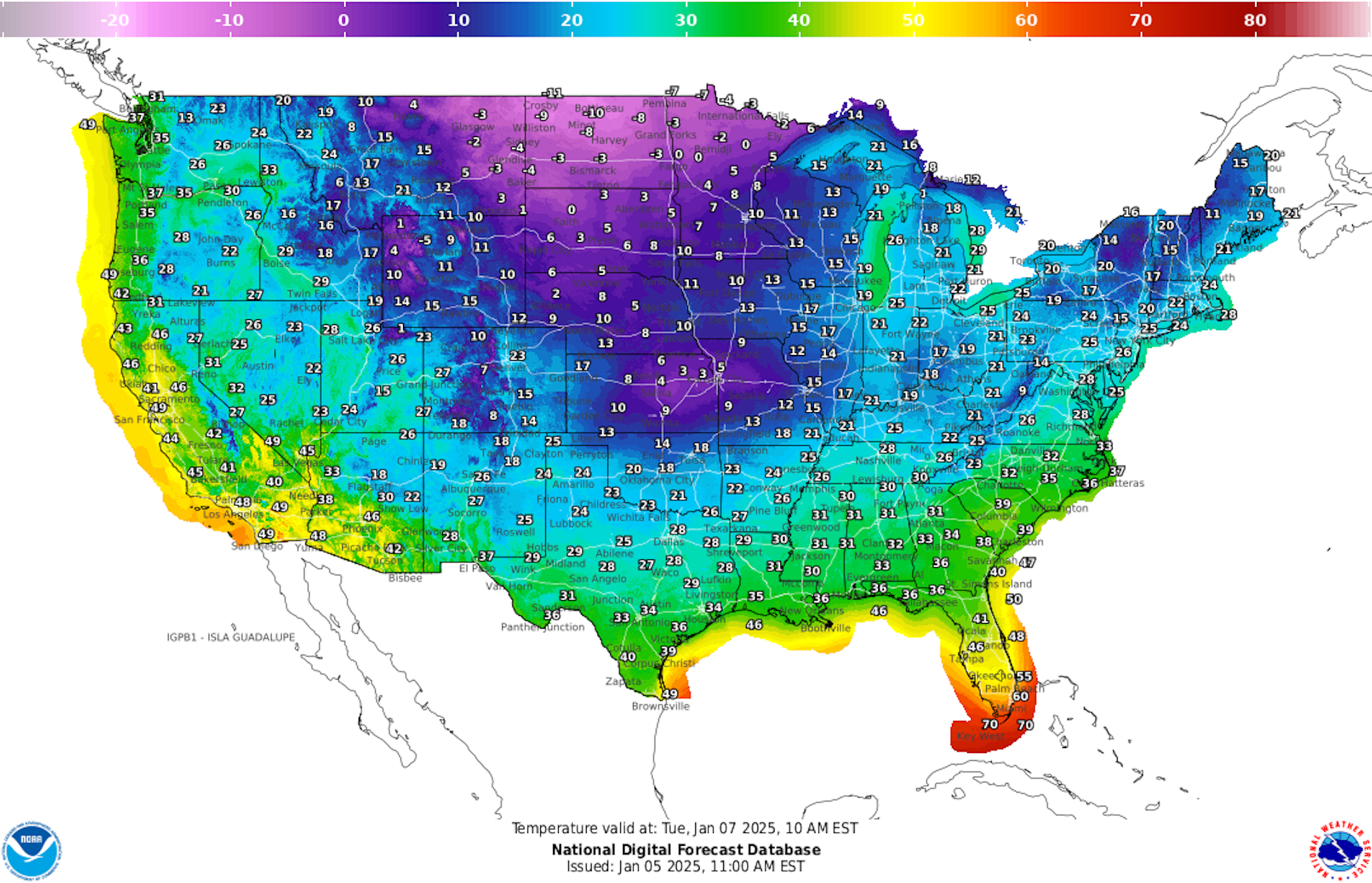
When winter fills the air with cold and bone-chilling gusts, and ice and snow bow down even the sturdiest looking of evergreen branches, it's easy to think that the weather is so much colder than normal. But is it? Using what's "normal" compared to what isn't normal can be confusing. "While temperature forecasts are important to help people stay safe, the comparison to normal can be quit misleading," writes Richard B. Rood for The Conversation. "That’s because what qualifies as normal in forecasts has been changing rapidly over the years as the planet warms."

Who determines what normal temperatures are? "One of the most used standards for defining a science-based normal is a 30-year average of temperature and precipitation," Rood explains. "Every 10 years, the National Center for Environmental Information updates these normals, most recently in 2021."

Over the past century, the planet's temperatures have increased. Rood writes, "Because global temperatures are warming, what’s considered normal is warming, too. So, when a 2025 cold snap is reported as the difference between the actual temperature and normal, it will appear to be colder and more extreme than if it were compared to an earlier 30-year average."

How U.S. temperatures considered normal have changed over the decades. Each 30-year period is compared to the 20th-century average. (NOAA Climate.gov graphic via The Conversation)
To get a better picture of our warming planet, "NASA scientists use 1951-1980 as a baseline," Rood explains, "The reason becomes evident when you compare maps. For example, January 1994 was brutally cold east of the Rocky Mountains. If we compare those 1994 temperatures to today’s normal – the 1991-2020 period – the U.S. looks a lot like maps of early January 2025’s temperatures: Large parts of the Midwest and eastern U.S. were more than 7 degrees Fahrenheit below normal, and some areas were much colder. . . . But if we compare January 1994 to the 1951-1980 baseline instead, that cold spot in the eastern U.S. isn’t quite as large or extreme."

Despite global warming, cold air outbreaks will continue, "but as the Arctic and the rest of the planet warm, the most frigid temperatures of the past will become less common," Rood adds.

Friday, November 08, 2024

Forty-eight states face moderate drought, which affects groundwater supplies, agriculture and river transportation

Drought caused this sunflower crop to fail.
(Adobe Stock photo)
This summer's scorching heat may be over, but across the United States a lack of soil-absorbed rainfall has left most states facing drought conditions. "More than 150 million people in the country – and 149.8 million in the 48 contiguous states – are in a drought this week. That is about a 34% increase since last week and an over 150% increase since last month," reports Marina Dunbar of The Guardian. Drought is present in every state except Alaska and Kentucky, in fact, this is the greatest number of states in drought in U.S. Drought Monitor history.

Drought conditions aren't just about lack of rainfall, they "are driven and exacerbated by abnormally high temperatures that can quickly suck moisture from the atmosphere and the earth," Dunbar explains. "Droughts can occur even when there is slightly more rain than usual, depending on the frequency of rainfall. If there is a lot of rain all at once, it’s difficult for the water to be properly absorbed into the ground."

National Integrated Drought Information System data

When droughts occur, groundwater supplies get tapped, which can take weeks, months or centuries to replenish. "According to the National Integrated Drought Information System, droughts will increase an area’s reliance on groundwater. Groundwater provides more than 40% of the water used for U.S. agriculture and domestic water supplies. Increased pumping during droughts can reduce the future availability of those supplies."

Meanwhile, dry conditions have a domino effect on water sources, agriculture production and commodities trading. "Low water levels on rivers and other waterways [can cause] ports and other water-borne transportation to become limited due to a reduction in available routes and cargo-carrying capacity, which increases transportation costs. . . That cost increase is ultimately transferred to consumers, who see it in the form of higher-priced products, groceries and other commodities."

Friday, November 01, 2024

Will this winter be as mild as last winter? Experts give national 2024-2025 outlook predictions.

The 2024-2025 winter outlook map shows the greatest chances for cooler conditions
in the Pacific Northwest. (NOAA map via Dovers)

In most parts of the country, last year's winter was mild. So mild, in fact, Wisconsin snowmobile enthusiasts dubbed it the "lost winter" because there was so little snowfall, reports Cheyenne Kramer of Drovers. "But according to Eric Snodgrass, senior science fellow at Nutrien Ag Solutions, the consensus is that the months ahead are going to look a lot different."

Snodgrass believes that "this winter brings about a 75% chance for La Niña to develop, which is when the trade winds across the equatorial Pacific are strong. With La Niña in the forecast, the National Oceanic and Atmospheric Administration is predicting wet conditions in the north and dry, warm weather in the south," Kramer adds. "Department of Agriculture meteorologist Brad Rippey says La Niña can also bring chances for extreme cold events."

One of the gains agribusiness advocates hope to see this winter is enough moisture to balance regional droughts. Snodgrass told Kramer, "The best winters for agriculture are the ones we hate and remember as being terrible — we get good, hard freezes and plenty of moisture comes in. If we don’t see that, we get into a situation where we become very dependent on spring rains and may have a conversation about 2025 drought risk.”

The 2024-2025 winter outlook map for precipitation shows wetter-than-average conditions
likely across the Great Lakes region (NOAA map via Drovers)

The increase in droughts across southern U.S. tiers is worrisome, and this winter may not improve that problem. Northern areas are predicted to receive more moisture. Rippey told Kramer, "While much of the north will have the opportunity for relief from this growing drought. . . . We are expecting a generally warmer- and drier-than-normal winter across the entire southern tier of the United States. . . . That does include important winter wheat production areas in the southern Great Plains. There’s not much reserve right now in terms of soil moisture."

If rain and snowfall are to help drought regions, timing is everything. Rippey told Kramer, "It’s important to start getting moisture before it gets too cold. When you go into a cool season like this with limited soil moisture, if the cold air comes in too quickly, you freeze the soils before you get moisture, which can limit the absorption of rain and snow into those soils." Kramer adds, "the timing of when La Niña really starts to take effect will be important as well."