Showing posts with label mass shootings. Show all posts

Tuesday, July 02, 2024

Opinion: Indictments aren't enough to account for law enforcement's 'epic' failures at Uvalde school shooting

Teachers and students followed active shooter survival steps.
Law officers did not. (Adobe Stock photo)
On May 24, 2022, Salvador Ramos, 18, entered Robb Elementary School with his AR-15-style rifle and started looking for victims. When shots rang out from his gun, teachers and students implemented their live shooter training. The Uvalde, Texas, police arrived at the scene within five minutes of the first 911 call, but they did not enter the building. In the 77 minutes it took for police to breach classroom 112, 19 children and two teachers were shot dead.

Last week a grand jury indicted former Uvalde Consolidated Independent School District Police Chief Pete Arredondo and former school police officer Adrian Gonzales on criminal charges for failing to protect the victims, but many Uvalde residents feel the indictments fail to hold the larger law enforcement community accountable, writes Neil Sturdevant in his commentary for the Uvalde Leader-News. "Perhaps to some, the 29 felony indictments for child endangerment/abandonment feel like justice served, but we think otherwise. Other officers, especially those in leadership positions who failed to intervene. . . should not walk away without consequences."

Arredondo served as the "de facto on-scene commander," as concluded in the 575-page Department of Justice report released last January. "The veteran officer bore direct responsibility to protect life on the Robb campus," Sturdevant explains. But his mistakes multiplied the victims. He treated the shooter as though he was a "barricaded suspect" instead of an active shooter in a school filled with young pupils. 

Gonzales was the "first on the scene and was able to quickly identify the classroom where the carnage was unfolding. . . and yet he did not approach the classroom," Sturdevant writes. "Gonzales had undergone active shooter training and taught the course earlier that year." But Arredondo and Gonzales weren't the only officers who abandoned students and teachers. Four other officers actively delayed intervention, which allowed more children to be shot or bleed to death while they waited for help.

"We wonder how evidence presented to grand jurors failed to illicit similar indictments for [those other] men," Sturdevant asks. "The same can be said for members of the Uvalde Police Department, elite Texas Rangers and state police who milled in the Robb hallway during the rampage killing. . . . Now two men stand alone as the sole source of blame for one of the most incompetent police responses in U.S. history."

"How does Uvalde district attorney Christina Michell look families in the eye and say this is a good deal? Mountains of evidence outlined a failure of epic proportions," Sturdevant writes. "The children and teachers who were carried, limped or dragged from their classrooms. . .were clearly abandoned by police. Now our criminal justice system has failed to right those grievous wrongs."

Friday, May 24, 2024

Uvalde families have filed a $500 million suit against Texas state police just before anniversary of school shooting

Front page of Uvalde Leader-News special
memorial section for Robb Elementary shooting.

On May 24, 2022, Salvador Ramos, 18, killed 19 students and two teachers at Robb Elementary School in rural Uvalde, Texas. It was the deadliest shooting at a U.S. school since 2012 when 28 were killed in Sandy Hook, Conn., another small community.

Now, the families of 17 of the 19 fourth-grade children who were shot and killed and two who were wounded have "filed a $500 million federal lawsuit against nearly 100 state police officers who were part of the botched law enforcement response," report Acacia Coronado and Jim Vertuno of The Associated Press. "The lawsuit. . . is the latest of several seeking accountability for the law enforcement response. More than 370 federal, state and local officers converged on the scene, but they waited more than 70 minutes before confronting the shooter."

On the day of the attack, once teachers and students realized an active shooter was in their school, they followed active shooter protocols. The state police did not. "The lawsuit notes that state troopers did not follow their active shooter training or confront the shooter," Coronado and Ventuno write. This federal lawsuit is the first "to be filed after a 600-page Justice Department report was released in January that cataloged 'cascading failures' in training, communication, leadership and technology problems that day."

Earlier this week, the families "agreed to a $2 million settlement with the city, under which city leaders promised higher standards and better training for local police," Coronado and Ventuno write. "Families said the settlement was capped at $2 million because they didn't want to bankrupt the city where they still live. . . . The settlement establishes May 24 as an annual day of remembrance, a permanent memorial in the city plaza, and support for mental health services for the families and the greater Uvalde area."

The $500 million federal lawsuit isn't the only active lawsuit brought by families, nor is it the biggest. "A separate lawsuit was filed by different plaintiffs in December 2022 against local and state police, the city, and other schools and law enforcement, seeking at least $27 billion in class-action status for survivors," AP reports. "And at least two other lawsuits have been filed against Georgia-based gun manufacturer Daniel Defense, which made the AR-style rifle used by the gunman."

Tuesday, May 21, 2024

Quick hits: Documentary on Uvalde Leader-News shooting coverage to air; adding solar can benefit farms; wildfire prep

Front page of Uvalde Leader-News special
memorial section for Robb Elementary shooting.
A new documentary, Print It Black, that premieres on ABC News Live and Hulu at 8 p.m., E.T. on Friday, May 24, will examine how Uvalde Leader-News journalists covered the mass shooting at Robb Elementary School in 2022, reports Kory Grow of Rolling Stone magazine. "A trailer for the film shows the stress and devastation the staff felt in the immediate aftermath of the shooting, beginning with reporter Kimberly Mata-Rubio, who lost her daughter, Alexandria, in the massacre." The trailer also presents the "public cries for justice that followed the massacre, which was made worse by a delay on the part of local authorities to act after the shooting began."

Some farmers are welcoming solar energy as a way to save on their electrical bills and maximize land use. "Jerry Howle was skeptical about installing a $300,000 solar panel system on his South Carolina chicken farm. Then he found out he could get it free of charge," report Amrith Ramkumar and Patrick Thomas of The Wall Street Journal. "Solar panels now sit on his two chicken houses, powering giant fans that keep as many as 60,000 birds inside cool. The panels are being paid for entirely by subsidies from the new climate law and will virtually eliminate the farm's $10,000 annual utility bill."

Wildfire season can be unpredictable, but planning and reliable tools can make managing it easier. Wirecutter has gathered a "best of wildfire preparedness" to help those who live in wildfire-prone areas be as ready as possible. "This guide to wildfire preparedness builds on the expertise of its original author, Eve O'Neill, who was forced to evacuate her California home in 2017 during the Tubbs Fire, which killed 22 people," reports Ellen Airhart of Wirecutter. "This list was also informed by interviews and research conducted for our larger guides to the best emergency-preparedness supplies and the best gear for your bug-out bag."

Solar storms knocked some farmers offline during peak
planting time. (Photo by Chris Ensminger, Unsplash)
While active solar storms knocked some farmers offline during the thick of planting season, the problem was not as dramatic as some reported. "Many farmers were forced to press pause and wait until GPS satellites came back online. . . . It seems, however, that like most things discussed online [on] social media channels perhaps made the situation seem a bit more dire than it turned out," reports Matthew J. Grassi of Farm Journal. Curt Covington from AgAmerica told Grassi, "There were some scattered reports of these storms delaying planting over the weekend, particularly in the Midwest, but no major disruptions have been reported by farmers at this time."

Many American families are facing some hard health care realities -- there aren't enough in-home care workers and those that do exist are often outside of their financial reach. As a result, many children are forced to care for aging or injured family members, reports Clare Ansberry of The Wall Street Journal. "There are an estimated 5.4 million children under the age of 18 providing care to parents, grandparents or siblings with chronic medical conditions or functional decline, up from about 1.3 million nearly 20 years ago, according to two reports from the National Alliance for Caregiving and others."

U.S. mining company Energy Fuels opened the mines last
year. (Photo by S. Hermann/F. Richter, Pixabay via MT)

To lessen U.S. dependence on Russian uranium and keep global energy promises, "Three uranium mines have gone into production along the Arizona-Utah border, with more on the way elsewhere in the Mountain West, as market conditions for the mineral needed for nuclear energy improve in response to a global push to reduce the consumption of fossil fuels to slow climate change," reports Wyatt Myskow of Inside Climate News. "The biggest problem the mining industry faces — especially with uranium—is opposition from local communities, tribes and environmentalists. The three mines that just started operations endured years of pushback and litigation."

Friday, April 19, 2024

More than half of American teachers are worried about a school shooting on their campus; parents are worried, too

1 in 4 U.S. teachers experienced a gun-related lockdown
at their school. (Adobe stock photo)
U.S. teachers must deftly manage tasks, lessons and discipline. To get the job done, educators make an average of 1,500 decisions a day. While that description sounds challenging, most teachers have the added worry of facing school gun violence, reports Jennifer Gerson of The 19th, a nonprofit newsroom for social issues.

"The majority of American K-12 public school teachers say they are at least somewhat worried about the possibility of a shooting at their school, according to a new survey conducted by the Pew Research Center," Gerson writes. "Fifty-nine percent told Pew researchers that they were concerned about shootings on their campuses, with 18% saying they were 'very' or 'extremely' worried. Only 7% of teachers polled said they were not worried at all."

More than two decades have passed since the Columbine High School massacre, but those years have not produced an answer to gun threats in schools. Gerson reports, "Last year, roughly 1 in 4 American teachers reported experiencing a gun-related lockdown at their school. Fifteen percent of respondents said they went through one emergency lockdown, with another 8 percent saying that it happened where they teach more than once."

Regardless of party affiliation, most surveyed teachers advocated for student mental health screening as part of the solutions. "A large majority — 69% — said they believed improving mental health screening and treatment for children and adults would be extremely or very effective in preventing school shootings," Gerson explains. "This emphasis was held across party lines, with 73% of Democratic teachers and 66% of Republican teachers saying that investment in mental health resources would be an extremely or very effective prevention tool."

Teachers aren't alone in their safety concerns -- many parents also profess a significant degree of worry. "A Pew Research Center study released last fall found that a third of American parents said they were extremely or very worried about a shooting at their child's school, with an additional 37 percent saying they were somewhat worried," Gerson reports.

Friday, April 12, 2024

New rule closes the 'gun show loophole' and will require more sellers to register as licensed firearms dealers

The new rule will dramatically increase firearm purchase
background checks. (PBS News Hour photo)
To deliver on gun control policy promises, the Biden administration has expanded the number of sellers who must register as federally licensed firearms dealers, reports Glenn Thrush and Erica L. Green of The New York Times. "That means those sellers must run background criminal and mental health checks on potential buyers. . . . [The change] is the broadest expansion of federal background checks and an attempt to regulate the shadow market of weapons sold online, at gun shows and through private sellers that have contributed to gun violence."

Although President Biden was blocked from implementing universal background checks for gun buyers, the administration used the bipartisan gun control law passed in 2022 to "achieve an elusive policy goal that enjoys widespread public support: closing the so-called gun show loophole," Thrush and Green write. "The new regulation, which is likely to face legal challenges, could add as many as 23,000 federal dealers to the 80,000 already regulated by the Bureau of Alcohol, Tobacco, Firearms and Explosives."

In many states, the gun show loophole allowed "unlicensed private sellers to legally sell at gun shows, out of their houses and through online platforms without having to submit to the background check system created to prevent sales to children, criminals, domestic abusers, and people with mental illnesses or drug addictions," the Times reports. "Four in 10 illegal gun cases tracked by the bureau from 2017 to 2021 involved such unregulated sales."

The new rule aims to accomplish two goals. It will "pull legitimate sellers into the regulatory sunlight and, second, to deprive brokers who knowingly traffic in criminal gun sales of a legal shield provided by the vagaries of federal firearms laws," Thrush and Green explain. Previous rules required gun sellers who made their chief income selling guns to join the federal system, but that wording has changed and now includes sellers who "predominantly derive a profit" to register. "Failing to register carries a penalty of up to five years in prison and $250,000 in fines."

Friday, January 05, 2024

UPDATED: NRA's tax returns show declines in revenue, assets, member dues; longtime leader says he's quitting

Illustration by Elizabeth Brockway, Daily Beast via Getty

Despite its reputation as an organization with a powerful political reach, the National Rifle Association has been on a downward spiral sparked by declining revenue, internal fighting and alleged mismanagement. "Over the last several years, the NRA has experienced a public implosion, as the group loses members and revenue amid serious accusations of mismanagement and corruption," reports Roger Sollenberger of The Daily Beast

NRA's popularity and power began to slide more than a decade ago. Sollenberger writes, "The gun rights group's tax filings and political spending over the last 15 years provides some of the clearest evidence of its downfall. . . . Its most recent tax return, filed in November of this year for 2022, reveals dramatic declines along almost every conceivable metric: revenue, assets, member dues, lobbying, and political spending — with conversely sharp increases in legal costs and deficits."

The New York Times also reported that "On the eve of a legal battle in New York, Wayne LaPierre told board members on Friday that he would step down as the longtime chief of the National Rifle Association" effective Jan. 31. The Times reported that LaPierre "has led the organization for more than three decades. But his resignation came as he faced his gravest challenge yet, a corruption trial in Manhattan amid a legal showdown with New York’s attorney general, Letitia James. Jury selection has already begun and opening arguments were scheduled for early next week."

In 2010, the NRA wielded a powerful lobby. But in the wake of extreme gun violence in the U.S., 15 GOP senators "repudiated the NRA, passing the first meaningful gun control package in decades," Sollenberger writes. "That could be a signal of the NRA's demise, but it also could be interpreted as a reaction to the surging gun violence that continues to this day."

Regardless of why and how political favor and donor sentiment have changed, "The NRA today is in a dismal state. On the income side, 2022 was the fourth year in a row that revenue fell, marking its weakest fundraising year since at least 2008," Sollenberger reports. "Membership dues are at all-time lows, according to available public data, and staffing is at the lowest point since those costs began their downward plunge in 2016." 

Despite those numbers, NRA spokesman Billy McLaughlin said in a statement to the Daily Beast that the NRA remains the largest and most effective gun rights organization. 

Wednesday, December 06, 2023

Report: Uvalde teachers and students correctly followed their live-shooter training, but officers weren't prepared

The 21 people who died on May 24, 2022, at Robb Elementary School.
(Courtesy photos, the Families via ABC News, Reuters, AP)

It was May 24, 2022, when Salvador Ramos entered Robb Elementary School in Uvalde, Texas, and began shooting his AR-15-style rifle into classrooms. In the first four minutes, Ramos fired over 100 rounds that echoed throughout the building.

Surviving teachers and students knew they were targets, and instinctively followed their live-shooter training protocols. "They dropped to the floor, crouching under desks and countertops, far from the windows. . . . A few grabbed bloodied phones and dialed 911. . . . And as students across the country have been instructed for years, they remained quiet, impossibly quiet. . . and waited, report Lomi Kriel, Lexi Churchill and Jinitzail Hernández, co-authors from ProPublica and The Texas Tribune. Responding to 911 calls, "Hundreds of law enforcement officers descended on Robb Elementary School. They, too, waited. They waited for someone, anyone, to tell them what to do."

Once in the school, law enforcement waited for more than an hour to act. "They waited for the right keys and specialized equipment to open doors. They waited out of fear that the lack of ballistic shields and flash-bangs would leave them vulnerable against the power of an AR-15-style rifle. Most astonishingly, they waited for the children's cries to confirm that people were still alive inside the classrooms," according to the report. In total, 376 law enforcement officers responded, according to an investigation from the Texas House of Representatives.

After an exhaustive number of investigative interviews, listening, and watching hundreds of hours of video and body camera footage, the reporters from ProPublica, The Texas Tribune, and Frontline came to a conclusion. They write: "The children in Uvalde were prepared, dutifully following what they had learned during active shooter drills, even as their friends and teachers were bleeding to death. Many officers, who had trained at least once during their careers for such a situation, were not."

America has become a country where "mass shootings have become a fact of life, with at least 120 since the 1999 Columbine High School shooting," they write. "Debates often erupt along partisan lines as anguished communities demand change. . . . One thing that seemingly unites all sides is the notion of better training for law enforcement. But, in actuality, few laws exist requiring such instruction. . . . A nationwide analysis by the news organizations shows states require far more training to prepare students and teachers for a mass shooting than they do for the police who are expected to protect them."

Monday, October 30, 2023

Maine gun owner opinion: 'The only people capable of shifting the gun conversation are the people who buy them'

Smith & Wesson rifles civilian versions of the AR-15 for sale
at a gun show. (Photo by Luke Sharrett, The New York Times)
The Second Amendment of the U.S. Constitution gives all Americans "the right to keep and bear arms," but the amendment's scope did not envision the AR-15 or a society that would tolerate hundreds of mass shootings. In his opinion for The Atlantic, Mainer and gun owner Tyler Austin Harper writes about why many American love their guns and asks, "How Much Blood Is Your Fun Worth?"

"During my first semester of teaching while in grad school, I made a habit of showing up to my classroom half an hour early. . . . The second week of classes, coffee in hand, I arrived to find an undergrad crouched in front of a half-open window. He was taking a photo with his phone, and when he saw me, he jumped. . . .When I asked if everything was all right, he said he was making sure the windows opened. 'My mom told me to always check to make sure they work, just in case, you know.' . . . . I must have looked confused because he continued: 'In case some gun nut with an AR-15 tries to shoot up the place. When a new semester starts, my mother makes me send her a photo of the open windows in each of my classrooms.' I tried to come up with something to say and found I could not.

"Last night, as I sat on my couch watching CNN anchors discuss a mass shooting that left 18 dead and 13 injured in Lewiston, Maine — the little city where I teach at Bates College and where I lived until recently — I thought about my terrified students who were sheltering in place. About my colleagues who live in town who could have been at the bar or bowling alley where the violence unfolded. . . . I thought about the hospital workers who were in the middle of the worst night of their life, I thought about all the people waiting for news, or getting news.

"As the night wore on and surreality gave way to cold reality, my grief also slowly gave way to guilt. I felt guilty and complicit. . . . I felt guilty because gun nuts are, whether I like it or not, my people: I grew up in gun country. I spent my teenage years working at a Pennsylvania gun club. I’ve been a gun owner nearly my entire life. . . . I am embarrassed to say that this is what it took — a place I love to become somewhere that a uniquely American tragedy has taken place — for me to fully understand our country’s mass-shooting problem.

"I am filled with nothing so much as rage. Rage at my gun-nut friends from home who will see this tragedy as a reason for less gun control, rather than more of it. . . . Rage at the politicians here and beyond who have refused to solve a problem for which solutions readily exist. Rage at myself for being so blind. . . . But it is only now that gun violence has visited my little corner of the world that I have been forced to confront reality, a truth that has been there all along but that I have refused to admit: I own guns because I like them and because I am an American and I’m allowed to and no one stops me.

"The inescapable fact is that the only people capable of shifting the gun conversation in this country are the people who buy them. . . . Yesterday’s events haven’t made me change my mind about being a gun owner. . . . . The shooting in Lewiston changed my mind about being a quiet gun owner. I have spent years of my life making apologies on behalf of my gun-nut acquaintances. Staying silent when friends bring up the National Rifle Association despite my fierce opposition to that organization. Not pushing back when they call minor reforms such as mandatory waiting periods 'totalitarian.' Changing the subject rather than asking 'Why do you need a military-style rifle?'

Read Harper's full essay here.

Friday, October 27, 2023

Mass shooting survivors face physicial and mental trauma, but perhaps worst of all, their sense of security is 'shattered'

The plaques are part of a memorial to the seven victims in
Highland Park, Illinois. (Photo by Roger Schneider, AP)
Mass shootings have stripped away much of what Americans always felt were public safety zones. Shooting survivors say the loss, fear and trauma never leave them, reports Claire Savage of The Associated Press. "Since 2016, thousands of Americans have been wounded in mass shootings, and tens of thousands by gun violence, with that number continuing to grow, according to the Gun Violence Archive. Beyond the colossal medical bills and the weight of trauma and grief, mass shooting survivors and family members contend with scores of other changes that upend their lives."

In speaking with individuals and families, Savage explores the aftermath of mass shootings. She writes, "Survivors talked about the mental and physical wounds that endure in the aftermath of shootings in Uvalde; Las Vegas; Colorado Springs, Colorado; and the Chicago suburb of Highland Park, Illinois, during a July Fourth parade last year."

The Zamora family, whose 11-year-old daughter Maya was airlifted out of Uvalde, Texas, after being critically injured in the Robb Elementary school shooting, shared a glimpse of how much the shooting changed their lives forever. Savage reports, "Mayah suffered wounds to her chest, back, both hands, face and ear, and needed so many surgeries her parents said they stopped counting. The family relocated to San Antonio, where Mayah spent 66 days in the hospital and still needs care. A year later, Christina and Mayah's father, Ruben, said they didn't know what bills would be covered by insurance. When Mayah was discharged, they realized one parent needed to stay home to care for her." Mayah's mother, Christina, told Savage: "Her hospital bill is insane. It reaches close to $1,000,000, maybe over." 

Leah Sundheim, 29, was a night manager at a hotel in Las Vegas when "she got 'the worst phone call you can ever receive," Savage writes."Her mother, Jacquelyn Sundheim, had been killed at a shooting during Highland Park's 2022 Fourth of July parade, along with six other people. . . . Mass shootings cause a variety of trauma, she said. Her experience is different from that of her aunt and cousins, who were sitting next to Jacquelyn Sundheim when she died." Sundheim told Savage: "That flight home broke me. . . . [trauma] shatters the sense of security that you have in the world."

From Las Vegas to Highland Park, shooting survivors impart unique losses and a common fear that nowhere is safe. "So far in 2023, nearly 400 people in the U.S. have been wounded in mass shootings, according to the Gun Violence Archive," Savage reports. "And 140 people have died in mass killings this year, which is on track to surpass 2019, the deadliest year on record for mass killings since 2006," according to a database maintained by The Associated Press and USA Today in a partnership with Northeastern University.

Tuesday, August 01, 2023

Uvalde Leader-News Publisher Craig Garnett wins Gish Award for courage, integrity and tenacity in rural journalism

Uvalde Leader-News Publisher Craig Garnett (OPA photo)
Craig Garnett, publisher of the Uvalde Leader-News in southwest Texas, is the winner of the 2023 Tom and Pat Gish Award presented by the Institute for Rural Journalism and Community Issues at the University of Kentucky.

Garnett owns the twice-weekly newspaper that continues to cover, and contend with, the aftermath of the May 2022 school shooting in which 19 children and two teachers died.

“The award recognizes not only Craig’s courageous coverage and commentary about the tragedy, but his longtime willingness to tell hard truths about things that matter in Uvalde County,” said Al Cross, director of the Institute and extension professor of journalism.

Tom and Pat Gish
The award is named for the couple who published The Mountain Eagle in Whitesburg, Kentucky, for more than 50 years. Their son and successor, Ben Gish, is on the award selection committee. He said of Garnett and the Leader-News, “It’s one thing to read national news accounts about law enforcement not moving quickly enough to save the lives of many of the victims, but it’s entirely something else to read the local newspaper’s far deeper accounts of that continuing controversy. . . . The Leader-News does not hesitate when it comes to letting family members of the victims have their say, nor does it shy away from printing the responses of those whose actions, or lack thereof, are being questioned.”

In a column shortly after the shooting, Garnett wrote that a regional police official "could not answer why it took an hour to end the attack" and quoted him: "It is a complex situation. They are measuring; they are measuring." He wrote, "The question is how much measuring is permissible, while children are being murdered. Or perhaps they were already gone. It pains to write these words of criticism about law enforcement, but parents and the community have the right to know. They must be told why police, whom parents at the scene begged to go in and save their children, failed to act. They have to know, to ever begin to heal."

He concluded, "There is a final question that no one will ever adequately answer. It came on Thursday in the form of a text message from our reporter, Kimberly Rubio, whose fourth-grader Lexi did not come home that day: 'Why would someone hurt my baby, Craig?'"

Rubio, now in the newspaper’s advertising department, praised Garnett for the paper’s family atmosphere and encouraging environment: “He is gifted in seeing a person’s potential. He is a teacher, able to guide us as we harness that potential. He believes in us, and we learn to believe in ourselves. I have the same faith in him and his writing staff.”

Garnett spent hours “sitting with families who lost children, siblings, friends; interviewing survivors, teachers and students, about their experience,” Leader-News Managing Editor Meghann Garcia said in nominating him. She said he has made a “dogged pursuit to learn how so many things went wrong that day, how every single fail-safe failed. . . . He has done all of this without a break from the office, from the work.”

In an editorial a month after the shooting, Garnett named names and was blunt: “No mass school shooting in the United States has ended with such glaring failures in both the law enforcement response and school district security. . . . Neither [school] Police Chief Pete Arredondo, acting city chief Mariano Pargas, Uvalde County Sheriff Ruben Nolasco nor any state or federal officer among the 376 responders to the scene was willing to take the helm of what was clearly a rudderless ship cast into a hurricane.”

A week later, another Garnett piece endorsing more gun control concluded: “I am not about to surrender my guns, and they are many, but I challenge you to give me one good reason (and please not the “slippery slope” argument that did not come to pass when assault weapons were banned) why a teenager should have the firepower to stand down 376 lawmen. If disturbed young men are going to commit horrific crimes with firearms, why not take the most devastating amplifier out of the mass shooting equation?”
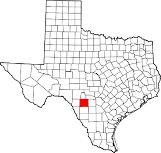
Uvalde County (Wikipedia map)
Criticism of local law enforcement and support for more gun control didn’t sit well with some people in the town of 15,000 and county of 25,000. Garnett said at a meeting of the newspaper association in Oklahoma, his native state, that by the end of the day of the shooting, “The school and police agencies that the newspaper had a good relationship with all clammed up. A year later we still can’t get answers. We have filed about 10 to 15 requests with the school district and still can’t get any answers.”

Garcia began her nomination of Garnett with the story of a call from a reader who objected to a picture of “a local pediatrician, outspoken in the shooting aftermath, at the White House, in a commanding photo with President Joe Biden and Vice President Kamala Harris.” The caller said Garnett had “better not acknowledge Biden's presidency again if he wanted to keep the caller's subscription,” Garcia wrote. “The call was mild compared to what the newspaper staff had fielded over previous weeks . . . . Craig immediately turned to his typewriter to work on a subscription refund check and your-wish-is-now-granted letter.”

Garcia continued, “It wasn't the first time our coverage, or Craig's politics, went against the grain.” Garnett had editorialized against the Iraq War, and opposed “a water pipeline that would take local water, dearly needed for agriculture, a mainstay of the area economy, and funnel it to San Antonio,” she wrote. And four years before the shooting, he opposed the idea of a separate school police force, which botched the response to the shooting. The next year, the paper a guest-written series of stories about the local Ku Klux Klan chapter of 100 years before.

“Craig has never been afraid of taking a stand or telling the news, despite how unpopular it might be with subscribers and advertisers, who are also often his friends,” Garcia wrote. And he has used his own family’s troubling experience as an example to give hope to others.

His wife, Melissa Garnett, told the Gish Award selection committee, “One of his best columns was about our son’s process of recovery from drugs and alcohol. That took courage. He must have hit all the right notes, as the response was great – he had taken the bold step of using his pain of an addicted child to remove the stigma of talking about addiction.”

The column celebrated their son’s year-plus of sobriety and concluded, “Far too many addicts today, especially those in thrall to opioids, don’t get Logan’s chance at recovery. The steps that will lead them from a world of pain and failure remain stubbornly distant and daily receding until hope is lost. We should do all we can to help them discover a path because inside every addict lives someone’s treasured child, father, husband, brother or friend.”

Garnett “and his paper have been a continuing source of strength in that community and beyond,” said selection committee member Bill Bishop, founding editor of The Daily Yonder, a national rural-news publication and a former weekly editor in Bastrop, Texas, and columnist for the Austin American-Statesman.

Garnett, who earned an economics degree from Southern Methodist University, joined the Fort Worth Star-Telegram in 1977, moved to the Kansas City Star in 1978, became general manager of the Leader-News in 1982 and owner and publisher in 1989. Under his ownership, the newspaper has won many awards.

“I am extremely honored to receive the Gish Award,” Garnett said. “And I am deeply humbled by the support from coworkers and friends in the industry who thought my work worthy of such recognition.”

The Institute for Rural Journalism (publisher of The Rural Blog) will present the Gish Award to Craig Garnett in Texas, at a time and place to be determined. UPDATE, Dec. 17: The award will be presented Feb. 29 at the University of Texas during a symposium, "Courage, Tenacity, Integrity and Innovation in Rural Journalism," sponsored by the Institute, the Texas Center for Community Journalism at Tarleton State University and The Center for Ethical Leadership in Media in the UT School of Journalism and Media.

Garnett will be recognized Oct. 26 in Lexington, Ky., at the Institute’s annual Al Smith Awards Dinner, with USA Today Washington Bureau Chief Susan Page as the keynote speaker. At that event, Ben Gish and Mountain Eagle reporter Sam Adams will receive the Al Smith Award for public service through community journalism by Kentuckians.

Tuesday, July 11, 2023

Uvalde weekly's editor-publisher wins Texas Press Assn. award for community leadership, the latest in a long line

Craig Garnett (Oklahoma Press Association photo)
Craig Garnett, editor and publisher of the Uvalde Leader-News, received the Texas Press Association's Frank W. Mayborn Award for Community Leadership at the group's recent convention. He was cited for the twice-weekly's coverage of the school shooting that left 19 students and two teachers dead, and its aftermath, the Texas Press Messenger reports. Incoming TPA President Ken Esten Cooke writes, "The entire staff . . . showed bravery and tenacity through a horrible community tragedy."

"On May 24, 2022, we got an assignment we never expected and we never wanted," Garnett told his colleagues. He told college students in an Dow Jones News Fund editing program at the University of Texas, "If we hadn't been a family, we wouldn't have survived the past year."

Garnett earned an economics degree from Southern Methodist University in 1975, joined the Fort Worth Star-Telegram in 1977 and moved to the Kansas City Star in 1978. He became general manager of the Leader-News in 1982 and owner and publisher in 1989.

"Garnett and the newspaper have won countless regional and state press awards," the Messenger reports. "The Leader-News took home sweepstakes honors in the 2022 Texas Better Newspaper Contest." Its latest award was for Best Editorial in the National Newspaper Association contest.

Saturday, June 24, 2023

Uvalde editor-publisher recalls how shooting sealed relationships inside weekly, broke them with schools, police

Uvalde Leader-News Editor-Publisher Craig Garnett speaks to the Oklahoma Press Association.

Last year's shooting of 19 students at Robb Elementary School in Uvande, Texas, tested the relationships that the twice-weekly Uvalde Leader-News had in its newsroom and local authorities. It strengthened the first and broke the second, Editor-Publisher Craig Garnett said at the state press association convention in Oklahoma, his native state, this month.

“Our reporter, Kimberly Rubio, was at her desk that morning in the newsroom. She had two children at Robb, and she began to get a little nervous,” Garnett recalled. Then Rubio learned that her 10-year-old daughter had been killed, Rod Serfoss reports for Oklahoma Publisher.

“Our newsroom consists of four people – three of them women – and Kimberly Rubio had been with us for 10 years,” Garnett said. “She brought her Lexy, who was killed, to our office when she was five days old. The relationship in our newsroom is extremely close. All three women were shaken to the core. They cried for the first two weeks in between writing – and I don’t know how they did it. They would go, then have a bad spell, and then gather themselves and return to their computer – because that is just what you do.”

By the end of May 24, 2022, the day of the shooting, “The school and police agencies that the newspaper had a good relationship with all clammed up,” Garnett said. “A year later we still can’t get answers. We have filed about 10 to 15 requests with the school district and still can’t get any answers. The shooter needed help from the school and didn’t get it. They just expelled him. The school district failed this young man. We now have a completely antagonistic relationship with the school district. They won’t answer our phone calls, and only respond to half of our text messages. They feel like we are out to get them – and we are. They didn’t do their job.”

But Garnett added, “We failed as a newspaper by not looking more closely at the school district. It was easier for them to get rid of kids than to help them.”

Asked how to cover such an event, Garnett replied, “I don’t know.”

Tuesday, June 20, 2023

Gun-violence prevention should include gun education and understanding gun ownership, a rural Westerner writes

Illustration by Zoe van Dijk, The Washington Post
In the broad swaths of the landscape that constitute rural America, there are many reasons for gun ownership. Education writer Maddy Butcher of Montezuma County, in the southwest corner of Colorado, shares her thoughts in "What city dwellers don't get about gun ownership in the rural West," a piece for The Washington Post. She focuses on a visit to the area by Jonathan McMillan, director of Colorado's new Office of Gun Violence Prevention:

"We had gathered for McMillan's recent 'listening tour' stop in Cortez, held at the county annex building just off Main Street. Over dinner, served from foil catering trays onto paper plates, many of the more than 100 attendees told McMillan and his team about their concerns, mostly centered on the potential disruption of what until recently has been gun-toting normality in the rural West. . . . Folks here have a lot of thoughts on gun-violence prevention, beliefs that likely do not align with those living in cities and suburbs. . . . One value did bubble up that I think anyone could embrace: the need for education.

"The message from rural dwellers with many reasons for gun ownership was clear: Don't shun guns. Get to know them. Teach your kids about using them safely. . . . Thanks to my parents, I learned how to handle guns when I was young. . . . As rural areas absorb more people from the cities, conversations around responsible gun ownership and classes for safe gun handling are more essential, not less. Guns are ubiquitous here. For shooting prairie dogs and rattlesnakes. For hunting deer and elk. For putting down a suffering animal. For deterring predators. For fun. . . . Even if folks here raise their children in gun-free homes, with a shun-gun approach, the kids will likely still come across one at a friend's house or during a gravel-road hangout after a team practice or in a pickup truck or back pasture. . . . According to the gun-violence-prevention organization Everytown, there have been at least 136 unintentional shootings by children, resulting in 55 deaths. Would your child be able to handle a gun safely?

"During McMillan's stop, a gray-haired woman told him that her grandson called her 'evil' for owning guns. She implored McMillan to bring hunter education back to schools and to 'teach our kids not to hate guns.' . . . I wish more urbanites and suburbanites could hear these passionate appeals to be understood from a part of the country where guns may be plentiful but mass shootings are not. . . . It's true that in rural Western states, where scant resources and social stigma around mental health are chronic problems, suicide by firearm is too common. But high rural homicide rates occur predominantly in the Southeast. . . .

"McMillan prefaced the meeting by saying, 'There is no one-size, quick or simple solution' to gun violence. . . . This is especially true for women like me, moms who want nothing to do with 'patriots' or preppers. Be careful about gun-owner stereotyping: We may recycle, wear Patagonia puffies and feel strongly about our preferred shotguns and rifles. We see that the tendency today is for virulent, if-you're-not-with-us-you're-against-us side-taking. But why?"

Sunday, June 18, 2023

North Country Public Radio wins 3 Sigma Delta Chi awards; coverage of wildfires, prisons, Uvalde shooting also win

A disabled mother and daughter in northern New York lived
in this tent and in their car. (North Country Public Radio)
Several of the Sigma Delta Chi Awards for excellence in journalism, announced Saturday night by the Society of Professional Journalists, had rural resonance.

The rural media standout was North Country Public Radio, based in Canton, the seat of St. Lawrence County, New York. Its report on affordable housing, or the lack of it, won the award for public service in radio, and its report on uninspected housing for dairy workers won the award for small-market radio feature reporting. NCPR also won the contest's new award for regional political reporting with its profile of U.S. Rep. Elise Stefanik, chair of the House Republican Conference, whose district coves most of NCPR's coverage area, where it has 33 transmitters.

A prison in rural Illinois was the topic of "How the newest federal prison became one of the deadliest," a two-part story by NPR and The Marshall Project, which advocates criminal-justice reform. The package won the award for radio investigative reporting. The Intercept's five-part report on the effect of global warming and climate change on prisons and inmates won the award for science, environment or climate reporting.

Coverage of two major wildfires won awards. CBS's "60 Minutes" won the award for television investgative reporting for “What Happened at Grizzly Flats,” a California town destroyed by a mismanaged forest ifre; and KUSA-TV of Denver won the award for TV documentaries in large markets for “The story behind the Marshall Fire” near Boulder. 

Also in broadcasting, Virginia Public Media won the award for small-market television feature reporting for its story on black descendants of Thomas Jefferson; Scripps News and the Center for Investigative Reporting won the award for narrative podcast or radio documentary for their six-part "Inside the global fight for white power;" and NPR won the radio feature reporting award for interviews with the mother of one of the victims of the 2012 Sandy Hook, Conn., school shooting.

Journalism about the mass shooting at Robb Elementary School in Uvalde, Texas, last spring, received two SDX awards. KPRC-TV in Houston won for deadline reporting, and the San Antonio Express-News won the large-market editorial award for its "Standing with Uvalde" series. David Plazas of The Tennessean won the smaller-market award for a collection of editorials. Jake May of the Flint Journal was a double winner for feature photo and small-circulation breaking-news photo.

Other awards of general interest included:
Fact checking: Glenn Kessler of The Washington Post for "The truth about Hunter Biden."
Washington correspondence: Nick Grube of Honolulu Civil Beat, for coverage of Hawaii's congressional delegation.
Editorial cartooning: Michael Ramirez, Las Vegas Review-Journal (small markets), and Gary Markstein, Creators Syndicate.
Magazine writing: Lizzie Presser of ProPublica and The New York Times Magazine for "I was never ready for this," a profile of a teenager from Copperas Cove, Texas, who became the mother of twins after a judge refused to let her get an abortion.
General column writing: Melinda Henneberger of The Sacramento Bee, for five columns.

Tuesday, May 23, 2023

School shootings have risen dramatically since 2017; they may make students think about survival instead of studies

Includes any incident when a gun is "brandished, is fired, or a bullet hits school property for any reason."
Graph by Tory Lysik of AxiosVisuals, based on data from Center for Homeland Defense and Security

Wednesday, May 24, is the one-year anniversary of the killing of 19 children at an elementary school in Uvalde, Texas. It brings to mind this imagined teacher-and-student question and answer:
Teacher: What would you like to be when you grow up?
Student: If I get shot at school, I won't be anything.

That may sound overly dramatic, but statistics can suggest otherwise. "More than 1,000 incidents involving firearms have shaken America's schools since 2018 — a dramatic increase over any similar period since at least 1970, according to the K-12 School Shooting Database," reports Erin Doherty of Axios. "Guns are the leading cause of death for U.S. children and teens and firearms accounted for nearly 19% of childhood deaths in 2021, according to the Centers for Disease Control. . . . Gun-related incidents such as gun suicides and gun murders, reached record levels in 2021 and 'swatting" calls,' or fake reports of shootings or bombs that prompt SWAT team responses and lockdowns, are rising." Sarah Burd-Sharps, the senior director of research at Everytown, told Doherty, "The threat of gun violence has become a constant in children's lives in this country, and we're seeing the impact of it."

While an in-school shooting does not scar every pupil, most students are engaged in training to deal with one, which can interfere with student concentration and a sense of safety. "Nearly all (98%) K-12 public schools reported drilling students on lockdown procedures as of the 2019-2020 school year, according to the National Center for Education Statistics," Doherty writes. "Ninety-six percent of schools reported having written procedures for an active shooter incident. . . . Research suggests safety measures can effectively prevent gun-related incidents, but they risk disrupting the norms of the school day and have become controversial among some parents and activists." Burds-Sharps pointed out to Doherty, "At nine o'clock [students] have to hide in the bathroom for long periods and be silent and then at 10 o'clock, they need to learn math. . . . It's not a recipe for America's schoolchildren to learn and to achieve in school and to be able to focus and to concentrate."

Gun deaths remain racially divided. "Black children and teens disproportionately bore the burden of gun violence and were about five times as likely as white kids to die from gunfire in 2021, according to a Pew Research Center analysis of CDC data," Doherty reports. "While guns became the leading cause of death for all American children in 2020, they have been the leading cause of death for Black children for over a decade. Dr. Katie Donnelly, a pediatric emergency medicine physician, told Doherty that she interacts "with a lot of kids who really aren't thinking about what they want to be when they grow up because they don't expect that they're going to grow up."

Friday, May 19, 2023

ABC News spent a year in Uvalde, Texas, after the school shooting; its report is on the air tonight and Hulu tomorrow

Nicco Quiñones of ABC News films inside the home of Jerry and Veronica Mata. Their daughter Tess, pictured on the wall, was one of 19 students shot and killed in Uvalde, Texas, last May. (Photo by Jenny Wagnon Courts/ABC News via AP)
By David Bauder
Associated Press

After most mass shootings that capture the public’s attention, national news organizations will send reporters for a few days, a week maybe, before moving on. There’s always another community, another tragedy.

ABC News tried something different after 19 elementary school students and two teachers were shot and killed in Uvalde, Texas, last May. The journalists stayed.

For a year, ABC kept a team in Uvalde. The result is a nuanced portrait of what happens over time to a suffering community, as seen in the two-hour documentary, “It Happened Here — A Year in Uvalde,” that airs Friday on ABC and Saturday on Hulu.

“What we discovered has been profoundly moving and inspiring and, we hope, useful,” said ABC News President Kim Godwin.

The story’s richness is in the details: There are the children’s rooms left undisturbed since May 24, 2022, the brush a parent can’t give up because it contains a dead girl’s hair, the survivor made upset by the sound of a block of ice being cracked, and the once-carefree boy who worries a lot. And we see a father who sits at his daughter’s grave each night to talk to her.

There are those who lived but deal every day with survivor’s guilt, and there’s the mother who torments herself for not letting her daughter come home with her after a morning awards assembly.

Uvalde County (Wikipedia map)
ABC’s idea was born out of a desire to bring something new to stories that have taken on a numbing familiarity. “I don’t think that any community should be defined by a tragedy that befalls it,” said Cindy Galli, executive producer of ABC’s investigative unit.

A core team of about a dozen people were assigned to the project, a significant commitment at a time when ABC News, like many other news organizations, is cutting staff. The team, with reporters John Quiñones, Maria Elena Salinas and Mireya Villarreal, rotated in and out depending on other assignments.

The project enabled the journalists to get to know community members and build trust by talking to them without cameras running all the time, she said.

“One of the aspects of being in a small community is that we would run into people at Starbucks or the grocery store,” Galli said. “They knew that we were there and knew that we were there for the long haul.”

That was important to families dealing with their grief, said Kimberly Rubio, whose daughter Lexi was killed in the attack. Rubio was featured in a segment early in the film, talking about how she uses time spent jogging to reflect upon what happened to her daughter.

“It also helped that it wasn’t different reporters all the time,” Rubio said. “I had two that I worked with. It made it much easier for me to be vulnerable.”

The ABC team filed more than 200 stories during its time in Uvalde, Galli said. Their presence enabled them to break news, such as when Quinones got the first interview with a woman falsely accused of leaving a door open at the school that the killer used for access.

Questions about why it took police more than an hour to enter the affected classrooms kept Uvalde in headlines longer than most mass shootings. ABC’s access deepened the documentary’s narrative retelling of the story, with recordings of a chilling 911 call from a trapped girl pleading for a police response to the gunman.

“I had a pencil,” said Arnie Reyes, a teacher injured that day whose recovery is followed by ABC. “It’s not the same battle.”

The documentary talks about tensions in Uvalde between affected parents and people who supported school administrators and police. That aspect of the story points out a hole in the ABC team’s reporting, although it’s not necessarily their fault: The network had trouble getting people in law enforcement and their supporters to talk.

Lexi’s dad, Felix Rubio, eventually resigned his job as a deputy police officer, explaining that he couldn’t go back to work with people who didn’t rush into the school to try and save the children.

The film also traces the growing activism of Kimberly Rubio and 10-year-old Caitlyne Gonzales in seeking legislation to prevent future school shootings.

John Quiñones (ABC News photo)
“There are vital details, nuances that are missed, when we as reporters parachute in and out” of a story, Quinones said.

The extended assignment meshed with how Quiñones likes to report such stories. He doesn’t see the point of reporters trying to force themselves on people when they don’t want to talk. There were times when he had to step away, like when a family he’d been talking to learned that their child might have survived if police had moved more quickly.

The entire experience was eye-opening for the network, Galli said. Following the Uvalde team’s lead, an ABC digital team is spending time in Buffalo, where 10 people were killed in a mass shooting, also in May 2022.

Quiñones, a Mexican American who grew up in nearby San Antonio, said the extended Uvalde assignment has been the most powerful story he’s ever been involved in.

“There’s no doubt in my mind that this is the kind of story that will live with me forever,” he said.

Thursday, April 06, 2023

Why an AR-15 is so lethal: bullets fired at very high speed

Screenshot of Post 3-D animation of AR-15 bullet impact*
What does the average American know about the AR-15? It's powerful? Controversial? It's both, but why? It's about the automatic rifle's bullets and their speed.

"The AR-15 fires bullets at such a high velocity — often in a barrage of 30 or even 100 in rapid succession — that it can eviscerate multiple people in seconds. A single bullet lands with a shock wave intense enough to blow apart a skull and demolish vital organs," report N. Kirkpatrick, Atthar Mirza, and Manuel Canales of The Washington Post. "The carnage is rarely visible to the public. Crime scene photos are considered too gruesome to publish and often kept confidential. . . . Medical examiners who, in some cases, have said remains were so unrecognizable that they could be identified only through DNA samples."

Joseph Sakran, a gunshot survivor and a trauma surgeon at Johns Hopkins Hospital, told the Post, "It literally can pulverize bones, it can shatter your liver and it can provide this blast effect." The Post explains, "The bullets from an AR-15 are uniquely lethal. . . . Consider a .223-caliber-sized round inside an AR-15. What makes the weapon so deadly is the speed of that bullet. It is small and light. Its cartridge holds enough propellant to send the bullet flying out of the barrel at a speed that would cross six football fields in a second."

Handgun rounds are heavier and slower. "Any bullet can kill, and instantly, when it hits a vital organ," the Post reports. "The higher speed of a bullet from an AR-15 causes far more damage after it hits the body and drastically reduces a person's chances of survival." Trauma surgeon Babak Sarani, an authority on casualties from mass killings, told the Post, "As that bullet slows down, that energy is so massive it has to go someplace, and your body will literally tear apart."

"In a hypothetical scenario, the bullet bursts into the chest cavity. It shreds lung tissue, severs nerves and vessels and causes massive bleeding. It also begins to tumble, taking a chaotic path in the body," the Post writes. "The speed at impact creates a blast effect, like the wake that follows a boat, causing internal injuries far outside the bullet's path."

And finally, "The bullet from the AR-15 leaves behind a gaping exit wound. The 9mm bullet fired from the handgun has a much smaller exit wound," the Post adds. "In this scenario, with immediate medical care and minimal bleeding, the victim has a chance at surviving the 9mm shot to the chest. . . . The bullet from the AR-15, however, causes torrential bleeding that is quickly lethal. . . . It works with brutal efficiency."

*Washington Post editor’s note: We are publishing these 3D animations to show the destructive power of the AR-15. The images may disturb some people.

Tuesday, April 04, 2023

The unending tragedy of Sutherland Springs: Life goes on, but for some shooting victims, wounds and losses remain

David Colbath visits the church where he was shot nine times.
It now serves as a memorial to the dead. (Photo by Lisa Krantz, The Washington Post)

On a quiet Sunday morning in November 2017, the First Baptist of Church of the rural hamlet of Sutherland Springs, Texas, was filled with worshipers. Around 11 a.m., Devin Patrick Kelley entered the church, "Wielding a Ruger AR-556 rifle, fired 450 military-grade bullets inside the church within minutes. . . . Over two dozen parishioners were killed," report Silvia Foster-Frau and Holly Bailey of The Washington Post. "Twenty others were wounded, sentenced to lives of unending pain and illness."

A 25-year-old woman survived the attack but now struggles to live. "Multitudes of purple freckles dot Morgan Workman's legs, arms, chest and cheekbone — tiny shards of metal from bullets and shrapnel that struck her as she worshiped in her church more than five years ago," the Post explains. "The fragments are leaching lead. Workman suffers from toxicity symptoms, including body pains, fatigue, depression — and has been told by doctors that she probably can't have a baby. . . . Workman was shot twice."

Entire families were decimated. "John Holcombe and his now-12-year-old daughter, Evelyn, cling to each other for support. His pregnant wife, Crystal, had shielded Evelyn from the gunman and was killed along with Evelyn's three siblings and grandparents," the Post reports. Rusty Duncan, a paramedic who happened to be driving by and was one of the first responders, described the scene to the Post, "It was like walking into a war zone where everyone was already dead. . . . It looked like a bomb went off in there. . . Just pieces of people everywhere."

"David Colbath was shot nine times in the arm, leg and back. He recalled needing six surgeries in the weeks after the shooting, as doctors decided which bullet fragments to remove and which were buried so deep they were better left inside him," the Post reports. "He takes eight to 12 ibuprofen pills a day, he said, in addition to a handful of Tylenol at night." Colbath told the Post, "I've normalized pain every night. I've normalized pain every day. I'll never be normal again."

Life goes on, but will never be the same. "Five years on, many in the working-class town of 600 — nestled in the dusty-road countryside an hour southeast of San Antonio — still attend services every Sunday. They pray in a new church built next to the old one. The sanctuary, funded by donations from around the country, has fortified walls and security cameras," the Post reports. "Many of the congregants — in addition to those in the church's new security team — carry guns on their hips for protection. . . . Children hobble through the pews with leg braces. Men carry colostomy bags that sometimes leak. Some, like Workman, are marked by sprays of odd-looking freckles. . . . Every Sunday, they chime a bell in the church's tower where 25 portraits of those lost hang high, along with an image of angels to honor Crystal's unborn child."

After the shooting, professionals assessed the combined carnage of a killer's malice and his choice of weapon. "Kelley stormed the church and stalked the aisles, shooting people at point-blank range. He fired 196 times inside the church in 16 separate bursts. . . . The dead ranged from age 1 to 77," the Post reports. "Terry Snyder, a longtime Texas Ranger among the first on the scene, later described seeing victims where bullets had 'disintegrated the skull' — including a toddler's." Snyder told the Post, "Even the survivors, the wounds that I saw … it was unbelievable, just the damage the bullet would cause." 

Update:
The Justice Department has reached a $144.5 million settlement with the surviving family members from the Sutherland Springs massacre, reports Glenn Thrush of The New York Times. The Texas church shooting killed 26 people and "lead to an acrimonious legal battle in which the government claimed it was not liable for its failure to update the national firearms background check system. . . . Attorney General Merrick B. Garland has signed off on the deal, which lawyers in the Justice Department’s civil division negotiated with lawyers representing the families of victims and survivors. . . . The settlement is among the largest of its kind, exceeding previous ones the department reached over mass shootings that stemmed from the government’s failure to take steps to prevent mass shootings by sharing intelligence and other information that might have been used to stop them."

Thursday, November 17, 2022

Cop in charge at Uvalde quits after CNN reveals he knew 8 or 9 kids needed saving, and after re-election to county post

Top half of the twice-weekly's latest front page; click on it to enlarge
The acting police chief during the elementary-school massacre in Uvalde, Texas, "will no longer serve on the force, following release of a phone call showing he knew that 'eight to nine' victims were still alive inside two interconnected classrooms" at Robb Elementary School, Publisher Craig Garnett reports for the Uvalde Leader-News. Mayor Don McLaughlin told Garnett that Lt. Mariano Pargas "will be gone by this week, whether he chooses to retire or he's fired."

“If we’d had those videos that he (CNN reporter Shimon Prokupecz) showed on Pargas, then we would have done something two months ago,” McLaughin told Garnett. The Associated Press reports that Pargas left the agency "voluntarily but it was not immediately clear whether he retired or resigned, according to city spokeswoman Gina Eisenberg."

Pargas is a member of the Uvalde County Commissioner's Court but was absent Wednesday when "six community members called for Pargas to resign the post he was re-elected to on Nov. 8," Julye Keeble reports for the Leader-News. Two people who lost relatives in the May 24 shootings "expressed disappointment that Pargas did not attend the meeting and called on him to resign," Keeble reports. "Diana Olvedo-Karau, one of three write-in candidates against Pargas in the general election, which he won with slightly over 45 percent of the fewer than 1,300 votes cast, said she does not dispute the election results but she is disappointed in the low voter turnout."

"Olvedo-Karau implored commissioners to remove Pargas from office," Keeble reports. "They do not have the authority to remove a sitting commissioner. . . . She said she is convinced of his failure to act at Robb Elementary School on May 24, where 19 students and two teachers died after law enforcement waited 77 minutes to breach the adjoining classrooms where survivors waited."

AP reports, "In the months after the shooting, state officials have focused blame on the school district police chief, Pete Arredondo, saying he made “terrible decisions” as the on-scene commander not to confront the gunman sooner. Arredondo was fired in August but has said he didn’t consider himself the person in charge and assumed someone else had taken control of the police response that eventually swelled to nearly 400 officers." The Leader-News' main headline Wednesday was "Pargas knew children needed saving."