Showing posts with label photography. Show all posts

Tuesday, January 13, 2026

It's almost here! The annual Great Backyard Bird Count is coming up Feb. 13-16.

Illustration by Stephanie Fizer Coleman,
Peachtree Publishers
Feathers, beaks, chirps, songs and plenty of bird community fun return during the 2026 Great Backyard Bird Count Feb. 13 through 16.

Participation can take just 15 minutes: Open a window or step outside, and spend some time counting and trying to identify your feathered friends. Then, submit your counts using one of the tools on the GBBC website to tally all the birds you see or hear. Backyard birders help scientists better understand and protect birds all around the globe.

If you’re new to bird watching and have a smartphone, GBBC experts recommend using the Merlin Bird ID app to enter your first bird. It is free and considered easy to use. For more experienced bird lovers, using the free eBird Mobile app is a fast way to enter your bird lists in real time.

For more social bird counters, communities across the world will be hosting group count events. Click here to see if there’s a flock near you to join.

A free, one-hour webinar will be offered at 2 p.m. Thursday, Feb. 5, for anyone wanting to learn more about how to participate in the bird count. A second session of the beginner-friendly webinar will be offered at 6 p.m. on Wednesday, Feb. 11.

The webinar is a collaboration of the National Audubon Society, Cornell Lab of Ornithology and Birds Canada.

Registration is available online.

‘This lively, beginner-friendly webinar will inspire you to deepen your connection with birds while joining a worldwide count,” organizers said.

The Great Backyard Bird Count is an opportunity for parents and children to do something outside that brings joy and helps nature. To get kiddos on the path to counting greatness, many local libraries have books about the count. Other bird-oriented books for younger readers include stories about watching, drawing and feeding birds.
A white-breasted nuthatch at a bird feeder. (Photo by 
Devon Stivers via the Hoptown Chronicle)
The count is sponsored by the ornithology lab at New York state’s Cornell University, the National Audubon Society and Birds Canada. The sponsors say counting birds has become more important, and note that scientists recently reported a decline of more than one in four breeding birds in the U.S. and Canada since 1970. To sign up, click here.

The 2025 GBBC yielded some incredible results. Together, birders from 217 countries or eBird subregions found 8,078 species of the world’s known species — 158 more than in 2024. To participate in this year’s momentous count, click here

This post was produced by The Rural Blog and the Hoptown Chronicle

Tuesday, July 08, 2025

Quick hits: Kentucky history in photos; rural SNAP use; world's biggest telescope; gloomy toy tariffs; radishes!

South Fork of the Kentucky River, Breathitt County, Kentucky, 1940. 
(Photo by Marion Post Wolcott, Farm Security Administration)


Even one photo of an event or a person during a historical era can add rich nuance to a story. Sometimes, photos can even be the story. "Imagine looking at a state in forty-year intervals. Documenting Kentucky: Three Photographic Surveys, does just that in a new show at the Frazier History Museum in Louisville, Kentucky," reports Ted Wathen for The Daily Yonder." From loading cut tobacco leaves to a handful of newly hatched guinea chicks to horse-led recliners, the photographs tell quite a story.

Far fewer rural families currently use the federal Supplemental Nutrition Assistance Program, known as SNAP, than they did in 2015. "SNAP use has declined in nearly every state," reports John McCracken of Investigate Midwest. "Rural states have seen major drops in the number of households using the program, with Iowa, Mississippi, Arkansas and Tennessee seeing the most significant declines." The recently passed "One Big Beautiful Bill Act" will reduce federal SNAP spending by $290 billion over the next decade.

A small section of the observatory’s total view of the Virgo cluster. Bright stars in the Milky Way galaxy shine in the foreground, and many distant galaxies are in the background. (NSF-DOE photo)

Outer space can be a shared adventure as the world's largest telescope starts taking pictures. "The Vera C. Rubin Observatory is poised to discover billions of new astronomical objects, revolutionizing understanding of everything from the history of the solar system to the workings of dark energy," reports Jay Bennett for Wired. "The telescope will create a decade-long, high-resolution movie of the universe. It will generate about 20 terabytes of data per day, the equivalent of three years streaming Netflix."

While Santa Claus hasn't commented on the subject, the U.S. toy industry is hurting from high tariffs on Chinese goods. "The cost of toys and games is rising at a record rate as the industry begins to feel the impact of President Donald Trump’s tariffs on China," reports Rhian Lubin of The Independent. "Nearly 80% of the toys sold in the U.S. are sourced from China, according to The Toy Association, and the industry is bracing itself. . . . Last month Mattel, the creator of Barbie, Hot Wheels, Uno, American Girl and more, was threatened by Trump for refusing to move its production to the U.S. – the ultimate goal of the president’s tariffs."

Radishes come in a wide variety of flavors, colors
and shapes. (Photo by Philippe Collard, Unsplash)
For some people, summer's glory is summed up in a trip to the garden or a local farmer's market, where a variety of colors and flavors await to be tossed together into a delectable meal. Some visitors love fresh sweet corn, while some are rhubarb aficionados, but others love root crops -- especially radishes. "Of all the root crops known to humankind, my favorite is the humble radish," writes Jerry Nelson of Successful Farming. "Radishes are a good source of vitamin C, minerals, and bad breath. But their benefits don’t end there. They don’t even begin there. . . ."

Despite all their flaws, people are remarkably adaptable and creative beings. "Humans are the only animal that lives in virtually every possible environment, from rain forests to deserts to tundra," reports Christina Larson of The Associated Press. "This adaptability is a skill that long predates the modern age. According to a new study published in Nature, ancient Homo sapiens developed the flexibility to survive by finding food and other resources in a wide variety of difficult habitats." In other words, we were born food foragers and farmers!

Tuesday, February 04, 2025

Great Backyard Bird Count goes through Feb.17; more than 7,900 species were identified in 2024

    Siberian Stonechat in Israel, left, Pied Cormorants in Australia, center, Adelie Penguin in Antarctica, right
(Photos by Parmil Kumar, Andy Gee and Steve B, Macaulay Library)

The global Great Backyard Bird Count is almost here. Spotters can begin counting and reporting all the birds they see or hear beginning on Friday, Feb. 14. Last year, more than 210 countries or subregions spotted approximately 7,920 of the world’s known bird species.

This year the count will run from Feb. 14 through Monday, Feb. 17 as the GBBC celebrates its 28th year of magnificent bird sights and sounds. During last year's count, GBBC participants shared 164,740 media uploads, including photos, videos, chirps, songs and squawks. Delightful images from around the world made up more than 159,967 submissions.

In 2024, the global community donned their bird goggles and rekindled their love of ornithology. The U.S. tallied 212,673 checklists and identified 676 species. India flew into second place, with 65,111 eBird submissions. Canada was third with 31,151 eBird checklists and 14,049 Merlin sightings.

This year promises to be as fun-filled and educational as bird watchers flock together with their tallies, photos and shared "rare finds." Participation is simple:

  • Count birds on one or more days of the four-day event and report their sightings using Merlin Bird ID or eBird on mobile or computer.
  • Anyone can take part in the count, from beginning bird watchers to experts, and you can participate from your backyard or anywhere in the world.
  • Count birds you see or hear for 15 minutes or as long as you want.
  • If you are a beginning bird admirer and new to bird identification, try using the Merlin Bird ID app to tell us what birds you are seeing or hearing.
  • If you have participated in the count before and want to record the number of birds, try the eBird Mobile app or enter your bird list on the eBird website (desktop/laptop).
  • Visit the official website for more information and check out the latest educational and promotional resources.
  • On the program website, participants can explore real-time maps that show what others are reporting during and after the count.

Thursday, November 30, 2023

Nature bits 'n bites: Unearthly fish; plant memories; forest tardigrades; gray wolves return; a very hungry beetle

(Photo by Dante Fenolio,
Science Photo Library via Hakai)
Creatures that dwell in the deep ocean may look like inedible Star Wars characters, but fish industry experts are looking into their potential. Scientists are also studying these fish in an attempt to protect them. "Mesopelagic fish are not yet commercially exploited, though projects are underway to investigate the marketability of the species and the best methods for harvesting them," reports Moira Donovan for Hakai magazine. "Scientists working in this area are, therefore, in the rare position of being able to assess potential impacts from fishing before they happen. But with so many unknowns, the question remains: can they do it in time — for the fish's sake and our own?" The telescopefish, above right,  has large tubular eyes to maximize light collection and a highly extensible jaw with needle-sharp teeth that ensure a firm grip on prey.

Plants aren't normally considered "learners," but maybe they should be. "In the study of the plant kingdom, a slow revolution is under way. Scientists are beginning to understand that plants have abilities, previously unnoticed and unimagined, that we've only ever associated with animals. In their own ways, plants can see, smell, feel, hear, and know where they are in the world," reports Sarah Laskow for Atlas Obscura. "Of the possible plant talents that have gone under-recognized, memory is one of the most intriguing."

Do dairy calves need more love to keep them from unhealthy oral habits? A new Florida study suggests that more pets can keep young calves happier and less likely to chew on everything out of boredom or frustration, reports Shea Swenson for Ambrook Research. "The presence of somebody scratching and having some contact with them reduced the duration of those pen-directed sucking behaviors, particularly for the individual housed calves."

Tardigrades are part of a forest's dynamic life forms.
(
Photo by Oliver Meckes and Nicole Ottowa, Nat Geo)
Mary, Mary, quite contrary, what makes a forest grow? Tardigrades! "A photographer and biologist put microscopic fungi, roots, and slime molds from Germany's Black Forest under a scanning electron microscope—and found creatures like this astounding tardigrade among the forest's essential, and often overlooked, life forms," report Oliver Meckes and Nicole Ottowa for National Geographic. "This discovery in the moss on a tree trunk, magnified 2,400 times, marked a newfound species among the 1,300 known types of tardigrades."

Next month, Colorado will begin its planned reintroduction of gray wolves, with the release of about 50 wolves captured in Oregon, reports Trevor Hughes of USA Today. "The exact [release] locations will be kept secret, but the wolves will generally be released on state or private land in a rural area of west-central Colorado. . . . Backers of Colorado's reintroduction plan say that wolves are a natural and important part of the ecosystem. . . . They argue that safety concerns are wildly overblown, and that ranchers and farmers who lose livestock will be fairly compensated by taxpayers. . . . But farmers and ranchers consider wolves a dangerous threat to wildlife and stock alike."

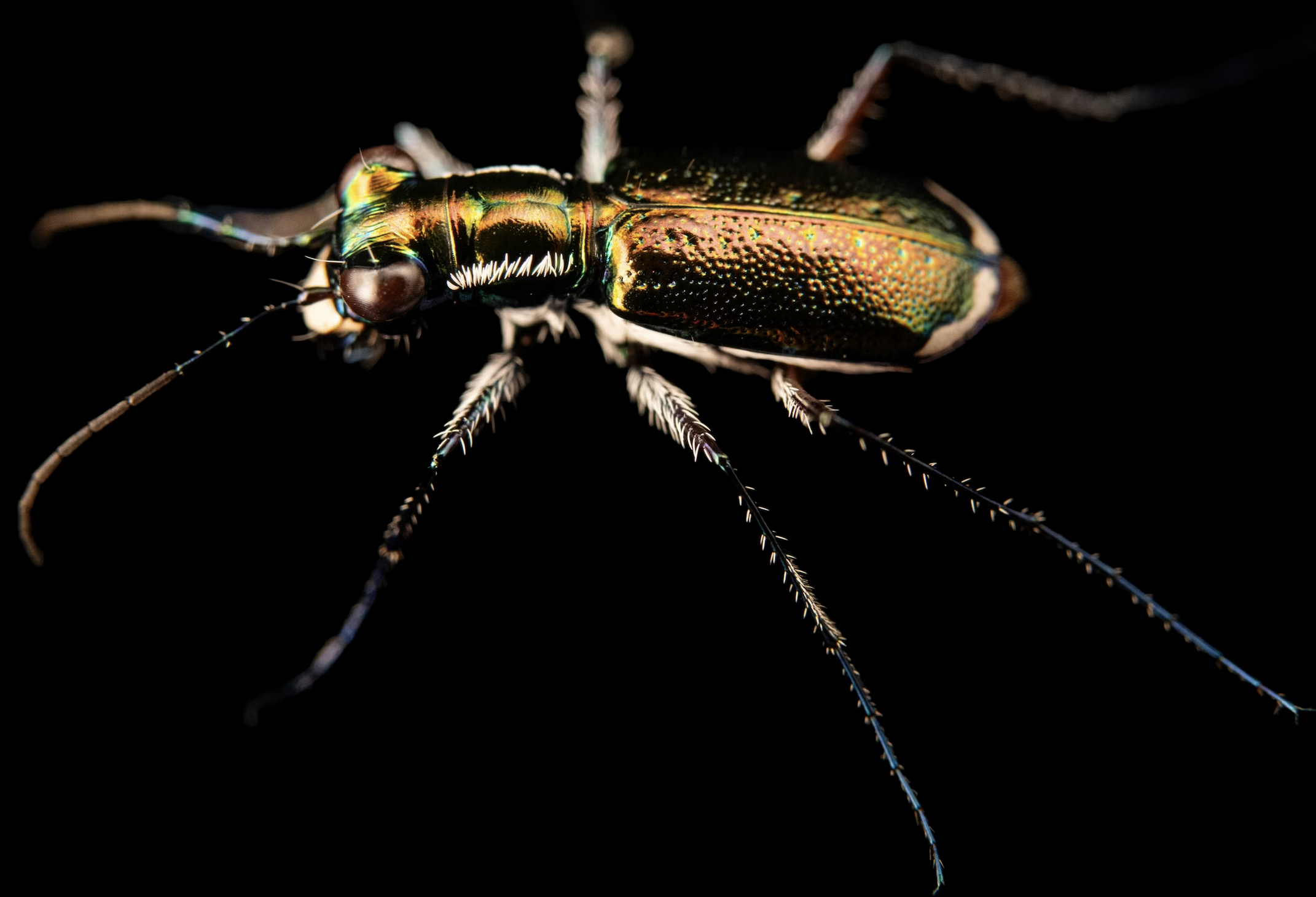
The Miami tiger beetle has 'big, serrated mandibles.'
(Photo by Joel Sartore, National Geographic, Photo Ark)
Meet the Miami tiger beetle, named for its 'highly voracious predatory behaviors, it's the 15,000th species in National Geographic's Photo Ark. "The beetle was rediscovered in 2007 after a more than 60-year absence," reports Rachel Fobar. "With its iridescent blue-green exterior and round, expressive eyes, some would call the Miami tiger beetle beautiful. . . . But when photographer Joel Sartore looks at one, he also sees carnage. . ."


Wednesday, November 15, 2023

Wednesday quick hits: Oreo scandal; dead solar panels; photos of the year; the nurse shortage; food inflation dips

Is there less creme filling?
(Wall Street Journal photo)
Sometimes less is more, but sometimes less is just less, especially if you're talking about less filling in your delightfully creamed Oreo. "Oreo fans think there's less filing, but the Snack maker says it hasn't tinkered with creme ratio," reports Jesse Newman of The Wall Street Journal. "But suspicious consumers are on high alert."

Inquiring minds want to know: Where do dead solar panels end up? "The majority end up in landfills," reports Izzy Ross of Grist. "But there are no federal requirements for recycling solar panels, and states have different regulations for what to do with them. Panels can also contain small amounts of heavy metals like lead, which makes getting rid of them more complicated. The vast majority of panels are thrown away in landfills — only about 10 percent are recycled."

Photo by Louie Palu, National Geographic
It's finally time for the National Geographic photos of the year. A diverse and beautiful world awaits. In the photo, left, Finnish and U.S. soldiers train for winter warfare by navigating an obstacle course while on skis. The exercise took place two months before Finland — which shares an 800-mile border with Russia — joined NATO. The training was arranged in response to the war in Ukraine.

Is there a nursing shortage? That depends. "In 2022, the American Hospital Association quoted an estimate that half a million nurses would leave the field by the end of that year, bringing the total shortage to 1.1 million," reports Brittany Trang of STAT. "At the same time, National Nurses United insists there isn't a nurse shortage at all. There are plenty enough nurses for the country, they say — merely a shortage of nurses who want to work under current conditions."

Bill Watterson comic via
Mental Floss

When life gets too heavy, lift yourself up with some comics like Calvin and Hobbes. The wacky duo gets up to all kinds of shenanigans. The cartoon strip's artist was also a bit of a card himself.

After two years of stubborn food inflation, Americans can expect a slow drop in at-home food costs. "According to economists with the Department of Agriculture, while food prices are expected to remain higher in 2024, the rampant inflation rates experienced in 2022 and 2023 are anticipated to return to more 'normal' levels in the upcoming fiscal year, reports Charlsie McKay, RFD-TV News, which covers rural America.

Photo by M. Zilses, Unsplash
As the the holiday season approaches, it's time to consider how to eat all the treats you love without looking like you ate all the things you love. "What if the best way to curb sugar cravings is just to eat as much as you want? That is the core of an idea gaining traction among dietitians," reports Alina Dizik of The Wall Street Journal. "Who say that letting ourselves graze unfettered on a cache of Halloween fun-size Snickers can reduce our sugar lust in the long run."

Sunday, July 09, 2023

Yale student wins photography competition in rural Kentucky with his essay on the theme 'Picking Up the Pieces'

Tommy Fryman on his scavenging route through Cynthiana, Kentucky (Photos by Lukas Flippo)

From the inside out: Fryman hunts through a trash bin.
Lukas Flippo of Yale University was judged to have the best photo essay in the Dusk to Dusk 24-Hour Student Photojournalism Challenge in Harrison County, Kentucky, this weekend. The event was held by Boyd's Station, a local nonprofit arts-and-journalism residency with a gallery in the county seat of Cynthiana. Ten students pursued the theme "Picking Up the Pieces," assigned shortly before the contest began. The runner-up was Annie Barker of Michigan State University, who also won for best single image, and Abigail Pittman of the University of North Carolina was third.

Here's how Flippo described his subject: "We start with a partial inventory of what's in Tommy Fryman’s shopping cart, drenched in rain on this stormy Saturday in downtown Cynthiana: over a hundred crushed soda cans, a new pack of diapers, a new window blind, a pool noodle, and 4 pizza pans. Oh, and the chief offenders, two metal pipes. Even with the rope tied around them, they are too big for the cart, extending over a foot over the railing of each side of the cart.

Fryman gets paid at the recycling center.
"Fryman’s life is a numbers game. 24 cans a pound, 50 cents for a pound of aluminum at Randy’s Odd Jobs Recycling Center. Seven days a week, Fryman walks around town, averaging 10 miles a day, to pick up cans and other goods to sell at Randy’s Odd Jobs Recycling Center to supplement his disability check, which he receives for epilepsy. Cynthiana has no recycling system, and Randy’s business helps Tommy make the ends meet.

"Fryman is well known in the community. People stop their cars on the road to give him cans and businesses leave them by their dumpsters. No one bats an eye when Fryman bends over a trash can. The task gets harder everyday. Fryman gets short of breath, and legs frequently buckle and give out. But that won’t deter him from his mission: to clean the streets of Cynthiana and make some honest cash."

“Not many people have a heart like I do,” Fryman said. “And I won’t give up, not until God calls me home.”
Flippo's photo essay included five other pictures.

Sunday, June 18, 2023

24-hour Student Photojournalism Challenge July 7-8 in Ky.; also open to college graduates from the past two years

Harrison County (Wikipedia map)
Next month Boyd's Station, a nonprofit arts and journalism residency program in Harrison County, Kentucky, will host the 2023 Dusk to Dusk 24-Hour Student Photojournalism Challenge, in which photographers will document and interpret a competition theme that will be announced on the Boyd's Station website and social media sites at 3 p.m. Friday, July 7.

The challenge will begin three hours later, at 6 p.m. July 7, and end at dusk July 8. Judging will begin immediately at the Boyd's Station Gallery in the couty seat of Cynthiana, with winners announced that evening. The awards for photo essays will be $400 for first, $200 for second and $50 for third. The best single image will win $100. The awards are sponsored by Think Tank Photo.

On Sunday, July 9, at noon, a lighting workshop  will be presented by Nick Henry of Roberts Camera at the Boyd's Station Gallery. At 2 p.m., New York Times staff photographer and two-time Pulitzer honoree Stephen Crowley will give a talk.

Students competing in the Dusk to Dusk 24-Hour Student Photojournalism Challenge must be students in high school or college, or college graduates in the past two years. For more information contact Jack Gruber at jack@boydsstation.org.

Monday, April 24, 2023

California's superblooms can be seen from space

Wildflowers between highways (Satellite image ©2023 Maxar Technologies via Los Angeles Times)
Image from Washington Post collection of satellite photos from
Planet Labs PBC notes one species of wildflowers; the purple
flowers are Great Valley phacella (Phacella ciliata)
In a galaxy, not far away, comes something epic: superblooms! Nature's flower power has come to California and the world via space photos, reports Terry Castleman of the Los Angeles Times. "New satellite photos from Maxar show hillsides across the state adorned with flowers . . . The variety of colors is astonishing."

The last superbloom was in 2019. It takes a unique series of conditions, beginning with dormant seeds tucked away in the soil, report Allyson Chiu and Naema Ahmed of The Washington Post: "Naomi Fraga, director of conservation programs at the California Botanic Garden, told the Post that . . . the flowers are waiting for 'just the right conditions' to start their life cycle. California's impressive floral showing is most likely connected to the massive amounts of precipitation that drenched much of the state in recent months."

Fraga told the Post, "They're winter annuals; they respond to winter rain. . . . When the seed bank in the soil experiences this sort of range of temperatures and precipitation across time, then that can stimulate several different species to germinate." Chiu and Ahmed explain, "Before the heavy rains and snowfall that pummeled the state . . . California had experienced three of its driest years on record. The drought could have reduced the number of invasive grass seed on the landscape and helped improve the chances for native plants to capitalize on the heavy rains and thrive."

"Superbloom" is not a scientific term, but is "a wonderful natural phenomenon where many annual wildflowers all bloom simultaneously," Fraga said. "You have a great diversity, an abundance of many different wildflower species, all flowering, creating bright patches of color on the landscape where they become the dominant feature. . . . [the blooms] are an ephemeral phenomenon." 

"If people aren't mindful when they visit these flower patches, experts say, there will probably be consequences," the Post reports. Walking through blooms could trample the flowers before they produce seeds. High foot traffic could also compact the soil, making it more difficult for flowers to grow in that area." If you're in California to experience the super bloom, there's a solution to "not squishing flowers" and possibly snuffing out their ability to seed and reproduce. Go by zipline, suggests Jeanette Marantos of the Times: "At $90 to $160 a person — depending on the length of the ride — the experience is more expensive than parking your car and wading through flowers, but it's also much kinder to these fragile native plants." Fraga pointed out to the Post, "It's not just for our enjoyment or the display. It's life happening. . . . For that life cycle to continue, we need to know that this flower isn't the end goal. The end goal is the seed."

Tuesday, April 04, 2023

'Remarkable and unexpected,' colorful northern lights (aurora borealis) filled skies from Arizona to North Carolina

A brilliant aurora appeared Thursday night in Shenandoah National Park. (Photo by Peter Forister)

In a word, breathtaking. "As soon as the sun set Thursday, extreme weather photographer Peter Forister excitedly headed for the hills. Forecasts had suggested that recent storming on the surface of the sun could set off auroras — brilliant dancing streaks of light, also known as the northern lights — in the Lower 48 states," reports Kasha Patel of The Washington Post. "At around 11 p.m., the sky lit up with vibrant red and yellow streaks visible to the naked eye." Forister told Patel, "You just step back and jaw drop and just watch the show for a few minutes. It was really remarkable, like the kind of show that will make you stop and just catch your breath." Patel writes, "Yet the light show wasn’t in an aurora hot spot such as Canada, Iceland or even the northern tier of the United States. This was in Shenandoah National Park in Virginia, 75 miles southwest of D.C."

That show was no average sun storm. "On Thursday night, a 'severe' geomagnetic storm — rated a level four out of five by the National Oceanic and Atmospheric Administration — brought vibrant, bright auroras as far south as Arizona, California, Oklahoma, Iowa, New Mexico and North Carolina, according to reports on Twitter," Patel notes. "Some even reported seeing another newly discovered aurora-like phenomenon called STEVE, or Strong Thermal Emission Velocity Enhancement, which shows as bright streaks rather than the aurora's curtain effect. Bill Murtagh, program coordinator at NOAA's Space Weather Prediction Center, told Patel, "We were not expecting that level of storm by any means. A lot of variables come into play. … It's difficult to get people spun up for the aurora because so often things don't work out much more often than they do." Patel adds, "The last time a severe 'G4' level storm like this occurred was 2017."

How does this work? "Murtagh explained: Think of the coronal mass ejection as a magnet shot out from the sun. That magnet now interacts with the Earth's magnetic field," Patel reports. "Like two bar magnets, the fields connected in such a way that 'just opened things up.' Murtagh told Patel, "The [sun's] magnetic field coupled perfectly with Earth's magnetic field, and the consequence was severe storming and beautiful aurora extending down into the mid-latitudes."

It also involves something called a "puff." Patel reports, "NASA solar physicist Alex Young said 'a puff' appeared to come from the center of the sun and practically had a straight shot at Earth. . . . Those kinds of puffs are called stealth coronal mass ejections, which Young thinks kicked the geomagnetic activity up a notch. . . . Young said we're also in what some people loosely call 'aurora season.' Auroral activity tends to pick up around the equinoxes, one of which just passed on Monday."

Thursday, February 16, 2023

'East Kentucky Flood' tells the story of a deadly disaster, a courageous and heartfelt recovery, and an uncertain future

Rockhouse Creek, a major tributary of the North Fork of the Kentucky River, flooded Isom and its supermarket.
The record flash floods in southeastern Kentucky last summer killed 45 people and worsened a regional housing shortage. More than six months later, hundreds of people are still staying in campers or substandard housing, Bill Estep of the Lexington Herald-Leader reports. Some people in the region worry that it will become depopulated, but others see the flood as an opportunity to build back better. They're the stars of a half-hour documentary, "East Kentucky Flood," produced by the Center for Rural Strategies in Whitesburg, one of the flooded towns.

Letcher County, Kentucky (Wikipedia)
Like all well-told stories, this one is in three parts: Stories of the flood and its close calls, the courageous and heartfelt response, and the ongoing recovery and prospects for the future. And it focuses on one Appalachian county, Letcher, which has the headwaters of three rivers. The villain in this story, funded by the Flora Family Foundation, is the North Fork of the Kentucky River.

A man recalls the waters rising around him: “It was everything I could do to keep my feet on the ground.” Another tells of a woman in her late 70s who uses a walker but hung on to the roof of her front porch for five hours awaiting rescue. Whitesburg firefighter Charles “Red” Colwell found a woman neck-deep in water and couldn’t get her into a kayak: “I just found some adrenalin and I just was able to put her in that kayak. I said, ‘We have to go. We have to go now. I cannot swim.’”

Much help came from “the hillbilly refugees, the people who have moved out of here,” recalled Gwen Johnson of the Hemphill Community Center. “They knew we weren’t gonna get any help from anybody else,” and started making contact. “When the roads opened up, they rolled in here.” She said three “drunk angels” arrived with a load of meat and “stayed with us three days, and I don’t think they drew a sober breath while they was here, and they just kept on a-cookin’.” 

But much help has also come from local residents, including fellow victims. Huffman said, “I noticed that the ones who lost so much have been trying to help everybody else.”

Appalshop filmmaker Willa Johnson recalled, “I didn’t know the people who were showing up to help me – or it was people I never expected show up to help me. People who have very openly disagreed with me on politics – it’s become a line in the sand for us, and we just can’t talk – were showing up.”

Photographer Malcolm Wilson of Blackey said he made 2,500 images of the flood, “some of the hardest photographs I’ve ever made in my life. . . . Some things I didn’t photograph, that I saw; I just couldn’t bring myself to do it . . .  The other thing that really blew me away was the Isom IGA.”

Simon and Gwen Christion in their Isom IGA, being rebuilt (Images from documentary)
The rural supermarket's owner, 67-year-old Gwen Christon, who had spent 50 years in it, told the filmmakers, “For a week, I actually walked around in shock, wondering what I was going to do.” But her tragic story brought outside help, and a determination to reopen, with the help of her son, Simon, who decided two years ago to follow in her footsteps. She said she worked 50 years to buy the store and pay the mortgage, and he said “I’m next in line to work another 50 years and get it paid up.” She said, “We plan on opening April 1, 2023. This is our home. This is our people, and we have to stick together. . . . I think we can come back stronger. I think we can come back more together.”

Angie Hatton hopes that's true. The former state representative, defeated for re-election due to gerrymandering fostered by long-term population loss, said tearfully, “I just don’t want people to move away. The people who’ve stayed have been so brave to try and stay, you know . . . We can do a lot with a little here; we always have been able to. And for those who are moving away, I get it, you know, I understand, but I just hope we can find a way to build housing up off of the creeks, flood-proof our bridges and use this disaster was, instead of the end of us, as a catalyst for a new beginning for everything that makes it hard to live in Eastern Kentucky.”

Coal companies own most of the high ground. Educator Jeff Hawkins mentions coal without saying the word: “Part of the struggle has been that we have been so closely connected to a single industry; it has really driven our economic base and our personality and who we are for a century.”

Wes Addington of Appalachian Citizens Law Center said as he was surrounded by relatives’ homes: “It’s really difficult to figure out, well, how do you move away, or how do you leave the place? And I haven’t mentioned, it’s like, a beautiful part of the country. It’s a really pretty place to live.”

But how does it build back better? “Frankly, it's gonna require a lot of federal money – and interest in, you know, supporting a region that’s really supported a lot of the rest of the country’s growth over the past 100 years," Addington said. "That’s what I hope happens. I think it’s really uncertain.”

WEKU-FM has concluded its six-part series "Rise" about the flood and recovery. The opening narrative for the closing episode: "While still adjusting to such heavy loss and amid much uncertainty, Eastern Kentuckians are giving careful consideration to the future. In addition to addressing the immediate need for housing on higher ground, that future includes preparing for the possibility of more frequent extreme weather. Is this a turning point? Or just another turn on the curvy road ahead? Residents demonstrate the most important key to a strong community is knowing how to show up for your neighbors."

Tuesday, February 07, 2023

Rural Montanans were the first civilians to report the Chinese spy balloon; why are such balloons still used?

One of Larry Mayer's photos for the Gazette
Rural Americans were the first civilians to spy China's "weather balloon" escapade. "The president of the United States knew about the presence of the Chinese spy balloon for several days before it was spotted drifting over Montana. But the White House wanted to keep it secret fearing news of the surveillance balloon would sabotage Secretary of State Antony Blinken’s planned diplomatic trip to China, Bloomberg News reported. . .That changed when on Feb. 1 when Billings Gazette photographer Larry Mayer, responding to vague reports that the airspace around Billings had been closed, photographed an odd glowing orb high in the sky," the Gazette reports.

"Using a large telephoto lens, Mayer discovered it was a high-altitude balloon powered by a large solar array. ... The Gazette’s publication of those photos, connecting them to the closed airspace and the fighter jets being scrambled to track the balloon, was quickly picked up by other media around the world — and the White House," the Gazette notes. "The White House was especially alarmed the balloon was hovering over a part of Montana that houses intercontinental nuclear missile silos."

Thank you, curious Montanans. So, what is a spy balloon? "A spy balloon is literally a gas-filled balloon that is flying quite high in the sky . . . It has some sophisticated cameras and imaging technology on it, and it’s pointing all of those instruments down at the ground. It’s collecting information through photography and other imaging of whatever is going on down on the ground below it," reports Iain Boyd of The Conversation, an independent source of news and views from the academic and research community.

How and why do spy balloons work? Spying satellites give us clues, but have built-in disadvantages. In low Earth orbit, Boyd writes, "It takes them about 90 minutes to do one orbit around the Earth. That's pretty fast to take clear photographs." In geosynchronous orbit, satellites stay in one place above the ground to capture images continuously but are much farther away. "A balloon in some ways gets the best of those. These balloons are much, much closer to the ground than satellites, so they can see even more clearly. The balloons are moving, but they’re moving relatively slowly, so they also have a degree of persistence."

What was it doing up there? "It’s likely to be different kinds of cameras collecting different types of information," Boyd writes. "The broad interest in this incident illustrates its unusual nature. Few people would expect any country to be actively using spy balloons these days." UPDATE: The Washington Post reports that the balloon is part of "a vast aerial surveilance program" that "has for years collected information on military assets in several countries, U.S. officials said."


Wednesday, January 25, 2023

Close encounters of the critter kind: Wildlife cameras catch interspecies meetings, caused in part by human activities

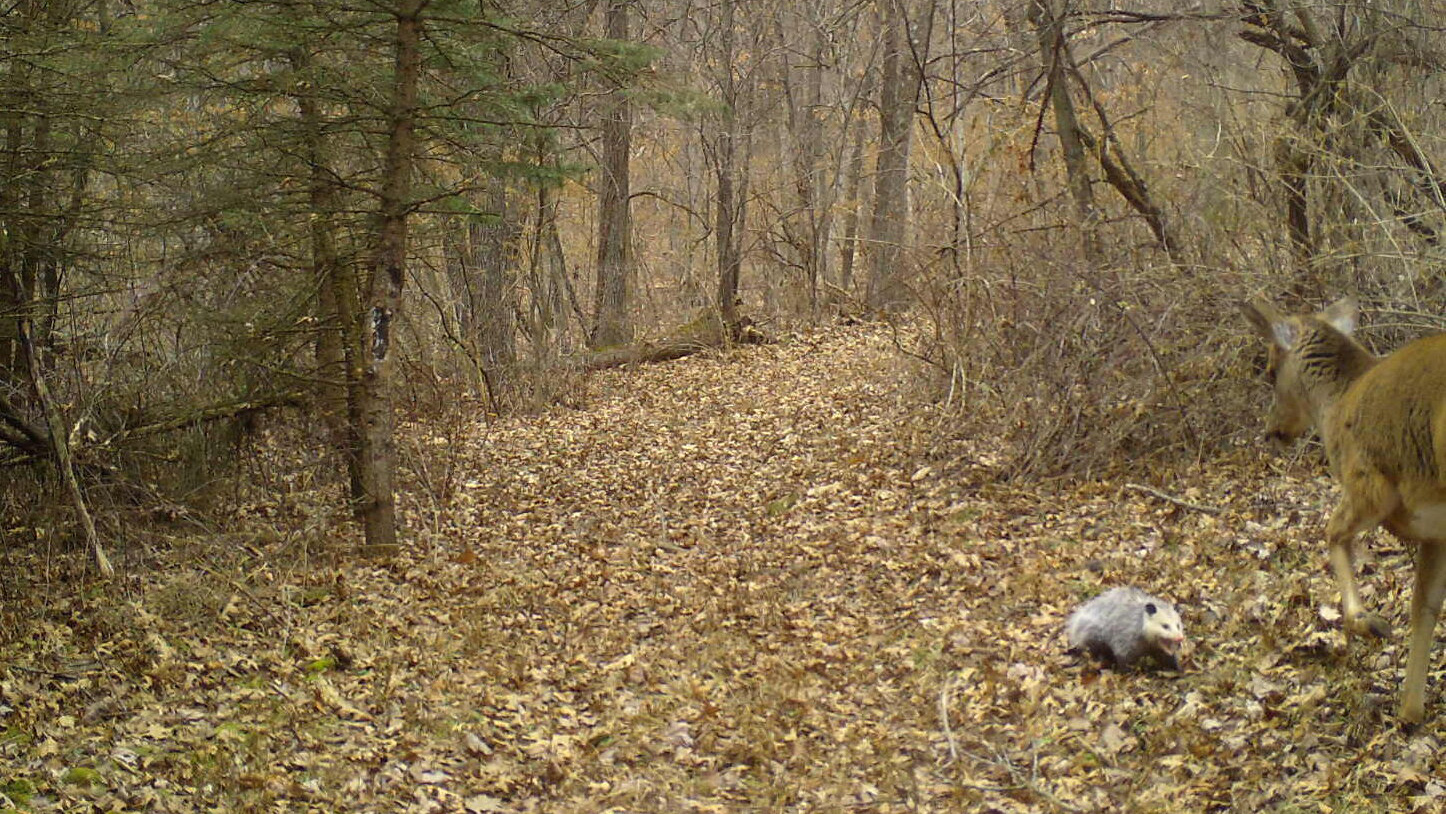
An opossum confronts a deer in a surprise encounter. (Photo via DNR Snapshot Wisconsin)
A turkey and a fawn in a close encounter (DNR Snapshot Wisconsin)
Even in the forest, timing is everything: "Hours, minutes or even seconds can make the difference for an animal between stumbling upon a predator and avoiding one, between finding a bush loaded with berries and discovering branches that have already been gnawed bare," writes Emily Anthes of The New York Times. "Now, a new study reveals how humans might unwittingly rewrite these ecological scripts, altering how the characters interact and fueling more interspecies encounters."

Anthes explains: "Neil Gilbert, a postdoctoral researcher at Michigan State University, and his colleagues analyzed images captured by Snapshot Wisconsin, a citizen-science project run by the Wisconsin Department of Natural Resources. Since 2016, volunteers have deployed more than 2,000 wildlife cameras across the state . . . Wild animals of different species were more likely to lead overlapping lives — appearing at local camera sites in quicker succession — in human-altered landscapes, like farms, than in more undisturbed locations, such as national forests," researchers reported in Proceedings of the National Academy of Sciences.

Anthes notes that human land use
Not all meetings are interspecies. ((DNR Snapshot Wisconsin)

"can squeeze animals closer together, increasing the odds that they bump into each other . . . Although more research is needed, that interspecies squeeze could have effects such as making it harder for prey to evade predators, intensifying competition for resources or increasing the risk of interspecies disease transmission, the researchers say." Benjamin Zuckerberg, an ecologist at the University of Wisconsin-Madison and an author of the study, told Anthes in an email, “The compression of species niches will likely lead to new interactions among species with unknown consequences.”

"The cameras, which are triggered by motion and body heat, have captured a menagerie of animals going about their everyday lives: bald eagles scavenging in the snow, bear cubs climbing trees, a newborn fawn, a bevy of otters gamboling down a grassy trail," Athens reports. "The time intervals between detections varied enormously. Sometimes the cameras captured the odd animal couples in the same frame; other times, days or weeks might pass between their appearances. But overall, across all animal pairs, the trend was clear: In relatively pristine habitats, such as national forests, roughly six days elapsed, on average, between detections. In the most human-altered habitats, that interval dropped to an average of four days.

Jennifer Stenglein, a state research scientist, said the study illustrates the potential for using wildlife cameras to probe aspects of animal behavior that might otherwise be difficult to observe.

Turkeys keep close watch on a sandhill crane. (Photo via DNR Snapshot Wisconsin)

Wednesday, November 30, 2022

Photo essay: A bypassed town tries to keep going

The big road in Crab Orchard, Kentucky, is US 150, which began as the northwest leg of the Wilderness Road blazed by Daniel Boone and others. But now the federal route bypasses the town of 700-plus, leaving KY 39 as Main Street.
Story and photos by Richard Yarmy

Kentucky Route 39 is a two-track strip of pavement running out of horse country near Lancaster, Ky., that cuts right through the heart of Crab Orchard — one of the bypassed villages scattered all across the country.

There's still a place to eat, on the former US 150 (now KY 2750).
No Trader Joe’s, no Sam’s Club or Costco — just an abandoned movie house, and some closed cinder block storefronts. I’ve passed by several times, but decided to stop the other day.

I was kneeling in the middle of the highway, framing the movie house when a car pulled up behind me. It was a police cruiser. The window came down and the officer said: “Did you get your shot?” I said I did, and he said: “OK, I thought you might want me to stop traffic while you worked.”

He was the first car I had seen in the 20 minutes I had been there.

Later when focusing on a faded wall with a Coca-Cola sign rapidly disappearing, another gentleman stopped by in an older pick-up.

“Whatcha doin’?”
The theater still advertises its last movies. To enlarge any image, click on it.

“I’m documenting the town, “ I said.

“Well, if you need anything, let me know, I’m on the town council and I can show you around.”

I told him about meeting the police officer.

He said: You didn’t meet an officer — you met the entire Crab Orchard police force.

Nice people, nice town. Glad I stopped.

I hope they get the funds to restore the theater. I will send a check.

Crab Orchard is in Lincoln County, where the Bluegrass gives way to Appalachia. Yarmy told The Rural Blog, "Little adventures like this one is what I think is meant by the cliché 'stop and smell the roses'." More photos from his sojourn in Crab Orchard are at https://www.flickr.com/photos/140962699@N06/albums/72177720304074291.

Monday, July 11, 2022

Profiles of nursing-home residents by student-run Georgia weekly illustrate a bedrock community-journalism principle

Excerpt from the Echo's recent package
The Oglethorpe Echo
in Macon County, Georgia, recently published a package featuring seniors at a local nursing home, with a photo and a paragraph with interesting tidbits from their lives. It's a powerful and simple but original idea that illustrates a basic principle of community journalism: People are interested in people, and in reading about them. 

Former Echo visual journalist and University of Georgia journalism student Julia Walkup interviewed and photographed the seniors earlier this year as part of a UGA photojournalism weekend workshop that encourages students to capture in-depth portraits of community members. 

UGA students and faculty have staffed the Echo since last fall, when local resident Dink NeSmith, retired co-owner of a community newspaper chain, kept the owner from closing the 148-year-old weekly by turning it into a non-profit and getting the university involved.

Friday, February 11, 2022

Get ready for the Great Backyard Bird Count Feb. 18-21; free webinar at 2 p.m. ET Feb. 16 can help you participate

A Carolina wren (Great Backyard Bird Count photo by Gary Mueller)
The Great Backyard Bird Count returns for its 25th year next weekend, Feb. 18-21. Participating is easy: Pick a spot and watch birds for 15 minutes or more at least once, using one of the tools on the GBBC website to tally all the birds you see or hear while you're observing.

Participants can count birds anywhere in the world, and help scientists get a snapshot of global bird populations. Volunteers from around the world count the birds they see for at least 15 minutes on one or more days of the count, and then enter their checklists at birdcount.org. In 2021, a record 300,000+ participants counted some 6,436 species.

Birders of all ages and experience levels can attend a free webinar at 2 p.m. ET on Wednesday, Feb. 16, to "brush up on bird ID, unlock the mystery of bird songs, and practice counting birds no matter how large the flock or busy the feeder," according to the website.

The count is sponsored by the ornithology lab at New York state's Cornell University, the National Audubon Society and Birds Canada. The sponsors say counting birds has become more important, and note that scientists recently reported a decline of more than one in four breeding birds in the U.S. and Canada since 1970. "In addition to these steep declines, Audubon scientists projected a grim future for birds in Survival By Degrees, a report showing nearly two-thirds of North America’s bird species could disappear due to climate change. Birds from around the world are facing similar challenges and declines," the Great Backyard Bird Count website says. To sign up, click here.

From a weekly in the Texas Panhandle, and close to the Okla. Panhandle, a blend of weather news and photo art

Republished with permission of The Canadian Record, Canadian, Texas; for a larger version, click on it.

Tuesday, December 21, 2021

This year's Comedy Wildlife Photography Awards winners feature a 'ninja prairie dog' and more

Two of this year's winning Comedy Wildlife Photography Awards entries (Photos by David Eppley, left, and Arthur Trevino)

The bald eagle is usually an awe-inspiring sight, but it's looking a little less so in two winning entries in this year's Comedy Wildlife Photography Awards. Wildlife photographer Paul Joynson-Hicks created the annual competition in 2015 in an attempt to "widen understanding and engagement with global conservation - for the preservation of biodiversity and the health and enrichment of everyone on Earth," according to the website. Click here to see all the winners.

This year's winning photos span the globe, from some Taiwanese mudskippers doing an impression of Sesame Street Yip Yips, to a raccoon pulling some Mission: Impossible moves on a screen window. And, of course, the eagles: one face-planting into a branch during a botched landing, and the other getting menaced by a 'ninja' prairie dog.

If you'd like to submit your funny wildlife photos for next year's competition, click here for more information.

Monday, October 18, 2021

National Geographic wildlife photography contest winners a reminder of the importance of protecting wilderness

National Geographic has announced the finalists and winners of its annual wildlife photography contest. Here are the five featured and winning entries from the U.S., which serve as a reminder of the importance of protecting wilderness and wild animal habitats.

"Grizzly leftovers" (Photo by Zack Clothier)

Zack Clothier's "Grizzly leftovers" (above) won in the Animals in their Environment category. The remotely-triggered photo shows a curious grizzly bear in Montana looking at the camera as it approaches bull elk remains for a bit of lunch. The photo was taken in very early spring, when hungry bears attempt to bring their weight back up after hibernation.

"Storm fox" (Photo by Jonny Armstrong)
Jonny Armstrong's "Storm fox" was highly commended in the Animal Portraits category. Armstrong is a professor of fisheries and wildlife at Oregon State University, but the photo was taken at Karluk Lake on Kodiak Island, Alaska. He and a colleague followed the red fox around for several days, watching as it foraged berries, chased songbirds, and teased a brown bear cub. 


"River dance" (Photo by David Herasimtschuk)
David Herasimtschuk's "River dance" was highly commended in the Underwater category. The photo shows a school of longnose gar in Citico Creek, Tennessee, in the Great Smokies near the Virginia border. In spring, hundreds of them migrate upstream to spawn. Appalachian streams are some of the most biologically diverse in the world, but a recent study in nearby West Virginia showed that mining cuts aquatic species biodiversity by 40%.


"Drama at high water" (Photo by Mac Stone)

Mac Stone's "Drama at high water"
was highly commended in the Behavior: Mammals category. The image captures a raccoon rescuing its young from flooding caused by unusually heavy rains in the Everglades.

"Up for grabs" (Photo by Jack Zhi)


Jack Zhi's "Up for grabs" was highly commended in the Behavior: Birds category. The photo, shot in
Southern California, captures a young white-tailed kite reaching to grab a live mouse from its father. Juvenile white-tailed kites typically must master aerial food hand-offs from their parents until they can hunt on their own.