Showing posts with label automobiles. Show all posts

Friday, September 19, 2025

Rivian Automotive forges onward and breaks ground on its $5 billion electric vehicle plant in a small town in Georgia

Rivian builds electric in Georgia.
Despite the downturn in electric vehicle sales and enthusiasm, Rivian Automotive overcame delays and broke ground last week on its $5 billion plant in Social Circle, Georgia, a town with a population of 5,415.

"It seems like a terrible time to build an electric vehicle plant in the U.S., but Rivian Automotive leaders say they’re confident," report Jeff Amy and Alexa St. John of The Associated Press. Since its public offering, the company's stock has dropped "by more than 80%. . . . Rivian lost $1.66 billion in 2025’s first half."

The Georgia plant will make truck models that are smaller and less expensive than Rivian's current offerings, which feature high-end electric trucks that start at $70,000. The smaller models will start at $45,000, which the company predicts will enable it to sell to a much broader market and turn a profit.

While some state and local governments have resisted the push to go electric, Georgia is welcoming the change. "Georgia Republican Gov. Brian Kemp says he wants to make Georgia 'the electric mobility capital of America,'" AP reports. "Georgia has pledged $1.5 billion of incentives to Rivian in exchange for 7,500 company jobs paying at least $56,000 a year on average."

Not everyone in Social Circle supports Rivian building in the small, bucolic town about 45 minutes from Atlanta. According to the AP article, "Some residents say the plant is an inappropriate neighbor to farms and will pollute the groundwater."

Tuesday, September 16, 2025

Drugged driving is difficult to detect, but it impairs drivers and contributes to accidents and fatalities

Cannabis slows reaction time and alters spatial awareness. 
 (Jason Doiy, iStock, Getty Images via The Conversation CC)
Despite its often invisible presence, drugged driving is a developing problem in most states. On rural roads where almost half of fatal crashes in the U.S. occur, the risks posed by drugged drivers may be disproportionately higher, but difficult to detect or prove.

In 2020, roughly 12.6 million people aged 16 and up drove after using illegal drugs. "Of that total, roughly 11.7 million were under the influence of cannabis," writes Andrew Yockey, a public health expert at the University of Mississippi, for The Conversation

While cannabis use is often downplayed, it impairs reaction time and spatial perception. Yockey explains, "Multiple studies have found that drivers with THC, the primary psychoactive compound in cannabis, in their bloodstream are about twice as likely to be involved in a fatal crash – either as the cause or as a victim – compared with those who haven’t used drugs or alcohol."

Other drugs or any mix of drugs also play a part in devastating vehicle collisions and fatalities. "Opioids can cause drowsiness and dizziness. Stimulants like cocaine or methamphetamine may lead to overconfidence and aggressive driving," Yockey adds. "When drugs are mixed — or combined with alcohol — the risks increase dramatically."

All states prohibit drugged driving, but how they enforce those laws varies, leaving "legal gray areas in how the laws are interpreted and enforced," Yockey writes.

Despite laws designed to discourage and punish drugged driving, detecting and measuring illicit drug use in drivers is tricky. "There is no standardized way to measure drug impairment as there is with blood alcohol content," Yockey explains. "Roadside tests that cops use to spot drunk drivers don’t work as well for drug impairment."

States have increasingly turned to using roadside saliva tests, which can "detect recent drug use more quickly," Yockey writes. But again, the measurement of drugs still in the bloodstream and how that translates into driving impairment or ticketed offenses isn't clear.

Friday, May 16, 2025

Quick hits: Racing cars with a 'twist;' egg prices slide; lower tariff for 'happy nut;' bird flu cases slow; PFAS trial

The Gary Wilson Jr. 2009 Toyota Yaris heads down the track. (Photo by Sam Wolfe, NPR)

Camden, S.C., may only have 7,800 people, but it hosts a raucous event where residents and visitors are treated to cars with bad rap sheets and crazy detailing. "The race cars roll into downtown like an old-fashioned circus . . . . A Honda Civic has a lawnmower, squirrels and flamingoes on its roof," reports Bill Chappell of NPR. "They're all here for the local installment of 24 Hours of Lemons, an endurance car race with a major twist: The cars can't cost more than $500. The series bills itself as 'racing for real people.' The 24 Hours of Lemons races started more than 15 years ago in California. There are now 23 races each year, from coast to coast."

Good news! Sort of. "The average price for a dozen Grade A eggs declined to $5.12 last month after reaching a record $6.23 in March," reports Dee-Ann Durbin of The Associated Press. "It was the first month-to-month drop in egg prices since October 2024. Overall, the average price of eggs of all sizes fell 12.7%, the steepest monthly decline since March 1984. . . . Still, retail egg prices remain near historic highs."

California farmers grow millions of pounds of
pistachios a year. (Adobe Stock photo)
U.S. farmers aren't the only ones grateful for a break from extreme U.S.-China tariffs -- Chinese pistachio lovers are also rejoicing. "Chinese consumers crave pistachios for their taste and health benefits, referring to them in a way that translates to 'happy nuts,'" reports Jim Carlton of The Wall Street Journal. "Since 2017, the value of U.S. pistachios shipped into China has shot up 20-fold from $42 million to $842 million last year, accounting for almost a third of the $3 billion crop."

Dairy trade between the United States and the United Kingdom has historically been skewed in the UK's favor; however, the new negotiation framework announced by the Trump administration "marks a crucial turning point as the U.S. seeks a level playing field with global dairy exporters," reports Karen Bohnert of Dairy Herd Management. "According to Gregg Doud, president of the National Milk Producers Federation, achieving a robust trade agreement with the UK is a vital step in correcting the current imbalances in the dairy trade."

Chickens, farmers and farm workers enjoy a reprieve from bird flu infections. (MedPage Today photo)

While not entirely explainable, "detections of H5N1 avian influenza have slowed in both animals and humans, but continued surveillance is warranted, Centers for Disease Control and Prevention researchers said," reports Kristina Fiore of MedPage Today. "Someone questioned whether there was seasonality to H5N1. . . .Todd Davis, PhD, chief of the virology at the National Center for Immunization and Respiratory Diseases, said any seasonality noted in other countries 'primarily corresponds to migratory bird patterns.'"

The first PFAS, or "forever chemicals," personal injury trial will focus on plaintiffs who allege they developed kidney cancer from firefighting foam. "The trial, set for Oct. 20, could include up to three individuals who claim their exposure to per- and polyfluoroalkyl substances (PFAS) in aqueous film-forming foams (AFFF) caused their cancer," reports Pat Rizzuto of Bloomberg Law. "In [an] effort to manage the nearly 10,000 personal injury cases that are part of the Aqueous Film-Forming Foams Products Liability Litigation MDL 2873, Judge Richard M. Gergel, with the U.S. District Court for the District of S.C., established three batches of cases involving different illnesses."

Tuesday, April 15, 2025

Foreign businesses have replaced textiles in Upstate South Carolina. Residents are 'baffled' and worried by tariffs.

BMW employs 11,000 people at its 8 million square-
foot campus in Spartanburg, S.C. (BMW photo)
Upstate South Carolina was once known as the country's textile hub until the 1990s when "automation and cheaper labor overseas took the industry away from the state," reports Eduardo Medina of The New York Times. President Trump's new tariffs aim to revive the industry, but some people who used to work at the old mills don't know why anyone would want to bring that work back because of the low wages and often unpleasant working conditions. Much of the region has new industrial partners that have improved the overall quality of living for many residents.

Adolphus Jones worked at a mill in the small town of Union, S.C. Medina writes, "Jones, now 71 and retired, scoffed at President Trump’s vision of an American manufacturing revival through tariffs. The mill work had paid little, Jones recalled, and upward mobility was nonexistent." Jones told him, “The textile industry is dead. Why would you want to bring it back here? Truthfully, why would the younger generation want to work there?”

The Trump administration's push to bring back an industry few residents miss represents a mismatch between current economic realities and the limits of what tariffs can accomplish. "Today, companies like BMW and Michelin — from Germany and France — are the economic engines of the region," Medina explains. "Now, leaders say that waging a trade war could undermine future recruitment of international investments and risk losing the jobs that are already in the region."

BMW alone "has invested more than $14.8 billion into its South Carolina operations" and has created "most than 11,000 jobs." BMW's suppliers have created thousands of additional jobs in the region. 

So, local residents were baffled "when the White House’s top trade adviser, Peter Navarro, attacked BMW’s manufacturing process in an interview . . .," Medina reports. "He told CNBC that 'this business model where BMW and Mercedes come into Spartanburg, S.C., and have us assemble German engines and Austrian transmissions — that doesn’t work for America. It’s bad for our economics.'"

Even in Union, a rural area with 8,000 residents, a recovery from textile's downfall has slowly evolved. Medina writes, "Union County has successfully recruited renewable power companies, bioscience and medical employers, and a Dollar General distribution center that employs nearly a thousand people."

Some Union residents think a more modern mill might further improve Union's economy. Leroy Spencer, a retiree in Union, told Medina, "If Trump can bring that back, it would be amazing, and I think the economy would pick up around here and get better." However, building new mills with automation and modern equipment would mean ordering machinery and supplies from overseas, which will likely face higher tariffs and thereby increase construction costs.

Jones sees the "whole tariff back and forth as baffling," Medina writes. "When he worked in a plant decades ago, he made tassels for graduation caps. Now, he says, more of Union’s next generation should be wearing those caps — not making them."

Friday, March 14, 2025

Steel and aluminum tariffs may price the Ford F-150, America's No.1-selling vehicle, out of reach for many people

The sticker price for a 2025 Ford F-150 is $38,810.
Ford proclaims its F-150 truck as "The Future of Tough," but newly announced 25% metal tariffs could dent Ford F-150 purchases and profits.

The F-150 is not only the country's number-one selling vehicle, it's also Ford's' main money maker and "one of the industry’s biggest users of aluminum," report Mike Colias and Bob Tita of The Wall Street Journal. "The Trump administration reinstated a blanket 25% tariff on steel imports and boosted the levy on aluminum made outside the U.S."

The sticker price of new vehicles is already a stretch for many Americans and an increase in tariffs could put a new auto purchase out of reach. "The tariffs are the latest Trump administration trade barrier that threatens to inflate already-high car prices," the Journal explains. "The aluminum tax in particular presents a problem for automakers: They are using more of the lightweight metal in cars, but the U.S. has been producing less of it" when measured over the past 30 years. 

Colias and Tita write, "Even though Ford gets most of its aluminum sheet from rolling mills in the U.S., those suppliers rely on smelters in Canada to provide much of the aluminum they roll."

In the past five years, though, domestic investment in aluminum production has increased. Even with that growth, "a Ford spokesman said it would take many years to rewire its supply chains to get more automotive-grade aluminum from the U.S," the Journal reports. "He declined to comment on the potential effect on prices should the tariffs last."

The steel tariff is easier for U.S. automakers to avoid because "companies source most of their steel from U.S. suppliers and have more domestic options," Ford has said it gets 90% of its steel from U.S. sources," Colias and Tita add. 

Even if U.S. tariffs remain in place, new auto purchase prices could remain unchanged for a little while. The Journal reports, "Many automakers have fixed-price metals contracts, and any effect on car prices would likely be delayed for a few months as suppliers and carmakers negotiate over who will absorb the added costs."

Friday, January 19, 2024

Rural Tennessee communities want agreements to ensure that they will benefit from Ford's big electric vehicle complex

Ford and SK's mega EV complex in Tennessee is nearly six square miles.
(BlueOval City photo)

Named after Ford's iconic logo, Blue Oval City is a burgeoning electric vehicle development in Stanton, Tennessee, a rural town of 615 residents, many of whom are working to ensure the massive operation provides regional community advantages.

"The joint venture, between Ford and Korean company SK Innovation, promises 6,000 good-paying jobs for residents of the small, rural communities. . . . Development on such a large scale will, [residents] fear, change the community, suck up water and electricity, and prompt an influx of newcomers and development," reports Katie Myers of Grist. "The towns orbiting Stanton are sitting down with Ford and SK to negotiate a binding agreement that will ensure they benefit from Blue Oval City as much as the companies do."

Community advocates wanted residents to have a say in what benefits the companies provided, including youth facilities and support for road maintenance, alongside binding assurances for responsible plant waste disposal. To empower regional voices, they formed a coalition, which "drafted a list of stipulations, called a community benefits agreement, that it wants Ford/Blue Oval SK to abide by," Myers explains. "CBAs are a contract between a corporation and a coalition of local organizations that gives the community, through binding arbitration, leverage to ensure the commitments are kept."

In Los Angeles, the entertainment industry used CBAs to negotiate for a large sports arena, but a CBA's purpose and power can be broadly applied. Vonda McDaniel, the president of the Central Labor Council of Nashville and Middle Tennessee, "is helping to formulate Blue Oval agreement and plan town halls," Myers reports. "The process has been lively." McDaniel told her: "We haven't had a whole lot of wilting flowers that have shown up at our meetings. . . . The community is feeling a bit squeezed; there's heavy equipment up and down the road every day."

The "squeeze" is understandable. Blue Oval City is a 3,600-acre campus covering nearly six square miles. The complex is slated to open in 2025 and will employ at least 5,700 people. The surrounding towns of Covington, Brownsville and Stanton have an estimated population of 19,015.

Kathleen Mulltigan, who leads the National Labor Leadership Initiative at Cornell University, told Myers: "What we're really trying to do is bring real democracy into the economic realm, because a lot of the work of shaping the economy happens without workers having any voice in it."

The coalition will need Ford and SK to come to the negotiation table. The group plans to "take a complete draft of the agreement in hand early in the new year," Myers reports. "Even if the effort is not immediately successful, community members say, the relationships they've built with one another will only get stronger, leaving possibilities for further organizing open down the road."

Friday, December 15, 2023

At last, the first electric vehicle charging station built with federal infrastructure funds opens in Ohio

The charging equipment at the Pilot Travel Center in Ohio.
(Photo by Dan Gearino, Inside Climate News)
The promise of federal funding for electric vehicle charging stations has finally come to fruition. "On the western outskirts of Columbus, Ohio, two doors down from a Waffle House, is a truck stop that, as of last Friday, has the first electric vehicle charging station in the country to be financed in part by the 2021 federal infrastructure law," reports Dan Gearino of Inside Climate News. "The Pilot Travel Center at I-70 and U.S. 42 has four charging ports. They are part of a partnership between General Motors and Pilot that the companies say will lead to chargers being installed at 500 Pilot and Flying J locations."

It's a first step with many more installations to go. "Ohio was one of the leaders in securing a share of this money and stands to receive $140 million over five years to construct charging stations along major travel routes," Gearino writes. The federal government is "showing progress in turning $5 billion worth of charger funding into completed projects." Charger expansion is critical to moving U.S. transportation away from gasoline dependence.

Building EV charging stations at a national truck stop chain offers travelers off-road conveniences for travelers and helps dispel "concerns from some EV drivers that the nation's charging network isn't nearly robust enough," Gearino reports. 

Pilot has other chargers at 18 locations in nine states, with ongoing expansions throughout the country. "The Ohio location is the first of those to benefit from the federal program," Gearino adds. "The country had 141,714 public charging ports as of the end of June, according to the National Renewable Energy Laboratory. . . . Many more federally funded chargers will follow the one in Ohio." The National Electric Vehicle Infrastructure program lists projects in Alaska, Colorado, Hawaii, Kentucky, Maine and Pennsylvania.

Friday, September 01, 2023

Auto industry moves South with electric vehicle factories; one rural town of 400 gets ready for 6,000 Ford workers

Business has picked up at Suga’s Diner in Stanton, Tenn.
(Photo by Andrea Morales, The Wall Street Journal)
How does a town of 400 people prepare for an influx of 6,000 additional residents? Stanton, Tennessee, is showing the way as the town readies for “all the people the Ford plant auto-complex build will bring,” reports Nora Eckert of The Wall Street Journal. Ford’s complex is a sign of the times: “The U.S. auto industry is accelerating its move south as car companies pour billions of dollars into new factories in Georgia, Kentucky and Tennessee. The shift is creating pockets of frenzied activity—and anxiety—for rural, southern towns bracing for new workers and residents.”

“Once fully operational, Ford’s 3,600-acre site is expected to employ about 6,000 workers, about 15 times Stanton’s current population,” Eckert writes. “Allan Sterbinsky, the mayor of Stanton, spends his days planning how the town—home to a barbecue restaurant, a Dollar General and a couple of cemeteries—will build thousands of new homes, expand the local school system and potentially establish a police force.” Sterbinsky told Eckert, “It’s tremendously overwhelming, just everything that has to be done.”

As America's shift to EVs gained momentum, the auto industry’s move South increased speed. “Auto companies have announced more than $110 billion in EV-related investments in the U.S. since 2018, with about half that sum destined for Southern states, according to the Center for Automotive Research, a nonprofit based in Ann Arbor, Michigan," Eckert adds. "Automakers are now rushing to construct assembly plants and battery-making facilities—some sitting on sites the size of 60 football fields.”
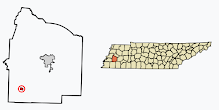
Location of Stanton in Haywood County,
Tennessee. (Wikipedia map)
For decades, Southern states have been setting the groundwork to attract automakers, “laying veins of waterways and electrical lines and shoveling heaps of dirt to prepare the land for potential new factory megasites," Eckert reports. "Local governments and technical institutes have partnered to train a new generation of manufacturing workers, including in automotive, even before some of the first construction beams were erected. "Ford Chief Jim Farley said one of the reasons the automaker based its manufacturing campus in Tennessee is because the Tennessee Valley Authority, an electricity company, is one of the largest clean-energy providers in the U.S. The state’s lower energy costs also attracted Ford there, he has said."

Meanwhile, folks in Stanton and surrounding towns of Haywood County, pop. 17,900, have their hands full. "The median household income in Haywood County, where the Ford complex is located, is about $40,000. One in five residents live in poverty," Eckert reports. Already some local restaurants and services are enjoying growth, but for some, Ford's presence has hurt their business. "Teknor Apex, a chemical producer and major employer in the county, was already struggling to find workers. . . . Many young people in the area end up leaving for better pay and a greater variety of opportunities elsewhere, draining the local talent pool."

Wednesday, May 24, 2023

Ford does a U-turn; all its vehicles will still have AM radio

Photo by Caleb White, Unsplash
If you were looking at buying a new Ford vehicle, especially if you travel out yonder, you will probably be glad to learn that Ford Motor Co. has changed its tune on AM radio and will include it in all its cars, trucks and SUVs, reports Tom Krisher and Wyatte Grantham-Philips of The Associated Press. "CEO Jim Farley wrote in social media postings Tuesday that the company is reversing a decision to scrub the band after speaking with government policy leaders who are concerned about keeping emergency alerts that often are sounded on AM stations." Farley wrote on Twitter, "We've decided to include it on all 2024 Ford and Lincoln vehicles. For any owners of Ford's EVs without AM broadcast capability, we'll offer a software update."

"The move comes after a bipartisan group of federal lawmakers introduced a bill Wednesday calling on the National Highway Traffic Safety Administration to require AM in new vehicles at no additional cost. . . . . Sen. Edward Markey, D-Mass., one of the bill's sponsors, said eight of 20 major automakers including Ford, BMW and Tesla have pulled the band from new vehicles," Krisher and Grantham-Philips write. The Kentucky Broadcasters Association reports, "Sponsors of the 'AM for Every Vehicle Act' cited public safety concerns, noting AM's historic role in transmitting vital information during emergencies, such as natural disasters, especially to rural areas."

Amplitude-modulation radio continues to have a dynamic public presence. "With tens of millions of listeners, it serves as a vital lifeline to the public and a critical source of community news and exchange of diverse ideas," KBA reports. "The National Association of Broadcasters commends Ford for this commitment, which will keep Americans safe and informed, particularly in times of emergency. . . . In light of Ford's announcement, NAB urges other automakers who have removed AM radio from their vehicles to follow Ford's lead and restore this technology in the interest of listeners and public safety. . . . Supporters of the AM Radio for Every Vehicle Act. . . are helping to shine a light on the need to keep this critical service in all cars."

Monday, May 01, 2023

Some car makers drop AM radios; stations react with PR campaign, citing AM's roles in communities, public safety

Retro is on at 12 noon on WLSD. (Image via WLSD website)
AM radio is being threatened with extinction. It stands for "amplitude modulation," most definitely not "automobile makers."

"As auto manufacturers expand their electric vehicle offerings, many new models will ship without AM radios," reports Matt Busse of Cardinal News in southwest Virginia. "Broadcasters and some public officials are pushing back, arguing AM radio is vital for distributing public safety information during emergencies."

Busse writes, "There are more than 130 AM radio stations in Virginia, including more than 60 operating in Southside, Southwest and the Alleghany Highlands. Now, those AM stations and others around the country face a new challenge: Some carmakers say they won't include AM radios in new vehicles, citing the availability of other listening options as well as interference between AM radio signals and the increasingly complex electronic systems such as those found in electric-only vehicles."

Radio station WLSD [named for Wise, Lee, Scott and Dickenson counties] serves as Busse's example: "Broadcasting at 1,000 watts on 1220 AM since it first signed on in 1953 [before the psychedelic drug LSD became widely known], WLSD has weathered numerous storms [including] competition such as satellite radio and digital streaming services." Adam Sturgill, the station's staff engineer and program director, told Busse, "We're providing a service still yet to the community. That's really what it's about, is doing the local ball games and being there for events in the towns and communities, so that's the one thing that helps keep it going."

"This month, the National Association of Broadcasters announced a public-relations campaign with a website, www.DependonAM.com, which features materials such as suggested scripts for radio stations to read on the air touting the importance of AM," Busse reports. "The NAB highlighted efforts by politicians such as Sen. Ed Markey, D-Mass., and Rep. Josh Gottheimer, D-N.J., to keep AM radios in vehicles." Markey told Busse, "Although many automakers suggested that other communication tools – such as internet radio – could replace broadcast AM radio, in an emergency, drivers might not have access to the internet and could miss critical safety information."

Simultaneous broadcasting is an option. Busse reports, "Gary Burns owns 3 Daughters Media, which operates multiple AM stations. . . . he noted many AM stations, including his, already simultaneously broadcast on FM, a move encouraged by the Federal Communications Commission through its "AM Revitalization" effort." Burns told him, "The FCC, in anticipation of diminishing AM listenership, has made avenues available to the AM broadcast to see that their message can still get out."

Despite tech-savvy listeners and more options, Busse reports, "In many parts of the WLSD listening area, it can be difficult to stream anything on a phone in the car, Sturgill said. . . . Broadcast radio keeps motorists both entertained and informed, especially during situations such as severe storms that might knock out other forms of communication. . . . Sturgill, noted that the car manufacturers' recent decision is just the latest challenge AM radio has faced." Sturgill told Busse, "I don't think it's an attack on AM radio. . . . I think it's just a technical problem."

Monday, April 17, 2023

Animal vs. vehicle usually ends badly; pilot program aims to build more wildlife crossings; 60% of funding to be rural

Photo by Travis Essinger, Unsplash
In animal vs. vehicle, animal rarely wins. "More than one million animals and 200 people are killed in wildlife-vehicle collisions every year, according to Department of Transportation estimates. The property damage from these collisions is estimated to cost $2 billion," reports Claire Carlson of The Daily Yonder. "The DOT announced a new pilot program that will allocate $350 million for wildlife crossing projects on roads, specifically in rural communities where vehicle collisions with animals are most common. . . . At least 60% of the funds must go to projects in rural areas. . . . Program administrators hope to target rural areas that have previously been overlooked during federally managed infrastructure projects."

While the funding is considered a positive start, "experts say a lot more work – and money – is needed to significantly decrease the number of animals killed on the nation's roads," Carlson adds. Dividing it among 50 states will lessen the impact. Mike Leahy, director of wildlife, hunting, and fishing policy for the National Wildlife Federation, told Carlson, "Rural states like Montana or West Virginia are high on the list of highest wildlife-vehicle collision state. And a lot of that is because you have cars moving pretty fast down two-lane or smaller highways where there's a lot of wildlife around, including big game that can be crossing the road at any time."

Carlson reports, "The area where animals can move around uninterrupted by roads has shrunk tremendously over the past century. For some animals, this has become a serious problem: In California, mountain lions whose territory is constricted by newer six-lane highways inbreed, causing health issues. . . .The agency's new wildlife crossings program is one of several initiatives to increase animal safety on roads. . . . The goal is to reduce habitat fragmentation that prevents animals from traveling throughout their natural environments, which should fight biodiversity loss."

"These efforts are a good step, according to Fraser Shilling, director of the Road Ecology Center at the University of California-Davis, but without addressing the other causes for wildlife mortality like threats from invasive species and disease, pollution, and climate change, biodiversity loss will continue," Carlson reports. "Habitat fragmentation is just one part of the problem, he said." Shilling told her, "[Wildlife] crossings… have an important ecological function in terms of restoration, but without taking care of the other things, they also have decreased utility."

"The $350 million will be released in segments, starting this year. Applicants have until August 1 to submit project proposals," Carlson adds. "Two more funding rounds will be opened in 2024 and 2025 before the program’s expiration in 2026." Leahy told her, “There’s a lot of demand out there already and a lot of excitement around the country within the states, with tribes, with conservationists. . . . I think the demand will probably exceed the level of funding…. I think there’s a good chance Congress renews the program after the pilot program expires.”

Monday, March 06, 2023

Idea of making vehicular-homicide convicts pay child support for surviving children spreads 'like wildfire' in states

Police video from the Los Angeles Times

States are seeking stronger ways to tackle drunk driving but what seems fair to some is seen by others as duplication of relief. 

In more than a third of the states, legislators "have introduced some form of 'Bentley’s Law,' which would require impaired drivers who are convicted of vehicular homicide to pay child support for the surviving children of their victims," reports Austin Jenkins of Pluribus News. Frank Harris, director of state government affairs at Mothers Against Drunk Driving, told Jenkins, "I haven’t seen anything like this before with bills on drunk driving reform. It is like wildfire the way this is taking off."

The bill's concept originated with "Cecilia Williams after her son, future daughter-in-law and 4-month-old grandson were killed in a 2021 crash in Missouri. Williams was left to raise her son’s two surviving children, Bentley, 6, and Mason, 4," Jenkins writes. "After the fatal crash, Williams began advocating for states to require restitution on behalf of children who lose a parent or guardian because of an impaired driving accident. . . .So far in 2023, versions of 'Bentley’s Law' have been introduced or reintroduced for the second year in a row in at least 18 states, according to tracking by both MADD and the National Conference of State Legislatures."

Tennessee was the first state to pass the law. "Missouri lawmakers considered the idea last year but did not pass it," and bills in Mississippi and Virginia have died," Jenkins reports. "MADD’s tracking shows most of the other bills are still in committee." A bill similar to Tennessee's is moving through Washington state's legislature.

"In Virginia, the Family Law Coalition opposed the legislation," Jenkins reports. Daniel Gray, the coalition’s chair, told Capital News, “There’s already a very expansive wrongful death statute that people can take advantage of and get relief of the type that this bill is trying to introduce." Jenkins adds, "Concerns have been raised in some states about the logistics of implementing the child support requirement."

Jenkins reports, "State lawmakers are paying fresh attention to the issue of drunk and drugged driving amid a concerning rise in roadway fatalities, including a 14% increase in alcohol-impaired driving deaths from 2019 to 2020. That trend has prompted some states to consider lowering the legal drunk driving limit from .08% blood-alcohol concentration to .05%. There are also proposals to expand the use of ignition interlock devices to prevent repeat drunk drivers."

Tuesday, December 13, 2022

Electric cars threaten future of AM radio and maybe local radio news, but overcoming interference is possible

Rush hour in Chicago. Many AM radio listeners tune in during
commutes. (Photo by Alyssa Schukar, The New York Times)

Amplitude modulation transmissions, or AM radio, may be on its way out, which is bad news for local news in places that still have local radio news. "An increasing number of electric models have dropped AM radio in what broadcasters call a worrisome shift that could spell trouble for the stations and deprive drivers of a crucial source of news in emergencies," reports Michael Levenson of The New York Times.

"Carmakers say that electric vehicles generate more electromagnetic interference than gas-powered cars, which can disrupt the reception of AM signals and cause static, noise and a high-frequency hum," Levenson writes. AM and electricity are similar forms of electromagnetism. "Tesla, Audi, Porsche and Volvo have also removed AM radio from their electric vehicles, as has Volkswagen from its electric S.U.V., ID.4, according to the carmakers and the National Association of Broadcasters."

It is possible to overcome the interference issues, Levenson reports: "Such changes require money and effort, and it’s not clear whether carmakers are willing to spend more in the service of AM radio fans. . . . If more electric vehicles drop AM radio, some broadcasters say they could lose a connection to their core listeners."

AM stations have a healthy percentage of the U.S. radio market. "About 47 million Americans listen to AM radio, representing about 20 percent of the radio-listening public, according to the Nielsen Co., the media tracking firm," Levenson reports.

"Brian Winnekins, the owner of WRDN in Durand, Wis., which has seven hours of farm-related programming every weekday on AM and FM, told Levenson he has been urging listeners to tell carmakers not to drop AM, noting that it can reach farmers in remote areas. “If you can make a vehicle drive by itself,” Mr. Winnekins said to Levenson, referring to the driver-assistance systems in Teslas and other vehicles, “you can make a decent radio receiver."

Wednesday, November 30, 2022

Rural roads in Minn. giving tests to autonomous vehicles

Cruising across rural Minnesota, the autonomous
vehicle. (Photo by Jiahong Pan, The Daily Yonder)
There's a new way to get across rural Grand Rapids, Minnesota. It's called the 'goMARTI' autonomous vehicle. Five goMARTIs will be hitting North American roads for the next 18 months, and Grand Rapids is the first U.S. community to get them. Here's a "first ride" experience from Jiahong Pan of The Daily Yonder:"

"A Toyota Sienna, looks different from a regular Sienna. It has a cylinder mounted just above the windshield. Someone is in the driver's seat, but they aren’t actually driving. Instead, they are outfitted with a headset, ready to take over in case something goes wrong. To their left, a mobile device shows where the vehicle is going. It also plays the baseball charge tune every time the vehicle goes through an intersection."

Five of the autonomous vehicles were sent out for testing in September, and "for the following 18 months they will navigate around Grand Rapids," writes Pan. "In conditions unfamiliar to them: snow, extreme cold, and lots and lots of trees. If it works out, it could prove to be a solution to help those with limited mobility who live in remote, rural areas get around. It could also affect the workforce for good, and for bad."

The shortage of transportation alternatives in Grand Rapids and other rural communities is striking, and it is amplified if an individual is handicapped. "Today, more people with limited mobility are living in rural America," Pan reports. "For rural counties across the United States with no concentrated core population of 10,000 people or greater, 18% lived with a disability in 2019, up from 17.71% in 2014. In Itasca County, which contains Grand Rapids, 17% of residents lived with a disability in 2020, up from 15% in 2012."

This is where Myrna Peterson, a retired teacher who uses a wheelchair, comes in. "She founded Mobility Mania, which partnered with the Minnesota Department of Transportation, the city of Grand Rapids, May Mobility, New York City-based transportation technology company Via, and a St. Paul, Minnesota-based consulting firm called The Plum Catalyst, to deploy the project, called goMARTI," Pan writes. "MARTI stands for Minnesota’s Autonomous Rural Transit Initiative, the project cost $3.5 million to deploy, with a share of this funding coming from the state."

The autonomous vehicle may be paving the way for rural future. And likely there will be multiple challenges. "There may be more autonomous vehicle systems — and more workforce changes and development opportunities — to come for rural communities," Pan reports. "The Bipartisan Infrastructure Law passed last year includes $500 million over the next five years for public agencies to develop autonomous vehicle systems. Pending rulemaking as of this writing, applicants might not need to comply with Buy America provisions, potentially allowing them to work with providers overseas to deploy projects across the nation."

Saturday, July 30, 2022

What Joe Manchin got in the climate bill for West Virginia, energy industries, sick coal miners, Toyota and himself

Manchin (Tom Williams, CQ-Roll Call, via Getty)
"Congress is suddenly poised to pass the most ambitious climate bill in United States history, largely written by a senator from a coal state who became a millionaire from his family coal business and who has taken more campaign cash from the oil and gas industry than any of his colleagues have," Brad Plumer and Lisa Friedman of The New York Times write of West Virginia Sen. Joe Manchin, a moderate-to-conservative Democrat who holds much power in the 50-50 Senate.

So what did Manchin get in his deal with Senate Majority Leader Chuck Schumer? The federal government would lease more public lands and waters for oil and gas drilling, forcing President Biden to break a campaign promise. Tax credits for carbon capture technology that "could allow coal or gas-burning power plants to keep operating with lower emissions" would be expanded, the Times reports. And Manchin got a vote on a separate bill "to speed up the process of issuing permits for energy infrastructure," such as a West Virginia gas pipeline, the Times reports.

There's more. The trust fund for coal miners with black-lung disease would become permanent; new incentives would be offered "to build wind and solar farms in areas where coal mines or coal plants have recently closed," and there would be "generous tax credits for nascent technologies like carbon capture and storage and low-emissions hydrogen fuels, which Mr. Manchin has supported."

“Those are his pet projects,” James Van Nostrand, a law professor at West Virginia University, told the Times. “I think he’s going to say, ‘I used my strategic position to bring back benefits for West Virginia.’ And he’ll probably do pretty well in the next election.” Some environmentalists complained about more oil and gas leasing, "but energy analysts and many of the country’s biggest environmental groups said that any additional emissions from fossil fuel leasing would be dwarfed by the clean-energy provisions in the bill," the Times reports.

The bill was a long time coming, and "At every step of the way, Mr. Manchin shaped the legislation," the Times reports. He killed a plan to pay utilities to replace fossil-fuel power with renewables and "bigger tax credits for consumers who bought union-made electric vehicles, a measure that was opposed by Toyota Motor, which operates a non-union plant in West Virginia. And he ensured that the tax credits for electric vehicles could not be used by the wealthiest Americans." He won a lower fee for leaks of methane and "ensured that longstanding tax breaks for the fossil fuel industry, which many Democrats wanted to repeal, went untouched."

Monday, April 18, 2022

Kentucky’s burgeoning electric vehicle industry is no laughing matter, rural reporter tells social-media skeptics

Kentucky is about to gain thousands of good-paying manufacturing jobs making electric-vehicle components, but some conservative Kentuckians are treating the notion of EVs with contempt on social media, reports C. Josh Givens, a reporter for The Hancock Clarion in Hawesville, Ky.. He writes that was confused, since two recently announced battery-manufacturing projects represent the two largest economic-development projects in state history. Last week Envision AESC, a Japanese firm, announced a $2 billion investment to build a power-cell and module facility in Bowling Green. In 2021, Ford Motor Co. announced it would build two battery facilities near Elizabethtown.

"One would think such huge projects would be celebrated all across the Commonwealth of Kentucky, and certainly they are celebrated in some circles, but don’t tell that to the cheerleaders of fossil fuels for vehicles and energy production," Givens writes. "Kentuckians have a choice here: either embrace this burgeoning economic shift in our state or get left on the outside looking in. The plants will be built, workers will be hired, and the economic landscape will be altered. Kentuckians must accept that all things change, and many times those changes are for the better and transform our lives in exciting ways. And no amount of laughter, vitriol or putting your head in the sand is going to stop that."

Monday, March 21, 2022

Deadly Texas crash with 13-year-old driver draws attention to rural custom of allowing young teens behind the wheel

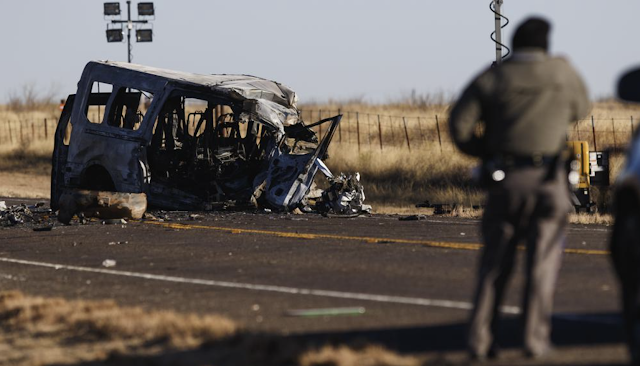
Texas state troopers survey the wreckage from a fatal March 16 crash in west Texas caused by a 13-year-old driver. (Associated Press photo by Eli Hartman)

A deadly crash is drawing renewed attention to the common rural practice of allowing young teenagers and even younger children to drive. Nine people died in West Texas last week when a 13-year-old driving a pickup truck blew a tire and overcorrected, striking a van carrying members of the men's and women's golf teams of the University of the Southwest, a private Christian school in Hobbs, N.M. The teen and his 38-year-old father were killed, along with a golf coach and six students, Gene Johnson reports for The Associated Press. The crash occurred in Andrews County, about 30 miles east of the New Mexico border.

"At a news conference in Odessa, Texas, on Thursday, National Transportation Safety Board Vice Chairman Bruce Landsberg said the dangers of underage driving put it on the agency’s 'most-wanted list'," Johnson reports. "Along with drunk and distracted driving, Landsberg said 'youthful driving' and excessive speed on rural roads are among the problems that make highway driving the most dangerous form of transit in the United States."

In 2020 alone, drivers aged 13 and under were involved in 47 fatal crashes and 1,057 crashes that caused injuries, according to National Highway Traffic Safety Administration data. And though there aren't specific statistics on where such underage drivers live, rural roads are nearly twice as deadly overall: "In 2019, the fatality rate per 100 million vehicle miles traveled was 1.9 times higher in rural areas than in urban areas," Johnson reports. Put another way: nearly half the nation's traffic fatalities in 2019 happened on rural roads, though less than one-fifth of the population is rural.

There were other risk factors: The crash happened at night, on a road with a 75 mile-per-hour speed limit, the tire that blew was a spare not meant for high-speed use, and the driver was a teenage male—one of the highest-risk segments of the driving population, Johnson reports. Several people he interviewed recalled learning to drive on the family farm when they were as young as 10, but also said their parents emphasized safety and refused to let them to drive on public roads until they were legally allowed. One man observed that the road where the crash happened had heavy traffic from nearby oil fields, and said no 13-year-old should have been driving on it to begin with.

William Van Tassel, who manages the American Automobile Association's driver training programs, told Johnson that, while rural teens frequently start driving at a younger age than their suburban and urban peers, that doesn't mean they're ready to hit the highway: "When it comes to public roads, the laws are pretty clear: You can’t be out there until you’re legally eligible."

Friday, January 14, 2022

Rural U.S. not ready for electric vehicles, witnesses tell House committee; Jan. 19 webinar to discuss rural EVs

"Though the Biden administration is going full speed ahead at expanding the use of electric vehicles, witnesses told the House Agriculture Committee on Wednesday that rural America in particular faces a number of barriers to overcome," Todd Neeley reports for DTN/The Progressive Farmer. "The committee held a four-hour hearing that featured witnesses from the auto industry, rural power interests and the ethanol industry, who painted a cloudy picture of just how rural areas will contribute to the Biden administration's goal of electric vehicles (EVs) making up 50% of all auto sales by 2030."

Rural residents worry about the cost and practicality of EVs. Many have to drive long distances for work, shopping or appointments, and fear EVs won't be feasible because the vehicles must recharge every so often, Manhattan Institute senior fellow Mark Mills said. Government subsidies could alleviate sticker shock, and fears about recharging are unfounded since most EVs on the market offer mileage rates comparable to regular cars, Neeley reports.

But, Mills said, a farmer with a heavy load might get far lower mileage. Another problem: recharging an EV battery takes about 10 hours, though supercharger stations can do it in 40 minutes. Upgrading available charging stations to superchargers would be an expensive proposition, especially since infrastructure costs more to upgrade in rural areas, Neeley reports.

Another problem Mills noted: Rural residents see 50% more power outages than urban areas. When the power is out, they rely on gasoline-powered generators. A good supply of gasoline is a few hundred dollars, but if homeowners had to rely on electricity, they'd have to spend over $30,000 on a home-based battery storage system, Neeley reports.

Renewable energy newsroom CleanTechnica will host a free webinar at 1 p.m. ET Wednesday, Jan. 19, to discuss EVs and electrification in rural communities. CEO Zachary Shahan will moderate a panel including representatives from Dominion Energy Virginia and ABB, a tech company that makes EV charging stations. Click here for more information or to register.

Tuesday, November 16, 2021

Electric cars could help coal in some states

In coal country, electric cars are often derided as an impractical symbol of renewable energy, but the notion has an ally that might seem odd but isn't: the coal industry. 

In North Dakota, one of the nation's largest coal-producing states, "The thinking is straightforward: More electric cars would mean more of a market for the lignite coal that produces most of North Dakota’s electricity, and if a long-shot project to store carbon emissions in deep underground wells works out, it might even result in cleaner air as well," Will Englund reports for The Washington Post. "As many parts of the country attempt to shift their energy production away from fossil fuels and toward solar, wind and other renewables, what’s happening here shows how the electric car revolution might play out in parts of the country far less friendly to either clean cars or clean energy." Read more here.

Monday, December 07, 2020

Less highway traffic in pandemic may have boosted rural car-wreck mortality rate by encouraging speeding

There were fewer traffic fatalities in 2020's second quarter than in 2019's, but that's because fewer vehicles were on the road during the pandemic. The traffic fatality rate, however, has increased. 

According to recent state and national data compiled by the National Highway Traffic Safety Administration, several factors contributed to the fatality-rate increase. "First, there is evidence of an increase in ejection rates among people who were in crashes, suggesting a decrease in the seat-belt use rate of vehicle occupants. This increase was heavily tilted toward males, people 18 to 34 years old, and people in rural areas," the report says. "Second, according to state data and other reports, speeding was more prevalent on the roads. The reduction in traffic volume coupled with community efforts to reduce law enforcement personnel exposure by implementing changes in law enforcement activity provided drivers a greater opportunity to speed."

Moreover, there is evidence of higher usage of alcohol and drugs such as marijuana and opioids among 2020 crash victims compared to those who died in 2019. Survey research indicates that this may be because many people have begun to use such substances or increased their use to cope with pandemic-related stress, the report says.