Showing posts with label dam safety. Show all posts

Friday, April 11, 2025

Without key personnel, dam safety may falter. Watchdogging reporters can help protect their communities.

Part of Oroville Dam broke allowing water to the right 
of main spillway to flow downstream. (Wikipedia photo)
The Trump administration fired the entire National Dam Safety Review Board, which provided federal oversight to ensure U.S. dams remain structurally sound and functional. Without key employees to inspect, maintain and run dams, they could pose a risk to surrounding lands and communities.

"When a major dam fails, people’s lives could be lost and property destroyed, writes Joseph A Davis for the Society of Environmental Journalists. "Right now the best hope many residents in harm’s way have for staying safe is watchdogging by environmental journalists."

Some dam details:
  • The 2017 Oroville Dam crisis is an example of what can happen when a dam is compromised.
  • The National Dam Safety Review Board is only one part of the federal dam safety program, which is administered by the Federal Emergency Management Agency.
  • States regulate roughly 70% of the country's dams.
  • Most U.S. dams are privately owned and state-regulated.

Story ideas:

  • Take a look at the National Inventory of Dams and locate any “high hazard” dams in your state. What populated areas would their failure threaten?
  • Find out what condition those dams are in. This may be harder. When were they last inspected and what was their rated condition? Can you get the inspection report? Try your state engineer.
  • Do the high-hazard dams in your area have “emergency action plans?” Can you get a copy? Will the plan keep people safe? Who’s in charge of notification and evacuation?
  • Who regulates and inspects the dams in your area? Talk to your state engineer.
  • Are any of your area’s dams in line to get federal money via the Inflation Reduction Act, Bipartisan Infrastructure Law, etc.? Is it being held up?

Reporting resources:

U.S. Society on Dams: A professional organization, nonprofit and nongovernmental, that shares knowledge about engineering.
Association of State Dam Safety Officials: A good access point to the many state-level officials, often engineers, who work on the problem of dam safety.
American Society of Civil Engineers: A professional organization of engineers working on all kinds of civil works, including dams.
Interagency Committee on Dam Safety: ICODS is “the permanent forum for the coordination of federal activities in dam safety and security.”

Tuesday, June 14, 2022

Army Corps starting program to help repair unsafe dams

Eight years ago, Congress created a fund for federally backed loans to repair risky dams. This month, the Army Corps of Engineers finally published proposed regulations for the program, reports David A. Lieb of The Associated Press.

"The Corps’ National Inventory of Dams lists more than 92,000 structures across the U.S., most of which are privately owned," Lieb notes. "The safety of the nation’s dams has garnered increased public scrutiny in recent years, in part because of high-profile failures that forced the evacuation of thousands of residents in Michigan and California."

Lieb notes AP's recent census of more than 2,200 dams in poor or unsatisfactory condition that are classified as high-hazard, meaning failure "likely would unleash a flood killing at least one person," he writes. "That figure was up substantially from a similar AP analysis three years earlier."

The average U.S. dam is 61 years old, and many pose more risk than when they were build because of downstream development. Also, "A changing climate with intense rainstorms has strained some dams beyond their original designs," Lieb reports. "Maintenance also has been deferred, often because dam owners lack the money to pay for it. The Association of State Dam Safety Officials estimates it could cost nearly $76 billion to rehabilitate the almost 89,000 dams owned by individuals, companies, community associations, states, local governments and other entities besides the U.S. government.

The new federal loan program, which makes more than $7 billion in guarantees available, “puts a pretty good dent in the existing need,” Aaron Snyder, interim director of the Corps’ Water Infrastructure Financing Program, told Lieb, who notes, "Most states don’t have grant or loan programs specifically targeted for repairing dams." Congress authorized the Corps program in 2014 but didn't fund it until December 2020, Lieb reports: "It got a big funding boost from the Infrastructure Investment and Jobs Act signed by President Joe Biden last November."

Friday, May 06, 2022

More dams are in danger of collapse, but the Army Corps won't disclose the condition of some 'high-profile' dams

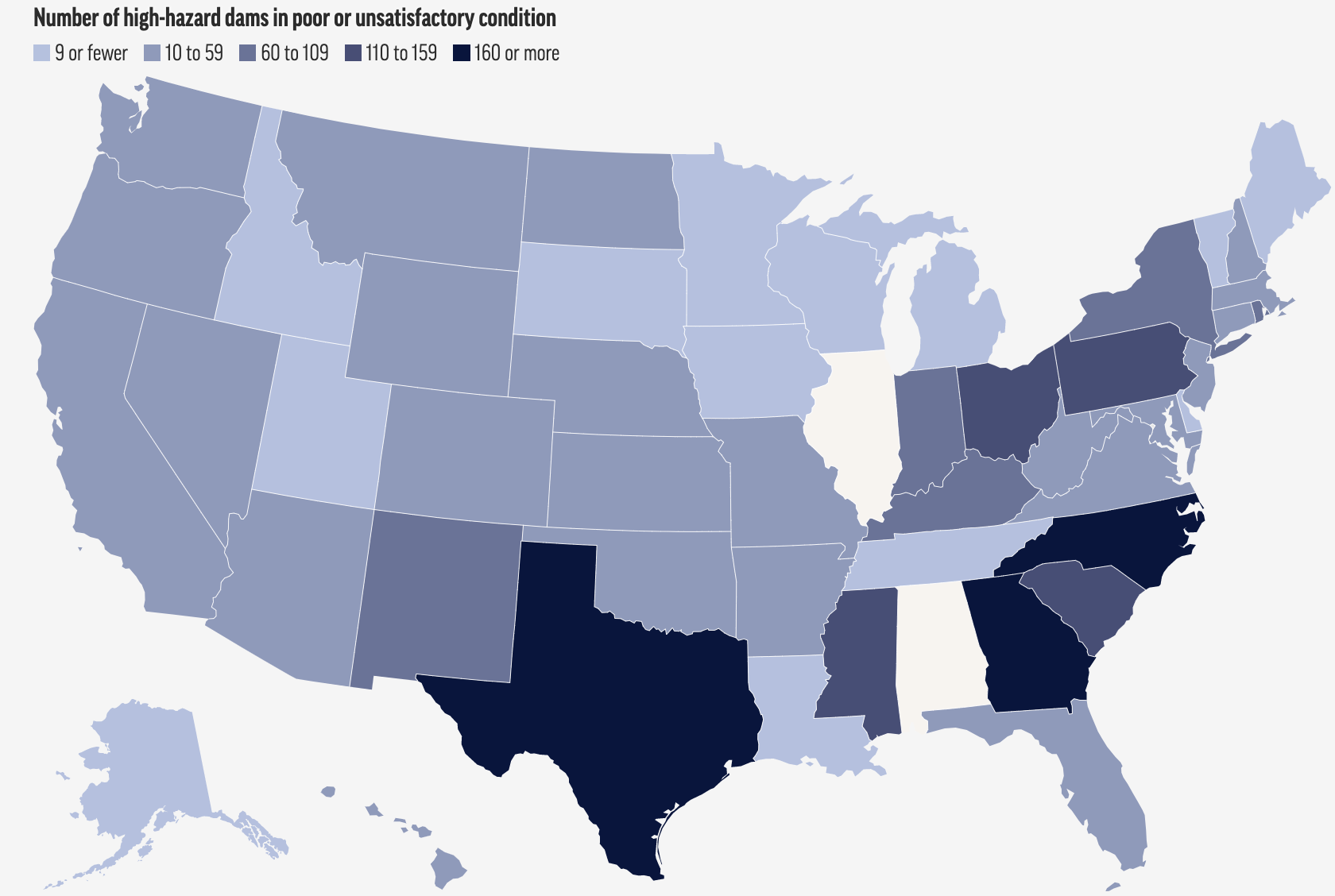
More than 2,200 of the nation's 92,000 dams are in poor condition and likely to cause deaths if they fail. Alabama doesn't have a dam safety program and Illinois doesn't assign condition ratings to its dams. (Associated Press map)

"An Associated Press analysis tallied more than 2,200 high-hazard dams in poor or unsatisfactory condition across the U.S. — up substantially from a similar AP review conducted three years ago. The actual number is likely even higher, although it’s unclear because some states don’t track such data and many federal agencies refuse to release details about their dams’ conditions," David Lieb, Michael Casey and Michelle Minkoff report for The Associated Press. The U.S. Army Corps of Engineers maintains the National Inventory of Dams, a federal database that discloses the condition and hazard rating of most dams nationwide, but it doesn't list data for many prominent dams such as Hoover Dam or California's Oroville Dam. More than 180,000 residents near Oroville had to evacuate in 2017 after its spillway failed. The dam was found to be poorly designed, built and maintained.

"The nation’s dams are on average over a half-century old and often present more of a hazard than envisioned when designed because homes, businesses or highways have cropped up below them. Meanwhile, a warming atmosphere can bring stronger storms with heavier rainfall that could overwhelm aging dams," AP reports. "Decades of deferred maintenance has worsened the problem. But a changing climate and extreme floods — such as the one that caused the failure of two Michigan dams and the evacuation of 10,000 people in 2020 — have brought a renewed focus to an often overlooked aspect of America’s critical infrastructure."

Last year's $1 trillion infrastructure bill allotted about $3 billion into dam-related projects, including repairs and state dam safety programs. "Yet it’s still just a fraction of the nearly $76 billion needed to fix the almost 89,000 dams owned by individuals, companies, community associations, state and local governments, and other entities besides the federal government, according to a report by the Association of State Dam Safety Officials."

Some states are trying to deal with dam problems, but it can be difficult. "Addressing the problems posed by old, unsafe dams can be challenging. Repairs can be costly and take years to complete," AP reports. "Attempts to remove dams — and empty the lakes they hold back — can spawn legal battles and a public outcry from those who rely on them for recreation or to sustain nearby property values."

Wednesday, August 11, 2021

Infrastructure bill has provisions for abandoned mine and well reclamation, dangerous dam removal, and more

The infrastructure package the Senate passed Tuesday has plenty in it for rural America. The Rural Blog has previously reported on this, but some parts of the huge bill are still coming to light. 

The package allocates $11.3 billion to help clean up abandoned mines, nearly double the $6 billion the Abandoned Mine Reclamation Fund has received in the past 15 years (see p. 1776 of the bill) but short of the estimated $20 billion (click here for state estimates) needed for total clean-up costs.

The package also has $4.7 billion for plugging and reclaiming abandoned oil and gas wells on federal, state and tribal lands (p. 1744). States can apply for competitive grants of up to $25 million for the purpose. Well and mine operators must post bonds meant to cover clean-up costs, but they're often inadequate, and rural governments are frequently stuck with the bill when companies go under.

The mine funding will be spread over 15 years and will go to 25 states and three tribes: Alabama, Alaska, Arkansas, Colorado, Illinois, Indiana, Iowa, Kansas, Kentucky, Louisiana, Maryland, Mississippi, Missouri, Montana, New Mexico, North Dakota, Ohio, Oklahoma, Pennsylvania, Tennessee, Texas, Utah, Virginia, West Virginia, Wyoming, and the Crow, Hopi and Navajo.

Dam safety also gets attention in the bill: It creates and funds a $553 million grant program for hydroelectric dam owners to make them safer and more efficient. And it would provide $1.6 billion for government agencies to remove dangerous dams. 

The package calls on the Transportation Department's Build America Bureau to establish a Rural and Tribal Assistance Pilot Program to provide technical, financial and legal assistance to rural and tribal governments' infrastructure projects. The pilot program is meant to last five years, and is funded as follows: $1.6 million for fiscal year 2022, $1.8 million for FY 2023, $2 million for FY 2024, $2.2 million for FY 2025, and $2.4 million for FY 2026.

Thursday, May 21, 2020

Failure of 95-year-old dam in rural Michigan draws fresh attention to the nation's crumbling dam infrastructure

Water breaches the Edenville Dam in Michigan on Wednesday, May 20. (CNN photo by Sarah Tilotta)
Thousands of Michigan residents were forced to flee their homes yesterday evening after heavy rains caused the Edenville Dam to fail. The hydroelectric dam unleashed so much water down the Tittabawassee River that the 2,600-acre Wixom Lake essentially drained itself and breached the nearby Sanford Dam as well, Paul Murphy reports for CNN. Most of Midland, a city of 41,000 downstream, was told to evacuate.

The incident highlights the poor condition of many of the nation's dams, and the difficulty of regulating privately owned dams. According to the National Inventory of Dams, the Edenville and Sanford dams are both privately owned by Boyce Hydro Power LLC ; both were built in 1925, and both were last inspected on June 26, 2018, and rated as a high hazard to the public if they fail.

About 64 percent of the nation's 91,000 dams are privately owned, which can make them trickier to regulate. It's difficult for "regulators to require improvements from operators who are unable or unwilling to pay the steep costs," David Lieb, Michael Casey, and Michelle Minkoff report for The Associated Press.

Another problem is that the nation's dams are aging: 69% were built before 1970, and 17.1% are high-hazard. The Association of State Dam Safety Officials estimates that it would take more than $70 billion to modernize the nation's dams, the AP reports.
Federal Emergency Management Agency map, based on U.S. Army Corps of Engineers data

Friday, January 10, 2020

Trump administration proposal would nix federal environmental reviews for most construction projects

"The Trump administration on Thursday unveiled significant changes to the nation’s landmark environmental law that would make it easier for federal agencies to approve infrastructure projects without considering climate change," Emma Newburger reports for CNBC. The administration has argued that the overhaul is necessary to help businesses grow and protect jobs.

Under the White House Council on Environmental Quality's proposed changes to the 50-year-old National Environmental Policy Act, construction projects that don't have major government funding would no longer require any kind of federal environmental review. The category of NEPA-exempt projects would also be expanded, Newburger reports.

Response to the proposal was sharply divided. Business groups lauded it because they say the law has delayed or blocked projects like oil pipelines, dams, mines, and more. Environmentalists said the changes would hurt wildlife and put more greenhouse gases into the air, Newburger reports. 

"The move is the latest effort by the Trump administration to roll back a slew of environmental regulations in place to curb greenhouse gas emissions and protect natural habitats from drilling and development," Newburger reports. "The changes are expected to be published in the Federal Register on Friday. There will be a 60-day comment period and two open hearings before the final regulation is delivered." If approved, the proposed changes would be the first major overhaul to the rules in more than 40 years. Lawsuits are expected.

Friday, March 29, 2019

FEMA denies half the money California requested to repair partially failed dam; may be a signal to other states

Thousands of dams in the U.S. are deemed at risk of catastrophic failure (Federal Emergency Management Agency map)
After the Federal Emergency Management Agency denied about half the money California requested to repair a dam, "state and local governments can no longer assume the federal government will cover the costs of disasters it deems caused by deferred maintenance," Dave Nyczepir reports for Route Fifty.

Sperling's Best Places map
Heavy rains damaged the spillway on the Oroville Dam, triggering a flood that forced more than 180,000 residents to evacuate in February 2017. The state requested $639 million for repairs, but last week FEMA notified the state Department of Water Resources that it would only provide $333 million. FEMA said the state should have addressed preexisting structural problems to the dam, Nyczepir reports. A 2018 report found that the dam had problems not just with maintenance, but with design and construction.

"The state agency plans to appeal the decision to FEMA for itself and 29 local water contractors, wholesalers that supply treated water," Nyczepir reports. "But FEMA has made clear state and local governments should expedite repair or replacement of aging infrastructure before it fails."

FEMA's decision could be a warning to other states, all of which have dams considered at high risk of catastrophic failure. 

Thursday, September 20, 2018

Florence floods put stress on North Carolina dams, call attention to the poor shape of nation's dams

A map of U.S. dams shows that many are rated "high hazard.
(Federal Emergency Management Agency map)
Devastating flooding in North Carolina in the aftermath of Hurricane Florence has raised concerns about whether dams across the state, some of them already in poor condition, will be able to hold up under the strain," reports Sarah Rankin of The Associated Press. "State and local officials have been monitoring dam safety and say there have been at least two breaches so far that caused no major issues. But there have been several other locations of concern and false alarms about dam failures that have caused panic."

Of North Carolina's 5,700 dams, 1,445 have been rated high-hazard -- that is, their failure would likely kill at least one person. According to the Army Corps of EngineersNational Inventory of Dams, recent inspections showed that 185 of those high-hazard dams were in poor or unsatisfactory condition; many were in flooded areas, Rankin reports. Before Florence hit, state Dam Safety Program workers tried to reduce the likelihood of dam failure by contacting dam owners and operators to inform them of the threat and ask them to lower water levels temporarily to make room for heavy rains, she reports. 

But though North Carolina appears to have pulled through Florence without major dam failure, the hurricane draws attention to the poor condition of dams nationwide. "The American Society of Civil Engineers gave a 'D' grade to the state of the country’s dams in a 2017 report, noting the average age of the dams is 56 years old," Rankin reports. "The ASCE estimated there are more than 2,000 'deficient high-hazard' dams lacking investment in repairs and upgrades." Along with earthquakes and age, flooding is a leading cause of dam failure, she reports. And as climate change makes extreme weather more common, the risk of dam failure grows.

Monday, January 08, 2018

Probe finds 'long-term systemic failure' in Calif. dam disaster

Dams ranked by hazard (FEMA map; click on the image for a larger version)
Independent investigators released their final report Jan. 5 on the flood at a northern California dam in February 2017. "In a 584-page dissection of the disaster at America's tallest dam, the investigative team said Oroville Dam was designed and built with flaws from the beginning, which were exacerbated by inadequate repairs in the years that followed," Dale Kasler reports for the Sacramento Bee. The investigation team was six independent engineering consultants from around the country.

Nearly 200,000 people were evacuated downstream in early February 2017 when engineers discovered damage to the spillways after heavy rains. Repair of the dam is estimated to cost $500 million. The dam was inspected regularly before the disaster, but in the interim report released Sept. 5, investigators said the inspectors relied too heavily on visual inspections. "Due to the unrecognized inherent vulnerability of the design and as-constructed conditions and the chute slab deterioration, the spillway chute slab failure, although inevitable, was unexpected," the panel report said.

The investigators also warned the entire dam industry to pay attention, since about 14,000 of the more than 87,000 dams in the U.S. are classified as "high hazard potential".

Wednesday, November 22, 2017

Texas paper points out risks of many dams, lack of state inspection, public records and awareness

Federal Emergency Management Agency map; click on it to see a larger version
The near-disaster at California's Oroville dam and the disaster of Hurricane Harvey in Texas prompted the Austin American-Statesman to do what news outlets all over the country should do on a regular basis: alert their audiences to the dangers of dams that are classified as "high hazard" by state and federal officials.

Texas has "several hundred substandard dams upstream of populated areas in Texas that violate state law intended to guard against dam breaching, or failure, in catastrophic floods," Ralph K.M. Haurwitz reports. "The adequacy of hundreds more dams that could put people in harm’s way is unknown because they haven’t been studied. . . . A state law passed by the Legislature and signed by then-Gov. Rick Perry in 2013 permanently exempts 45 percent of the dams in Texas from inspections and other safety requirements because of their relatively small size and rural locations."

Awareness of the risks appears to be low. "Few people who could be at risk are aware of the hazard of living in what engineers call the potential inundation zone, which includes areas well outside the 100-year flood plain," Haurwitz writes. "Lack of public awareness about the hazards posed by dams is no accident. After the terrorist attacks of Sept. 11, 2001, federal and state officials, citing security concerns, have restricted the ability of news organizations and the public to obtain information about the hazards posed by many dams."

And the problem in Texas is probably worse that it might seem, because the state "applies its strictest safety standards only if a dam’s failure would probably cost seven or more lives," the Statesman reports. Some states doubtless do likewise. What about yours?

Tuesday, October 24, 2017

Repair of near-collapsed dam to cost $500 million; U.S. has thousands of aging, high-hazard dams

Construction crews repair the Oroville Dam
(Photo by Calif. Dept. of Water Resources)
"The costs to repair the nation's tallest dam after a nearly catastrophic failure of the spillways will top $500 million, nearly double the original estimate of $275 million," Jonathan Cooper reports for The Associated Press. When the spillways for the 770-foot tall Oroville Dam ruptured in February, nearly 200,000 people were evacuated while the dam was stabilized.

But that $500 million figure only includes repair costs by the main construction contractor, Kiewit Corp. The state will also have to pay for other contractors as well as the emergency responders who helped in the immediate aftermath of the disaster. Erin Mellon, a spokesperson for the California Department of Water Resources, said the cost for the emergency responders alone is estimated at $140 million to $160 million.

The Federal Emergency Management Agency has reimbursed some of the costs for the emergency response, but it's unclear whether it will fund long-term repair work. California state officials say they hope FEMA will pay up to 75 percent of that bill, Cooper reports.

The narrowly-avoided disaster calls attention to the nation's aging dam system. The U.S. has thousands of high-hazard dams, and visual inspections alone can't predict if a dam is in danger of failing. Even small dams can cause major damage when hit by powerful storms. And because of climate change, even more extreme weather is likely on its way. That's prompted calls for more federal involvement in design and operations parameters for dams, Jeremy Jacobs reports for Energy & Environment News. The federal Bureau of Reclamation has a program to do just that, but President Trump's 2018 budget proposal calls for eliminating the program's budget, which ranges from $1.5 million to $3 million.

Thursday, September 07, 2017

Calif. dam investigators say visual inspections can't predict failure, and could be a nationwide problem

Forensic investigators say there were plenty of red flags that could have alerted inspectors before the , disastrous flood from California's Oroville Dam, and they hope other dam inspectors are paying attention. In an interim report Sept. 5, investigators said "The state and federal officials who inspected Oroville Dam relied too heavily on visual inspections, ignoring blueprints, construction records and other documented clues that could have warned them about the dam’s troubled flood-control spillway long before it fractured in February. The fracture led to near-catastrophe and the evacuation of thousands of residents," Dale Kasler and Ryan Sabalow report for The Sacramento Bee.
Many U.S. dams are rated "high hazard." Click on FEMA map to enlarge it.
The investigators were hired by the state's Department of Water Resources to study the cause of the flood. They aid the spillway fracture was probably caused by cracks in the concrete and a faulty drainage system under a sometimes too-thin concrete chute. "Visual inspections alone, conducted annually by DWR and once every five years by the federal government, wouldn’t allow regulators to pull all the clues together and point to the likelihood of failure," the Bee reports.

The investigators say similar problems could be happening in other dams all over the country, and inspectors may not catch them if they continue to overrely on visual inspections. "The panel called on regulators to supplement visual checks with painstaking reviews of original design and construction specifications, as well as maintenance records, with an eye toward finding 'design shortcomings' that contrast with current state-of-the-art practices," the Bee reports. "The reviews should go beyond spillways and take in the entire dam structure."

Federal dam inspections are handled by the Federal Energy Regulatory Commission. In May, FERC said it was re-evaluating dam safety inspections because of Oroville. FERC's most recent inspection of the Oroville dam in 2014 "concluded that the a failure of the flood-control spillway at Oroville was so unlikely that there was no need to plan for such an emergency," the Bee reports.

Tuesday, August 01, 2017

States paying more attention to risky dams

The Federal Emergency Management Agency classified about 14,000 of the more than 87,000 dams in the U.S. as "high hazard potential" in 2016, and some states are taking it seriously.
A map of U.S. dams shows that many are rated "high hazard." (FEMA map)
California officials have ordered the owners of 93 dams, many of them utility companies, to inspect their flood-control spillways. The inspection was prompted in part by the failure of the Oroville Dam north of Sacramento in February, which caused 188,000 downstream citizens in small towns and rural areas near the dam to evacuate. The list of dams to be inspected includes some of the largest in California, but the number is still less than 10 percent of the 1,250 dams overseen by the state's Department for Water Resources dam safety division, Dale Kasler and Ryan Sabalow report for The Sacramento Bee. The dam safety division wrote in a letter to the dam owners that preliminary assessments of the dams, which are 70 years old on average, "may have potential geologic, structural or performance issues that could jeopardize its ability to safely pass a flood event."

In Virginia, about $1.15 million in state grants has recently been dedicated to upgrading 72 dams in the state. More than half are classified as "high hazard", which means they pose the greatest threat to life and property if they fail, Spencer Burke reports for WVIR-TV in Charlottesville. Albemarle County Environmental Services Chief Greg Harper told Burke, "Some of the dams around here started out as being farm ponds, so a lot of the construction techniques maybe weren't that great."

In Kentucky, where the eastern coalfield has many dams rated as high hazards, the U.S. Department of Homeland Security Science & Technology Directorate awarded the state Division of Water a $200,000 grant for a pilot project on dam safety. The funds are to be used to research and "develop instrumentation monitoring and flood warning systems for dams," The Associated Press reports. The state anticipates additional funding in 2018 to execute the plan on a state-owned dam.

In Oregon, legislators have approved a bill that would "require the owners or operators of high-hazard dams to develop emergency action plans for their structures," Michael Harris reports for HydroWorld.

Read more here: http://www.sacbee.com/news/state/california/water-and-drought/article164021327.html#storylink=cp

Wednesday, March 22, 2017

It's World Water Day, so we're looking at U.S. water policy and infrastructure

With today being World Water Day and this week, March 19-25, being Water Week 2017, Alison Burke, of the Brookings Institution, has put together a list of facts about water policy and infrastructure in the U.S.

Thirty "of the country’s largest water utilities support up to $52 billion in economic output and 289,000 jobs annually, and millions of households, businesses and industries depend on water systems every day," Burke writes. "The federal government actually plays a small role relative to states and localities, which are responsible for almost 96 percent of public spending on drinking water and wastewater facilities nationally each year."

One problem with investing in water is that the nearly 52,000 community water systems in the U.S. "frequently cross geographic and political boundaries and touch multiple watersheds and users," she writes. Another problem is modernizing facilities. "While more than 88 percent of Americans believe some type of action is needed to solve the country’s water infrastructure challenges, only about 17 percent of utilities are confident that they can just cover the cost of existing service through rates and fees—let alone pursue needed upgrades."

Another problem is that 64.2 percent of the nation's 90,000 dams are privately owned, compared to 20 percent by local government, 7.3 percent by state government and 3.7 percent by the federal government, Burke writes. Also, 62,700 of dams, or 69.3 percent, "were built before 1970, and 17.1 percent pose a potentially 'high hazard' to the economy, environment, and human life if they were to fail." (Brookings graphic: Dams built before 1970)

Monday, March 20, 2017

Administration lists top 50 infrastructure projects, many for rural areas, but McConnell is skeptical

One of Trump's top infrastructure projects calls
for repairs of Interstate 95 through North Carolina
The Trump administration recently released a priority list of 50 infrastructure projects, including several that would benefit rural areas, report Lynn Horsley, Steve Vockrodt, Walker Orenstein and Linsday Wise of McClatchy Newspapers: "The preliminary list offers a first glimpse at which projects around the country might get funding if Trump follows through on his campaign promise to renew America’s crumbling highways, airports, dams and bridges."

The No. 1 project is the Gateway Program, which would be a $12 billion reconstruction of high-risk Northeast Corridor rail infrastructure between Newark, N.J. and New York City. Second on the list is the Brent Spence Bridge, a $2.5 billion project to fix the nation's 15th worst bridge on I-75 between Northern Kentucky and Cincinnati. Next is $2 billion to construct the National Research Lab for Infrastructure in Columbus, Ohio, $3 billion to complete the Olmsted Locks and Dam on the Ohio River near the Mississippi to aid barge traffic on the rivers, and $1.5 billion for critical highways repairs on I-95 in North Carolina.

Rounding out the top 10 are $8 billion for bridge repairs on I-95 in Philadelphia, $1 billion for Mississippi River shipping channel dredging in South Louisiana, $10 billion for the NextGen air traffic control system to replace outdated equipment, $2.5 billion for a 720-mile transmission line to move clean, wind power energy from the Oklahoma Panhandle to Memphis, and $3 billion for seven new water tunnels in Cleveland to reduce contaminated water in Lake Erie.

Other projects that could benefit rural areas: $850 million to repair South Carolina dams; $250 million for water recovery in Cadiz, Calif; $3 billion for the TransWest Express Transmission Project to deliver cost-effect renewable energy in Wyoming to desert regions in Arizona, California and Nevada; $5 billion for a wind energy project in Wyoming; $4.5-5 million for the Atlantic Coast Pipeline; $600 million to find new, sustainable water sources in New Mexico; $800 million to widen I-93 in Massachusetts and New Hampshire; $800 million for reconstruction of I-395/I-95; $1 billion to improve the I-70 Mountain Corridor in Colorado; and $1 billion to improve I-25 in Colorado.

But the prospects of a big infrastructure package getting through Congress aren't good, judging from comments Senate Majority Leader Mitch McConnell made in an interview last week with Al Cross, director of the Institute for Rural Journalism and Community Issues and publisher of The Rural Blog.

"We’re not interested in going out and borrowing money and plussing up a bunch of federal accounts," McConnell said. "A credible infrastructure bill has to be paid for, and the two ways to pay for it are both challenging politically. The Democrats don’t like public-private partnerships, which invariably means tolling. Everybody’s queasy about a gas-tax increase because of the way lower middle-class people have fallen behind over the last eight years. . . . Everybody loves roads, everybody loves buildings, but it’s going to have to be credibly paid for to be passed by this Congress."

Asked if he wanted want no sort of federal appropriations that would add to the deficit to build infrastructure, McConnell replied, "No. We need to pay for it. We’ve got a $21 trillion debt." Told that some research has shown better infrastructure improves economic productivity, he replied, "You can argue that, but we’ve got a $21 trillion debt, and about half of it we’ve accumulated in eight years, and I think we have a dangerous level of debt to GDP [gross domestic product] and I don’t think this particular Congress is going to be interested in making it worse."

Public-private partnerships are less feasible in rural areas because investors need high volume to pay tolls or other fees to recoup their investment, Ashley Halsey reported for The Washington Post last month.

Friday, February 24, 2017

More than 70% of U.S. dams will be 50 years old by 2020; thousands in need of repairs

U.S. dams are getting older and creating hazardous conditions like the near disaster in Oroville, Calif., that led to the evacuation of 180,000 people, Troy Griggs, Gregor Aisch and Sarah Almukhtar report for The New York Times. The Association of State Dam Safety Officials in 2015 listed nearly 2,000 state-regulated high-hazard dams in the U.S. as being in need of repair. The American Society of Civil Engineers says that by 2020, 70 percent of U.S. dams will be more than 50 years old. (Times map: Age of major U.S. dams)
In 2016, the Association of State Dam Safety Officials "estimated that it would cost $60 billion to rehabilitate all the dams that needed to be brought up to safe condition, with nearly $20 billion of that sum going toward repair of dams with a high potential for hazard," reports the Times.

The U.S. Army Corps of Engineers says more than 8,000 of the 90,000 dams in its inventory are classified as major dams by height or storage capacity, according to guidelines established by the United States Geological Survey, reports the Times.

Hazard potential for Nevada dams
While the Oroville dam drew national attention, there was another disaster two weeks ago in Nevada when heavy rains caused the Twentyone Mile Dam to burst, "resulting in flooding, damaged property and closed roads throughout the region," reports the Times. The Corps says "The earthen dam, built in the early 1900s and less than 50 feet tall, is one of more than 60,000 'low hazard' dams. Typically, failure of a low hazard dam would cause property damage, but it would most likely not kill anyone."

Monday, February 20, 2017

Oroville dam episode exposes rural-urban conservative-liberal divide in California

Residents of Oroville, Calif., say the near-failure of the nation's tallest dam near their town is an example of how little their state cares about its rural residents, compared to liberals who live in coastal cities and surburbs, Trevor Hughes reports for USA Today. "The liberal, more populated parts of California suck up all the political attention and public dollars, leaving little for the men and women who help grow the nation’s food, fruits and nuts. That dichotomy has bred a mistrust of state government and a healthy skepticism of federal officials, Trump excepted," Hughes writes.

And the bigger question, Oroville residents tell Hughes, is how did state and federal officials seemingly not have the money "to properly fix the dam’s problems when they were first identified, but have seemingly untold millions available when the crisis finally arrived? . . . Statewide, Hillary Clinton clobbered Trump, winning 61 percent of the popular vote and 4.2 million more votes than Trump. On one hand, this is a state that utterly rejected Trump. On the other hand, because California is so big, there’s wide variation in political affiliations," Hughes writes.

Butte County, which includes Oroville, went to Trump 46 percent to 42 percent. Its downstream neighbor, Yuba County, reflected a more rural barometer, favoring Trump at nearly 58 percent, Hughes writes. "Here in inland California, Gov. Jerry Brown’s name evokes disgust, and President Donald Trump is seen as the one who really cares. Here, residents distrust a state government they think is all-too-eager to help undocumented immigrants and build a bullet train to serve the rich coastal elites, leaving them with little."

Brown is seen as "the bad guy" for picking fights with the president over immigration, though Trump has said that California is "out of control," suggesting that he might withhold federal funds Hughes writes.

Butte County Sheriff Kory Honea ordered the evacuation and then spent days defending it against critics on both sides of the aisle, Hughes writes. “We have this longstanding history in our country, based on the idea that people control the government, not the other way around,” Honea said.

State and federal emergency-management agencies waded into the political tension, too, Hughes writes. Craig Fugate, the head of FEMA under President Obama, told Hughes: “Basically, they’re like don’t mess with us. We don’t need you . . . until we need you . . . You have to understand that level of mistrust. It’s not personal.”

"Fugate said the political dynamic in California mirrors that of many states, from his native Florida to the urban-rural divide of Washington state. The Oroville Dam’s potential failure could have been the first major test of the relationship between Trump and outspoken critic Brown, who after opposing the president asked him to declare a disaster in Oroville," Hughes writes. (Read more)

Wednesday, February 15, 2017

Near-disaster at California dam is a reminder that U.S. has thousands of high-hazard dams

Damaged spillway with eroded hillside near Oroville, Calif.
(California Department of Water Resources photo)
The near-disaster at Oroville Dam, which caused the evacuation of 188,000 people in Butte County, California, northeast of Sacramento, should be a reminder that the U.S. has many dams that are considered serious hazards.

As dams get older, experts say a growing number of people downstream are at risk, USA Today reports: "Among those high-hazard dams, nearly 1 in 5 lack an emergency action plan," and "the average age of the United States' 84,000 dams is 52, according to the American Society of Civil Engineers' report." The Federal Emergency Management Administration explains how dams are rated for hazards, and states have lists of dams and their ratings.

The Oroville episode is an example of how changing weather patterns are affecting dam safety, Anne C. Mulkern reports for Climatewire. Daniel Swain, a climate scientist at UCLA, said "a series of storms powered by a phenomenon known as the atmospheric river hit Northern California this winter. Those filled Oroville, prompting the release of water onto its spillway. Then that structure suffered a sinkhole that became apparent last week."

Dam operators last weekend "stopped sending water down the spillway, and flows crested the alternate 'emergency' spillway, essentially a hillside," Mulkern writes. "When that caused soil erosion headward, or in the direction toward the structure, dam officials feared the concrete spillway would collapse, sending a 30-foot wall of water downstream, causing 'catastrophic flooding,' Democratic Gov. Jerry Brown said in a letter to President Trump." The 770-foot-high dam is the tallest in the U.S.

Best Places map
The near-disaster didn't come as a surprise to environmentalists, Jeremy P. Jacobs and Hannah Northey report for Greenwire. In 2005 Friends of the River, the Sierra Club and the South Yuba River Citizens League predicted such as event. "They spoke directly to what would happen if the concrete lip became compromised, a situation they called 'loss of crest control,'" which "could not only cause additional damage to project lands but also cause damages and threaten lives in the protected floodplain downstream."

A July 27, 2006 memo from John Onderdonk, a senior civil engineer with the Federal Energy Regulatory Commission's Dam Safety and Inspections, "said that if the emergency spillway were to be used, it 'would not affect reservoir control or endanger the dam,'' reports Greenwire. "He also said 'in the rare event of a discharge, the emergency spillway would perform as designed' and could conceivably handle a flow of water at a rate of 350,000 cubic feet per second. But last weekend, water flowed down the emergency hillside spillway at a maximum rate of about 12,000 cubic feet per second—a far lower rate—and significant erosion occurred."

Wednesday, December 23, 2015

National Inventory of Dams is the place to go for journalists looking for data on local dams

The National Inventory of Dams (NID) is a great resource for journalists writing about any of the more than 85,000 dams in the U.S., Liz Lucas and Andrew Kreighbaum report for the Society of Environmental Journalists in the Winter 2015/16 edition of SEJournal. "With the 1972 National Dam Inspection Act, Congress required the U.S. Army Corps of Engineers to inspect every dam in the U.S. But because of a lack of funding and other issues, the requirement was never fulfilled. Instead, the act led to creation of the NID, which is based on information from inspections completed by both federal and state regulatory agencies."

NID should contain information on: High hazard classification (loss of human life is likely if the dam fails); significant hazard classification (possible loss of human life and likely significant property or environmental destruction if the dam fails); equal or exceed 25 feet in height and exceed 15 acre-feet in storage; and equal or exceed 50 acre-feet storage and exceed six feet in height. The database has been a resource for many stories, including this report from KVUE-TV in Austin:

"There are about 70 fields in NID, including key pieces of information, such as owner name and owner type (private or state-owned), inspection date, height and storage levels, river or stream on which the dam is built, longitude and latitude and year of construction," Lucas and Kreighbaum write. "A list of detailed field definitions is included in the files provided in the NID database. Because the data includes many technical terms, reporters should probably consult and engineer at some point in their reporting to provide perspective."

Also included are the number of dams in each state and what percent of those dams are high hazard, Lucas and Kreighbaum write. "If you want to zero in on individual dams, the NID is a good starting place, but you'll have to seek additional documentation on individual dam hazards and the results of inspections. But the NID can help you figure out which dams to start investigating." The current issue of SEJ is by subscription only. Past issues can be read by clicking here. (Wikipedia map: U.S. dams)

Tuesday, May 06, 2014

Feds measure potential hydroelectric power sources

Generating untapped hydropower in the Grand Canyon and other major gorges and rivers for renewable energy could help offset climate change, according to a report by the U.S. Department of Energy.

American rivers and streams "have 84.7 GW (gigawatts) hydropower capacity, enough to generate 460 terawatt hours of electricity annually" that is not being used, Bobbg Magill reports for Climate Central. "Subtracting protected areas such as the Grand Canyon, the U.S. has 65 GW of untapped hydropower capacity, if all the streams with hydropower potential were eventually developed, according to the DOE study." (Colorado, Idaho, Montana, Oregon and Washington have the greatest hydropower potential, while Delaware, New Jersey and Rhode Island have the least; click on image for larger version)
"One gigawatt of hydropower can provide electricity for more than 700,000 homes," Magill writes. "Currently, hydropower totals 7 percent of total U.S. electric power production, and full build-out of all the sites that would total 65 GW of capacity would nearly double total U.S. hydropower generation, according to the DOE."

"While it is highly unlikely that the U.S. would ever fully build out its hydropower potential because of high regulatory hurdles and the environmental consequences of damming or diverting water from rivers or expanding existing hydropower facilities, the DOE is suggesting that at least some development will help reduce reliance on fossil fuels for electric power generation," Magill writes. (Read more)