Showing posts with label hydroelectric power. Show all posts

Tuesday, June 27, 2023

Sun and wind power surpass coal; it's a first for the two renewables combined without adding hydropower

Solar panels in a California desert at sunset.
(Photo by thinkreaction/Getty Images via E&E)
For the first time, solar and wind have generated more U.S. power than coal as measured during the first five months of 2023, reports Benjamin Storrow of Climatewire: "Federal data shows renewable energy generation exceeded coal-fired power in 2020 and 2022, but only when hydropower was counted as a source of renewable energy, according to figures compiled by the Energy Information Administration."

Storrow reports, "The milestone illustrates the ongoing transformation of the U.S. power sector as the nation races to install cleaner forms of energy to reduce greenhouse gas emissions from fossil fuels. Power markets have witnessed a precipitous drop in coal-fired generation this year, driven by low natural gas prices, a mild winter and a wave of coal plant retirements." Andy Blumenfeld, an analyst who tracks the coal industry, told Storrow, "From a coal perspective, it has been a disaster. The decline is happening faster than anyone anticipated."

Coal has been in decline since 2008 "as a wave of older coal facilities retired and was replaced by a combination of natural gas and renewables," Storrow explains. "Yet even by that standard, coal's sudden drop in 2023 has been remarkable." In 2022, the war in Ukraine caused a temporary increase in coal prices, but now, "coal plants will have difficulty competing against gas in that market, analysts said. But structural factors have also contributed to the fall in coal output. . . The U.S. has retired around 14 gigawatts of coal capacity, or roughly 7 percent of the coal fleet, since the start of 2022. . . . EIA figures show that coal was down 27 percent compared with the same time last year and below levels recorded in 2020."

The quick switch to renewables has some experts worried about the reliability "of the country's web of power grids," Storrow reports. "In recent testimony to Senate lawmakers, North American Electric Reliability Corp. CEO Jim Robb said, 'The pace of change is overtaking the reliability needs of the system.' . . . Others said those worries could be eased by unclogging a bottleneck that's preventing clean energy projects from connecting to the grid." Still, the switch "is a boost to U.S. climate efforts. Coal accounted for 55 percent of power sector emissions in 2022, according to Environmental Protection Agency data, despite representing just 20 percent of total power generation. . . . Carbon Monitor, an emissions tracker run by academics, estimates U.S. emissions were down 5.6 percent through April compared with the same time in 2022. Power sector emissions were down by nearly 1 percent."

Friday, May 20, 2022

Quick hits: Statewide News Collective launched; how to grow huge tomatoes; tips for buying and selling rural land

Here's a roundup of stories with rural resonance; if you do or see similar work that should be shared on The Rural Blog, email us at heather.chapman@uky.edu.

The Statewide News Collective, a new consortium for news organizations that serve statewide audiences or sometimes cover statewide issues, has just launched. Read more here.

Many of the nation's dams need repair. Retrofitting some to produce hydroelectric power could help the nation become more energy-independent while strengthening infrastructure. Read more here.

Want to grow huge tomatoes this summer? Here are seven tips for how to do it. Read more here.

A study shows California's record-breaking wildfire season may be the new normal. Read more here.

If you're buying or selling rural land this year, here's some tips on how to get the best return on your investment. Read more here.

Tuesday, November 30, 2021

Coal prices highest in more than a decade as stockpiles dwindle after hot, dry summer boosted use of electricity

"Coal piles at power plants have dwindled to their lowest point since the 1970s, and the race to build up inventories ahead of heating season has sent domestic thermal-coal prices to their highest levels in more than a decade," Ryan Dezember reports for The Wall Street Journal. "Inventories in the U.S. power sector are about two-thirds of the five-year average for this time of year, according to the Energy Information Administration. Richard Nixon was in the White House the last time there was so little on hand, EIA data show."

Extreme weather driven by climate change bears some of the blame: "A lot of coal was burned this summer to power air conditioning during some of the hottest weather on record," Dezember reports. "The western drought reduced hydropower output, and coal plugged some of the generation gap, along with natural gas. The price of gas, which started out the heating season at its highest in more than a decade, has made switching to coal attractive to power producers that can burn both."

Most coal is sold in advance, and there isn't much available to buy for immediate use. "Coal has lost market share to natural gas, wind farms and solar installations over the past decade, drying up financing for speculative production," and it's challenging to produce more than previously set quotas, Dezember reports. "Backed up ports and railways would make delivery difficult, even if there were more coal coming out of mines."

Gas and renewable energy have increasingly crowded out coal's market share and depressed its production, Dezember reports, "yet coal remains an important source of power generation, serving as a swing fuel to augment other sources when output from renewable sources, like wind farms, is insufficient or natural-gas prices are high, as they are today."

Wednesday, October 13, 2021

Markets, not politics, rule coal business; consumption and prices are up, especially in Central Appalachia, a sore spot

Bloomberg graph, adapted by The Rural Blog
Burning coal for energy in the United States has rebounded under President Biden in a way it never did under Donald Trump, who promised to revive the industry, Will Wade of Bloomberg reports.

"U.S. power plants are on track to burn 23% more coal this year, the first increase since 2013, despite Biden’s ambitious plan to eliminate carbon emissions from the power grid. The rebound comes after consumption by utilities plunged 36% under Trump, who slashed environmental regulations in an unsuccessful effort to boost the fuel," Wade reports.

"The boom is being driven by surging natural gas prices and a global energy crisis that’s forcing countries to burn dirtier fuels to keep up with demand. It’s also a stark reminder that government policy can steer energy markets, but it can’t control them. . . . As the world emerges from the coronavirus pandemic, reopening economies are driving a huge rebound for power demand. But natural gas is in short supply, creating shortfalls at a time when wind and hydro have been unreliable in some regions."

Central Appalachia, the major coal region that has been hurt most by the decade of downturn under Trump and Barack Obama, the most anti-coal president ever, has benefited most from the rebound. Coal prices there have risen 39% since Jan. 1 to $75.50 a ton, the highest since May 2019, Wade reports: "Prices in other regions are lower, but also on the rise."

Coal is a boom-and-bust business, but the trend is expected to continue, due to market forces and forecasts of a colder-than-usual winter. "Demand for coal will likely remain strong into next year, said Ernie Thrasher, CEO of Xcoal Energy & Resources, the biggest U.S. exporter of the fuel," Wade reports. "Supply is already constrained, and Thrasher said he’s hearing some utilities express concern that they may face fuel shortages over the next several months as colder weather pushes energy demand higher to heat homes."

Friday, May 29, 2020

Owners of failed dam in rural Michigan bought it as a tax shelter, ignored needed fixes to save money

An explosive new report underlines the difficulty of regulating private dams, which make up about 64 percent of the nation's 91,000 dams.

Last week, the 95-year-old Edenville Dam in rural Michigan failed after heavy rains, forcing thousands of residents downstream to evacuate. The disaster put a spotlight on the nation's crumbling dam system, especially the fact that it's more difficult for regulators to force private dam owners to make needed repairs.

The Edenville Dam's owners, it turns out, had bought the dam and three others nearby in 2006 as a tax shelter, then fought with regulators for years to avoid having to pay for repairs, taxes, or upgrades to make the dam safer, Mike Wilkinson, Kelly House and Riley Beggin report for Bridge, a nonpartisan, nonprofit Michigan newsroom.

Heirs to William Boyce, a Chicago newspaper publisher and founder of the Boy Scouts of America, managed the fortune as trustees of the William D. Boyce Trusts. In 2006 they decided to reinvest money from the sale of an Illinois property so they wouldn't have to pay $600,000 in capital gains taxes to the Internal Revenue Service, Bridge reports. The two lead trustees, Las Vegas architect Lee Mueller and his cousin Michel d'Avenas came up with the notion to buy four hydroelectric dams near Midland under the name Boyce Hydro Power LLC, which Mueller manages. They took out loans to pay the $4.8 million for the dams.

"In the 14 years that have followed, Mueller and the trust have clashed repeatedly with state officials, federal regulators, local homeowners and even fishermen," Bridge reports.

The Federal Energy Regulatory Commission told Mueller and previous owners since at least 1993 that the Edenville Dam needed to have its flood capacity increased or it could fail. Last week's "flood came 1½ years after federal regulators terminated Boyce Hydro’s license to generate power at the Edenville Dam, citing decades of failures to fix spillways that can prevent flooding," Bridge reports.

Mueller's attorney told Bridge that Mueller would have liked to make the repairs, but didn't have the money. According to Boyce Trust records filed in court, the dams have lost money every year since at least 2016, Bridge reports.

"Residents who live on lakes surrounding the dams are dubious about the pleas of poverty and accuse Mueller and the Boyce Trust of being absentee owners who for years didn’t invest in repairs," Bridge reports.

Wednesday, January 29, 2020

TVA must do more to generate clean energy, write energy analyst and former environmental reporter

As part of his "Green New Deal" plan, Democratic presidential primary candidate Bernie Sanders wants the Tennessee Valley Authority to shut down all its fossil fuel-burning plants and generate electricity solely from renewable sources. TVA currently operates six coal-fired power plants, 17 natural gas plants, and one diesel generator site. The rest of its power comes from nuclear, hydroelectric, solar, wind and biogas.

That may seem fanciful, but two writers say in The New York Times that it's not a bad idea for TVA focus on clean energy generation. Justin Gillis is a former Times environmental reporter; Jameson McBride is an energy analyst at the Breakthrough Institute, an environmental research center.

TVA, which sells power across parts of seven states, has a history of polluting waterways and property by improperly storing the toxic coal ash generated by its coal-fired power plants, they write: "In December 2008, an immense spill of coal ash at a TVA plant in Kingston, Tenn., polluted a nearby river and caused millions of dollars of property damage. The TVA had failed to carry out elementary safety measures, and the lead cleanup contractor was found negligent in court. Many workers on the cleanup have fallen ill and close to 40 have died; how much responsibility the contractor bears for the deaths is still being contested in court."

Though TVA is moving away from coal, and generates the lion's share of its electricity from nuclear power, Gillis and McBride write that the federal utility is moving too slowly to build more wind and solar generators. The modest solar buildout the agency's has adopted will result in higher electric bills for TVA customers than those who buy from other producers, they believe.

The biggest problem is that TVA has no central boss to drive change; just board members appointed by the president. "So the agency, long dominated by a conservative engineering mind-set, has gotten little pressure from Washington to move faster on the energy transition. But it is starting to get pressure from the other direction: cities that buy power wholesale and resell it to their citizens. Memphis, for instance, is considering pulling out of the TVA system and cutting its own deals for clean power," Gillis and McBride write.

TVA already has some of the lowest emissions in the country, but it could achieve much more in short order if it wanted to, they write: "The backwardness of the TVA on this issue is not just a national embarrassment; it is a betrayal of the agency’s own progressive legacy as one of the signature creations of the New Deal. The next president, whether Mr. Sanders or somebody else, needs to shake up the TVA board and demand that the agency become a leader, not a laggard, in battling the climate crisis."

Tuesday, December 24, 2019

Energy agency sides with coal and gas over other sources for electricity, says it's leveling the field; consumers will pay

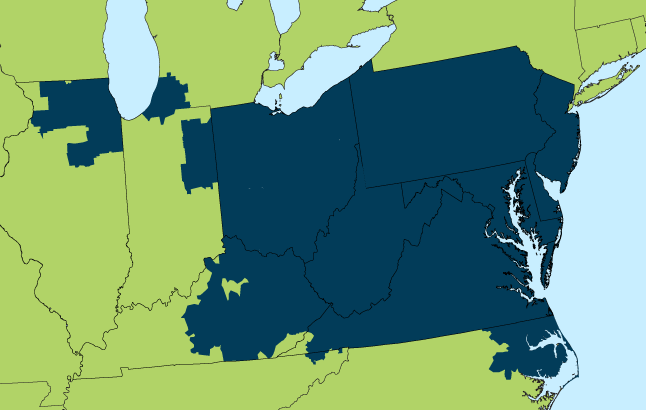
PJM Interconnection's service areas
The Federal Energy Regulatory Commission has approved rules "for the nation's largest electricity market that effectively prop up fossil-fuel power plants and discourage new investments in renewable power, demand-response and energy-storage projects," Rod Kuckro and Jeremy Dillon report for Energy & Environment News.

FERC changed the rules for PJM Interconnection, the largest electric-power manager in North America, "508 days after the agency issued a decision calling the current market rules unjust and unreasonable and directing PJM to devise a fix," E&E reports. "The decision is among the most consequential by the commission since it created regional power markets 20 years ago this week. It's certain to be challenged. . . .The agency gave PJM 90 days to file a response on how it will comply."

The vote was 2-1, along party lines. Dissenting Commissioner Richard Glick called it "a bailout, plain and simple" to the power industry and its suppliers of coal and natural gas. The PJM area has more electric-generating capacity than it needs, and "cheaper renewables and nuclear plants have been crushing conventional fossil fuel resources on price" there, E&E notes. PJM had asked FERC not to force it to buy electricity from aging coal plants.

FERC Chair Neil Chatterjee denied that the move favors fossil fuels over renewables. He and the other Republican commissioner, Bernard McNamee, "argued that state subsidies for nuclear and renewables artificially give those resources a leg up," and said FERC was "leveling the playing field," E&E reports. Glick said the move would cost the 65 million consumers in PJM's area $2.4 billion a year; other estimates were as high as $8 billion.

Wednesday, May 01, 2019

Monthly use of renewable energy outpaced coal for the first time in April (a month of moderate temperatures), feds say

Chart by Energy Information Administration; click the image to enlarge it
For the first time ever, last month renewable energy sources generated more electricity in the U.S. than coal, according to projections by the U.S. Energy Information Administration. The EIA predicts that renewables will outpace coal in May as well, and that coal and renewables will swap ranks several times throughout the coming year, Phil Dzikiy reports for Electrek, a news site that tracks changes from fossil fuel to electric power in transportation. Coal use is generally lowest in April, as temperatures moderate.

"Renewables (including hydro, solar, wind, biomass, and geothermal) are projected to generate more electricity than coal-fired plants in April, according to an analysis of EIA data by the Institute for Energy Economics and Financial Analysis," Dzikiy reports. "Estimates show renewables generating 2,322 and 2,271 thousand megawatt-hours per day in April and May. Coal is expected to reach 1,997 and 2,239 thousand MWh/day during those same two months."

Overall, the IEEFA notes that renewable energy is catching up to coal, and doing so faster than previous predictions suggested, Dzikiy reports.

Chart by EIA; click the image to enlarge it.

Monday, May 21, 2018

Signs of more drought ahead for Colorado River basin

National Oceanic and Atmospheric Administration map of drought conditions
Runoff levels in the Colorado River from melting snowpack peaked early last week, the earliest peak in the past 50 years. It's also the fourth lowest volume of peak runoff recorded in 85 years. Peak runoff's early appearance and modest height predict a drought that experts say will be more common, Allen Best reports for Route Fifty.

Several parts of the U.S. already face drought conditions, mainly the Southwest. That will likely hurt the nearly 40 million people and 5 million acres of farmland that depend on the Colorado and its tributaries.

"If you ask why there is so little runoff in the Colorado and other rivers this year and why it has come so early, the No. 1 reason is we didn’t get much snowfall. That explains the bulk of this anomaly,"  Jeff Lukas, a research integration specialist with the University of Colorado’s Western Water Assessment, told Best. "But the temperature, much warmer than normal, especially from November to January, is a part of the story."

Lukas noted that runoffs have been unusually low for the past 16 years and that droughts are now more common than they were in the past, which he said "may speak to the contribution of human-caused warming."

Increased temperature is the main cause of the drought, with precipitation a secondary contributor, according to a 2017 paper by Jonathan Overpeck, dean of the School for Environment and Sustainability at the University of Michigan. "Temperatures in the region have increased, and as they do, the warming atmosphere needs more moisture.," Best reports. "Overpeck and his co-researcher, Brad Udall of Colorado State University, concluded that the moisture is being induced into the atmosphere through increased evaporation and transpiration." 

"This turns out to be the very biggest consequence of the temperature-induced drought in the Colorado River Basin,” Overpeck said. "Wildfire is going crazy in the Southwest, and it’s for the same reason."

Tuesday, April 10, 2018

Google building data centers on old TVA power plant sites

Alabama Gov. Kay Ivey, U.S. Rep Mo Brooks and Google and local officials ceremonially break ground on the data center.
(Chattanooga Times Free Press photo by Dave Flessner)
In an apt symbol of rural economic revitalization, Google broke ground on a data center in the northeast Alabama town of Bridgeport (pop. 2,400) on the former site of a Tennessee Valley Authority coal-fired power plant. Google also announced a $100,000 grant to the Jackson County School District for local science, technology, engineering and math programs. "The Google complex, which is expected to employ from 75 to 100 people there once in full operation, was heralded by Alabama officials Monday for turning an economic hardship to a potential economic windfall," Dave Flessner reports for the Chattanooga Times Free Press.

The 360-acre data center, only the eighth in the U.S. and the 14th worldwide, will be built on the 2,000-acre site of the Widows Creek Fossil Plant. The plant, which closed in 2015 after 63 years, brought hundreds of jobs both directly and indirectly in its heyday. Google may buy more of the Widows Creek land, which TVA is still cleaning up.

The Bridgeport facility and a similar one on a former TVA site in Clarksville, Tenn., northwest of Nashville, are aimed at helping meet growing demand in the Southeast for internet services such as cloud-based programs, browser searches and video streaming. Widows Creek, on the Tennessee River, was an attractive location because of its plentiful land, water, local labor, and the availability of green energy: Google wants to power the plant with only clean energy, and the TVA promised to provide it with electricity generated with renewable solar, wind or hydroelectric energy.

Bridgeport Mayor David Hughes told Flessner that "Having Google in our area will usher in a new era for our community . . . Ultimately, Google will help us recruit other high-tech companies to our area."

Thursday, September 28, 2017

US and Mexico expand Colorado River Compact

The Colorado River is in the midst of a historic drought.
(Smithsonian photo by Peter McBride)
After months of negotiations, U.S. water district officials said that "the United States and Mexico have agreed to renew and expand a far-reaching conservation agreement that governs how they manage the overused Colorado River, which supplies water to millions of people and to farms in both nations," Dan Elliott reports for the Associated Press. The deal, which was signed yesterday, is known as Minute 323, an amendment to the 1944 Mexican Water Treaty. It will be in effect for nine years.

The U.S. and Mexico first created the Colorado River Compact in 1922; the two nations agreed to work together on river management since the Colorado and its tributaries run through seven U.S. states before passing briefly through Mexico and emptying into the Gulf of California. Because of heavy use, the river usually dries up before it reaches the ocean.

The average annual flow of the river is about 20 billion cubic meters of water; Mexico is promised 1.9 billion cubic meters of that under the agreement. Also, the U.S. must invest $31.5 million in conservation improvements to Mexico's water infrastructure to reduce water loss to leaks and other problems. Mexico, in turn, must develop specific plans for reducing water consumption if the river runs too low to supply everyone's needs. Major consumers of the Colorado's waters would have to agree on their own shortage plan before Mexico produces one. And the deal will extend a previous agreement that both countries will cut back on water use if the river runs low.

Figuring out what to do in case of water shortage was paramount in the agreement. "The Colorado River is in the midst of a prolonged regional drought, and some climate scientists have said global warming is already reducing the amount of water it carries. A study published in February by researchers from the University of Arizona and Colorado State University said climate change could cut the river’s flow by one-third by the end of the century." Elliott reports.

Tuesday, September 12, 2017

Study for tribes argues for giving the Columbia River and its tributaries a more natural flow

"The Columbia River and its tributaries could generate an additional $1.5 billion a year in economic activity if U.S. and Canadian agencies change the way they manage the numerous dams and reservoirs in the Pacific Northwest, a new study shows," Bryce Oates reports for The Daily Yonder.

The study, conducted by Earth Economics, advocates releasing more water from the Columbia and its tributaries during the spring and summer to make the flow more natural. The change would reduce the amount of hydro-generated electricity, causing a $69 million drop in power revenue, but would increase fish populations, expand wetlands, make water cleaner and increase the size and health of forests, the study says. That would boost outdoor recreational activities, commercial fishing, and improved economies for Native American tribes in the area, which the study says would make up for the drop in power revenue.

The study was commissioned by a group of tribes that want to change how the river is managed as they prepare to renegotiate the Columbia River Treaty among the U.S. and Canadian governments and various tribes, which is due for an update in 2024.

Thursday, September 07, 2017

Calif. dam investigators say visual inspections can't predict failure, and could be a nationwide problem

Forensic investigators say there were plenty of red flags that could have alerted inspectors before the , disastrous flood from California's Oroville Dam, and they hope other dam inspectors are paying attention. In an interim report Sept. 5, investigators said "The state and federal officials who inspected Oroville Dam relied too heavily on visual inspections, ignoring blueprints, construction records and other documented clues that could have warned them about the dam’s troubled flood-control spillway long before it fractured in February. The fracture led to near-catastrophe and the evacuation of thousands of residents," Dale Kasler and Ryan Sabalow report for The Sacramento Bee.
Many U.S. dams are rated "high hazard." Click on FEMA map to enlarge it.
The investigators were hired by the state's Department of Water Resources to study the cause of the flood. They aid the spillway fracture was probably caused by cracks in the concrete and a faulty drainage system under a sometimes too-thin concrete chute. "Visual inspections alone, conducted annually by DWR and once every five years by the federal government, wouldn’t allow regulators to pull all the clues together and point to the likelihood of failure," the Bee reports.

The investigators say similar problems could be happening in other dams all over the country, and inspectors may not catch them if they continue to overrely on visual inspections. "The panel called on regulators to supplement visual checks with painstaking reviews of original design and construction specifications, as well as maintenance records, with an eye toward finding 'design shortcomings' that contrast with current state-of-the-art practices," the Bee reports. "The reviews should go beyond spillways and take in the entire dam structure."

Federal dam inspections are handled by the Federal Energy Regulatory Commission. In May, FERC said it was re-evaluating dam safety inspections because of Oroville. FERC's most recent inspection of the Oroville dam in 2014 "concluded that the a failure of the flood-control spillway at Oroville was so unlikely that there was no need to plan for such an emergency," the Bee reports.

Thursday, August 24, 2017

Dept. of Energy report: More use of renewables could threaten reliability of power grid

The Department of Energy released a controversial study Aug. 23 that says too much electricity from renewable energy and natural gas could make the U.S. power grid less reliable in the future. "The 187-page study, commissioned by Energy Secretary Rick Perry in April, recommends that federal regulators make changes to wholesale electricity markets that could potentially benefit existing coal and nuclear plants. Revenues for many of these facilities have slumped in recent years as electricity prices have declined, mostly because of cheap natural gas, the study said, but also as a result of low electricity demand growth and the rise of wind and solar power," Brad Plumer reports for The New York Times.

The study says the grid is fine right now because gas and hydropower can easily shore up gaps caused by the intermittent nature of wind and solar, but that could be threatened if more coal and nuclear plants shut down because they can produce electricity around the clock. The study is open to public comment.

Critics of the study say it's an effort by the Trump administration to help the ailing coal industry. Sierra Club officer Mark Kresowik told NPR's Jeff Brady that "coal and nuclear interests are making a last-ditch attempt to try and preserve their market share, that is being taken up by fast-growing, clean, reliable, affordable resources like wind and solar." And Richard Graham, chief executive of clean energy company coalition Advanced Energy Economy, told Plumer that diversifying America's energy sources makes the power grid "more flexible, reliable, and resilient."

Whether or not the study is biased, it's still a boon for the coal and nuclear industries. Utilities buy electricity from energy producers in what's known as a "power purchase agreement." The gas boom and subsidized wind power have driven down the prices coal and nuclear plants can get from utilities. Some believe the study is the administration's way of  "laying the groundwork to justify subsidies for coal and nuclear power plants," Brady reports. Neil Chatterjee, the new head of the Federal Energy Regulatory Commission, said coal plants should be "properly compensated to recognize the value they provide," Plumer reports. Nuclear power plants in some states have already received subsidies.

Tuesday, August 15, 2017

New U.S.-Mexico water-sharing agreement for Colorado River emphasizes preservation

Lake Mead's water level is at a historic low. (Desert Sun photo by Jay Calderon)
"Mexican and American officials are finalizing a water-sharing deal for the Colorado River, and a newly released summary of the accord’s key points shows negotiators have agreed on a cooperative approach geared toward boosting reservoir levels and trying to stave off a severe shortage," Ian James reports for The Desert Sun in Palm Springs, Calif.

The river is shrinking because of overuse and a 17-year drought, and scientists predict that climate change will cause the river's flow to go down 35 percent or more in this century. Lake Mead, the country's largest reservoir, is only 38 percent full. All of this threatens the nearly 40 million people and 5 million acres of farmland in the Southwest that depend on the Colorado and its tributaries.

The current five-year agreement expires Dec. 31; the new one, titled Minute No. 323 to the 1944 Mexican Water Treaty, builds on that and would remain in effect through 2026. It is expected to be signed this fall. Though relations between Mexico and the U.S. have been tense at times during President Trump's administration, negotiations on the river agreement within the International Boundary and Water Commission have gone smoothly. Talks began on the new agreement during President Barack Obama's administration and were mostly finished a year ago. The commission includes members of both the Mexican and American governments, and representatives of affected U.S. states have also participated in the talks.

Central Basin Municipal Water District map
"The agreement itself has not yet been publicly released. The summary provided by the U.S. Bureau of Reclamation was presented Wednesday at a board meeting of the Imperial Irrigation District, which holds the biggest single entitlement to water from the river," James reports. The accord lays out a plan for Mexico and the U.S. to cooperate to reduce water use, secure water for environmental purposes, restore and monitor habitats along the Colorado River, and reduce the risk of Lake Mead hitting a critically low level. A too-low Lake Mead would affect not only water supply but hydroelectric power generation from Hoover Dam. The agreement also calls for the U.S. and Mexico to establish several joint working groups to focus on specific issues such as river salinity.

Imperial Irrigation board members said in a memo that several agreements must be made between states, water agencies and the Department of the Interior in order for the U.S. to implement the commitments it would be agreeing to in the deal. "Those agreements include a U.S.-funded program to invest $31.5 million in water conservation projects in Mexico, including infrastructure upgrades such as concrete lining for leaky canals and other improvements to reduce water losses from distribution systems," James reports.

Tuesday, August 01, 2017

States paying more attention to risky dams

The Federal Emergency Management Agency classified about 14,000 of the more than 87,000 dams in the U.S. as "high hazard potential" in 2016, and some states are taking it seriously.
A map of U.S. dams shows that many are rated "high hazard." (FEMA map)
California officials have ordered the owners of 93 dams, many of them utility companies, to inspect their flood-control spillways. The inspection was prompted in part by the failure of the Oroville Dam north of Sacramento in February, which caused 188,000 downstream citizens in small towns and rural areas near the dam to evacuate. The list of dams to be inspected includes some of the largest in California, but the number is still less than 10 percent of the 1,250 dams overseen by the state's Department for Water Resources dam safety division, Dale Kasler and Ryan Sabalow report for The Sacramento Bee. The dam safety division wrote in a letter to the dam owners that preliminary assessments of the dams, which are 70 years old on average, "may have potential geologic, structural or performance issues that could jeopardize its ability to safely pass a flood event."

In Virginia, about $1.15 million in state grants has recently been dedicated to upgrading 72 dams in the state. More than half are classified as "high hazard", which means they pose the greatest threat to life and property if they fail, Spencer Burke reports for WVIR-TV in Charlottesville. Albemarle County Environmental Services Chief Greg Harper told Burke, "Some of the dams around here started out as being farm ponds, so a lot of the construction techniques maybe weren't that great."

In Kentucky, where the eastern coalfield has many dams rated as high hazards, the U.S. Department of Homeland Security Science & Technology Directorate awarded the state Division of Water a $200,000 grant for a pilot project on dam safety. The funds are to be used to research and "develop instrumentation monitoring and flood warning systems for dams," The Associated Press reports. The state anticipates additional funding in 2018 to execute the plan on a state-owned dam.

In Oregon, legislators have approved a bill that would "require the owners or operators of high-hazard dams to develop emergency action plans for their structures," Michael Harris reports for HydroWorld.

Read more here: http://www.sacbee.com/news/state/california/water-and-drought/article164021327.html#storylink=cp

Thursday, June 29, 2017

Virginia approves re-purposing abandoned coal mines to generate hydroelectric power

Dominion Energy has received a green light from the Virginia General Assembly to repurpose abandoned coal mines as pumped hydroelectric storage facilities, reports Robert Sorrell of the Bristol Herald Courier.

One such facility, the largest in the world, has been operating in Bath County, Virginia, since 1985, and can power 750,000 homes. As the coal industry shrivels, rural lawmakers and utility companies have sought ways to use coal mines to generate power in a different way.
Hydroelectric storage facilities work like this: two reservoirs at different elevations are connected by large pipes. When water runs from the upper reservoir to the lower reservoir, it goes through turbines, which spin generators and produce electricity. At night when the public uses less electricity, the turbines function as pumps that pull water back up to the upper reservoir.

Dominion spokesman Dan Genest says it is too soon to estimate the cost of a reclaimed coal-mine hydroelectric storage facility, or how much power one could generate.

The editorial board of the Herald Courier is optimistic about the project, saying it "presents bright prospects for the area's economy, potential job market benefits and energy production. Potential tax breaks, offset electricity prices, available power stored for on-demand usage and new jobs from the construction and maintenance of the facility all push the region toward prosperity."

Wednesday, October 01, 2014

Quebec-to-Queens power line will provide electricity to densely populated region

The U.S. Department of Energy "has approved construction of a $2.2 billion, 1,000-megawatt power cable that will stretch from Quebec to New York City and bring badly needed electricity to the densely populated region," Colin Sullivan reports for Environment & Energy Publishing. The project was expected to be granted a presidential permit today. (Getty Images by David McNew)

The project "would connect to Quebec at Champlain, N.Y., and run under Lake Champlain and the Hudson to link up with a new converter station 336 miles to the south in Astoria, Queens," Sullivan writes. "The project would fill a crucial need in a region long hampered by transmission bottlenecks that could also face the loss of more than 2,000 MW from the Hudson Valley's Indian Point nuclear power station."

"In its own approval of the project, the New York Public Service Commission argued the much-needed power would address long-term demand and help to lower regional greenhouse gas emissions in the same breath," Sullivan writes. "The hydropower would also help the state avoid overreliance on natural gas, the PSC said." (Read more)

Some upstate New York legislators have opposed the power line, "saying it would compete with New York power producers," reports The Associated Press. "Supporters say it would make the state less dependent on the 2,000-megawatt Indian Point nuclear power plant, which provides about one-fourth of the power used in New York City and Westchester County. Democratic Gov. Andrew Cuomo has said he wants to close the aging nuclear plant but needs an alternate source for the energy it produces." (Read more)

Tuesday, May 06, 2014

Feds measure potential hydroelectric power sources

Generating untapped hydropower in the Grand Canyon and other major gorges and rivers for renewable energy could help offset climate change, according to a report by the U.S. Department of Energy.

American rivers and streams "have 84.7 GW (gigawatts) hydropower capacity, enough to generate 460 terawatt hours of electricity annually" that is not being used, Bobbg Magill reports for Climate Central. "Subtracting protected areas such as the Grand Canyon, the U.S. has 65 GW of untapped hydropower capacity, if all the streams with hydropower potential were eventually developed, according to the DOE study." (Colorado, Idaho, Montana, Oregon and Washington have the greatest hydropower potential, while Delaware, New Jersey and Rhode Island have the least; click on image for larger version)
"One gigawatt of hydropower can provide electricity for more than 700,000 homes," Magill writes. "Currently, hydropower totals 7 percent of total U.S. electric power production, and full build-out of all the sites that would total 65 GW of capacity would nearly double total U.S. hydropower generation, according to the DOE."

"While it is highly unlikely that the U.S. would ever fully build out its hydropower potential because of high regulatory hurdles and the environmental consequences of damming or diverting water from rivers or expanding existing hydropower facilities, the DOE is suggesting that at least some development will help reduce reliance on fossil fuels for electric power generation," Magill writes. (Read more)

Wednesday, May 08, 2013

Conflicting laws put Idaho placer miners, Forest Service at odds over land and stream use

Placer miners trying to take advantage of a boom in gold prices are at odds with the U.S. Forest Service over land in northern Idaho. Both sides are clinging to laws, one put in place in the 19th Century to protect prospectors, the other a more recent one that lets the federal government deny miners use of land that could be used as potential sites for hydroelectric power, reports Marshall Swearingen for High Country News. (Photo is by Linda Lantzy for Idahoscenics.com)

Placer mining involves excavation, sifting or washing of alluvial deposits for minerals, usually precious onces such as gold. The 1872 General Mining Law "prioritizes mining above all other land uses," Swearingen writes, but the Mining Claims Rights Restoration Act of 1955 lets the federal government challenge placer miners potential hydropower sites. North Fork, Idaho, is one of the few places where the areas overlap. So far, the government is winning the battle.

The controversy began last summer when miners began selling 36 claims on the Internet. After receiving some complaints, the Forest Service called for a hearing before the Department of Interior Office of Hearings and Appeals, arguing "that miners would push out campers and anglers and harm critical habitat for bull trout, a threatened species," reports Swearingen. They said "larger-scale placer mining could destroy Native American artifacts in the riverbanks, and would hamper efforts to designate the North Fork as a Wild and Scenic River." Miners didn't defend 20 of the 36 claims. A judge will rule on the other 16 claims sometime this summer. (Read more)