Showing posts with label birds. Show all posts

Friday, February 20, 2026

30,000 trees and 2,000 volunteers can restore New Orleans' wetlands

Volunteers from the CRCL plant trees as part of
 their Native Plants Program. (CRCL Photo)
Organizers are working to plant 30,000 trees in New Orleans to restore the wetlands around the city that have remained destroyed since Hurricane Katrina, reports Melina Walling for The Associated Press

Native trees like bald cypress and water tupelo will keep the land from slipping further below sea level, cultivate a better habitat for wildlife and provide New Orleans with a protective barrier from storms, Walling explains.

After the Great Mississippi Flood of 1927, the U.S. Army Corps of Engineers made the Mississippi River—Gulf Outlet Canal (MRGO) to use as a shipping channel during the government’s new levee initiative, Walling reports. This canal furthered the damage during Hurricane Katrina in 2005 by letting saltwater into the freshwater ecosystems around New Orleans, killing many of the trees which held the land in place.

Environmental organizations have formed the Central Wetlands Reforestation Collective to start restoring the land after the MRGO was shut down, and the salt levels were able to normalize. “We’re one part of a larger movement to resist this sort of ‘doomerism’ mindset, and to show that recovery is possible,” Christina Lehew, executive director of one of these organizations, told Walling.

The organizers were able to receive federal and state funding for two large grants to work on the tree planting. 

Many of the organizers experienced the hurricane firsthand, so this initiative has helped them to heal and find hope in future generations.

Tuesday, January 27, 2026

Spring is coming: Tips on exploring regional bird populations and what readers can do to help them rebound and thrive

The Kirtland's warbler was listed under the Endangered Species Act for more than 
50 years. (Photo by Joel Trick, Flickr Creative Commons, CC by 2.0 via SEJ)
Much of the steep decline in U.S bird populations since 1970 has been caused by human activity, which also means that human activity can reverse that trend. Local environmental journalists can uncover how people are harming birds and help readers learn how to help them recover. 

"If you look deeper into the causes of their decline, it will lead you to many other stories that are the bread and butter of environmental journalism: chemicals, land disturbance, local ecosystems and more. Also, insect decline," writes Joseph A. Davis for the Society for Environmental Journalists

As winter slowly slips into spring, bird populations will begin migrating again. Now is a good time to plan stories that explore how birds in your region are faring and provide readers with information that will help them enjoy the wonders of spring migration while supporting bird survival.

Davis provides the following information for journalists.   

Story ideas:

  • What were the findings of the Christmas Bird Count in your area? They’re just out — find them here. Talk to local experts about the reasons for the decline of favorite species.
  • Find out which migrating bird species go through your area. Where do they stop to rest or feed? What geographic features do they follow?
  • Do your bird migrants fly at night? Weather radar images of bird migrations at night make for cool graphics. BirdCast is one good place to find them.
  • What can homeowners do to help or hurt bird populations? Lawn chemicals? Native plants? Bird feeders (in my town, we call them cat feeders)?
  • What are the ecological features that offer the best habitat and food to birds flying through your area? Coastal wetlands? Prairie potholes?
  • How do birds sleep when they migrate? This Associated Press article is very suggestive.
  • Are H5N1 bird flu or other diseases hurting the population of migrating birds in your area? Talk to wildlife biologists.
  • What has the Trump administration done to strengthen or weaken the enforcement of the Migratory Bird Treaty Act?

Reporting resources:

  • Cornell Lab: Cornell University’s Ornithology Laboratory is a treasured resource for anyone who wants to know more about birds.
  • Merlin: This smartphone app goes anywhere with you and helps you identify birds, not only by their appearance but also by their songs and calls. Made by Cornell Lab. You need this app. Download it free here.
  • U.S. Fish & Wildlife Service: USFWS runs a fleet of some 570 wildlife refuges, many of which are rest stops for migrating birds. They often have interpretive staff or even bookstores.
  • American Birding Association: Another membership association with local chapters. A good way to meet local birders.
  • Local wildlife refuges: Beyond the national system, there are many state, local and private sector refuges which are open to the public. Talk to staff.
  • State wildlife agencies: A good way to zero in on your particular area.
  • Academic ornithology departments: The Wilson Ornithological Society has a nice list of serious ornithology programs.

For more about bird reporting, go to: TipSheets on how the simple backyard bird feeder can lift local environment reporting, and on declining bird populations, talking to birders and the problems of lead ammunition, plus a Reporter’s Toolbox on a bird migration explorer. Also, get the latest EJToday headlines about birds

Tuesday, January 13, 2026

It's almost here! The annual Great Backyard Bird Count is coming up Feb. 13-16.

Illustration by Stephanie Fizer Coleman,
Peachtree Publishers
Feathers, beaks, chirps, songs and plenty of bird community fun return during the 2026 Great Backyard Bird Count Feb. 13 through 16.

Participation can take just 15 minutes: Open a window or step outside, and spend some time counting and trying to identify your feathered friends. Then, submit your counts using one of the tools on the GBBC website to tally all the birds you see or hear. Backyard birders help scientists better understand and protect birds all around the globe.

If you’re new to bird watching and have a smartphone, GBBC experts recommend using the Merlin Bird ID app to enter your first bird. It is free and considered easy to use. For more experienced bird lovers, using the free eBird Mobile app is a fast way to enter your bird lists in real time.

For more social bird counters, communities across the world will be hosting group count events. Click here to see if there’s a flock near you to join.

A free, one-hour webinar will be offered at 2 p.m. Thursday, Feb. 5, for anyone wanting to learn more about how to participate in the bird count. A second session of the beginner-friendly webinar will be offered at 6 p.m. on Wednesday, Feb. 11.

The webinar is a collaboration of the National Audubon Society, Cornell Lab of Ornithology and Birds Canada.

Registration is available online.

‘This lively, beginner-friendly webinar will inspire you to deepen your connection with birds while joining a worldwide count,” organizers said.

The Great Backyard Bird Count is an opportunity for parents and children to do something outside that brings joy and helps nature. To get kiddos on the path to counting greatness, many local libraries have books about the count. Other bird-oriented books for younger readers include stories about watching, drawing and feeding birds.
A white-breasted nuthatch at a bird feeder. (Photo by 
Devon Stivers via the Hoptown Chronicle)
The count is sponsored by the ornithology lab at New York state’s Cornell University, the National Audubon Society and Birds Canada. The sponsors say counting birds has become more important, and note that scientists recently reported a decline of more than one in four breeding birds in the U.S. and Canada since 1970. To sign up, click here.

The 2025 GBBC yielded some incredible results. Together, birders from 217 countries or eBird subregions found 8,078 species of the world’s known species — 158 more than in 2024. To participate in this year’s momentous count, click here

This post was produced by The Rural Blog and the Hoptown Chronicle

Friday, December 12, 2025

Flora & Fauna: Masked bandits evolve; 2-purpose turkeys; foraging stats; whales' aging secrets; birds can help farmers

Perhaps one day, urban raccoons will be pets.
(Adobe Stock photo)
Racoons are masked, cute, and affectionately known as "trash pandas," and they are proving to have a real knack for evolving to live alongside humans, reports Axios. "The same evolutionary forces that turned wolves into domesticated dogs over thousands of years may now be reshaping urban raccoons, recent studies suggest." Marcie Logsdon, who works closely with wildlife rehabbers, told Axios, "Raccoons have adapted incredibly well to our presence. . . [They are] bold enough to raid garbage cans but polite enough" to avoid altercations with people.

An agrivoltaic 'trial flock' enjoys solar panel shade.
(Photo by Evan Carpenter, Offrange)
These turkeys have it made in the shade as they peck and strut under solar panels, unwittingly being prepared as a holiday dinner while also participating in a "dual-use agrivoltaic system," reports Jake Zajkowski for Offrange. Evan Carpenter, who is raising the "trial flock," will share bird and energy outcomes with "project collaborators United Agrivoltaics and Cornell University, to study the feasibility and business model of Carpenter’s project to scale dual-use income land."

In the Mid-Atlantic forests of the U.S., researchers Amy Wrobleski and Eric Burkhart explored regional fungi foraging and shared some of their findings with The Conversation. "We learned that harvesters use the mushrooms primarily for food and medicinal purposes. . . . Over 800 harvesters reported that, collectively, they foraged 160 species of wild mushrooms. . . . Morels and chicken of the woods were the two most popular. . . .Other popular species were hen of the woods, oysters, lion’s mane, black trumpet, honey mushroom, turkey tail, bolete, reishi, puffball, chaga, shrimp of the woods and Dryad’s saddle." Mid-Atlantic fungi can be found here

Bowhead whale and calf (NOAA Fisheries photo)
At full-grown, a bowhead whale can weigh 88 tons, which is roughly the weight of 15 elephants. But that's not the only outrageous bowhead fact -- the whale can live to be 268 years old. "Some whales caught in the late 1900s had old harpoon points lodged in their blubber that dated to the mid-1800s," reports Carl Zimmer of The New York Times. "A study published in the journal Nature offers a clue to how the animals manage to live so long: They are extraordinarily good at fixing damaged DNA."

K4 Ranches photo
When it comes to raising cattle, a horse is a rancher's best friend. "Using horses to check and gather cattle is typically the only option with rugged terrain," reports Maddy Rohr for Drovers. Diamond A Ranch, a division of K4 Ranch in Arizona, employs a large crew with seasonal cowboys and eight camps with full-time cowboys." Sarah Kieckhefer of K4 told Rohr, "A good horse can go where a pickup, ATV or side-by-side can’t. Horses can cover long distances and a horse allows you to move quietly, ease cattle along and reduce stress, which leads to fewer wrecks and better weight retention.”

Photo by Mike Wagner via Reasons to be Cheerful

American rice grower Mike Wagner welcomes thousands of migratory ducks, geese and shorebirds that "arrive on his farmland after harvest every autumn," writes Elizabeth Hewitt for Reasons to be Cheerful. "Over winter and early spring, the birds clean up leftovers from the growing season. Thousands of webbed feet mix up soil and water, leaving the fields ready for planting when they depart in the spring. And their droppings are so rich that Wagner has cut how much synthetic fertilizer he needs for his crop by more than a third."  

Friday, October 31, 2025

Flora & Fauna: Delightful Federal Duck Stamps; pumpkin history; bats for bug control; the incredible shooting plant

The simple genius behind duck stamps has supported conservation for over 90 years. (Adobe Stock photo)

Undeniably adorable when waddling on land, elegant and playful while paddling in water and given to showstopping, streamlined moves while flying: Ducks give artists so many reasons to love them. Among those artists, there is a special group -- realist wildlife painters vying to win the Federal Duck Stamp award, which many artists consider a "career pinnacle achievement, comparable to the Oscars or the Grammy’s," writes Kim Kobersmith of The Daily Yonder. The simple genius behind duck stamps has supported conservation for more than 90 years. "Duck hunters over 16 years old are required to purchase the stamp annually. . . . Ninety-eight percent of stamp proceeds go directly to add protected land to the National Wildlife Refuge System. In its 91-year history, the duck stamp has raised $1.2 billion and conserved 6 million acres across the country." The Fish and Wildlife Service website features the nation's Federal Duck Stamp gallery

How pumpkins evolved from a humble staple to a "spicy fall obsession" is a tale that began 9,000 years ago in ancient Mexico, writes extension specialist and horticulturist Shelley Mitchell for The Conversation. "I educate the people about the plant’s storied history and its prominence today." Mitchell explains that Native Americans grew pumpkin crops "even before [they grew] corn and beans." Being completely edible, pumpkins are a versatile crop, and early American settlers learned that growing them in North America was easier than in Europe. Read Mitchell's full history about this adaptable member of the squash family here.

A bat researcher measures the ears of a 'chatty' evening bat.
(Photo by Michael Minasi, KUT News)
An orchard filled with stink bugs, mosquitoes and dusty moths is an evening bat's dream dinner. "The tiny brown bats fill the Texas skies each night, and collectively eat tons of insects. They’re essential for farms – including where these researchers are working: Swift River Pecans," reports Michael Marks for Harvest Public Media. "The orchard’s owner, Troy Swift, hosted the researchers so they could collect more information on the species that visit his 266-acre property . . . Swift decided to forego using pesticides on part of his pecan orchard and just let the bat population handle the bugs this year."

An autumn road trip through rural Maine is one way to find the rarest and most coveted apples. "As leaf-peepers flood the state, apple-obsessives also fan out to find oddball specimens that range from rare heirlooms to never-before-tasted seedlings," writes Jen Rose Smith for The Wall Street Journal. "As an amateur fruit fanatic myself, I’ve long wanted to taste my way through Maine’s apple underground. . . along the state’s 3,500-mile coastline." Read Smith's complete apple adventure here.

A great blue heron stands in a restored stream that was once a cranberry bog. 
(Photo by C. Jackson, The Living Observatory via Inside Climate News)
Rising temperatures in Massachusetts have left some cranberry farmers unable to grow the state's signature crop. Instead of continuing to grow cranberries in a climate no longer suited for them, some area farmers are using state assistance to "transform their bogs into wetlands, ensuring the land remains protected," reports Nicole Williams of Inside Climate News. "The shift, called a green exit strategy, has been developed by state agencies and conservationists and driven in part by farmers finding tougher competition from regions with colder climates and younger vines."

American witch hazel plants use internal 'spring' pressure to shoot
their seeds at alarming speeds. (Snapshot via bioGraphic video)
 
As an understory shrub native to the eastern U.S., the American witch hazel (Hamamelis virginiana) plant may sound boring, but it has secret powers. "For centuries, Indigenous peoples in eastern North America have brewed 'magic water' by boiling bark from the twiggy shrub and using it to treat all manner of maladies," writes Katie Garrett for bioGraphic. "Perhaps the plant’s strangest trait is how it spreads its seeds. As winter approaches, they fire their glossy black seeds across the forest floor with audible pops — sometimes launching the start of a new generation as much as 10 meters (33 ft) away from the parent plant."

Friday, October 03, 2025

Flora & Fauna: Chunk, the Fat Bear Week winner; learning bird songs; deterring wolves; nabbing feral pigs

Chunk's broken jaw didn't stop him from feasting on sockeye salmon and gaining hundreds of pounds this summer. 
(Photo by Christine Loberg, NPS)

During this year's Fat Bear Week, many Alaskan brown bears made the salmon run at Brooks Falls in Katmai National Park the place where they packed on the pounds eating as much sockeye salmon as possible. But there was one bear that was more dedicated to getting his unfair share of salmon: Chunk. "A bear weighing in at over 1,200 pounds — with a broken (but healing) jaw — is the 2025 Fat Bear Week champion," reports Ava White of NPR. "It’s the first time number 32, or as he’s aptly nicknamed Chunk, has been dubbed the fattest bear in Katmai National Park and Preserve."

An unlikely union between two plants created the potato, affectionately known as the spud. "The origin of the potato has long puzzled scientists. Genetically, it is a close relative of the tomato. But in appearance, it resembles three potato-like species found in South America known as Etuberosum," reports Aylin Woodward of The Wall Street Journal. "The problem is, Etuberosum don’t have tubers — the parts of the potato plant that grow underground, and that we eat baked, mashed or fried. . . . An examination of these DNA sequences revealed that between eight million and nine million years ago, Etuberosum and an ancient tomato exchanged genes." And today's spud was born.

Watching and listening to birds is a delightful hobby that can be enhanced by learning to identify birds by their songs. "Learning bird songs is the difference between 'hearing' and 'listening,'" writes ornithologist Chris Lituma for The Conversation. "Listening requires full attention and limiting distractions. It means using your ears to pick up different patterns in the sounds that birds make. Every person has the capacity to listen and learn patterns in sound." Read all of Lituma's tips for learning bird songs and sounds here.

In this remote arctic town, it's too cold for trees, but strawberries grow by the dozens. "A high-tech greenhouse brings fresh produce to Gjoa Haven, an Inuit hamlet in Canada’s Arctic whose residents have little experience growing plants," reports Norimitsu Onishi of The New York Times. "The greenhouse, researchers hope, will eventually provide an alternative to perishable goods flown in at great cost from southern Canadian cities — and a healthier diet for the Inuit, the only people who have lived in Canada’s Arctic for centuries."

The wolves have learned to associate the drones
with people. (Illustration by A. Dixon, Offrange)

In most states, gray wolves are protected, which means livestock owners have had to find creative ways to keep wolves from preying on their cattle. While human presence and voices remain the most effective wolf deterrent, it's often not feasible, so some ranchers are experimenting with drones combined with human voices from speakers to deter wolves from grazing cattle, reports Rose Garrett for Offrange. Dustin Ranglack, predator project leader for the National Wildlife Research Center, told Garrett, "The wolves in this area have had exposure to the drone, and they will often already be moving away when we approach them. They’ve already come to associate the drone with people, and we’re not necessarily having to use the human voice."

When feral pigs invade the countryside, they go hog wild, eating farm crops, tearing up the ground, prolifically reproducing and spreading diseases. States have been under pressure to find ways to oust unwanted swine, but few have been as successful as Missouri. "Alan Leary, the feral hog coordinator with the Missouri Department of Conservation, says since 2016 the state’s population of feral hogs has dropped 80%," reports Chris Six of Farm Progress. The state formed a multi-agency partnership that "uses traps, drones, helicopters and more to find and eliminate the feral hogs."

Friday, June 13, 2025

Farm updates: Eradicating screwworms; air detecting for bird flu; John Deere suit continues; Farm Dog of the Year!

Tusk-like mandibles can rasp the flesh of living warm-
blooded animals. (USDA photo via Successful Farming)
Despite its eradication from the U.S. in 1966, the New World Screwworm has returned to Mexico, which means the aggressive, flesh-eating flies could re-enter the U.S. 

While the NWS could prey on any warm-blooded animal, its return would be devastating for the U.S. cattle industry. Angie Stump Denton reports for Farm Journal, "The larvae can kill an animal in just four to seven days if not quickly detected and treated."

Experts believe Texas would be the most likely place for NWS to enter the U.S. from Mexico. In late April, after Agriculture Secretary Brooke Rollins threatened to suspend cattle imports from Mexico to the U.S. as she did in November 2024, the two countries were able to agree on a strategy to control the NWS. Listen to more details on the NWS and USDA approaches for "complete eradication" here.

New bird flu detection sensors are fast. By testing air from exhaust vents, the systems monitor for
 bird flu 24/7. (ASC Publications graphic)

Bird flu remains a significant concern for egg and poultry industries as well as backyard and small chicken or turkey farms. The virus presents numerous difficulties, one of which is a lack of "any 'early warning' system," reports Alfred Poor for Offrange. "Testing requires a lab and can take days to deliver results. … A new detection technology can produce results in minutes and is designed to be installed on-site, right in the flock housing buildings, to provide continuous monitoring. … The system samples air from the exhaust vents from the animals’ housing. The researchers have described their results in a paper in ACS Sensors."

The new detection technology doesn't require any technical training to run and it's accurate. Poor adds, "According to the team’s own published results, the system’s results showed a 90% correlation with the standard PCR lab results."

Even though U.S. farmers can now legally repair their tractors, a lawsuit addressing John Deere's past repair policies and tactics with farmers will still make its way through the court system. "The Agriculture equipment giant must face a lawsuit by the U.S. Federal Trade Commission accusing the company of forcing farmers to use its authorized dealer network and driving up their costs for parts and repairs," reports Mike Scarcella of Reuters. "U.S. District Judge Iain Johnston in the federal court in Rockford, Illinois, ruled for now to reject Deere’s effort to end the lawsuit."

Deere countered the suit saying that "it does not compete in the market for repair services," Scarella reports. "The company also challenged the lawfulness of the structure of the FTC. … Deere alleged that restrictions against removing FTC commissioners illegally bar the president from exercising lawful oversight."


We don't know how we missed it, but it's our pleasure to introduce "Sirius," the amazing and lovable 2025 Farm Bureau Dog of the Year. "Livestock guardian dog Sirius is a 'hero behind the heroes' – a herd of miniature therapy horses that bring comfort to those who have experienced traumatic events," the American Farm Bureau Federation reports


The mini-horses that Sirius and his fellow Maremma sheep dogs help protect from behind the scenes have given people joy during some of their worst experiences. They visited families after the Sandy Hook school shooting and comforted victim families and first responders after the Pulse Nightclub shooting. They make people smile and laugh in children and veteran hospitals wherever they go. 

While Sirius and his fellow canine guardians stay home at the farm, they help owners Jorge and Debbie Garcia-Bengochea know the horses are safe. Jorge told FB, "The Maremma breed is intended to bond with the herd. When these dogs are on alert and watching the herd, I feel like it's a  24/7 security system."

Farmers are encouraged to enter their tremendous farm dog here for the 2026 award.

Tuesday, March 25, 2025

The U.S. isn't ready for another pandemic, but it could happen anyway. As bird flu spreads, the threat grows.

Bird flu, or H5N1, kills between 90% and 100% of infected
chickens, normally within 48 hours. (Adobe Stock photo)
Whether it's high egg prices or the fear of another pandemic, many Americans want bird flu, also known as avian flu, contained and a long-term answer found. Secretary of Health and Human Services Robert F. Kennedy Jr., however, "recently mused about a novel way to contain bird flu, which is to let it 'run through the flock so that we can identify the birds, and preserve the birds, that are immune to it,'" reports Hanna Rosin of The Atlantic. "This could involve millions of birds dying slower, more horrible deaths."

While studying birds -- not necessarily chickens -- that are immune to bird flu is important work that could help breed more resilient flocks, many scientists would not recommend letting bird flu "run through" flocks "because it would only give the H5N1 virus that causes bird flu more opportunities to evolve, which it’s already doing at what experts see as an alarming rate," Rosin explains. "So far, the outbreak has caused one human death in the United States and several others overseas."

Looking back, the U.S. government had a brief window to act and contain the virus in the spring of 2024, when bird flu surfaced in a small number of dairy cows. Science reporter Dr. Katie Wu explained to Rosin how the virus spread: "Instead, they let business proceed as usual and dairy cattle move all over the place throughout their lifetime. They gave the virus more opportunities to spread. That should have been a five-alarm-fire level of: We need to ratchet up this response and make sure that the virus does not move any further than it already has. And that did not happen."

Will the virus reach a tipping point from a growing concern to a full-blown epidemic? That point is uncertain and perhaps there are more important concerns. Wu told Rosin, "I think the right question to be asking is: How prepared would we be if this truly escalated to that point? And the answer is: not at all. Like, not even a little bit. It’s impossible to say with any kind of certainty, Oh, there’s exactly, you know, a 14.7 percent chance this is going to turn into a pandemic. . . .We can’t know those things. A lot of this is about randomness, about how we continue to respond, about just vagaries of the virus that people don’t fully understand yet."

Covid-19 and Americans' response to it still has many citizens weary from years of mask debates and misinformation wars. Wu told Rosin, "The public is still really fatigued from having to respond to all of that — there was a lot of trust in public health and science eroded during that time —and I think because of the nature of the slow burn of all this, just slowly percolating through animals, affecting certain farm animals, maybe sort of affecting some aspects of the food supply."

To read more about how bird flu could mutate into something much more harmful for humans, read Rosin's full transcript here or listen to the podcast. To explore a more complete snapshot of bird flu's effect on the the U.S. economy, click here

Tuesday, March 18, 2025

Flora & Fauna: Bald eagle vs. Canadian goose; ping! It's a whale; a woolly devil; feathered roommates; bird hitchhikers

A Canada goose and a bald eagle battled in Burlington, Ont.
The goose survived. (Photo by Mervyn Sequiera via CBC)
A bald eagle swooped down on a Canadian goose that looked like an easy meal. A battle ensued. "Mervyn Sequeira — who watched and photographed a 20-minute battle between the two birds — the goose held its own," reports Aura Carreño Rosas of CBC News. "Sequeira and his family witnessed a rare event — a fight between the national bird of the U.S. and the iconic Canadian animal. Sequeira told Rosas, "When we thought that it was really over for the goose, strangely, the bald eagle just gave up and left."

A marine AI tool is doing something humans can't do. "This is WhaleSpotter, an artificial intelligence-powered whale detection system that aims to transmit real-time alerts to ships to prevent them from colliding with whales — a threat that leads to the injury or death of thousands of whales each year," reports Ashley Braun of bioGraphic. "While the AI system is designed to filter out false alarms — such as signals from birds, breaking waves, and boats—the aim is for ship captains to receive zero false alerts, so that every ping truly requires their attention."

The first photo of the woolly devil made a stir among
botanists. (Photo by Deb Manley via Atlas Obscura)
Big Bend National Park has bragging rights to a "devilish" discovery. "This tiny, fuzzy sunflower relative has been hiding in plain sight — it represents the first new genus identified in a U.S. national park in nearly 50 years," reports Andrew Coletti of Atlas Obscura. "The Big Bend species has been given the scientific name Ovicula biradiata. Informally, it’s become known as 'the woolly devil,' for its fur and the 'devil horn'-like rays protruding from its flowers."

Maple seeds are made to get around -- even if that means flying in the rain. "When wind or other disturbances detach winged maple seeds called samaras from their parent tree, they spin through the air – and can even spin when it’s raining," reports Andrew Dickerson for The Conversation. "The samaras’ spinning movement, called autorotation, keeps them in the air for longer so they travel farther. My colleagues and I filmed raindrops as they crashed into autorotating samaras. The samaras shed drops by shattering them, flinging the drops off, or rolling out of the way – like they’re turning away from a punch."

Spike is a 'small but mighty' Eastern Screech Owl.
(Fontenelle Forest photo via M. Stewart)
It's hard to match the curious cuteness of screech owls -- especially when they have heart-tugging stories. Meet Spike and George. "Spike was found trapped in a train car, during which he sustained brain damage that made it impossible for him to survive in the wild. But since finding his new home at Fontenelle Forest, one of Nebraska's oldest conservation organizations, Spike has been thriving," reports Sydney Wingfield for Martha Stewart magazine. "Spike is an excellent roommate to George, another owl who arrived at the conservation 12 years ago after his nest tree was mistakenly cut down. While George is notorious for being a picky roommate, he and Spike have proven to be a perfect match."

Flower mites hitch rides on hummingbirds. (Pixabay public domain photo via Physics.org)

Hummingbirds may seem like an odd choice for a taxi, but tiny bugs can hop on for a ride. "Flower mites spend their lives slurping nectar and nibbling pollen in flowers throughout the tropics. To travel from one blossom to another, these tiny, eight-legged creatures hitch rides on the beaks of hummingbirds, taking shelter in the birds’ nostrils during flight," reports Douglas Main of The New York Times. "When a speedy hummingbird arrives at a flower to drink nectar, mites run toward its beak to get onboard before eventually transferring to another blossom." The mini stowaways are blind and can't jump. Main explains how they "hummingbird hitchhike" here.

Tuesday, February 04, 2025

Great Backyard Bird Count goes through Feb.17; more than 7,900 species were identified in 2024

    Siberian Stonechat in Israel, left, Pied Cormorants in Australia, center, Adelie Penguin in Antarctica, right
(Photos by Parmil Kumar, Andy Gee and Steve B, Macaulay Library)

The global Great Backyard Bird Count is almost here. Spotters can begin counting and reporting all the birds they see or hear beginning on Friday, Feb. 14. Last year, more than 210 countries or subregions spotted approximately 7,920 of the world’s known bird species.

This year the count will run from Feb. 14 through Monday, Feb. 17 as the GBBC celebrates its 28th year of magnificent bird sights and sounds. During last year's count, GBBC participants shared 164,740 media uploads, including photos, videos, chirps, songs and squawks. Delightful images from around the world made up more than 159,967 submissions.

In 2024, the global community donned their bird goggles and rekindled their love of ornithology. The U.S. tallied 212,673 checklists and identified 676 species. India flew into second place, with 65,111 eBird submissions. Canada was third with 31,151 eBird checklists and 14,049 Merlin sightings.

This year promises to be as fun-filled and educational as bird watchers flock together with their tallies, photos and shared "rare finds." Participation is simple:

  • Count birds on one or more days of the four-day event and report their sightings using Merlin Bird ID or eBird on mobile or computer.
  • Anyone can take part in the count, from beginning bird watchers to experts, and you can participate from your backyard or anywhere in the world.
  • Count birds you see or hear for 15 minutes or as long as you want.
  • If you are a beginning bird admirer and new to bird identification, try using the Merlin Bird ID app to tell us what birds you are seeing or hearing.
  • If you have participated in the count before and want to record the number of birds, try the eBird Mobile app or enter your bird list on the eBird website (desktop/laptop).
  • Visit the official website for more information and check out the latest educational and promotional resources.
  • On the program website, participants can explore real-time maps that show what others are reporting during and after the count.

Tuesday, December 10, 2024

USDA orders testing of raw milk for bird flu to begin on Dec. 16. Testing is 'precautionary' and will aid virus containment

Mandatory milk testing will begin in six states
on Dec. 16. (Adobe Stock photo)

The Department of Agriculture has expanded its response to bird flu infections in U.S. dairy herds by ordering milk testing to begin on Dec. 16 -- "a step public health experts have clamored for following the detection of the H5N1 virus in U.S. dairy herds for the first time this spring," report Mark Johnson and Sabrina Malhiof The Washington Post. "The mandatory testing system is designed to identify which states and specific herds have been affected by the H5N1 virus." 

California, Colorado, Michigan, Mississippi, Oregon and Pennsylvania will be the first states to roll out mandated testing. The Post reports, "An industry representative in Pennsylvania, which ranks second in the nation for the number of dairy farms, said monitoring efforts are precautionary. No cases of H5N1 have been detected in the state’s dairy herds to date." So far, H5N1 infections have been reported in 720 herds in 15 states.

The mandate includes raw milk testing by "dairy farms, bulk milk transporters, milk transfer stations and dairy processing facilities," Johnson and Malhiof explain. "Herd owners whose cattle test positive for the virus must provide information for contact tracing and disease surveillance. Private laboratories and state veterinarians must report all milk that tests positive to the USDA."

Overall, dairy farmers and processors "have been reluctant to test animals or milk for the virus as they fear economic or other repercussions," reports Rachel Dobkin of Newsweek. However, as the virus spread, some farmer sentiments have changed. Keith Poulsen, director of the Wisconsin Veterinary Diagnostic Laboratory, told Dobkin,"It's another step in the right direction. They're coming around that we need a better handle on it."

Health officials maintain that "the risk to people from bird flu remains low, and pasteurization kills the virus in milk, making it safe to drink," Dobkin adds. "Federal officials continue to warn against drinking raw milk."

Friday, December 06, 2024

Making sense of bird flu virus H5N1, from its risks to why there's reason to be hopeful

Bird flu H5N1 can kill chickens in 48 hours, but the
infection is less severe in humans. (J. Whitt photo, Unsplash)
As avian flu spreads among birds, cows, and people, understanding the virus can help lessen unnecessary worry and build support for virus containment, testing and possible vaccination efforts.

David Leonhardt of The New York Times demystifies the bird flu virus through questions and answers. The answers have been lightly edited.

1. What is bird flu?
It’s an influenza virus officially known as H5N1 (and sometimes called avian flu). It attracted global attention in the late 1990s after an outbreak among chickens in southern China. . . . That outbreak was especially worrisome because it included the first documented human cases of the virus. At least 18 people were infected, six of whom died.

2. Why the recent concerns?
The virus has recently expanded in two ways: across regions and across species. Rather than being concentrated in Asia, bird flu has moved across much of the planet. And it has infected a wider variety of animals, including mammals. Dairy cows in many parts of the United States have tested positive.

Most concerning, at least four people have tested positive without evidently having had contact with a sick animal. . . . These infections raise the possibility that the virus can move from one human being to another, rather than only from an animal to a person. Human-to-human transmission can lead to a much more rapid spread of a disease.

3. What are the reasons to be hopeful?
First, it’s not yet clear whether those four recent cases stemmed from human-to-human transmission.

Second, H5N1 seems to have become less severe in human beings recently. The reasons aren’t clear. . . . As my colleague Apoorva Mandavilli says, 'Very few people known to be infected with bird flu in the United States have become seriously ill, and none have died.'

4. How can the U.S. reduce the risks?
More testing — of birds, cows and farmworkers — would help. “We know very, very little about how far this virus has spread and how many people and animals have been infected,” Mandavilli said. Testing could allow farms to isolate infected animals and people.

What about a vaccine?
A vaccine for bird flu exists, but the supply is modest. Jennifer Nuzzo, director of the Pandemic Center at Brown University, believes the government should help expand production and make the vaccine available to farmworkers who want to receive it.

The bottom line:
Caitlin Rivers, an epidemiologist at Johns Hopkins, recently published a book on preventing outbreaks called "Crisis Averted." In it, she argues that one of the most effective public health strategies is honesty: Experts should level with people, rather than telling selective truths intended to shape behavior in paternalistic ways (as happened during Covid).

Tuesday, October 08, 2024

Flora & Fauna: Flightless eagle mystery solved; beware of black-legged ticks; secret lives of plants; Pesto the Penguin

Bald eagle that was captured and believed to be ill. (Photo by
Wilson's Creek National Battlefield via The Guardian)
People thought this raptor was wounded because he couldn't fly. As luck would have it, this bird was not ill, but he had gobbled up his Thanksgiving dinner early. "Wildlife officials in Missouri rescued what they thought was an injured and flightless bald eagle, only to discover it had gorged itself on a roadkill raccoon and was 'too fat to fly,'" reports Richard Luscombe of The Guardian. "The eagle was released, completely healthy and full of energy, after a short period of 'rehabilitation' at the zoo’s wildlife hospital."
 
Among stretches of corn and beans in Midwestern Iowa, swaths of pollinator-loving plants and flowers grow. These "prairie strips" were sown by farmers and "they are part of a growing movement to reduce the environmental harms of farming and help draw down greenhouse gas emissions," reports Cara Buckley of The New York Times. "While giving fauna a much-needed boost and helping to restore the land. . . .The aim is to reduce nutrient runoff from cropland, and help birds and bees."

Black-legged ticks are small, wingless, bloodsucking arthropods that spread diseases, such as lyme and babesiosis, by latching onto wildlife or human hosts. "Lyme is the most commonly reported illness spread by ticks," reports Kevin Loria of The Washington Post. "But it is far from the only one: The black-legged ticks that carry Lyme can spread at least six different illnesses. Babesiosis is a parasitic illness, spread by Babesia microti parasites, which can live inside black-legged ticks. . . . It can be serious, especially for people who are immunocompromised."
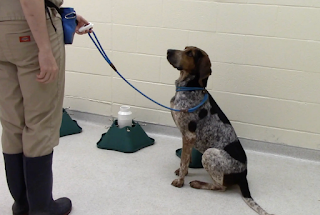
Runnels the hound dog, reporting for duty.
(Texas A&M photo via Ambrook Research)
Livestock can die from bovine respiratory disease, which is notoriously difficult to detect. To help farmers avoid the pain and expense of losing cattle, scientists are exploring how canines can help identify BRD. "At Texas A&M University, a cross-discipline pilot study set out to discover whether working dogs, with their superior olfactory senses, could be used as early BRD detectors," reports Jesse Hirsch of Ambrook Research. "After many trials. . . researchers got up to 82% accuracy with one dog, and 65% with the other. But. . . the dogs didn’t fare nearly as well when given only two chances to distinguish between a BRD-infected swab and a clean one." 

Kate McCulloh
Flora have secret lives of their own. Although they can't ambulate, they find ways to move, morph and adapt to everything humans and Mother Nature "hurl their way," writes Kate McCulloh, an associate professor of botany at the University of Wisconsin. "Their complex physiology responds to each of these threats in often quite subtle ways. The solutions that plants employ differ among species, varying with the climate in which those species evolved."

Colorado mountain lions should be protected from hunts, writes Dan Ashe, a former director of the U.S. Fish and Wildlife Service, in his opinion for Writers on the Range. "Emerging science tells us that these apex predators aren’t the enemy, they’re allies. They are likely providing an important ecosystem service in checking the spread of chronic wasting disease, CWD, an existential threat to healthy deer and elk populations, by targeting animals weakened by the disease." Mountain lions should be left alone to "do their job as predators."
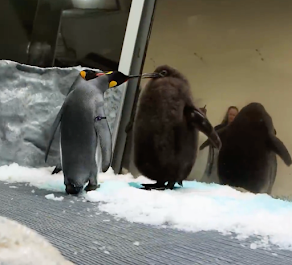
Pesto and his "short" parents. (Sea Life
Melbourne Aquarium photo via CNN News)

Taller and decidedly fluffier than his parents, "Pesto" the baby king penguin is adorable and famous. "Photos of Pesto – who is 90 centimeters tall (about three feet) – towering over his parents have gone viral online. He has also provided opportunities for people to learn more about penguins," reports Lilit Marcus of CNN News. "Although most people recognize the adult black-and-white birds, king penguins are born covered in brown feathers. Once they learn how to swim, they will begin shedding those feathers – a process known as fledging. . . . Pesto’s biological father, Blake, is one of the aquarium’s oldest and largest penguins. But he’s being raised by Tango and Hudson, younger penguins whom Sea Life keepers wanted to try out as parents."

Friday, September 27, 2024

Flora & Fauna: Celebrity goat; pest-resistant tomatoes; eye-popping foliage; grizzlies on the move; pawpaw popularity

Crisco hasn't let stardom go to his head. He enjoys hiking
and roaming just like not-famous goats. (Facebook photo)
For people needing novel bucket-list items, adding a visit to see Crisco, the roaming goat turned celebrity, might be an excursion. "For nearly a decade, Crisco, who escaped a roundup, has ruled the bluffs overlooking this reservoir straddling Arkansas and Missouri," reports Jim Carlton of The Wall Street Journal. "His legend exploded after a Facebook page began chronicling his exploits three years ago. Now some 14,000 followers eagerly await Crisco updates."

It may seem unbelievable, but after 30 years of lab work, "Researchers finally completed a new line of tomatoes, bred with natural pest-resistant qualities, reports Shea Swenson for Ambrook Research. "Plant breeder and geneticist Martha Mutschler-Chu is about to successfully hand off new lines of pest-resistant tomatoes to any interested seed company, where they can ultimately be bred for commercial sales. . . . As far as Mutschler-Chu’s tomato is concerned, the process of creating it is considered traditional cross-breeding, not genetic modification."

The Midwest is predicted to have 'electric' fall colors. (Adobe Stock photo)

Fall is leaf-viewing season, and the country's heartland is the place to gawk. "Some of the most colorful displays could be in the Midwest. AccuWeather, the commercial forecasting service, said in early September that it expects especially vibrant foliage in states such as Michigan and Illinois," reports Patrick Whittle of The Associated Press. "The service also said powerful, popping colors are expected in upstate New York and parts of Pennsylvania, while New England will follow a more typical color pattern."

Ambrook map, from ArcGIS data,
click to enlarge

Grizzly bears haven't lived on British Columbia’s Vancouver Island for 10,000 years, but that may be about to change. Brian Payton of Hakai magazine writes, "There they were. . . a grizzly sow and two cubs browsing in the grass. As the cubs rose onto their hind legs, Joyce Ellis raised her camera, capturing a portrait of a family poised to change the course of natural history."

Fall bird migrations are in full swing and while there are lots of ways to follow favorite feathered friends, Birdcast has some incredible tracking tools, including real-time predictions of bird migrations, a migration dashboard and local bird migration alerts. To show birds more love, CornellLab offers seven simple actions to help birds thrive.

The charming hoiho (A.S. photo)
Delightful, shy and a little bit stinky, the "hoiho," or yellow-eyed penguin won New Zealand's 2024 Bird of the Year election," reports The Associated Press. Although the country's avian elections are "fiercely fought," there's little talk of "interference scandals and cheating controversies of past polls," instead campaigners start "meme wars, seek celebrity endorsements and some even [get] tattoos to prove their loyalty. . . . Hoiho supporters hope that recognition from its victory might prompt a revival of the endangered bird."
The pawpaw’s green skin, and its 'custardy'
interior (Photo by Kat Arazawa, Civil Eats)

For farmers and fans, September means a delicious trip to the pawpaw patch. "Pawpaws are America’s largest edible native fruit, and their ineffable mystique will bring thousands of visitors to the farm’s annual pawpaw festival in late September," reports Ben Seal of Civil Eats. "Festivals in several states give people a chance to taste the fruit for the first time. . . a blend of banana, mango, and pineapple, so soft it’s eaten with a spoon. . . . Research and plant breeding efforts are underway to explore and expand its potential as a sustainable low-input, high-value crop that could figure into the future of small farms throughout the eastern U.S."