Showing posts with label prevention. Show all posts

Friday, March 06, 2026

Study: More Americans ages 18-54 are dying from severe first heart attacks

Even some 35-year-olds are at risk for severe heart
attacks. (Photo by E. Akurt, Unsplash)
Death by heart attack used to be a worry for only older Americans, but a new study revealed an alarming increase in heart attack deaths among younger Americans. The results are particularly worrisome for younger rural Americans who tend to have less access to preventative medical treatment, are more likely to smoke cigarettes and often face longer drives to reach emergency care. 

"The proportion of adults ages 18 to 54 who died in a hospital of a severe first heart attack rose 57% between 2011 and 2022, according to the study published in the Journal of the American Heart Association," reports Betsy McKay of The Wall Street Journal. The study data showed that more than 75% of severe heart attack deaths were men, and 71% were between the ages of 45 and 54 years.

The increase in heart attacks deaths is yet another indicator younger Americans aren't as healthy as previous generations. McKay writes, "Poorer health among younger adults is one reason heart disease remains the leading cause of death in the U.S."

Americans who died after a heart attack often had other underlying chronic health issues or smoked. "About 60% had high blood pressure, while more than half also had high cholesterol and smoked. About a quarter had diabetes."

Younger adults need to be warned that the risk of heart attacks can begin "as early as age 35," McKay adds. "Younger people could use a risk calculator on the AHA’s website." Experts recommend using the 30-year estimate rather than a 10-year one for greater accuracy.

Tuesday, June 24, 2025

If you get bitten by a tick, save it -- and other tips for dealing with ticks' ever-spreading presence

Illustration of a tick biting. 
(Art by Sebastian Kaulitzki, Adobe Stock)

What's to like about ticks? They are an important food source for wildlife, such as birds, lizards and bats. What's not to like? For humans, the list is long. 

Ticks can carry and spread more than 12 different "disease-causing agents including toxins, allergens, bacteria, parasites and viruses," reports Pien Huang of NPR. Across the U.S., some 31 million people are bitten by ticks every year.

Although not every tick bite ends in disease, many do. "Most reported cases of vector-borne disease (including mosquitoes) come from ticks, which can carry pathogens with terrible consequences," Huang explains. "Lyme disease is the most common tick-borne disease in the U.S., estimated to affect more than 470,000 people each year."

When it comes to ticks, working to avoid contact is the first line of defense; however, knowing what to do if you find one attached or have suspicious symptoms such as a rash is just as important.

If you find a tick attached, remove it immediately, but place it in a plastic bag or container it can't escape. Huang writes, "Identifying some key information about the tick can help determine your risks. That includes what kind of tick it is, whether it's in the nymph or adult stage and how long it's been feeding on you." 

The University of Rhode Island's website contains tick identification tools and instructions on how to submit the tick's photo to a tick-tracking expert.

An engorged deer tick. (CDC photo)

The ever-growing list of diseases ticks carry often depends on geography, although warming temperatures have led some tick species to spread into new regions. "In the past 20 years, scientists have discovered at least seven new tick-borne pathogens in the U.S.," Huang reports. "The mid-Atlantic recently saw its first fatal case of Heartland Virus."

For people heading outdoors, Huang provides this tick-avoiding guidance from CDC experts:

  • Do careful and frequent tick checks on yourself and your family members and pets.
  • If you're hiking, it helps to stay in the middle of a well-maintained trail, since ticks tend to hang out in the shrubs and foliage around the edge.
  • Treat outdoor clothing with permethrin, a chemical similar to chrysanthemum extracts that stops ticks from biting.
  • Additionally, treat your exposed skin with EPA-registered insect repellents containing DEET, picardin, or other active ingredients that deter ticks. (Use the EPA's search tool to find one that works.)

Thursday, February 08, 2024

After at least 3 fentanyl deaths in 7 months, weekly in small Kentucky county alerts its readers to dangers, details

Most of this week's front page; click it to enlarge.
Photo illustration is based on a DEA image. 
After three fentanyl overdoses since June in Crittenden County, Kentucky, the first recorded in the county of 9,000 people, and another death in which fentanyl could have been a contributing factor, the local editor-publisher thought it was time to alert his readers to the danger.

"Considered by some as the grim reaper of recreational drugs, fentanyl has hit Crittenden County like a reaper’s scythe over last the few months," Chris Evans of The Crittenden Press began his story, which reported the deaths without the victims' names, noted that the county normally has about three overdoses of any drug in a year, then gave a rationale for the story and made it an implicit example to follow: "Observers say small communities like Marion should raise awareness or prepare to see more deaths in their neighborhoods."

Evans quotes local and state officials and writes, "Fentanyl is approximately 100 times stronger than morphine and 50 times more potent than heroin. Illegal manufacturers often lack understanding, ability and precision to make fentanyl. It’s not a forgiving drug. One minuscule mistake is irreversibly deadly."

Dr. Christopher Kiefer of the state medical examiner’s office told him, “High-school-age kids might be swapping pills. That’s not uncommon. They might think they’re getting a mild painkiller pressed in a lab. They might think it’s Oxycodone or Lortab, but it ends up being fentanyl. You don’t have to be using a needle to die of an overdose. . . . It is a dangerous time right now because people don’t know what they’re getting,”

Crittenden County (Wikipedia map)
Evans adds, "The doctor further explains that fentanyl made and distributed on the black market can be dressed or disguised as just about anything. Someone may think they’re getting a pill from a friend’s mom’s medicine cabinet when it’s something far more sinister and deadly." He quotes Marion Police Chief Bobby West as saying that families and friends of drug users can be the best preventers of overdoses, and “Conversations need to be had about this drug and how it can kill you.”

Evans concludes, "The stark reality of this drug is that it can creep undected into any corner of society and become an instant killer. Now, it’s in Marion." His package also includes sidebars about synthetic opioids (fentanyl is one) and a quick-look box giving street names for the drug, how it is used, what it does and what an overdose can look like: "Stupor, changes in pupil size, clammy skin, cyanosis, coma, and respiratory failure."

Evans has made this week's issue available online, here.

Wednesday, August 09, 2023

Colon cancer is up among young adults; many don't think they're susceptible to it, and thus don't get screened for it

Cancer survivors pose for a photo at a colorectal-cancer awareness
installation. (Photo by Paul Morigi, Getty Images, via NatGeo) 
Colorectal cancer is no longer "an old people's disease;" it's hitting younger people more frequently, reports Tara Haelle of National Geographic. "One in five cases diagnosed today occurs in people younger than age 55, compared to one in 10 cases in 1995, according to a study published by the American Cancer Society. . . . There’s no clear explanation for this trend, but a new paper published in Science suggests a number of possible reasons, including environmental and genetic factors. Low screening rates and misdiagnosis in people who don’t suspect cancer likely also play a role."

The research also found more "diagnoses of advanced disease, which is particularly concerning because colonoscopies are 'a great tool for prevention and early detection of colorectal cancer in terms of screening that can actually detect and remove precancerous lesions,' says lead author Rebecca Siegel, senior scientific director of cancer surveillance research at the American Cancer Society," Haelle reports. "Survival rates are 90 percent if detected early enough."

Earlier screenings are part of the solution. Haelle notes that the U.S. Preventive Services Task Force now recommends that screenings begin at age 45 instead of 50, but Siegel said earlier screening is needed for those with risk factors "such as genetic risk scores, dietary lifestyle, obesity and family history," Haelle reports. "The most common symptoms for colorectal cancer in younger patients are abdominal pain; unexplained weight loss; changes in the frequency, size or appearance of stools; and rectal bleeding, which occurs in 46 percent of early-onset cases compared to 26 percent of cases in adults over age 50." 

Friday, August 04, 2023

Extreme heat puts your heart and other organs at risk

Heat can be deadly, as this sign in Death Valley National Park
warns. (Photo by David McNew, Getty Images via NPR)
Extreme heat is the most deadly kind of weather for humans, and the body's main cooling mechanism, sweat, is not enough for extreme temperatures and humidity, so people risk organ failure, heart attack and kidney failure, reports Maria Godoy of NPR.

Organ failure can sneak up on you. "When your body is exposed to heat, it will try to cool itself down by redirecting more blood to the skin, says Ollie Jay, a professor of heat and health at the University of Sydney, where he directs the Heat and Health Research Incubator," Godoy notes. "But that means less blood and less oxygen are going to your gut. If these conditions go on long enough, your gut can become more permeable. Jay told her: "So, nasty things like endotoxins that usually reside and stay inside the gut start leaking out of the gut, entering the circulation. And that sets off a cascade of effects that ultimately result in death."

When the body redirects blood to the skin, the heart has to pump faster, "which can make you feel lightheaded – to keep your blood pressure up," Godoy explains. But not all hearts can manage a sudden or sustained jump in pace. "Those spikes in the heart rate can be triggers for a heart attack, Jay says, especially for the elderly and those with underlying heart conditions."

Sweat can only do so much, and comes with its own limitation: hydration, Godoy notes. "People can sweat as much as a liter and half per hour, Jay says. And if you don't replenish those fluids, you get dehydrated and your blood volume shrinks, which makes it harder to maintain blood pressure. That can strain your heart and your kidneys," and people with kidney disorders can be at greater risk.

Signs of mild heat exhaustion include headaches, dizziness, lethargy, and feeling unwell in general, Godoy notes: "If that happens, Jay says, get out of the heat and into the shade or indoors ASAP. Drink plenty of water and wet your clothes and skin. Immersing your feet in cold water can also help. . . . Jay says the goal is to cool down so you don't progress to severe heat exhaustion, where you might start vomiting or seem to lose coordination – signs of neurological disturbance. If your core body temperature rises to about 104 degrees Fahrenheit, Jay says, that's where you risk heatstroke."

Thursday, February 02, 2023

Expert opinion: 'The new normal cannot fall back to a pre-Covid normal; we must be bigger, better and smarter'

By Katelyn Jetelina
Your Local Epidemiologist

On Monday the World Health Organization’s Emergency Committee gave official word that they voted to renew the Public Health Emergency of International Concern. They are likely teeing up for “the end” in 2023. The U.S. is far more confident in “the end” of the national emergency. On Monday, the White House announced that they are ending it in mid-May.

An inflection point is clearly on the horizon, albeit with uncertainty. This leads to legitimate questions: Are we still in an emergency? What will the future hold? What happens next?

Are we still in an emergency? There is no “level of disease” that defines a pandemic or emergency. Even if there was an objective metric, the reality is that this isn’t determined through epidemiology alone. Where we, as a society, place SARS-CoV-2 in our repertoire of threats is a collective decision—a psychological, cultural, and political decision. Every day we consciously (or subconsciously) decide how much risk and suffering we are willing to accept: How many people get the booster? How many people wear a mask? How many people order free antigen tests? How many deaths, and among whom, are we willing to accept?

This has sparked an intense tug-of-war among scientists, leaders, and the public throughout the pandemic: a push towards “normalcy” from some and push back towards “urgency” from others. All individuals and societies fit somewhere on this spectrum. And one’s position may (and perhaps should) change with time.

How did winter play out? How we fared this winter gives us a good idea as to whether we are still in “emergency” phase in the U.S. We essentially had two tests:

How well did our immunity hold up against a constantly changing Omicron? According to varying hospitalization models from early fall, the 2022-23 winter played out as a best-case scenario for Covid-19. Even the best-case scenario, though, led to a peak of 48,000 hospitalizations.
Projections of hospitalizations, from CDC's Advisory Committee on Immunization Practices meeting on Sept. 1, 2022

Could our hospital systems handle the stress of a novel virus on top of the “normal” respiratory viruses? We hadn’t previously seen the impact of all of them at the same time. In addition, health-care workers are increasingly burnt out, and hospitals are increasingly understaffed. Given all of this, hospitals did okay this winter. Pediatricians were drowning, particularly because of a massive RSV wave. Emergency rooms were overcrowded with sickness. But a Covid-19 emergency declaration wouldn’t necessarily help with either of these. Hospitals were not overwhelmed with adults because of our immunity wall, and I’m increasingly convinced there was viral to viral interaction—in other words, we didn’t see all three viruses peak at the same time.

Given this, I agree that we are not in an emergency phase in the U.S. An emergency declaration was appropriate when we had rational hope that transmission could be interrupted on a population level and when we needed extreme measures to prevent collapse of healthcare systems. We are past this. Continuing the emergency would not be constructive given public sentiment and lack of funding anyway. As one epidemiologist told me, “If it’s always an emergency, nothing’s an emergency.”
What will the future hold?

If we end the emergency, it begs the question: What phase are we in?

I don’t believe we are in an endemic phase— a state of predictability. I think we are on our way, and Covid-19 will eventually fall into seasonal patterns. But this will likely take years. Until then, we will be in an awkward space between pandemic and endemic. Epidemiologists don’t have an official word for this phase. WHO flu risk management people would probably call this the “transition” phase.
Graph from World Health Organization pandemic risk management guide

We will continue to see the virus ebb and flow—it will mutate, we will get waves, people will continue to miss work and daycare, and people will continue to be hospitalized and die, particularly those over 65 years and immunocompromised. The end of an emergency does not mean the end of disruption or suffering.

Deaths from Covid-19 are projected for 2023; data from CDC, here

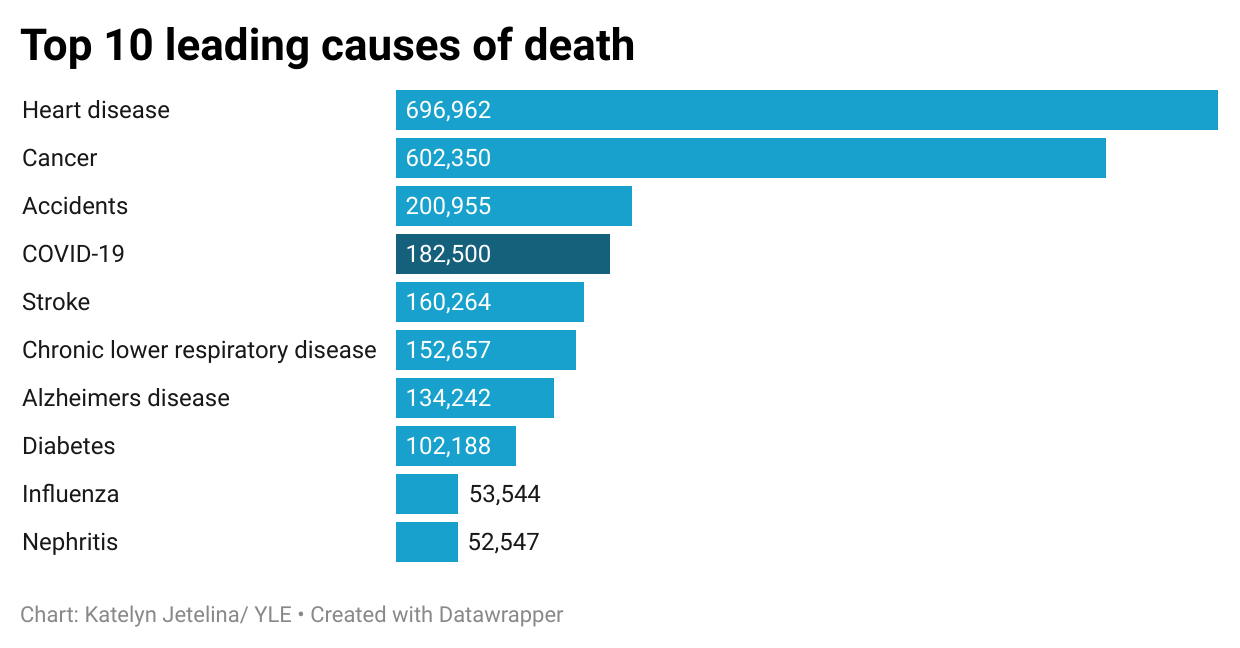
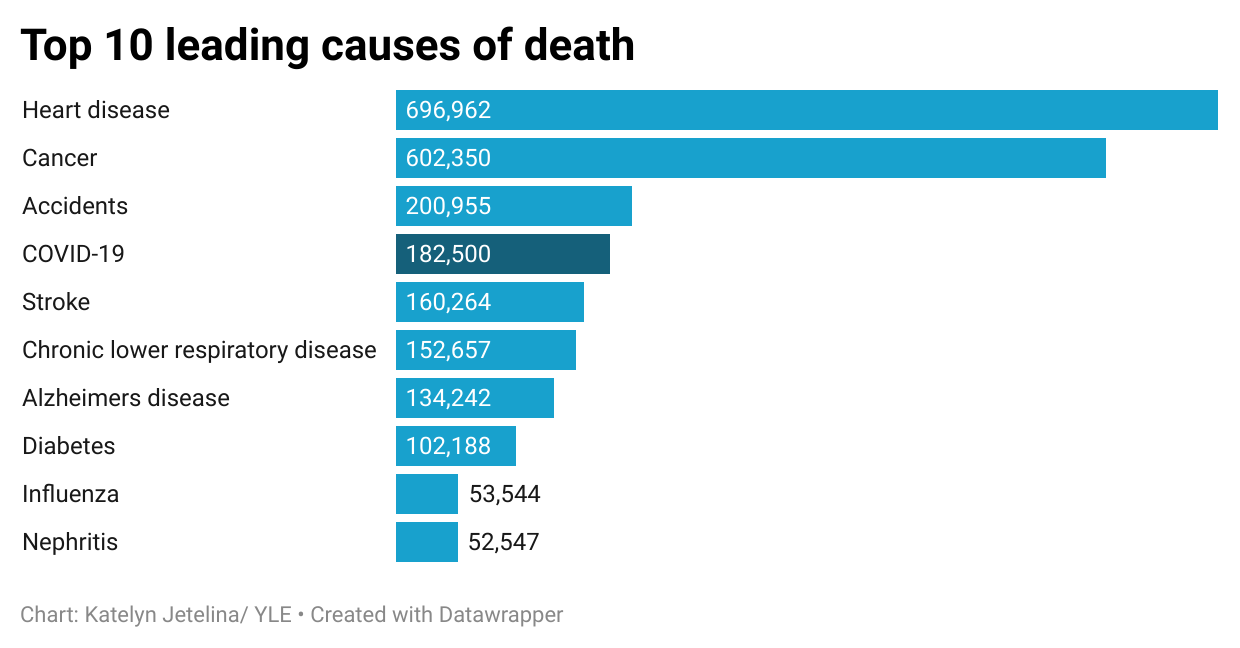
Today, roughly 500 Americans are dying each day from Covid-19. At this rate, SARS-CoV-2 will be the fourth leading cause of death in the U.S. in 2023—about triple the threat of influenza.

What happens next?

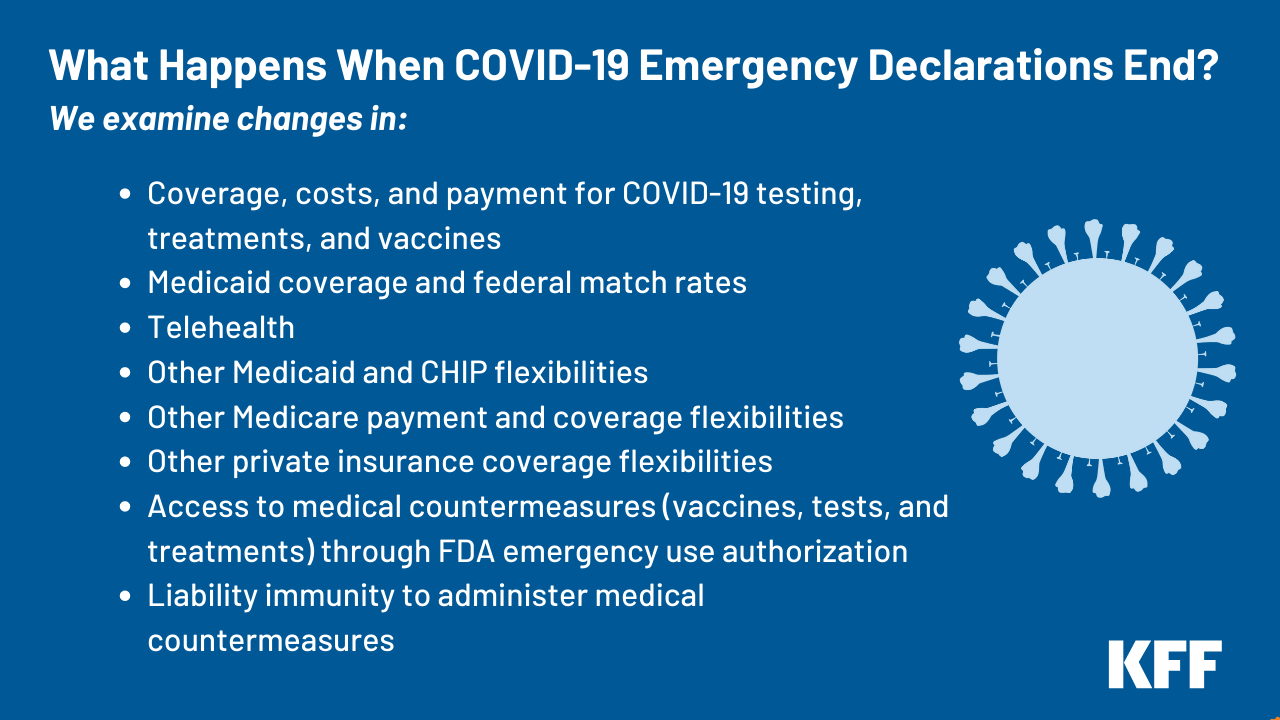
Unraveling the public-health emergency may get messy. It will certainly take time (hence the 3 month lag time). The Kaiser Family Foundation outlined the implications nicely:


This does not impact the Emergency Use Authorization of vaccines and therapeutics from the FDA. In other words, these will still be available.

HOWEVER, the ending of funding for testing and vaccines is a real cause for concern. Once our free supply is out, everything will be privatized. Pfizer announced its vaccine will cost $130 per dose. Insurance will have to cover it, like the flu vaccine. This will, no doubt, fuel deep inequities in the U.S. And it is part of a much larger, deeply flawed system of pharmaceutical profiteering that this country hasn’t got the ethical fortitude to address yet.

Our work is not done: Most importantly, the end of the emergency doesn’t mean our work is done. There is no infectious disease more insidious or with greater impact on global mortality, morbidity, and health care systems than Covid-19.

As individuals, we still need to get vaccinated. We still need to leverage antigen tests. We need to invest in better filtration and ventilation. We still need to protect the most vulnerable.

As public-health officials, we must decide the minimum structure needed moving forward. Invest in wastewater monitoring. Continue to report hospitalizations (and get better at it). Commit to transparent and effective communication. Vaccine innovation is needed.

As a society, we MUST put real energy, innovation, and investment into repairing and strengthening our health and public health systems. The new normal cannot fall back to a pre-Covid normal. We must be bigger, better, and smarter. This means the very notion of for-profit healthcare needs to be fixed. In public health, we must figure out how to get out of the cycle of panic and neglect through preparation. We are LESS prepared for the next pandemic, given loss of trust, polarization, changing information echo-systems, and mis/disinformation.

Sadly, I’m starting to see denial and wishful thinking. I hope this changes as it will definitely not be another 100 years before the next pandemic emerges to grip the globe in a choke hold.

Bottom line: In the U.S., the end of the emergency is coming. I agree with this decision, but this certainly isn’t the end of Covid-19 or public health threats. In fact, this end is the beginning. We have our work cut out for us.

Katelyn Jetelina is a California epidemiologist and biostatistician who says she writes her newsletter on Substack as a way to translate public-health science for everyday use, helping people to make evidence-based decisions. She is a consultant to several organizations, including the CDC.

Wednesday, December 07, 2022

Epidemiologist says the dreaded triple-demic is here, with RSV, flu and Covid-19 cases all rising together

 
Centers for Disease Control and Prevention map

With national rates of influenza, Covid-19 and respiratory syncytial virus (RSV) all rising, the "dreaded and much anticipated triple-demic is finally here," epidemiologist Katelyn Jetelina writes in her newsletter, Your Local Epidemiologist. 

RSV is a common virus that usually causes mild, cold-like symptoms. And while most people recover in a week or two, it can be serious for infants and older adults.

The weekly Centers for Disease Control and Prevention influenza-like illness (ILI) surveillance, which includes a tally of patients that go to the doctor with a fever and a cough and/or a sore throat is a general indication of the climate of respiratory health in the United States. The report does not include laboratory confirmed flu cases. 

The ILI map for the week ending Nov. 26 shows that every state except for four have either a high or a very high ILI activity level. "This level is truly unprecedented; we’ve never seen such high levels of ILI activity at this time of year," she writes. 

Hospitalizations for respiratory illness are also on the rise. On Monday, CDC Director Rochelle Walensky said: “Hospitalizations are the highest now than they have been in the past decade.” 
Jetelina points out that while ILI surveillance offers an overall view of respiratory illness in the U.S, surveillance for specific diseases also exist, but is imperfect. 

RSV: CDC data shows that RSV continues to rise, although we may be seeing the first signs of peaking on a national level, Jetelina reports. She adds that this is expected given that the positivity rate for RSV tests have already clearly peaked. 

Flu: "Flu cases are increasing and increasing fast," Jetelina writes. She notes that flu hospitalizations are lagged, but increasing. "We expect hospitalizations to continue to rise in weeks to come," she writes. 

As Inside Medicine reported, for the first time during the pandemic, flu hospitalizations overtook Covid-19 hospitalizations last week. "This may be a one-off occurrence since Covid-19 hospitalizations are increasing now, too, but it is noteworthy," she writes. 

Jetelina adds that epidemiologist are hopeful that the U.S. flu season will follow what has happened in the Southern Hemisphere (Australia specifically) where there has been a high number of flu cases but a moderate level of hospitalizations. 

Covid-19: "Covid-19 is on the rise across the globe due to the combination of seasonal changes, behaviors changes, and the variant soup. In the U.S., all signs point to the beginning of a wave. For example, SARS-CoV-2 in wastewater is rapidly increasing across all regions," she writes. 

"One major concern is the rapid rise in hospitalizations among older adults, which has exponentially increased 28% in the past two weeks," Jetelina writes. "This is partly (or wholly) due to abysmal vaccination rates—only 1 in 3 adults over the age of 65+ have their fall Covid-19 booster. A public health failure. Without a recent booster, many people are technically vaccinated but not protected." 

Bottom line, she concludes: "This viral season is like no other. . . .  I’m especially concerned for hospital systems, kids under 5, and adults over the age of 65, as they are at highest risk." 

She adds, "There’s a lot we can do: mask, test before seeing loved ones, get that airflow moving, stay home when you’re sick. The least you can do for a healthy season is get a flu and fall Covid-19 booster. If you haven’t gotten one yet, it’s never too late." 

Jetelina is a California epidemiologist and biostatistician who says she writes the newsletter on Substack as a way to translate public-health science for everyday use, helping people to make evidence-based decisions. She is also a consultant to a number of organizations, including the CDC. 

Wednesday, November 16, 2022

New school-masking research helps define best practices

(Photo by Kelly Sikkema, Unsplashed)
School masking policies remain topics of tension, but studies like a new one in the New England Journal of Medicine may help inform the debate, reports Donna St. George of The Washington Post: "Public schools that kept universal masking requirements in place last year had significantly fewer coronavirus cases than their counterparts that lifted mandates as state policies changed. . . This new study from Boston and Chelsa, Mass., has shed some light on what might work as the best protection."

"The study, which followed schools in the Boston region during the 2021-22 academic year, found that the end of mask requirements was associated with an additional 45 coronavirus cases per 1,000 students and staff members — or nearly 12,000 cases during a 15-week period from March to June. . . The findings support on-ramps and off-ramps for mask mandates," St. George writes.

The study by researchers from Harvard University, Boston University and the Boston Public Health Commission found that masking was just one strategy for avoiding virus transmission. "Universal masking helped most when the levels of virus were highest, suggesting that the safety measure is most useful just before or throughout periods of high transmission," St. George reports.

Jennifer Kates, a senior vice president of the Kaiser Family Foundation, a nonprofit focused on health issues, told St. George the study demonstrated a “sizable” effect of universal masking — a finding that could be useful to efforts to control a future coronavirus variant or another infectious disease: “This is a very low-cost, highly effective intervention.”

When it comes to avoiding RSV, influenza, and Covid-19, Meagan Fitzpatrick, an epidemiologist and infectious-disease transmission modeler at the University of Maryland School of Medicine, told St. George, “Masking is one of the rare tools that can combat all of these.”

Monday, August 01, 2022

In cleanup after a flood, how to stay safe and healthy

Disaster workers in high heat, like that forecast in
Kentucky this week, take breaks and keep hydrated.
The extent of the devastation caused by the flooding in Eastern Kentucky is still not fully known, as the death toll is 37 and rising, but cleanup has begun even as search-and-rescue operations are still going on. That overlap, and the urgency that many feel in such situations, could create even more danger as people risk their safety and health in trying to recover.

"As people try to re-enter flood-damaged properties, the risk of serious injury and even death is high," Anna Goodman Hoover, an assistant professor in the University of Kentucky College of Public Health, told Kentucky Health News. She shared a package of "vetted materials from various agencies and environmental/disaster organizations that provide safety information for re-entering, cleaning up, etc." and KHN published most of the list.

The material comes from the Federal Emergency Management Agency, the National Institute of Environmental Health Sciences, the National Institute of Occupational Safety and Health, the Occupational Safety and Health Administration, the Centers for Disease Control and Prevention and the U.S. Army Corps of Engineers. The college's Department of Epidemiology and Environmental Health has put the material on a web page.

Thursday, May 05, 2022

Rural Pa. school staffers increasingly bore the brunt of pandemic frustration: 'We went from being heroes to villains'

A school in rural Pennsylvania during the pandemic (Associated Press photo by Matt Rourke, via The Conversation)

Penn State
professors wanted to see how schools in Pennsylvania's 235 rural districts fared in the pandemic, so they surveyed and interviewed rural superintendents, principals, teachers and parents. Their findings, which are likely echoed in most other rural communities: Rural schools already faced disparities in technology, broadband access, and teacher staffing before the pandemic, but it made things much worse, Gerald K. LeTendre and Peggy Schooling report for The Conversation, a site for journalism by academics.

"Over the more than two years of dealing with the pandemic, schools increasingly bore the brunt of the frustration local residents had with state or federal guidelines," LeTendre and Schooling report. One school leader even told them, "We went from being heroes to villains." LeTendre is an educational administration professor and Schooling is a professor of practice in educational leadership and the executive director of the Pennsylvania School Study Council.

Through focus groups, the researchers identified four phases in parent sentiment during the pandemic. In Phase 1 there was widespread concern about teacher and student wellbeing, and was marked by "rapid adaptation and improvisation," LeTendre and Schooling report. Phase 2 was about getting back to school and navigating the new rules of sharing classroom space. Common public sentiment in Phase 3, one participant said, held that "Teachers are no good and just do not want to work." And Phase 4, another participant said, devolved into people saying "You can’t make my kid wear a mask! I am the parent! Teachers are the devil!"

Many in rural communities were eager to return to normal by this spring, but there remains a deep divide between those who believe schools should return completely to pre-pandemic practices and those who want to continue to incorporate more technology into normal learning routines so as to be ready for future surges, LeTendre and Schooling report.

Tuesday, March 15, 2022

Bipartisan efforts are needed to reduce the growing rural-urban gap in Covid-19 vaccinations, Oklahoma prof says

The pandemic is waning, but so are are rates of new Covid-19 vaccinations, leaving wide swaths of the country – especially rural areas – more vulnerable to the disease and acting as potential reservoirs for mutations of the coronavirus into more contagious or deadly strains.

Through January, 59% of rural residents had received a first dose of a vaccine, but 75% of urban residents had, and that gap has more than doubled since April 2021, according to a study by the federal Centers for Disease Control and Prevention.

CDC graph, adapted by The Rural Blog
The divide is particularly stark among children and teenagers who need parental consent to get vaccinated," notes Angel Adegbesan of Bloomberg News. "Only about 15% of children ages 5-11 have been vaccinated in rural areas, compared with 31% in urban areas."

However, Adegbesan writes, "In President Joe Biden’s National Covid-19 Preparedness Plan there’s a glaring omission: efforts to improve on high levels of vaccine hesitancy in rural parts of the U.S. . . . While the administration says it has improved vaccine equity among adults of different races and ethnicity, particularly in rural areas, vaccination among children and adolescents remain alarmingly low.
Perhaps it’s time to consider a bipartisan approach."

So says Matt Motta, a political scientist and an assistant professor of political science at Oklahoma State University. He told Adegbesan, “We need more of an effort, not just from the Biden administration, but from Republicans who are sympathetic and enthusiastic about vaccinating.”

Adegbesan notes, "Partisanship remains a major contributor to vaccine hesitancy. Unvaccinated adults are now three times more likely to lean Republican than Democratic, according to a report by the Kaiser Family Foundation. And those who refuse to be vaccinated are also less likely to vaccinate their children."

"Motta says people might be more amenable to getting the vaccine if someone in their community who shares the same political beliefs encourages them to do so," Adegbesan reports.

Wednesday, March 09, 2022

States and schools across nation drop mask mandates, but concern remains about low vaccination rates among kids

States and school districts all over the country are dropping mask mandates in the wake of the Omicron surge.

"Parents, teachers and principals face a complicated balancing act in navigating the new rules. Some families are thrilled that their children no longer have to wear masks, while others say they’re still tentative and urging their kids to keep wearing face coverings for now. Teachers and principals are caught in the middle," Philip Marcelo and Dave Collins report for The Associated Press.

Deciding whether to mask or not can hinge on complicated factors. The Centers for Disease Control and Prevention recently advised that most Americans can safely stop wearing masks, but should keep them on where infection rates are still high. Also, "Those hesitant about ending school mask mandates often point to low childhood vaccination rates among American children," Marcelo and Collins report. "Only about a quarter of children ages 5 to 11 have been fully vaccinated against the coronavirus, and about 58% of children ages 12 to 17 are inoculated, the CDC says."

Research shows that masks make a dent in infection rates. A recently published study of Arkansas schools showed that those with required masking had 23% fewer coronavirus cases than those where masks were optional.

In Kentucky, where infection rates remain high in many counties, the state legislature may pass a bill allowing K-12 students to opt out of any masking, testing or coronavirus vaccination mandates, and ban such mandates at public colleges and universities. When asked for his masking advice to the general public, Gov. Andy Beshear said: "The No. 1 piece of advice I can give is, don't feel pressure." He said people should consider their daily activities and the infection level in their county, and those with pre-existing conditions should wear one because "There is still a lot of Omicron out there."

Wednesday, December 29, 2021

Omicron variant makes better masks necessary, experts say

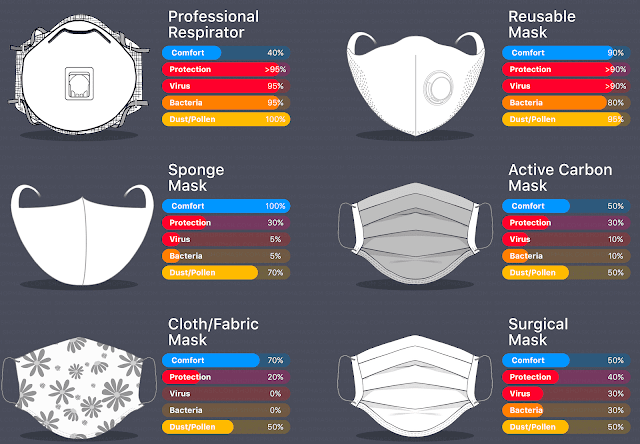
Chart from ShopMasks.com; click on it to elnarge.
"With another coronavirus variant racing across the U.S., once again health authorities are urging people to mask up indoors. Yes, you’ve heard it all before," Maria Godoy reports for NPR. "But given how contagious Omicron is, experts say, it’s seriously time to upgrade to an N95 or similar high-filtration respirator when you’re in public indoor spaces.

“Cloth masks are not going to cut it with omicron,” Linsey Marr, a researcher at Virginia Tech who studies how viruses transmit in the air, told NPR.

Omicron "spreads at least three times faster than Delta," Godoy notes. "One person is infecting at least three others at a time on average, based on data from other countries."

Robert Wachter, chair of the medicine at the University of California, San Francisco, told Godoy, “The kind of encounter that you could have had with prior versions of the virus that would have left you uninfected, there’s now a good chance you will get infected from it.”

Early research at the University of Hong Kong shows "Omicron multiplies 70 times faster inside human respiratory tract tissue than the delta variant does," NPR reports. "That study also found that Omicron reaches higher levels in respiratory tract tissue 48 hours after infection, compared with Delta."

Marr said, “That would suggest to me that maybe it reaches higher levels and then we spew out more [virus particles] if we’re infected,” Also, Omicron may be so contagious that it takes fewer viral particles to create an infection.

Also, "Virus particles from an infectious person can linger in the air indoors for minutes or even hours after they leave a room in some situations, says Dr. Abraar Karan, an infectious disease physician at Stanford University," Godoy reports.  Karan told her, “I think that people need to realize that transmission here can happen even when you’re not near somebody.”

Godoy says, "Given all this, you want a mask that means business when it comes to blocking viral particles. Unlike cloth masks, N95, KN95 and KF94 respirators are all made out of material with an electrostatic charge." That “pulls these particles in as they’re floating around and prevents you from inhaling those particles,” Karan told her. “And that really is key.”

Surgical masks also have an electrostatic charge, but they tend to fit loosely, "A snug fit — with no gaps around nose, cheeks or chin — 'really makes a big difference,' says Marr, who has studied mask efficacy," Godoy reports.

"KN95s tend to be a bit more comfortable than N95s, but counterfeits continue to be a problem. For safer shopping, check out a site like Project N95, a nonprofit that helps consumers find legitimate personal protective equipment. Or check the CDC’s site for advice on how to spot a counterfeit and a list of trusted sources for surgical N95s. For maximum protection, make sure your N95 fits snugly as well, creating a seal around your mouth and nose. The CDC explains what makes a good fit and how to test that yours is sealing well."

Thursday, September 23, 2021

Rural residents in top 25 markets were more likely to follow pandemic precautions when lockdown hit, study says

Rural residents who watched television news from stations in the top 25 TV markets last year were more likely to follow precautions against catching the coronavirus, a study found.

“For some rural residents, their local news often focuses on urban communities with issues quite different from their own,” wrote Eunji Kim, Michael Shepherd and Joshua Clinton in the Proceedings of the National Academy of Sciences.

To measure viewers' compliance with recommended precautions, they studied mobility data from Cuebiq in 771 rural counties in the first week of April 2020, when American were advised to stay home. They also surveyed 9,081 residents from 705 of the counties about their efforts to social distance, their media consumption, and their concerns about Covid-19.

They found that rural residents who watched local news from a top-25 market were more likely to social distance than those outside of a top-100 market. Rural residents in top-25 markets were also more likely to say they wore a mask outside during the period studied, and more likely to stay home, except for trips to buy food. However, political ideology was a stronger predictor of behavior.

Friday, September 10, 2021

Biden's vaccine mandates likely to have big rural impact

"President Biden announced sweeping new coronavirus vaccine mandates Thursday designed to affect tens of millions of Americans, ordering all businesses with more than 100 employees to require their workers to be immunized or face weekly testing," The Washington Post reports. "Biden also said that he would require most health-care facilities that accept Medicare or Medicaid funding to vaccinate their employees, which the White House believes will cover 50,000 locations." That includes outpatient facilities like dialysis clinics and home health agencies.

Biden will also require vaccinations—with no exceptions for regular testing among the unvaccinated—for employees of Head Start programs, Defense Department contractors, and federally operated Native American schools. "The White House estimates that the policy will affect about 80 million workers, or two-thirds of the country’s workforce. Businesses that ignore the mandate could face up to $14,000 per violation," the Post reports.

The new mandates will likely have a large impact in rural America, especially among large rural employers such as manufacturers, meatpackers, and Walmart, and hospitals. Rural health-care facilities are more likely to rely on Medicare and Medicaid for reimbursement, and many are already on the brink of bankruptcy. The new mandate will affect about one in three workers in Maine, the most rural state by population.

The announcement drew immediate criticism from many, including some Republican governors, The Associated Press reports. Wyoming Gov. Mark Gordon has asked his attorney general to fight the mandate when it is put into effect, and Missouri Gov. Mike Parson is considering a special legislative session to challenge the mandate. Biden called such governors "cavalier" with the health of children and of their communities for resisting the mandates.

Thursday, September 02, 2021

About 40% of Americans say they get coronavirus vax info from social media, but not many believe it's the best source

Pew Research Center chart; click on it to enlarge.

Social media is a notorious source of misinformation about the pandemic and vaccines. That adds significance to a new Pew Research Center survey showing that nearly 40 percent of Americans say social media is an important source for coronavirus vaccine news. Pew conducted the survey from July 26 to Aug. 8. Here's some of what they found:

  • Women and younger Americans are more likely than men and older Americans to say they get coronavirus vaccine news and information on social media; younger Americans and women are more likely to be on social media in the first place.
  • About half of the respondents said they get news and information about vaccines from social media: 30% said they get "some" and 18% said they get "a lot."
  • The other 51% say they've gotten little or no vaccine news or information from social media.
  • Though half the respondents get at least some vaccine news from social media, only a few (6%) believe it's the best way.
  • Another 33% said it's an important way, 29% said it's not an important way, and 31% said they don't get any vaccine news on social media.
  • Respondents who say social media is an important source of vaccine information are more likely to regularly rely on social media for news in general.
  • Only 4% of respondents said they regularly get general news from Snapchat, and 11% said the same about Instagram. But 85% of people who regularly get news from those platforms say they get a lot or some information about the vaccine there too.
  • 31% of respondents said they regularly get general news from Facebook, and 82% of that group say they're getting vaccine news there too.

Sunday, August 22, 2021

Sense of community, common sacrifice missing among many in pandemic, especially politicians, Silas House writes

House (Berea College photo)
In a 1,634-word article for The Atlantic, Appalachian writer Silas House explores the resistance to masking to fight the coronavirus. He begins by recalling his grandmother's stories of sacrifice during the Great Depression and World War II, and his parents' help for the less fortunate, and the lessons he learned from them.

"I was taught to sacrifice my own comfort for the good of others, whether it be by volunteering my seat to elders in a crowded waiting room, letting a pregnant woman go in front of me in the grocery line, or giving half of my sandwich to a hungry classmate," House writes. "Sacrificing for the common good was something most of us were taught when I was growing up. Just a few decades later, I’m seeing people in my hometown, and all over the country, thinking only of themselves. They’re not just unwilling to make sacrifices for others during a pandemic; they’re angry about being asked to."

House's object example is Kentucky Gov. Andy Beshear's mask mandate for schools, and he goes beyond his usual craft to commit journalism, interviewing upset parents and Science Hill Independent Schools Supt. Jimmy Dyehouse, who called Beshear a "liberal lunatic" in a message to parents. "He said that many studies had proved that masks were ineffective," House reports. "He didn’t cite any sources, but at least 49 scientific studies go against his claims."

Conversing with parents on Facebook, "Two of them said that their children broke down in tears at the news of having to go to school in a mask," House reports. "Others say the masks hamper social life, hinder education by being a distraction, and keep students from understanding their teachers. Several told me the masks are making kids sick because they are breathing in the same carbon dioxide repeatedly, a claim that has been widely debunked."

After noting recent statements of U.S. Sen. Rand Paul and Rep. Thomas Massie of Kentucky, House says his grandmother "would have been disgusted by the politicization of a virus that has now killed more than 620,000 Americans. . . . Maybe too few people today understand the necessity of putting aside one’s own comforts to help others. Perhaps our sense of community has suffered in the digital age. It seems to me, however, that most of the blame should go to politicians who care more about stirring up fear to defeat their opponents than they do about people’s lives or the economy. And I blame anyone who intentionally spreads misinformation to further their own agenda."

Tuesday, June 08, 2021

Study finds rural seniors less likely than urban ones to follow Covid-19 prevention advice, especially social distancing

Rural adults 65 and older were less compliant than their urban peers when it came to following some of the suggested strategies to slow the spread of the coronavirus, especially social distancing.

So says a recent study published in The Journal of Rural Health, which looked at whether "community dwelling" seniors (those not living in assisted living, nursing homes or other congregate settings) had adopted preventive measures recommended by the Centers for Disease Control and Prevention to slow the spread of the virus.

Following the CDC's advice is especially important for seniors because they have a higher risk of dying from Covid-19 if they get it. 

The study researchers used self-reported data from the National Health and Aging Trends Study, conducted from June to October 2020, which asked about eight different risk-mitigation behaviors. The survey included nearly 3,000 community-dwelling urban and rural seniors.  

The researchers found that seniors' compliance with each of the eight behaviors to limit the spread of Covid-19 was high, but rural seniors were less likely to report compliance on five: social distancing, limiting gatherings, avoiding restaurants and bars, not touching their faces, and avoiding contact with those outside their households. 

However, after the data were adjusted for demographic characteristics, only maintaining a six-foot distance remained lower among rural seniors to a statistically significant degree. There were no rural-urban differences when it came to mask wearing, handwashing and limiting shopping.

Still, the researchers said their findings suggested the need for rural-specific messaging when it comes to such public-health emergencies.

Wednesday, May 05, 2021

A little moderation on masks could go a long way in rural areas, Kentucky writer tells a national audience

Writing from Anderson County, Kentucky, population 23,000, for The Washington Post, columnist Teri Carter says some advocates of mask wearing go too far for rural areas like hers.

Teri Carter
"Even as Americans are getting vaccinated, we are still fighting about masks," she writes. "Because thanks to dangerously bungled messaging from the former president and his mask-snubbing administration, as well as conflicting messages from the Centers for Disease Control and Prevention, fights about masks are long past being about safety. Many of my neighbors stopped thinking about the coronavirus pandemic a long time ago. But they may never be finished arguing about it."

Carter writes about politicians, pastors and churches, and also about national news media.

"When I hear politicians and national media organizations saying that vaccine hesitancy is due to the pause of the Johnson & Johnson vaccine or because rural people in Trump country don’t believe in science, I wonder how many people they’ve talked to in towns like mine," Carter writes to introduce her key anecdote:
I live on a small lake. On Sunday afternoon, my next-door neighbor (a Trump supporter) came over to help us back our boat trailer into the woods. The first thing he said was, “I’m vaccinated! I can hug you now!” After we finished with the trailer, as we talked about coming out of the pandemic and having an outdoor party to celebrate, he said, “Okay, what’s this whole thing about wearing masks outside — outside! — after the shots? It’s such complete bull----. For crying out loud, if they want people to trust the vaccine, they need to give people a reason to get the vaccine besides how much it will help everybody else.”
Carter concludes, "From where I sit — out here where neither I nor anyone I know has ever worn masks outside — vaccine hesitancy and debates over masks are not about people needing more information, but about the need to get local leaders that people trust, like their preachers, Republican club heads and volunteer firemen, to do the talking. They would be a significant improvement over national politicians who continue to knowingly spread falsehoods about everything from the coronavirus to the 2020 election results."