Showing posts with label Canada. Show all posts

Tuesday, June 09, 2026

New World Screwworm enters the U.S.

NWS infestations were discovered just days apart on calves that grazed
roughly 5.6 miles from each another. (Photo via Hoosier Ag News
Despite ongoing efforts from the U.S. Department of Agriculture, the Mexican government and on-the-ground teams along the U.S.-Mexico border, last week the USDA's Animal and Plant Health Inspection Service (APHIS) confirmed two cases of New World screwworm in Texas livestock, reports Jennifer Carrico of Progressive Farmer. In both cases, the flesh-eating blowfly larvae were discovered in young calves about 6 miles apart in Zavala County, Texas.

After the second case was confirmed, Texas Governor Greg Abbott "issued an updated statewide disaster declaration for the NWS infestation," Carrico writes. At a news conference, Abbott encouraged the use of "all state resources to combat the NWS." Additionally, the executive director of the Texas Animal Health Commission, Budd Dinges, reminded the public that NWS isn't a threat to consumer food safety but rather poses a threat to livestock production. 

In response to the infestations, APHIS has "deployed mobile response trailers, and sterile fly releases are underway with 2 million aerially and 4 million released on the ground per week," Farm Journal reports. "Movement control zones have been activated at a 20-kilometer (12.4-mile) radius around each site."

Both NWS cases were found in Zavala, Texas, 
in red above. (Wikipedia map)
The discovery prompted the Canadian Food Inspection Agency to place "temporary restrictions on livestock imports from Texas," reports C.J. Miller of Hoosier Ag Today. "Under the order, cattle, horses and other livestock that originated in Texas or were present in the state within 21 days before entering Canada will be denied entry."

Although the USDA intensified its battle to prevent the NWS from reentering the U.S. including banning Mexican livestock from entering the U.S. beginning in July 2025, some ranchers don't think the government's response was enough.

"On Friday, about 100 ranchers in mud-splattered boots and cowboy hats packed a small high school cafeteria for a Texas Animal Health Commission briefing on screwworm, peppering officials with questions and venting frustration over what they saw ​as a slow federal response,” reports Heather Schlitz of Reuters

Even as the USDA works to contain NWS infestations, they are likely to spread throughout the summer months, Miller reports. Prior to last week, the NWS hasn't been found in the U.S. for at least 60 years.

Friday, March 06, 2026

A 'Mafia' outfit centered on growing more American oats

Oats used by most American cereal brands are sourced from
Canada. (Graphic by Adam Dixon, Offrange)
Over the past several decades, the acres of oats American farmers have produced have dipped dramatically. The USDA doesn't heavily subsidize oat crops like it does corn and soybeans, and most oats used in the U.S. are sourced from Canada. However, a "growing group of more than 100 Midwestern farmers is trying to bring it back," reports Aimee Rawlins for Offrange.

Back in 2018, Martin Larsen, a fifth-generation farmer in Minnesota, looked at his crops and thought oats would be good for his soil, and the rising popularity of oat milk could help his bottom line, Rawlins writes.

Larsen convinced other Minnesota farmers to add oats to their rotation. The group struggled to find mills and break into the supply chain. Rawlings writes, "But Larsen and his fellow farmers weren’t deterred. Instead, they coined a name for their group: the Oat Mafia. They decided to create a supply chain — and, eventually, a mill — of their own."

Part of the reason Oat Mafia farmers have persisted is that oat crops do soil systems a world of good, including removing nitrogen that "might otherwise leach into groundwater," Rawlings explains. "And when added to a corn-soy rotation, oats help break pest cycles, reduce disease pressure, and curb resistant weeds." Oats also thrive during severe droughts.

The group's persistence has paid off. "Today, the Oat Mafia has around 125 farmers with 50,000 acres of tillable land and about 6,000 acres of oats, said Larsen, who started with just seven acres and now grows 500," Rawlings writes.

The group is investing in building their own mill to avoid milling entanglements, and Larsen is spending more time promoting oats to other farmers as a financially manageable addition to crop rotations. Rawlings reports, "He aims to be a resource for other farmers who aren’t sure where to start, offering advice on everything from what varieties to plant and how many oats per acre, to how much fertilizer to use and how to combine them."

Tuesday, March 03, 2026

Waves of American doctors and nurses leave their practices and head to Canada to avoid U.S. political climate

Often born and trained in the U.S., many nurses and doctors are leaving the U.S. for Canada.
(Graphic by Oona Zenda, KFF Health News)

At a time when Americans can least afford to lose medical professionals, many are leaving the U.S., citing the country's current political climate as their reason for leaving. In rural parts of the U.S., already facing a chronic shortage of medical care providers, the loss of any medical professionals makes accessing care more difficult.

"American nurses, doctors, and other health care workers moving to Canada, and specifically British Columbia, where more than 1,000 U.S.-trained nurses have been approved to work since April 2025," Brett Kelman of KFF Health News reports

Justin and Amy Miller from Wisconsin serve as one example. They are both nurses who were born in the U.S. and trained at American schools, but didn't want to stay in the U.S. because of policies and cuts by the Trump administration, Kelman explains. They moved their family of five to Canada, where they found new nursing jobs.

As the Trump administration systematically slashed "funding for public health, insurance, and medical research, many nurses have felt the draw of Canada’s progressive politics, friendly reputation, and universal health care system," Kelman reports.

For U.S.-trained nurses, Canada is rolling out the welcome wagon. "Ontario and British Columbia have streamlined the licensing process for American nurses since Trump returned to the White House," Kelman writes. British Columbia also launched a $5 million advertising campaign last year to recruit nurses from California, Oregon, and Washington state."

Doctors are leaving as well. "Michael, an emergency room doctor who was born, raised, and trained in the United States, packed up his family and got out," Kelman reports. KFF did not use his last name because he expressed concerns about reprisals if he returned to the U.S. 

Rural Canadians, who also struggle with accessing medical care, are also hoping to attract some American medical professionals. Doctors Manitoba, which "represents physicians in the rural province that struggles with one of Canada’s worst doctor shortages, launched a recruiting campaign after the election to capitalize on Trump and the rise of far-right politics in the U.S," Kelman writes. 

Tuesday, January 13, 2026

Long Canadian Pacific trains bring a small town's busy Main Street to a standstill each day

A westbound Canadian Pacific train makes its way into Jackman, Maine.
(Photo by Linda Coan O’Kresik, Bangor Daily News)

In Jackman, Maine, drivers waiting to cross Main Street can spend 30 minutes idling as Canadian Pacific Kansas City trains pass through the heart of town. Daniel O’Connor for The Maine Monitor reports, "More than 3,000 cars and trucks pass through the railroad crossing every day."

Doubling as U.S. Route 201, Jackman's Main Street and the railroad that divides it connects Quebec with "southern Maine and the rest of the Northeast," O’Connor explains. "Trains passing through town sometimes exceed 200 railcars, stretching for more than two miles in length. . . .That’s longer than 90% of North American freight trains operated by companies like CPKC." Some of the wait time can be blamed on aging rail lines and increased traffic.

Jackman, Maine, is 16 miles from the Canadian
border. (Northern Outdoors map)

Locals tried to avoid Main Street during the hours when trains were scheduled to cross, but train schedules varied too much. Waits can be extended when an international border scanner, which checks trains for illegal goods from Canada, notifies Customs and Border Protection that additional scanning is needed.  

For Jackman residents and Route 201 travelers, the long and unpredictable daily train waits are frustrating and pose a potential danger. O'Connor explains, "With the town split in half for part of the day and ambulances on one side of the track, trains could delay responses during an emergency."

Maine’s border shares seven rail crossings with Canada, but Jackman’s border crossing "is the only one to see a clear increase in shipping year-over-year," O'Connor reports.

CPKC has made rail improvements to "upgrade the rails in the area since it acquired the route in 2020, but said border security caused slowdowns in Jackman," O'Connor adds. "Many in town seemed to accept that the long trains were just part of life up north."

Friday, October 03, 2025

Flora & Fauna: Chunk, the Fat Bear Week winner; learning bird songs; deterring wolves; nabbing feral pigs

Chunk's broken jaw didn't stop him from feasting on sockeye salmon and gaining hundreds of pounds this summer. 
(Photo by Christine Loberg, NPS)

During this year's Fat Bear Week, many Alaskan brown bears made the salmon run at Brooks Falls in Katmai National Park the place where they packed on the pounds eating as much sockeye salmon as possible. But there was one bear that was more dedicated to getting his unfair share of salmon: Chunk. "A bear weighing in at over 1,200 pounds — with a broken (but healing) jaw — is the 2025 Fat Bear Week champion," reports Ava White of NPR. "It’s the first time number 32, or as he’s aptly nicknamed Chunk, has been dubbed the fattest bear in Katmai National Park and Preserve."

An unlikely union between two plants created the potato, affectionately known as the spud. "The origin of the potato has long puzzled scientists. Genetically, it is a close relative of the tomato. But in appearance, it resembles three potato-like species found in South America known as Etuberosum," reports Aylin Woodward of The Wall Street Journal. "The problem is, Etuberosum don’t have tubers — the parts of the potato plant that grow underground, and that we eat baked, mashed or fried. . . . An examination of these DNA sequences revealed that between eight million and nine million years ago, Etuberosum and an ancient tomato exchanged genes." And today's spud was born.

Watching and listening to birds is a delightful hobby that can be enhanced by learning to identify birds by their songs. "Learning bird songs is the difference between 'hearing' and 'listening,'" writes ornithologist Chris Lituma for The Conversation. "Listening requires full attention and limiting distractions. It means using your ears to pick up different patterns in the sounds that birds make. Every person has the capacity to listen and learn patterns in sound." Read all of Lituma's tips for learning bird songs and sounds here.

In this remote arctic town, it's too cold for trees, but strawberries grow by the dozens. "A high-tech greenhouse brings fresh produce to Gjoa Haven, an Inuit hamlet in Canada’s Arctic whose residents have little experience growing plants," reports Norimitsu Onishi of The New York Times. "The greenhouse, researchers hope, will eventually provide an alternative to perishable goods flown in at great cost from southern Canadian cities — and a healthier diet for the Inuit, the only people who have lived in Canada’s Arctic for centuries."

The wolves have learned to associate the drones
with people. (Illustration by A. Dixon, Offrange)

In most states, gray wolves are protected, which means livestock owners have had to find creative ways to keep wolves from preying on their cattle. While human presence and voices remain the most effective wolf deterrent, it's often not feasible, so some ranchers are experimenting with drones combined with human voices from speakers to deter wolves from grazing cattle, reports Rose Garrett for Offrange. Dustin Ranglack, predator project leader for the National Wildlife Research Center, told Garrett, "The wolves in this area have had exposure to the drone, and they will often already be moving away when we approach them. They’ve already come to associate the drone with people, and we’re not necessarily having to use the human voice."

When feral pigs invade the countryside, they go hog wild, eating farm crops, tearing up the ground, prolifically reproducing and spreading diseases. States have been under pressure to find ways to oust unwanted swine, but few have been as successful as Missouri. "Alan Leary, the feral hog coordinator with the Missouri Department of Conservation, says since 2016 the state’s population of feral hogs has dropped 80%," reports Chris Six of Farm Progress. The state formed a multi-agency partnership that "uses traps, drones, helicopters and more to find and eliminate the feral hogs."

Tuesday, April 08, 2025

U.S. dairy industry sees a positive side to new tariffs. Grain and soybean farmers share a pessimistic outlook.

Graphic by Lindsey Pound, Dairy Herd Management
The U.S. dairy industry says the new reciprocal tariffs announced by President Trump could end in a "net positive" for the sector, reports Rhonda Brooks of Dairy Herd Management.

Gregg Doud, President and CEO of the National Milk Producers Federation, issued a statement supporting the tariffs: "'Tariffs can be a useful tool for negotiating fairer terms of trade. . . .We are glad to see the administration focusing on long-time barriers to trade that the European Union and India have imposed on our exports. If Europe retaliates against the United States, we encourage the administration to respond strongly by raising tariffs on European cheeses and butter. We also appreciate the president’s recognition of the sizable barriers facing U.S. dairy exports into the Canadian market.”

Krysta Harden, president and CEO of the U.S. Dairy Export Council, "gave added perspective on the new tariffs being rolled out, " Brooks adds. Harden said, "A firm hand and decisive approach to driving changes is most needed with the European Union and India to correct their distortive trade policies and mistreatment of American agriculture."

A partial list of the countries and their tariff percentages to be levied include:
  • China - 34%
  • European Union - 20%
  • Vietnam - 46%
  • Taiwan - 32%
  • Japan - 24%
  • India - 26%
  • South Korea - 25%
  • Thailand - 36%
  • Switzerland - 31%
  • Indonesia - 32%
Grain and soybean farmers have a gloomier outlook on how the tariffs might alter their market share and future income. "During the 2018 trade war with China, U.S. agriculture experienced more than $27 billion in losses, according to the American Soybean Association," Brooks adds. "The association says the U.S. has yet to fully recover its former market share of soybean exports to China, the world’s No. 1 buyer of the commodity."

North Dakota farmer and rancher Chase Dewitz weighed in on the "pain" the new tariffs will cause agribusiness stakeholders. He told Brooks, "Everyone says, ‘this needs to be fixed,’ and then on the backside they say, ‘as long as it doesn’t affect me.' Well, it’s going to affect everybody.”

Friday, February 07, 2025

Fund used to buffer U.S. farmers from tariff wars is dwindling; rural America could face an 'immense fallout'

Rural America could bear the brunt of possible trade wars
with China, Mexico and Canada. (Adobe Stock photo)
As U.S. farmers prepare for spring planting season, federal tariffs and trade wars are among their top income worries. Their concerns are shared by lawmakers who "fear they’ll have to enact billions of dollars in new aid to rescue farmers harmed by President Donald Trump’s escalating trade wars with China, Canada, and Mexico, reports Meredith Lee Hill of Politico. "The fund Trump tapped to send farmers $28 billion in 2018 is now dwindling."

During Trump's first-term tariff duel with China, his administration used the Department of Agriculture's Commodity Credit Corporation to send relief checks to farmers; however, the CCC's available funds are low. Hill writes, "After upcoming payments are made, there will only be an estimated $4 billion left for the Trump administration to spend on any fallout from his newest trade battle."

The newest round of tariffs include a 10% tariff on Chinese imports imposed this week, which will ultimately make purchasing farm equipment more expensive. Canada and Mexico garnered a pause on a 25% import tariff Trump threatened, but that levy is still possible. Hill explains, "Farmers are warning that their products will be harder to sell if the three countries retaliate with their own tariffs."

When the CCC was flush with funding, giving farmer bailout checks was a simpler process. This year is different. "Replenishing [the CCC] could become another sticking point in the bipartisan spending talks happening ahead of a potential mid-March government shutdown," Hill explains. "With farm-state Republicans expecting federal help from the fund to offset any trade-war impacts on their constituents, Democrats could make their own steep demands in exchange."

With the Trump administration targeting the country's three largest agricultural trading partners, farmers could face the harshest consequences. "Among those raising alarms is the American Farm Bureau Federation, which this weekend detailed the immense fallout for rural America should the trade wars proceed," Hill reports. "New levies 'may inadvertently create financial hardships for U.S. farmers and ranchers who are already operating on very thin or negative margins,' the group’s president and long-time Trump ally Zippy Duvall wrote to the president."

Friday, December 20, 2024

Leaders and economists worry over what Trump's planned tariffs might do to business profits and consumer wallets

Businesses and U.S. economists are worried about how tariffs
could impact profits and American budgets. (Adobe Stock photo)

World leaders and CEOs are working to convince President-elect Donald Trump to reconsider his hard-line plans for tariffs against the country's biggest trade partners, which could "disrupt global trade and pummel profits," report Andrew Ross Sorkin, Ravi Mattu, Bernhard Warner, Sarah Kessler, Michael J. de la Merced, Lauren Hirsch and Tariq Panja of The New York Times. They "feel they’re making little headway in warning him of the consequences." Meanwhile, if Trump makes good on his threatened levies, U.S. consumers will likely pay higher prices.

Trump's first tariff announcements targeted Canada, Mexico and China. He said "he would impose 25% levies on Canada and Mexico, if they didn’t tighten their borders and stem the flow of illegal migration to the U.S.," The Times reports. "In subsequent social media posts, he went after BRICS countries," which include Brazil, Russia, India, China and South Africa, and other emerging markets.

Even though many Americans list high inflation, particularly on groceries and household staples, as a primary concern, "Trump conceded that he 'can’t guarantee tariffs won’t hit consumers hard," the Times reports. "That’s a concern among economists and big companies such as Walmart and Costco, who fear that levies could lead to price rises."

An estimate from The Budget Lab at Yale "found that the cost to consumers from Trump’s proposed tariffs could reach as much as $1,200 in lost purchasing power on average based on 2023 incomes, assuming retaliatory duties on U.S. exports are put into place," reports Rob Wile of NBC News. "While Trump has insisted other countries end up paying the cost of tariffs, most economists agree those costs wind up getting passed on to shoppers."

The National Retail Federation warned about "the impact of tariffs to everyday households," Wile writes. "Some Trump allies suggested the president-elect doesn’t actually plan to follow through with the proposed tariffs. . . . Rep. Dan Crenshaw, R-Texas, conceded, 'Tariffs will hurt the American consumer, that’s true. But they also make for good negotiation tools.'"

Thursday, August 22, 2024

Canadian rail strike leaves U.S. commodities unable to move; agricultural interests push for a resolution

Rail-traffic has stopped at U.S.-Canadian
border. (Denley Photography, Unsplash)
As U.S. farmers prepare for expected bumper crops of corn and soybeans, the shutdown of Canada's two largest railways threatens a chunk of their incomes. The fallout from Canada's unresolved rail closures stretches beyond agriculture. It could have "dire consequences for North America’s economy, threatening deliveries of cars, timber and petroleum products," reports Lauren Kaori Gurley of The Washington Post. "The U.S. railway Union Pacific has said a shutdown would sideline more than 2,500 railcars that normally cross the U.S.-Canada border each day."

The two Canadian railways, the Canadian Pacific Kansas City railroad and the Canadian National Railway have been unable to strike a deal with Teamsters Canada "despite days of heated negotiations," Gurley writes. "The Teamsters say the railways are requesting that the union make concessions 'on crew scheduling, rail safety, and fatigue management' — echoing union concerns at the heart of a threatened 2022 rail strike in the United States." The two railroads insist they have offered "significant pay increases and addressed concerns about scheduling."

U.S. agricultural interests are pushing hard for a resolution. Gurley reports, "In a letter addressed to President Joe Biden as well as other U.S. and Canadian officials, dozens of trade associations, including the American Farm Bureau Federation and the National Cotton Council, said a rail shutdown would trigger 'harmful consequences for Canadian and American agricultural producers, the agricultural industry, and both domestic and global food security.'”

Earlier this week, U.S. companies worked to slow the flow of goods to the U.S. Canadian border, which means "that massive flow of goods has screeched to a complete halt," Gurley explains. But the problems go both ways. "Murad Al-Katib, chief executive of AGT Foods, one of the world’s largest suppliers of staple foods such as beans and wheat, said food supply chains would be 'immediately disrupted,' noting that many commodities — such as peas, lentils, chickpeas and durum wheat used for pasta — travel across the Canadian border to U.S. processing and packaging facilities."

Meanwhile, Teamsters Canada said that it won't agree to the rail companies' "grueling schedules," and in turn, both railway companies said "they’ve made generous offers to the union," Gurley writes. "The Canadian government has rejected calls to intervene, but Canadian Prime Minister Justin Trudeau urged parties to 'get to a resolution.'"

Tuesday, August 15, 2023

News-media roundup: Presses dwindle; why the Kansas raid was unusual; family-owned daily marks 175 years

"Many residents in rural areas with poor internet access still rely on printed papers for local news." So says the American Press Institiute, painting with a broad and somewhat loose brush in noting the Medill Local News Initiative's report on press closures. Mark Caro pegs his piece to the shutdown of the press at Gannett Co.'s Pueblo Chieftain, first noted here last month, and examines the lack of any newspaper press in Vermont. Presses have been shutting down all over for decades, largely due to ownership consolidation, leading to earlier deadlines, changed publication schedules, longer drives, higher costs and a few newspaper closures. Anna Brugmann, policy director for the Rebulld Local News Coalition, told Caro that rural publishers discuss the need for “a runway” to transition to digital, but “Chopping off the runway altogether means the plane runs aground.”

Why is a police raid on a newspaper in Kansas so unusual? asks The Associated Press. David Bauder and Jim Salter write, "It’s very rare. . . . Police have confiscated material at newspapers, but usually because they are seeking evidence to help investigate someone else’s crime, not a crime the journalists were allegedly involved in, said Clay Calvert, an expert on First Amendment law at the American Enterprise Institute. . . . The Marion raid 'appears to have violated federal law, the First Amendment, and basic human decency,' said Seth Stern, advocacy director for the Freedom of the Press Foundation. 'Everyone involved should be ashamed of themselves.'"

"One of the oldest newspapers still owned by the same family" celebrates its 175th anniversary in Celina, Ohio, this month. "The Daily Standard and the genealogy of the Snyder family are, for all intents and purposes, one and the same. That makes this newspaper both a cherished family heirloom and a critical public trust," the paper says. "The family watched as corporations gutted newsrooms and cut back on local news coverage in pursuit of higher profits and the adverse effects these moves had on the communities they served. . . . It's a tough fight for a family-owned newspaper to stay afloat in a world where people expect free news content on the internet, but one worth waging to keep residents informed of happenings in their local governments, schools and communities."

Still native, but not only American: "The Native American Journalists Association announced Friday it is changing its name to the Indigenous Journalists Association in an effort to become more inclusive and strengthen ties with Indigenous journalists worldwide," AP reports. The change was announced at the group's annual conference in Winnipeg, Manitoba, after members voted 89-55 in favor of it. "About 400 Indigenous members were eligible to vote."

Friday, August 11, 2023

J. R. 'Robbie' Robertson, who 'turned old American folklore into modern myths' with The Band and others, dies at 80

Robertson at his Santa Monica studio in 2019. (Photo by Carolyn Cole, L.A. Times)
Robbie Robertson, a native Canadian who helped create the muscal genre Americana or "roots music," did Wednesday in Los Angeles. He was 80.

James Royal Robertson was lead songwriter and guitarist of The Band, which started out as The Hawks, often a backup group for rockabilly singer Ronnie Hawkins and Bob Dylan, and "ended up as The Band — a conceit their fans would say they earned — because people would point to them when they were with Dylan and refer to them as 'the band'," writes Hillel Italie of The Associated Press. "The Band profoundly influenced popular music in the 1960s and ‘70s, first by literally amplifying Dylan’s polarizing transition from folk artist to rock star and then by absorbing the works of Dylan and Dylan’s influences as they fashioned a new sound immersed in the American past. . . . They remain defined by their first two albums, 'Music from Big Pink' and 'The Band,' both released in the late 1960s." Robertson's works "offered a rustic vision of America that seemed at once mythic and authentic," writes Jim Farber of The New York Times.

Robertson "had the knack of making everything he recorded sound fashioned by hand, produced in a barn and played from the heart," Ty Burr writes for The Washington Post. "But his influences and inspirations came from all over the map: the lost colony of Acadia and Louisiana’s Cajun diaspora, deep-blues juke joints in the Mississippi Delta and rockabilly rave-ups at a Midwest county fair. There was jazz in there, and folk music and country; there was a lot of backwoods front-porch hootenanny. There were the atmospheric orchestrations of modern film scoring, too, and underneath it all and increasingly on the surface there was Robertson’s birthright: the sounds of Ontario’s Six Nations people and, by extension, the indigenous tribes of an entire continent — the roots music whose roots go deepest of all. Robbie Robertson didn’t make Americana. He made North American music."

The Band's songs, sung by drummer Levon Helm, keyboardist Richard Manuel and bassist Rick Danko, "were unlike anything on the AM or FM dial — older, wiser, sadder and friskier, with bones that went back to a time before electricity," Burr writes. "Parables like 'The Weight,' which straddled the Bible and the tall tale; 'The Night They Drove Old Dixie Down,' which sounded like it really was sung by a defeated Confederate soldier in 1865; ''King Harvest Has Surely Come', a busted Depression-era farmer’s lament; 'Up On Cripple Creek,' a truck driver coming home to Bessie in 'Lake Charles, Looozeyana'. . . . Like Dylan, Robertson was a self-taught musicologist and storyteller influenced by everything American from the novels of William Faulkner to the scorching blues of Howlin’ Wolf to the gospel harmonies of the Swan Silvertones." Farber says Robertson's lyrics "conjured a wild place, often centered in the South, peopled by rough-hewed characters," such as "the shady creatures in 'Life Is a Carnival'."

In death, Robertson has a final hit: His 2017 memoir Testimony "has returned to the top of the bestseller lists," Variety reports. Here are "15 essential Robbie Robertson songs," from the Los Angeles Times, whose Stephen Thomas Erlewine says "Robertson turned old American folklore into modern myths" and "acted as the ringleader in 'The Last Waltz,' widely regarded as one of the greatest concert films ever made." Erlewine reports on Robertson's later work and notes, "In lieu of flowers, the family has asked that donations be made to the Six Nations of the Grand River to support a new Woodland Cultural Center."

Friday, March 17, 2023

Flora/fauna quickies: Dancing honeybees; brown widows attack black widows; bringing birds back to the farm . . .

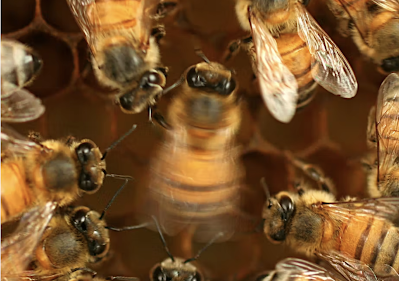
The center bee does the waggle dance. (Photo by Heather Broccard-Bell, CC BY-ND)
They've got a waggle dancer, waggle dance groupies and distance dialects. It's not a rural string band, Black Velvet line dancing, or even "Hey! . . .Ho!" by the Lumineers. It's how honeybees tell each other "where to find resources such as food, water or nest sites," reports James C. Nieh for The Conversation, a platform for journalism by academics. Nieh studied how many "waggle skills" bees are born with and how many they learn from older bees, and reports, "In addition, each colony has a 'dance floor,' or the space where bees dance, with complex terrain that the dancers may learn to better navigate over time or by following in the footsteps of older dancers."

The connection between humans and whales has been so strong that a humpback whale song was included on NASA's Golden Records, launched into space on the Voyager spacecrafts as a representation of life on earth, reports Kiley Bense of Inside Climate News. "After decades of conservation efforts to protect whales, two recent books shed light on why they're still threatened—and how we might change that. . . . Tom Mustill's book, How to Speak Whale, offers one possible means of altering whales' fate: technology."
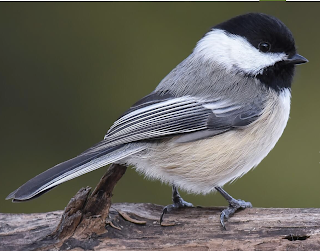
Black-capped chickadee (Photo by Scott Martin, Cornell Lab)
That's for the birds! What? Bugs. In California, the Wild Farm Alliance is working to bring birds back to the farm as natural pest control, reports Twilight Greenaway of Civil Eats. WFA Executive director Jo Ann Baumgartner told Greenaway, "There are so many beneficial things that birds do related to pest control, and different kinds of birds offer different kinds of pest control." Who are the best insectivorous birds? "Tree swallows, which are aerial foragers, meaning they're cruising around in the air and catching moths, flies, and flying insects," Greenaway shares. "There's chickadees, titmice, ash-throated flycatchers, violet-green swallows, and various kinds of wrens and nuthatches."

Mention Canada, and many people will think of mountains, beauty, Mounties, etc. One thing people don't think about is tornadoes. Canada has the second-highest number of tornadoes each year, reports Oliver Whang for The New York Times. Another surprise, Canada's tornadoes are hard to count. "Canada is vast. . . . Canadian tornadoes end up touching down in areas with no [human] witnesses. . . . The Northern Tornadoes Project in London, Ontario, has been seeking to address this. . . . Using social media and eyewitness reports, satellite imagery, drone footage and fallen trees, the group has tracked more Canadian tornadoes than ever before."
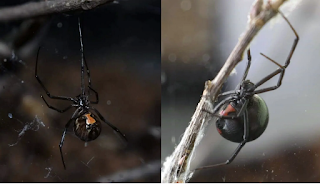
Left: Black widow spider. Right: Brown widow spider.
(Photos by Louis Coticchio, The New York Times)
Deadly, feared, found in song lyrics and old sneakers, black widow spiders have fearsome reputations. "But throughout the South, the bulbous arachnids with red hourglasses on their bellies are engaged in a lethal competition with the brown widow, a relative from abroad — and they're losing," reports Asher Albein of The New York Times. "Brown widows tend to be bold, investigating nearby webs and attacking spiders that don't resist. . . . The shy, retiring black widows generally try to escape, fighting back only as a last resort."

Found an egg in your pocket? Well, that's worth quite a bit. "For the first time in human history, the care and keeping of 11 hens all winter to receive one egg a day is now a pretty good deal," reports Eliza Blue of The Daily Yonder. "Imagine my delight then when the very next morning I arrived at the coop to discover not one, not two, but four eggs! It felt like I had won the egg lottery now that I knew how much they were worth. I complimented every single one of the hens since I couldn't be sure who had actually laid the eggs. . . . It also was a wonderful reminder that we've tipped toward spring and spring's abundance as hens increase their laying with the return of the light."

In some states, insects are not considered wildlife. They are left unprotected, and yet . . . "Bees, butterflies and beetles pollinate plants, enrich soils and provide a critical protein source for species up the food chain. The U.S. Forest Service says, 'Without pollinators, the human race and all of earth's terrestrial ecosystems would not survive,'" reports Catrin Einhorm of The New York Times. "Conservation officials in at least 12 states have their hands tied, legally speaking, when it comes to protecting insects. The creatures are simply left out of state conservation statutes, or their situation is ambiguous."

Monday, December 19, 2022

Rural Canadian town that once rejected immigrants by local law now embraces their contributions. What changed?

Habiba Hmadi, a native of Tunisia, lives in Hérouxville.
(Photo by Nasuna Stuart-Ulin of The New York Times)
Fearing further dilution of French culture, Quebec has been the outlier in broad Canadian support for immigration. In 2007, Hérouxville, Quebec, pop. 1,300, set a code of conduct that caused a national buzz with its bold message: Immigrants and their traditions were not welcome, and there would be no "stoning women to death in the town square," Christmas was celebrated, and Halloween was the only time citizens could cover their faces, reports Norimitsu Onishi of The New York Times.

Ten years after Hérouxville's code was established, Canada adopted a sweeping pro-immigration policy, Onishi writes. Now the shift has made its way into Quebec, including Hérouxville. Bernard Thompson, the mayor of Hérouxville, Quebec, a one-time supporter of the town’s anti-immigrant code, told Onishi, "We now want as many immigrants as possible."

New York Times map
Hérouxville's cultural attitude shift "stemmed from a combination of factors, including an aging population, a low birthrate, the need to fill an acute labor shortage," Onishi reports. "But also profound shifts in views among younger generations and the personal journeys of individuals like Mr. Thompson.

“If we’re unable to respect each other’s culture, whether it’s religious or not, I think that’s a mistake,” Thompson told Onishi. “We have to show an openness.”

Canada's his continuing its pro-immigration policy: "Canada’s federal government has announced plans to welcome record numbers of new immigrants over the next three years, with the goal of adding 1.45 million immigrants to the country’s population of 39 million," Onishi reports. "In contrast to other Western nations, where immigration has cleaved societies and fueled the rise of political extremism, there is a broad consensus in Canada over the value of immigration."

Thursday, December 15, 2022

British Columbia amps up mining ventures; Native Americans in U.S. and Canada push for 'a seat at the table'

Argonaut Wharf near Campbell River, British Columbia, which calls itself "Salmon Capital of the World," is the primary export outlet for the Myra Falls mine in Strathcona Provincial Park. (Photo by Alex Ratson, Getty Images)
Wikipedia map
Native American tribes are asking the U.S. government "to pressure Canada to stop additional mining activity in British Columbia, which they say contaminates waters and threatens Native American ways of life in Alaska, Montana and Idaho," Jacob Fischler reports for States Newsroom.

“BC is moving full-steam ahead with doubling their amount of mines,” Jill Weitz, the natural-resource manager for the Central Council of Tlingit & Haida Tribes of Alaska, who was part of the delegation, told Fischler, “Tribes and downstream communities do not have a meaningful seat at the table as it relates to the management of these shared rivers and resources that everyone is dependent upon."

Fischler writes: "British Columbia plans to expand its profitable coal, copper and gold mining industry. . . . Spending on mineral and coal exploration in British Columbia increased by 56% in 2021 over 2020, reaching $660 million, according to a study for the provincial government."

Rich Janssen Jr., head of the Department of Natural Resources for the Confederated Salish and Kootenai Tribes in Montana and Idaho, told Fischler, "Once mining impacts occur, it’s very difficult to clean them up. We’re not against mining at all, but we’re against mining that doesn’t do the environment justice.”

To support their cause, "The Native American leaders are asking for the countries to refer the matter to the International Joint Commission, a U.S.-Canada partnership created to oversee water issues between the two nations," Fischler writes. However, Weitz told Fischler that "historically [matters] have only been resolved when both countries recognize the need to meet."

Diana Tan, a spokesperson for the Canadian Embassy, told Fischler that "Canadian diplomats met with tribes and other advocates this week for 'constructive discussion' but did not commit to any steps beyond continuing the conversation."

Friday, June 11, 2021

Children on farms pick up risky behaviors from parents, Canadian study confirms; U.S. experts say it applies here

Farm kids learn how to farm from their parents, grandparents and sometimes even great-grandparents. They may also learn risky behaviors that get passed from generation to generation, according to a Canadian study that U.S. researchers say applies south of the border.

The study in the Journal of Rural Health surveyed farmers Saskatchewan farmers. It concluded, "Occupational health and safety risks and protections experienced on farms appear to be transferred between generations. This suggests the need to target farm owner-operators, the responsible authority on the farm, as a focus of primary prevention strategies aimed at injury risks to children and young workers."

The researchers at the University of Saskatchewan and the University of Alberta wrote, "Family farms provide an opportunity to pass down traditions of hard work, valuable occupational skills and abilities, and family values. Some of these traditions, however, can have a negative side with respect to rural health. There is a quiet epidemic of traumatic farm injuries that are disproportionately experienced by farm children, which may be related to cultures of safety and risk-taking that are also passed down through generations."

Two leading farm-safety researchers in the U.S. told The Rural Blog that the study is valuable.

“This inquiry into the intergenerational aspects of farming practices is critical in broadening and deepening our understanding of how the social-cultural aspects of risk impact current and future generations of farmers,” said Casper Bendixsen, director of the National Farm Medicine Center at the Marshfield Clinic Research Institute in Marshfield, Wis. “While the study is based on Canadian farmers, the findings resonate with me as a U.S. researcher and as the son of farming and ranching. It also grounds what is theoretical, and sometimes mythical, into concrete, quantitative findings.”

Dennis J. Murphy, Nationwide Insurance Professor emeritus of agricultural safety and health at 
Penn State, wrote, “This research is innovative and very applicable to farm and ranch operations in the United States. I think agricultural safety and health researchers and educators have always thought along these lines but there is little, if any, direct research that supports these notions. Their suggestion that injury prevention strategies for the protection of children and young workers should target the responsible authority on the farm or ranch is certainly applicable throughout the U.S.”

Thursday, March 26, 2020

Small newspapers in Canada, U.K. suspend printing; some in U.S. may due to pandemic-driven loss of ad revenue

We noted in an item earlier this week that loss of ad revenue has hurt small newspapers in Michigan. Many rural newspapers in the U.S. are considering temporarily suspending their print editions, says Al Cross, director of the Institute for Rural Journalism and Community Issues, which publishes The Rural Blog. New stories from Canada and the United Kingdom show that the phenomenon is even more widespread than that. 

"Halifax-based SaltWire Network announced Tuesday afternoon it's temporarily laying off 40 percent of its Atlantic Canadian workforce, suspending production of all weekly newspapers across Newfoundland and Labrador and Nova Scotia, and producing only four daily publications: the St. John's Telegram, the Halifax Chronicle Herald, the Cape Breton Post and Prince Edward Island's Guardian," the Canadian Broadcasting Corporation reports. "The company intends for the layoffs and suspension of publications to continue for the next 12 weeks."

JPI Media, which owns dozens of newspapers in England, "told staff on Wednesday that all of its free newspapers delivered door-to-door would temporarily stop printing due to the logistical challenges of arranging delivery, alongside the catastrophic collapse in the local advertising market," Jim Waterson reports for The Guardian. "JPI Media said it intended to retain journalists at the non-printing outlets to run websites. But the decision to cease printing raises questions about how long this can sustained, given that sources have suggested digital advertising revenue was already minimal at many of these outlets. Instead they relied heavily on income from print advertising, which has been cut heavily as small businesses cut spending." The British government "has made clear that it considers reporters and print newspaper distribution staff as key workers during the crisis, due to the importance of getting accurate information to people’s homes," Waterson reports.

Friday, November 08, 2019

Why not give a struggling newspaper to the community instead of closing it? Quebec paper is giving it a shot

Canadian newspapers are facing most of the same problems as their American counterparts: more than 250 Canadian media outlets closed between 2008 and 2019. A small paper in Quebec, The Gleaner, was almost one of them, but instead of closing the financially struggling paper in November 2018, owner Gravité Media decided to try and give the paper's rights to the community it served, Karen Longwell reports for Harvard University's Nieman Lab.

The Gleaner, an English-language paper, was established in 1863 and serves several rural towns in the Chateauguay Valley west of Montreal. Gravité reached out to Stéphane Billette, the local National Assembly of Quebec member at the time. Billette then spoke with Hugh Maynard, chairperson of The Gleaner's steering committee, who called a public meeting, Longwell reports.

Nearly 40 people showed up to the meeting, and non-profit organization Chateauguay Valley Community Information Services was created, with Maynard at the helm. As a symbolic gesture, Gravité sold the newspaper rights to CVCIS for $1, Longwell reports. The paper's sale to CVCIS marked its return to local ownership. It was locally owned until 1985, then was sold to a succession of media chains, ending with Gravité in 2017.

"An 11-member steering committee got to work publishing the paper again. The committee consisted of former Gleaner journalists and editors, along with a retired secretary, an artist, a cartoonist, a retired teacher, a website designer, and a farmer," Longwell reports. "Many of the community volunteers had some background in media but several had no journalism experience."

Chantal Hortop, a former Gleaner editor, told Longwell that some people stepped in because they valued the newspaper, even though they had no experience in journalism or communications. "They just felt strongly that The Gleaner had to keep going, and if there was a way to do it with community effort, we were going to make it happen," Hortop told Longwell.

The newly owned paper relaunched with its first print edition of 5,000 copies on June 5. Volunteers distributed the paper for free from a booth at an area carnival. The paper has published monthly issues since then, and on Oct. 9 formalized the nonprofit and elected a board of directors. Though advertising and community fundraising has more than covered printing costs, the board hopes to find a way to start paying contributors. The board plans to move The Gleaner toward a biweekly print schedule starting in January with weekly updates online, and hopes to secure 1,500 subscribers.

The reaction to The Gleaner's comeback has been positive. "I have seen more than one person hug the newspaper," CVCIS committee member Lorelei Muller told Longwell. "It is our valley news. It is what connects us. If something big happens in the area, sure CTV or CBC or whoever is going to cover something big, but they don’t have our day-to-day stuff, our regular community news."

Thursday, November 22, 2018

Canadian government proposes much greater subsidies to help the country's struggling newspapers

In Canada, where newspapers seem to be in more trouble than in the U.S., the federal government this week proposed half a billion dollars in subsidies to news outlets. They would include "measures to facilitate fundraising by non-profit news organizations and tax breaks to fund the production of original content," and "a temporary 15 percent tax credit for Canadians on online subscriptions to some media outlets," Daniel LeBlanc reports from Ottawa for the Toronto Globe and Mail.

A tax credit would be granted for donations to non-profit news operations that "release content for free under a creative commons license, which the government hopes will have a knock-on effect for local news organizations that can post the stories or incorporate them into their own journalism," Stuart Thomson reports for the National Post.

"An independent panel comprised of members of the news and journalism industry will flesh out the application of the moves," LeBlanc reports. "The group will decide which journalism jobs and which news organizations are eligible for the new funding." However, "The issue of federal funding for news organizations has divided Canada’s media community and sparked heated political debate."

Terence Corcoran, a columnist for the Financial Post, disputed Morneau's assertion that the measures would be “arm’s-length and independent of the government.” He wrote, "They are not, and they represent a step backward for Canadian journalism. . . . There is no way Ottawa’s journalism-bailout scheme can pass any press-freedom test." Noting that the plan says "Benefits are expected to be shared by the diverse groups of men and women, including their families, working in this sector," Corcoran writes, "The supposedly independent panel of journalists and others from the 'news community' already has its first government directive. . . . The mere act of appointing a panel with objectives and instructions is a form of state interference. Which members of the news community will be selected?"

The government says Canada’s news industry needs help adapting to "new media-consumption habits and the migration of advertisers toward foreign digital platforms," LeBlanc reports. Finance Minister Bill Morneau told the House of Commons that the goal is to “protect the vital role that independent news media play in our democracy and in our communities.” The five-year proposal would cost $595 million in Canadian dollars; at the current exchange rate, that would be $452 million in U.S. dollars. That is about 10 times the amount of media subsidy in the current budget, Thomson reports.

Monday, October 30, 2017

Most counties dependent on exports are small, so they could be hurt most by changes to NAFTA

Changes to the North American Free Trade Agreement could have an outsized impact on many places in rural America. "Although counties containing big cities such as Los Angeles, New York and Houston generate the highest dollar volumes of exports, the most export-dependent places tend to be relatively small, often rural or suburban counties whose economies are based on a single industry – or sometimes even a single company or plant," Drew DeSilver reports for the Pew Research Center. "In fact, of the 154 counties or county equivalents where exports accounted for more than a quarter of GDP last year, only 11 had populations above 100,000 and half had fewer than 25,000 residents, according to a Pew Research Center analysis of data compiled by the Brookings Institution for its 'Export Monitor 2017' report." Many of the high-export counties manufacture automobiles or auto parts.
Pew Research map; click on it to enlarge it.
Three U.S. counties rely on exports for more than 50 percent of the local gross domestic product. Leading the pack is Hancock County, Ky., a county of 8,810 residents which brings in 55.3 percent of its GDP from manufacturing aluminum and other nonferrous metal products.

In the counties with the greatest growth in exports, "booming U.S. oil and gas production and higher precious-metals prices have turbocharged export growth in many resource-rich counties. In 17 of the 30 counties with the highest annualized real export growth rates between 2003 and 2016, the economic sector that contributed the most to that growth was mining, oil and gas extraction," DeSilver reports.

Canada and Mexico are the two biggest destinations for U.S. exports, so a change in the U.S.'s trade relationships with those countries could hurt rural America. The NAFTA renegotiation talks are ongoing, but have been granted an extension after negotiators have had a hard time meeting stringent American demands.

Wednesday, September 27, 2017

Broadcaster hires local journalists instead of 'parachute coverage'

An ambitious new project at TVO, a nonprofit educational television network in Toronto (similar to PBS), aims to cover a broader area of Canada in its current affairs show The Agenda with Steve Paikin. So far, so normal. But it's how the $2 million Ontario Hubs project accomplishes this that's interesting: Instead of dispatching in-house journalists from Toronto for short-term "parachute" coverage, TVO has hired four journalists from around Canada who have deep ties to their region, as well as one roving on-air reporter, a copy editor, and a regional editor. The reporters act as one-person bureaus and can bring knowledgeable, in-depth stories to Toronto, Karen Ho writes for the Columbia Journalism Review. To help manage costs, local universities have agreed to provide TVO reporters with office space, studio space, and access to high-speed internet in exchange for internship opportunities.

John Ferri, TVO’s vice president of current affairs and documentaries, says the project is important because of decreasing local news coverage in rural areas. "You're seeing less and less journalism on the ground, and it's affecting smaller communities," he said. "There's really a sense of something fundamental that's lost."

"The model presents an approach that could be replicated in underserved parts of the US, where the loss of local-news reporting is at a crisis point as newspapers close and remaining outlets orchestrate round after round of layoffs," Ho writes.