Showing posts with label county governments. Show all posts

Tuesday, November 19, 2024

Tired of big-city decisions, rural counties in some states work to form their own governments

New Illinois activists encourage residents
to "leave Illinois without moving."
Voters in rural towns and counties are working to break away from their state's blue-voting big cities and create their own governments. The "breakup" process has already begun in Illinois and California and is gaining momentum in "other states where vast swaths of red, rural counties are dominated by a few blue cities," reports Joe Barrett of The Wall Street Journal. "More residents are pushing to break off and form new states. . . . A group called New Illinois State declared itself independent from actual Illinois and passed the first draft of a new constitution."

On Nov. 5, voters in rural Iroquois County, Illinois, "backed the idea of forming a new state with every Illinois county except Cook, home to Chicago and more than 40% of the state’s population," Barrett explains. "The nonbinding resolution also passed in six other counties," which means nearly 33% of the state's counties voted to leave the Chicago area behind.
Location of Iroquois County
in Illinois (Wikipedia photo)

Iroquois County resident and "new state" activist Phil Gioja, explained his motivation to Barrett, saying, "There’s a lot of people in Chicago, and I think that they make a lot of decisions that affect people downstate. It’s just sending a message that ‘Hey, you know, there’s people that would like to be part of the conversation, and often aren’t.’" Still, Gioja "doesn't expect a New Illinois anytime soon."

Even if counties were allowed to form separate states, it's uncertain that new states could financially survive without the funding they receive from bigger city revenues.

Counties working to "divorce" their bigger city counterparts and create new states face potentially messy uphill battles. "Becoming new states would require the consent of the existing legislatures — extremely unlikely in most blue states — as well as Congress," Barrett writes. Paul Preston, founder of the New California State, "plans to petition Congress for statehood based on the argument that the current California government is a one-party communist state, and technically, they have seceded from the Union already.'"

Preston's approach may seem ridiculous to some but "appealing to Congress is a strategy that could work," Barrett reports. Jason Mazzone, a constitutional law professor at the University of Illinois, who told Barrett, "It seems far-fetched. But we live in uncertain times. So if you’ve got the right people in Congress — and I don’t think we do have the right people in Congress — you could do it.”


Friday, July 26, 2024

Rural Nevada leaders seek a voice in massive energy builds, but almost 80% of their land is federally managed

Across western federal lands, some renewable energy expansion is going at such a frenetic pace that rural county officials in Nevada can't keep up with the requests, reports Jeniffer Solis of the Nevada Current. "Several rural counties are now asking state lawmakers to establish a policy requiring federal agencies to coordinate all their land use planning and management decisions with state and county governments when considering massive utility-scale energy projects. . . . As of June, there are over 130 pending applications to build renewable energy projects across Nevada’s public lands. Most of those projects are in rural counties, where as much as 80% of land is federally managed."

NV Energy photo
Currently, Nevada lacks a statewide utility-scale solar plan, which exacerbates the problem for local governments.  In fact, county officials from Eureka and Lander County told state lawmakers that managing the sheer number of clean energy projects coming to their offices isn't workable because they lack staff and management capacity. Solis writes. "Rural governments told lawmakers that the intensity and scale of utility-scale energy proposals they are seeing in their counties will require targeted state policy to support and protect rural economies."

Eureka and Lander County lands are included in the "proposed Greenlink North Transmission Project — a 235-mile transmission line along Highway 50, which is expected to attract more solar projects in the coming years," Solis explains. And while the project is expected to bring thousands of good-paying jobs to the state, county officials want their offices and residents to have a say in local installations and time to prepare for the profound changes the builds are sure to bring.

Eureka County’s natural resources manager, Jake Tibbitts, "proposed amending state policy to clarify that federal agencies are expected to enter formal agreements with local governments in Nevada when considering projects on public land in their county," Solis reports. "Under the proposed amendment, those agreements would need to include a detailed coordination plan. . .especially when addressing conflicts between local land use plans and federal plans."

Solis adds, "But like Nevada as a whole, land in Eureka County is largely administered by the Bureau of Land Management and the Forest Service, leaving the county at the whims of federal land use policy."

Thursday, October 19, 2023

Government officials have 'unqualified access to private land;' hunters sue to change Open Fields doctrine

The Open Fields doctrine has allowed government officials access
to private land. (Photo by Institute for Justice via Farm Journal)

Sometimes private land isn't private, and in states such as Pennsylvania, the question, "How much power does the government claim on private land?" is answered by a court ruling, reports Chris Bennett of Farm Journal. On Sept. 29, a "court ruled against two hunting clubs in their lawsuit accusing the Pennsylvania Game Commission of private property rights violations. . . . In its ruling, the Commonwealth Court of Pennsylvania noted the government's absolute power to 'roam private land without consent, warrants, or probable cause.'"

The hunting clubs, Pitch Pine and Punxsutawney sued PGC "after game wardens consistently entered club lands without permission or warrant, and secretly monitored club members, including photo collection via installation of a hidden game camera," Bennett writes. "The wardens' behavior, the lawsuit asserted, was a direct violation of Pennsylvania's state constitution, which explicitly protects 'persons, houses, papers, and possessions.'"

The Open Fields doctrine allows state and federal officials "unqualified access to private land" without requiring a warrant to "enter or surveil private land," Bennett reports. "The Commonwealth Court detailed the alarming powers and 'unfettered discretion' assumed by the government via Open Fields: To ensure their members' privacy, the Hunting Clubs have posted their properties with no trespassing signs and have installed gates at all entrances to exclude nonmembers and intruders. However, the Entry Statutes empower game wardens with unfettered discretion to enter upon and roam private land without consent, warrants, or probable cause."

"Six states place state constitutional authority above the Open Fields doctrine: Mississippi, Montana, New York, Oregon, Vermont, and Washington," Bennett writes. The Institute for Justice represents Pitch Pine and Punxsutawney is appealing the decision. "Arguments before the Pennsylvania Supreme Court should take place in 2024, with a decision likely in 2025. IJ is litigating similar Open Fields cases in Virginia and Tennessee about warrantless intrusions on private land."

(For more on Open Fields, see How Much Ag Property Is Protected From a Warrantless Search?)

Wednesday, September 27, 2023

Op-ed on improving news coverage: A news site publishes an indictment of the losses caused by cutbacks

The Ithaca Voice is a nonprofit digital newsroom in Ithaca, N.Y., pop. 32,000, in Tompkins County. The op-ed below was written by the Tompkins County Public Information Advisory Board and shared on the newspaper's front page.

When was the last time you read, heard or watched a local news report on one of these issues in the community?
-- What's the status of the 20+ years of repeated efforts to clean up the lead and arsenic contamination at the popular hiking and pet walking trail at Ithaca Falls? How does that contamination impact visitors?
-- Why does Tompkins County's polio vaccination rate lag the state's vaccination rate and several other counties in the region?
-- Who are your school district, municipal, county, state or federal representatives? Do you know what actions they took on a public issue in the last 6 months?

Tompkins County, New York
(Wikipedia map)
If you're uncertain of any answer, you're not alone. News coverage on significant local issues has been shrinking, making it more difficult for Tompkins County residents to be well-informed about their communities while eroding community cohesion and deepening polarization. The local pattern is the same in both New York and the nation.

The rapid growth in free or inexpensive digital advertising made available by tech giants eroded the ability of local news providers to generate revenue to pay their journalists, ad salespersons, marketing staff and administrative employees. In 2004, New York had 62 daily papers and 439 weekly papers. By 2019, these numbers declined to 54 dailies and 249 weeklies. With those closings, newspaper newsroom employment shrunk 25 percent. The loss was not offset by more jobs appearing in local and regional TV, radio and digital news operations.

Locally, The Ithaca Journal's newsroom staff reductions illustrate the sobering metrics. Twenty years ago, the Journal had two dozen full-time reporters, sports writers, editors, photographers and clerks. Another six freelance writers produced weekly "town talk" columns on every town in Tompkins County. The Journal's last full-time staff reporter resigned in the spring and was replaced in August when the Journal contracted with a freelance reporter to handle the news coverage that nearly 30 full-time staffers and freelancers once produced.

Meanwhile, The Ithaca Times and The Ithaca Voice face a daunting task of covering local news with their small and dedicated staffs of young journalists. The Voice launched in 2014, as a web-based nonprofit, local news provider. Its website lists one editor and three full-time reporters on its staff, while a handful of freelance contributors supplement its coverage. The Ithaca Times weekly newspaper, its website ithaca.com, and its Finger Lakes Community Newspapers of nine small weeklies lists two managing editors and a sports reporter. Tompkins Weekly, WHCU, WRFI and a few other news outlets have small local operations and some regional media like WSKG cover news across many counties. All face challenges in providing community news.

The impact of fewer journalists working in Ithaca has been a sharp decrease in the regular coverage of local government, school boards and issues as important as health, economic development and public safety. There's less access to information that brings communities together, like sports coverage, highlighting student achievements, and recognizing when someone passes away. Getting key public information to residents has become more difficult for local governments as leaner local media budgets reduce their supply of community news. In the absence of media coverage, newsmakers such as politicians and local governments try to fill in the information gap, often with limited resources.

The Tompkins County Public Information Advisory Board has been discussing this trend, and we are increasingly alarmed to see important stories not being told. Less access to local news leaves community members lacking the information they need to participate in the political process, hold government and powerful private actors accountable and engage in civic activities from voting to volunteering.

Legislation in both Albany and Washington has proposed ways to improve community news coverage. Among those:
  • A tax deduction for personal subscriptions to eligible local news organizations might incentivize more individuals to pay for local journalism and boost the revenues of local outlets.
  • Tax offsets for eligible production expenditures incurred by newsrooms could help defray the costs associated with original reporting.
Elected leaders should consider resolutions supporting such legislation, as well as ways to bolster resources available to support local news coverage — but governments aren't the only ones with skin in the game.

Local businesses and organizations should also consider increasing advertising efforts in local publications, and residents who have the means can consider donating to local nonprofit news outlets such as The Ithaca Voice, WSKG, or WRFI. Local philanthropies should consider inviting news providers to apply for funds to increase and sustain their coverage. Also, our community's media should explore collaborations to improve local news coverage.

In the coming months, PIAB will examine ways our community can foster better coverage of major public issues and their impact on residents as well as improve basic news about public safety, governmental actions and local events. We're inviting community ideas to increase and improve public information efforts. If you have ideas, please share them with us at tcgov.co/piabideas or email pubinfo@tompkins-co.org.

The Tompkins County Public Information Advisory Board includes Chair Larry Roberts, Secretary Patty Poist, Bruce Estes, Elizabeth Graeper-Thomas, and Kate Supron. Legislature Liaison Amanda Champion and Tompkins County Communications Director Dominick Recckio assist the board.

Tuesday, September 26, 2023

Election official turnover is nearly 40% in some states, new report shows. Workers quit to avoid 2024 conflicts.

Election official have left their jobs to avoid 2024
conspiracies. (Photo by Elliott Stallion, Unsplash)
Underpaid, overworked, and sometimes threatened or harassed, many election officials have left their jobs rather than face the 2024 election cycle. Some states face a dramatic shift of experienced workers leaving and taking their expertise with them. "In some battleground states, more than half of the local election administrators will be new since the last presidential race, according to a new report from the democracy-focused advocacy group Issue One," reports Miles Parks of NPR

Overall election official turnover is "notoriously hard to come by — but experts have been saying for years that they worried about a mass exodus driven by the polarized environment," Parks reports. The Issue One report focused on 11 western states and "found that the problem of voting official turnover is particularly acute in the region's swing states, where conspiracies have flourished. . . . More than 160 chief local election officials — nearly 40% of the region's officials — have left their positions. Experts say they expect to see a similar trend in other states as well, as recent polling and NPR's own reporting have indicated many people in these roles fear for their or their colleagues' safety."

Marine veteran Josh Daniels, a Republican who became an election official in Utah County, Utah, in 2019, "grew to love the complex minutiae that went into running an election. . . . But when the time came to decide whether to run for reelection in 2022, Daniels decided against it. Voting conspiracies had become too much to take." Daniels told Parks: "It was just exhausting. It really was like "The Twilight Zone" of government service. "Groundhog Day". . . every day you wake up, and it's the same thing over and over again. It doesn't matter how much information and data you share; it doesn't matter how many concerns you answer. There will just be a new group of critics to again dish out the new conspiracy of the day."

With so much knowledge walking out the door and inexperienced officials filling the gap, a new problem surfaces -- the number of human errors new employees make while learning their roles. "Issue One found that the officials who left took with them more than 1,800 years of experience. . . . New voting officials make more mistakes than seasoned ones. So the exodus brought on by election conspiracies may beget more conspiracies, as first-time honest mistakes are treated like evidence of malfeasance."

Wednesday, September 13, 2023

Rural election voting processes have improved since 2020; the election denial movement could pose a threat

As the country gears up for November voting as well as a future presidential election, experts are voicing concern over the election denial movement, which threatens to disrupt improvements in how votes are cast, counted and reported in rural America, reports Claire Carlson of The Daily Yonder. "Civics experts say rural communities have the most to lose from the pressures of the election denial movement. . . . Rural America already has lower voter turnout rates, which some researchers argue is due to inadequate election infrastructure. One 2022 study found that voting-by-mail restrictions hurt rural voters the most because there are fewer rural polling locations than urban ones, increasing the distance a person must travel to cast a vote."

U.S. voter engagement has trended steadily upward, "The 2020 presidential election saw the highest turnout in the 21st century with 66.8% of citizens age 18 or older casting a vote, according to the Census Bureau," Carlson writes. "Former President Donald Trump's unfounded attacks on the U.S. election system and the resulting election-denial movement put these gains in jeopardy."
La Plata County Clerk Tiffany Lee in the county elections
office (Photo by Ilana Newman via The Yonder)

The election-denier movement focuses its suspicion on rigged voting machines, for which the only antidote is  manual counts. Carlson reports, "[There are a] growing number of counties–rural, suburban, and urban–where election deniers have successfully urged local governments to recount election results or throw out electronic voting machines altogether." Justin Grimmer, a political science professor at Stanford University who studies election denialism, told Carlson, "We're at this period that I think should be being celebrated as a sort of high point of participation in American democracy." Carlson reports, "reversing improved election infrastructure – the use of equipment that more accurately counts votes and ensuring better access to voting through absentee and mail-in ballots, for example – could set back civic participation."

Carlson reports, "After Trump left office, the election denial movement morphed into a "core group of 'influencers. . . .These influencers have made it a full-time job traveling the country to spread the election denial movement's primary message: elections are being stolen, and it's the government's fault."

Charles H. Stewart, a professor of political science at the Massachusetts Institute of Technology, published research earlier this year exploring election-denial roots. He told Carlson, "The thing that we're seeing in 2020 that we didn't see in 2016, or in 2012, or other times when these sorts of [election integrity] questions arose, is that we now have about a half-dozen of these traveling road shows." Carlson reports, "In La Plata County, Colorado, an influx of open records requests have poured in since 2020, challenging the county's election tools, including Dominion Voting Systems, an electronic voting hardware and software company, and mail-in ballots. The county has relied on mail-in ballots since 1992." La Plata County Clerk Tiffany Lee told Carlson: "What's happened to us is people from the outside and different organizations that don't have anything to do with our local communities are attacking us because ‘Oh my gosh, you have Dominion or you use mail ballots, and we don’t trust you.'"

Tuesday, September 12, 2023

Some Eastern Oregonians look to join Idaho, saying they have little in common with people in their current state

Map by Amanda Hernández, from Stateline research
Amid ongoing tensions and political disagreements, Eastern Oregon residents from 12 counties look to secede from Oregon and join Idaho. "At a meeting late last month, 25 people packed into a stuffy conference room in the Wallowa County Courthouse—35 miles west of the Idaho state line and 260 miles east of Portland—to hear county commissioners debate a single agenda item: leaving Oregon," reports Matt Vasilogambros of Stateline. Known as "The Greater Idaho movement," the idea to leave Oregon for Idaho had "sputtered along for years, gaining little traction. But then, the coronavirus hit in the spring of 2020."

Disagreements over Oregon's Covid management became the tinder that reignited the Greater Idaho movement. "Quarantines and remote learning inflamed residents' anger with the state government for shutting down schools and businesses," Vasilogambros explains. "This tension invigorated the effort to join Idaho, a state whose government reacted wholly differently to Covid than Oregon did. . . . Secession is a long shot that would require approval by Congress; so far, there have been ballot measures, and there has been a lot of talk. But the fact that the movement has gotten even this far illustrates the growing tear in the American fabric."

Greater Idaho has reached succession benchmarks other states, such as California and Illinois, have failed to meet. "If supporters here achieve their goal, it could mean a paradigm shift nationally, proponents say, inspiring more states to split along cultural and political lines," Vasilogambros writes. "County by county, Eastern Oregonians have voted on similar measures over the past three years, securing much of the large rural region for the secessionist movement. In June, Wallowa County became the 12th to pass a ballot initiative in support of joining Idaho."

Wallowa County is 6 hours, 55 minutes from
Oregon's capital in Salem. (Geology.com map)
"Stateline traveled more than 1,000 miles of Eastern Oregon, where supporters of the movement to join Idaho said they feel unheard by the decision-makers in Salem," Vasilogambros reports. "Would-be secessionists freely recognize that their communities represent less than a tenth of the state's population, but they also asked: Don't we matter? Their grievances are many: They dislike rules that restrict tree-cutting, protect coyotes and promote electric vehicles. They oppose transgender rights, classroom discussions of gender and race, and limits on guns. They detest the taxes and regulations they believe have devastated the region's economy. And they hate what became of Portland, a city many of them look back on with nostalgia."

For Eastern Oregonians, there's "a sense of desperation, as if all options have been exhausted and all that remains is joining Idaho," Vasilogambros reports. Mike McCarter, who leads the Greater Idaho movement, told Vasilogambros: "I have people come at me and say, 'Well, what can we do to change it?' It's gone too far over the top to change." Vasilogambros adds, "Whether they can succeed is another story."

Friday, September 08, 2023

By addressing inmates' mental health problems, some rural counties aim to stop a cycle of incarceration

Photo via RHIHub

Rural jail population statistics paint a grim picture of traumatized, abused or mentally ill individuals who volley between jail and life outside without ever receiving treatment; rural counties aim to change that dynamic by addressing mental health needs during incarceration, reports Gretel Kauffman for Rural Health Information Hub.

Washington County, Texas, pop. 35,000, is one of those countries. Eric Hensley, the county's chief sheriff's deputy overseeing jail operations, "heard about a psychological telehealth program at nearby Texas A&M University. Hensley immediately began to wonder how the technology could be used in the Washington County Jail," Kauffman reports. "Three years later, an estimated 150 people incarcerated in the Washington County jail have participated in virtual group or one-on-one counseling through a partnership between the jail and the Texas A&M Telebehavioral Care program, and two other rural Texas counties have replicated the program in their own jails, too."

In Marion, Ohio, pop. 36,000, "seeing familiar faces in the courtroom was a common occurrence for James Boleyn," Kauffman reports. "Boleyn, who serves as Director of Specialized Dockets for Marion Municipal Court, told Kauffman, "We were running into this situation again and again, and we decided we needed to do something as a community and say, 'How can we interrupt this cycle and better resource these individuals?'" Kauffman adds, "In 2021, Marion County signed onto the Stepping Up Initiative, a project by the National Association of Counties that encourages counties to improve and expand mental health resources in their local criminal justice systems. . . .The county is focusing its efforts inside the jail, which hasn't offered mental health treatment services up until this point."

Many communities address inmates' mental health needs while helping them plan for life upon release. Kauffman reports, "While rural communities may have fewer mental health resources available to people recently released from jail, that simplicity can also help to streamline the transition process, Erin Comartin, an associate professor in the Wayne State University School of Social Work, noted. In one rural community she worked with, the mental health center and jail were a parking lot away from each other." Comartin told Kaufman: "It was really great because when the jail was releasing somebody, they just call over and say, 'Hey, do you want to come to the other end of the parking lot and help this person get back into services?'"

Isaac Saldivar, a psychologist working virtually with clients in the Washington County Jail and two other rural county jails, "describes jail-based mental health services as having the potential to produce a 'dramatic domino effect' throughout rural communities," Kauffman writes, "The more they heal, the healthier the community becomes." Saldivar told Kauffman: “These are community members that are hurting and need healing. That's someone's friend, someone's brother, someone's sister, someone's father. And the more they heal, the healthier the community becomes.”

Tuesday, July 25, 2023

Oklahoma publisher who caught officials in racist, violent talk is losing his top reporter: son who took on the sheriff

The reporter who some officials of a rural Oklahoma county would like to kill, according to his newspaper's surreptitious recording of their discussion at a county commission meeting, is leaving his family's newspaper, citing threats and stress, Paige Wiliams reports for The New Yorker.

Chris Willingham, photographed through the paper's
window. (Photos: Joseph Rushmore for The New Yorker)
Chris Willingham is the son of Bruce and Gwen Willingham, who own the McCurtain Gazette in Idabel, Okla. The paper has a history of taking on McCurtain County officials, and Chris did a series of stories about irregularties in the office of Sheriff Kevin Clardy. One said 53 crime reports were missing, including “a shooting, a rape, an elementary school teacher being unknowingly given marijuana cookies by a student and a deputy allegedly shooting out the tires” of a car. The headline: “Sheriff regularly breaking law now.” 

Sheriff's Capt. Alicia Manning "was investigating several suspected pedophiles," Williams reports. "Manning told a TV news station that 'possibly other people in the community' who were in a 'position of power' were involved . . . and referred to Chris as 'one of them.' Without citing evidence, she accused him of trading marijuana for videos of children. Chris, stunned, suspected that Manning was just looking for an excuse to confiscate his phone. But when he started to lose music students, and his kids’ friends stopped coming over, he feared that rumors were spreading in the community. . . . He developed such severe anxiety and depression that he rarely went out; he gave his firearms to a relative in case he felt tempted to harm himself."

Chris and his wife Angie had "suppressed the occasional urge to leave the Gazette, knowing that they would be hard to replace," Williams writes, but now it was clearly an option. On March 6, he sued Manning and Clardy in federal court for “slander and intentional infliction of emotional distress.” They denied the allegations, and Manning's response said that whatever distress Chris suffered was within the limits of what “a reasonable person could be expected to endure.”

"On the day that Chris filed his lawsuit, the McCurtain County Board of Commissioners held its regular Monday meeting . . . Bruce, who has covered McCurtain’s commissioners for more than 40 years, suspected the board of discussing business not listed on the agenda—a potential misdemeanor—and decided to try to catch them doing it. . . . As they neared the end of the listed agenda, Bruce slipped a recording device disguised as a pen into a cup holder at the center of the conference table." When the room was vacated left hours later, "He went back inside, pretended to review some old paperwork, and retrieved the recording device."

In the three-and-a-half-hour recording, other officials come in, startig with Clardy and Undersheriff Larry Hendrix. Commission Chair Mark Jennings said the 2024 race for sheriff would have several candidates who “don’t have a goddamn clue what they’re getting into, not in this day and age.” Formerly, he said, the sheriff could “take a damn Black guy and whup their ass and throw ’em in the cell. . . . Take ’em down there on Mud Creek and hang ’em up with a damn rope. But you can’t do that anymore. They got more rights than we got.”

Manning came in and "continually steered the conversation to the Gazette," Williams reports. She "talked about the possibility of bumping into Chris Willingham in town: 'I’m not worried about what he’s gonna do to me, I’m worried about what I might do to him.' A couple of minutes later, Jennings said, 'I know where two big deep holes are here, if you ever need them.' 'I’ve got an excavator,' the sheriff said. "Well, these are already pre-dug,' Jennings said. He went on, "I’ve known two or three hit men. They’re very quiet guys."

Editor-Publisher Bruce Willingham in his "clutterbucket of an office"
Williams writes, "Bruce took the tape to the Idabel Police Department. Mark Matloff, the district attorney, sent it to state officials in Oklahoma City, who began an investigation." On April 15, the Gazette reported the conversation under the headline, “County officials discuss killing, burying Gazette reporters.” The next day, Gov. Kevin Stitt demanded that Clardy, Manning, Hendrix and Jennings resign; only Jennings did. The sheriff’s department said the recordign was illegal and “altered.” Chris Willingham told Williams that he reduced the background noise in the audio file before his father took it to the police. Oklahoma Press Association Executive Director Mark Thomas said two of the three commissioners were present and had no expectation of privacy.

"People wanted to hear the recording, not just read about it, but the Gazette had no website," Williams reports. "The Willinghams published an oversized QR code on the front page of the April 20 issue, linking to a Dropbox folder that contained the audio and Angie’s best attempt at a transcript. They eventually put Chris’s articles online. In a rare move, the 17-member board of the Oklahoma Sheriffs’ Association voted unanimously to suspend the memberships of Clardy, Manning, and Hendrix. . . . [Idabel Mayor Craig] Young was among those who hoped that Gentner Drummond, the attorney general, would depose the sheriff 'so we can start to recover.' But on June 30, Drummond ended his investigation," saying that the conversation was “inflammatory” and “offensive,” but not criminal. But Chris's latest story reports that Manning is under FBI investigation.

Williams ends her story this way: "Bruce and Gwen worried that the ongoing stress would drive Chris and Angie away from the Gazette — and from McCurtain County. Sure enough, they’re moving to Tulsa. Angie told me, 'We’re 40 years old. We’ve been doing this half our lives. At some point, we need to think of our own happiness, and our family’s welfare.' Bruce protested, but he couldn’t much blame them."
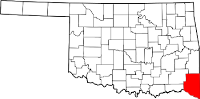
McCurtain County (Wikipedia map)
Williams' story has some observations about hard-nosed rural newspapering: "Bruce Willingham once wrote, 'We are aggressive about protecting the public’s access to records and meetings, because we have found that if we don’t insist on both, often no one else will.' . . . The Gazette exposed a county treasurer who allowed elected officials to avoid penalties for paying their property taxes late, and a utilities company that gouged poor customers while lavishing its executives with gifts. 'To most people, it’s Mickey Mouse stuff,' Willingham told me. 'But the problem is, if you let them get away with it, it gets worse and worse and worse.'

"In a small town, a dogged reporter is inevitably an unpopular one. It isn’t easy to write about an old friend’s felony drug charge, knowing that you’re going to see him at church. When Chris was a teenager, his father twice put him in the paper, for the misdemeanors of stealing beer, with buddies, at a grocery store where one of them worked, and parking illegally—probably with those same buddies, definitely with beer—on a back-road bridge, over a good fishing hole.

"Among law-enforcement sources, 'Chris was respected because he always asked questions about how the system works, about proper procedure,' an officer said. Certain cops admired his willingness to pursue uncomfortable truths even if those truths involved one of their own." Another unnamed officer told her. "If I was to do something wrong—on purpose, on accident—Chris Willingham one hundred per cent would write my butt in the paper, on the front page, in bold letters."

And one last revelation: Bruce and Gwen Willingham "rent several cabins to vacationers in Hochatown . . . a resort area known as the Hamptons of Dallas-Fort Worth," three hours away. Chris told her, “If we didn’t have tourism to fall back on, we couldn’t run the newspaper. The newspaper loses money.”

Monday, April 24, 2023

Reporting on a rural county's political transformation, driven in part by outside forces, leads to threats of violence

Doni Chamberlain worked as a reporter for 10 years before starting
her own online publication. (Photo by Marlena Sloss, The Guardian)

When local politics become driven by outside forces, community reporting can become dangerous, especially if it focuses on the transformation of a rural county by those forces. Ask Doni Chamberlain of A News Cafe in Northern California.

"In a seemingly long-gone era – before the Trump presidency, and Covid, and the 2020 election – Doni Chamberlain would get the occasional call from a displeased reader who had taken issue with one of her columns. They would sometimes call her stupid and use profanities. . . . Today when people don't like her pieces, Chamberlain said, they tell her she's a communist who doesn't deserve to live. One local conservative radio host said she should be hanged," reports Dani Anguiano of The Guardian. "Chamberlain, 66, has worked as a journalist in Shasta County for nearly 30 years. Never before in this far-northern California outpost has she witnessed such open hostility towards the press. She has learned to take precautions. No meeting sources in public. She livestreams rowdy events where the crowd is less than friendly and doesn’t walk to her car without scanning the street. Sometimes, restraining orders can be necessary tools."

Chamberlain has published stories "revealing that police were investigating the county’s top candidate for said CEO job, a leader of a California secessionist group, for an incident with a teenage girl at a local business . . . an analysis from the county clerk about the risks of introducing an untested manual tally voting system in response to disproven theories about Dominion voting machines . . . a large gathering held in defiance of Covid restrictions; a pandemic shortage of nurses temporarily closing a local neonatal intensive care unit; and a sheriff’s deputy promoting far-right extremist content on social media."

Chamberlain started A News Cafe after being laid off from her job as a columnist for the local weekly newspaper, the Shasta Scout. It reported on a "hanging threat" seemingly directed at her: "Vaguely threatening statements towards the media were made as a part of a recent podcast produced by 'Red, White and Blueprint,' an effort to document attempts to recall Shasta County Supervisor Leonard Moty," who lost his seat over anti-pandemic mandates, the Scout's Annelise Pierce wrote. "As the show was coming to a close, Clendenen spoke about the Nuremberg Trials, tribunals held by the Allies after World War II that ultimately prosecuted many of Nazi Germany's leaders. He said, 'I think in our own country there's a day coming that the media will have to pay, in one way or another. . . . I'm not saying that we're going to hang them.'"

Shasta County (Wikipedia map)
Chamberlain told Anguiano that Shasta County has a "perfect storm" of hard-right groups that have coalesced "to form a powerful political force with outside funding and publicity from fringe figures," Angiano wriites. "Anger coalesced into an anti-establishment movement backed financially by the Connecticut millionaire Reverge Anselmo. . . . Chamberlain's writing has made her a public enemy of the conservative crowd intent on remaking the county. Far-right leaders have confronted her at rallies and public meetings, mocking and berating her." Chamberlain told Anguiano, "This isn't how it's supposed to be to be a journalist. I shouldn't go to my car, afraid one of these guys is gonna bash me in the head with a baseball bat."

Chamberlain says the atmosphere makes finding sources difficult, and many people are afraid of speaking out, "even anonymously, "Anguiano reports. "Her family worries for her. Her son has put cameras all around the house. For Mother's Day, he gifted her gel pepper spray. . . . Chamberlain's twin sister has warned her not to poke the bear." She told Anguino, "I say, 'I'm not poking a bear, I'm just holding a flashlight. . . . I'm reporting things other people can't report. . . . I feel a moral responsibility to let people know what's happening.'"

Friday, January 20, 2023

Newspaper public notices take hit as big Fla. county shifts to online; some papers' mishandling of ads undermine industry

Notices of public hearings in Sarasota County, Florida, will no longer appear as paid advertising in the Sarasota Herald-Tribune, which could be the canary in the coal mine for newspapers in the state, and perhaps beyond. The county commission acted under a new state law that is "the most significant piece of public-notice legislation in modern history," says the Public Notice Resource Center, an advocate for the "legal ads" that have become a much more important revenue source for local newspapers as their advertising bases have shrunk.

Sarasota County will shift the notices on its own website, just as local governments all over the nation are lobbying their state legislatues to authorize. Newspapers argue that citizens won't go to government sites to look for such notices; governments stress cost. Sarasota County officials say they have averaged spending $200,000 a year on the "legal ads" and have hired a full-time employee to run the legal-ad program at an annual cost of $80,000.

Florida Press Association President Jim Fogler told the commission that newspapwer publication provides third-party verification that state law is being followed, and "that allowing the county to post the notices would create a conflict of interest," the Herald-Tribune reports. “We believe that there’s definitely a transparency issue there,” Fogler said. Most state newspaper associations have websites where papers post public notice free of charge.

The public-notice news wasn't all bad for newspapers in 2022, but some papers are causing trouble for the industry by not running notices when they should be run. "It's an isssue that affects a small but significant cohort of papers, and it appears to be growing worse," the Public Notice Resource Center reports. "The scope of the problem is evident any time a group of press-association directors meet and talk about public notice. During a roundtable discussion at the Newspaper Association Managers convention this summer in Austin, the topic dominated conversation. One director after another complained about member papers that have little connection to the communities they serve and make it more difficult for their press association to protect newspaper notice in the state legislature. . . . The biggest offenders are corporate newspaper chains."

Noting papers' staff cuts, PNRC reports, "There are now multiple papers in every state that don't even employ a publisher, which attenuates local relationships and accountability at those publications. Those factors played a significant factor in the Florida Legislature's passage of HB 7049, and they threaten to torpedo newspaper notice in other states as well. If newspapers hope to continue to serve as the government's official provider of notice, they need to make it as easy as possible for customers to publish their statutorily required notices. It's as simple as that."

Wednesday, October 12, 2022

Kentucky newspaper offers $3,000 for proof of vote buying

A newspaper in an Eastern Kentucky county that has been notorious for vote buying is offering a cash reward of $3,000 for evidence of the illegal act. The weekly Salyersville Independent made the offer in a full-page ad last week.

"Owner Ritt Mortimer says it wasn’t a decision he came to lightly," reports Kelsey Souto of WKYT-TV in Lexington.

Mortimer told Souto, “It’s of my opinion that every election of my 51 years has involved vote buying in Magoffin County, either to a small or very large degree at times, depending on the races involved, the money, the other factors.”

Souto reports, "He says new technology is making it easier than ever to record video or audio that could be used to prosecute individuals. It’s his way of trying to protect democracy in his hometown, but it will take a committed effort from everyone."

Typically, votes in rural Kentucky are bought through use of mailed absentee ballots, and sometimes through machine absentee voting that can be subject to manipulation. Magoffin County has long been a leader in the use of absentee voting; in the 2010 primary election, 17 percent of the vote came from absentee ballots; 7.7% of the total came from mailed-in absentees. The statewide shares were 4.3% and 1.6%, respectively.

Monday, August 22, 2022

Public-notice battles get more political, threaten existence of many small newspapers that need the 'legal ads' to survive

The long battle over public-notice advertising, a source of revenue that has become critical for small newspapers as they have lost retail ads, gets some needed national attention from the Local News Initiative at Northwestern University's Medill School of Journalism.

Writer Susan Chandler notes the latest efforts in several state legislatures to reduce public-notice requirements, including passage of a very worrisome law in Florida, and the laws in some states that leave selection of public-notice platforms up to elected officials, who can ignore basic standards while exercising political retribution.

Custer County (Wikipedia map)
She cites the examples of two Colorado counties: Pitkin, where the county commission made the Aspen Daily News the paper of record after The Aspen Times mishandled a libel suit and its fallout, and Custer, population 4,700, where commissioners moved public notices from the long-established Wet Mountain Tribune "to a nine-year-old partisan newspaper called the Sangre de Cristo Sentinel even though the Tribune submitted the low bid. . . . One of them cited the Tribune’s 'combative' coverage as the reason for the change. Losing legal notices has cost the Tribune between $10,000 and $15,000 a year in direct revenue, said Publisher Jordan Hedberg. . . . The loss is likely higher because of the halo effect of being the paper of record, he added."

Hedburg told Chandler that he may file a federal lawsuit, citing the First Amendment: “The Supreme Court has ruled that governments can’t use contracts to retaliate against protected speech, but we have a county commissioner retaliating against us for doing our job. Basically, the only way we are going to qualify is if we don’t write anything that irks this particular commissioner.”

Richard Karpel, executive director of the Public Notice Resource Center, which tracks the issue and sponsors an annual award for the best stories that come from public-notice ads, told Chandler, “We’ve seen it become more of a partisan issue in the last five or 10 years. In some states, there are Republicans who are in battle with the media as part of their political strategy.”

This is an existential issue for many newspapers, Chandler warns: "Les High, a longtime publisher in a small town in North Carolina, estimates that small community papers could lose 20 to 25 percent of their revenue if legal notices went away, compared with only a 5 percent loss for larger dailies."

“It’s the little guys who are under threat,” said High, who runs the Border Belt Independent, a nonprofit public-interest news site that covers four North Carolina counties. “They’re struggling already and they’re in counties without large revenue streams from retailers. If we lost public notices here, I bet you would see 15 to 20 percent of small newspapers disappear.”

Newspapers need to do a better job with public notices to help save them, said Dean Ridings, CEO of America's Newspapers, a trade group: “Publishers need to look for creative ways to push those out. Maybe it’s a bigger button on their website. Maybe it’s having a standing report once a month. This would be a good time to devote effort to making them easier to find digitally. We know how to do those things.” (Read more)

Wednesday, August 17, 2022

Pandemic influx of city-dwellers triggered housing shortages in many resort towns, pricing out the locals

Early in the pandemic, many city dwellers moved to rural areas. Communities with vibrant tourist economies were especially attractive for such people, according to a recent report from the Economic Innovation Group. Housing was frequently in short supply even before the pandemic in many small towns, but the new residents have triggered soaring housing prices that price out mid- and low-income workers critical to the local economy, Molly Bolan reports for Route Fifty.

Exclusive ski-resort town Sun Valley, Idaho, and surrounding communities offer an extreme example. "It is not just service workers struggling to hold on. A program director at the YMCA is living in a camper on a slice of land in Hailey," Mike Baker reports for The New York Times. "A high-school principal in Carey was living in a camper but then upgraded to a tiny apartment in an industrial building. A city-council member in Ketchum is bouncing between the homes of friends and family, unable to afford a place of his own. A small-business owner in Sun Valley spends each night driving dirt roads into the wilderness, parking his box truck under the trees and settling down for the night."

The housing shortage now threatens the once-thriving local economy in the area: "The hospital, school district and sheriff’s office have each seen prospective employees bail on job offers after realizing the cost of living was untenable. The fire department that covers Sun Valley has started a $2.75 million fund-raising campaign to build housing for their firefighters," Baker reports. "Already, restaurants unable to hire enough service workers are closing or shortening hours. And the problems are starting to spread to other businesses." However, when Ketchum officials sought a tax increase to build hundreds of affordable housing units over the next decade, voters wouldn't approve it.

Resort towns have long grappled with how to house their workers, but in places like Sun Valley those challenges have become a crisis as the chasm widens between those who have two homes and those who have two jobs. Fueled in part by a pandemic migration that has gobbled up the region’s limited housing supply, rents have soared over the last two years, leaving priced-out workers living in trucks, trailers or tents.

More than just housing prices are affected, Bolan reports: "Local officials in smaller communities that have seen an influx of residents are dealing not just with squeezed housing markets, but also added pressure on infrastructure like water systems, crowded backcountry destinations, and increased traffic congestion."

And Summit County, Colorado, another ski area with a booming pandemic population, "has had a lot of 'churn' in its schools, as new students enroll and others move away. As property values have increased, some families who can’t afford the higher prices are being pushed out," Bolan reports.

Friday, January 21, 2022

Smaller communities worry they'll miss out on cybersecurity grant money from feds due to lack of expertise to ask for it

Many leaders of smaller city and county governments are excited about a new $1 billion federal cybersecurity grant program, but they're worried they'll miss out on the money because they don't have the resources or expertise to create proposals, Jenni Bergal reports for Stateline.

The funding comes from the $1.2 trillion infrastructure law, and will be distributed to states over the next four years through the Federal Emergency Management Agency. States must ensure that 25 percent of the money goes to rural areas, and 80 percent overall to local governments, Bergal reports.

The need for funding is dire in rural areas. "Ransomware has wreaked havoc on local governments in the past several years. It typically spreads when hackers email malicious links or attachments that people unwittingly click on. Malware then hijacks the computer system and encrypts data, holding it hostage until victims either restore the system on their own or pay a ransom, usually in bitcoin, in exchange for a decryption key," Bergal reports. "Last year, there were at least 77 successful attacks on local and state governments and another 88 on school districts, colleges and universities."

Local governments, particularly in rural areas, are far less equipped to deal with a cyberattack. Their computer systems tend to be older, and their staff tend to have less training in how to deter such attacks, Bergal reports.

"In rural communities, the IT person, who is probably also the public works director or the city recorder, is expected to know what software they need to buy or how at risk they are," Brenda Wilson, executive director of the Lane Council of Governments in Oregon, told Bergal. "They just don’t know. How can they put together a plan to submit to the state?"

Thursday, January 13, 2022

Op-ed: Towns with schools need newspapers; without one, their young people's achievements 'are left unsung'

Lloyd Omdahl
Rural newspapers have been closing "left and right" over the past two decades, but it's important to keep them open, especially in communities with schools, according to a column in the Minot Daily News in North Dakota by former lieutenant governor and political-science professor Lloyd Omdahl. One big reason: local newspapers highlight and increase community pride. 

"Much of our community life revolves around the local school. Towns without newspapers still have young people competing in a full array of sports and extracurricular activities. For them, school days leave indelible memories, supported by clippings of their feats from the local newspaper – if there is one. Without the paper, they are left unsung," Omdahl writes. "Every city with a school has youngsters eager to excel and to be encouraged. The local newspaper gives enduring evidence of their efforts. Every town with a school needs a newspaper."

Because newspapers are so important to communities, Omdahl proposed several months ago that city treasuries pitch in some funding. Many editors were skeptical of the notion out of a desire to retain independent from even perceived government influence. But other local governments have invested in their newspapers after recognizing the critical role they fill, Omdahl writes.

"Most of the nostalgics like to think of the days when their home towns had a healthy sense of community. While it is not possible to retreat to earlier days, it seems that communities ought to preserve what is left and find new ways to build a sense of place and belonging," Ohmdal writes. "Many of our communities are surrendering their sense of community without a fight. To conduct this fight, perhaps newspapers may have to become reoriented to the changing demographics and economics by accepting different ways of financing."

Tuesday, December 14, 2021

Investigation: S.C.'s poor ethical oversight has let small-town corruption flourish, especially in news deserts

This February, The Post and Courier partnered with dozens of smaller South Carolina newspapers for a yearlong project aimed at filling gaps in public accountability, especially those left by expanding local news deserts. The latest entry in the "Uncovered" series shows how the Charleston paper partnered with 17 community papers to expose how the state's inadequate ethical oversight system has allowed corruption to flourish in small towns, especially those with poor news coverage. Examples: 
  • A rural school superintendent had an expensive travel habit, spending thousands of dollars without the school board's permission on out-of-state trips with student groups.
  • Mysterious health problems made residents in Summerton afraid to drink the tap water. It turns out the local water tank was slowly filling with sludge because it hadn't been cleaned in years, and no one in charge noticed. A town council member's company was meant to be working on the system, but he didn't notify colleagues or publicly disclose his ties, and allegedly falsified logbooks and allowed equipment to fall into disrepair.
  • A convicted felon was improperly elected to city council, then kept collecting a salary and traveling using local government funding even after he had been suspended from office. His travels came at a time when the city could barely afford to cover payroll.

Monday, November 22, 2021

Kansas state officials hid public information at private firm's request; it's part of a national trend against transparency

The Kansas state government hid large parts of an audit to please a private company. The audit, which cost taxpayers $100,000, "was meant to watchdog about $160 million in prescription drug spending on state employees, though experts say it came nowhere near achieving that, despite its hefty price tag," Celia Llopis-Jepsen reports for KCUR in Kansas City. "Kansas bowed to the auditor’s wishes for secrecy, even though an attorney for the state couldn’t find anything in the report that qualified for protection from public view."

The incident is part of a larger trend: "In Oregon, a city is hiding from a newspaper how much of the region’s precious water Google uses to cool its servers — claiming it’s a Google trade secret. A Utah county refused to show a disability rights center its jail manuals for things such as hygiene and medical care — because the author had copyrighted them," Llopis-Jepsen reports for the NPR affiliate. "Virginia pre-emptively promised Amazon it would redact as much as it could get away with if any citizens asked for public records involving the company — to please the retail behemoth."

State and local governments regularly duck transparency laws by citing private companies' intellectual property rights. "And in the case of Kansas, it effectively outsources the redaction process to private companies that don’t work for the public, that don’t have any legal obligation to follow open records law and that can’t be hauled before a judge for breaking it," Llopis-Jepsen reports.

Frank LoMonte, director of the Brechner Center for Freedom of Information, told Llopis-Jepsen he worries that governments are increasingly allowing businesses control what the public can see: "This is not a Kansas problem. It’s not an Oregon problem . . . It’s an everywhere problem."

Thursday, June 03, 2021

Small Business Administration offers pandemic-recovery grants up to $5 million to local governments, businesses

A new Small Business Administration initiative, the Community Navigator Pilot program, will provide millions in grants to eligible organizations, including state and local governments, to speed post-pandemic economic recovery. "State and local governments are among the entities eligible to apply for the SBA’s Community Navigator Pilot program, which will offer $100 million in grants to agencies that develop a system to deliver services to underserved small businesses," Andrea Noble reports for Route Fifty. "The program offers eligible organizations, including governments, grants from $1 million to $5 million."

The government has already provided targeted relief from the SBA's Paycheck Protection Program and other programs, but many businesses could use advice and support in navigating the new economy, Bruce Strong, the state director of the Minnesota Small Business Development Center Network, told Noble. Even businesses that got PPP loans could benefit from a navigator program to ensure they use and document the funds properly, he said.

The program will award grants to up to 100 programs. The application deadline is in July, and the SBA expects to announce the awards in August. Click here for more information.

Wednesday, April 21, 2021

Local jail operating costs rose by $25 billion over past 40 years, but recent cost-cutting could help long after pandemic

"The cost of operating local jails has increased by $25 billion in the last four decades despite drops in both crime rates and jail populations, according to recent research from the Pew Charitable Trusts," Kate Queram reports for Route Fifty. "But mandated population decreases during the Covid-19 pandemic helped jails in some jurisdictions find creative cost-cutting measures that could continue long after the threat of the virus has passed, local officials said last week during a webinar hosted by the National Association of Counties."

Some counties kept jail populations down by issuing citations instead of arresting people and, at the officer's discretion, keeping them on house arrest. Others began assessing mental health during intake, then offering diversions such as treatment centers, Queram reports.

"Reducing operating costs in jails can produce significant savings for county governments, which spend more on correctional services than on things like libraries, courts, parks and recreation, fire protection, and water and sewer, according to Pew," Queram reports. "In 2017, the most recent year data was available, one out of every 17 county dollars went to jails, accounting for roughly 6% of county budgets across the country."

Those costs kept rising even as crime and jail admissions fell by double digits from 2007 to 2017, Queram reports. Prisoner populations stayed mostly stable because they were staying longer, on average. But during the pandemic, governors in many states mandated a reduction in prisoner populations, which led to a 25% drop in jails from June 2019 to 2020. But that didn't immediately translate to big savings in operation costs because jails had to spend more on medical costs, cleaning and personal protective equipment.

The prompted some law enforcement officials to consider whether jails had been incarcerating the right people before the pandemic. "If they can be supervised in the community during covid, why can’t they be supervised in the community after covid?" Martha Travis, director of standards and accountability at the Davidson County Sheriff's Office in Tennessee. "It’s really an opportunity for each and every community to evaluate their processes. Who do they have in jail? Do we have the right people in the jail?"