Showing posts with label Mississippi Delta. Show all posts

Friday, January 06, 2023

264 of 304 persistent high-poverty counties are rural: Black Belt, Delta, Appalachia, Ozarks, Rio Grande, Native lands

Map by Economic Research Service, United States Department of Agriculture

A fresh review of data from the Economic Research Service of the U.S. Department of Agriculture shows counties with continuous high poverty since 1960 are largely rural, reports Jody Heemstra of Dakota Radio Group News

President Lyndon Johnson's War on Poverty and the Economic Opportunity Act of 1964 helped move many counties out of high-poverty status, but in more than 300 counties, most of them rural, high poverty has persisted: "In 1960, 78 percent of U.S. counties had poverty rates of 20 percent or more. Among them, 28 percent continued to have high poverty through 1980," Heemstra reports. "As of 2019, there were 304 counties—13 percent of the counties with high poverty in 1960—that consistently had poverty rates of 20 percent or more over the last 60 years."

Heemstra writes, "The majority—264 counties—are rural counties and are clustered in the Appalachian states; the Black Belt in the South; the Mississippi Delta; the Ozarks region of Missouri, Arkansas, Oklahoma, and southeast Kansas; the Southwest; and in counties with large American Indian and Alaska Native populations."

Tuesday, January 11, 2022

First African American nominated to head Delta authority

Corey Wiggins
President Biden has nominated Corey Wiggins, executive director of the Mississippi State Conference of the NAACP, to be federal co-chair of the Delta Regional Authority. If confirmed by the Senate he would be the first African American to serve as a presidential appointee at the DRA, a regional development agency serving parts of eight states from Illinois to Louisiana, according to the Delta Grassroots Caucus.

"Corey Wiggins grew up in rural Mississippi and has demonstrated a deep commitment to public service throughout his distinguished career," the caucus said in a press release. Wiggins, a native of Hazelhurst in southwest Mississippi, has a master's degree on public health with an emphasis in health policy and a Ph.D. from the University of Alabama at Birmingham.

Monday, December 27, 2021

Major towns in Arkansas' part of the Mississippi Delta fight to reverse decline, demonstrated by loss of population

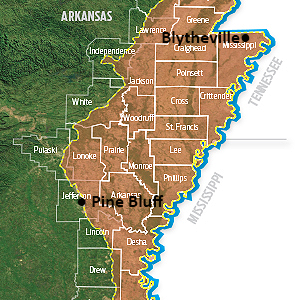
Partial map of Arkansas shows the Mississippi Delta in brown.
The Mississippi Delta is a place of poverty, poor health and other problems, often given short shrift by news media that serve the region. The Arkansas Democrat-Gazette took a look Monday at the state's part of the Delta, through two large towns, Blytheville and Pine Bluff, after a broader story Sunday.

"Poverty, population loss, abandonment and crime are issues that affect the rural parts of the Delta, but some urban parts of the region have also suffered from those things," Stephen Simpson reports. "At its peak, Blytheville’s population was nearly 25,000 in the 1970 census, but by 2020, the number of people had dropped to close to 13,000. . . . From the 1970 to 1990 censuses, Pine Bluff had a population of about 57,000, but as of the 2020 census, the population has declined to a little more than 41,000."

Blytheville has lost several major employers in the last 30 years, most notably the Air Force base that closed in 1992. "Local government officials and businesses turned their sights into making Mississippi County the steel capital of the state," Simpson reports, quoting Cliff Chitwood, Mississippi County’s economic development director: “We played our part in bringing 4,000 jobs to Mississippi County, but 4,000 is not 8,000.” And not all those folks have moved to the county.

"Steel-mill jobs pay so well that [they] attract people from far away," Simpson reports, citing Chitwood: “The job is a four-days-on and four-days-off type of business, so people are coming here from Little Rock and Fayetteville, staying in their fancy trailers while working here and then going back . . . It wasn’t because people didn’t like it here. It wasn’t because we didn’t have the amenities.”

In Pine Bluff, which is near Little Rock and overlooks the Delta, drugs, crime and poor health have contributed to decline. Now health officials are worried that depression is a major health risk in the area. “You need a healthy economy to have healthy people and you need healthy people to have a healthy economy,” Dr. Brookshield Laurent, the executive director for the Delta Population Health Institute, told Simpson. “If you don’t have opportunities for jobs in the workforce then people will leave and there will be a disinvestment in the communities.”

Friday, October 23, 2020

Quick hits: Photo book follows Mississippi R.: coal-ash ponds reprieved; USDA rural opportunity agency proposed

How the Sturgis Motorcycle Rally may have spread coronavirus. Read more here.

The Trump administration will let some leaking or otherwise dangerous coal-ash storage ponds stay in operation longer, and some unlined ponds stay open indefinitely, under a rule change. Read more here.

A new photo book follows the Mississippi River from headwaters to the Delta and Gulf. Read more here.

The director of a rural health research center, whose work has led to laws aimed at improving rural maternity care, has won a prestigious award. Read more here.

A left-leaning think-tank proposes a Rural Opportunity Administration within the USDA. Read more here.

A recent Cargill study found that most Americans acknowledge the difficulties farmers are facing during the pandemic, and an "overwhelming majority" said they're generally confident that farmers can meet demand and feed growing populations. Read more here.

The Farmer Veteran Coalition has announced that it will hold its annual stakeholders conference online on Nov. 18-19. Read more here.

Wednesday, September 02, 2020

Residents in town of 300, without public water for over a year, getting it after investigative reporter sounds alarm

Wikipedia map
Pushed by investigative journalism, officials installed a new well system after a reporter revealed that residents in a small Mississippi town had gone for more than a year without a public water supply.

Residents on the outskirts of Schlater, a majority-Black town of about 300, had been without clean, running water since July 2019 because of broken well pumps, forcing them to travel nearly 13 miles to get water several times a week, Aallyah Wright reports for Mississippi Today, a nonprofit news outlet.

After Wright's initial story in December about the problem, Brandon Presley, Northern District commissioner on the state's elected Public Service Commission, "conducted follow-up discussions with federal and local water agencies and local lawmakers to see what could be done to assist the families and established a two-phase plan," Wright reports.

"In May, the Mississippi Department of Human Services announced the receipt of a $63,000 grant from the U.S. Department of Health and Human Services to build a new well," Wright reports. It took more legal wrangling, but last week Schlater residents finally celebrated a groundbreaking ceremony for the new system, which should be complete in two to three months.

At the groundbreaking, Presley celebrated the success story, but voiced worry that other small towns are "falling through the cracks" because they aren't getting the same kind of attention, Wright reports.

"There’s too many areas in Mississippi like where we are today that are forgotten places and that’s just a fact," said Presley, a Democrat who was mayor of Nettleton, a town of 2,000. "Too many people in state government forget that areas like Schlater in our small, rural communities exist."

Friday, March 23, 2018

County-level interactive map shows rural population increasing, after declining in each of the last six years

County population change, 2016 to 2017. (Stateline map; click the image to enlarge it or view the interactive version here.)
After six years of decline, the population in some rural areas is starting to grow again while growth in large cities slows down, according to newly released data from the Bureau of the Census.

"Rural areas, defined by the U.S. Department of Agriculture as counties outside cities and their suburbs, gained population between 2016 and 2017 for the first time since 2010. They grew by about 33,000 residents nationwide, after losing more than 15,000 residents the year before," Tim Henderson reports for Stateline.

Heavily agricultural areas are growing; they tend to have fewer jobs available, but may attract people looking for a cheaper place to live or retire. One exception: the Mississippi Delta, which continued to lose population. So did the Central Appalachian coalfield, hurt badly by the industry's swoon. Most counties in Wyoming, the nation's top coal-producing state, lost population.

Rural areas with manufacturing jobs are growing, mainly in counties with a town of at least 10,000 people, according to senior demographer Kenneth Johnson of the University of New Hampshire's Carsey School of Public Policy, who published a paper analyzing the census data. Counties with towns from 10,000 to 50,000 are classified as "micropolitan."

"This seems to be the beginning of a return to population dispersal after a decade or so of clustering into cities and the biggest metropolitan areas," Brookings Institution demographer William Frey told Henderson. "Steady improvement in the economy and recovering housing markets may be prompting employers and job seekers to look again at areas that were growing before the Great Recession — suburbs, exurbs and small towns."

Friday, October 20, 2017

Delta authority's new boss says he's cut overhead expenses and will send communities the money

Lee Powell, left, executive director of the Delta
Grassroots Caucus, talked with Peter Kinder.
The temporary boss of the Delta Regional Authority told a regional lobbying group Thursday that he had eliminated more than $500,000 in administrative costs from the agency's $30 million budget, and "We're going to push those resources out to the communities who need them, where they need to be. . . . I think that's a pretty good start for the first two months."

Peter Kinder, who was a three-term Republican lieutenant governor of Missouri, was appointed by President Trump as alternate federal co-chairman of the DRA, which covers 252 counties and parishes in eight states: Louisiana, Mississippi, Alabama, Arkansas, Tennessee, Missouri, Illinois and Kentucky. Trump has nominated Christopher Caldwell, an aide to Sen. John Boozman of Arkansas, as federal co-chair. The top post requires Senate confirmation, which is pending.

Kinder, who lives in Cape Girardeau, Mo., said the region has "some of the greatest economic challenges of any region in the country," but also has opportunities. He said it has shown its commitment to rural areas by sending 84 percent of its awards over the last six years to places with less than 50,000 population.

Kinder spoke to the opening session of a conference held by the Delta Grassroots Caucus, a coalition of local leaders in the region. Other speakers included Mayor Chuck Espy of Clarksdale, Miss., a former congressman; and Mayor Shirley Washington of Pine Bluff, Ark. Today's speakers include Arkansas Gov. Asa Hutchinson, U.S. Sen. John Boozman and U.S. Rep. Rick Crawford of Arkansas.

Monday, July 17, 2017

Delta Regional Authority creates fund to address emergency infrastructure needs in 8-state region

DRA service area with LaSalle Parish highlighted
The Delta Regional Authority has granted $300,000 in emergency funding to replace a damaged tank that supplies water to more than 1,000 residents and businesses in Louisiana's rural LaSalle Parish. DRA has little money compared to its model, the Appalachian Regional Commission, but recently created an infrastructure fund that can be used for emergencies.

The deterioration of the Nebo Water System's tank was an immediate risk to the lives of those using the tank, the system said in its funding application to the DRA. LaSalle Parish is under a boil water advisory and the Louisiana National Guard has been providing bottled water to locals. Restaurants, schools and other organizations are unable to prepare food, beverages and ice that require municipal water, and the the community pool is closed.

DRA has provided water and sewer service to more than 66,000 residents across eight states since it was created by Congress in 2000 to "help create jobs, build communities, and improve lives through strategic investments in economic development," it said in a news release.

Friday, October 07, 2016

USDA announces $401M for 26 projects to reduce rural poverty in nation's poorest communities

Agriculture Secretary Tom Vilsack was in Berea, Ky., Thursday to announce $401 million for 26 projects to help reduce rural poverty in some of the nation's poorest and most isolated communities, says a U.S. Department of Agriculture press release. Most of the projects are in Appalachia, the "colonias" along the U.S./Mexico border and in the Mississippi Delta. The grant fund will be managed by Justin Maxson, executive director of North Carolina-based Mary Reynolds Babcock Foundation and former head of the Berea-based Mountain Association for Community Economic Development.

The grants will make long-term, low-interest financing available to the community-development organizations, which "will 're-lend' the money to build, acquire, maintain or renovate essential community services and facilities, such as education, health care and infrastructure," Jack Brammer reports for the Lexington Herald-Leader.

"Under the program, private financial institutions, including $100 million from Bank of America, will provide guarantees for a portion of the loans," Brammer writes. "The recipient organizations, or 're-lenders,' also must seek grants provided by seven of the nation's premier philanthropic organizations through a $22 million fund."

Vilsack said: "This effort builds on our commitment to lifting up the economic prospects of communities that have not benefited from the revitalization of rural America. By engaging with local and national partners, private-sector financial institutions and philanthropic organizations, USDA will inject a game-changing level of investment capital to reduce poverty in targeted rural areas where the capacity for growth has not been realized. As we have seen with the Obama administration's Promise Zone initiative and USDA's StrikeForce effort, targeted, place-based investments can have a real impact on reducing poverty. This funding adds another important tool in that fight."

UPDATE, Oct. 9: The Herald-Leader praised the effort in an editorial.

Wednesday, February 24, 2016

Child poverty has gotten more rural in last 30 years

The number of rural counties with persistent high child poverty rates increased from 43 percent in 1980 to 64 percent in 2010, with many clustered in Appalachia, the Mississippi Delta, the Black Belt, the Ozarks, Indian resrervations and other parts of the Southwest, says a study by the Carsey School of Public Policy at the University of New Hampshire. Overall, 58 percent of U.S. counties had high child poverty rates in 2010, including 47 percent of urban counties. (Carsey map: Persistent child poverty counties from 1980 to 2010; some of the blue metropolitan counties are primarily rural)
"Only 14.3 percent of the total child population resides in a rural county, but these counties contain 17.2 percent of the nation’s poor children," states the report. "More than three-quarters of counties with persistent high child poverty have a substantial minority child population. Child poverty rates are dramatically lower for non-Hispanic white than for minority children regardless of the racial-ethnic composition of the county in which they live."

The percentage of rural counties with high child poverty increased steadily over the 30-year period. Urban child poverty fluctuated, most recently during the Great Recession. The study looked at persistent high-poverty counties "where the poverty rate for children was 20 percent or greater for the past three decades," Tim Marema reports for the Daily Yonder. "About a quarter of all U.S. counties fit that category. Three quarters of those counties are rural." Study authors Andrew Schaefer, Marybeth J. Mattingly and Kenneth M. Johnson wrote: “The overwhelming focus of welfare programs in the United States is urban. ... Any national discussion of child poverty must address the challenges faced by children living in isolated rural areas.”

Friday, November 13, 2015

Ruralites less likely to be screened for cancers of private parts, thus more likely to die from them

Poor, minority and rural residents are less likely to be screened for breast, colorectal and cervical cancers and more likely to have high mortality rates from the diseases because they are detected too late, says a state-by-state study by USA Today and the North American Association of Central Cancer Registries, Laura Ungar reports for USA Today. (USA Today maps)

The South, especially the Mississippi Delta, has some of the highest rates of deaths, given evidence, from screenable cancers by incident-to-mortality rate, Ungar writes. Using data from 2008 to 2012, the study found that Alabama has the highest level of deaths for cervical cancer, Mississippi has the highest levels for breast cancer and Arkansas, which has the highest rates for colorectal cancer, is third in cervical and breast cancer.

"While the Affordable Care Act has brought insurance coverage to millions, it hasn’t solved the myriad other problems impeding access to care, such as transportation difficulties, lack of education, inability to take time off from low-wage jobs for medical appointments and shortages of doctors, hospitals and cancer-screening facilities," Ungar writes. "It hasn’t made all doctors 'culturally competent' to effectively care for minority patients."

And it isn't expected to get better any time soon, she writes. "Federal funding for cancer screening is in flux. A nationwide program that has provided more than 12 million mammograms and Pap tests for low-income women since 1991 lost $8 million in federal funds in the last five years. And President Obama’s proposed budget for next year cuts $42 million from breast, cervical and colorectal cancer-screening programs on the assumption the ACA will improve access to screening. A bipartisan spending deal hasn't yet determined specific allocations for particular programs, but previous House and Senate bills restored at least some of the money."

States with large poor, minority and rural populations need more local programs like one in Kentucky where "a local gastroenterologist with a passion for preventing colon cancer started the nationally renowned Colon Cancer Prevention Project, which raised money and awareness of the disease and pushed for programs such as free screening for low-income, uninsured residents," Ungar writes. "Since the group started 11 years ago, the screening rate has more than doubled to 69.6 percent—and deaths are down more than 25 percent." (Read more)

Friday, July 10, 2015

Rural counties, mostly in South, have higher rates of colon cancer deaths

Rural counties in the Lower Mississippi Delta, west Central Appalachia and eastern Virginia/North Carolina have the nation's highest rates of colorectal cancer deaths, says a study published on Wednesday in Cancer Epidemiology, Biomarkers & Prevention, a journal of the American Association for Cancer Research. Researchers identified those three areas as hotspots for colon cancer.

The study, which used data from 2009-2011, found that the rates in 94 counties in the Lower Mississippi Delta were 40 percent higher than in non hotspot areas. That area consists of 27 counties in Mississippi, 17 in Arkansas, 16 in Illinois, 15 in Missouri, 10 in Tennessee, six in Louisiana and three in Kentucky. (Washington Post graphic: Hotspots for colon cancer deaths)

Rates in west Central Appalachia—60 counties in Kentucky, 22 in Ohio, 19 in West Virginia and six in Indiana—were 18 percent higher than in non hotspots. Rates in eastern Virginia/North Carolina—11 counties in northeastern North Carolina and 26 counties in southeastern Virginia—were nine percent higher than rates in non hotspot areas.

"Researchers don’t know why rates in these three primarily rural regions are so high, but they tick off several underlying factors: high poverty, unemployment and obesity rates; low education and health-literacy levels; poor access to health care; and lower cancer-screening rates," Lena Sun reports for The Washington Post. "They note that as of March, only six of the 12 states in these high-risk regions had expanded Medicaid coverage under the Affordable Care Act to include more low-income adults."

"Most disturbing are the data for black men in the lower Mississippi Delta, said Rebecca Siegel, an epidemiologist with the American Cancer Society and one of the authors," Sun writes. "The colon-cancer death rate increased by 3.5 percent every year for black men in that region between 1970 and 1990 and has since remained unchanged."

Friday, June 13, 2014

Feds create small program to promote local food

Agriculture Secretary Tom Vilsack introduced a new federal assistance program this week called "Local Foods, Local Places." The Department of Agriculture, the Environmental Protection Agency, the Department of Transportation, the Appalachian Regional Commission and the Delta Regional Authority are investing a total of $650,000 to help local communities "create more livable places by promoting local foods," according to a White House release.

The goal is to "boost economic opportunities for local farmers and businesses and foster entrepreneurship," improve access to healthy local food, "revitalize downtowns, main street districts and traditional neighborhoods by supporting farmers’ markets, food hubs, community gardens, community kitchens and other kinds of local food enterprises and by providing people with affordable choices for accessing those amenities, such as walking, biking or taking transit," the release says.

Vilsack said in a USDA release, "Buying locally is one of the best things a community can do to grow its economy. Partnerships like Local Food, Local Places help rural leaders develop strategies for promoting farm products grown by people right in their own communities. The demand for local food is growing rapidly nationwide, creating more opportunities for American farmers and ranchers and growing the entire country's rural economy." (Read more)

All communities are eligible to apply, but those given particular attention include areas served by the Appalachian and Delta agencies, as well as federal Promise Zones and USDA StrikeForce counties. Application letters are due by July 15. (Read more)

Monday, December 23, 2013

Organizations use Promise Neighborhood grants to improve education in distressed communities

Berea College, the Delta Health Alliance, and Renewal Unlimited Inc. have been awarded Promise Neighborhood grants, which go "to colleges, universities, or non-profits that serve as lead agencies in partnership with school districts and other community-based organizations in distressed communities," reports Rural Policy Matters, a publication of the Rural School and Community Trust.

For the past 15 years Berea College, just outside the East Kentucky Coalfield, "has implemented federal pre-K–12 education grants in the region" through Berea Promise Neighborhood, RPM reports. "Berea has expanded its college and career-readiness programs and built on its family engagement experience as the basis for expanded academic work with schools. It has formalized partnerships, set up its data system, built out its work into elementary schools and implemented early childhood partnerships, and piloted a variety of programs, in health, wellness, safety, and arts and culture." (Berea College map: Promise Neighborhood serves nine counties and 10 school districts in Eastern Kentucky)

The program was designed "to increase academic performance and college readiness;
to increase high school graduation rates and college-going rates; and to build and enrich a college-going culture in the schools and communities we serve," according to the college. Last month Berea hosted the Rural Education Summit, which "addressed issues surrounding rural poverty and the need for rural-centric responses" and "offered tours to sites in rural Kentucky to see the Berea Promise Neighborhood in action," Rural Policy Matters reports.

Delta Health Alliance, based in Indianola, Miss. left, "has extensive experience providing health interventions and education in the Mississippi Delta," Rural Policy Matters reports. Vice President for External Affairs John Davis told RPM, “Delta Health Alliance has a strong track record reducing infant mortality and low birth weight with health care, home visitations, and other work with expectant and new mothers. It starts with getting them here healthy.”

The alliance also "expanded pre-birth through five supports and led efforts to have Indianola certified as an Excel by 5 community—meaning it has achieved standards and provides supports to reach the goal that all children are ready to learn in school at age five," RPM reports. "It also formalized partnerships  and began working directly with the Indianola school district and other partners to establish and expand after school programs."

Renewal Unlimited Inc. has pre-school programs, family resource centers and other family and education programs in a five-county region of central Wisconsin including Adams County (Wikipedia map), which, "with a population of about 20,000, retains an agricultural economic base, supplemented with light manufacturing," Rural Policy Matters reports. To read the entire article in RPM's December issue, click here.

Monday, October 21, 2013

Mississippi Delta's population keeps falling, dramatically in several counties

Last year the number of people living in non-metro counties, the most common definition of rural America, declined for the first time since the Census Bureau began estimating populations. Population losses aren't anything new in the Mississippi Delta, where demography and economics caused 16 counties to lose between 10 to 38 percent of their population from 2000 to 2010—and 12 lost 50 to 75 percent since 1940, The Economist reports in a recent post on its "The Economist Explains" blog. (Commercial Appeal photo by Alan Spearman: Greenville, Miss., lost more than 7,000 residents in 2000-10)

The unnamed blogger answers the question, "Why are so many people leaving the Mississippi Delta?" Where the region differs from many rural areas is its history of agriculture and slavery and the mass migration of African Americans, who fled the South for the North in the middle of the 20th Century. "The Delta was built not just on agriculture but on slave labour—and lots of it," says the British magazine. "Slaves cleared the brackish, heavily forested floodplain and turned it into arable land. Slaves planted and reaped the cotton fields. After America's civil war, ex-slaves and their descendants provided a vast pool of cheap labour. Railroads into the Delta opened up new markets, but they also carried away workers looking for more opportunity to Chicago during the Great Migration, to military and defence industries during the second world war and to the industrial Midwest and north-east when America's car and steel industries were thriving."

Agriculture is still a major commodity in the Delta, "but farms that once required hundreds of people have become mechanised," The Economist notes. As an example of struggling population, the news source cites Issaquena County, which in 1860 had a population of 7,224 slaves and 587 whites. The current population is 1,386, with 40 percent of those people living below the poverty line. In all, the county has 10 private non-farm business that employ only 99 people, which The Economist says is "a tax base that nightmares are made of and that functional schools and services are not." (Read more) Oddly shaped Issaquena County is the second southernmost county in the Delta (see map of Delta counties). 

Wednesday, May 15, 2013

Clinton tells Delta allies good policy needed for rural growth; easier to avoid partisanship at local level

Former President Bill Clinton said he has high hopes for continued economic progress in the area served by the Delta Regional Authority, which he helped create during his presidency, reports the website for the Mississippi Delta Grassroots Caucus, a private support group for the federal agency region.

“There is never going to be enough government money to take a poor region of America out of the dumps all by itself,” Clinton said this month at a caucus meeting. “You’ve got to have private-sector growth. In order to have private-sector growth, you’ve got to have good government policy. You have to have government and the private sector, and increasingly all these great foundations working together.”

The closer to the grass roots, the less national politics complicates things, Clinton said: “All of the debate in Washington tends to be about what I would call macro-economic policy. But real life is lived in what the economists would call microeconomic policy. The more you go to the micro, the more jobs you’re going to create and the more bipartisan cooperation you’re going to have, because there is no other Republican or Democratic way to locate a plan, to start up an agricultural project,” and to do all the other range of economic development activities, the caucus website reports.

Friday, March 15, 2013

Tourists in Miss. can sleep in plantation shacks

Photo: P.F. Edwards, Garden & Gun
Entrepreneurs in Clarksdale, Miss., have found a way to market rural poverty with the Shack Up Inn, a collection of authentic sharecropper shacks, Tracy Thompson writes in her book, The New Mind of the South.

In a book excerpt in the Daily Yonder, Thompson says the inn is on "the site of the old Hopson Plantation a few miles outside of town, retrofitted with some modern necessities like indoor plumbing, heat and air conditioning, and then rented to tourists traveling down Highway 61 on the Mississippi Blues Trail."

The Shack Up Inn website says that visitors can "immerse yourself in the living history you will find at Hopson. Virtually unchanged from when it was a working plantation, you will find authentic sharecropper shacks, the original cotton gin and seed houses and other outbuildings. You will glimpse plantation life, as it existed only a few short years ago. In addition, you will find one of the first mechanized cotton pickers."

The inn is a hit with the musical and literary set, but there have been few African American visitors, writes Thompson. More than 40 percent of Clarksdale residents lived below the poverty level in 2007-11, according to a U.S. Census Bureau report. The population is 79 percent black.

Wednesday, January 16, 2013

Community newspaper in Kentucky tackles poverty in a series that it says will last all year

The Todd County Standard in Elkton, Ky., started a year-long series last week about the county's growing poverty rate. It's an issue that most community newspapers might shy away from, but the Standard is again proving why it has been judged the best small weekly newspaper in the state for six straight years. The county is not in Appalachia, as you might expect, but in southwestern Kentucky and the edge of the territory covered by the Delta Regional Authority.

"While our prospects for being able to attract manufacturers and the regional concept that has brought water, economic development and perhaps a regional job training center offer Todd County several ways to overcome poverty, the sad reality now is that we are in a state of crisis and we need to admit it," the paper opined. "With one of the highest rates of uninsured people in the state; with children in poverty on the rise; with one in three families on some sort of government assistance; with 40 percent of children born between 2007 and 2009 to mothers who do not have high school diplomas; with 61 percent of school-age children on free or reduced lunches there is more than enough information to make us concerned."

The paper will study Todd County's poverty to inform the public about it and discuss ways in which it can be addressed. The first two stories in the series appeared in the Jan. 9-15 edition, and cover babies born to mothers without high school diplomas and high rates of children receiving free or reduced-price school lunch. "Poverty is not a plague," the paper writes. "It is curable. It has been cured in other places, but the only way it can be cured is for people to become aware of its severity and then to care about poverty's demise." For the editorial and the stories in the first installment of the series, click here.

Monday, August 27, 2012

The Box Project celebrates its 50th year of personal outreach to those in rural poverty all across the U.S.

Marilyn Kriegl of San Francisco, right,
and Willie Mae Bush of Mississippi,
paired through Box Project (BP photo)
The Box Project, a grass-roots program of the Community Foundation of Northwest Mississippi, still holds promise for relieving rural poverty as it marks its 50th year. The project, writes Henry Bailey of The Commercial Appeal in Memphis, was "designed to link needy families in the Delta and other areas with sponsors across the country." Originally focused on the Mississippi Delta, and based in Hernando, Miss., the Box Project has expanded its outreach efforts to include rural areas in Maine, Appalachia including West Virginia, Kentucky and the Native American reservations of South Dakota.

An example of its work: Tim Holston grew up among the dirt roads around Itta Bena, Miss., and faced bleak prospects. But as a youth, he received the first two books he ever owned from his Box Project sponsor, Marcia Cook of Concord, Mass. -- and now he's completing a doctorate in computer science. His sister has already graduated.

The Box Project began with an airline conversation, and in the living room of a woman from New Hampshire. On a 1962 flight, Virginia Naeve met Coretta Scott King, the wife of the Rev. Dr. Martin Luther King Jr.  Bailey writes, "The conversation turned to conditions in rural Mississippi and what might be done to help families in the Mississippi Delta, one of the worst areas of rural poverty in America. 'Mrs. King gave Virginia the name of a specific family she knew needed help,' Tom Pittman, president of the Community Foundation, said. 'Virginia returned home and began writing letters and sending boxes of clothing, food and supplies that the family desperately needed.' Soon, neighbors heard of her actions and were giving her boxes to send to Mississippi too. Other families in poverty were added to the mailing list, and things kept growing until Naeve got the simple idea of matching up sponsor families directly, and the Box Project was launched. Since that modest start, it's grown to a network that has directly helped more than 15,000 recipient families." (Read more)

Thursday, June 03, 2010

Mississippi Delta doctor frustrated by state's resistance to health-care reform

Many health-care pundits have pointed out the irony that some of the areas that reform could help the most are the areas fighting it the hardest, and at least one rural health advocate is worried about that tension. Anne Brooks, left, a Roman Catholic nun who has run a health clinic in Tutwiler, Miss., for 27 years, "sees the nation's new health care law as a potentially happy turn in a long, hard journey," Noam Leevy of the Tribune Co.'s Washington Bureau reports. "But there's a good chance this story will end with another difficult twist in the road for Brooks and for Tutwiler," as Mississippi Republican Gov. Haley Barbour has "joined a lawsuit filed by GOP officials in several states seeking to overturn the law." (Los Angeles Times photo by Lance Murphy)

Barbour "campaigned on a promise to cut the health-care safety net to balance the state budget," Leevy writes. "Shortly afterward, Mississippi began requiring Medicaid recipients to submit to in-person interviews once a year, making it the only state with such a sweeping rule. In Tutwiler, the closest registration office is in nearby Sumner. It's open one day a week, on Tuesdays, from 9 a.m. to noon and 1 p.m. to 3 p.m., as well as the third Wednesday of month." The governor said the federal health-care overhaul "would prove disastrous" for Mississippi.

Four in 10 patients at the Tutwiler Clinic have no insurance at all. "When someone brings me a basket of squash, I'm happy," said Brooks, who received a medical degree at age 44 from Michigan State University's College of Osteopathic Medicine. In 2008, she collected $552,572 for delivering medical care, just over a quarter of the clinic's expenses, Leevy reports. The rest of her funding comes from private donations and grants. Brooks  told Leevy she's doubtful Mississippi leaders will take advantage of the federal help. "I just know I have to see my patients," she said, "It would be nice if someone could figure out a way to pay us for doing it." (Read more)