Showing posts with label Latinos. Show all posts

Friday, February 20, 2026

After a jarring ICE raid at a horse racing track, residents of a tiny Idaho town measure the aftermath

Agents outside La Catedral Arena, a horse track in Wilder, Idaho, 
Oct. 19, 2025. (Idaho Statesman photo via Mother Jones)
Some residents of Wilder, Idaho, say the town hasn't been the same since federal Immigration and Customs Enforcement agents descended on an off-the-beaten-path horse racing track and detained roughly 100 Latinos who were working or attending the races. 

The horse track, known as La Catedral Arena, had been a place where immigrant families gathered to enjoy food and racing together, reports Anna Griffin of The New York Times. Few whites ever attended the races or questioned track activities.

Wilder is located in Canyon
County, Idaho. (Wikipedia)
Sixty percent of Wilder's 1,725 residents are Latino, and most residents take pride in living in harmony. But on Oct. 19, things changed. ICE agents, including a swarm of gun-toting agents on the ground, a helicopter, and the agency's signature SUVs, descended on the track during the busiest time of day. Agents rounded up nearly 100 Latinos and later deported 75.

The raid did more than "crack an alleged gambling ring and increase deportation numbers," the Times reports. "It shattered Wilder’s innocent belief that its out-of-the-way location and deep-red politics could isolate the town from raids." 

Wilder resident Chris Gross, who farms sweet corn seed and mint, expressed concern about how the raid might limit immigrant farm workers. She told Griffin, "We rely on Hispanic labor." 

"The raid 'nearly destroyed' the community, said David Lincoln, a longtime Wilder resident and executive director of a nonprofit economic development agency serving rural towns in western Idaho," Griffen writes. Griffin adds, "Wilder won’t really know the impact until planting season begins this spring."

The day after the raid, at least half of Wilder's students didn't show up for class. Griffin reports, "Gross, who is white, said anyone who sees a black SUV roll through town, regardless of their race, 'freezes up.'" 

Still, the town's mayor, Steve Rhodes, claims the raid "has had 'zero effect' on the town," He told the Times, "These were not our people. What happened out at that track had nothing to do with Wilder.”

Tuesday, December 17, 2024

Rural communities struggle to find ways to communicate with growing non-native English-speaking population

Despite the ongoing growth of non-native English-speaking populations in rural communities, people in many counties and towns have failed to find effective ways to communicate with residents still learning English. The small town of Elko, Nevada, serves as an example. The town's "Hispanic or Latino population has grown to about 26%," reports Jazmin Orozco Rodriguez of KFF Health News. "The share of people age 5 or older who speak a language other than English at home increased to 18% as of 2022, while Spanish is the language spoken in nearly 15% of households."

With Elko's number of non-native English-speaking residents, the area needs translation support to ensure all residents understand vital information. Unfortunately, "state lawmakers in Nevada left out smaller counties from a recently enacted statewide language-access law," Rodriguez writes. "Not providing language access to people who need it is not only a violation of civil rights protected by Title VI of the Civil Rights Act, but it also can create public health and safety concerns said Jake Hofstetter, a policy analyst for the Migration Policy Institute, a think tank focused on immigration policy and research."

While much of rural America is white and English-speaking, its population has diversified, leaving smaller communities struggling to adapt to residents who aren't proficient in English. Rodriguez explains, "Implementing state and local language-access laws, however, is a challenge, researchers say, given standards can vary across state agencies and localities, making it difficult to ensure high-quality assistance is provided to speakers of various non-English languages."

The language-access challenges rural communities now face will continue to grow. "The number of white residents in rural parts of the nation decreased by about 2 million from 2010 to 2020, according to an analysis by the Carsey School of Public Policy at the University of New Hampshire," Rodriguez reports. "And the percentage of people who are members of a racial or ethnic minority living in rural areas increased from 20% in 2010 to 24% in 2020, with the largest share being Hispanic."

Language access services in metro and urban settings have grown; however, "Hofstetter said he doesn’t see many local policies that focus on the issue in rural areas," Rodriguez writes. "People living in rural areas may still benefit from a patchwork of resources through state agencies that provide services in their counties or local programs required to address language access because of federal funding."

Nonetheless, language barriers put non-native English speakers at a disadvantage. Rodriquez adds, "The degree to which local governments offer communications in languages other than English varies for several reasons, including enforcement of civil rights protections. That enforcement relies on civil rights complaints, which often must be filed by residents who may not know their rights related to language access."

Friday, January 06, 2023

264 of 304 persistent high-poverty counties are rural: Black Belt, Delta, Appalachia, Ozarks, Rio Grande, Native lands

Map by Economic Research Service, United States Department of Agriculture

A fresh review of data from the Economic Research Service of the U.S. Department of Agriculture shows counties with continuous high poverty since 1960 are largely rural, reports Jody Heemstra of Dakota Radio Group News

President Lyndon Johnson's War on Poverty and the Economic Opportunity Act of 1964 helped move many counties out of high-poverty status, but in more than 300 counties, most of them rural, high poverty has persisted: "In 1960, 78 percent of U.S. counties had poverty rates of 20 percent or more. Among them, 28 percent continued to have high poverty through 1980," Heemstra reports. "As of 2019, there were 304 counties—13 percent of the counties with high poverty in 1960—that consistently had poverty rates of 20 percent or more over the last 60 years."

Heemstra writes, "The majority—264 counties—are rural counties and are clustered in the Appalachian states; the Black Belt in the South; the Mississippi Delta; the Ozarks region of Missouri, Arkansas, Oklahoma, and southeast Kansas; the Southwest; and in counties with large American Indian and Alaska Native populations."

Friday, April 29, 2022

Quick hits: Sterile super-Romeo trout may help curb invasive species; tools for rural electric co-ops transitioning to renewable energy; federal aid fuels pickleball boom

Brook trout have been outcompeting native trout for years.
(NPL photo by Nick Hawkins)
Here's a roundup of stories with rural resonance; if you do or see similar work that should be shared on The Rural Blog, email us at heather.chapman@uky.edu.

People of color and low-income communities are at a disproportionate risk of being harmed by pesticide exposure, according to a newly released study. Read more here.

A non-profit has a page full of tools and guidelines to help rural electric cooperatives transition to renewable energy. Read more here.

To save an underdog fish species out West, scientists are turning some invasive trout into sterile super-Romeos and setting them loose. Since they're taking the bulk of female trout's attention during mating season, that helps reduce births among the species. Read more here.

Federal Covid-19 aid is funding a pickleball court construction boom. Read more here.

Tick bites are causing an increasing number of people to become allergic to meat. Read more here.

Monday, April 18, 2022

Ex-census overseer: Skewed 2020 census meant 6 states wrongly lost a House seat, 6 more rural states gained one

The 2020 census was underfunded, understaffed, and cut short. This apparently affected some rural areas, but widespread undercounts of Blacks and Hispanics and overcounts of whites and Asians caused a malapportionment of U.S. House seats that benefited more rural states, Robert Shapiro writes for The Washington Monthly. Shapiro oversaw the 2000 census as President Clinton's commerce undersecretary for economic affairs, and chairs the economic policy think tank Sonecon.

"The large-scale errors in the census cost New York, Texas, Florida, Arizona, California, and New Jersey one seat each, and resulted in an extra representative for Minnesota, Pennsylvania, Oregon, Montana, Wisconsin, and Indiana," Shapiro writes. "Those wide-ranging errors are matters of public record, because the professionals at the Census Bureau obligingly report the decennial census undercount and overcount rates by race and ethnicity. Compared to 2010, undercounts in 2020 jumped from 2.06 to 3.3 percent for Blacks, from 1.54% to 4.99% for Hispanics, and from 0.15% to 0.91% for Native Americans on reservations and Alaskan Natives. Overcounts also shot up, increasing from 0.83% to 1.64% for whites and from virtually zero to 2.62% for Asians." Shapiro's crew calculated the effect on apportionment by applying the error rates to each state's racial and ethnic makeup.

"The debasement of the 2020 census did not have clear partisan effects. The more diverse states that lost out—states in which Black and Hispanic people account for between 33 percent and 52 percent of the population—include not only blue New York, California, and New Jersey but also red Texas and Florida and purple Arizona," Shapiro writes. "Similarly, the unwitting winners include not only red Montana and Indiana but also blue Minnesota and Oregon and purple Pennsylvania and Wisconsin—all states with populations that are 80 to 87 percent white and Asian."

Shapiro says the Trump administration didn't skew the census by overtly manipulating the results but by simply making it easier for serious errors to occur.

Monday, March 07, 2022

USDA and EPA officials tour Black Belt county to see chronic sewage problems, a disproportionately rural issue

Department of Agriculture Undersecretary for Rural Development Xochitl Torres Small, EPA Administrator Michael Regan and activist Catherine Coleman Flowers toured a mobile home park in Lowndes County, Alabama, with standing pools of raw sewage in the yards. (AL.com photo by Dennis Pillion)

"On the eve of the Selma Jubilee, commemorating the 'Bloody Sunday' march that helped catalyze support for the Voting Rights Act 57 years ago, the head of the U.S. Environmental Protection Agency toured Alabama’s Black Belt to witness a different kind of struggle: the battle for clean water and basic sanitation," Dennis Pillion reports for AL.com. EPA Administrator Michael Regan, Agriculture Undersecretary for Rural Development Xochitl Torres Small and other EPA and USDA officials "went to three different properties in Lowndes County Saturday, seeing homes where malfunctioning septic systems discharged untreated sewage into backyards and in between mobile homes, and where some residents had nowhere to go to address their sewage issues."

The group was led by author and activist Catherine Coleman Flowers, the founder of the Center for Rural Enterprise and Environmental Justice, who won a MacArthur Foundation "Genius Grant" in 2020 for bringing attention to the issue in her native county and other rural areas, Pillion reports.

More than 2 million Americans lack access to clean water, according to a 2019 report by clean-water advocacy non-profits DigDeep and the U.S. Water Alliance. It's a problem that disproportionately affects rural residents and those in substandard housing. Because rural Black, Latino and Native American residents are more likely to live in substandard housing, they're more likely to be affected.

A key to the problem is that rural populations are often too spread out to make traditional utility lines cost-effective, and sewers are the most expensive basic utility. Cash-strapped local or tribal governments are increasingly on the hook to pay for water system improvements, according to the DigDeep report. The 2021 infrastructure package earmarked $29.3 billion in grants over five years for counties to upgrade their water systems. But rural counties may miss out on much of that money, since they often lack the manpower and know-how to compete for or spend such grants.

Regan said the situation was "unacceptable" and clean water and safe sewage systems were a "basic right" that every American deserves, Pillion reports. Regan continued: "Straight piping into lagoons, failing septic systems, waste and raw sewage backing up into yards into homes, seeing children have to walk around delicately so that they don’t sink or get bogged down into their own front yards. This is not the America that we all know it should be."

Wednesday, February 23, 2022

Rural U.S. lost population for first time ever in 2010-20, but some rural areas grew, mostly through adult people of color

Population change in nonmetropolitan counties from 2010 to 2020
(University of New Hampshire Carsey School map; click the image to enlarge it)

We've known that most rural areas lost population in the last decade, but a new analysis of Census data found that rural America overall lost population for the first time in history, and the trend could continue, according to new analysis of 2020 census data by the University of New Hampshire's Carsey School of Public Policy. But some rural areas are gaining population, mostly from adult people of color, according to an analysis by The Daily Yonder.

Nonmetropolitan counties lost 289,000 residents out of about 46 million from 2010 to 2020, Kenneth Johnson reports for the Carsey School. In the previous decade, rural America gained 1.5 million new residents and in the 1990s grew by nearly 3.4 million.

"If rural outmigration is ongoing, and deaths continue to exceed births in many rural areas due to low fertility and higher mortality among the aging rural population, then population losses are likely to continue in much of rural America," Johnson reports. "And the onset of Covid-19, which generated additional social, economic, and epidemiological turbulence, is likely to contribute to more rural population loss because it significantly increased rural deaths and discouraged births. Rural counties with sustained population loss face significant challenges maintaining critical infrastructure needed to provide quality health care, education, and a viable economy for the remaining residents."

Though rural America as a whole has fewer people, "Parts of rural America are adding population, and some segments of the rural population — especially adults, people of color, and Hispanics — are growing," Sarah Melotte reports for The Daily Yonder. "Rural America’s adult population (ages 18 and up) increased 1.2%, according to a Daily Yonder analysis. During the same period, the share of the adult rural population composed of people of color and Hispanics grew by 22%, from 17.1% in 2010 to 20.8% in 2020. Diversity in the adult population increased in over 95% of the nation's rural counties since the last census -- about the same percentage as urban counties."
Percentage change in non-white and Hispanic population by metro status, 2010-2020
(Daily Yonder map; click the image to enlarge it or click here for the interactive version)

Tuesday, November 30, 2021

Rural households are hurt more by inflation than urban ones

Inflation is at a 30-year high in the U.S., and rural households are some of the hardest hit. 

"Inflation has hurt lower-income families, families of color, and rural households more than other demographics, a Bank of America research report found last week," Jason Lalljee reports for Business Insider. "Breaking down demographics by race, geography, and income, the bank found that the 'inflation shock' of 2021 has disproportionately affected the marginalized: Households without college graduates, African American, Hispanic and Latino communities, and those not living in cities have been spending more of their post-tax income on goods and services."

Rural households are paying an average of 5.2 percent more of their post-tax income because of inflation, compared to 3.5% of households in metropolitan areas. "All of the high-inflation categories, particularly energy and new and used cars, make up a larger share of the consumption basket for rural households," researchers wrote. "They also earn and save less than urban households, and so inflation is a bigger drag on their income, and they have less buffer against the shock."

Inflation has been blamed on everything from corporate greed to President Biden, but it's mostly a function of reduced supply and increased demand.

Friday, October 01, 2021

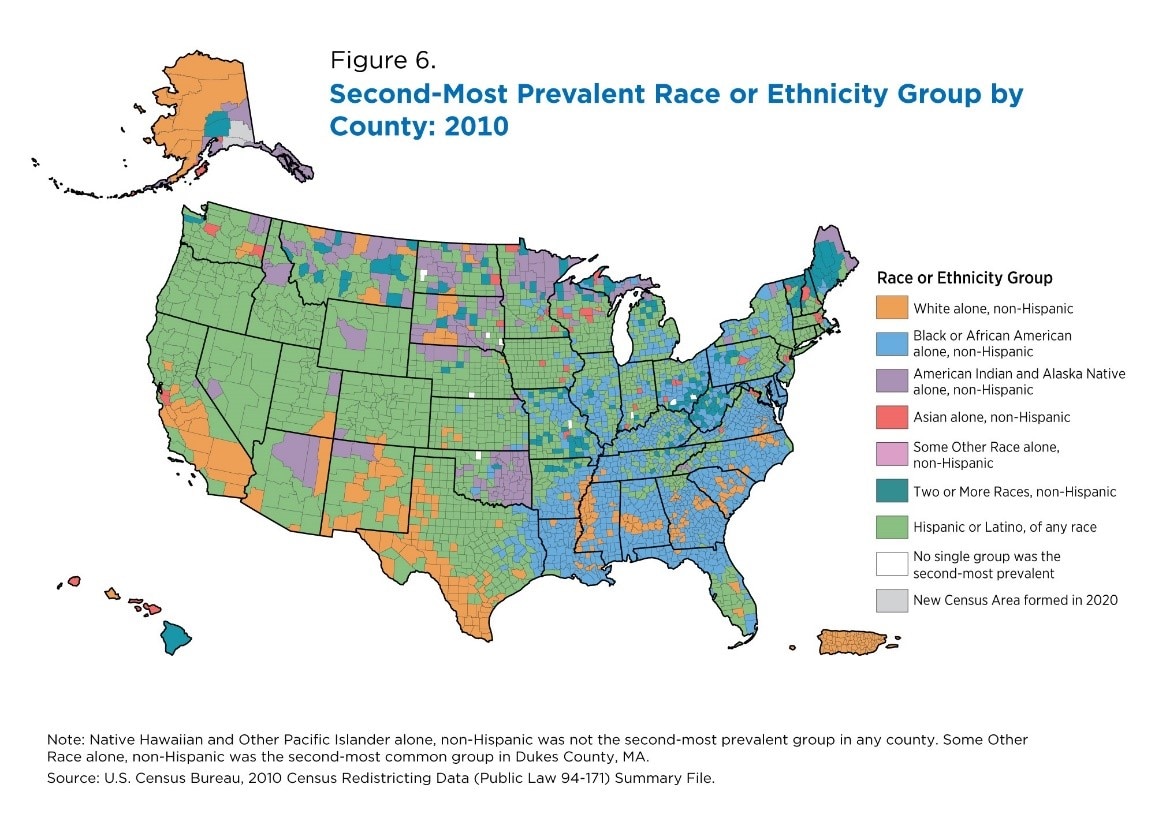
Census shows rural America becoming more racially diverse

Second-most prevalent race or ethnicity in U.S. counties, 2010 and 2020
Census Bureau maps for 2010 and 2020, adapted by The Rural Blog; click to enlarge.

Rural America is becoming more racially and ethnically diverse, and Latinx and multi-ethnic people drove almost all rural population growth, recently released Census Bureau data show.

"Traditionally, rural communities have not been as racially or ethnically diverse as the nation overall. The 2020 Census reported that approximately 74.8% of the rural population is White non-Hispanic, compared to 57.8% for the United States as a whole. Hispanics are the second most prevalent racial or ethnic group in rural America comprising 10.4% of the rural population. It is important to note that Hispanics may be of any race. With a population count of 4.5 million, Black residents make up 7.4% of the rural population, and are the third most prevalent racial or ethnic group in rural areas," Lance George, Natasha Moodie and Keith Wiley report for The Daily Yonder. "Both nationally and in rural areas, some of the largest growth among racial and ethnic groups were among residents who identified themselves as being of two or more races. In rural communities in 2020, approximately 2.4 million or four percent of the rural population were of two or more races. Persons of two or more races surpassed Native Americans as the fourth most prevalent racial or ethnic group in rural areas. Native Americans, identified as American Indians or Alaska Natives, comprised roughly two percent of the rural population in 2020 – which is more than twice the rate of Native Americans nationally."

Monday, July 26, 2021

Pandemic roundup: Medical groups seek vaccine mandate for health-care workers; some legislators want to ban such

Here's a roundup of recent news about the pandemic and immunization efforts:

More than 50 medical groups released a joint statement today calling for mandatory coronavirus vaccinations for health-care workers. Read more here.

Republican lawmakers across the nation are moving to limit public-health agencies' power to impose pandemic mitigation efforts, saying they want to protect individual freedoms. Read more here.

New Hampshire residents can't be required to get a coronavirus vaccine in order to access public facilities, according to a newly signed law. Read more here.

Louisiana hospitals are leery of mandating vaccines because there are so many vaccine-hesitant employees. Read more here.

Arkansas Gov. Asa Hutchinson blamed misinformation for "hardened" vaccine resistance, but defends his decision to approve a statewide ban on mask mandates. Read more here and here.

Alabama's governor, Republican Kay Ivey, said "It's time to start blaming the unvaccinated folk" as the pandemic worsens. Read more here.

An Alabama mother who lost her son to Covid-19 says not getting vaccinated is her biggest regret. Read more here.

Covid-related misinformation is still thriving on Facebook, YouTube and Twitter. Read more here.

A Baptist pastor in Tennessee has vowed to kick out anyone who attends his church wearing a mask. Read more here.

Hispanic and Black communities lag in vaccination rates; experts say it's because of mistrust and accessibility issues. Read more here.

Most coronavirus cases among children have been mild, but doctors are worried about a growing number of long-haul covid cases, and a rare but dangerous inflammatory disease particularly prevalent among Black and Latino children. Read more here.

Experts weigh in on the Wuhan lab experiment debated by Sen. Rand Paul, R-Ky., and top infectious disease expert Anthony Fauci. The verdict: Fauci was correct, but the reason is unlikely to reassure Americans concerned about the lab's risky work. Read more here.

Monday, April 26, 2021

Study: Closing of rural hospital delivery rooms puts Black and indigenous moms and babies at far higher risk of death

"A new study from the University of Minnesota Rural Health Research Center has found that when rural hospitals close their obstetrics units, it puts Black and indigenous mothers at a far greater risk," Liz Carey reports for The Daily Yonder. "That’s because the hospitals that close their obstetrics units are more likely to be located in counties where the majority of residents are non-white or Hispanic," and they're more likely to be small and/or critical access hospitals. 

Fewer than half of rural counties in the U.S. have hospitals that deliver babies. Obstetrics, which has high malpractice-insurance costs, is among the first to be cut when hospitals tighten their belts. 

But pregnant people still need obstetric services even when the local hospital doesn't offer them. In rural hospitals with shuttered obstetrics units, almost half had the same number of births as most rural hospitals that still had the service, Carey reports.

"What we see are issues with systemic racism. And we see general, overall health is poor among BiPOC communities particularly black and Indigenous moms," study co-author Julia Interrante told Carey. "And I think you have this combination then when you have an obstetrics unit closing in those same areas that need potentially more care for patients. It’s a compounding problem."

Health and Human Services Secretary Xavier Becerra said his department will provide $12 million over the next four years for the Rural Maternity and Obstetrics Management Strategies program. "The grants will be used to test models that address unmet needs for rural Black moms," Carey reports. "For the first time, HHS said, applicants are required to focus on populations that have historically suffered from poorer health outcomes, health disparities and other inequities."

Friday, March 05, 2021

Study examines why some LGBTQ+ Americans prefer rural; some say urban gay culture is too focused on sexuality

Pop culture portrays LGBTQ+ Americans as urban dwellers, but between 15 and 20 percent of them live in rural areas, a greater share than the rural population. A new study delves into why some choose to be ruralites and what life is like for them. Christopher T. Conner, assistant sociology professor at the University of Missouri-Columbia, has conducted in-depth interviews with 40 rural LGBTQ+ Americans since 2015 and analyzed various survey data to augment his research. 

Many view their sexual identity very differently than their urban counterparts and "question the merits of urban gay life," Conner writes for The Conversation, a site for academics to write journalistically about their research. The stereotype is that LGBTQ+ young adults who grow up in rural areas escape to large cities with thriving "gayborhoods" so they can feel normal and accepted, but research by Conner and others shows that many who flee to the cities ultimately return home. His interview subjects commonly downplayed their sexual or gender identities and focused on other parts of their lives such as sports, music, nature or games. They said they found urban gay culture to be shallow and too focused on sexuality as the defining characteristic of life. 

Rural LGBTQ+ Americans are often shown as lonely and less able to live openly, "but my analysis of a 2013 Pew survey of LGBTQ Americans – the latest available comprehensive national survey data on this population – showed that LGBTQ rural residents are actually more likely to be legally married than their urban counterparts: 24.8% compared with 18.6%. This aligns with what I’ve heard in interviews. The rural LGBTQ people I spoke with placed a high value on monogamy – on what many of them consider a 'normal' life," Conner writes. "Those who returned home from urban gayborhoods also told me they found gay city living rarely delivered on its promises of companionship and inclusion. Many said they had experienced rejection while trying to date or develop a social circle. And they had missed the charm of small-town life."

However, Conner notes, rural Black and Latino LGBTQ+ people tend to face more difficulties because, according to a 2019 report, "discrimination based on race and immigration status is compounded by discrimination based on sexual orientation, gender identity and gender expression."

Some interview subjects said they'd rather live in rural areas because they would face discrimination no matter where they are, and living in small towns allows them to focus on other parts of their lives they feel are more important. "For some LGBTQ Americans, then, rural life allows them to more fully express themselves. Given the variety of issues facing LGBTQ Americans, from health care access to work problems, the rural world is not an escape from discrimination," Conner writes. "But neither are urban areas."

Thursday, February 11, 2021

North Carolina weekly uses Facebook grant to bring in Latinx readers, offering valuable lessons for other papers

"Over the last nine months, the Chatham News + Record has leveraged a $30,300 Facebook grant to receive an $8,000 commitment from a local hospital by giving voice to a voiceless Latinx community on a health issue, namely the impact of the Covid-19 pandemic," University of Kentucky associate journalism professor Buck Ryan reports.

"As weekly community newspapers, suffering financially from the pandemic’s jolt to advertising revenues, struggle to stay afloat, the News + Record (3,800 paid circulation, about half from street sales) provides some valuable lessons on how to improve quality news coverage that gets recognized with financial support from a community institution," Ryan writes.

Tuesday, December 15, 2020

Brookings paper: Viewing America as rural vs. urban is inaccurate, and has real consequences for rural places

Viewing America as a rural-urban binary is not only inaccurate, it has real consequences for rural places, Hannah Love and Tracy Hadden Loh write for the Brookings Institution. The consequences can be split into four major categories, they write. Love is a senior research analyst at Brookings' Metropolitan Policy Program. Loh is fellow at the Anne T. and Robert M. Bass Center for Transformative Placemaking.

"First, it prioritizes the political concerns of an imagined, white rural monolith and erases the needs of rural people of color during a pandemic which is disproportionately devastating rural Black, Latino or Hispanic, and Native American communities.

"Second, it furthers misconceptions about rural economies which devalue the role of rural places in American (and urban) prosperity.

"Third, it propagates a myth of place-based poverty that erases people living in a range of high-poverty geographies, justifying oversimplified antipoverty policies.

"And finally, the binary-based narrative obscures effective policy and practice solutions for rural economic development that embrace the interdependence of rural and urban economic futures." Read more here.

Thursday, November 12, 2020

Racial, ethnic disparities persist in rural education levels

Educational attainment rates for racial and ethnic minorities have improved over the past two decades, but large gaps persist for rural nonwhites. Rural Hispanics, Blacks, Native Americans and Alaska Natives were only half as likely as their white counterparts to have a bachelor's degree or higher in 2018, the most recent year of data available. That's according to a newly published study by the U.S. Department of Agriculture's Economic Research Service.

Among all rural residents 25 and older, "the percentage who had completed a bachelor’s degree or higher rose from 15% in 2000 to 20% in 2018. Conversely, the share of that population without a high school degree or equivalent dropped from 24% in 2000 to 13% in 2018," Tracey Farrigan reports. "Among racial and ethnic groups in rural America, Hispanics continued to have the highest percentage (35 percent) without a high school degree, despite significant gains in high school and higher educational attainment rates between 2000 and 2018.

Meanwhile, African Americans "had the largest decrease (20 percentage points) of rural individuals without a high school degree," Farrigan writes. "This change eliminated the gap between the shares of Blacks/African Americans and Whites who had graduated from high school but had not completed a bachelor’s degree. Nevertheless, the share of Blacks without a high school degree remained nearly double that of whites in 2018."

Wednesday, November 11, 2020

How Trump won over Latino voters in the Rio Grande Valley

While Joe Biden was competitive in Texas, President Trump was able to win over the heavily Latino, reliably Democratic counties in the Rio Grande Valley along the border, helping him carry the state. 

"The bluest of blue counties along the river, Zapata County, flipped to President Trump, who won 52.5 percent of the vote. It was the first time since Reconstruction that a Republican presidential candidate won Zapata County," Arelis Hernandez and Brittney Martin report for The Washington Post. That may seem odd to outsiders who may see voters as Latinos first and rural residents second, but rural conservatism is nothing new, said University of Texas-San Antonio political scientist Sharon Navarro.

The difference, she says, is that this year Republicans did the work to court these voters and tailor their message about the election around the economy and jobs. Republicans won those Rio Grande counties by "taking advantage of the habitual underinvestment and lack of infrastructure there, as well as neglect from the state and national Democratic parties," the Post reports. "The shift extended through the more than 1,200-mile border, from the populous lower delta of Brownsville and McAllen to the sparse ranchland near Laredo and the high desert of El Paso."

Biden won most of the valley counties, but by much smaller margins than Hillary Clinton did in 2016. "The story of Trump’s performance and Biden’s backslide along the Texas border, experts say, shows the importance of cultivating deeper relationships with a diverse Latino population that continues to claim a growing and dominant share of the Texas electorate," Hernandez and Martin write.

Courting the Latino vote, especially in Texas, is more important than ever. Latinos make up about 40% of the Texas population and about 30% of its voters, and that number is rising. Each year, more than 203,000 Latinos come of voting age in Texas, Rogelio Saenz, a UT-San Antonio demographer, told the Post, which reports: "While White migration to the state has slowed, Saenz said, there has been a significant increase in Latinos and African Americans moving to Texas in recent years."

Monday, November 09, 2020

Some farmworkers, with little or no financial security, must decide whether to keep working or risk dangerous infection

The Trump administration declared farm laborers "essential workers" in the spring, but hasn't provided much guidance on how to keep them from getting sick or spreading the infection to others, and that has forced some of them to make tough choices between working and risking infection, Frank Hernandez reports for the Midwest Center for Investigative Reporting.

"While some people work from home during the covid-19 pandemic, agricultural workers pick and pack the fruits and vegetables Americans rely on," Hernandez writes. "They do so in potentially dangerous conditions — they often live in cramped housing, ride in crowded buses to job sites and work close to others — and without the federal government guaranteeing coronavirus protections," 

Some counties and "states such as VirginiaOregon and Washington have created their own enforceable rules to control, prevent and mitigate the spread of the virus among farmworkers," Hernandez reports. "But federal mandates are necessary to ensure that employers are doing enough to protect workers, advocates said."

At least 16 farmworkers have died from covid-19, but there could be many more because of weak monitoring. The Occupational Safety and Health Administration doesn't keep track of covid-19 reports involving agricultural workers, who are mostly migrants with temporary H-2A visas. But OSHA does track such complaints from farm-labor contractors who hire such workers and transport them to job sites, Hernandez reports.

"As of Sept. 6, OSHA has closed nine complaints about covid-19 that involve farm-labor contractors," Hernandez reports. "Twelve complaints about farm-labor contractors remain open. There have also been two COVID-19 complaints related to migrant camps, where some workers live; one has been closed."

Among farmworkers, the virus has disproportionately hit Latinos, who make up more than 60 percent of farm labor. About three-quarters of the nation's 3 million farmworkers were foreign-born as of 2018, most  of them from Mexico, Hernandez reports.

The Mexican government says nearly 2,400 Mexican nationals had died from covid-19 in the United States as of Sept. 14, but didn't keep track of job descriptions for the deceased, Hernandez reports.

Thursday, July 02, 2020

Study: Patients with underlying health conditions 12 times more likely to die from covid-19

Many rural residents who get covid-19 are at a higher risk of being hospitalized or dying from it, according to newly published data.

Coronavirus patients with underlying health conditions were hospitalized six times more often than otherwise healthy patients during the first four months of the pandemic, and they were 12 times more likely to die, according to federal health data," Kate Queram reports for Route Fifty. "The data, reported by state and territorial health departments and compiled by the Centers for Disease Control and Prevention, covers more than 1.7 million cases of covid-19 and 103,700 deaths, all between Jan. 22 and May 30. The information shows the disproportionate effect the virus continues to have on different groups, including Black and Latino people, the elderly and those with pre-existing medical conditions.

The CDC data dovetails with a recently published paper in The Journal of Rural Health that found that rural residents and racial/ethnic minorities are at a higher risk of dying from covid-19, especially those who are both rural and a racial or ethnic minority.

Tuesday, June 23, 2020

Rural families struggle with finding child care

Rural families are more likely to live in child-care deserts, meaning areas where demand for licensed child-care programs far outstrips local supply, according to a newly published data analysis by University of Minnesota researchers and the liberal-leaning Center for American Progress.

"The first-of-its-kind nationwide portrait shows that . . . rural families nationwide had the fewest child-care slots relative to demand across all categories, the researchers found," Amanda Becker reports for The Washington Post. The study also found that, on average, areas with large Latino populations and households with a combined income of $75,000 to $85,000 were the most likely to be in child-care deserts.

"The analysis comes as the coronavirus pandemic has upended an already tenuous child-care landscape," Becker reports. "Industry groups predict that one-third to half of child-care programs may close permanently without significant public investment, and many economists warn as much as $50 billion may be needed to assist the industry as parents attempt to return to work."

Congressional Democrats and Republicans have proposed bills with billions in funding for the Department of Health and Human Services' already-existing Child Care and Development Block Grant, which gives states and tribes funding to help lower-income workers access child care, Becker reports.

Tuesday, November 19, 2019

Report: more than 2 million Americans lack clean water

More than two million Americans lack access to clean water, according to a new report by clean-water advocacy non-profits DigDeep and the U.S. Water Alliance. The U.S. doesn't have a reliable, central data source to track how many Americans lack access to water and sanitation, according to the report. So DigDeep founder George McGraw commissioned experts from around the country to piece together the data.

The problem disproportionately affects rural residents, especially Native Americans on reservations, and those in substandard housing, the report found. Because African American and Latinx populations are more likely to live in substandard housing, they're disproportionately affected too.

Moreover, states and local or tribal governments are increasingly on the hook to pay for water system improvements. "Today federal funding for water infrastructure is a small percentage of what it once was. Across the country, 44 million people are served by water systems that recently had Safe Drinking Water Act violations," Lauren Morales reports for NPR.

Native Americans are the worst off, according to the report. Out of every 1,000 Native American households, 58 lack plumbing, compared with three of every 1,000 white households, Morales reports. Navajo Darlene Yazzie said she has to drive nine miles away to access fresh water, and the price is going up soon. She has a windmill-powered well, but the well is dry when the wind isn't blowing, she told Morales. "Yazzie said the windmill water isn't safe for humans anyway. Officials told her arsenic and uranium levels are too high. Yazzie and many others give the water to their animals, even though they plan to eat them," Morales reports. But it's often prohibitively expensive to build water pipelines to remote tribal nations in the Southwest: the Indian Health Service estimated it would cost $200 million to provide basic water and sanitation access to the Navajo Nation.

The problem isn't limited to reservations. Martin County in rural Eastern Kentucky has gained national attention because its water system is so terrible. Things got so bad there that state regulators ordered the water district to sign a contract giving control to outside management by tomorrow or face serious financial penalties. "State regulators placed the blame squarely on the district’s past and current management, saying officials made 'little to no effort to repair and replace aging infrastructure in order to maintain an adequate level of service to its ratepayers,' failed to keep adequate financial records, and failed to hire a permanent general manager," Will Wright reports for the Lexington Herald-Leader.