Showing posts with label talk radio. Show all posts

Thursday, November 30, 2023

A live call-in radio show aims to give the Midwest a 'place at the table' in national conversation about issues facing U.S.

Jeremy Hobson with Cynthia Wang during The Middle’s
first episode. (The Middle courtesy photo)
The voices of middle Americans can sometimes go unheard in discussions about problems and opportunities facing the United States. But Jeremy Hobson, a former NPR host, has found a way to highlight those voices. He's the producer and host of a live-caller radio show aptly named The Middle, which highlights midwestern opinions, reports Corbin Bolies of the Daily Beast. "Each episode of The Middle, which airs live on Thursdays on nearly 400 radio stations across the U.S., revolves around a singular topic, with Hobson, two expert panelists, a journalist-turned-DJ — and hundreds of live callers — weighing in with their perspectives."

An Illinois native, Hobson felt that most radio shows "rarely considered those who lived where he was born — residents whose states’ electoral politics often shift presidential elections," Bolies writes. Hobson told him, "I’ve been in public media for over 25 years. What I have seen, and I grew up in central Illinois, I feel like these voices need to have a part in our national conversation. . . . That’s what we’re trying to do. So it’s about bringing these voices in that are not typically heard, allowing listeners to take part.”

Stephanie Curtis, the content director of Minnesota Public Radio, told Bolies: “I thought it’d be more of a program where, like, ‘What are those people in the middle of the country thinking?’ But it isn’t. It sounds like it’s led with real curiosity. It’s about the biggest issues that are facing the U.S., but then highlighting the voices of people from the Central Time Zone, from Middle America.”

The Middle began with a "series of self-funded pilot episodes that aired just before the 2022 midterm elections — and a yearlong, individual pitching process to radio stations nationwide. Hobson officially launched the show in September out of WILL-FM, the Illinois Public Media station in Urbana, Illinois," Bolies reports. "It currently airs across 380 public radio stations nationwide. Hobson believes it is the only national public radio program in the U.S. that takes live calls."

Hobson aims for The Middle to give the Midwest a voice that genuinely reflects the region. He told Bolies: "One of the things we’re trying to do here is to dispel the stereotypes of the geographic middle and say no, actually, it’s incredibly diverse, it’s incredibly dynamic, it’s incredibly interesting, economically and in so many other ways. . . . It’s a time that people from all walks of life in the middle have a place at the table and the national conversation.”

Monday, August 15, 2022

W.Va. radio show is often Manchin's first stop because of host's integrity, canny questioning, and broad rural reach

Hoppy Kercheval
In an evenly divided Senate, moderate Democrat Joe Manchin plays the key role in passing top-priority Democratic legislation—including the bill Democrats named the Inflation Reduction Act, which President Biden plans to sign this week. That means pundits, legislators, and other stakeholders spend a fair amount of time trying to divine the West Virginia senator's mindset. One of the best ways to do that is by tuning in to "Talkline," a MetroNews radio show from Morgantown. Its host, Hoppy Kercheval, "has the keys to the political castle" this year because Manchin is his frequent guest, Scott McFarlane reports for CBS News.

Manchin often reveals many of his big decisions to Kercheval. "When I'm on Hoppy, everyone's listening to Hoppy . . . because they know he can get me to say exactly the purpose of what I'm doing and why I'm doing it," Manchin told CBS. In the nearly 40 years he's been hosting the show, "Kercheval has learned the art of trying to pin down Manchin," McFarlane reports.

But it's more than respect for Kercheval's integrity and canny questioning that keep Manchin coming back; it's the fact that "Talkline" reaches almost every nook and cranny of the Mountain State. "In an era of 24-hour cable news and social media, radio remains king in West Virginia, the most effective way to reach voters in a state which still has areas lacking broadband, in which 60 percent of the population lives outside metro areas," McFarlane reports. Manchin told him: "I talk to Hoppy first because I know I'm talking to West Virginia when I talk to Hoppy."

Friday, November 06, 2020

Election misinformation is widespread; local news media could help with fact-checking

Misinformation about the election has been running rampant on social media since the election, driven mainly by President Trump and his allies. "This is a critical time for local news organizations to call out misinformation about the election," said Al Cross, director of the University of Kentucky’s Institute for Rural Journalism and Community Issues, which publishes The Rural Blog.

Karen Mahabir, the fact-check and misinformation editor for The Associated Press, said "It's been a really busy time for us." Much of the misinformation she and her team are seeing right now center on ballots and the voting process, AP reports. 

Mahabir said that, in the coming days, "I think we’re going to see a lot more claims that are focused on the states that are still counting the votes. We’ll see anecdotal situations that are probably going to be blown out of proportion. All of this is kind of typical. It’s taking reality and twisting it into something that it’s not, creating an impression of impropriety."

Trump and his allies are boosting the signal for false claims and conspiracy theories from others, Matthew Rosenberg, Jim Rutenberg and Nick Corasaniti report for The New York Times. They say Fox News and conservative talk radio have helped spread Trump claims.

Social media platforms have stepped up efforts to curb misinformation, Mahabir said, but it remains to be seen how much impact such efforts will have, the AP reports.

For a better understanding of how misinformation and disinformation are affecting this election, tune in at 5:30 p.m. ET Nov. 18 for a News Literacy Project webinar. Host Darragh Worland will moderate a panel discussion featuring Jane Lytvynenko of BuzzFeed News and Joan Donovan, research director at Harvard Kennedy School’s Shorenstein Center on Media, Politics and Public Policy. Click here for more information about the webinar or to register.

In the meantime, here are some trustworthy fact-checking sources:

Wednesday, August 26, 2020

Los Alamos to lose local newspaper and radio station Sun.

Los Alamos, N.M. (Wikipedia map)
Los Alamos, a historic community of 12,000 in New Mexico, will lose its only paid print newspaper and its major community radio station on Sunday. The coincidental announcements draw attention to not only the economic pain the pandemic has caused local businesses, but the increasing importance of public-notice ads to newspapers.

After nearly 60 years in print, the Los Alamos Monitor announced Monday that it will close at the end of the week. Landmark Community Newspapers, which has owned the now twice-weekly paper since 1979, told the staff Friday, The Associated Press reports.

"Landmark President Mike Abernathy said the staff has worked hard to produce a quality newspaper but that their efforts weren’t enough to overcome economic challenges that have worsened in the face of the coronavirus pandemic," AP reports. "Officials also pointed to diminishing community support for the newspaper, noting a decision by local government officials to send their legal advertising to a free-newspaper competitor."

That points up the recently increased importance of public-notice ads to newspapers, especially during the pandemic, which has reduced commercial advertising, said Al Cross, director of the Institute for Rural Journalism and Community Issues, publisher of The Rural Blog.

The Monitor's shuttering adds to the more than 50 small newsrooms in the U.S. that have closed or merged in 2020, mostly rural weeklies, Kristen Hare reports for Poynter, drawing on research by the University of North Carolina's Penny Abernathy.

Meanwhile, Los Alamos AM/FM station KRSN announced Aug. 11 that it also will close Aug. 30.

KRSN started in 1945 as part of the Manhattan Project to build the atomic bomb, which was accomplished at Los Alamos. It has become a community staple over the past 70 years, announcing local news, weather, sports and other programming, the online Los Alamos Reporter reports. David and Gillian Sutton, who have owned and operated it for the past 15 years, said the pandemic is to blame: "With the cancellation of high-school sports, events, the closure of small businesses and the struggles of those remaining, KRSN can no longer raise the advertising revenues it takes to run your free to you community radio station."

Both the Monitor and KRSN are for sale, so it's possible that buyers may resurrect them. In the meantime, the community's main source of local news will come from two free online-only publications, the Reporter and the Los Alamos Daily Post.

Wednesday, March 25, 2020

Some conservative radio talkers downplayed covid-19 threat and criticized efforts to blunt its spread, ProPublica reports

Several conservative radio talk-show hosts, "including at least four of the 12 most listened to as measured by Talkers," an industry magazine, "have downplayed the threat of the coronavirus and criticized efforts to blunt its spread," Jack Gillum and Derek Willis report for ProPublica.

The reporters researched archives of TVEyes.com and Cortico, a noprofit that says it works with the MIT Media Lab "to foster constructive public conversation in communities and the media that improves our understanding of one another."

Even after President Trump declared March 13 that the coronavirus and its covid-19 disease constituted a national emergency, "Some hosts groused that aggressive measures to contain the disease were a political ploy to undercut the president or ram through unpopular Democratic legislation," ProPublica reports. Polling before Trump's declaration showed considerably less concern among Republicans about the virus than among Democrats; that gap has since narrowed.

Several hosts, including the nationally syndicated Mark Levin, compared covid-19 to seasonal flu, even though it has a higher mortality rate, a much higher hospitalization rate, and a much longer incubation period, allowing people who don't have symptoms to spread the virus unwittingly. "Also, unlike the flu, covid-19 has no vaccine or approved treatment," the reporters note. "Although the hosts conceded that some level of concern about covid-19 is justified, their skepticism could deter their audiences from self-quarantining, social distancing and other behavioral changes that health officials say are necessary."

Friday, May 17, 2019

Former print journalist's rural Iowa talk radio show puts local officials in the 'Danger Zone'

Sheri Melvold in the control room at KMAQ. (Daily Yonder photo by Julianne Couch)
If you want to see what great rural broadcast journalism can look like, look no farther than Maquoketa, Iowa. The town of 6,000 is home to KMAQ AM/FM, one of the state's few locally owned and operated radio stations. The rural Jackson County station plays a mix of music, a call-in auction, live reading of obituaries, bingo, and more. But one of its most distinctive offerings is "Just Talk", an interview and call-in show focused on local news, Julianne Couch reports for The Daily Yonder.

Though KMAQ already had a long-running talk show, local owner Dennis Voy decided in 1996 that he wanted a show from a female perspective. He and his wife Nancy immediately thought of Sheri Melvold to head up the show. "An Arizona native, she’d worked for newspapers such as the Phoenix Gazette and the Arizona Republic. Her then husband, Doug Melvold, was a journalist, too, and a Maquoketa native," Couch reports. "When he returned to take over the family-run Maquoketa Sentinel Press, she accompanied him and worked for the paper. Even after the couple divorced, she continued working there for several more years. She also contributed to other area newspapers on occasion and became well known in the community. Her local knowledge and journalism chops meant she was an obvious choice to take on a live interview and call-in show, even though she had never worked in radio before."
Sperling's Best Places map
Melvold signaled from the beginning that she was no pushover. She chose the Kenny Loggins hit "Danger Zone" as her show's theme song to remind any politicians who might drop in that they shouldn't get too comfortable. "Melvold knows her show isn’t a hard-hitting political news program. She tries not to press too much. But she does run the ship and reminds certain guests that it isn’t her job to present only the positive side of community stories," Couch reports.

Melvold covers plenty of non-political local goings-in, and reads local newspapers to make sure she has her finger on the community's pulse. Though the station's audience is aging, they're loyal. And Melvold believes KMAQ holds a unique place in the community as a rapid-response news source.

Wednesday, April 17, 2019

Dee Davis: Rural residents, largely abandoned by major papers, vulnerable to partisan influence and 'fake news'

Sources of credible, comprehensive local news have been drying up in rural America over the past 20 years, and people are getting skewed information from other sources, changing rural Americans' political views, writes Dee Davis, publisher of The Daily Yonder and president of the Center for Rural Strategies.

"The change helped get Donald Trump elected," Davis writes. "It helped conservative evangelicals establish themselves as news providers across rural America. And it helps explain why rural people’s understanding of their own self-interest may seem out of sync with what people who get their news in metro media hubs think it should be."

Dee Davis (NPR photo)
Davis notes the decline in circulation of, and reporting by, major newspapers in his native Appalachia, and writes about a little-known topic, the increasing prevalence of evangelical Christian radio broadcasters. Before 2000, low FM frequencies had been devoted to secular education and nonprofit news. After the law changed, religious broadcasters became a tour de force in rural America, and by 2006 small evangelical radio stations were the second largest radio format in the nation, Davis writes.

"What’s under the radar is that the Christian news feed and other programs are nationalized and weaponized by conservative think tanks and by Evangelical church networks," Davis writes. "Also under the radar is the accounting that shows these radio networks and affiliated institutions have gone glandular monetizing religious radio stations and media support services like news, sermons, and church literature. In 2011 the revenue for Focus on the Family, a service ministry, was reported to be over $95 million."

Social media, too, have created online echo chambers where users find only the news that confirms their biases and friends who share the same opinions. Davis saw the power of social media to mislead during the 2016 presidential election, when several people in Whitesburg, Ky., where he lives, believed a fake story that Sen. Tim Kaine of Virginia, the Democratic vice presidential candidate, abused a girl. Though the story was easily proven false, "when you see that the same abuse news story went systematically unchecked to a million voters, you can begin to appreciate the power of emerging news platforms programmed to hunt down gullibility and sidestep candor," Davis writes.

Friday, July 01, 2016

Keillor's final 'A Prairie Home Companion' is Sat.

Garrison Keillor (Associated Press photo)
Garrison Keillor's last original episode of "A Prairie Home Companion" will air Saturday. The show, which began in 1974, has a weekly audience of 3 million. Chris Thile will step in for Keillor in October. 

"The overall form of the show, an olio of songs, stories, skits and ads for invented products—invented because public radio carried no commercials—was inspired by Keillor’s reporting, for a 1974 New Yorker piece, on the last broadcast of 'The Grand Ole Opry' from Nashville's Ryman Auditorium, built in 1892, before its move to plush new digs at Opryland," Robert Lloyd reports for the Los Angeles Times. Keillor wrote, "You listen to the Opry and pretty soon you have a place in mind … and eventually you have got to go and be there too. Closing my eyes, I could see the stage just as clearly as when I was a kid lying in front of our giant Zenith console."

"Populated with characters not from Keillor's own small-town youth but from the world of his parents, their siblings and their friends, Lake Wobegon—the fictional subject of Keillor’s weekly monologue—is on the face of it old-fashioned: a needlepoint sampler created in the year of 'Chinatown,' 'The Texas Chainsaw Massacre,' Kraftwerk's 'Autobahn,' and the Ramones' first public appearance," Lloyd writes.

The show "has been a sort of ark between the old world and the new, the analog and the digital," Lloyd writes. "It kept audio comedy alive into an age of video – I bow down here to the flexible brilliance of company members Sue Scott and Tom Russell and to the sound-effects artistry of Fred Newman and Tom Keith, given a pride of place unmatched elsewhere."

It's probably not the last fans will hear of the 73-year-old Keillor. In 2013 he published a book of poetry, O, What a Luxury, and in 2012 a work of fiction, Guy Noir and the Straight Skinny. He has also been writing about the political landscape, most recently for The Washington Post.

Friday, April 29, 2016

Tiny, isolated radio station punches above weight

Wikipedia map
A radio station in a remote desert town in West Texas has been scoring big with listeners, Kristen Hare reports for The Poynter Institute. The station, KRTS, Marfa Public Radio won an award in every category in this year's regional Edward R. Murrow Awards for small markets in Texas and Oklahoma. Awards representative Derrick Hinds told Hare, "It’s like their building, and then the nothingness for just miles. They’re out there and they’re just doing incredible radio." While Marfa only has 1,819 residents, partnerships with Texas Standard, AudioTexas and Fronteras make the station available in six of the country's top 20 markets.

Tom Michael, who founded the station in 2005 and is its general manager, said it focuses on three areas: "borderlands," including ranching and immigration; energy (the station serves a community in the Permian Basin), and "arts and culture, a staple of public radio," Hare writes.

Staff members are expected to know how to do everything, Hare writes. "Staff needs to tweet on their way to report a story, collect audio, get images, put together a tease for the morning show and prepare a post for the site. If they have past audio or interviews they can use with current reports, they will. Additionally, each quarter, the station produces between 50 to 70 original spots and features." (Read more)

Tuesday, April 12, 2016

Nonprofit radio station provides a unique perspective for Central Appalachia

WMMT 88.7 FM is the 15,000-watt noncommercial community radio station for Appalshop, a nonprofit arts, media, and education center in southeastern Kentucky that has served Appalachian residents since 1969. Anna Clark reports for Columbia Journalism Review that the station, which was launched in 1985, "isn’t your ordinary public radio station. WMMT takes its tagline—'Real People, Real Radio'—seriously. The station is largely powered by 50 volunteer DJs who play and say whatever they wish, barring a scarce few rules about what’s allowed on air. Anybody can come in, go through training and a few supervised on-air segments, and get a regular time slot. The result is an unusually eclectic sound: community elders and 20-somethings, people who prefer to play bluegrass music and people who talk, and people who span the political and religious spectrums. The one common thread is deep roots in the community." (WMMT photo: DJ Jim Webb)

Orange line shows extent of WMMT's primary coverage area
Al Cross, director of the Institute for the Rural Journalism and Community Issues, which publishes The Rural Blog, told Clark, “It serves to be a unifying influence for that region. The counties in the central Appalachian coalfield have always been somewhat isolated from each other because of geography—the mountains. It helps to have media outlets look at things regionally and tell people in Eastern Kentucky, northeast Tennessee, southern Virginia, and southwest West Virginia that they have some things in common.” He said reliable news coverage is even more important now as the region deals with job losses in the coal industry.

Clark writes, "Appalshop was founded by Bill Richardson, a Yale architecture student who studied low-income housing and poverty, and had been struck by his first visit to Appalachia in 1966 for a school project. After graduating, he used a small federal grant to provide young people with video cameras and help them develop a community film workshop. Then, as now, Appalshop documentaries tend to be largely non-narrated, giving space for subjects to tell their own stories. In 1990, one of the workshop’s documentaries, about the fight against strip mining of land without the consent of surface owners, won a duPont award for broadcast journalism."

Cross told Clark he would like to see WMMT reach a wider and more mainstream audience: "They present information and entertainment that isn’t available anywhere else, but a lot of times people forget about the left end of the FM dial." The station is also available online. (Read more)

Monday, February 08, 2016

Deadline for Scripps Howard Awards is Wednesday; includes Community Journalism category

The deadline to submit entries to the annual Scripps Howard Awards is Wednesday. For the last several years the awards have included a category called Community Journalism, partly to recognize strong journalistic efforts by smaller media outlets that deserve recognition but might not be competitive with larger ones in national competitions.

The awards are open to journalists and news organizations whose work was distributed by U.S.-based media outlets. There is a $50 entry fee (with the exception of First Amendment and Administrator/Teacher of the Year). Winners will be announced in March, share $180,000 in cash prizes and be recognized at an April 28 dinner in Phoenix.

Besides Community Journalism, categories include: Top Story of the Year; Opinion; Breaking News; Business/Economics Reporting; Digital Innovation; Environmental Reporting; First Amendment; Human Interest Storytelling; Investigative Reporting; Photojournalism; Public Service Reporting; Radio/Audio In-Depth Reporting; TV/Cable Local Coverage; TV/Cable National/International Coverage; Journalism School Administrator of the Year; and Journalism Teacher of the Year.

The first winner of the Community Journalism prize was Daniel Gilbert, then of the Bristol Herald Courier and now of The Seattle Times, whose same work went on to win the 2010 Pulitzer Prize for Public Service. He donated his $10,000 cash prize from the Scripps contest to the Institute for Rural Journalism and Community Issues (publisher of the Rural Blog) to create a fellowship program for rural journalists to gain the same sort of computer-assisted reporting skills that enabled him to expose mismanagement of coalfield energy royalties in southwest Virginia. The fellowships send rural journalists to the computer-assisted reporting boot camp of Investigative Reporters and Editors.

Tuesday, December 22, 2015

Scripps Howard Awards entry deadline is Feb. 10, 2016; includes a Community Journalism category

For the last several years, the annual Scripps Howard Awards have included a category called Community Journalism, partly to recognize strong journalistic efforts by smaller media outlets that deserve recognition but might not be competitive with larger ones in national competitions.

The deadline to submit entries to the contest is Feb. 10, 2016. The awards are open to journalists and news organizations whose work was distributed by U.S.-based media outlets. There is a $50 entry fee (with the exception of First Amendment and Administrator/Teacher of the Year). Winners will be announced in March 2016, share $180,000 in cash prizes and be recognized at an April 28 dinner in Phoenix.

Besides Community Journalism, categories include: Top Story of the Year; Opinion; Breaking News; Business/Economics Reporting; Digital Innovation; Environmental Reporting; First Amendment; Human Interest Storytelling; Investigative Reporting; Photojournalism; Public Service Reporting; Radio/Audio In-Depth Reporting; TV/Cable Local Coverage; TV/Cable National/International Coverage; Journalism School Administrator of the Year; and Journalism Teacher of the Year. (Read more)

The first winner of the Community Journalism prize was Daniel Gilbert, then of the Bristol Herald Courier and now of The Seattle Times, whose same work went on to win the 2010 Pulitzer Prize for Public Service. He donated his $10,000 cash prize from the Scripps contest to the Institute for Rural Journalism and Community Issues (publisher of the Rural Blog) to create a fellowship program for rural journalists to gain the same sort of computer-assisted reporting skills that enabled him to expose mismanagement of coalfield energy royalties in southwest Virginia. The fellowships send rural journalists to the computer-assisted reporting boot camp of Investigative Reporters and Editors.

Monday, September 21, 2015

Rural radio station becomes key source of comfort, information during Northern California wildfire

A rural radio station in Northern California has become the lifeline for local residents seeking information during the devastating wildfires that have ravaged the area, Laura Nelson reports for the Los Angeles Times. Officials at KPFZ 88.1 in Lakeport had planned "to broadcast the usual rock and reggae—maybe some Bob Marley and Deep Purple—out over the area's chaparral-covered hills and low-lying mountains, throwing in some free legal advice." (Wikipedia map: Lake County, California)

Instead, "volunteers began taking on-air calls from people wanting to know what was going on in what would, within days, become a 110-square-mile zone of fear and confusion," Nelson writes. "A week later, the phone is still ringing. Hour after hour, callers—sometimes fighting back panic—have asked for information about missing friends or offered beds, food and clothes for evacuees."

"Victims of natural disasters often turn to Twitter and Facebook to get information and check in with loved ones," Nelson writes. "But many of Lake County's poor and elderly residents don't have Internet access, and evacuees fled without laptops or smartphones. There is, though, one thing almost everyone has: a car radio. It didn't take elected officials and state safety workers long to realize that going on 88.1 FM was the best and perhaps only way to reach many Lake County residents."

"Founded in 1995 as a low-frequency pirate station, KPFZ cut its teeth fighting a proposed prison in Lake County," Nelson writes. "Since then, it has found legal spots on the FM dial and the Internet, along with a small but loyal audience in the towns along Clear Lake's 100 miles of shoreline. The station typically divides its programming evenly between music and public affairs programs, including 'I'm Not a Lawyer But I Play One on the Radio' and 'Alternate Current' (subtitle: No Tea Party Allowed). The hosts are politically plucky, relaying what goes on at Board of Supervisors meetings, sometimes accusing officials of failing to support the county's poor, elderly and Native American residents."

"But any small-town sniping was put on hold as walls of fire roared through one community after another, charring homes and cars and putting traditional means of communication out of commission," Nelson writes.

Thursday, May 28, 2015

Biggest threat to future of journalism is the decline of local political coverage, Bob Schieffer says

The biggest threat to the future of journalism is the decline of local political coverage, outgoing CBS anchorman Bob Schieffer told NPR's Diane Rehm in an interview on Tuesday.
Schieffer said, "Unless some entity comes along and does what local newspapers have been doing all these years, we're gonna have corruption at a level we've never experienced. . . . Because there's nobody—so many papers now can't afford to have a beat reporter. For example, many papers don't have a city hall reporter anymore. They send somebody to cover the city council meetings, but to cover city hall, you have to be there every day, and you have to know the overall story, not just report whatever happens on a particular day."

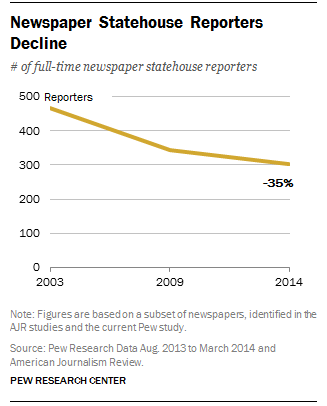
Schieffer's remarks prompted Chris Cillizza of The Washington Post to note the concern about shrinking coverage of statehouses and Washington. A Pew Research Center study found that less than 33 percent of newspapers assign a reporter to cover the statehouse and only 14 percent of local television stations have a part-time or full-time statehouse correspondent.(Pew graphic)

Citing The Courier-Journal's elimination of a D.C. correspondent after almost 150 years, Cillizza writes, "The elimination of a reporter covering, say, Washington for a major Kentucky paper means that that job almost certainly won't be coming back. And that means one less set of eyes watching what happens in Washington and relating it back to the people of Kentucky."

Cillizza continues, "As Schieffer notes in the Rehm interview, no one knows what local pols are up to better than the people covering them day in and day out. Sure, national media swoops in on occasion when some local story gets huge—but the reason those stories get on the national radar in the first place is because of the spadework of local reporters."

The hidden cost to readers is that politicians are very much aware that local newspapers are unable to cover everything, Cillizza writes. "Not only are there fewer eyes watching politicians, legislation and the like but also the pols are all-too-well well aware of that fact. More things are tried—in a bad way—by politicians because they know there is a far smaller chance of them getting caught or even called on it."

Wednesday, April 01, 2015

NPR re-focusing attention on winning over audiences with creative, fact-based journalism

The Internet has created a vast source of news outlets, a large number of which focus on celebrities, sensationalism, sports and entertainment. And that's exactly why NPR CEO Jarl Mohn feels now is the right time for NPR, which has had its fair share of layoffs, to flourish by taking advantage of its connection to a diverse audience that craves news stories.

"With 34 bureaus, evenly split between domestic and international, NPR News is a fixture for many Americans, a dependable daily friend," reports Ken Doctor for Capital. Mohn, who was hired nine months ago, told Doctor, “Most of the world is moving away from fact-based journalism. That creates a lot of opportunity for us in public radio. The world has enough sources of info about Kim Kardashian.”

NPR has about 1,500 journalists, but some have expressed concern about the quality of reporting, Doctor writes. "NPR’s own staff sets a national standard for serious, if often entertaining, national coverage; local coverage can be as good but often flags in reporting smarts, voice and quality. Anyone who has ever listened to local public radio traveling across the country can recognize the great disparities in reporting. Closing that gap is central to the next generation of NPR News—and public radio itself."

That's where Michael Oreskes comes in, Doctor writes. Hired to run NPR news operations, Oreskes will have to find a way to manage money—funding for new initiatives, beats and projects—while meshing a legacy/digital mix to its news success. As he said in a first interview, "NPR’s success will be found 'grabbing [audience] attention with stories told in creative new ways.'” (Read more)

Minnesota radio station series examines impact of crude oil derailments on local areas and residents

WCCO News Radio 830, a CBS affiliate in Minnesota, is running a five-part series called "Tracking Danger" that examines crude oil train derailments and the impacts those derailments could have on local areas. (CBS photo)

"Rice is a sleepy town of about 1,200 people, but every 15 minutes or so, trains come flying through the heart of it at 50 mph. These trains are carrying a variety of freight, but much of it is oil from the Bakken Oil Fields in North Dakota," reports Jennifer Lewerenz. "City Fire Chief Scott Janski is in charge of a 24-man volunteer fire crew and says a derailment would overwhelm their department and worries about their ability to respond."

While Rice can rely on help from 13 other area fire departments, the closest one is 17 miles away, Lewerenz reports. That doesn't comfort local residents, one of whom told Lewerenz, "It’s actually kind of scary because I live in a residential neighborhood where there’s lots of kids, and if they’re outside playing and there’s a train that derails, I mean, they’re not really protected."

Fridley fire chief John Berg said being located near the Mississippi River is helpful and state training has been beneficial, but there is only so much a fire department can do in the event of a train derailment, reports Laura Oakes. Berg told her, “Are we prepared to respond to 30,000 gallons, 90,000 gallons, 120,000 gallons of fuel burning and put the fire out immediately? No. I don’t think we’ll ever get to that point. Are we prepared to respond to something like that, evacuate people, protect exposures and know what resources to call in? Yes.”

Oakes reports, "It’s a different story in Minnesota’s tiny rural communities with much smaller water supplies and maybe a handful of volunteer firefighters." The big challenge there, said Kevin Reed, Operations Director with the state’s Emergency Management Division, "is getting enough water to the scene to activate the chemical foam needed to fight an oil fire."

Another story looks at the impact on the Twin Cities.

Wednesday, November 12, 2014

NPR to air series on delinquent mine safety fines; first show is at 4 p.m. (ET) today

Beginning at 4 p.m. (ET) today NPR will begin airing a series on delinquent mine safety fines as part of its show All Things Considered, NPR's Howard Berkes said in an email to The Rural Blog. "We’ve documented what happens at mines that get away with not paying millions in safety fines while they’re delinquent, most for years, some for decades," Berkes writes. Additional shows will air on Thursday and Friday morning on All Things Considered.

Monday, July 07, 2014

Rural Radio station provides news, sports and music for rural audience

Rural Radio features everything rural. The station, SiriusXM Channel 80, which went live on July 15, 2013, is the first rural-concentrated station, providing "a variety of programming focused on agriculture, equine, hunting, fishing, western sports and rural lifestyle," Kelsey Johnson reports for RFD-TV. Approaching its one-year anniversary, Rural Radio includes news reports on agriculture, the commodities market, local weather, FFA and music. It also includes results, highlights and individual features from western sports such as bull riding, cutting pen, horse shows and bass fishing. (Read more) (Rural Radio daily schedule)

Friday, June 06, 2014

Without access to the Internet many Native Americans rely on radio for information, news

While some rural areas are waiting patiently—and sometimes impatiently—for faster Internet service or to be connected at all, Native Americans in isolated areas like the 7,000 residents of the Hopi Reservation in Arizona, rely on the local radio station to stay in tune with the rest of the world, Tristan Ahtone reports for Al Jazeera America. Only 10 percent of Indian County has access to broadband, according to some reports.

"As access to instant digital media and news spreads across the United States, tribal radio stations are a rich example of just how the digital divide continues to separate Native America from the United States and how tribes use technology often seen as outdated to bridge that gap," Ahtone writes. (To view the interactive version of this broadbandmap.gov click here)
Richard Davis, manager for KUYI 88.1 on the Hopi reservation, told Ahtone, “There aren’t the basic emergency response services. There’s no fire department on Hopi. When there’s a wildfire, we’re going to be the only people that let folks know where it’s burning. When there are icy road conditions, we’re going to be the only folks letting people know where to drive a little more safely.” Some areas are completely isolated. KBRW in Barrow, Alaska, is the only station in about 94,000 square miles, said station manager Jeff Seifert.

Of the 53 Native stations in the U.S., it’s estimated that 92 percent create local programing, 75 percent produce hyperlocal news, 70 percent air tribal programming and 57 percent broadcast in their local tribal language, Ahtone writes. Thirty-five of the stations rely on funding from the Corporation for Public Broadcasting, but federal funding has dropped 5 percent and is expected to keep decreasing. About 20 percent of the stations work on an annual budget of about $100,000 and more than half on a budget of $200,000. (Read more)

Tuesday, November 12, 2013

Kansas community media leaders receive awards from rural development institute

The Huck Boyd National Institute for Rural Development at Kansas State University recently honored its community leaders of the year at a ceremony at the college, the Hutch Post in Hutchinson, Kan., reports. Recognized as Leaders of the Year in Radio were Bob Schmidt, co-founder and chairman of Eagle Communications, and Gary Shorman, Eagle's president and CEO. An employee-owned company, Eagle owns 28 radio stations in Kansas, Missouri and Nebraska, and 30 cable systems in Kansas and Colorado. Recognized in newspapers was Dolph Simons Jr., chairman and editor of The World Co., which publishes the Lawrence Journal-World and other newspapers in the area. (Read more) (Post photo: Gary Shorman and Bob Schmidt)

Each week, the Huck Boyd institute has a radio show called  "Kansas Profile" that describes "the ideas and achievements of a local leader or entrepreneur in a rural community," according to the organization's website. The show, which began airing in 1992, was created to provide "positive recognition to such leaders and sharing their ideas, we hope to encourage these and other Kansans to build on their examples. In doing so, rural Kansas can be made an even better place to live and work." (Read more)