Showing posts with label alcohol. Show all posts

Tuesday, May 19, 2026

The bourbon bubble has burst

Tight budgets and health concerns have slowed U.S.
bourbon sales. (Photo by Thomas Park, Unsplash)
After years of sales growth and production expansion, bourbon distillers and barrel cooperages have seen their businesses shrink as Americans tighten their purse strings, explore sober-curious lifestyles or choose hangover-free options like cannabis and THC beverages, reports Laura Cooper of The Wall Street Journal. "The Trump administration’s trade wars have dented U.S. alcohol exports."

Bourbon's renewed popularity began around 2010, as craft cocktail designers used it as an elevated staple, followed by the pandemic lockdowns, when "Americans heavily stocked their bar carts … with bourbon and other spirits," Cooper explains. "But after peaking in 2022 at 31.2 million nine-liter cases, consumption of American whiskey — including bourbon, Tennessee whiskey, rye and single malts — has slowed."

In Kentucky, where 95% of the world's bourbon is made, the spirit's sinking sales are leading to closed stills, employee layoffs and labor-hour reductions. The state is "awash" with unsold bourbon, Cooper reports. "Kentucky is sitting on roughly 16.1 million barrels of bourbon — the equivalent of around 300 million cases. That’s the largest reserve ever, enough to last as much as 10 years."

Because U.S. law requires bourbon to be aged in new, charred barrels of oak, the bourbon boom became a barrel boom. At its zenith in 2023 and 2024, distillers were "paying upward of $285 per barrel. Since then, prices have dropped significantly, industry players say," Cooper adds. Some large spirit companies have announced plans to sell their cooperages because barrel production isn't needed.

Since bourbon distillers can only use a barrel for bourbon once, when barrels are emptied, they are "often resold to distillers in Scotland or Ireland, where they can find a second act storing scotch, rum or other spirits, over a lifespan of some 80 years," Cooper explains. Used barrels that would have fetched "more than $200 at the end of 2024, now go for around $50, as liquor demand has also plummeted."

Tuesday, March 03, 2026

The 'quintessential institution,' the American tavern, makes a comeback

The Stissing House embraces the 'building’s history as a tavern as far back as the 18th century.'
(The Stissing House photo)

American taverns have been part of the country's social weave since early colonial times, sometimes tucked into the cozy basement of a town-square quilting shop or casting warmth onto a darkening street next to the town bakery. But after decades of popularity, the appeal of the American tavern began to fade, until more recently, when chefs and locals began reviving the meeting place for a bit of company, good food and a relaxing pint.

"Across the country, chefs are abandoning the Sisyphean task of running high-end big city restaurants and returning to why — and what — they started cooking," reports Joshua David Stein of The Wall Street Journal. Taverns, which live in a space that's neither bar nor restaurant, are "one of the country’s most quintessential institutions. . . . a 'third place' between home and work where a community can gather."

Chefs Jon Nodler and Sam Kincaid found big-restaurant success in Philadelphia, but longed for something different. After closing their Philly restaurant, "they moved back west and settled in New Glarus, Wis., a village about 30 miles from Madison," Stein writes. "In October 2025, the couple opened Canter Inn in a restored Queen Anne-style building built in 1902." The inn offers neighborhood regulars and visitors a welcoming, elegant atmosphere with a full-service, first-come, first-served bar.

Chef Clare de Boer left a "coveted" chef career in New York to become the Stissing House tavern keeper. The Stissing House "leans into the building’s history as a tavern as far back as the 18th century," Stein reports. "De Boer focuses on the kind of fare a traveler craves when coming in from the cold: venison and Sherry pie, spit-roasted duck, cups of warming bone broth. De Boer also embraces a tavern’s essential function as a community hub."

Not sure how to become a regular at a tavern that's on the way home to work? Stein advises, "You just have to do what tavern-goers have done for the last 250 years: Show up and order a drink — then do it again and again until everyone there knows your name."

Wednesday, April 23, 2025

Reporting on addiction resources helps journalists approach alcohol use disorder with more accuracy and empathy


Reporting on Addiction offers an audio "Tip Sheet" for journalists who want to understand what alcohol use disorder is, address alcohol use stigma or enhance your community's understanding of the diagnoses.

Throughout April, which is designated Alcohol Awareness Month, journalists can access Reporting on Addiction's resources and learn the different parts of alcohol use, including prevention, harm reduction, treatment and recovery. 

The tip sheet helps reporters approach alcohol issues with more accuracy and empathy. According to Reporting on Addiction, when journalists engage in informed reporting, they benefit their communities by helping to:

  • Reduce the stigma associated with alcohol use disorder.
  • Make the public more aware of available help and support services.
  • Foster more productive community discussions and effective policies regarding alcohol.
  • Ultimately improve overall community health and well-being.

Reporting on Addiction is on a mission to improve how the media discusses and depicts addiction in the news. The collaborative service offers education for professional and student newsrooms that uses addiction science experts, research-based reporting resources, an expert database, and a network of media professionals passionate about decreasing stigma and improving the media’s portrayal of addiction and recovery. Access their materials here.

Wednesday, September 20, 2023

Young heavy drinkers are more likely to carry handguns

Photo by Tom Def, Unsplash
A young person in rural America who drinks heavily is 43% more likely to carry a handgun in the following year, according to a study conducted in seven states over 15 years and published in The Journal of Rural Health.

The study defined "heavy drinking" as consumption of five or more alcoholic drinks in a row at least once in the two weeks before the question was asked of 2,002 youth, aged 12 to 26, from 12 rural communities in Colorado, Illinois, Kansas, Maine, Oregon, Utah and Washington. Survey responses were collected annually from 2004 to 2019 starting with children who were in fifth or sixth grade, as part of the university's national Community Youth Development Study (CYDS).

Lead author Alice Ellyson, an acting assistant professor of pediatrics at the University of Washington, told The Rural Blog that no Southern states were included in the study because the Southern communities that participated in the survey consortium that helped develop the CYDS "chose not to continue as part of the community-randomized trial portion where we obtained our data for this study."

The university says, "Recent evidence suggests that rural adolescents may start carrying a handgun earlier and carry with a higher frequency and duration than their urban counterparts. Handgun-carrying is associated with bullying, physical violence, and other risk factors for violence. Understanding youth behaviors associated with carrying a firearm has significant safety implications. In 2020, suicide and homicide were among the leading causes of death among U.S. individuals ages 12-26 years. About 91% of homicides and 52% of suicides among this age group involved a firearm."

Communities That Care is a program for preventing these behaviors and their consequences in rural areas. It has no communities in Southern states, "but they would be very willing for that to change," Ellyson told The Rural Blog.

Monday, June 12, 2023

Monday quick hits: Cowboys and cows; Kingsolver interview; beer brewing and NASA; travel in the U.S.A. . . .

Gunfight at the O.K. Corral (Illustration by Bridgeman, ACI, via National Geographic)

Eric Clapton bluntly admitted, "I Shot the Sheriff," but shooters and guilty parties are not that clear in the case of who shot whom at the O.K. Corral in Tombstone, Ariz. Some details about Wyatt Earp and the fight's aftermath might be surprising, Fernando Martín reports for National Geographic.
"Lester," a wily steer, escaped his pen, made a run for freedom and ended up on a stretch of busy interstate in Michigan, reports Cathy Free of The Washington Post. Lester's owner discovered his disappearance and called for cowboy help. Cowboy Ricky Littlejohn came to the roping rescue. Littlejohn told Free, "It was pretty wild — cars were still flying by when I went after him."
How do you write a book about decades of poverty, industrial abuses and opioid addiction that people will enjoy reading? Kentucky author Barbara Kingsolver found a way in her Pulitzer Prize-winning novel Demon Copperhead, reports Rae Johnson for the Louisville Courier Journal. Commenting on her rural upbringing, Kingsolver told Johnson: "I've always been the writer from Carlisle, Kentucky. The person in me who is the underdog and who feels sort of fiercely protective of the underdogs is in everything that I write." Read the interview here.
CiCi helps the brewery lessen its carbon footprint by
recycling CO2. (Photo by Sergio Flores,The Washington Post)
Do people typically put beer brewing and NASA technology in the same category? Well, no, but maybe they should. "The fresh, doughy aroma around the conical fermentation tanks at Austin Beerworks is a sign that trillions of yeast cells are turning the sugary, hoppy liquid inside into beer. But there's another byproduct: carbon dioxide," reports Charlie Scudder of The Washington Post. "Until recently, Austin Beerworks's cellar manager had to truck in carbon dioxide in tanks 10,000 pounds at a time. But now, he's using techniques developed by NASA to capture the naturally produced CO2 and dissolve the molecules into his brews. . . The machine that enables tanks is the size of a large, double-door refrigerator is nicknamed CiCi — short for 'carbon capture.'"
Summer travel can be a glorious break from busy daily life. A long drive can give time for reflection and solitude. Along one stretch of pavement is the professed "loneliest road in America" right on U.S. Route 50—a place to feel the country's expansiveness and historical changes.

The Butler County Donut Trail in Ohio, might be a favorite
byway for children. (Photo by Jason Bohrer, The Daily Yonder)
If the loneliest road seems too solemn, America has flamboyant byways and memorable stops. "Federally-recognized routes are collectively called 'America's Byways,' and they encompass epic road trips like Route 66, unique communities like Amish Country, awe-inspiring geology like Volcanic Legacy, and immersive history like the Harriet Tubman Underground Railroad," reports Kim Kobersmith of The Daily Yonder. "The following four trips are some of the most popular in the country. Not only are they fun to travel, but their organizers have also learned some best practices for coordinating this kind of visitor experience that they share below."

Friday, April 21, 2023

White women in rural America are dying at accelerated rates; new memoir explores why this group 'feels forgotten'

Book cover via Amazon
"A New Divide in American Death" was a Washington Post headline in 2016. The article's research pointed to an only partially explained reality: "The most extreme changes in mortality have occurred among white women, who are far more likely than their grandmothers to be smokers, suffer from obesity or drink themselves to death," Joel Achenbach and Dan Keating wrote. "The statistics show decaying health for all white women since 2000. The trend was most dramatic for women in the more rural areas."

But why? Sometimes it takes a story rather than a study to show us. Journalist and author Monica Potts grew up in Clinton, Arkansas, a town of about 2,500. She left to pursue her dreams, but her best friend, Darci, stayed in Clinton. In an interview with NPR Host Scott Detrow, Potts discusses the two women's contrasting stories in her new book, The Forgotten Girls: A Memoir Of Friendship And Lost Promise In Rural America.

Detrow: Two best friends start with the same dream but grow up to live very different lives. It's the story at the heart of a new memoir about getting out of a small town and the crushing pressures to stay in it. . . .So you're the one who, as it were, got out. But let's start with this - your friend Darci didn't. Tell us about Darci, and tell us about when the two of you were really young, the type of dreams you shared.
Potts: Darci and I met when we were really young, like, 5 or 6. From that moment on, we were almost sisters. We grew up in a small town in the Ozark Mountains. . . . It's a strong evangelical community. When we were little, we would look through an old atlas and dream about getting away when we were older to a big place. . . . When we were older, we dreamed about going to concerts and listening to bands we liked instead of the country music we heard everywhere.
Detrow: Just focusing in on that marriage message, you also write about the hypocrisy and the confusion about, your life is about getting married; your life is about finding a husband; your life is about having children. And yet, if you have sex before marriage and if you get pregnant, that's a terrible, terrible decision - and just trying to make sense of all of these conflicting messages as a teenager.
Potts: Yeah. Well, it's a terrible decision, but the path to redemption is through the church.
Detrow: At the expense of your education in many examples, right?
Potts: Yeah.
Detrow: You write about people dropping out of high school their sophomore or junior year, even, and getting married once they become pregnant.
Potts: At the expense of your education and whatever else you might have wanted for your life. Your life becomes about being a mother, and everything else you might have wanted becomes subsumed by that.
Detrow: So you go to college. You begin a career as a journalist. Darci drops out of college relatively early. She stays in and around Clinton. She's in a series of abusive relationships. . . .has drug problems. . . but you ultimately reconnected as adults.
Potts: I was working as a journalist, and I had started to read a series of studies about white women with the least amounts of education - were losing years of life expectancy compared to the generation before. That felt very personal to me. . . .That group of women was similar to the girls that I had grown up with, and I wanted to report what was happening and across rural America. . . .While I was [in Clinton] in April 2015, Darci reached out to me for the first time . . . . We met up. . . . I told her the kind of book I wanted to write. . . And she said, well, maybe you should just write about me. From there, we started to talk more about her life.
Potts: We spent a lot of time together over the next few years.
Detrow: And she really struggled in those interactions with you.
Potts: It was really up and down, and it was often painful to watch. . . . But she thought that if her story might help other people, then it would be worth it.
Detrow: And what do you think the big picture lessons are?
Potts: I've spent about five years thinking about this. . . One of the things in rural America is this perception of scarcity. I think it's easy for people here to believe that they've been forgotten, that there's no help for them, that there are no options. . . . or life outside of the church and motherhood and marriage for girls is. . . .They're just not connected to those options. I think the first place to start would be expanding those worlds and connecting people to the broader world . . . . giving people the freedom to become who they are and who they need to be.
Detrow: Over the period where you began reporting this book and writing this book, you decided to move back there yourself. Why?
Potts: There was a moment when I started to come home in my mid-30s. . . . I just realized how beautiful this place was to me. I have really deep roots here. . . . And there are things about this place I love - the wildness, the mountains, the rivers, and some of the culture. I felt I needed to close the loop before I could move on with my adulthood and experience this place anew and with fresh adult eyes.

Wednesday, April 19, 2023

'Given the critical mass that we have,' single-malt whiskey to get official definition in U.S.; it has more stills than Scotland

American distilleries can choose colors and aromas that celebrate
their region. (Photo by Lauren Lancaster, The New York Times)
Single-malt whiskey is going mainstream. "In the coming months, the Tax and Trade Bureau, a part of the Treasury Department, will release an official definition of American single malt — the first new spirit category in many years and a recognition that a once-niche whiskey has entered the mainstream," reports Clay Risen of The New York Times. Steve Hawley, who in 2016 co-founded the American Single Malt Whiskey Commission to push for the new definition, told Risen, "It’s a necessary step given the critical mass that we have here, with over 200 distilleries making single malt whiskey in this country. That’s more than all of Scotland.”

Affectionately referred to as "the freewheeling cousin of Scotch, the proposed American definition is looser than Scotland’s famously rigid rules. Like Scotch, American single malt would have to be made at one distillery — hence 'single' — using 100 percent malted barley," Risen explains. "But while the Scottish version must be distilled on a pot still and aged for at least three years, neither requirement would exist in the U.S. . . . Tradition (though not law) dictates that single malt Scotch be aged in used casks, usually bourbon barrels, but no such expectation exists for its American counterpart."

The American single-malt industry continues to grow "with a diversity that reflects the country’s sheer size and its wide variety of climates, traditions and agriculture," Risen reports. "One advantage of malted barley is that it’s more like a canvas than a color. Its soft, nuanced flavors allow distilleries to layer it with influences at every step of production, from the variety of yeast and barley, to the peat or other sources of smoke used to stop the seeds from germinating, to the type of barrel it ages in. . . . Such diversity has allowed for a variety of distillery house styles to emerge."

"Master distiller Matt Hofmann draws inspiration from Pacific Northwest agriculture and culinary traditions," Risen writes. Hofmann told him, "We can do this in a way that’s not a clone of Scotch. Not that there’s anything wrong with Scotch. But it’s just like, what else is out there in an industry that’s 500 years old? For me, growing up here in the Pacific Northwest, it’s the ability to make a whiskey that is reflective of this place that I love.”

Monday, March 06, 2023

Idea of making vehicular-homicide convicts pay child support for surviving children spreads 'like wildfire' in states

Police video from the Los Angeles Times

States are seeking stronger ways to tackle drunk driving but what seems fair to some is seen by others as duplication of relief. 

In more than a third of the states, legislators "have introduced some form of 'Bentley’s Law,' which would require impaired drivers who are convicted of vehicular homicide to pay child support for the surviving children of their victims," reports Austin Jenkins of Pluribus News. Frank Harris, director of state government affairs at Mothers Against Drunk Driving, told Jenkins, "I haven’t seen anything like this before with bills on drunk driving reform. It is like wildfire the way this is taking off."

The bill's concept originated with "Cecilia Williams after her son, future daughter-in-law and 4-month-old grandson were killed in a 2021 crash in Missouri. Williams was left to raise her son’s two surviving children, Bentley, 6, and Mason, 4," Jenkins writes. "After the fatal crash, Williams began advocating for states to require restitution on behalf of children who lose a parent or guardian because of an impaired driving accident. . . .So far in 2023, versions of 'Bentley’s Law' have been introduced or reintroduced for the second year in a row in at least 18 states, according to tracking by both MADD and the National Conference of State Legislatures."

Tennessee was the first state to pass the law. "Missouri lawmakers considered the idea last year but did not pass it," and bills in Mississippi and Virginia have died," Jenkins reports. "MADD’s tracking shows most of the other bills are still in committee." A bill similar to Tennessee's is moving through Washington state's legislature.

"In Virginia, the Family Law Coalition opposed the legislation," Jenkins reports. Daniel Gray, the coalition’s chair, told Capital News, “There’s already a very expansive wrongful death statute that people can take advantage of and get relief of the type that this bill is trying to introduce." Jenkins adds, "Concerns have been raised in some states about the logistics of implementing the child support requirement."

Jenkins reports, "State lawmakers are paying fresh attention to the issue of drunk and drugged driving amid a concerning rise in roadway fatalities, including a 14% increase in alcohol-impaired driving deaths from 2019 to 2020. That trend has prompted some states to consider lowering the legal drunk driving limit from .08% blood-alcohol concentration to .05%. There are also proposals to expand the use of ignition interlock devices to prevent repeat drunk drivers."

Thursday, February 23, 2023

Moonshine goes legal, but daughter of famous moonshiner says illegal form of the beverage still exists in Appalachia

Moonshine sample at Ole Smoky Distillery in Pigeon Forge,
Tennessee (Photo by Keith Roysdon, The Daily Yonder)
First-aid kit? Grab some moonshine; it's better than hydrogen peroxide anyway. Home-brewed alcohol, known for its powerful kick, "has always been the stuff of Appalachian legends. For some, it was a way of life," reports Keith Roysdon of The Daily Yonder. "And it’s now a big business. Stills have been brought down from the hills, figuratively speaking, and set up along the Parkway in Pigeon Forge and Gatlinburg, Tennessee," neat the Great Smoky Mountains National Park, once the private land of moonshiners. "But not all the stills are out of the hills. Is moonshine – the unregulated, untaxed 'shine – still made by liquor renegades in hollers throughout the land?"

"Of course it is!" said Sky Sutton, daughter of the late Marvin 'Popcorn' Sutton, who was probably the best-known moonshiner in the region.

"The history of the product of corn distilled into powerful liquor is long and colorful and goes back beyond society’s image of a hillbilly tending a copper still in a thick stand of trees," Raysdon writes. "The Encyclopedia of Appalachia book notes that in the 1700s, immigrants from the British Isles and Northern Ireland imported their knowledge of distilling using copper pots and condensing coils, 'introducing a craft and eventually illegal enterprise that became a central element of the region’s identity.' The Encyclopedia notes that the production of moonshine boomed during the Prohibition years, 1920 to 1933."

The trickle of moonshine into mainstream liquor began when Tennessee "was making changes to its liquor laws, particularly in relation to the production, sales, and service of liquor and what’s branded as moonshine.  . . . With manufacturing overseen by the state, the federal government overseeing taxes and local municipalities deciding through referendums if they want to be dry or wet," Roysdon reports. "In the wake of changes in liquor laws, Ole Smoky Moonshine Distillery entered the scene. In 2010, the distillery became the first federally licensed distillery in East Tennessee. The company’s original distillery opened in 2010 in Gatlinburg and the Pigeon Forge location opened in 2014."

Sky Sutton told Roysdon, “I think that over-the-counter moonshine and mountain-made likker are two different beasts. The over-the-counter kind now has its place on the shelves of liquor stores. The mountain-made kind is still elusive, mysterious, and much stronger. . . . I think the government and the black market – booze, betting, etc. – are both as old as dirt and will both stay around for a long time."

Monday, February 13, 2023

From the food to the turf and maybe even the pizza guy's tip, this year's Super Bowl was brought to you by farmers

Photo by Successful Farming
Super Sunday can be likened to the American version of the Garden of Eden: All the good things agriculture has to offer. Before the game, Heather Barnes and Lisa Foust Prater of Successful Farming
reported that from the chicken wings to veggie trays to all the meats, cheeses and chips, "A whopping 79% will be spent on food and beverages, all of which come from farms. Americans eat more food on Super Bowl Sunday than any other day of the year except for Thanksgiving."

Don't forget the barley for the beer. "The National Restaurant Association says 51.7 million cases of beer are sold every year during Super Bowl weekend. One bushel of barley, grown mostly by farmers across the Northern Plains and Pacific Northwest, will make 565 12-ounce beers," Barnes and Prater write. "Whether it’s the stadium, the field, the ball, or the food, one thing is clear: no farms, no Super Bowl."

And it goes beyond food. "Leather is also used to make the ball. Even though it's often called a pigskin, footballs are actually made of cowhide," Barnes and Prater write. "Wilson [Sporting Goods] is the official supplier of footballs for the NFL: 120 of its footballs will be used in Sunday's game. One cowhide will make 10 footballs. Not just any cowhide is used; it comes from cattle grown in Iowa, Kansas, or Nebraska."

Bet you didn't think of this: Barnes and Prater ask, "Did you know 75% of that dollar bill you just used to tip the pizza delivery guy is made of cotton?" Thank you, American farmers. We like money. What about all that turf? "The turf in State Farm Stadium in Glendale, Arizona, is a hybrid drought-tolerant Bermuda grass, grown on a turf farm and trucked the 25 miles to the stadium," they report. "The grass is housed in a single tray, which is 40 inches deep, 234 feet wide, and 403 feet long. The entire tray is rolled outside when the grass needs sunlight or the stadium is being used for other events."

Sunday, October 02, 2022

Don White, who published mug shots of convicted drunk drivers and did much more as a weekly editor, dies at 74

Don White (Photo via Somerset Commonwealth Journal)
Don White, who as a weekly newspaper editor drew national attention by publishing photos of people convicted of drunk driving, then entered the Kentucky Journalism Hall of Fame, died Wednesday in a one-car accident that may have been caused by a medical condition. He was 74.

In 1998, White had been editor of The Anderson News in Lawrenceburg for 20 years when he decided to tackle drunk driving in Anderson County, which had about 19,000 people at the time. “Most violators of the law dislike having their name in the local paper,” he wrote in an editorial announcing his plan. “We hope the certainty that their picture will also be published will keep more drunks off our highways.” In that edition, he also ran drunk-driving statistics and stories about seven people killed by drunk drivers. A few months later, he limited the photos to residents of counties where the paper circulated, according to an ethics case study for the Society of Professional Journalists by Elizabeth Hansen, then a journalism professor at Eastern Kentucky University.

"The only cases in which photos were not published were those where the DUI suspect was injured, taken to the hospital for treatment and, although charged, never processed at the jail and never photographed," Hansen wrote. "Only once did White give any person special treatment. When the chairman of the county Democratic Party was convicted of drunk driving for the second time in five years, White published his mug shot and a story on Page 1 rather than on the District Court page."

From 1999 to 2000, drunk-driving cases in the county declined 37 percent, and the National Commission Against Drunk Driving gave White an award. When he retired in 2006, Ben Carlson, the new editor-manager placed by Landmark Community Newspapers, stopped the practice. He wrote that publishing mug shots of those convicted “adds a level of punishment, or at least embarrassment, beyond what is imposed by a judge.” He told the Lexington Herald-Leader, “I really don’t think that the role of a community newspaper is to punish or embarrass anybody. It’s to report the news and provide information.”

White was softspoken but resolute in his convictions, and had a quick wit. He was news editor of the Commonwealth Journal in his hometown of Somerset and wire editor of The Lexington Leader, but joined Landmark as editor of the Casey County News in 1976 because he missed contact with the public. He won many awards and helped spur school consolidation in Anderson County, but also restoration of a one-room school, one of several civic activities. After retiring, he traveled the state writing syndicated features and a book, Paper Boy: Giving His Heart to Journalism. “He called what he did with feature writing ‘living obituaries.’ It was so important to him to tell people’s stories,” his daughter, Amanda White Nelson, told the Somerset paper.

"Don was the ultimate community journalist, Hansen wrote on her Facebook page. "I often used his work as an example in my community journalism classes at EKU. I will miss him." Funeral services were held Sunday; the family says expressions of sympathy should be a subscription to your local paper or a donation to the Kentucky Journalism Hall of Fame Fund "to support and honor the work of journalists, like Don, who are passionate about telling Kentucky's stories."

Monday, August 29, 2022

James Fallows returns to smaller towns: 'The rest of the country is in trouble. In my town, we are working things out.'

Deborah Fallows in her hometown (Photo by James Fallows)
We shall not cease from exploration
And the end of all our exploring
Will be to arrive where we started
And know the place for the first time
.
--T.S. Eliot, "Lttle Gidding," The Four Quartets, 1943

The boldfaced words in the penultimate stanza of Eliot's poem are the title of the latest post by James Fallows on Breaking the News, his Substack site. The subhead says, "Eliot wasn't writing about the Ohio of 2022. But he could have been." The post continues Fallows's and his wife Deborah's exploration of civic life in America's small towns, logged in their book, Our Towns: A journey into the heart of America. Here is the entire article, which is in the public domain.

By James Fallows

This post is about the challenge of knowing one’s own country—a challenge that is almost an impossibility for a country as large, diverse, contradictory, and rapidly changing as the United States. The same of course applies in China, India, Indonesia, Brazil, “the Arab world,” and other places.

But what Americans “know” about this moment for their country seems skewed in ways that are dangerous and destructive—yet potentially correctable. I hope you will bear this dispatch in mind the next time you hear a report on “a nation on the cusp of civil war,” or “Red and Blue America, with no common ground in between.”

I’ll start by declaring my premises on three points. Then I’ll give a list of illustrations from the past seven days that my wife, Deb, and I recently spent in parts of America not usually covered in the news.

Three principles: Here are three points that guide what I write about America and the world.

1. Keeping contradictory truths in mind.

Through the years Deb and I were living in China, it would drive me crazy when experts would opine from afar on what was good or bad about the place. The certainty of their views and the sweep of their theories seemed directly connected to how little they’d seen of the country, except at some internationalized conference center in Beijing or Shanghai or Sanya.

By contrast, most reporters on-scene tried constantly to portray how China was both better and worse than it seemed from afar. Both stronger and weaker, both more likable and more off-putting, both more tender and more cruel. And that the main challenge in dealing with it was trying to keep these contradictions in mind. This is one of many reasons it’s bad for the world that Xi Jinping’s government is making it so hard for foreign reporters and foreigners in general to be inside China.

2. The arc of loss and rebirth—and how a culture stays ‘young’

Through the years I have lived in and studied American history, I’ve come to believe that the through-line in the nation’s story is constant loss, and constant creation.

The loss and change are certain: Name your decade since the 1620s, and I can name the emergency or tragedy of its times. Name your American family, and its background will include hardship and dislocation. Name your community, and it will have gone through significant ups and downs. For instance: Bend, Oregon, now one of the country’s most desirable locations, had some of the worst unemployment in the country 30-plus years ago, when the logging and timber industries collapsed. At about the same time, the now-celebrated Greenville, South Carolina, had a textile-based economy. Nearly all of those mills have disappeared, but Greenville has adjusted and prospered.

For arc-of-history purposes, the question is always how the creation in any given era balances against the destruction. Who is helped and hurt; how the gains offset the losses; who is able to recover; how to protect those who cannot. Change is a given; adjustment to change is the variable, and the one more within our control.

The older people become, the more likely they are to mourn how things “used to be.” The younger they are, by the calendar or in spirit, the more likely they are to think about what comes next.

When people say that America is a “young” country, this is what they mean. Despite having the oldest continuous form of government of any major country, and apart from immigration giving the U.S. a lower median age, what makes America young is an orientation ahead, rather than behind.
 
3. ‘The rest of the country is in trouble. In my town we are working things out.’

Through the decade in which Deb and I have reported on the goods and bads of smaller-town American life, we’ve become convinced that national media’s focus on “heartland” America mainly as an arena for Red-vs-Blue political showdowns (“guy in a diner”) has a profoundly distorting effect. As someone wrote about this problem:

"An important part of the face of modern America has slipped from people’s view, in a way that makes a big and destructive difference in the country’s public and economic life. Despite the economic crises of the preceding decade and the social tensions of which every American is aware, most parts of the United States that we visited have been doing better, in most ways, than most Americans realize. Because many people don’t know that, they’re inclined to view any local problems as symptoms of wider disasters, and to dismiss local successes as fortunate anomalies. They feel even angrier about the country’s challenges than they should, and even more fatalistic about the prospects of dealing with them."

As you’ve guessed, that someone is me, in the introduction to the book Our Towns. I wrote that four years ago; I am here to tell you that Deb and I believe this all the more strongly now than before the pandemic.

Because virtually the only thing Americans know about the parts of the country where they don’t live is the non-stop crisis narrative of national media, they naturally think the country’s problems are even worse than they are. In the parts of life they experience directly, people can see the goods and bads in perspective, and recognize not just possibilities for progress but encouraging practical steps. It’s hard to realize that all across the country, people who are never in the news are innovating and progressing in similar ways.

Now let’s make this specific.

Over a seven-day period this month, Deb and I interviewed and met people in six smallish, and very small, towns and villages in northwest Ohio. This is where Deb grew up, on the shores of Lake Erie, and where she considers herself “from.”

It’s also an area that, if it ever appears in the national news, is usually in the context of “despair and division in the heartland,” the latest Biden approval ratings, what the Vance-Ryan Senate race means for next year’s legislative agenda, and why Arizona and Nevada have become “swing states” but Ohio no longer is.

All those things matter.

But here are some of the other things that matter but are rarely if ever in the national news, and therefore are not part of general understanding of “how America is doing.” Each of these is a place marker for upcoming more detailed reports by Deb and me at the Our Towns site.

The community foundation. Findlay, Ohio, is the county seat of Hancock County, with a city population of more than 40,000. It’s the regional hub. Over the past three decades, the Findlay-Hancock County Community Foundation, headquartered there, has become a force in regional well-being whose effects can be compared to those of the great Gilded Age philanthropies in Pittsburgh. (Mellon, Frick, Carnegie, Heinz, etc.) Everywhere we went in the area we saw the Community Foundation’s imprint. What it has done deserves study and emulation.

As far as we can tell, this Community Foundation, which is transforming a region, has not been mentioned in mainstream national news.

Family Center. One of the Community Foundation’s projects in Findlay is the “Family Center,” in a former large grocery-store building on the north side of town. The insight behind this Center was the importance of combining a range of non-profit services—medical and dental clinics, housing and homelessness assistance, legal aid, a library, a food pantry and thrift shop, and more—all in one place. That way, as we heard, families for whom a $20 taxi ride was a decisive barrier could do all their business in one attractive and dignified place.

We have not seen anything like this in other cities. It’s a story worth learning from. Again, as far as we can tell, it has not been featured in the national news.

Sandusky on all cylinders. Sandusky is the county seat of Erie County, on the lake, and has a population of just over 25,000. More is going on there, in more different areas and directions, than I can even suggest at the moment. I’ll give just two illustrations.

First, we happened to be there at a moment when the national spotlight hit Sandusky. At an event on the waterfront, a trans-partisan group got together to announce good news on the “infrastructure unites us all” front. Rob Portman, the outgoing Republican senator from Ohio; Marcy Kaptur, the very Democratic representative from the district; and Pete Buttigieg, the former mayor of South Bend and now secretary of transportation, were on hand to celebrate Sandusky’s success in winning a competitive $25 million grant for local road, transit, and bike improvements.

From  left: Tom Horsman, City of Sandusky; Kha Bui, brewery owner;
City Manager Eric Wobser; James Fallows (Photo by Deb Fallows)
Second, one of the most impressive breweries-and-pubs you will find anyplace in America is in downtown Sandusky, founded by Kha Bui, who was born in Saigon, then left as a child on a boat into the South China Sea and spent several years in refugee camps. The brewery is called CLAG, and the adjoining restaurant/pub is called Small Cities. Each time we went near the place, it was packed. Kha Bui’s idea is to sell certain lines of his beer only at the taphouse and restaurant, so that people will have to come to Sandusky to get it. Again as far as we can tell, they have not been in the national news.
 
Sandusky, in perspective. When reporting from “they’ve already succeeded” towns, like Greenville or Bend or Burlington, Vermont, Deb and I often wondered what it would have been like to be there ten years earlier.

I think it would be like being in Sandusky now.

And this is not even to talk about the school system or the faith community. Or a new branch of Bowling Green State University. Or other aspects we will return to.

Villages, challenging what you think about small-town Ohio. One of the Community Foundation’s many projects in Hancock County has been supporting smaller villages’ enrollment in the Community Heart & Soul® process. (Heart & Soul has been a partner and supporter of Our Towns reporting.) The three villages we visited — village is the technical term — that had been through this process were really small. Mount Blanchard’s population is around 500. Arlington’s, about 1,500. And McComb’s, about 1,600 — though it also is home to the largest cookie-and-cracker factory in the country. That will be a story of its own.

Yet each of these communities, surrounded by corn and soybean farms, and with a population base smaller than an average city block in New York or Chicago, has engaged in a systematic civic-engagement process to help it identify what its residents most care about, and where it should invest its efforts.

Mount Blanchard discovered and rehabilitated old ball-playing fields that had been left neglected. It has better park facilities than most places with 20 times its population. Arlington has attracted young people back to town, and has ambitious retail and restaurant investments. (For instance, Hurdwell.) And in McComb, we met fully 1% of the town’s total population — the equivalent of 7,000 people in our current home town of Washington, D.C. — at a meeting to discuss already-approved plans to build more housing, and in-progress plans for a revived downtown. More on all of these to come. But in all of these tiny communities, we saw counter-examples to the idea that Americans no longer engage with their neighbors.

Vermilion, which is Deb’s homeland, has deliberately made the most of its assets, which are a lakeside setting and still-extant traditional architecture. Its streets, shops, and restaurants were jammed when we visited two days ago.

We didn’t ask any of these people in any of these places for their views of national politics. But in all of them, from the larger cities to the smallest settlements, people younger and older, Black and white, volunteered their optimism about prospects for their communities. In one of them, a civic leader took us through all the “used to be” sites — the gas station, the grocery store, the hardware store. “They’re all gone,” he said. “But I know that towns like this are coming back.”

Is this the full American story of these days? Of course not, and no one knows where these village-by-village ambitions will lead.

But it is part of the story, And part that is too often left out.

Friday, August 26, 2022

Drug roundup: Law enforcement warns about 'rainbow fentanyl'; young adults using pot and hallucinogens at record rates; needle exchange project in rural Nevada

Rainbow fentanyl (U.S. Customs and
Border Patrol Protection
photo)
Law enforcement officials across the U.S. are reporting a spike in seizures of "rainbow fentanyl," a brightly-colored version of the synthetic opioid that often looks like candy. Some officials believe the drug is being marketed to children, but others dispute that. Still, officials agree that fentanyl is dangerous no matter what it looks like. Read more here and here.

The amount of young adults (ages 19 to 30) who report using marijuana and/or hallucinogens is at its highest rate since 1988, when the National Institutes of Health began tracking it. Marijuana vape usage reached pre-pandemic levels last month after dropping off in 2020. Meanwhile, hallucinogen usage rates began spiking in 2020. Bing drinking rates are also on the rise since the beginning of the pandemic. Read more here.

A needle exchange project modeled on urban efforts aims to save lives in rural Nevada. The program "comes as leaders in small, often conservative cities have been asked to adopt policies forged in large, more liberal cities, such as New York and San Francisco," Jazmin Orozco Rodriguez reports for Kaiser Health News. "Federal reports show people who use needle exchange programs are five times as likely to start drug treatment programs and three times as likely to stop using drugs as people who do not, but programs in Nevada and other states have faced similar pushback."

Thursday, August 18, 2022

Bourbon boom has downsides for neighbors who don't want aging whiskey feeding unsightly fungus and posing risks

Buffalo Trace Distillery built these warehouses at Frankfort, prompting complaints from neighbors. Now it wants to build a similar group of warehouses in the nearby Elkhorn Creek valley. (Photos by Ryan C. Hermens, Lexington Herald-Leader)
Fungus on a nearby sign
The boom in bourbon has been a boon to Kentucky economically, but now rural residents in a swath of the western Bluegrass region are fighting the warehouses that turn whiskey into bourbon. They object to the fungus that is fed by the aging alcohol escaping into the air from barrels in the warehouses, worry about the storage of so much flammable material, and dislike what they call an industrial invasion of bucolic landscapes.

Residents of Henry, Franklin and Anderson counties point to the black fungus that is obvious on signs, homes and other surfaces. Distillers pooh-pooh those concerns, citing studies that show the fungus is harmless, but they acknowledge it's unsightly. And the concerns are more than cosmetic.

Wendell Berry
“What I fear is this will be a continuation of an old Kentucky story, in which outsiders come in, take as nearly as they can what they can, what they want, and give as little back as they possibly can,” farmer-author-poet-activist Wendell Berry, 88, told Janet Patton of the Lexington Herald-Leader. Near the farm where Berry grew up, Angel’s Envy has won Henry County Planning Commission approval to turn a 1,200-acre cattle farm into a "bourbon campus" with up to 25 warehouses, lodging, an amphitheater, a visitors center, a helicopter pad and more.

“We are being asked to sacrifice this land to tourism and whiskey,” Berry told the commission last month. The commission voted 6-3 for the zone change; the final decision is up to the county's legislative body, the Fiscal Court, on Sept. 20.

One the other side of the argument is "Connie Blackwell, a Lawrenceburg real estate agent who lives in Tyrone in the valley below the Wild Turkey distillery," Patton reports, quoting her about the fungus: “It is a mess; you do have to pressure-wash your house once a year. You get used to it. Everybody down here in Tyrone tolerates it. It’s just no big deal … for the taxes they bring into our county, it’s worth it, to me. . . . I don’t believe the whiskey fungus hurts us. Honest to god, for the amount of taxes . . . it really is a fair exchange.” But Patton notes that distillers are lobbying for the local tax on aging whiskey to be reduced, which would be the latest in a series of tax breaks that have helped fuel the boom.

Monday, July 11, 2022

'Dry' territory is becoming harder in find in rural Kentucky

Maps by Lexington Herald-Leader (bottom map by Jacob Latimer), adapted by The Rural Blog

Rural Kentucky continues to get wetter, and we're not talking about the weather. Only 10 counties are "dry," meaning that the sale of alcohol is illegal there, and they are all small, rural counties.

"Residents in several of those are trying to get enough signatures on petitions to call for a vote in November on whether to allow sales, according to information from the state Department of Alcoholic Beverage Control and local officials," reports Bill Estep, longtime rural reporter for the Lexington Herald-Leader. "A few counties have limited alcohol sales, such as at a golf course or farm winery, and there are a number of wet cities in otherwise dry counties, but the time when many Kentucky residents had to drive an hour or more to legally buy a 12-pack of beer or a bottle of whiskey is gone."

Why? The reasons "include economic concerns, efforts to boost tourism, generational shifts, people moving into rural Kentucky from places where alcohol has long been legal, changes in attitudes — including greater acceptance of alcohol among churchgoers — and even rising problems with other drugs such as methamphetamine and fentanyl," Estep writes. "There is still a great deal of addiction and other problems like fatal wrecks caused by alcohol, but rising overdose deaths from other drugs make it seem tame by comparison, said Gene Cole, a Baptist minister who heads the Kentucky League on Alcohol, Gambling Problems and Substance Use Disorder." Cole said the perception of alcohol is that “It’s not as bad as some of the other stuff out there.”

"Cole still preaches abstinence from alcohol, but acknowledged some pastors don’t push against alcohol as passionately as they once did, and that many churchgoers no longer see alcohol as evil because of the influence of popular culture and other factors," Estep reports. Nick Catron, director of missions for a regional association of Southern Baptist churches, said some have become complacent about alcohol: “As Baptists, predominantly we frown upon consumption of alcohol. But again, it just seems as if so many people today don’t find any fault in it.”

Economic concerns have been important, too, and a move on that front helped break down the cultural and social obstacles. In 2000, the legislature allowed local referenda to legalize alcohol sales at larger restaurants, golf courses and farm wineries. "Before that, voters had to choose whether to allow the full range of alcohol sales," Estep writes. "It was more than many could swallow, including people worried about liquor stores and bars changing the character of rural communities and small towns. . . . The momentum continued from there as people got used to the idea of having legal sales in their communities, with voters in several cities and counties first approving restaurant sales before voting later to go fully wet. . . . Legislators changed state law to allow votes on alcohol sales at smaller restaurants and dropped the requirement for a city to have at least 3,000 residents in order to hold a wet-dry vote."

Tuesday, May 24, 2022

Fentanyl drove record number of drug-related deaths in 2020; teens often score the pills on social media

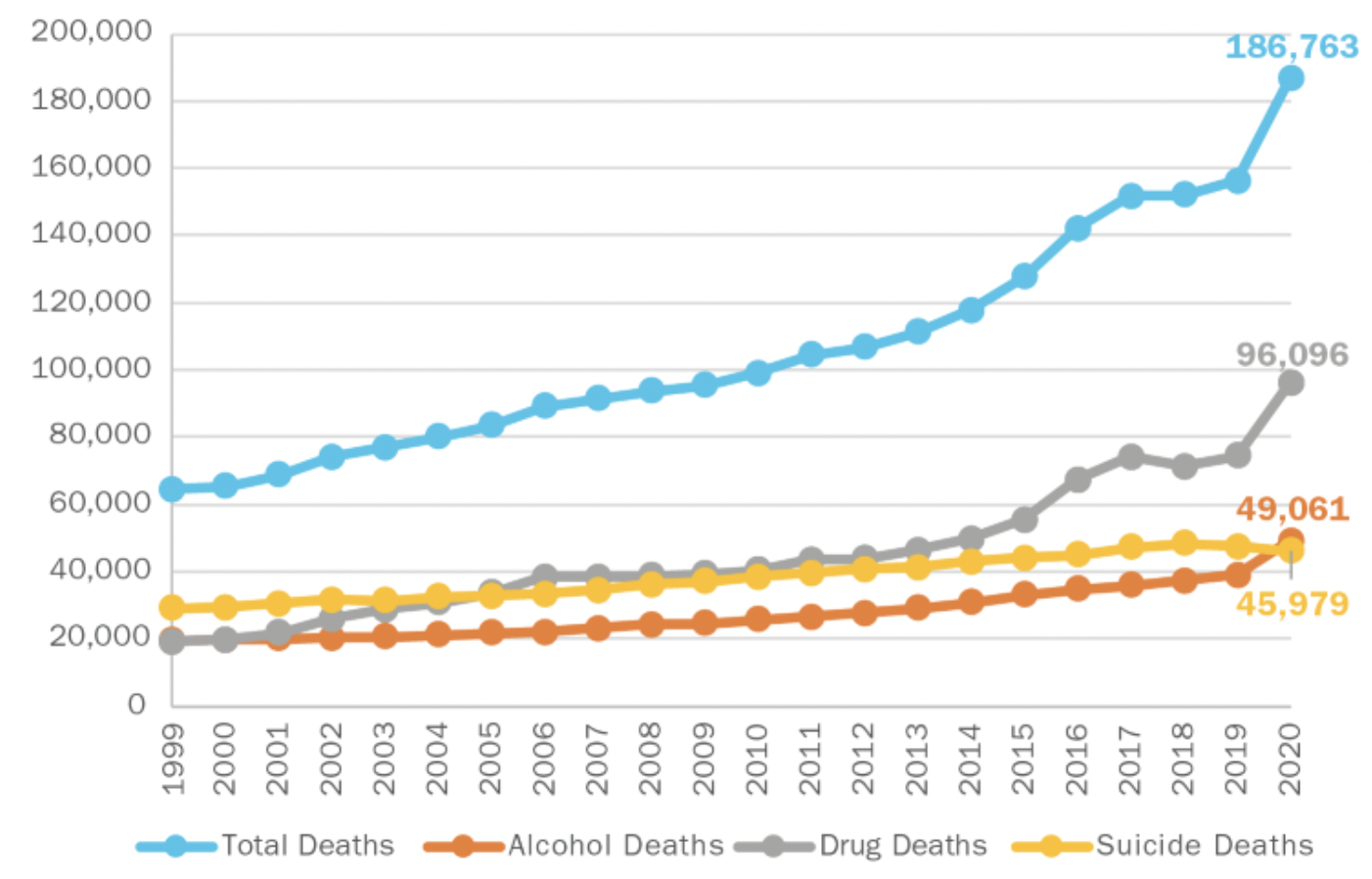
Annual deaths from alcohol, drugs and suicide in the United States, 1999-2020
(Chart by Trust for America's Health and Well Being Trust; click on the image to enlarge it.)

So-called deaths of despair—those related to alcohol, drugs, and suicide—hit an all-time high in 2020, claiming the lives of nearly 182,000 Americans, according to the Trust for America's Health and Well Being Trust. The 2020 total is 20 percent more than 2019, and mark the highest number of substance-misuse-related deaths recorded in any year; 2020 was dominated by the pandemic.

"While alcohol, drug, and suicide deaths have been increasing for decades, the 2020 increase was unprecedented and driven by a 30 percent increase in the rate of drug-induced deaths and a 27 percent increase in the rate of alcohol-induced deaths," Rhea Farberman and Amy Shields report for the Trust. "Combined rates of alcohol, drug, and suicide deaths increased in all 50 states except New Hampshire, and for the first time two states – West Virginia and New Mexico – surpassed 100 deaths per 100,000 state residents from alcohol, drugs, and suicide combined in a single year."

Synthetic opioids such as fentanyl and psychostimulants drove the increase in substance-misuse deaths. Rates for such deaths increased among all population groups except for people over age 75. People of color, youth aged 17 and under, and people 18-34 years old saw particularly high increases, as well as people who live in the South and West, the report says.

Fentanyl-related deaths have at least doubled in every state in the nation during the pandemic, and the report projects that such deaths will continue to rise. One big problem is that most people who overdose from fentanyl had no intention of taking it. Street drugs are often cut with fentanyl to stretch them further and make dealers more money, but the synthetic opioid is so potent that even adding a tiny bit more to a pill can be lethal. Teens often score fentanyl-laced drugs on social media.

The report calls for a comprehensive nationwide strategy that focuses on prevention, early identification of mitigating factors, harm reduction, and effective treatment.

Thursday, March 24, 2022

Study: Alcohol-related problems jumped during pandemic

Alcohol-related health issues and deaths spiked during the first year of the pandemic, according to a newly published study by researchers at the National Institute on Alcohol Abuse and Alcoholism in the National Institutes of Health.

"The startling report comes amid a growing realization that Covid’s toll extends beyond the number of lives claimed directly by the disease to the excess deaths caused by illnesses left untreated and a surge in drug overdoses, as well as to social costs like educational setbacks and the loss of parents and caregivers," Roni Caryn Rabin reports for The New York Times.

The researchers looked through death certificates and included all deaths where alcohol was listed as an underlying or contributing cause. "Among adults younger than 65, alcohol-related deaths actually outnumbered deaths from Covid-19 in 2020; some 74,408 Americans ages 16 to 64 died of alcohol-related causes, while 74,075 individuals under 65 died of Covid. And the rate of increase for alcohol-related deaths in 2020 — 25 percent — outpaced the rate of increase of deaths from all causes, which was 16.6 percent," Rabin reports. "The alcohol-related deaths went up for everybody — men, women, as well as every ethnic and racial group. Deaths among men and women increased at about the same rate, but the absolute number of deaths among men was much higher." Adults aged 25-44 saw the largest increases in alcohol-related deaths that year, increasing nearly 40% from the previous year.

The authors believe many who died were recovering alcoholics who relapsed after losing easy access to support, even as they needed it more than ever due to the pandemic. "Stress is the primary factor in relapse, and there is no question there was a big increase in self-reported stress, and big increases in anxiety and depression, and planet-wide uncertainty about what was coming next," lead researcher Aaron White told Rabin. "That’s a lot of pressure on people who are trying to maintain recovery."

Similarly, "drug overdose deaths also reached record levels during the first year of the pandemic, with more than 100,000 Americans dying of overdoses during the 12-month period that ended in April 2021, a nearly 30 percent increase over the previous year, according to reports issued in November," Rabin reports. "The number of deaths from opioids in which alcohol played a role also increased."

Tuesday, March 01, 2022

Some states and counties are yanking Russian-made liquor from stores; what about your local bars and stores?

"At least 11 states, including Oregon, North Carolina and West Virginia, have banned the sale of Russian-made alcohol to denounce Russia’s invasion of Ukraine," Joseph Pisani reports for The Wall Street Journal. Local bans are cropping up too, such as in Montgomery County, Maryland. All the states and counties with such bans control liquor sales or have government-owned liquor stores.

Most states have been careful to specify the removal of specific brands such as Russian Standard, Hammer & Sickle, and Ustianochka. That's because Russian vodka sales in the U.S. have plummeted nearly 79% since 2011, and now account for about 1% of sales nationwide, Jordan Valinsky reports for CNN. Other brands with Russian names, like Smirnoff and Stolichnaya, are actually produced elsewhere, Pisani reports. Smirnoff is owned by a British company and manufactured in Illinois, while Stoli is made in Latvia and headquartered in Luxembourg.

However, some bars are pouring out Smirnoff and/or Stoli as a gesture of solidarity. Terry Compton, co-owner of Uncorked Wine & Spirits in Shawnee, Okla., pulled Stoli and Russian Standard from the shelves on Saturday. Though he's aware that Stoli is manufactured and bottled in Latvia, Compton "said he removed it because Stoli’s labels say it uses wheat from Russia, where it’s distilled, and then taken to Latvia," Pisani reports. "A spokeswoman for Stoli said a small amount of wheat comes from Russian farmers, which it plans to stop doing."

Compton said he's replacing the Stoli and Russian Standard with Ukrainian-made Khor. "We want to do everything we can, even if it’s a small part, to support the Ukrainian people," he told Pisani.

Friday, December 03, 2021

Study details how myths surrounding alcohol and addiction can hurt indigenous Americans

Photo from istockphoto.com
The many indigenous Americans who believe the myth that they are genetically predisposed to heavy drinking may crave alcohol more, drink more frequently, and suffer worse alcohol-related consequences than those who don’t believe the myth, according to a recent study that followed 141 Native American and Alaskan Native adults who who identified as having a substance use problem and had consumed alcohol in the previous 90 days.

The participants were interviewed and filled out questionnaires assessing their alcohol and substance use and its consequences, their craving, their confidence in their ability to moderate their drinking or drug use, and their belief that indigenous Americans are genetically predisposed to heavy drinking. The researchers then looked for associations between these factors, comparing indigenous participants who only used alcohol with those who used alcohol and hard drugs such as methamphetamine or opioids. The study was published in the peer-reviewed journal Alcoholism: Clinical & Experimental Research.

About 60 percent of participants expressed some belief in the myth that heavy drinking is in their genes. Among those who used alcohol only, believing the myth was associated with greater craving and more frequent drinking, which was in turn linked to worse alcohol-related consequences. Among those who used alcohol and hard drugs, belief in the myth was associated with fewer drinking days. But these participants were also less confident in their ability to self-moderate their substance use. They also reported craving substances more and experienced worse substance use consequences, suggesting that any potentially positive effect of their belief was slight. 

For all participants, more frequent drinking was associated with lower self-efficacy, which is the belief that one can control one's behaviors. Belief in the myth was not associated with self-efficacy, however, perhaps because the adults’ perception of their ability to moderate their drinking was more influenced by other factors, such as personal struggles with alcohol.

The myth of a biogenetic “cause” could falsely imply that problematic drinking is predestined and incurable, contributing to worse outcomes. The association between this belief and drinking frequency was found in participants who used alcohol only, not in those who also used hard drugs. In both groups, however, belief in the myth was linked to craving, which can impair recovery. The researchers cautioned that the study does not reliably indicate the causes of substance use, and recommended that more research examine how shifting belief in this myth may affect alcohol-related outcomes.

Wednesday, October 13, 2021

Next week is National Forest Products Week; bourbon's one

Oct. 17-23 is National Forest Products Week, designated by Congress in 1960 as the third week of October as to recognize the value of American forests and the products they create. "It also acknowledges the value of woodlands, commitment to good stewardship and conservation practices," says a news release from the University of Kentucky, a state more heavily forested than most.

A forest product, imparting color and flavor (Distiller.com photo)
Forests provide timber, water, wildlife habitat, opportunities for recreational activities, take carbon dioxide from the atmosphere and add back oxygen. In Kentucky, "Forests provide white-oak wood for [charred] barrels, which impart 70 percent of the flavor and all of the color in bourbon," the release says, giving you a reason to observe National Forest Products Week that may not have occurred to you.

"We see it as a time to recognize and support how important forest and forest products are not to just our daily lives, but to our future," says ForestProud.org, which says it is "committed to making choices that keep forests as forests. . . . By offering renewable, sustainable, plant-based alternatives to plastics, concrete, and fossil fuels, forests and forest products provide some of the most innovative and powerful solutions we have to climate change. And we think that that is something worth supporting."