Showing posts with label lobbying. Show all posts

Wednesday, July 01, 2026

Regenerative-ag farmers had to persuade Trump to sign order over opposition from Farm Bureau boss in Oval Office

Cattle farmer Will Harris shared this photo of the meeting by White House photographer Parick Witty.

"A group of farmers walked into the Oval Office last week expecting to smile as the president signed an executive order supporting the popular farming practice called regenerative agriculture, a method cheered by the Make America Healthy Again movement as an alternative to pesticides. Instead they were greeted by a virtual buzzsaw as President Donald Trump also brought in a top advocate who opposed the policy, prompting a live debate between top advisers, Cabinet secretaries and farmers," reports Politico's Cheyenne Haslett.

Zippy Duvall (Farm Bureau photo)
After an hour of back-and-forth between the farmers, the president, and American Farm Bureau Federation President Zippy Duvall, Trump signed the executive order, "which directs government agencies to promote holistic farming practices that rely on natural land rehabilitation over chemicals," Haslett reports. Also in the room were Health Secretary Robert F. Kennedy Jr. and Agriculture Secretary Brooke Rollins, who supported the order.

“I thought the farmers … were going in there just for a photo opportunity,” Jonathan Lundgren, a former Agriculture Department scientist who runs a regenerative farm in South Dakota, told Haslett. He and two other farmers said Duvall told Trump "he was concerned that the order would insinuate a negative impact from pesticide use and said he would not be able to advocate for Trump on behalf of farmers if he signed it," Haslett reports.

A Farm Bureau spokesman denied that Duvall said he would forsake Trump. "Trump went back and forth with Duvall, asking him what he opposed, to which Duvall said he hadn’t been able to fully read the order, the three farmers said. Trump eventually told him he didn’t think the order posed a threat to farmers," Haslett reports.

Regenerative farmer Rick Clark of Indiana told Haslett, “President Trump was just making sure that he had everyone’s opinion and was given all the information before he signed that document,” Clark said. “Was there passion in the room? Yeah, most definitely passion.” Cattle farmer Will Harris of Georgia shared on his blog what he told Trump.

Earlier that day, the Supreme Court shielded Bayer, maker of the weedkiller Roundup, from "thousands of lawsuits that claim the company failed to warn people about the health risks associated with its products," Haslett notes. Lundgren told Trump that families were being “poisoned by these chemical companies and didn’t have recourse anymore.” He "found the president to be concerned," Haslett reports. "Trump turned to Rollins and Duvall, who explained the ruling to him, Lundgren said."

Kennedy and senior adviser Calley Means "framed the ruling as a black eye to MAHA, two of the farmers said, and Kennedy said the executive order on regenerative agriculture would be an important part of repairing relations with the MAHA supporters," Haslett reports.

Wednesday, January 21, 2026

As residential electricity costs climb, big users pay less

Between 2022 and 2024 residential electricity costs 
increased by 10%. (Photo by J. Maculan, Unsplash)
After years of wallet-draining food inflation, many Americans must now contend with soaring home electric bills. "Since February 2020, electricity prices have increased by an average of 40% across the country," reports Shannon Osaka of The Washington Post. Overall, the brunt of the increased costs is being paid by residential customers even when they aren't the biggest users.

Many utilities have increased rates to fund needed infrastructure builds, but residential customers are paying more than commercial users. Osaka writes, "Residential electricity costs rose by 10% between 2022 and 2024. Commercial users, spanning everything from small corner stores to giant, energy-sucking data centers, have seen rates increase just 3%."

Building and repairing the poles, wires and transformers required for residential electricity delivery is costly and isn't generally needed by large commercial users, which is one reason many residential customers pay higher rates. Oska notes, "The average electricity price at the end of 2024 was 16 cents per kilowatt-hour for homes and apartments, and just 13 cents for commercial customers."

While infrastructure costs explain some of the difference in electrical prices, a complex system of lobbying goes on behind the scenes to determine how much a business will pay for electricity. Osaka reports. "In theory, each group is supposed to pay an amount that aligns with the cost to bring them power — but in practice, different groups can lobby for lower prices."

Charles Hua, executive director of PowerLines, a group that works to lower electricity costs for consumers across the country, told Osaka, "Residential consumers feel like they don’t have a voice in our utility regulatory system." Osaka adds, "Utilities often sign special contracts with data center customers that place them outside standard pricing agreements."

Some states are working to prevent data centers from shifting their expansion costs onto residential customers. Osaka reports, "Virginia recently established a new class for data centers and other huge users of electricity, with agreements in place to make sure the data centers pay for more of the grid upgrades required."

Tuesday, October 14, 2025

American agricultural industry successfully prevents MAHA strategy plan from bashing key pesticides

MAHA's initial report and strategy are found on
the White House website. 
The first report issued by Health and Human Services Secretary Robert F. Kennedy Jr.'s "Make America Healthy Again" commission alarmed America's "Big Ag" leaders; however, the agricultural industry's intensely focused response appears to have reduced some of the commission's concerns over pesticides, report Amudalat Ajasa and Rachel Roubein of The Washington Post.

Released in May, the first MAHA report was Kennedy's initial attempt to define the reasons for chronic illness in American children. It didn't completely bash all pesticide use in American farming, but instead it "raised questions about the health effects of two commonly used pesticides, glyphosate and atrazine," the Post reports. "The report’s rhetoric frustrated powerful agriculture groups," such as CropLife America, a trade group for pesticide companies, and the American Soybean Association.

In an effort to influence the commission, the agricultural industry launched lobbying "blitzes" and "coordinated social media campaigns," Ajasa and Roubein explain. "Their efforts seemingly paid off. The Trump administration’s MAHA strategy document, released last month, did not call for restrictions on pesticides."

While big agriculture companies may be relieved at MAHA's softer stance on pesticides, some of Kennedy’s allies "believe it went too far in bowing to the agriculture industry," Ajasa and Roubein write. But supporters of the strategy claim that MAHA's focus on innovative solutions and technology can benefit American health and farmers.

Meanwhile, Kennedy is still tasked with rooting out the causes of chronic childhood diseases. MAHA's strategy report "notably avoids proposing restrictions on commonly used products such as glyphosate and atrazine," the Post reports. "The report pledges that the EPA will work with the food and agriculture industries to ensure the public has 'awareness and confidence' in the agency’s 'robust review procedures.'"

Some MAHA activists remain frustrated by the report's failure to call out pesticide use and the Trump administration's appointments to the Environmental Protection Agency.

Tuesday, July 15, 2025

Hospital advocates have two years to push lawmakers to repeal the most 'painful' parts of Trump's new budget

Hospitals are busy planning how to lobby for changes
in the new law. (Photo by P. Guillaume, Unsplash)
Since President Donald Trump's "One Big Beautiful Bill" became law, news headlines have warned how its Medicaid cuts will devastate local hospital systems. But many of those changes don't take effect until 2028, giving "hospitals [and] their armies of lobbyists and many allies on Capitol Hill. . . two and a half years to persuade lawmakers to rescind them," report Robert King, Amanda Chu and David Lim of Politico. "And 2028 is not only an election year, but a presidential one."

Chris Mitchell, the head of the Iowa Hospital Association, told Politico, "We’re going to talk to our delegation early and often about the impact of these cuts and how looming cuts down the road impact how hospitals run in the interim. . . . Are they really going to want to cut rural hospitals in an election?"

Congress does have a history of "delaying or repealing the painful parts of major legislation," King, Chu and Lim write. "Congress, for example, never allowed a tax on high-end 'Cadillac' insurance plans in 2010’s Affordable Care Act to take effect, and rescinded a tax on medical devices."

The stretch from now until 2028 gives hospital executives and health care advocates time to push Congress into making changes or to pull back cuts. Politico reports, "Several state-based hospital associations say they will ramp up meetings with lawmakers to stress the need for an off-ramp before the 2028 elections."

Eliminating Medicaid cuts comes with a downside for the U.S. economy and cost-weary consumers. "It’ll mean the One Big Beautiful Bill Act will be even more expensive than the Congressional Budget Office expects: $3.4 trillion in deficit spending over a decade," Politico reports. "That will have ramifications across the U.S. economy, exposing Americans to higher interest rates and slower economic growth, budget experts warn."

Friday, January 05, 2024

UPDATED: NRA's tax returns show declines in revenue, assets, member dues; longtime leader says he's quitting

Illustration by Elizabeth Brockway, Daily Beast via Getty

Despite its reputation as an organization with a powerful political reach, the National Rifle Association has been on a downward spiral sparked by declining revenue, internal fighting and alleged mismanagement. "Over the last several years, the NRA has experienced a public implosion, as the group loses members and revenue amid serious accusations of mismanagement and corruption," reports Roger Sollenberger of The Daily Beast

NRA's popularity and power began to slide more than a decade ago. Sollenberger writes, "The gun rights group's tax filings and political spending over the last 15 years provides some of the clearest evidence of its downfall. . . . Its most recent tax return, filed in November of this year for 2022, reveals dramatic declines along almost every conceivable metric: revenue, assets, member dues, lobbying, and political spending — with conversely sharp increases in legal costs and deficits."

The New York Times also reported that "On the eve of a legal battle in New York, Wayne LaPierre told board members on Friday that he would step down as the longtime chief of the National Rifle Association" effective Jan. 31. The Times reported that LaPierre "has led the organization for more than three decades. But his resignation came as he faced his gravest challenge yet, a corruption trial in Manhattan amid a legal showdown with New York’s attorney general, Letitia James. Jury selection has already begun and opening arguments were scheduled for early next week."

In 2010, the NRA wielded a powerful lobby. But in the wake of extreme gun violence in the U.S., 15 GOP senators "repudiated the NRA, passing the first meaningful gun control package in decades," Sollenberger writes. "That could be a signal of the NRA's demise, but it also could be interpreted as a reaction to the surging gun violence that continues to this day."

Regardless of why and how political favor and donor sentiment have changed, "The NRA today is in a dismal state. On the income side, 2022 was the fourth year in a row that revenue fell, marking its weakest fundraising year since at least 2008," Sollenberger reports. "Membership dues are at all-time lows, according to available public data, and staffing is at the lowest point since those costs began their downward plunge in 2016." 

Despite those numbers, NRA spokesman Billy McLaughlin said in a statement to the Daily Beast that the NRA remains the largest and most effective gun rights organization. 

Friday, August 18, 2023

News-media roundup: Wash. papers held out for right buyer; W.Va. public-media chief quits; Ariz. news lobbies merge

Leavenworth and Chelan County,
Washington (Wikipedia map)
The publisher of four weekly papers in north-central Washington kept "them going, barely, until new owners were found to revive them," reports Brier Dudley, free-press editor of The Seattle Times. After declining several offers, Carol Forhan sold the Leavenworth Echo, the Cashmere Valley Record, the Lake Chelan Mirror, the Brewster-based Quad City Herald and the monthly Wenatchee Business Journal to Terry Ward and Amy Yaley. Ward, a former reporter and longtime newspaper manager and publisher, told Dudley, “I think there’s a strong opportunity for a long life ahead of them.” Dudley writes, "That’s refreshing to hear from the new owner of newspapers that barely survived a plunge in business during the pandemic."

TV has challenges too: For the first time, broadcast and cable TV viewers now account for less than half of television usage in the United States "even as the prices of streaming services rise," CNBC reports on Nielsen’s monthly streaming report, The Gauge. "Usage among pay-TV customers fell to 29.6% of TV, while broadcast dropped to a 20% share during the month. Streaming made up nearly 39% of usage in July, the largest share reported since Nielsen’s first time reporting the monthly numbers in The Gauge in June 2021. . . . Year-over-year, pay-TV viewership was down 12.5%, while broadcast was down 5.4%."

West Virginia Public Broadcasting's executive director has quit after a year on the job, "the latest sign of upheaval at a news outlet recently shaken by a reporter’s allegation that she was fired for writing an unfavorable story about a division of the state health department," reports John Raby of The Associated Press. "Butch Antolini, former communications director for Gov. Jim Justice," gave no reason for his resiugnation in a letter to WVPB's board. Eddie Isom, chief operating officer and director of programming, was named interim director.

Arizona news-media trade groups merge: Following the lead of some other states, the Arizona Broadcasters Association and the Arizona Newspapers Association are merging to create the Arizona Media Association. I wish they had followed the examples of Ohio and Pennsylvania and named it the News Media Association, since the public increasingly has difficulty distinguishing among news media, social media and other forms of digital media. --Al Cross, director emeritus, Institute for Rural Journalism and Community Issues

Friday, July 28, 2023

News-media roundup: AL.com keeps winning prizes for police probe and commentary; latest on Aspen paper war ...

The winners of this year's Frank A. Blethen Award for Local Accountability Reporting from the News Leaders Association are John Archibald, Ashley Remkus and Ramsey Archibald of AL.com, for “The Rise and Fall of a Predatory Police Force” in an Alabama town, and Michael Stavola of the Wichita Eagle for “Secret Messages,” an expose about racist messages openly shared among law-enforcement officers. The judges said AL.com "took what everyone in a community knew to be true about a local police department and brought reporting depth and a clarity of writing that is too often hard to come by." It said Stavola "local newsroom had widespread impact that tremendously benefited the community and shocked even its highest-ranking officials." Kyle Whitmire of AL.com won the Mike Royko Award for Commentary and Column Writing, for “State of Denial: How 150 years of whitewashed history poisons Alabama today.” Whitmire's work and the police series also won Pulitzer Prizes this year. AL.com is owned by the Newhouse family's Advance Publications, which stopped printing its newspapers in Birmigham, Mobile and Huntsville this year. Those are the NLA winners with rural resonance; the rest are here.

FEDERAL ADS: The Senate bill to fund health and human services would direct agencies to prioritize advertising in "local media in small or rural markets." The provison was added by Sens. Jeff Merkley, D-Oregon, and Cindy Hyde-Smith, R-Miss., after lobbying by the National Newspaper Association.

LOCAL LEGALS: The city council in Aspen, Colo., has moved its public-notice advertising from the Aspen Times to the Aspen Daily News, reports Corey Hutchins of Inside the News in Colorado. The Daily News became Pitkin County's paper of record a year ago "to punish the Aspen Times over how the newspaper handled a lawsuit from a billionaire developer," Hutchins writes, but "deliberation among city leaders was prosaic. Staff and council members kept their reasoning limited to a 'clear set of criteria' between the two rival papers including experience, efficiencies, and cost." The Daily News is locally owned and has the motto “If you don’t want it printed, don’t let it happen;” the Times is owned by Ogden Newspapers. Hutchins notes, "Aspen is one of the few cities left in the United States with two daily newspapers." It has 7,000 people; the county has about 17,500.

Google map, adapted; click to enlarge
PRINT SITES: Hutchins also reports that the shuttering of the press at The Pueblo Chieftain "has put at least one newspaper out of business," the Eastern Colorado Plainsman in Hugo. It's the paper of record for Lincoln County; that status is likely to go to its sister paper, the Limon Leader, which says it is increasing prices and moving its printing to CherryRoad Media in Hutchinson, Kansas. That's a five-hour drive from Limon, but such hauls are becoming more common as newspaper chains consolidate their printing locations.

Monday, May 01, 2023

Some car makers drop AM radios; stations react with PR campaign, citing AM's roles in communities, public safety

Retro is on at 12 noon on WLSD. (Image via WLSD website)
AM radio is being threatened with extinction. It stands for "amplitude modulation," most definitely not "automobile makers."

"As auto manufacturers expand their electric vehicle offerings, many new models will ship without AM radios," reports Matt Busse of Cardinal News in southwest Virginia. "Broadcasters and some public officials are pushing back, arguing AM radio is vital for distributing public safety information during emergencies."

Busse writes, "There are more than 130 AM radio stations in Virginia, including more than 60 operating in Southside, Southwest and the Alleghany Highlands. Now, those AM stations and others around the country face a new challenge: Some carmakers say they won't include AM radios in new vehicles, citing the availability of other listening options as well as interference between AM radio signals and the increasingly complex electronic systems such as those found in electric-only vehicles."

Radio station WLSD [named for Wise, Lee, Scott and Dickenson counties] serves as Busse's example: "Broadcasting at 1,000 watts on 1220 AM since it first signed on in 1953 [before the psychedelic drug LSD became widely known], WLSD has weathered numerous storms [including] competition such as satellite radio and digital streaming services." Adam Sturgill, the station's staff engineer and program director, told Busse, "We're providing a service still yet to the community. That's really what it's about, is doing the local ball games and being there for events in the towns and communities, so that's the one thing that helps keep it going."

"This month, the National Association of Broadcasters announced a public-relations campaign with a website, www.DependonAM.com, which features materials such as suggested scripts for radio stations to read on the air touting the importance of AM," Busse reports. "The NAB highlighted efforts by politicians such as Sen. Ed Markey, D-Mass., and Rep. Josh Gottheimer, D-N.J., to keep AM radios in vehicles." Markey told Busse, "Although many automakers suggested that other communication tools – such as internet radio – could replace broadcast AM radio, in an emergency, drivers might not have access to the internet and could miss critical safety information."

Simultaneous broadcasting is an option. Busse reports, "Gary Burns owns 3 Daughters Media, which operates multiple AM stations. . . . he noted many AM stations, including his, already simultaneously broadcast on FM, a move encouraged by the Federal Communications Commission through its "AM Revitalization" effort." Burns told him, "The FCC, in anticipation of diminishing AM listenership, has made avenues available to the AM broadcast to see that their message can still get out."

Despite tech-savvy listeners and more options, Busse reports, "In many parts of the WLSD listening area, it can be difficult to stream anything on a phone in the car, Sturgill said. . . . Broadcast radio keeps motorists both entertained and informed, especially during situations such as severe storms that might knock out other forms of communication. . . . Sturgill, noted that the car manufacturers' recent decision is just the latest challenge AM radio has faced." Sturgill told Busse, "I don't think it's an attack on AM radio. . . . I think it's just a technical problem."

Tuesday, April 25, 2023

Conservative group works to relax child-labor laws, citing 'parental rights'; biggest victory has been in Arkansas

Chart by Jacob Bogage, Washington Post, from Department of Labor data
With guidance from a conservative lobbying group, some states are relaxing their child labor laws; the changes may make exploitive practices more common and violators harder to find, report Jacob Bogage and María Luisa Paúl of The Washington Post: "Iowa lawmakers voted last week to roll back certain protections. . . . The state's Senate approved a bill to allow children as young as 14 to work night shifts and 15-year-olds on assembly lines. . . .The measure, which still must pass the Iowa House, is among several the Foundation for Government Accountability is maneuvering through state legislatures. . . . The Florida-based think tank and its lobbying arm, the Opportunity Solutions Project, have found remarkable success among Republicans to relax regulations that prevent children from working long hours in dangerous conditions."

"On the surface, the FGA frames its child-worker bills as part of a larger debate surrounding parental rights, including education and child care," Bogage and Paúl write. "It achieved its biggest victory in March, playing a central role in designing a new Arkansas law to eliminate work permits and age verification for workers younger than 16. . . . . Sponsor, state Rep. Rebecca Burkes (R), said in a hearing that the legislation 'came to me from the Foundation [for] Government Accountability.'"

"Since 2016, the FGA's Opportunity Solutions Project has hired 115 lobbyists across the country with a presence in 22 states, according to the nonpartisan political watchdog group Open Secrets," the Post reports. David Campbell, professor at the University of Notre Dame, told Bogage and Paúl, "The reason these rather unpopular policies succeed is because they come in under the radar screen. . . .Typically, these things get passed because they are often introduced in a very quiet way or by groups inching little by little through grass-roots efforts."

Annie B. Smith, director of the University of Arkansas law school's Human Trafficking Clinic, told the Post, "This is likely to make it even harder for the state to enforce our own child-labor laws. . . . Not knowing where young kids are working makes it harder for [state departments] to do proactive investigations and visit workplaces where they know that employment is happening to make sure that kids are safe." The lack of documentation leaves children exposed. "The work permits — more than 2,700 of which were issued by Arkansas officials in 2022, according to state government data — required proof of age, parental permission and an employer's signature," the Post reports. "They left an 'important paper trail' of where children were employed and reminded businesses of the rules, said Laura Kellams, from the nonprofit Arkansas Advocates for Children and Families."

Congress passed the Fair Labor Standards Act in 1938 partly to "stop companies from using cheap child labor to do dangerous work, a practice that exploded during the Great Depression," Bogage and Paúl report. "The Labor Department has seen a 69 percent increase in minors employed in violation of federal law since 2018, officials reported. Between 2018 and 2022, federal regulators opened cases for 4,144 child labor violations covering 15,462 youth workers, according to federal data."

Wednesday, March 29, 2023

Once a shunned gun, the AR-15 is now America's most popular firearm; it was never intended for public use

Image from The Washington Post
How did a gun that was never made for mass use become America's favorite? The AR-15's beginnings are quiet: "Originally designed as a soldiers’ rifle in the late 1950s. 'An outstanding weapon with phenomenal lethality,' an internal Pentagon report raved. It soon became standard issue for U.S. troops in the Vietnam War, where the weapon earned a new name: the M16," report Todd C. Frankel, Shawn Boburg, Josh Dawsey, Ashley Parker and Alex Horton of The Washington Post. "Few gunmakers saw a semiautomatic version of the rifle as a product for ordinary people. It didn’t seem suited for hunting. It seemed like overkill for home defense. Gun executives doubted many buyers would want to spend their money on one. . . . The industry’s biggest trade shows banished the AR-15 to the back."

The move to market the AR-15 "began after the 2004 expiration of a federal assault weapons ban that had blocked the sales of many semiautomatic rifles. A handful of manufacturers saw a chance to ride a post-9/11 surge in military glorification. . . . This transformation — from made-for-combat weapon to mass-market behemoth and cultural flash point — is the product of a sustained and intentional effort that has forged an American icon," the Post writes. Randy Luth, the founder of gunmaker DPMS, one of the earliest companies to market AR-15s, told the Post, “We made it look cool. The same reason you buy a Corvette.”

The numbers tell the story: "Ten of the 17 deadliest U.S. mass shootings since 2012 have involved AR-15s. . . . after repeated mass killings involving the AR-15 that accounted for some of the nation’s darkest moments, efforts in Congress to resurrect an assault weapons ban repeatedly fizzled," the Post reports. "Calls by Democratic politicians to renew the ban fell short, with some in their own party voting against it at key moments. Almost no Republican would even entertain the idea." Sen. Chris Murphy, a vocal supporter of stronger gun laws, told the Post, “The protection of the AR-15 has become the number one priority for the gun lobby. It makes it harder to push this issue on the table because the gun lobby does so much messaging around it.”

Associated Press table from Northeastern U. Mass Killing Database
"Today, the AR-15 is the best-selling rifle in the United States, industry figures indicate. About 1 in 20 U.S. adults — or roughly 16 million people — own at least one AR-15. . . . Today, the industry estimates that at least 20 million AR-15s are stored and stashed across the country," the Post reports. "Video games introduced a new generation to the AR-15 through popular first-person shooter games such as 'Call of Duty.' Players got to simulate using military weapons with down-to-the-bolt realism."

The Post provides an AR-15 convert as an example: "Bill Shanley saw his first AR-15 up close when one of his adult sons came home with one in 2010. Father and son took the AR-15 to a gun range. Shanley couldn’t believe how loud it was. . . . . But the black rifle had little recoil. It was fun to shoot. Three shots with his old hunting rifle bruised his shoulder. Fifty rounds with the AR-15 felt like a breeze. Shanley was sold. He soon bought his own, a Smith & Wesson M&P 15." Shanley told the Post, "The AR is the modern-day musket."

"The AR-15 was also especially alluring to the gunman who killed 10 Black people at a supermarket in Buffalo in May 2022," the Post writes. "'The AR-15 and its variants are very deadly when used properly,' he wrote in a manifesto filled with hateful vitriol. 'Which is the reason I picked one.'. . . Ten days later, 19 schoolchildren and two adults were shot to death in Uvalde, Tex., with another AR-15, the Daniel Defense DDM4."

Saturday, January 14, 2023

Farm Bureau backs farm-program boost, alliance with food advocates to pass Farm Bill as GOP plans non-defense cuts

The nation's largest organization of farmers and ranchers wants the new Farm Bill to expand funding for federal agriculture programs but that "may run into a roadblock in the House of Representatives," where Republicans in a new but thin majority "are calling for cutting up to 25% of spending in federal non-defense agencies," Chris Clayton reports for DTN/The Progressive Farmer.

American Farm Bureau Federation convention delegates in Puerto Rico "voted Tuesday to expand baseline funding for the Farm Bill and ask Congress to develop more flexible disaster-relief programs," Clayton notes. Most Farm Bill money funds nutrtion programs run by the Department of Agriculture, by far the Supplemental Nutrition Assistance Program, formerly food stamps. An alliance of farm and nutrition advocates has been key to passing farm and food programs, and delegates' voters confirmed that the lobbying interests "should stick together to get a Farm Bill passed," Clayton reports: Delegates "approved new policy to support access to nutrition programs including connecting farms directly with food banks, increasing the number of SNAP-approved food sales outlets, and other efforts to make produce available to families living in food deserts."

There will be less presure to get a five-year Farm Bill passed by Sept. 30, the end of the federal fiscal year, than in past cases, because the current law lets nutrition and crop-insurance programs continue, DTN Political Correspondent Jerry Hagstrom reports.

On other issues, the delegates "also want to see more crop insurance options for specialty crops" and "more transparency" in the federal milk-pricing system," a Farm Bureau press release said. "Changes they would like to see in milk programs include more USDA audits of processing costs to ensure data remains accurate," Clayton reports. "Farm Bureau would also like to see the Federal Milk Marketing Orders voting procedure changed that would require 'cooperatives to communicate more clearly with members regarding proposed changes'."

Whom does Farm Bureau represent? AFBF said a poll of the 334 delegates found that 99% of those who cast votes "operate family farms and almost 65% represent small- to mid-size farms as defined by USDA," Clayton reports.

Wednesday, December 21, 2022

Big bill's rural-health items touch Medicaid money, telehealth rules, mental-health hotline, drug treatment, Native care

Senate Majority Leader Chuck Schumer speaks with reporters as he
walks to a vote at the U.S. Capitol. (Photo by Francis Chung, Politico)
The whopping 4,155-page omnibus spending bill is whipping its way through Congress. The $1.7 trillion measure is crammed with public-policy changes and funding provisions.

Here are some items with rural resonance that made it in, starting with several health-related provisions:
  • An earlier end to Covid-era state Medicaid funding and rules. Additional funding will end on April 1, 2023, instead of June 30. The change will end rules that effectively barred any state from dropping people from the rolls if the state wanted to get the 6.2% bonus.
  • An extension of rules that supported telehealth options through 2024, which "falls far short of a push from some lawmakers who wanted to make that flexibility permanent," Politico notes. The pandemic ushered in telehealth as accepted medical care.
  • Almost $502 million, a nearly $400 million increase, for the new 988 national hotline for mental-health services. "The ultimate goal is to be able to dispatch mobile crisis teams immediately to anyone in need, no matter where they live," The Washington Post reports.
  • Easier access for health-care providers to prescribe buprenorphine to treat opioid addiction. They would no longer have to get a separate waiver from the Drug Enforcement Administration.
  • More stable funding for the Indian Health Service, a result of perhaps the largest effort by Native American groups "to provide more funding certainty to the federal health agency that helps serve roughly 2.6 million American Indians and Alaska Natives," the Post reports.
  • A limit for tax breaks on land-conservation purchases: "The provision would automatically disallow any deduction that is 2.5 times more than what investors put into a partnership that is making the deals — an indication that easement organizers artificially inflated the value of conserved land to get more tax savings," reports Benjamin Guggenheim of PoliticoPro.
  • "Maine lawmakers successfully included a pause on new regulations they warned would cripple their state’s lobster industry," Politico reports. "The provision delays new rules by six years, which critics argue will allow fisheries to put off actions that would prevent fishing gear from harming and even killing endangered whales."
  • UPDATE: The bill funds a program that gives poor families $40 per month per child for summer groceries, and "allows schools and nonprofits in rural areas to deliver meals or offer pick-up options to families during those months," The New York Times reports.
The bill would also amend the Electoral Count Act of 1887 to make clear that the vice president, as presiding officer of the Senate, plays only a ministerial or ceremonial role in the counting of electoral votes from the states. The law's vagueness contributed to the violence at the Capitol on Jan. 6, 2021. The bill would also raise the threshold for challenging electoral votes to one-fifth of both the House and Senate, from the current one member of each chamber.

Thursday, August 25, 2022

Bill to force tech giants to pay for news content is moving

"Legislation to bring the big tech platform companies to the table and negotiate compensation for news stories they use has been redrafted and will be considered by Congress over the next six weeks," Rick Edmonds reports for Poynter. "The latest version of the Journalism Competition and Preservation Act was released Monday evening. The 35-page bill is headed for committee markup revisions in early September and then likely will be voted on by both the House and Senate. If successful, the legislation could infuse billions of dollars from Google and Facebook to pay journalists over its eight-year duration. A similar law in Australia – population 27 million – has so far brought news organizations there $140 million in new revenue."

The measure would temporarily waive anti-trust laws to let news publishers collectively negotiate with online platforms in hopes of getting better compensation for using their content. If publishers and platforms can't agree on a fair price, it goes to binding arbitration. 

Large nationwide news organizations aren't eligible, but smaller nationwide publishers and any local news outlet can participate, including those owned by chains. If the bill passes, Google and Facebook will likely file lawsuits to try to invalidate it. Edmonds has more on the ins and outs of the bill, as well as its likely prospects. Read more here.

Thursday, August 04, 2022

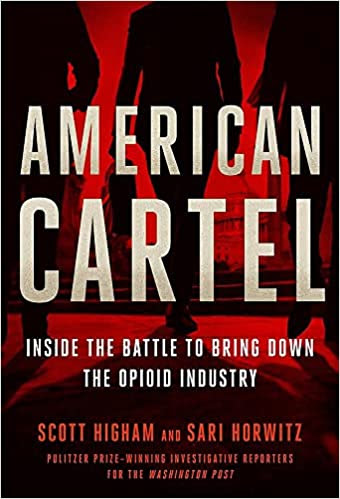
Book: American opioid industry operated like a drug cartel

In the new book American Cartel, Washington Post journalists Scott Higham and co-author Sari Horwitz "make the case that the pharmaceutical industry operated like a drug cartel, with manufacturers at the top; wholesalers in the middle; and pharmacies at the level of 'street dealers,'" Terry Gross reports for NPR. "What's more, Higham says, the companies collaborated with each other — and with lawyers and lobbyists — to create legislation that protected their industry, even as they competed for market share."

"Higham says that big pharma fought to create legislation that would limit the DEA's ability to go after drug wholesalers," Gross reports. "The efforts were effective; more than 100 billion pills were manufactured, distributed and dispensed between 2006 and 2014, during the height of the opioid epidemic. Meanwhile, both federal and state DEA agents are frustrated by the ways in which their enforcement efforts have been curtailed." Read more here.

Thursday, May 26, 2022

Why does U.S. have a unique problem with guns, and why can't we fix it? Look to our rural history and federal structure

Today's front page of the local twice-weekly newspaper
By Al Cross
Director, Institute for Rural Journalism and Community Issues, University of Kentucky

In the wake of the mass shooting at Robb Elementary School in Uvalde, Texas, President Biden asked when members of Congress would have the "backbone" to "stand up to the gun lobby." But the National Rifle Association and other Second Amendment groups are not the fundamental reason the United States is unable to do much about its unique problem with deaths from firearms. The roots are in America's history and its governing structure.

Our country was forged on a frontier, in which guns were necessary for food and defense -- and also used against Native Americans. That was after they were used against the British, and that's a main reason our Constitution has a Second Amendment saying "A well regulated Militia, being necessary to the security of a free State, the right of the people to keep and bear Arms, shall not be infringed."

In those days, there were no automatic weapons, the militia was able-bodied male citizens, and the amendment was a compromise that assumed two things, according to the National Constitution Center: The new federal government would have "almost total legal authority over the army and militia," but should not have any authority at all to disarm the citizenry." Recent U.S. Supreme Court decisions, both on 5-4 votes, said the amendment creates a limited individual right to keep and bear arms. In those cases, the court may not have been following the law as much as it was following public opinion; well-organized opposition to any sort of gun control, often appealing to the national heritage of firearms, has left almost half of Americans telling a 2021 Pew Research Center poll that gun laws are "about right" or should be less strict. They have grown more gun-friendly since 2018, with the share saying "less strict" in Gallup polls rising to 11% from 4%. That could reflect a growing belief among some Americans that armed conflict among civilians is becoming more likely.

The paper's stories begin on the back page.
Still, the latest Gallup survey on the issue found that 52% of U.S. adults feel that laws governing the sale of guns should be stricter, with 35% saying they should be kept as they are. A majority or a plurality have been in favor of stricter laws since 2012, the year of the most deadly school shooting, in the village of Sandy Hook in Newtown, Conn.

Why hasn't public opinion in the last decade moved Congress on the issue? The main reason is the Senate, where each state has equal representation, giving lightly populated states with largely rural landscapes disproportionate influence. That was a compromise made even before the Bill of Rights, at the convention that wrote the Constitution, which set the structure in stone by writing, "No State, without its consent, shall be deprived of its equal Suffrage in the Senate."

So, if gun laws are to be made stricter, it's not mainly a matter of overcoming "the gun lobby." It's a probably matter of changing opinion in states with large rural populations. States like Texas. And places like Uvalde.

Friday, April 29, 2022

Steve Key, 'one of the most respected and accomplished newspaper-association leaders,' retires today in Indiana

Steve Key makes the case for Indiana newspapers.
Steve Key, who has helped Indiana's newspapers for 30 years, retires today as executive director  of the Hoosier State Press Association. He is "one of the most respected and accomplished newspaper association leaders. His counsel is wise, his passion for the industry is vibrant, his questions are smart and focused, and his humble collegiality is second to none," writes Tom Silvestri, director of The Relevance Project, a project of U.S. and Canadian newspaper associations.

Key started with HSPA as legislative counsel and director of government affairs and became the boss in 2010, succeeding the legendary Dick Cardwell. He says Indiana, California, Florida and Pennsylvania are the only state press groups that have a lawyer on staff, and that won't change; he is being succeeded by Amelia Dieter McClure, who has been HSPA legislative counsel.

Asked his proudest career moment, Key said "Perhaps the most impactful was successfully lobbying for the permanent creation of Indiana’s Public Access Counselor’s office. This position serves as an educator and mediator on questions of the state’s right to know what its government is doing through use of the Open Door Law and Access to Public Records Act. The office has reduced the number of lawsuits required by the public to file to two categories – questions of how the law should be interpreted and situations where state or local public officials have decided to ignore the law."

Key has a journalism degree from Butler University in Indianapolis. He worked at the Quincy Herald-Whig in Illinois, the now-defunct Kentucky Post in Covington, the Daily Journal in Franklin, Ind., and the Noblesville Daily Ledger, where he was managing editor. After a brief spell in utility public relations, he got a law degree. He told The Rural Blog, "I’ve had a job that I believe in and I think is important because of the impact it can have on legislation and the viability of newspapers, so I’ve been very fortunate to do that."

Amelia Dieter McClure (Photo via IBJ)
McClure told the Indianapolis Business Journal that for newspapers, "The biggest issue is obviously the progress into online—print versus online. I saw it a lot this session, actually. The appetite for news is there. People want to know things. We see that with the coverage of Covid, that local news got such an infusion because they were the ones that were delivering the information on Covid directly to people that didn’t have any other way to find out about it. … That was a really good reminder for people how important local news is, but I think there’s this misconception out there that newspapers … are old-fashioned, they’re not moving forward. And that’s really not true." McClure is the daughter of Mary Dieter, former Indiana statehouse reporter for the Louisville Courier Journal. "Steve Key likes to say it's in my blood," she said. 

Tuesday, April 26, 2022

General anti-vaccine sentiment gaining new momentum amid opposition to coronavirus vaccination for children

Opposition to requiring coronavirus vaccines for children has breathed new life into a movement to eliminate all childhood vaccine mandates, or at least limit the application of such requirements.

More than 65 bills to limit or eliminate mandatory childhood vaccinations have been introduced in 25 states this year. "In Missouri, for example, legislators are considering a measure exempting private school students from vaccine requirements. In Louisiana, a bill in the House would prohibit vaccinations on school property and at school-sponsored events," Sandy West reports for Kaiser Health News. "All states require specific childhood vaccinations for illnesses such as polio, measles, and mumps, but exemptions vary. They all allow exemptions for people with medical concerns, 44 states allow religious exemptions, and 15 allow philosophical exemptions, according to 2021 data from the National Conference of State Legislatures."

Anti-vaccine activism isn't new, but public-health experts say the movement has gained ground amid fears surrounding the coronavirus vaccine. Anti-vaccine sentiment once relied on long-debunked theories that vaccines cause autism, but in recent years "the movement began to shift its focus to align more with the populist ideology of 'individual freedoms' put forward by Second Amendment advocates and the tea party," West reports.

That dovetails with a rising tide of conservative activists who have sought to influence policy in libraries, county governments and school boards to statehouses, under the banner of liberty.

However, general anti-vaccine efforts aren't entirely grassroots. The similarity of anti-vaccine bills from state to state "raises red flags to vaccine advocates because it suggests that a coordinated effort to dismantle vaccine requirements and public-health infrastructure is underway," one expert told West.

It's unclear how much traction anti-vaccine-mandate bills will get. Most people support childhood vaccine mandates, but the issue is increasingly getting tangled up in the political minefield surrounding coronavirus vaccinations. Some politicians say they're hoping cooler heads will prevail.

Kansas state Rep. John Eplee, a Republican and family physician, said he voted against a state mask mandate in hope of defusing tensions, but supports childhood vaccination mandates. "While Eplee hopes the 'passions' inflamed by Covid die down with distance from the early days of the pandemic, he’s concerned that voters have forgotten the damage done by vaccine-controllable diseases, making them susceptible to disinformation from determined anti-vaccine activists and the politicians among their ranks," West reports.

"I hate to see human nature play out like that," Eplee told West. "But if people are vocal enough and loud enough, they can swing enough votes to change the world in a not-so-good way for public health and vaccinations."

Tuesday, April 05, 2022

News media roundup: How to reach audiences that mistrust the news; media literacy podcast; a fact-checker's toolkit

Six cues used to make snap judgements about whether to trust a news source (Trust in News Project graphic)

Here's some recent news about media literacy, misinformation, and disinformation:

It's possible to reach people who mistrust the news, but you can't just relying on good reporting and writing, according to a recent Trust In News Project study by the Reuters Institute and the University of Oxford. Great headlines, graphics, photos, and more are essential too. The study also categorizes six cues audiences use to make snap judgements about which sources to trust (see graphic above). Here's a write-up about the study from Poynter and here's the study itself.

A fact-checker for Snopes discusses how she tells real news from fake and shares the toolkit she and colleagues use. Read more here.

Last year, Illinois became the first state to require all high school students to be taught media literacy skills. NPR podcast "In Case You Missed It" takes a deep dive into why media literacy is an essential skill today, as well as what people need to know who didn't learn about it in school. Listen to it here.

Here's a reminder to consider your source's motives and fact-check outrageous "trends" before reporting: Facebook parent company Meta hired GOP consulting firm Targeted Victory to help turn the public against social-media rival TikTok and draw attention away from Meta's privacy and antitrust issues. The nationwide media and lobbying campaign "includes placing op-eds and letters to the editor in major regional news outlets, promoting dubious stories about alleged TikTok trends that actually originated on Facebook, and pushing to draw political reporters and local politicians into helping take down its biggest competitor," Taylor Lorenz and Drew Harwell report for The Washington Post. Internal emails obtained by the Post show that the firm wanted to portray "the fast-growing app, owned by the Beijing-based company ByteDance, as a danger to American children and society." Facebook has already been under fire for engineering its algorithm to push users toward false and inflammatory news.

Thursday, February 24, 2022

Clamor to cap travel-nurse pay could keep rural nurses at local hospitals

Many registered nurses, feeling overwhelmed and underpaid during the pandemic, have jumped at the chance to double or triple their salaries as travel nurses. Cash-strapped rural hospitals are having a hard time retaining them. "In a nationwide survey late last year, 99% said they were experiencing staffing shortages," Melissa Phillip reports for the Houston Chronicle.

But some lobbyists and legislators are calling for an investigation in hopes of capping travel nurses' compensation; if successful, that could help stanch the flow of rural nurses to wealthier urban hospitals that can better afford to pay travel nurses' higher salaries.

"In the last few months, several groups, including the American Hospital Association, the American Health Care Association/National Center for Assisted Living and 200 members of Congress, have called for an investigation into claims that agencies that place travel nurses around the country have been 'price gouging' hospitals in need of staff," Chabeli Carrazana reports for The 19th. "The AHA has requested the Federal Trade Commission investigate the agencies, and late last month, a letter signed by a bipartisan group of legislators also asked the White House to investigate the claims."

Two representatives from largely rural districts—Democrat Peter Welch of Vermont and Republican Morgan Griffith of Virginia—"wrote that they have received reports saying staffing agencies have inflated prices by 'two, three or more times pre-pandemic rates' while taking 40 percent or more being charged to hospitals in profit," Carrazana reports. "At least eight private-equity firms have bought at least seven staffing agencies since early 2021, according to a report in STAT News."

"The White House did not comment on whether it was responding to the contents of the letter, and the Federal Trade Commission also declined to comment on whether an investigation was underway," Carrazana reports.

Tuesday, January 25, 2022

Farm Bureau backs bipartisan cattle market reform bill but opposes making packers buy certain share on cash market

The American Farm Bureau Federation says it supports a bipartisan Senate bill that aims to increase price transparency in regional cattle markets, except for a key portion that would require meatpackers to buy slaughter cattle on the cash market.

"Two sponsors of the Senate bill, Republicans Deb Fischer of Nebraska and Chuck Grassley of Iowa, said the Farm Bureau supported the overall goals of the bill — more competition and fair prices — despite its call for revisions to, or even elimination of, the language allowing the USDA to set regional mandatory minimum thresholds for cash and related 'grid' purchases," Chuck Abbott reports for the Food & Environment Reporting Network. "Their bill, S 3229, also would create a cattle contract library and require packers to report how many cattle are scheduled for slaughter in each of the next 14 days. Backers say those provisions would help producers know if they are being offered fair terms for their stock and the best time to ship cattle to market." The bill would also increase fines for meatpackers that violate the Packers and Stockyards Act.

Delegates at the recent annual Farm Bureau convention voted to oppose government mandates that force meatpackers to buy a certain percentage of their slaughter cattle on the cash market. Farm Bureau President Zippy Duvall said in a statement Sunday that, while the organization appreciates the work being done to increase transparency, "we cannot support mandatory cash sales." However, Abbott reports, Grassley noted that "the market clearly isn't working."

The bill is a response to complaints from cattle farmers and their advocates that the major meat processors Cargill, JBS, Tyson Foods and National Beef, which control over 80 percent of the beef processed in the U.S., have colluded to raise meat prices by limiting supply. The Agriculture Department is investigating claims against the Big Four, and President Biden recently announced $800 million in support for smaller meatpackers in an effort to increase competition.