Tuesday, July 18, 2017

Defeat of health-insurance bill is a relief for many rural health interests, but debate will go on

Provisions that would reduce Medicaid coverage may have helped kill Senate Majority Leader Mitch McConnell's health-insurance bill. Sen. Jerry Moran of Kansas, one of two Republicans whose joint announcement Monday night killed McConnell's revised bill, "faced pressure at home about how the bill would affect Kansas, including its rural hospitals," The New York Times noted. "The Kansas Hospital Association said last week that the latest version “comes up short, particularly for our most vulnerable patients.”

"Moran said he was concerned the bill wouldn't lower overall consumer costs and wouldn't provide adequate protection for those with pre-existing conditions. He also expressed concerns that deep cuts in Medicaid over the next decade could threaten the survival of already struggling rural hospitals and nursing homes," Jim McLean reports for NPR.

Because President Obama was unpopular in rural America, many loyal Republican voters criticized the Patient Protection and Affordable Health Care Act, but it helped rural communities deeply, Jennifer Steinhauer writes for the Times: "This was true for communities ravaged by the opioid crisis, which health care money helped treat; for rural states where hospitals had become all but dependent on increased Medicaid payments that covered the bulk of their patients; and for poor constituents with chronic medical conditions who had come to take it as an article of faith that their insurance companies could not deny them coverage for pre-existing conditions."

Many Republican governors expanded Medicaid under the ACA and have worried in recent months about how to keep their constituents covered if the Senate bill passed. Moderate Republicans such as Susan Collins of the very rural state of Maine, who was one of four to publicly oppose the bill, said she had been inundated by messages from Republican voters who urged her not to support the plan.

McConnell did not follow through on the warning he gave Republicans last month, that if they couldn't pass a comprehensive bill on their own, they would have to join with Democrats to stabilize the market for private health insurance. Instead, he said he would use the bill the House passed May 4 as a vehicle for a repeal-now, replace-later strategy advocated President Trump. But that strategy fell apart Tuesday, as three senators from rural states -- Collins, Shelley Moore Capito of West Virginia and Lisa Murkowski of Alaska -- said they could not support it, the Times reports.

Rural Kentucky hiking club is changing local attitudes about health and the community

The Breathitt County Hiking Club in the nearby Red River Gorge. (Photo by Josh Mauser)
Central Appalachia is the unhealthiest place in the country by most metrics, but 45-year-old librarian Stephen Bowling is trying to help Breathitt County buck the trend with a hiking club. An avid hiker, Bowling has been hosting monthly hiking trips one Sunday a month since the beginning of the year, Lyndsey Gilpin reports for Outside Online. His employer, the Breathitt County Public Library, sponsors the club and serves as a meeting place for members that range in age from 14 to 74.

Bowling says the monthly trips usually attract about 20 people, most of whom don't have much experience hiking. But he believes that even something as small as a hiking club can affect not just attitudes about fitness, but about the long-suffering community's ability to improve. “It’s a depressed area economically, but also emotionally and physiologically,” Bowling told Gilpin. “We’re told constantly that we’re the least healthy people, we are this, we are that, and people don’t feel empowered to change that. Some people aren’t willing, and some people aren’t able.”

Breathitt County, Kentucky
(Wikipedia map)
Appalachia is a prime example of the wellness divide between rural and urban America. Eight of the top 10 counties in the U.S. with the largest recent declines in life expectancy are in Kentucky, and one of them is Breathitt. About 14,000 people live in the county, most are white, and most are over 40. "Nearly half the population is obese, about a third smoke, and a third are physically inactive. The unemployment rate is almost 12 percent," Gilpin reports.

Most outdoor adventure spaces are under private control in rural areas, leaving people with far fewer options for outdoor recreation than residents of urban areas. "Most Southeastern states have less than 5 percent federal public land. In Kentucky, less than 4 percent of land is federally owned, and there are only a few state parks, most of them a half-day’s drive from Breathitt," Gilpin reports. "Only 17 percent of Breathitt County residents live within a half-mile of a park or within three miles of an accessible recreational facility; meanwhile, 98 percent of New York county [Manhattan] residents and 100 percent of San Francisco county residents have such access to a park within a half-mile or a recreational facility within just one mile."

Private landowners rarely create trails, and those that are created are mostly for all-terrain vehicles and aren't used by hikers and bikers, Gilpin reports. The area's walking trails are not often safe and well-marked, and local gyms are usually small with limited hours. Most exercise buffs instead rely on using local high schools' running tracks.

The rural South is studying how states like North Carolina and Colorado have boosted outdoor recreation to figure out how to make public lands accessible and profitable. "In July, legislation will go into effect to create the Kentucky Mountain Regional Recreation Authority, a group run by community members from around the state that will develop, maintain, monitor, and promote local trails," Gilpin reports. Republican State Rep. Chris Fugate introduced the bill, and says he wants to connect 17 counties through a walking trail system. "“Some of the most beautiful places are hidden away,” Fugate told Gilpin. “We haven’t done a good enough job of promoting and taking care of ourselves here.”

Mine workers union says new voluntary training won't help safety if inspectors can't cite vioations

UMWA President Cecil Roberts
The United Mine Workers of America is concerned that the U.S. Mine Safety and Health Administration's new voluntary training program won't help create a safer environment for coal miners.

In a recent letter to acting MSHA chief Pat Silvey, UMWA President Cecil Roberts said he is concerned that agency staffers who visit mines as part of this program will not be able to write violations. "To take away an inspector's right to issue a violation takes away the one and only enforcement power the agency and the inspector has," Roberts wrote, going on to say, "To believe that an operator will comply with the law on their own free will is contrary to historical experience and naive on MSHA's part, to say the least."

The voluntary training program was created to help new and inexperienced miners after a spate of recent coal-mining deaths. Six of the seven miners who have died this year had less than a year of experience at the mine where they died, but had at least six years of experience as miners in general, Kevin Ward Jr. reports for the Charleston Gazette-Mail. The training program follows a national trend of reducing formal inspections in favor of coaching miners on safer practices. But some critics say such programs don't help when, they believe, mine operators deliberately put miners in unsafe positions.

Utilities may try to sidestep EPA regulations using law that grants states control over coal-ash disposal

Coal ash at the Tennessee Valley Authority's
Gallatin Fossil Plant (Associated Press)
A 2016 law that granted states oversight authority over disposal of coal ash from power plants was meant to let them tailor disposal approaches to local conditions, but it may also serve as a way for states and industries to challenge Enivronmental Protection Agency regulations they find financially burdensome, Sean Reilly reports for Environment & Energy News.

The Utility Solid Waste Activities Group, an informal consortium of about 80 utility companies, cited the 2016 law, called the Water Infrastructure Improvements for the Nation Act, in a recent rulemaking petition asking EPA to reconsider or delay enforcing extensive regulations passed in 2015. "The rationale: Because states now have the leeway to craft their own coal ash permitting programs — conditioned on an EPA finding that those programs are at least as protective as the federal standards — they can tailor more flexible 'risk-based' provisions around conditions at individual sites," the petition said.

Environmental groups say the industry is trying to take advantage of the Trump administration's dislike for environmental regulations. They note the USWAG petition's allusion to recently adopted administration policies. "Those include an executive order intended in part to promote the use of fossil fuels and EPA's recent decision to postpone implementation of effluent limitations guidelines. The future of coal-fired power production is at risk, the petition warned, 'if there is no economical option for managing the residuals from its use,'" Reilly notes.

Easy-to-misuse weed killer pits Delta farmers against each other, may have led to a murder

Mike Wallace: shot to death
after arguing about dicamba.
The dispute over a common pesticide is causing bad blood between neighbors in farming communities. "The furor surrounding the herbicide known as dicamba has quickly become the biggest controversy of its kind in U.S. agriculture," reports Andrew DeMillo for The Associated Press. Dicamba was temporarily banned in Arkansas and Missouri on July 7, and Tennessee soon after announced new restrictions on when and by whom it could be sprayed.

Dicamba has been in use since World War II, but the recent problems began after farmers started spraying it on soybeans and cotton genetically modified to resist dicamba, in an effort to kill weeds that have become resistant to the most common herbicide, glyphosate (Roundup). Dicamba evaporates easily and drifts into other farmers' fields, causing damage to non-resistant crops and injury to farm workers. The Arkansas Plant Board "has received more than 630 complaints about dicamba so far this year, many more than the 250 or so total complaints normally received in a full year," DeMillo notes.

The chemical "has made good neighbors look like bad neighbors," Arkansas farmer Reed Storey told DeMillo. Storey says half his soybean crop has been damaged by drifting dicamba. Other farmers say that they need dicamba to kill pigweed, which can rapidly threaten a soybean crop. “We cannot lose this technology,” Arkansas soybean farmer Perry Galloway said to DeMillo. “We’ve come too far at this point to just throw it away.”

The dispute is even suspected as a factor in the murder of another Arkansas soybean farmer, Mike Wallace, in Mississippi County in northeast Arkansas. "Farm worker Allan Curtis Jones, 27, is accused of shooting Wallace, 55, in a confrontation over dicamba, which Wallace believed had drifted from the farm where Jones worked to damage his soybean crop," DeMillo reports.

Monday, July 17, 2017

Intern and editor at weekly respectfully stand their ground against criticism, get 'through to someone!'

Josh Qualls was having difficulty finding a source to help him explain how the House health-insurance bill might affect seniors on Medicaid in Lincoln County, Kentucky, where he just completed a summer internship with The Interior Journal in Stanford. So he went to the Boone Newspapers weekly's Facebook page.

"The very first response echoed some of the most disheartening, gut-wrenching rhetoric we’ve seen directed toward journalists in recent months. Its author offered a scathing indictment of the news media and accused us of being liberally biased," Qualls wrote in his intern report to the Kentucky Press Association, relying on memory because the poster had deleted the post. "She talked about how much 'Obamacare' didn’t help her health-hindered family, so I saw a way to connect with her."

Josh Qualls
Qualls wrote, “We appreciate your feedback … and we’re sorry to learn about your health problems and your family’s health-care situation. Our hearts go out to you.” He said no one at the newspaper "was happy with the Affordable Care Act allowing premiums to increase at an alarming rate," but said journalists must "seek the truth and report it," as the Society of Professional Journalists' Code of Ethics says.

“The truth, based on what we know about the American Health Care Act so far, is that these proposals may have long-term effects that are even more damaging than Obamacare,” Qualls posted. “The Congressional Budget Office reported last Wednesday that while premiums would likely decrease for younger Americans, older Americans would likely see a substantial increase and lose many of their benefits.”

Then he wrote this, which KPA highlighted in its report to members: “In this newsroom, we all have different political beliefs but respect each other. What we all have in common is that we’re biased against the things that harm the community we serve, and by community we mean people like you.” Those are lines to remember.

"The author quickly wrote back," Qualls reported to KPA. "She said that she never really thought about it that way and would consider what we wrote, that she appreciated our effort to connect with her and to explain what we were trying to accomplish." He and Editor Abigail Whitehouse, who had approved his message, "were ecstatic," yelling "We got through to someone!"

Though the reader soon deleted her post and the comments, Qualls said the episode showed the value of engaging with readers through social media: "People may think now that they have carte blanche to denigrate journalists, but Abigail taught me that we don’t have to cower in fear of what they might say or do — we must respectfully stand our ground. It simply comes down to this: People hate what they don’t understand, and some people unfortunately don’t understand journalists."

Qualls is a May graduate of the University of Kentucky School of Journalism and Media, which includes the Institute for Rural Journalism and Community Issues, which publishes The Rural Blog.

Dollar General crowding out small, rural stores; company has almost as many stores as McDonald's

Distribution of the 13,601 Dollar General stores in the U.S.
nears that of McDonald's, which has 14,000. (MarketWatch)
Mom-and-pop country stores are being increasingly crowded out by Dollar General stores, reports Jeff Sturgeon of The Roanoke Times. Dollar General Corp. is a $20 billion company with stores across the U.S. that average $1.7 million in annual sales each. Discount chains such as Dollar General and its direct competitors Dollar Tree and Family Dollar are expanding rapidly, especially in rural areas.

Over the last 20 years, Dollar General has refined its rural niche by stocking popular national brands instead of the heavily discounted off-brand items often found at the typical dollar store. "Due to their small size, Dollar General locations can go where Walmart can’t but offer a similar lineup of goods," Sturgeon writes. "The company describes its forte as offering product lines and prices that appeal to people from low- and fixed-income households. Its customers depend on government assistance to such an extent that the company’s sales track changes in food-stamp programs, according to filings with the U.S. Securities and Exchange Commission."

Encroaching Dollar General stores have caused some mom-and-pop businesses to close, since they can't compete with the selection and bulk buying power of the mega-chain. "It's unfair competition," country-store owner Wayne Lamay of Copper Hill, Va., told Sturgeon. He said his customers had promised to stay loyal to his store, but he sees their cars in the Dollar General store parking lot.

Local residents, many of whom live in food deserts, say they like the store's prices, but acknowledge it can be an eyesore. But those who dislike Dollar General are generally powerless to stop it, since the store often takes advantage of lax or absent zoning laws in rural areas to build their stores, reports Sturgeon. Rural county governments usually benefit from new Dollar General stores, since they keep retail dollars in the county that might otherwise happen elsewhere, and pay the government sales and real estate taxes.
Paula and Bruce Smith's view from their home in Copper Hill, Va., has changed.
They don't like it, and worry about pollution from light and heavy delivery trucks.
(Roanoke Times photo by Heather Rousseau) 

Nevada governor sees state's rural health care at risk, causing dilemma for Republican senator

Nevada is an example of states with large rural areas that have benefited from the Patient Protection and Affordable Care Act, and it may be the best political example right now because its Republican governor strongly opposes the health-insurance bill that needs almost every GOP vote to pass the Senate. Majority Leader Mitch McConnell may have a hard time gaining Nevada Sen. Dean Heller's support because of Gov. Brian Sandoval' s opposition to the bill, reports Amy Goldstein for The Washington Post.

Heller and Sandoval are wary of a bill that may cause rural residents to lose coverage. Sandoval was the first of many Republican governors to expand Medicaid under the ACA. "The prospect of losing ACA coverage in every rural county is a reversal of fortune for a state whose embrace of the 2010 health-care law has brought dramatic results. Before the ACA, 23 percent of Nevadans were uninsured, one of the worst rates in the country. Today, it is 12 percent," reports Goldstein.

But "months of uncertainty about the ACA’s future have heightened insurers’ qualms in Nevada about whether its marketplace is a financially safe space to be," writes Goldstein. "The sole company that had been expected to remain on the state exchange in Lyon County and Nevada’s 13 other rural counties announced otherwise last month and will be gone by January. Unless Anthem or another insurer reverses course, 8,000 people across hundreds of miles will be left without any ACA insurer next year — by far the largest such bare patch in the nation."
Bloomberg map shows Obamacare insurers by county; yellow counties have none.
Sandoval sent out a letter to all four insurers that sell plans on the ACA exchange in the state, telling them that they needed to find a solution to the gaps in healthcare coverage. "The reduced footprint of carriers on the exchange is a national embarrassment for a state that has made great strides in reducing our uninsured population."

Sandoval's Chief of Staff Mike Willden said state officials are talking to federal officials about creative solutions to keep rural Nevadans enrolled in health care if Anthem leaves the exchange. "Perhaps they could let people enroll in the health plans available in Reno and Las Vegas, though their doctors would be farther away. Perhaps the state’s four ACA regions could be collapsed into one, so that any insurer wanting to stay in the urban areas would have to sell health plans in the rural places, too. And a study is going to look at a novel strategy endorsed this spring by the legislature — letting any Nevadan pay to join a Medicaid health plan," reports Goldstein. In the meantime, Sandoval and Heller remain vocal critics of the Senate's health-insurance bill.

Yellowstone Park bobcat shows that ecotourism may make more money for rural areas than hunting

The bobcat prowls for water birds in Yellowstone
National Park, making it an object of wildlife
outfitters and photopgraphers. (Natl. Park Service)
A bobcat (well, at least one bobcat) is worth 1,000 times as much when you shoot it with a camera instead of a bullet, says one conservation expert. Mark Elbroch, lead scientist for the puma program of wild-cat conservation organization Panthera, researched the economic impact of one rare bobcat seen frequently in the Madison River area of Yellowstone National Park in recent years and came up with some surprising numbers, reports Jason Bittel for The Washington Post.

Wildlife outfitters and photographers frequently schedule expeditions in an effort to spot the elusive cat, because it preys on water birds. Elbroch contacted many of them and asked about their earnings (from sales of photos, for example) and expenses such as gas, guide fees and gear. He found that these ecotourists spent $308,105 on this one bobcat in one year. And Bittel reports that a 2012 study in British Columbia found that "bear viewing out-earned bear hunting by a margin of nearly $14 million."

Elbroch notes that states can also generate income from hunting licenses. In 39 states it is legal to hunt and trap bobcats. Considering the price of the pelt and the money the state makes from the hunting license, the value of the dead bobcat diminishes to a one-time profit of $315.17. Still, a famous bobcat is probably much more valuable than the average wild animal, writes Bittel. "It’s also not necessarily an either/or scenario. In the 2015-2016 season, close to 3,500 people bought trapping licenses in Wyoming, yielding $151,954 for the state, the study says. Just 284 of these licenses yielded bobcat pelts, none of which interfered with the ecotourism revenue created by the Madison River cat." He says there could be as many as 3.5 million bobcats in the U.S.

"Renowned biologist Stuart Pimm also sees value in these sorts of estimations," Bittel reports. "Pimm said there’s been a tendency on the part of some politicians to view the environment as an inconvenient hindrance to the success of American commerce. To which he says, and this is a direct quote: 'Poppycock.'"

Policies that harm ecotourism could hurt states like Wyoming, in which only mining brings in more money than tourism. Yellowstone National Park Superintendent Dan Wenk has expressed worry that the Interior Department's decision to remove Yellowstone-area grizzly bears from the endangered-species list could affect visitor experiences. Other legislation has been proposed to take gray wolves off the endangered species list as well.

"For his part, Elbroch said the study should not be viewed as a call to end hunting and trapping altogether," Bittel reports, "but instead an opportunity for further conversation about reforming hunting and trapping regulations based on the best science available."

Delta Regional Authority creates fund to address emergency infrastructure needs in 8-state region

DRA service area with LaSalle Parish highlighted
The Delta Regional Authority has granted $300,000 in emergency funding to replace a damaged tank that supplies water to more than 1,000 residents and businesses in Louisiana's rural LaSalle Parish. DRA has little money compared to its model, the Appalachian Regional Commission, but recently created an infrastructure fund that can be used for emergencies.

The deterioration of the Nebo Water System's tank was an immediate risk to the lives of those using the tank, the system said in its funding application to the DRA. LaSalle Parish is under a boil water advisory and the Louisiana National Guard has been providing bottled water to locals. Restaurants, schools and other organizations are unable to prepare food, beverages and ice that require municipal water, and the the community pool is closed.

DRA has provided water and sewer service to more than 66,000 residents across eight states since it was created by Congress in 2000 to "help create jobs, build communities, and improve lives through strategic investments in economic development," it said in a news release.

Sinclair doubles down on pro-Trump commentary that it makes stations run in local news programs

Sinclair is based in Hunt Valley,
Md. (Baltimore Sun photo)
Sinclair Broadcast Group, a mainly small-market company that is trying to get bigger, is telling its 173 stations to run more-than-daily commentaries by a former Donald Trump campaign aide who pitches the Trump line, media critic David Zurawik writes for The Baltimore Sun.

Boris Epshteyn’s commentaries "will now appear eight or nine times a week on all stations, Scott Livingston, Sinclair’s vice president of news, told The Sun. They had previously run three times week on a must-run basis," Zurawik reports. "Since joining Sinclair in April, Epshteyn has consistently parroted Team Trump’s position in 'Bottom Line With Boris' segments. Some of his commentary has come as close to classic propaganda as anything I have seen in broadcast television in the last 30 years." He gives examples, and other cases of questionable Sinclair behavior.

Maryland-based Sinclair, which has been criticized for biased documentaries and making a coverage deal with the Trump campaign, will be adding 42 more stations, many of them in major markets, if the Federal Communications Commission approves its $3.9 billion purchase of Tribune Media. The deal could put the chain in a position to rival Fox News for audiences seeking conservative or pro-Trump views.

On Sunday's "Reliable Sources" with Brian Stelter on CNN, Zurawik said putting Epshteyn's commentaries in local-news programs, "in the context of these people they've come to trust" as local journalists "is the perfect infrastructure to deliver that centralized message at a local level, which will make it more powerful."

Sinclair's Livingston told Zurawik that Epshteyn’s 90-second segments are “clearly identified as commentary” and are a small part of the chain's programming. “Local news is at the heart of Sinclair. We know that our greatest responsibility is serving our local communities by providing relevant information,” Livingston said.

Saturday, July 15, 2017

House Appropriations Committee votes narrowly to lift federal ban on horse slaughterhouses

Photo by Daniel Bockwoldt, Deutsche Press-Agentur
Congress is making another attempt to restart the slaughter of horses in the United States. The House Appropriations Committee voted 27-25 on July 12 to remove the 10-year-old congressional ban on use of taxpayer money for horse-slaughterhouse inspections by the Department of Agriculture.

A key vote was cast by Rep. Mario Diaz-Balart a South Florida Republican who had voted for the ban until recently. "The ban was an amendment tacked on to the annual Department of Agriculture funding bill, and a tie vote would have resulted in the ban failing," Alex Daugherty reports for McClatchy Newspapers. "Diaz-Balart voted in favor of the ban in 2014 but said the ban 'did not yield the positive results that many envisioned and I had hoped for' and voted against the ban the last three years."

Daugherty gives background: "The ban on horse-slaughter inspector funding passed the House committee in 2014 and 2016 but failed in 2015. The Senate overruled the House’s decision that year. Horses raised in the United States are not intended to be eaten by humans, but U.S. horses can be transported to other countries and slaughtered for meat according to European Union standards. Horse meat is considered taboo in the United States, but it is eaten in parts of Europe and Asia."

Diaz-Balart said in a statement, “The reality is, if these horses are not dealt with in USDA-certified and inspected facilities, they will be hauled off to a foreign market where the conditions are much more cruel and less humane.” He noted that the Government Accountability Office “found that the ban shifted slaughter facilities to other countries, including Mexico, where humane methods and responsible oversight are not as rigorous as those in the U.S.  GAO has also observed that there is not enough space in rescue facilities in the U.S. to handle abandoned horses.”

The 2011 GAO report "said horse exports for slaughter to Mexico increased by 680 percent from 2006 to 2010, after Congress stopped funding slaughter inspections," Daugherty notes. "Republicans from Western states with large populations of wild horses were the primary opponents of the ban, arguing that current methods of controlling wild horses aren’t enough. Wild horses, which have no natural predators, can disrupt food sources for other animals, but horse advocates say allowing horse slaughter is a handout to ranchers who dislike the horses because they compete with their cattle for food on public range land." President Trump's budget plan would allow purchase and slaughter of wild horses.

The Humane Society of the United States said it would fight to keep the ban. “We don’t pick up homeless dogs and cats and send them to slaughterhouses. We shouldn’t do that with horses either,” HSUS President and CEO Wayne Pacelle told Maura Judkis of The Washington Post.

Friday, July 14, 2017

Weekly publisher wins fight against coal-ash landfill

Publisher/landowner Dink NeSmith in the Altamaha River. (NNA photo by Fred Bennett)
A community crusade led by a weekly newspaper "fought off the efforts of a Fortune 500 solid waste giant that proposed to dump millions of tons of coal ash in a local landfill," Teri Saylor reports for the National Newspaper Association.

The story of the Jesup Press-Sentinel and publisher Dink NeSmith, who owns several other papers and 4,000 acres along the Altamaha River, two-thirds of it in conservation easements, was most recently told by Dan Chapman of the U.S. Fish and Wildlife Service, a former reporter for the Atlanta Journal-Constitution.

“When I first heard mention of coal ash in Wayne County I said, ‘Whoa. Then no. Then hell no. We don’t want that in our river’,” NeSmith told Chapman. “We threw our heart into the fight and our wallets followed. I have never seen the community more riled up.”

"NeSmith bankrolled much of the coal ash fight and wrote scores of scathing editorials in opposition. The company killed the project earlier this year," Chapman reports. His story is one of five in a series, with seven videos, on the Altamaha (pronounced al-ta-ma-HA).


Republic Services "had won enough battles to consider a small town like Jesup would be a pushover. But Republic had never tangled with newspaper owner, Dink NeSmith, and the power of a feisty small-town newspaper," Saylor writes. He got former president Jimmy Carter to write Microsoft's Bill Gates, "who owns millions of shares of Republic stock. . . . Gates wrote back two months later with promises to ask Republic Services to look into it." That was in August 2016; in April 2017, Republic dropped its plans. NeSmith, who had said his battle was one of David vs. Goliath, also corresponded with farmer-environmentalist-author Wendell Berry, who wrote him a congratulatory note with a P.S.: "David won."

Saylor provides background: "Jesup, the seat of Wayne County, is home to 12,000 residents, and located about 40 miles inland from the Atlantic Ocean in southeast Georgia. Wayne County’s landmass is mostly swampy coastal plain and piney forestland. The Altamaha River flows along the northern border of Wayne County . . . It is an ecologically sensitive area, inhabited by at least 120 species of rare or endangered plants and animals, reporter Derby Waters wrote in an email." NeSmith calls the river "the Amazon of the South."

N.C. farmers: Americans won't work in agriculture

Ag-visa worker Ricardo Almeida harvests cucumbers on
a North Carolina farm. (News & Observer photo)
President Donald Trump campaigned on promises to tighten immigration laws, saying that foreign workers are taking jobs from Americans. But North Carolina farmers say they can't find enough locals willing to work for them, reports Madison Iszler for the Raleigh News & Observer.

Of the estimated 80,000 to 150,000 mostly-Latino workers who toil on North Carolina farms, only a quarter of them—a mix of immigrants and U.S. nationals—live in the state permanently. About half the farm workers are undocumented, and a quarter work legally through the federal H-2A visa program. North Carolina farmers told Iszler they would like to hire American citizens, but must hire foreign laborers because few locals want to do the backbreaking work of farming. Jackie Thompson says there's "no doubt" in his mind that he couldn't keep his farm afloat without immigrants. "The U.S. complains with our mouths full. They want to eat it, but they don't want to pick it," he says. According to a 2013 study by the Center for Global Development, native workers don't generally take farm jobs no matter how bad the economy gets.

Agriculture is an $84 billion industry in North Carolina, so in February local and state politicians met with farmers and the North Carolina Farm Bureau begin determining how to best enact immigration reform in the state without damaging the economy. They are focusing on simplifying the H-2A program and determining an avenue for undocumented farm workers to obtain legal status. "Foreign labor is what provides jobs for U.S. citizens and North Carolina residents working in the agricultural industry," Sen. Thom Tillis told Iszler. "It is hard to overestimate what agriculture means to our state."

Now more than ever, North Carolina farmers are having a hard time filling agriculture jobs. Increased enforcement of illegal immigration laws and a generally slow-recovering economy have caused a decrease in undocumented Mexican workers. 

In April, President Trump and Secretary of Agriculture Sonny Perdue held a roundtable discussion with farmers and North Carolina Commissioner of Agriculture Steve Troxler to discuss their concerns, according to Iszler. Trump also created a task force focused on agriculture and rural issues. Though the president has consistently advocated for a wall between Mexico and the U.S. to "stop a lot of people from coming in that shouldn't be here," Perdue said in a speech soon afterward that Trump "understands that there are long-term immigrants, sometimes undocumented immigrant laborers, out here on the farms, many of them that are doing a great job, contributing to the economy of the United States.”

Mountaintop mining makes streams saltier and more perennial, study in W.Va. watershed finds

Map shows mined areas in red and a star on study area.
Mountaintop-removal coal mining has made the streams of West Virginia's Mud River basin run saltier but more regularly, researchers at Duke University and the University of Wyoming have found.

It has long been known that excavation of rock around coal seams, which is then placed into engineered fills at stream headwaters, releases salty substances into streams. But the study also confirmed something that has long been surmised, that "the porosity of the crushed rocks increases the water storage capacity of the valley fills. This decreases natural storm runoff during high-flow winter months while contributing proportionately more water to stream flows during the drier months that make up about 80 percent of the region's calendar year, says a UW press release published in Science Daily.
3-D map and chart in study compare streamflow in mined and non-mined areas.
The more frequent flows in ephemeral streams mean that the Mud River and its tributaries, "the site of extensive mountaintop mining in recent years . . . run consistently saltier for up to 80 percent of the year," the release says. That "has implications for farming, urban water use and the environment, as well as degradation of streamwater quality," says Matthew Ross, a Ph.D. student at Duke's Nicholas School of the Environment. His co-author is Fabian Nippgen, assistant professor of ecosystem science and management at UW. Their study was published this week in the journal Environmental Science & Technology. "It is among the first studies to document mountaintop-removal coal mining's long-term impacts on watershed, and to show how mined areas contribute to local and regional stream flow," the release says.

Wind companies offer job training to former oil, gas and coal workers in Wyoming

Turbines at a wind farm in Wyoming
(Wyoming Public Media photo)
Wind-energy companies are offering job training in Wyoming, a state known more for fossil fuels, and will expand to coal country next, Heather Richards reports for the Casper Star-Tribune. Wind-turbine manufacturer Goldwind Americas has partnered with wind-energy developer Viridis Eolia to offer three seminars in the state to see if Wyoming workers are interested in becoming wind technicians.

The wind companies are looking to snap up oil-and-gas workers who are looking for jobs, figuring that those workers "have skills that are transferrable to the wind industry," such as working in hazardous conditions with heavy machinery, Goldwind Americas CEO David Halligan told Richards.

At the first meeting in Rawlins, more than 100 people showed up. In Casper, 40 came. The final seminar will be in Gillette, the "center of the nation's coal industry." The companies will offer free training for wind technicians, and hope to employ many of them on a planned 600- to 800-turbine farm near Medicine Bow. Wind technician is the fastest-growing occupation in the U.S., and is expected to grow another 108 percent over the next 10 years. And though Wyoming has been a coal powerhouse for the past 40 years, the industry is increasingly changing to other sources of power such as natural gas and renewable energy.

Some local politicians acknowledge that wind farms could be good for the economy of Wyoming. "I'm a former, probably, wind hater," Rep. Steve Harshman, R-Casper, told Richards. "I was raised in Midwest, [where] it's all about oil and gas and coal. But I think I've kind of jumped over that fence in the last year because of these realities coming at us."

Duke Energy wants customers to help pay for coal ash cleanup

Duke Energy dug up toxic coal residue from a spill from its
Dan Rivervpower plant in Eden, N.C.(Associated Press photo)
Duke Energy Corp. wants to increase electricity bills an average of 15 percent for 1.3 million North Carolina customers to pay for cleaning up the toxic byproducts of burning coal to generate power, Emery Dalesio reports for The Associated Press. People who live near the power plants were already unhappy, since they've been living on bottled water since toxic chemicals appeared in their wells. Charles Walker Jr. of the western North Carolina town of Allen says the company's profits should paying for the disposal. "In my opinion, if you’re going to be negligent, if you made a mistake, you need to feel the sting. Don’t just pass it on,” Walker said in an interview. “If a septic company comes to my house and accidentally spills sewage all over my property, are they going to send me the bill for that?”

The request for the rate increase from Duke Energy Progress was filed in June and is the first time Duke has tried to get North Carolina consumers to pay for part of the estimated $5.1 billion it will cost to clean up the waste there and in South Carolina. The increase would generate an extra $477 million per year. "The bulk of that would cover ongoing costs of replacing coal-burning plants with natural gas and storm repairs," reports Dalesio. "But it also includes $66 million already spent to deal with coal ash, and $129 million more in future clean-up costs." Duke Energy Carolinas is the holding company's other North Carolina subsidiary, and will likely request a similar rate increase for its 2.5 million customers in coming months.

Duke produces an average of 150 pounds of coal ash a year per household, but says it is disposing of it appropriately and coal-ash storage basins are not allowing toxic chemicals to seep into the surrounding groundwater, and that cleaning up the coal ash is a routine expense.

In one county, many non-coal jobs link to coal, but seeds of a more diverse economy are there

A new coal mine in western Pennsylvania is generating an estimated 70 jobs, but locals say that's not enough. Somerset County, which made news in 2002 when nine coal miners were rescued from several hundred feet underground after being trapped for four days, has a population of about 77,000 and voted overwhelmingly for President Trump. NPR's Steve Inskeep interviewed workers and employers in Somerset County to see how they make a living and what else they think Appalachia needs in order to attract opportunity.

Somerset County, Pennsylvania
Many locals work in tourism. Terry Smith was a miner for 25 years and says he would love to do it again if he could. But he developed black lung and now manages the bowling lane at a nearby ski resort. People have mined here for generations but even if the coal industry expanded again, modern mines employ far fewer people than they used to.  And "Somerset County has other employers in bigger industries where President Trump's influence is much less certain."

The medical sector is a large source of local jobs. One firm makes devices to help people with sleep apnea or black lung. Jeremy Rogers moved to Somerset County in his 30s to work there, and says they're a union shop employing about 300 people. Somerset Hospital, meanwhile, employs 900. CEO Craig Saylor says "We have a largely senior community that does not want or cannot travel." Inskeep reports up to 80 percent of the patients here rely on Medicare or Medicaid, and "The hospital could be affected by a Republican health bill that would restrain Medicaid spending." Saylor worries about the impact of Medicaid cuts on local employees: "Ultimately, someone has to either take a pay cut or, in the case of hospitals, absorb that loss of care."

Some locals work in the expanding field of renewable energy. Erik Widner, 28, oversees a wind farm with 68 turbines spread out over two mountain ridges near the town of Berlin. He's a Somerset County native who came back after college to work at the wind farm. "There's a lot of young folks that are just leaving the area. But with the wind industry coming in, there's a lot of good-paying jobs for technicians," Widner told Inskeep.

The owner of auto repair shop Barron Trucking says some employers would love to hire more, but are having a hard time finding qualified workers. "Trying to find a blue-collar worker in this area that can pass a drug test is the biggest challenge," says Jim Barron, and estimates that eight out of 10 applicants would fail a drug test. He acknowledges that auto repair is hard work and that "the pay does not justify the hours that you put in." The lack of high-paying jobs and economic development means that many qualified workers leave to find jobs elsewhere. "You've got to go where the jobs are," says Barron. "The only thing that has moved to Somerset is fast food."

"One thing we saw in the rural economy was possibility," reports Inskeep, a graduate of Morehead State University near the Appalachian coalfield. "No one industry will likely dominate as coal once did here, but we found the seeds of a more diverse economy with multiple employers, more flexible in hard times. It'll be up to Somerset County residents to grow it, though decisions being made in Washington will influence their chances."

Thursday, July 13, 2017

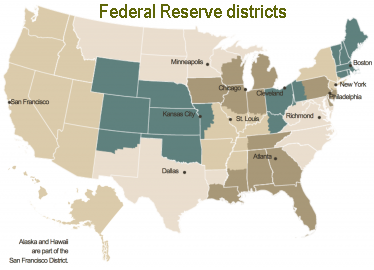
Federal Reserve looks at farm economy by district

The Federal Reserve Board's latest "Beige Book" update about the U.S. economy includes several observations about agriculture in several banking regions. Here's a sample, thanks to the Farmdoc Project at the University of Illinois:

Atlanta: “Heavy rainfall due to Tropical Storm Cindy exacerbated areas’ crop moisture conditions in much of the District that were already categorized as abnormally moist to excessively wet, and there were early indications of some crop damage. . . . On a year-over-year basis, prices paid to farmers in April were up for cotton, soybeans, and broilers but remained down for corn, rice, beef, and eggs.”

Chicago: “The agricultural sector continued to operate under stress in late May and June, with reports of some crop and dairy operations exiting or filing for bankruptcy. . . . Milk prices were lower, which contributed to mounting losses for many dairy operations.”

Minneapolis: “Agricultural conditions weakened since the previous report. Severe drought conditions affected the Dakotas and parts of Montana, hampering crop progress and triggering disaster relief payments to ranchers in some areas.”

Kansas City: “Farm revenue remained subdued since the previous reporting period, as most agricultural commodity prices remained low. . . . Livestock operators were slightly more optimistic than earlier, as cattle prices increased modestly from a year ago. Hog prices also increased modestly from the previous reporting period as global demand for meat products remained relatively strong.”

For the full Farmdoc excerpts from the report, click here. For the report, go here.

Scopes trial town has long had statue of Bryan, the prosecutor; it's getting one of defender Darrow

In the small Tennessee town where the "Monkey Trial" of John Scopes brought Charles Darwin's theory of evolution to the forefront of national debate in 1925, a group of atheists and agnostics will unveil a monument to honor the defense attorney in the case, reports Michael Miller of NPR.

In the trial, three-time Democratic presidential nominee and former secretary of state William Jennings Bryan was the special prosecutor of Scopes for teaching evolution in a Dayton, Tenn., high school, saying it violated a state law that made teaching human evolution illegal in public schools. Clarence Darrow, a leading civil libertarian, defended Scopes. Bryan was an influential "Christian crusader," while Darrow was a famous proponent of science and secularism, Miller notes. Scopes was found guilty and fined $100 but the verdict was voided on a technicality.

The trial put Dayton, which then had a population of 2,000 or less, on the map. Now numbering about 7,200, it has an annual Scopes Trial Festival, which starts Friday, and businesses with sly nods for names such as the Monkey Town Brewing Co. (serving Evolution IPA on tap). A bronze statue of Bryan has long stood in front of the Rhea County Courthouse, funded by Bryan College, a local evangelical institution. The statue of Darrow, which cost about $150,000 and was created by Philadelphia sculptor Zenos Frudakis, was funded mostly by the Freedom From Religion Foundation.

"It'll get people thinking and talking," Frudakis told Miller. "And it's just more historically balanced and accurate that way to have him there."

Rhea County, Tennessee (Wikipedia map)
Some locals are unhappy about the statue, as the Dayton Herald-News reported, but others have no problem with it, Miller reports. Christian writer Rachel Held Evans, who wrote the memoir Evolving in Monkey Town, told him, "I'm a Christian who believes in evolution, and those two things can exist together."