A digest of events, trends, issues, ideas and journalism from and about rural America, by the Institute for Rural Journalism, based at the University of Kentucky. Links may expire, require subscription or go behind pay walls. Please send news and knowledge you think would be useful to benjy.hamm@uky.edu.
Friday, January 14, 2022
Rural U.S. not ready for electric vehicles, witnesses tell House committee; Jan. 19 webinar to discuss rural EVs
Pandemic roundup: Interactive database lets you track local cases; dark days ahead for nurses and hospitals
Here's a roundup of recent news stories about the pandemic and vaccination efforts:
The pandemic highlights rural health-care disparities, writes the editorial board of The Daily Tar Heel, the student newspaper for the University of North Carolina at Chapel Hill. Read more here.
The New York Times has a new interactive database that allows you to track coronavirus cases in any state, county or metro area. Check it out here.
A recent Centers for Disease Control and Prevention study found that all vaccinated participants with severe Covid-19 had at least one other risk factor, including age, poor immune system, heart disease, and more. Read more here.
Hospitals and nursing homes are so short-staffed that some are asking infected nurses to come in to work. Some facilities are also asking nurses to use vacation and sick days to stay home if they test positive for coronavirus. That could put some infected nurses in an impossible position: risk financial ruin if they don't have enough paid time off, or go to work sick and endanger patients and coworkers. Experts warn that darker days are ahead for hospitals.
NBC News has a new interactive map tracking hospital stress. Check it out here.
Quick hits: Drought reveals 'lost national park' along Colorado River; podcast explores coal in Appalachia
A recent Inside Appalachia podcast explores coal's economic and health impacts on Appalachian coal communities. The hosts will also discuss the industry's past and future with regards to labor and climate change, and will talk to Indigenous communities about the future of coal. Listen to it here.
Hunters killed 20 wolves that wandered out of Yellowstone National Park in recent months, the most killed by hunting in one season since wolves were reintroduced to the area more than 25 years ago. The kills mean a "significant setback for the species' long-term viability and for wolf research," park officials said. Read more here.
The megadrought in the West has shrunk Lake Powell so much that it's revealing America's "lost national park," Glen Canyon. Read more here.
Sacramento radio station that connected with rural counties in early pandemic offers tips for other public newsrooms
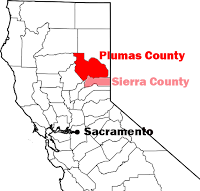
Sacramento State University radio station CapRadio usually focuses coverage on local and state government, but when the pandemic began, the station realized its wide-ranging signal could reach and inform rural audiences that might not have much, if any, local news coverage on pandemic-related topics such as infection rates, economic impact, supply chains, and more, Jesikah Maria Ross and Olivia Henry report for Current, a newsroom focusing on public media.
| Wikipedia map, adapted by The Rural Blog |
Since Covid-19 caseloads are skyrocketing again, Ross and Henry offer ideas for how other public radio stations can build sustained relationships remotely:
- Establish community partnerships with groups people trust for information and support.
- Find an engagement tool (possibly surveys) that works with partners' networks and bandwidth.
- Bring community partners and local journalists into the editorial process.
- Plan for how to share the stories back with residents.
New virtual platform set up by land-grant universities lets farmers help other farmers with greener farming practices
Thursday, January 13, 2022
Gates is nation's largest farmland owner for 2nd year in row
Gannett to stop Saturday print editions at 136 newspapers, but will give subscribers online access to all its papers
Rural America keeps gaining dollar stores, though some residents oppose them
![]() |
| Anderson's County Store in downtown Pittsgrove, N.J. (Philadelphia Inquirer photo by Alejandro Alvarez) |
Dollar General Corp. is a rural juggernaut, with more than 18,000 stores in the United States. But some rural residents don't want its stores. Local organizers in Pittsgrove Township, N.J., have been fighting to keep a Dollar General from opening in the community of just under 9,000, Jason Nark reports for The Philadelphia Inquirer.
The town's organizing board recently gave Dollar General preliminary approval to open, but some residents say the store would be an eyesore. Nick Mesiano, a 27-year-old web developer, has spearheaded efforts to keep Pittsgrove retain its character. Last year he launched a website, Save Pittsgrove, that organized locals to successfully fight off a proposed industrial trash facility. He later used the site to rally opposition to Dollar General, but since the store's construction seems inevitable at this point, he's trying to at least make sure it fits in with the township's historic buildings.
![]() |
| Pittsgrove Township in Salem County (Wikipedia map) |
A Dollar General spokesperson said the stores fill a retail void in rural America, but there are two other Dollar General locations within five miles of the proposed store. It's also half a mile from Anderson's County Store, "a quintessential general store that dates back to the 1700s. The store features plank floors worn smooth over the centuries, hot coffee, and a deli that makes sandwiches, things you wouldn’t find at Dollar General," Nark reports. Dollar stores often hurt locally owned businesses.
Pittsgrover resident Erik Cagle told Nark he thinks Anderson's will thrive even though Dollar General offers cheaper merchandise. "I guess they’ve created a recipe for creating revenue," Cagle said of Dollar General, “but I think they might be underestimating the closeness of the community."
What's happening in Pittsgrove is happening all over rural America, as rural areas increasingly lose grocery stores and gain dollar stores and super centers. Recently published research from the Agriculture Department's Economic Research Service also found that "although single-location grocery stores outnumbered chains in 2015, they have been decreasing in share of food retailers," USDA reports.
"Results showed that of the 1,947 nonmetro counties in the contiguous United States, rural nonmetro counties had fewer of all five types of stores than large and small urban nonmetro counties. In 2015, there were 23 counties without food retailers of any type, and all of those were in rural nonmetro counties. Of the 44 counties with no grocery stores, 40 were rural nonmetro and 4 were urban nonmetro. There were 41 nonmetro counties with just one food retailer, and 115 with only one grocery store," according to the report. "Single-location grocery stores, as opposed to chain stores, made up a larger percentage of the grocery stores in rural counties than in nonmetro urban counties. In 2015, single-location grocery stores comprised about 82 percent of all food stores in rural counties, compared with about 70 percent in large urban nonmetro counties and 74 percent in small urban nonmetro counties."State legislatures' pandemic precautions — or lack thereof — reflect gap between libertarians and public health
State legislatures' pandemic precautions for lawmakers — or lack thereof — "highlight a persistent partisan gap in pandemic policy as states begin a third year of legislative sessions amid a virus outbreak that many had assumed would be waning but is instead surging to near peak levels of hospitalizations because of the Omicron variant," David Lieb reports for The Associated Press. "As lawmakers in some Democratic-led states meet remotely because of renewed Covid-19 concerns, their counterparts in many Republican-led legislatures are beginning their 2022 sessions on a quest to outlaw vaccine mandates and roll back pandemic precautions.
For example, in Democrat-led Washington state, most House business this week was conducted remotely. Anyone who wants to step onto the House floor must get a coronavirus test three times a week and show proof of full vaccination and booster shot. "By contrast, Missouri’s Republican-led legislature began a fully in-person session with no Covid-19 screening at the Capitol and no requirement to be vaccinated or wear masks," Lieb reports. "One week into their session, lawmakers already have filed nearly three dozen bills banning, discouraging or providing exemptions from vaccination requirements."
Resistance to vaccination, masking, and/or mandates for either is mostly rooted in libertarian ideology, Lieb reports, quoting Georges Benjamin, executive director of the American Public Health Association: “In many ways, the data around vaccines, masks and all these things is kind of bearing out as a proxy for the role of government. . . . We have in effect pulled into two different camps with two different views of reality.” Benjamin sees an “intellectual schism” that is unlikely to be bridged and is “very disturbing. We have in effect pulled into two different camps with two different views of reality.”
Op-ed: Towns with schools need newspapers; without one, their young people's achievements 'are left unsung'
![]() |
| Lloyd Omdahl |
"Much of our community life revolves around the local school. Towns without newspapers still have young people competing in a full array of sports and extracurricular activities. For them, school days leave indelible memories, supported by clippings of their feats from the local newspaper – if there is one. Without the paper, they are left unsung," Omdahl writes. "Every city with a school has youngsters eager to excel and to be encouraged. The local newspaper gives enduring evidence of their efforts. Every town with a school needs a newspaper."
Because newspapers are so important to communities, Omdahl proposed several months ago that city treasuries pitch in some funding. Many editors were skeptical of the notion out of a desire to retain independent from even perceived government influence. But other local governments have invested in their newspapers after recognizing the critical role they fill, Omdahl writes.
"Most of the nostalgics like to think of the days when their home towns had a healthy sense of community. While it is not possible to retreat to earlier days, it seems that communities ought to preserve what is left and find new ways to build a sense of place and belonging," Ohmdal writes. "Many of our communities are surrendering their sense of community without a fight. To conduct this fight, perhaps newspapers may have to become reoriented to the changing demographics and economics by accepting different ways of financing."
Wednesday, January 12, 2022
Feds relax rules for local and state governments' relief funds; 'a major win for many smaller communities'
Does your state spend more or less than average on health care? Leaders in per-resident outlays tend to be rural
| Graphics by Self from Census Bureau survey of governments |
New rural coronavirus infections break single-week record last week as cases more than doubled from the week before
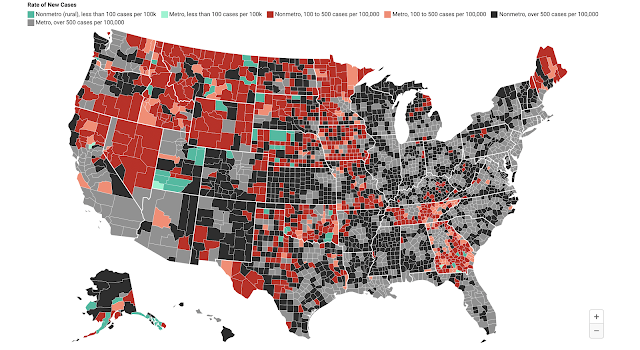
| New coronavirus infections, in ranges by county, Jan. 1-8 Map by The Daily Yonder; click the image to enlarge it or click here for the interactive version. |
Nonmetropolitan counties reported 393,000 new coronavirus cases Jan. 1-8, setting a new record for infections in a single seven-day period and increasing more than 205,000 from the week before. "That’s the largest single-week increase in new cases since the pandemic hit rural America in March 2020," Tim Marema reports for The Daily Yonder. "The previous record was 232,000 new cases, recorded one year ago this week at the height of the winter 2021 surge."
Though Omicron-variant infections were slow to infiltrate rural areas, "Rural counties are now seeing higher rates of infection increase than metropolitan areas," Marema reports. "New infections grew by 110% in rural counties last week. In metropolitan counties, new cases grew by 60%."
Deaths related to Covid-19 are rising in both rural and metropolitan counties. Rural counties reported 2,264 new deaths last week, an increase of about 20% over the week before. Metropolitan counties reported 8,407 new deaths in the same time period, a 25% jump from the previous week.
Click here for more charts, regional analysis, and county-level interactive maps from the Yonder.
If you see a snowy owl, that doesn't mean it's starving
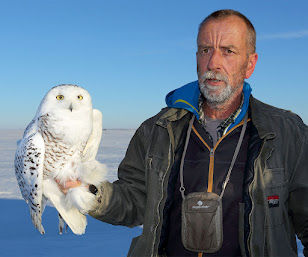
| Martin Stoffel of Saskatchewan is one of two owl banders who provided data for the research. (Photo by Daniel Dupont) |
Many snowy owls spend winter in southern Canada and the northern U.S. "They pop up in odd places—hunkering down on haystacks in farm fields, just off the runways at airports, atop light poles in grocery store parking lots—to the delight of birders and Harry Potter fans," writes Erica Cirino of All About Birds. "It’s also common for some people to feel anxiety over the snowies, believing them to be hungry vagrants." For example, a TV station in Michigan’s Upper Peninsula "reported that the owls’ southern travels were 'linked to food supply' and that 'Snowy owls often arrive in Michigan weakened and starving.' That first statement is often true, but the second is generally not true."
Wiebe and graduate student Alexander Chang published research in August that showed "most snowy owls wintering in southern Canada appeared to be doing just fine," Cirino reports. "Indeed, many of the owls actually put on weight over the winter by increasing their subcutaneous fat stores (fat that accumulates under the skin on birds’ chests and beneath their wings and is used for both insulation and energy)." Other studies have found likewise. At Logan International Airport in Boston, Norman Smith of Massachusetts Audubon says he’s banded more than 700 snowies since 1981. He has not experienced a single year where hatch-year owls have showed signs of starvation due to lack of food."
Supreme Court blocks bid to revive year-round E15 sales
Children whose parents died from Covid-19 need better access to mental-health services, especially in rural areas
Hundreds of thousands of children have lost a parent or caregiver to Covid-19, but many lack mental-health services, especially those in rural and other underserved communities.
"From January 2020 to November 2021, more than 167,000 children under 18 lost a parent or in-home caregiver to Covid-19, according to a December report titled 'Hidden Pain' by researchers at the University of Pennsylvania, Nemours Children’s Health and the Covid Collaborative," Aallyah Wright reports for Stateline. "Psychologists say this loss has caused an uptick in anxiety, depression, trauma- and stress-related disorders in some children. Mental-health professionals, like others in health care, have experienced burnout amid much higher caseloads. Last fall, the American Academy of Pediatrics, American Academy of Child and Adolescent Psychiatry and Children’s Hospital Association declared a national state of emergency in children’s mental health.""The Biden administration has directed some pandemic relief aid to student mental health programs and some states passed related legislation, but none of the efforts have focused solely on children who have lost caregivers," Wright reports. "With states’ 2022 legislative sessions underway, mental health advocates hope the youth mental health crisis will push lawmakers to pass laws that increase access and availability of services, expand mental health awareness and alleviate a strained mental health workforce, especially in rural areas."
Tuesday, January 11, 2022
Farmers urged to use clout on WOTUS rewrite; Biden says he's trying to help them; Vilsack touts cover-crop program
The American Farm Bureau Federation, the nation's largest agriculture organization, is holding its annual convention this week in Atlanta, through tomorrow. Here are some highlights:
Opening the convention on Monday, AFBF President Zippy Duvall urged members to use their political clout to ensure that Agriculture Department climate-change mitigation programs "respect farmers" and urged action on the Environmental Protection Agency's plan to rewrite the regulatory definition of "waters of the United States" in the Clean Water Act.
The Obama administration had rewritten the definition to protect intermittent and seasonal waterways under federal pollution regulations, which AFBF opposed, Chuck Abbott notes for the Food & Environment Reporting Network. The Trump administration rewrote the definition again to scale back protections, but a federal judge rejected it, saying it could lead to serious environmental harm. EPA and the Army Corps of Engineers have sought farmers' input on the planned rewrite.
"It is critical that this administration understands that we should not need a team of lawyers and consultants just to farm our land," Duvall said.
In a recorded speech to delegates Monday, President Biden sought to assure them that he is trying to help farmers prosper and ensure they get fair prices for their crops, Abbott reports: "Biden, who has assailed meatpackers for high profits during the pandemic, pointed to a proposed $1 billion to expand slaughter capacity and efforts to keep ag exports moving despite port congestion."
Biden said, "This isn’t about Republicans or Democrats, red states or blue states. It’s about making sure that your contributions are recognized and your challenges are addressed," Biden said. "Every day, you feed and fuel our country. I want you to know that every day—I mean this —every day you have a partner in the White House."
Immediately after Biden's message, Agriculture Secretary Tom Vilsack took the stage, saying USDA is committed to funding pilot projects to help farmers make more money while helping the administration meet its climate-change mitigation goals. He stressed that such programs must be "voluntary and incentive-based," Jeff Beach reports for AgWeek.
Vilsack announced a conservation program that aims to double the nation's cover-crop plantings to 30 million acres by 2030, Karl Plume reports for Reuters. The agency's Natural Resources Conservation Service has allocated $38 million to help farmers in 11 states plant crops in fields that would otherwise be left fallow. The practice can improve soil health, decrease soil erosion and capture and store carbon. "The investment, made through a partnership with the United Soybean Board, National Corn Growers Association, National Pork Board and others, is the latest farm-level effort by the Biden administration meant to address climate change," Plume reports. (In related news: A newly published study found that the Corn Belt has lost 35 percent of its topsoil since Europeans colonized the area).
Vilsack also called out China for being $16 billion behind on commitments to buy American farm products. In the "Phase One" trade agreement in early 2020, China said it would buy $80 billion in U.S. agriculture, food and seafood exports in 2020-21. But through November, with one month left in the agreement, China had purchased only $56.3 billion, Abbott reports.
First African American nominated to head Delta authority
| Corey Wiggins |
"Corey Wiggins grew up in rural Mississippi and has demonstrated a deep commitment to public service throughout his distinguished career," the caucus said in a press release. Wiggins, a native of Hazelhurst in southwest Mississippi, has a master's degree on public health with an emphasis in health policy and a Ph.D. from the University of Alabama at Birmingham.
Covid-19 infections at meatpacking plants slow production
Rising coronavirus infections among meatpacking workers "have forced meat plants to slow production and the government to replace slaughterhouse inspectors, meat companies and union officials said," Tom Polansek reports for Reuters. "Meatpacking, an early epicenter of the pandemic in 2020, is the latest sector to be disrupted by a surge in cases of the highly contagious Omicron variant, which has also left airlines, hospitals, and schools scrambling for staff."
As of Jan. 3, infections had increased over the previous two weeks in 26 of the 30 counties with the nation's largest beef production plants. The Agriculture Department "estimated beef processors killed 112,000 cattle on Friday, down about 6 percent from a year earlier and matching Jan. 3 levels that were the lowest since October. Pig slaughtering, meanwhile, was down about 5% from last year on Friday," Polansek reports. "Less slaughter capacity reduces U.S. beef supplies at a time of booming demand and means farmers must keep cattle longer in feed yards or on ranches. A sustained period of lower production could further increase high meat prices at a time of inflation fears."
It's not just the line workers getting sick: inspectors are increasingly getting infected too, and they could spread it to other plants. "USDA said it follows U.S. health guidelines and requires meatpacking workers in regions with high Covid-19 transmission to wear masks when inspectors are present," Polansek reports.
$10 billion Treasury program to help small businesses, especially minority-owned or those in poor or rural areas
The Treasury Department is reviving a program to hand out $10 billion to small businesses in a bid to help the nation's economy recover from the pandemic. The State Small Business Credit Initiative will set aside $1.5 billion for businesses owned by rural and other socially and economically disadvantaged groups; another $500 million is earmarked for businesses with fewer than 10 employees, Amara Omeokwe reports for The Wall Street Journal. Funding for the program comes from the $1.9 trillion pandemic aid package Democrats passed in March.