Tuesday, June 07, 2022

The state of rural journalism: Buyers are needed, news deserts are expanding, and social division can be a problem

Second in a series of reports on the National Summit on Journalism in Rural America, held June 3-4 by the Institute for Rural Journalism and Community Issues and the College of Communication and Information at the University of Kentucky. Summit sessions can be viewed on YouTube.

The challenges of rural journalism are mainly the challenges of the communities it tries to serve, and many of those challenges are daunting. But they are not dispositive. That was made clear at the National Summit on Journalism in Rural America by some sharp, innovative and courageous editors, publishers, academics and other journalism supporters.

"Community newspapers are still trusted" more than other news media, said Lynne Lance, executive director of the National Newspaper Association, citing at Friday's opening session the recent survey done for NNA in its the markets of its members, mainly weeklies and small dailies.

But more broadly, when you ask how America's rural newspapers are doing, you also need to ask, and answer, this question: "How is rural America doing?" said longtime Georgia publisher Robert M. Williams Jr.. "It's hard for any newspaper to ever rise above the quality of the community it operates in," but there are exceptions, he said Friday.

Tony Baranowski
The biggest problem in most rural communities is shrinking population, and that's a problem for their news media, as well as the shift of retail business to big-box stores that advertise little, Tony Baranowski, co-publisher of the Times Citizen in Iowa Falls, Iowa, said Saturday morning.

For many older newspaper owners in small towns, the biggest problem is finding an acceptable buyer for their newspaper.

"What we see are thousands of independent owners across the country who want to leave their legacy but don't have someone to buy their paper," Elizabeth Hansen Shapiro of Columbia University said Saturday morning. She is founder of the National Trust for Local News, which tries to keep local news media in local hands, rather than profit-motivated chains or politically motivated buyers.

Sharon Burton
Sharon Burton, editor-publisher of the Adair County Community Voice in Columbia, Ky., said Saturday morning, "I make money so I can be in the newspaper business. I'm not in the newspaper business to make money," like most recent buyers. "It's obvious by the quality of what they're doing that they're not in it because they love newspapering. I think they're part of our problem, because they hurt our reputation."

Some owners who don't want to sell to such buyers just close their papers, and some such buyers eventually merge or close them, or strip them down so much they create what Penny Abernathy of Northwestern University calls a news desert: a community "with limited access to the sort of credible news and information that feeds democracy at the grassroots level and helps residents make wise decisions about issues that will affect their quality of life and that of future generations."

In some cases, that means a "ghost newspaper." In others, it means no paper at all. Abernathy, who has tracked the trend for years, said Friday that the recent rate of mergers and closures is double what she expected, and they are now being seen in affluent communities. She is in the midst of writing an update of her research.

Oregon has lost a fourth of its newspapers since 2004, Jody Lawrence-Turner, executive director of the Fund for Oregon Rural Journalism, said Friday. She said half the incorporated cities in the state lack a local news source: "Nobody is watching them."

Bill Horner III
Social and political divisions are a growing problem for rural communities and their newspapers. Bill Horner, publisher of the Chatham News+Record in North Carolina, said is county is do divided along racial and political lines that it made him and his partners question whether it was still a place for a general-interest newspaper.

Horner said his twice-weekly lost its largest single-copy vendor (three stores, 200 papers) because his sports editor told the owner that the paper was doing a story on the history of lynching in Chatham County. But he said he continues outreach to Blacks and Hispanics, each 12 to 13 percent of the county's population, because sustainability relies on engagement and helping audiences solve their  problems. He said one recent success is a parenting newsletter, because most people are parents, and that crosses the social and political divides.

Baranowski said, "We have to embrace immigration, refugees, wherever they're coming from." His PowerPoint presentation said, "These are facts that are difficult for many of our overwhelmingly white communities to embrace, but we have to illustrate the successes" of embracing immigrants and refugees. He said "The community is not embracing their stories," one exception being an Afghan who was an interpreter for the American military. "Never underestimate the value of people being proud of lifting up an underdog," he said.

Dink NeSmith, a newspaper chain co-owner who came out of retirement to save The Oglethorpe Echo in northeast Georgia and made it a nonprofit staffed by University of Georgia students, said Saturday, "We began to cover the Black community for the first time," The county is 17% Black. He said a Black truck driver was appreciative, and donated $500.

Further reports on the National Summit on Journalism in Rural America will appear later. Topics will include nonprofit status, philanthropy, help from universities, and editorial approaches.

Higher housing costs hit residents of mobile-home parks

A mobile home park near Greeneville, Tenn. (Photo by Michael Williamson, The Washington Post)

"Surging home prices and rents are cascading down to the country’s mobile home parks, where heightened demand, low supply and an increase in corporate owners is driving up monthly costs for low-income residents with few alternatives. At the same time, private-equity firms and developers are often circling nearby, looking to buy up such properties and turn them into more lucrative ventures, including timeshare resorts, wedding venues and condominiums," reports Abha Bhattarai of The Washington Post.

The average price of mobile and other manufactured homes has risen by nearly half during the pandemic, from $82,900 to $123,200, according to the Census Bureau. "Average new home prices rose 22 percent in that period," Bhattarai notes. "However, less is known about how much mobile homeowners pay to rent the land under their homes. Lot rents typically rise between 4 and 6 percent a year, according to industry sources, though there is little data on exact costs or price increases. That lack of transparency is complicated by the fact few cities or states have rules governing rent increases at mobile home parks."

And a mobile home may not be very mobile. "Moving a mobile home — if it is new enough to be moved at all — can cost as much as $15,000, which means residents are often beholden to the parks where they live," Bhattarai reports.

Rents are rising with land prices and a shortage of affordable housing, Casey Dawkins, a professor of urban studies and planning at the University of Maryland, told the Post. Also, home parks are facing higher costs for utilities, workers and property taxes, John Pawlowski, managing director at real estate research firm Green Street Advisors, told Bhattarai.

Sometimes-impolitic editor-publisher in Minnesota is giving away his newspaper so he can help children in Ukraine

Lee Zion at his paper (Guardian photo by Matthew Cantor)
Another weekly newspaper editor-publisher has given his paper away, but he says it's not for business or journalistic reasons; he says his energies will be put to better use helping children in Ukraine.
 
“How could I sit comfortably at my desk while Ukrainian children die?” Lee Zion of the Lafayette Nicollet Ledger in Lafayette, Minn., asked Matthew Cantor of The Guardian. “If they want me as a teacher, I’ll be a teacher. If they want me as a guy driving a truck, delivering supplies, I will deliver supplies. If they need help with cleanup efforts in Bucha and other cities, I will assist with the cleanup.”

After unsuccessfully trying to sell the paper, Zion ran an ad saying he wanted to leave it “in good hands.” He said it was “financially solvent” but “The next owner must show that he or she has the knowledge, experience and the drive to take on the challenge.” Enter Robert Lawson, 37, a resident of Lafayette and former editor of another paper in the area, who told Cantor the opportunity “was just kind of perfect.”

"One element of his predecessor’s work Lawson may not pursue is his editorials, which have occasionally landed him in hot water," Cantor writes. "In 2019, Zion wrote a piece on declining fertility rates in which he suggested a remedy: women could 'have sex with me.' It also suggested increasing immigration, noting that this might bother some people because it could 'make America less white,' referencing Donald Trump’s 'Make America great again' slogan."
 
“There was a huge outcry,” Zion recalled. “Some people really, really loved that piece. And others hated it. Hated it with a passion. . . . One of them said, I will never advertise in this paper, so long as Lee Zion is in charge. Now that I’m done, a new person can probably win this guy back.”

Zion, a native of Brooklyn, N.Y., who has spent his adult life in newspapers, moved to Lafayette in 2018 to buy the Ledger for $35,000. Now he says he will stay in Ukraine “for as long as they’ll have me. And who knows? There’s a Jewish community in Ukraine. I could find a home among the Jewish community.” Cantor writes, "He hopes his plans inspire others to take similar action."

Climate has changed most in the West, the North and Florida; state-by-state figures may indicate local examples

National Oceanic and Atmospheric Administration data; Axios map, adapted by The Rural Blog

"Climate change is often cast as a global issue. But in reality, it's already affecting each of us in our backyards," write Andrew Freedman and Michael Graff of Axios. "The more people see the impact on their own lives, the more likely it is that they'll look for things they can do about it — from the candidates and policies they support to the personal changes they can make." Washington state just hired its first climate epidemiologist, Crosscut reports. Meanwhile, the amount of carbon dioxide in the atmosphere broke a record in May, The New York Times reports.

Local climate impacts include weather problems of farmers and "the fire ant and its march through North Carolina," Axios reports. "The non-native species with the unforgettable sting was first discovered in Brunswick County, North Carolina, in the farthest southeastern corner of the state along the South Carolina line, in the 1950s, about 20 years after it arrived in the U.S. from South America. Now 78 of North Carolina's 100 counties are under fire ant quarantine area designations, according to a North Carolina Agriculture report from January. The fire ants aren't migrating simply because the temperature is warming farther inland. They also float as colonies around their queen, hitching rides inland on floods from more frequent and intense rainfall events."

Some effects aren't quite so apparent, until they are. "Climate change unfolds in the margins day to day until it becomes impossible to avoid," Graff and Freedman write. "Perhaps one morning you realize the place you live experiences totally different weather conditions than when you first arrived there, or that your community has seen three so-called 100-year floods in the past two years. . . . Heavy precipitation events have become more frequent across the country, especially in the Midwest and Northeast. When Climate Central studied rainfall at 150 U.S. weather stations, it found that hourly rainfall intensity has increased since 1970 at 90 percent of them."

Inflation makes it harder for food banks to meet rising need

Robert Walton loads food from the Foodbank of Southeastern
Virginia and the Eastern Shore
. (NPR photo by Eze Amos)
Food has been hit with some of the highest inflation in  year40s, driving many Americans to food banks this year. But that same inflation has made it harder for food banks to stock enough food to meet their needs, especially higher-cost items like meat, Jennifer Ludden reports for NPR."Inflation is hitting both food banks and their clients in other ways: cost increases for fuel, for example, increase the cost of living in numerous ways for lower-income households that can ill afford extra expenses," Ludden reports. "Food is one of the items worst hit by the highest inflation in four decades. And the cost of food and other essentials, such as gas and rent, fall hardest on lower-income households" who are the main users of food banks.

An Urban Institute survey in December, before the food-price spike, "found that one in six adults relied on charitable food, a share that was still above pre-pandemic levels," Ludden writes. "It found Black and Hispanic adults were nearly three times as likely as white adults to use food pantries, with no significant decline since the first year of the pandemic."

Aspen Institute's Community Strategies Group to hold virtual meeting on rural environmental justice Friday

The Aspen Institute's Community Strategies Group will hold a virtual meeting about rural environmental justice from 1 to 3 p.m. Friday, June 3. To register, click here.

Aspen CSG says, "Rural America’s majesty derives from vast expanses of natural landscapes and ecosystems that produce value and benefit for our country and the entire world. However, inequitable practices and policies based on race, place, and class have too often burdened the most vulnerable rural communities with negative environmental and social consequences of an extractive global economy. Today, new rural and tribal efforts focused on environmental justice, just transitions, corporate stakeholder engagement, scientific conservation efforts, and Indigenous wisdom are helping balance natural ecosystems and strengthen local communities."

The meeting will include an optional meet-and-greet for peer networking, then the whole group will be in a discussion moderated by Bonita Robertson-Hardy, Aspen CSG’s co-executive director.

Monday, June 06, 2022

National summit sparks a continuing effort for innovation and sustainability in rural journalism; here's an initial report

Penny Abernathy of Northwestern University was the first presenter at the rural journalism summit.
By Al Cross
Director and Professor, Institute for Rural Journalism and Community Issues, University of Kentucky

"I leave hopeful for community newspapers," one attendee said as she left the National Summit on Journalism in Rural America, which concluded Saturday. And there were reasons to have hope.

At a time when newspapers must get more revenue from their audiences, who won't pay good money for bad journalism, there's plenty of evidence that good journalism is good business, even if you're not the only paper in your market. "It's still possible to run a successful small-town newspaper, if you do it right," said Marshall Helmberger, co-publisher of the Timberjay in Tower, Minn.

His co-presenter, Sharon Burton, won applause when she said "I wish people in this business would stop writing our obituary." Burton publishes the Adair County Community Voice in Columbia, Ky. She said the county's top elected official told her that she keeps the official from doing wrong.

That fit a statement from the Summit's first presenter, Penny Abernathy of Northwestern University: "A strong news organization build democracy and it builds community." To sustain such organizations, "There's not going to be one business model, there are going to be many," Abernathy said. "It just depends on what kind of community you're in."

The Summit had a research question: How do rural communities sustain local journalism that supports local democracy? The question was based on the increased need for community support for newspapers or any other form of news media, in an environment where people are "bombarded with information," as Burton described it.

Many local news media are getting more support from their communities with membership models that give subscribers extra benefits, but many publishers are reluctant to ask their readers for more. At least in the Great Plains, that attitude is off base, said Teri Finneman of the University of Kansas, reporting on her team's recent survey of publishers and readers in Oklahoma, Kansas, Nebraska and the Dakotas.

Finneman found that 40 percent of readers said they are likely or very likely to donate to their local paper to keep it going. She and Kansas Publishing Ventures, which publishes four weeklies, are testing that by implementing such a model later this month. "This is live, ongoing research," which should produce its first report this fall, she said.

At the close of the Summit, I observed that we are in a fast-moving environment in which news publishers and people who want to help them need to remain in contact, so the Institute for Rural Journalism and Community Issues will create a platform for Summit attendees and others to share information, questions and answers. And we will hold another Summit via Zoom in a few months, again focused on innovation and sustainability.

The Summit was held at the Shaker Village of Pleasant Hill in Kentucky, where the first summit was held 15 years ago. "It was a once-thriving community that faced oblivion only to be saved by a collaborative effort. Shaker Village, now Kentucky's largest National Historic Landmark, was a fitting setting for the rural journalism question that we need to keep asking," wrote Tom Silvestri of The Relevance Project of the Newspaper Association Managers. "A jam-packed agenda covered a lot of ground, from the state of community journalism, to groups working to uplift the industry, to the roles of philanthropy and national funders, to newspapers being run as non-profit organizations, to examples of journalism adapting to change, innovating and responding to coverage needs, to the research needed to help community journalism, and to new business models that can be viable options based on dynamic data."

Watch The Rural Blog for more details on discussions, questions and answers from the Summit.

Boy Scouts selling camps to pay settlements; open-space advocates scramble to keep developers from getting some

Deer Lake Boy Scout Reservation in Connecticut (AP photo)
"As the financially struggling Boy Scouts [of America] sell off a number of campgrounds, conservationists, government officials and others are scrambling to find ways to preserve them as open space," reports Pat Eaton-Robb of The Associated Press. "A $2.6 billion proposed bankruptcy settlement designed to pay thousands of victims of child sexual abuse has added pressure to an organization beset by years of declining enrollment, and the Scouts and their local councils have been cashing in on their extensive holdings, including properties where some of the abuse took place. Developers have bought up some. Preservation groups hope others can be protected and some legislators have taken notice."

U.S. Sen. Richard Blumenthal (D-Conn.) is trying to get Congress to provide money to preserve the properties, often called "reservations." In his state, the BSA's Yankee Council is considering developers' $4.6 million offer for the 252-acre Deer Lake Boy Scout Reservation near Long Island Sound. "The council has rejected offers from two conservation groups but is negotiating with one of them that offered a revised bid," Eaton-Robb reports. Also on the block is 96 acres on one of the Finger Lakes in western New York. Fifteen tracts have already been sold in Michigan, said the leader of a conservation group there.

“Unfortunately, local Boy Scout councils are selling to the highest bidder,” Blumenthal told AP. “So, I think it is a national challenge, but it goes to the core of what scouting means and the ethos and ethic of scouting, which they may be betraying.”

Because the councils hold title to the properties, "It’s unclear exactly how much land across the United States belongs to the Boy Scouts," AP reports. "But evidence in the bankruptcy trial indicated the local councils own close to 2,000 properties that could be worth between $8 billion and $10 billion, said Timothy Kosnoff, an attorney who represents more than 12,000 claimants in the bankruptcy."

Mass shootings 'have become a circuit of sorts,' Washington Post says; local editor-publisher decries 'media circus'

News-media trucks dwarf the memorial at Robb Elementary School. (Photo by Sarah Voisin, The Washington Post)

Karin Brulliard of The Washington Post writes from Uvalde, Texas: "The cowboy drove 1,213 miles from his Ohio farm and erected a blue tent and sign asking, 'NEED TALK?' on an empty corner lot. The Dallas artist painted a mural on tall canvas set up across the street from Robb Elementary School. The parents of a mass shooting victim flew down from Buffalo, advising new members of the terrible brotherhood created by yet another rampage. As this small town grieves for 19 children and two teachers slain at school by a gunman, it has also swelled, becoming a pilgrimage site for mourners, relief workers, therapists, proselytizers and voyeurs. . . .

"There are hordes of media, of course, with tents and cameras and vans and bright lights. But other outsiders came, too. Police vehicles from other Texas towns — Cactus City, Irving, Amarillo — cruise the streets, filling in for a local force facing intense scrutiny over its delayed response to the shooting. Whataburger employees from other store locations arrive each day so the Uvalde outlet’s staff can take time off. The Billy Graham Rapid Response bus, the American Red Cross, Christian bikers, San Antonio mariachi musicians and Florida therapy dogs have pitched up at makeshift memorials. The scene highlights an unusually American reality. Mass shootings happen so often here that their locations have become a circuit of sorts, the kind of place where regulars see familiar faces, and lament over the latest tragedy."

Mayor Don McLaughlin told Brulliard that news media have been intrusive and frustrating “to no end,” but counselors and spiritual leaders are a “blessing” because “Not only will these families need help … you’ve got as many citizens that are traumatized by this.”

Uvalde Leader-News Editor and Publisher Craig Garnett's latest column is about the "media circus" and how the twice-weekly paper is handling it. His conclusion begins with Pete Luna, his general manager and photographer, whose "heart-pounding images of children being rescued from Robb school have flown around the world. But he wants no part of being painted with the same brush as the global media." He quotes Luna: “When I carry my camera, I now try to hide it. I don’t want people to think that I am one of them.”

After Friday, he made sure to wear a shirt with Uvalde Leader-News stitched across the pocket," Garnett writes. "The circus has, for the most part, struck its big tent and departed. And despite what Anderson Cooper of CNN said about no one being left to inform the town after the funerals ended and CNN’s cameras were gone, we will be here. We are here for the long haul, standing with Uvaldeans to help with healing for the victims and this little town that we all love." In an editorial, Garnett writes that the delay in response to the shooting "surely will become Uvalde's darkest hour." 

Roundup (glyphosate) seriously damages wild bees' ability to keep their colonies at the right temperature, study finds

Photo by Susan Walker, Getty Images
Researchers have found that the weed killer glyphosate, typically sold as Roundup, seriously damages "the critical ability of wild bumblebees to keep their colonies at the right temperature, reports Damian Carrington, environment editor of The Guardian.

"The harm to bumblebees – vital pollinators – was not identified in regulatory risk assessments, which only test whether a pesticide rapidly kills healthy, individual bees," Carrington writes. "However, the collective failure to regulate colony temperature could have a massive impact on its ability to produce the next generation, the scientists said."

The study found damage "when the colonies were running short of food. This is common in farming regions, where wildflowers can be killed directly by glyphosate," Carrington reports. "The research is the first on wild bees, of which there are 20,000 species, though glyphosate had already been shown to harm honeybees by damaging larvae and the senses of adults. . . . Standard risk assessments are performed on well-fed, parasite-free bees, not affected by the many stresses they encounter in the real world."

EPA makes Renewable Fuels Mandate highest yet, says more ethanol in fuel supply will help consumers

The Environmental Protection Agency has set the Renewable Fuels Mandate for refiners to its highest level yet, including 15.25 billion gallons of corn-derived ethanol this year. "Ethanol is cheaper than gasoline at present, so biofuel backers said consumers would benefit at the fuel pump with more ethanol in the gasoline supply," reports Chuck Abbott of Successful Farming.

“At EPA, we are laser-focused on providing more options for consumers at the pump, and today we are taking steps to increase the availability of homegrown biofuels,” EPA Administrator Michael Regan said Friday. “Today’s actions will help to reduce our reliance on oil and put the RFS program back on track after years of challenges and mismanagement.”

"Trade groups for corn growers and ethanol makers applauded the EPA announcement," while the American Petroleum Institute complained, Abbott notes. "At 15.25 billion gallons, corn ethanol would provide the bulk of the 20.88 billion gallons in the RFS for this year. . . . Next-generation 'advanced' biofuels were set at 5.63 billion gallons in this year’s RFS, down slightly from EPA’s initial proposal. Biomass-based biodiesel would account for nearly half of it, at 2.76 billion gallons. Advanced biofuels, such as ethanol made from grasses and woody plants, have been slow to come to the market despite hopes for development of fuels that did not compete with food crops for feedstocks.

Along with setting the RFS for this year, the EPA adjusted the 2020 RFS to 18.84 billion gallons, an increase of 320 million gallons from its proposal last Dec. 7, to reflect actual ethanol use for that year. It also finalized a regulatory framework to include so-called biointermediates in the RFS. Biointermediates are feedstocks that are partially converted in one facility and processed into a RFS-eligible biofuels at another facility. Earlier this year, the EPA proposed a regulation to admit renewable diesel and other biofuels made from canola oil into the RFS.

The EPA also said it would deny a set of previously pending requests by small refineries for exemptions from the RFS at various points from 2016-2021, and proposed alternative ways from small refineries to comply with the RFS in 2016, 2017, 2018 and 2020.

Saturday, June 04, 2022

Rural Covid-19 vaccination rate grew little in April and May

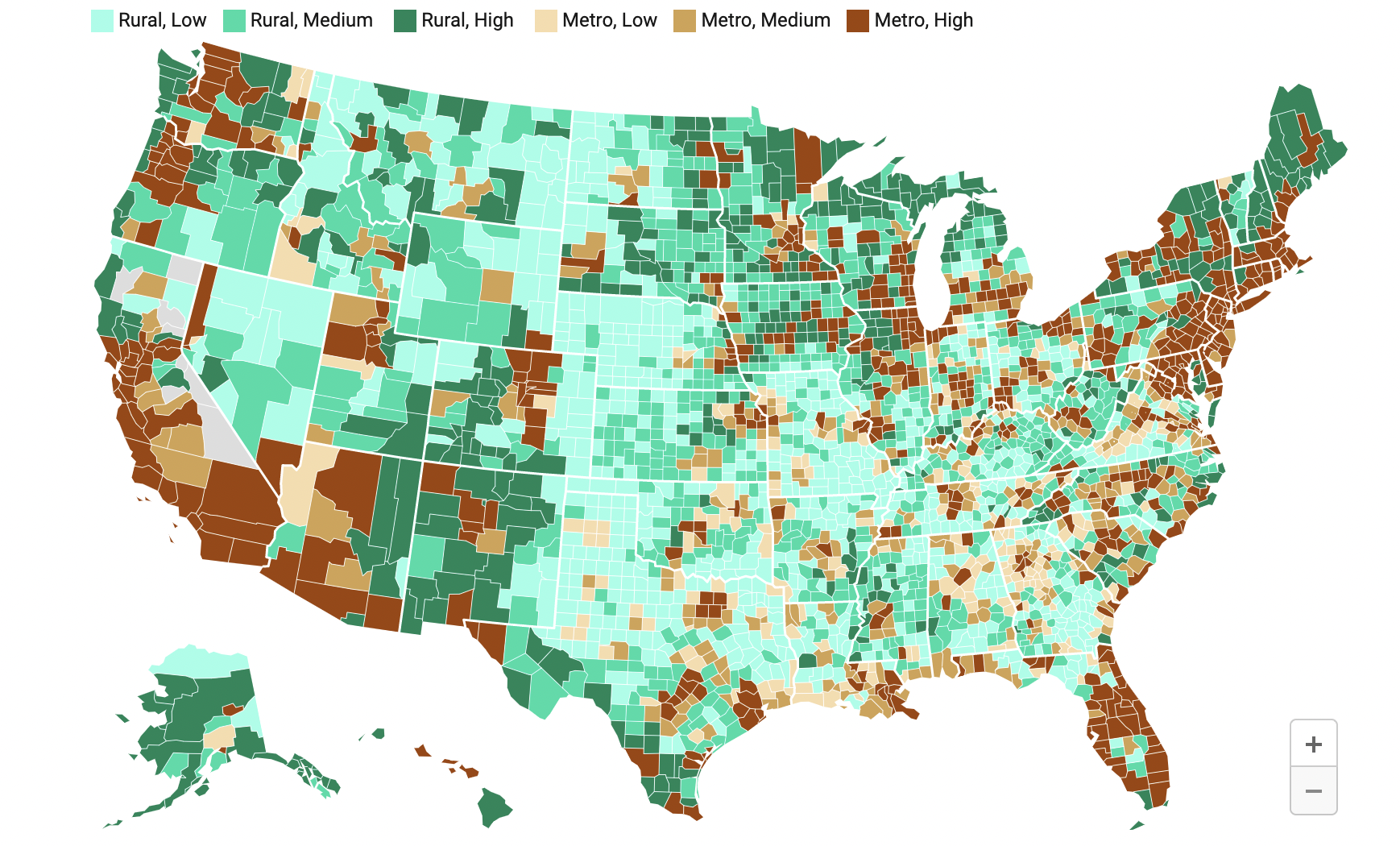
Coronavirus vaccination rates as of May 26, compared to national average and adjusted to account for vaccinations not assigned to a county. Map by The Daily Yonder; click the image to enlarge it or click here for the interactive version.

The rate of new coronavirus vaccinations in rural counties "grew by 0.4 percentage points from the last week of April to the last week of May. The rate grew by about that same amount from March to April," Tim Murphy and Tim Marema report for The Daily Yonder. "The pace of new vaccinations has slowed in both rural and metropolitan counties over the past several months. From December 2021 to January 2022, the rural vaccination rate grew by nearly 1.7 percentage points and the metropolitan rate grew by 2.2 points. As of May 26, 51% of the total rural population was completely vaccinated against Covid-19. In metropolitan counties, that rate is 65.4%."

Only 23.2% of people in rural U.S. counties have had at least one coronavirus booster shot, compared to 30.7% of the metro population, Murphy and Marema report.

Friday, June 03, 2022

Summit Fri. and Sat. asks: How do rural communities sustain local journalism that supports local democracy?

How do rural communities sustain local journalism that supports local democracy? That is the question before the National Summit on Journalism in Rural America, to be livestreamed on YouTube from 1:15 to 5 p.m. Friday and 9 a.m. until late afternoon Saturday.

The summit will be held at the Shaker Village of Pleasant Hill near Harrodsburg, Ky., where the Institute for Rural Journalism and Community Issues held the first summit 15 years ago. Two dozen invited speakers and a local audience will try to answer the question by exploring the current landscape of rural journalism and how rural news media are adapting to it, with revised business models and other innovations. All sessions will include a period for questions, answers and discussion among participants, and the YouTube audience can submit questions by email to al.cross@uky.edu. 

Following is the program, which has recently been revised. All times are Eastern.

Friday, June 3

1:15 Opening remarks: Why we’re doing this and what we hope to accomplish
Al Cross, director and professor, Institute for Rural Journalism and Community Issues, and Dr. Jennifer Greer, dean, College of Communication and Information, University of Kentucky

1:30 The state of America’s community newspapers and their journalism: Penelope Muse Abernathy, visiting professor, Northwestern University, will update her groundbreaking research.

2:15 Reports from leaders of the community newspaper industry: National Newspaper Association Executive Director Lynne Lance will join former NNA president Robert Williams Jr. and Tom Silvestri of The Relevance Project of the Newspaper Association Managers.

3:00 Putting local philanthropy in your business model: Nathan Payne of Kaiser Health News, recently editor of the Traverse City Record-Eagle, on how community foundations can help; Jody Lawrence-Turner of the Fund for Oregon Rural Journalism; and Dennis Brack of the Rappahannock News, Washington, Va., which uses local philanthropy for polling and reporting.

4:00 Converting your newspaper(s) to nonprofit status: Liz and Steve Parker, former owners and still operators of the New Jersey Hills Media Group, on their recent conversion to the nonprofit Corporation for New Jersey Local Media.

Saturday, June 4

9:00 National funders and supporters on help for rural journalism: Jason Alcorn, vice president for learning and impact, American Journalism Project; Jonathan Kealing, chief network officer at the Institute for Nonprofit News; and Elizabeth Hansen Shapiro, Columbia University, co-founder, National Trust for Local News.

10:00 Good journalism is good business, but how do we make people want local news? Editor-Publishers Marshall Helmberger of the Timberjay, Tower, Minn.; and Sharon Burton of the Adair County Community Voice, Columbia, Ky.

10:30 How two community newspapers are adapting to change: Publishers Bill Horner of the Chatham (N.C.) News+Record and Terry Williams of the Keene (N.H.) Sentinel discuss their work with Buck Ryan, associate professor of journalism at the University of Kentucky. 

11:15 Innovation at other community newspapers: Tony Baranowski, Iowa Falls Times-Citizen, with Jim Iovino, director, NewStart, West Virginia University.

12:00 Lunch session: A university-nonprofit team saves a weekly paper: Dink NeSmith of Community Newspapers Inc. and The Oglethorpe Echo, staffed by journalism students of the University of Georgia.

1:00 New business models for community newspapers, and a plan to test one: Dr. Teri Finneman, University of Kansas, who says many rural newspaper subscribers are willing to buy memberships and e-newsletters to keep their local papers healthy. (Read more)

2:00 What other research is needed to help community journalism? Bill Reader, Ohio University, and Clay Carey, Samford University, author of The News Untold: Community Journalism and the Failure to Confront Poverty in Appalachia.

3:00 Concluding roundtable, open-ended and led by Al Cross and Jennifer Greer.


Thursday, June 02, 2022

Some states are letting rural electric co-ops function as broadband providers in an effort to bridge the digital gap

In an effort to plug gaps and inadequacies in rural broadband service, some states are allowing rural electric cooperatives and other electric utilities to function as broadband providers, Susan Miller reports for Route Fifty.

"In Arkansas, more than a dozen electric cooperatives have partnered to form a new wholesale broadband provider that will leverage their fiber-optic networks to accelerate statewide broadband deployments," Miller reports. "Together, the electric co-ops will invest more than $1.66 billion in middle-mile fiber-optic networks that will serve nearly 600,000 potential customer locations."

In New York, a $1 billion initiative funded with public and private investments aims to bring affordable broadband to the whole state. As part of that initiative, the New York Power Authority will work with some rural electric cooperatives to use or install fiber-optic networks to reach more remote areas, Miller reports.

In Florida, Tri-County Electric Cooperative and local broadband provider Conexon Connect are teaming up on a $65 million project to build out a 2,400-mile fiber-optic network to homes within the next few years, Miller reports. Conexon partner Jonathan Chambers said co-ops own about half of the more than 5 million miles of electric distribution lines in the U.S. "To truly close the digital divide and not just wave at it, you’ve gotta get to the places no one else will build. Without co-ops I don’t think it would ever happen. With co-ops it’s got a fighting chance," Chambers said.

Rural electric cooperatives are one of the most promising possibilities for bridging the digital gap, according to reports from the Federal Reserve Bank of Richmond and the Institute for Local Self-Reliance. Some states have barred rural electric co-ops and municipal utilities from providing broadband, at the behest of telecommunications companies, but now some states are letting rural electrics get into broadband while still blocking municipal utilities. Legal issues can make it tricky for co-ops to operate outside their service areas, and there have been concerns that low-income minorities may not be able to afford the broadband provided by co-ops.

The federal infrastructure bill signed in November has $45 billion to close the digital gap. $42.5 billion goes to a program to distribute grants and loans to states, $1 billion goes to a program funding the construction of so-called "middle mile" internet infrastructure (co-ops are eligible to apply), and $1.5 billion goes to a program that distributes grants for boosting broadband connection among underserved populations, including rural.

However, rural electric co-operatives may be at a disadvantage in applying for other federal broadband grants. In February the National Rural Electric Cooperative Association called on the federal government to establish more rural-friendly rules for broadband grants.

Tractors are the top cause of fatal injuries for farm children; one family tells their story

Jaxon Boomsma at his fifth birthday party. 
He often said he wanted to be a farmer
when he grew up. (Photo provided)
Farming families often allow young children to ride along with an older relative on a tractor, but tractors are the number one cause of fatal injuries to children on farms. 

That's how the Boomsma family in Yankton, S.D., lost their 7-year-old son Jaxon in 2017. His parents and close friends of the family recently told their story to the National Children's Center for Rural and Agricultural Health and Safety in an effort to bring awareness to the dangers of allowing children on farming equipment. The family has also launched the "Keep His Smile Alive" agricultural safety campaign and is active on social media. 

"I know how hard it is to say no to a child, especially when it’s something they love to do, but we all have to learn to say 'no,'" Jaxon's dad, Troy, told Scott Heiberger. "My dad loved taking the kids around the farm and creating memories with them. He had said 'no' a thousand times before and did everything he could to make the farm a safe and fun experience for the kids. Sadly, it only takes one time."

Heiberger shares several safety resources for those looking to write about tractor safety, including the Keep Kids Away from Tractors campaign and the Cultivate Safety website, which has agricultural safety information and resources for farmers, ranchers, supervisers and reports.

New Hampshire Public Radio journalist's home vandalized

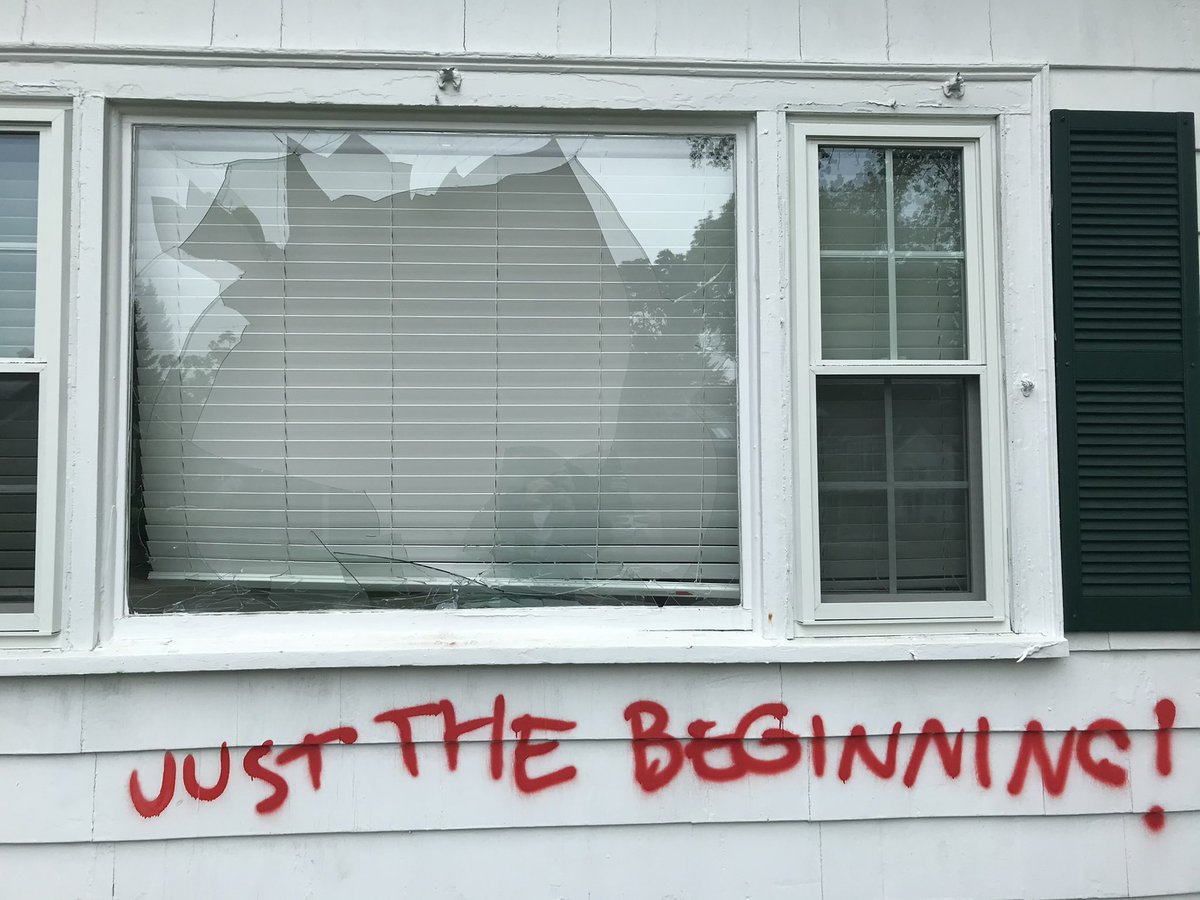
Reporter and producer Lauren Chooljian's home was spray-painted. (Photo provided)

Since late April, vandalism has hit five homes tied to New Hampshire Public Radio journalist Lauren Chooljian. All five were "hit with the same two weapons: a brick and red spray paint. Targets included her former address, her boss’s place and her parents’ home, which was hit twice," Jonathan Edwards reports for The Washington Post. "Investigators are considering the possibility that the attacks are linked to Chooljian’s work as a senior reporter and producer for NHPR. The possible motive: revenge for stories she published in the past, intimidation to silence her in the future, or both.

The graffiti on Chooljian's home in suburban Melrose, Mass., had a warning: "JUST THE BEGINNING!" In a tweet, Chooljian said the graffiti also included graphic slurs.

Health department prevention specialist in Wyoming works to reduce rural stigma on seeking help for mental health

Johnson County in Wyoming (Google map)
On paper, Bill Hawley "is the 'prevention specialist' for the public health department in Johnson County, a plains-to-peaks frontier tract in Wyoming that is nearly the size of Connecticut but has a population of 8,600 residents. His official mandate is to connect people who struggle with alcohol and drug abuse, tobacco addiction, and suicidal impulses to the state’s limited social service programs. Part bureaucrat, part counselor, much of Bill’s life revolves around Zoom calls and subcommittees, government acronyms and grant applications," Jose Del Real reports for The Washington Post. "But his mission extends beyond the drab county building on Klondike Drive where he works. One Wyoming man at a time, he hopes to till soil for a new kind of American masculinity."

Hawley knows that men overall and rural men in particular face intense pressure to be stoic, that stigma of needing mental-health care often prevents them from seeking it. But men accounted for 79% of suicide deaths in the U.S. in 2020, and 70% were white men. Most of those suicides involved firearms, and often involved alcohol or drugs, Del Real reports. The phenomenon is particularly bad in Wyoming, which has the highest suicide rate per capita in the nation. 

Sociologists believe toxic masculinity may be to blame, and that rural stigma can make things even worse. Hawley, "who is 59 years old and White, is working out his own theory. It has to do with the gap between the expectations men have for their lives and the reality of their individual experiences, worsened by cultural norms that discourage them from expressing any emotions besides anger," Del Real reports. "Toxic masculinity often turns outward. But it also turns inward."

Wednesday, June 01, 2022

Rural hospitals are still short of revenue to hire nurses as pandemic relief aid begins to run out

"Rural hospitals, already struggling with financial strains due to Covid-19, face an even more significant threat, experts said – the workforce shortage," Liz Carey reports for The Daily Yonder. "Hospitals say they are short on workers in all areas of the healthcare system, not just the clinical ones. According to the American Hospital Association, about 20 percent of all hospitals across the country expect worker shortages to reach dire levels."

In 2021, nearly 105,000 nurses in the U.S. left hospitals for one reason or another, including death and retirement; that was the largest drop in the nation's nursing workforce in history, according to Julia Harris, a senior policy analyst with the Bipartisan Policy Center. The pandemic "has really stressed the workforce in ways that we’re not going to recover from for decades," she told Carey.

"According to the U.S. Bureau of Labor Statistics, U.S. health-care organizations will need to fill nearly 200,000 nursing positions every year from now until 2030," Carey reports. "Some studies even project that the country will face a shortage of more than 29,000 nurse practitioners by 2025."

Harris noted that workforce is the number one expense for most cash-strapped rural hospitals, and that those expenses have been even higher during the pandemic because rural hospitals are obliged to use travel nurses, who are typically paid at least twice as much as staff nurses, Carey reports.

Federal pandemic aid has helped rural hospitals afford travel nurses, but with that money drying up, hospitals are increasingly on the hook for those expenses, Carey reports. And hospitals need the help, because they're still getting plenty of Covid-19 patients. Hospitals saw an average of 3,628 Covid-related hospitalizations as of May 28, 2022. On the same date in 2021, it was 3,060, according to the Centers for Disease Control and Prevention.

"The AHA is asking Congress for $1.51 billion to fund healthcare workforce development programs for the 2023 fiscal year’s budget, including $374 million for rural health programs," Carey reports. "The request represents an increase of $43 million over levels approved in 2022."

Threat of medical debt is a top worry for most farming families, says study about household-level farming stressors

Farming families are famously tough and resilient, but they face a host of challenges and fears. One of their top worries is that one of them might suffer an illness or injury that leads to significant medical debt, a recent study found after surveying 900 farm households in 10 states. 

According to the study, recently published in Agriculture and Human Values, more than 90% of farming households had health insurance in 2016, but 55% said they weren't confident they could cope with a major illness or injury without going into debt. That wasn't an unfounded concern, since 20% of farming households surveyed had medical debt of at least $1,000. That indicates that inadequate insurance is a problem for many farming families, according to study co-author Florence Becot. 

"The Affordable Care Act, or ACA, helped make medical coverage available to more Americans and benefitted farmers," Scott Heiberger reports for the Marshfield Clinic Research Institute in Wisconsin. "A provision of the ACA uses income and not assets to determine Medicaid and Marketplace subsidy eligibility, which decouples the family from the assets of the enterprise and addresses the 'land rich, cash poor' conundrum farmers often face. This provision allowed farm families a wider array of health-insurance choices via public health insurance and marketplace options. However, choices in the insurance marketplace can be limited, and health-insurance plans are often confusing. So-called 'skinny' plans – those with lower premiums but very high deductibles and out-of-pocket expenses – offer a weak safety net as people might avoid going to the doctor to limit costs, and a major illness or injury can result in medical debt."

The study matters, Becot and co-author Shoshanah Inwood write, because research on resiliency among farmers mostly focuses on problems such as fires, droughts, or economic trends. Little has focused on family-level concerns such as major illness, divorce, or off-farm employment. It's important to understand those things too, the authors write, because those stressors can lead farmers to sell their land and quit farming, further depopulating rural communities.

Teletherapy is popular and effective, but post-pandemic funding reductions may reduce rural patients' access to it

Qualified mental-health care services can be hard to find in rural America, where 75 percent of counties have no or few providers. Teletherapy is one way to bridge the gap, and it works, writes freelance author Amy Ettinger in a guest op-ed for The Washington Post. 

After helping her husband through his own mental-health crisis, Ettinger increasingly realized she needed help herself. But she has long-standing anxiety about going into a doctor's office, a phobia often called "white-coat syndrome." She worried that she wouldn't feel a connection to her therapist when appointments were via Zoom meeting, but to her surprise, things went well.

"Right away, I began to notice the benefits," Ettinger writes. "For the first time in my life, I felt no anxiety before a therapy appointment. I found it comforting to talk to my counselor while wearing fuzzy house slippers. And to my surprise, I was able to share my emotions through a screen much more easily than I’ve ever been able to with an in-person psychotherapist."

Telehealth soared in popularity during the pandemic, jumping from about 7.1% of psychologists' appointments to 85.5%, and research shows it can be as effective as in-person therapy. However, Ettinger notes, some therapists and patients may not be able to continue the practice for long: "Emergency orders established by states as the pandemic took hold, which mandate coverage of telehealth visits and allow out-of-state providers to participate, are expiring. And some private insurance companies have begun rolling back telehealth coverage."