Tuesday, February 21, 2023

School libraries' content is hotly debated in some places; study finds disputes related to local politcal environments

School libraries are supposed to be quiet oases of reading and study. But when it comes to deciding what books are on the shelves, they have become a hotbed of cultural debate. "School libraries have become a key battleground in contemporary culture wars over public education," reports Kirsten Slungaard Mumma, a postdoctoral fellow at Wheelock Educational Policy Center of the Brookings Institution. "In the 2021-22 school year, PEN America reported a record-setting 2,532 book challenges affecting 1,648 different titles in 138 school districts. Many of the challenged titles contain content related to LGBTQ+ issues or race/racism, topics that have also been the concern of state legislative efforts."

Photo from Brookings Institution
Mumma did a study: "I assembled data on hundreds of titles in public school libraries across the country. The list of titles across controversial topics includes both fictionalized stories and nonfiction titles. . . . My school library sample consists of 5,240 elementary/middle and 1,391 high schools in 48 states. This sample includes schools in rural and urban areas, schools in counties with conservative and liberal political leanings, and schools that serve students of very different backgrounds. I use these data to identify patterns in library resources and content, especially as they relate to political preferences, state laws, and book bans."

She shares some of the main findings from that work:
Finding #1: Libraries in low-income areas have lower staffing levels and less up-to-date collections. Compared to school libraries in low-income areas, school libraries in high-income areas have higher book acquisition rates (2.05 vs. 1.40) and employ more full-time equivalent librarians (1.12 vs. 0.80 per school). School libraries in high-income neighborhoods also have nearly twice as many recent best-sellers in their catalogues for young adults (18.58 vs. 9.44 titles) and middle grades (8.43 vs. 4.02 titles)

Finding #2: Access to controversial content is related to local political environments.
School libraries in the most conservative areas have fewer LGBTQ+ titles and fewer books that deal with race/racism or abortion than libraries in the most liberal areas. Libraries in conservative areas also have more Christian fiction titles and more Dr. Seuss titles that were discontinued from publication in 2021 because of racist imagery.

Controversial content is also associated with state laws that restrict curricular content. Libraries in states with anti-Critical Race Theory laws are 3.5 percentage points (46%) less likely to have The 1619 Project, a particularly contentious publication that reframes American history around slavery and its legacy. 

Finding #3: Book challenges may have chilling effects on the acquisition of LGBTQ+ content.
I find that schools in districts that were subject to book challenges over the last school year were less likely to have added recently published LGBTQ+ titles this fall. Specifically, libraries in districts subject to challenges were 0.55 percentage points less likely to have a recent LGBTQ+ title, a 55% decrease relative to the sample mean. I interpret this as suggestive evidence that book challenges are having “chilling effects” on the acquisition of LGBTQ+ content, leading librarians to avoid purchasing content that parents or politicians could find objectionable. 

Folks in tiny town remember, celebrate and prepare to say goodbye to their friend, neighbor and last rural president

Michael Dominick paints the Smiling Peanut in Plains, Ga. The peanut was
presented to former peanut farmer Jimmy Carter during a campaign event
in Evansville, Ind., in 1976. (Photo by Matt McClain, The Washington Post)

Washington Post map
The 550 residents of Plains, Georgia, are preparing to say goodbye to one of their own, America’s last rural president. Jimmy Carter "could have moved anywhere after leaving the White House. He could have cashed in on six-figure speaking gigs that have piled wealth on his successors," report Danielle Paquette and Mary Jordan of The Washington Post. "Yet the onetime peanut farmer and engineer chose instead to embrace his modest roots, making him all the more beloved in Plains and all the harder to lose."

"To everyone in Plains, he’s 'Mr. Jimmy.' To the rest of the world, he’s 'President Carter' — the Nobel Peace Prize laureate who rocketed to unexpected political heights, installed the first solar panels on the White House, brokered a peace deal between Egypt and Israel, slammed into controversy with gas shortages and the Iran hostage crisis and lost his reelection race to Ronald Reagan before launching decades of humanitarian work," the Post reports.

Plains has kept alive the spirit of the farmer who was president in 1977-81. "Every three years for the last 20, Jimmy Carter’s hometown hired Michael Dominick, a local handyman, to repaint the famous 13-foot peanut from the 1976 campaign," Paquette and Jordan report. "When word broke Saturday that Carter opted to spend his final days in hospice care at home, Dominick rushed out to find a bucket of automotive paint in a shade called 'peanut,' so he could touch up the 'Smiling Peanut.'"

Enthusiasm for the Carters didn't stop with sprucing up a statute. "A red, white and blue banner greets visitors on Main Street: HOME OF JIMMY CARTER. The general store below it sells peanut ice cream, celebrating Carter’s agricultural background," Paquette and Jordan report. "Admirers cram into his former campaign headquarters, a defunct railroad depot turned tiny museum." It's usually closed on Mondays, but not this Monday, NPR reports.

A niece of Carter, LeAnne Smith, told the Post, “I don’t know any life without him. It’s just hard sitting and waiting . . . .You just want it to be peaceful.” Smith, 61, a retired middle-school teacher, "had been crying in bursts since she got the call days ago from another family member," the Post reports. "What he wanted now, Smith said, was to rest at the ranch house he built six decades ago with Rosalynn. Smith visited over the weekend with plates of butter beans and corn muffins. The mood was calm, she said. Carter was asleep, but, his children told her, he was still eating."

Larry Cook, a presidential historian and a longtime friend of the Carters, gave a Presidents' Day talk in Plains. He told the crowd, "To the world, he’s a former president. To many of us in this auditorium, he’s our friend. He’s our family. He’s a neighbor.” Jill Stuckey, superintendent of the National Park Service histotic site in Plains, told reporters, "The town means everything to Jimmy, and Jimmy means everything to the town."

Political-memorabilia retailer Philip Kurland recalled to Maya T. Prabhu of the Atlanta Journal-Constitution how the Carters welcomed him to town and the former president sat with Kurland for an hour when he was ill. “It hasn’t sunk in, but it feels like I’m losing part of me,” he said. When Carter is gone, “It’ll feel awkward and odd to me, anyway, for a while. But I think overall when that’s passed, I think there will be a feeling of joy because every time I think of him it’ll put a smile on my face.”

Monday, February 20, 2023

Dollar store mania: Six in and near a town of 1,400

Daily Mail map
Dollar General store opened in Olive Hill, Kentucky, pop. 1,400, 50 years ago. Since then five more dollar stores have opened, all but one on the same road, U.S. 60, reports Keith Griffith for the Daily Mail. "In the Appalachian foothills, the town has two Family Dollar locations and four Dollar General stores. . . . leaving some residents wondering: Why so many dollar stores? Dollar General, like other major retailers, uses an algorithm to suggest new store locations. . . . Still, residents greet the recent explosion of dollar stores with a mixture of amusement and bewilderment."

"Just over the past couple years they’ve really started popping up," Jeremy Wells, editor of the Carter County Times, the local weekly, told Griffith. "People aren’t really upset by them, but they are a little puzzled." Griffith writes, "Over the past decade, dollar stores have been the fastest-growing food retailers by share of household expenditure, with growth in rural areas more than doubling, according to a recent study. . . . But critics noted health concerns about their food offerings, which skew toward high-calorie, ultra-processed packaged foods. . . . Dollar General has responded to this criticism by launching fresh produce sections in thousands of its stores, including several in Olive Hill." 

This Dollar General is also known as the ‘Olive Hill
Walmart.' (Photo by Keith Griffith, Daily Mail.com)

Christopher D. Merrett, director of the Illinois Institute for Rural Affairs at Western Illinois University, told Griffith that in some cases, a new dollar store can be a boon to rural areas where local businesses have shuttered; however, "If you are a small town that does have an existing grocery store, it's more complicated. It's not unilaterally positive. . . . We don’t want it to be a zero sum game, where a new store takes business from a longstanding locally owned business. It could force that existing grocery store to close."

Griffith notes, "Dollar General has expanded aggressively in rural areas and small towns, typically seeking out areas that are at least 20 miles from the nearest Walmart or major grocery chain. . . . its biggest footprint is in Southern states, and roughly 75% of Dollar General stores are in towns with populations under 20,000. . . . ‘We serve millions of Americans who may not have affordable food options nearby,’ Dollar General said in a statement."

The first Dollar General in the county was a "totally different experience," Wells said, with "a limited selection of mostly low-end dry goods," Griffith writes. "Olive Hill residents jokingly refer to the Dollar General closest to downtown as the ‘Olive Hill Walmart’ due to its wide variety of goods, including a small produce section stocked with fruits and vegetables." The town also has a Sav-A-Lot discount grocery. It is the birthplace of the late Tom T. Hall, country songwriter.

Opinion: One writer's breaking point with an unusual enemy that is changing the ecology of Eastern forests

The enemy (Photo by Christopher Furlong, Getty Images)
"I can’t take it anymore! I’ve bought a gun — and I intend to use it." That's the sound of a final straw snapping on political columnist Dana Milbank of The Washington Post. "No, I won’t be standing on my roof shooting at UFOs, though apparently that’s a thing. Nor am I prepping for when the deep state sends the IRS, CDC and FBI to force me to take an AP African American Studies course. . . . I do plan to be an armed vigilante. I will be wielding my gun against a brutal foe — one that destroys our forests, kills our wildflowers, sickens humans and threatens the very survival of birds, mammals, insects and amphibians. I am becoming a deer hunter."

Milbank confesses, "I love deer. My views on hunters come primarily from watching "Bambi." When I was a kid, my family put out a salt lick to attract deer. My heart still leaps when I see a spotted fawn. I’ve never seriously considered owning a gun. . . . Alas, peaceful coexistence with the white-tailed deer is no longer an option. Deer are no longer an adorable nuisance, munching our shrubs and flowers but otherwise minding their own business. They are causing an ecological disaster."

Bernd Blossey, a professor of natural resources at Cornell University, told Milbank: "The entire food web is unraveling. I call deer ecological bullies. Taking house and home and the ability to live away from other organisms, whether they’re birds, other mammals, insects or plants." Milbank notes that The Nature Conservancy argued in 2013 that deer might be "a bigger threat to Eastern forests than climate change, and things have only worsened. Doug Tallamy, an entomologist and wildlife ecologist at the University of Delaware, tells me that white-tailed deer in the East are now 'about 14 times over the carrying capacity,' meaning the ability of the ecosystem to sustain the species."

Milbank continues, "I became aware of the great white-tailed menace when researching the threat that invasive plant species pose to the survival of our forests. Deer gobble up native flora so fast that the plants are disappearing, leaving a vacuum for invasive species (that deer don’t enjoy) to fill. . . . Walk into the forest here, past the edge between field and woods where invasive vines now dominate, and you will find a manicured scene: all mature trees and no understory — none of the seedlings, saplings, flowers and shrubs that once covered the forest floor. The insatiable deer have eaten it all. They eat 3 percent to 5 percent of their body weight in leafy greens every day, Virginia state wildlife biologist David Kocka tells me."

Dana Milbank (2016 photo)
If nothing is done, the harm intensifies. Milbank warns, "Perhaps most ominously, the deer overpopulation prevents the growth of new trees, especially oaks, because they eat seedlings and saplings before the trees can mature. When old trees die, there are none to replace them. That means fewer acorns — the staple that allows bears, turkeys, woodpeckers, squirrels, chipmunks, mice and many other species to survive the winter. . . . None of this is the deer’s fault. They’re doing what they’re supposed to do. It’s our fault for removing their predators, leaving them free to multiply to unnatural levels. And now it’s our responsibility to fix the mess we’ve created."

What can humans do? Milbank reviews some semi-helpful options and then lands on the sort-of obvious: "Hunting. A dirty little secret is that even though gun sales are booming (more than 16 million in 2022), precious few of the purchases are for hunters. The number of hunters has been dropping nationwide for years. 'We’re losing about 3 to 4 percent a year over the last 20 years here in Virginia,' Katie Martin, the head deer biologist for the Virginia Department of Wildlife Resources, tells me. . . .There are now about 185,000 licensed deer hunters in Virginia, and they’re bringing in a similar number of deer each year — only about 15 percent of the deer population. 'We’re severely outnumbered,' Martin reports. To compensate for the dwindling number of hunters, Virginia has lengthened hunting seasons (from two weeks to several months in some places), and there are essentially no limits on the number of does a hunter can kill."

Milbank concludes, "So now I’ve got my gun. I’ve got my deer stand, 13 feet up in a tree. All I have to do before deer season opens in the fall is learn how to shoot — and, of course, buy a lot of camo gear. . . . I can’t pretend that my hunting will make a dent in the deer population. Experts, such as Cornell’s Blossey, say the real solution is regulated market hunting — allowing hunters to sell the meat to processors or restaurants. Market hunting worked so well in the 19th century that it nearly drove the white-tailed deer into extinction."

Six Central Arkansas communities share their African American history in an effort to help recover and preserve it

Damita Markes of Little Rock examines one of the displays.
(Photo by Staci Vandagriff, Arkansas Democrat-Gazette)
Arkansas 365 is a state highway that was once part of U.S. 65. It cuts through the heart of the state, from Conway to Little Rock to Pine Bluff, traversing many historic areas, including Black communities whose history has often been obscured or forgotten. To correct that, the Preservation of African American Cemeteries, an Arkansas nonprofit, launched "Project 365" with a grant from the Arkansas Humanities Council. Over the weekend, leaders from six of the communities gathered for "The Big Reveal," reports Ashley Savage of the Arkansas Democrat-Gazette.

"Those leading Project 365 hope to use cemetery transcriptions, slave narratives, oral history, church histories and photographs to better preserve African American history in the communities of Hensley, Woodson, Wrightsville, Higgins, Sweet Home and College Station," Savage reports, quoting Tamala Tenpenny-Lewis, president and co-founder of the cemeteries group: "There's not a lot of written history in these rural areas. Actually, there's really none at all. A collective history of the community is just not there."

Arkansas 365 (Wikipedia map)
Tenpenny-Lewis told Savage that the project is still seeking documentary materials, and the research relates directly to the reason her orgaization was founded: "We thought it was important to form this organization because there are so many cemeteries -- particularly in the rural South -- that are abandoned and in threat of destruction. So much of history is being lost."

The two-day presentation in the Wrightsville City Hall Gymnasium was titled "How cemeteries reveal the history of early Black communities." The event ended with luncheon for seniors who are helping with research and interviews. Ruth Hill, 93, "said she thinks efforts like Project 365 are crucial because it encourages younger people to get involved in learning and preserving the history that exists in their communities," Savage reports, quoting her: "In your past, there is somebody who has been outstanding. People are fascinated by it."

Former mayor of struggling Kansas town would like 'to bring people to town' with goats; not everyone agrees

David Criswell feeding his goats.
(Photo by Elise Kirk, The Wall Street Journal)
Wilson, Kansas, population 859, already has the world’s largest Czech egg — but its Chamber of Commerce is down to five members, and the former mayor has a gimmick for drawing tourists off Interstate 70, reports Shannon Najmabadi of The Wall Street Journal. "David Criswell, the former mayor of Wilson, became convinced he could milk a roadside attraction starring Nigerian dwarf goats clambering up and down a cluster of grain silos." Criswell told Najmabadi, "I’m going to bring people to town with these goats."

Famed for "trip trapping" over bridges, as in the tale "Billy Goats Gruff," Criswell decided another structure would offer more goat-frolicking space. "He paid all of $1 for more than a dozen 40-foot-high cement silos abandoned by former owners," Najmabadi writes. "He has since rounded up 12 Nigerian dwarf goats—two billy goats, Reo and Little Guy, and seven nanny goats. . . . He picked the breed for its compact size, around 24 inches tall, even temperament and relatively easy husbandry."

Not everyone in Wilson agrees on the goats. "The Wilson City Council on four occasions has rejected Criswell’s request to keep more than two goats within city limits," Najmabadi reports. "Some residents worry about goat smell: The silos aren’t far from the town’s only hotel, gas station and grocery store. Others have called the idea divisive and weird. . . . Susan Curtiss, who runs a local bed-and-breakfast, supports the goat project. Niki Mikulecky, one of the owners of Wilson’s gas station and convenience store, isn’t a fan. Mayor Mike Peschka considers the matter closed." Peschka told Najmabadi, “I’m really done talking about goats."

Wikipedia maps, adapted
Wilson is like a hundred or more non-county-seat towns in the Great Plains that are struggling to survive, and the town's economy could use a boost. "Wilson was once a bustling hub with four beer joints, two grocery stores and a bowling alley, Najmabadi writes. "The opera house, which had hosted movies and polka parties, burned down in 2009." Jerry Florian, who is head of the chamber of commerce and owner of Grandma’s Soda Shop, told Najmabadi, “That whole side of the street [Wilson's main drag] used to be full of businesses. There’s nothing over there now."

Najmabadi writes, "One-of-a-kind attractions are a competitive business in Kansas. There is a 24-by-32-foot reproduction of Van Gogh’s Three Sunflowers in a Vase in Goodland, Kan., the North Pole in WaKeeney, Kan., and "Truckhenge" in Topeka, Kan. . . . Criswell held up a T-shirt showing Reo the billy goat to illustrate his proprietary advantage. 'Why did I pick Nigerian dwarf goats?' Criswell asked. 'Nowhere else will have that.'”

Wisconsin Civics Games, created by Wisconsin Newspaper Association Foundation, engage students to be citizens

Students face off at the first Wisconsin Civics Games.
(Photo from Wisconsin Newspaper Association)
The Wisconsin Civics Games guide tells why the exercise exists: "Prior to the 1960s, three courses in civics and government were common in American high schools and encouraged students to explore the role of citizens and discuss current issues. Today, such courses are rare. In 2017, three in five Wisconsin municipalities reported an average of 1 or fewer candidates for each village board or city council seat. A lack of knowledge in civic affairs makes individuals less likely to be active, engaged citizens. It's a result that has been felt by municipalities across Wisconsin."

In response to these knowledge gaps, the Wisconsin Newspaper Association Foundation created the games in 2019, and more than 100 students from 25 schools participated. During the games, students heard from several local officials, newspaper editors, state legislators, the state Supreme Court chief justice and the governor. They even received a congratulatory letter from U.S. Supreme Court Justice Sonia Sotomayor. After all the preparation and two days of competition, the team from Platteville High School was named the first-ever Wisconsin Civics Games champion. Each member of the team was awarded a $2,000 scholarship to a Wisconsin college or university. 

After a pandemic hiatus, the Games are back for 2023, and follow the same format and scholarship offering for the winning team. The Games format can be reproduced by other communities that would like to engage young adults in interactive civics. 

WNAF's program contains the Civics Games Guide, with structure and rules; a websitesample registration for student teams; and a booklet for students to study: The Framework of Your Wisconsin Government.

The set-up is similar to a Scholastic Bowl or College Bowl, with timed questions and a buzzer.

Sample question: City and village governments in Wisconsin have been given wide-ranging powers to deal with providing services. A 1924 constitutional amendment granted them authority known as "home rule." What is "home rule" and what are these locally enacted laws called?
Answer:   Home rule is when a city or village may do things the way it wants unless the state constitution prohibits it - or if it is something of statewide concern that the legislature should handle. These locally enacted laws are called ordinances.

The games have volunteer and sponsorship opportunities for teachers, parents, community members and local businesses.

Friday, February 17, 2023

Places seeking federal broadband grants have problems with FCC map; process may hurt areas that need it most

Photo by Peter Cade, Getty Images
With state and local officials tasked with gaining their communities' fair share of "the federal government’s single-biggest investment in high-speed internet, some observers have voiced concern that the grant process will leave some communities short-changed," reports Lindsay McKenzie of StateScoop. "The National Telecommunications and Information Agency, which is managing the $42.5 billion Broadband, Equity, Access and Deployment program," plans to allocate money using the Federal Communication Commission's recently revised map of internet coverage.

"Officials in Vermont found more than 67,000 addresses in the state’s enhanced-911 database that were not present in the FCC map," McKenzie reports. "Confusion over the process for correcting inaccurate map data is raising worries that the broadband accessibility data that NTIA grant-makers are accessing does not reflect reality, which could prevent the funds from reaching the areas most in need . . .  For state broadband offices with limited resources, leaders face difficult choices. . . . Should they continue challenging the accuracy of the FCC map data in the hope that this information is taken into account? Or should offices instead look ahead and focus on developing plans for spending?" The priority should be "participating in the planning processes that are going on right now," said Scott Woods, who works at Ready, a software company that’s supporting broadband data collection and grant applications for ISPs — as well as state and local governments — through its broadband.money website.

For a chance at success, rural areas need to start early and keep at it. Jim Cupples, director of field operations at the Precision Ag Connectivity and Accuracy Stakeholder Alliance, a nonprofit focused on helping rural communities improve their broadband access, told McKenzie, "Rural communities need to have their ducks in a row and not just reach out to their state broadband office."

Cuopples added, "The map process feels rushed to the people at the county level that we work with. I think they understand the importance and want to accommodate the timelines, but many of them have one person working on geographic information systems. How is a small county like that supposed to take on the extra burden of data collection and GIS analysis to challenge these maps in a period of months? . . . It’s obvious that the maps and process are meant to prevent fraud and waste, but with all of the restrictions and confusing guidelines, it has ended up harming the communities it is meant most to serve — those that are currently unserved and under-served."

Rural communities often lack resources to get climate preparedness grants; some create special taxing districts

Photo by Chris Gallagher, Unsplash
Applying for any large federal grant requires working staff, money, and application know-how. Those are in short supply in many rural areas. "Rural communities with the fewest resources for climate-change preparedness have a harder time qualifying for the federal grants that could help, according to a study by a nonprofit research firm," Sarah Melotte of The Daily Yonder reports on a study by Headwaters Economics. The firm's Kristin Smith told Melotte, “For decades we’ve known there are many communities that struggle to access the federal resources they need. When these communities can’t [raise money for the match], they end up in a downward spiral. . . . We need to start rethinking some of our systems.”

Melotte explains: "Local match requirements . . . typically don’t change depending on the community’s population size or wealth. That makes it harder for rural or under-resourced communities to pay the same amount for a local match as an urban area." Also, "The federal grant application process is tedious, and many other communities don’t know where to start."

Three Forks, Montana, population 2,000, is a good example of a rural town doing its best to raise the match funds and complete multiple grant planning steps. Melotte writes: "In 2022, Three Forks received a Federal Emergency Management Agency flood-mitigation grant for $4.15 million, contingent on final reviews. The grant would help fund a $5.5 million grass-line conveyance channel to divert floods from town back into the Jefferson River. Kelly Smith, the city treasurer, told Melotte the city has to come up with $1.2 to $3 million . . . Three Forks created a special improvement district where the city raises taxes in an affected area to increase revenue for a project . . . . There are a few more steps the town needs to complete before they can officially be awarded the money."

While there are programs to help, "FEMA’s Building Resilient Infrastructure and Communities program is an attempt to help communities be proactive instead of reactive about climate change by funding large-scale hazard mitigation projects," Melotte writes. "But it’s come under scrutiny for inequalities in funding opportunities. In the fiscal year 2020, wealthier communities received more than their share of funding, while many rural and under-resourced communities failed to receive aid."

It's a first: Genetically modified trees have been planted in Georgia Pine Belt, with hopes for large-scale climate help

Living Carbon researchers used a crude technique known as the
gene gun method. (Photo by Audra Melton, The New York Times)
I think that I shall never see
A poem as lovely as a tree.

Poet and journalist Joyce Kilmer penned that in 1913. What would he have thought if he had looked out his window to see "a low-lying tract of southern Georgia’s Pine Belt where half-dozen workers were planting row upon row of twig-like poplar trees," some "genetically engineered to grow wood at turbocharged rates while slurping up carbon dioxide from the air," as Gabriel Popkin of The New York Times reports?

Made by God, but reingineered by humans: "The poplars may be the first genetically modified trees planted in the United States outside of a research trial or a commercial fruit orchard," Popkin writes "Just as the introduction of the Flavr Savr tomato in 1994 introduced a new industry of genetically modified food crops, the tree planters on Monday hope to transform forestry. Living Carbon, a San Francisco-based biotechnology company that produced the poplars, intends for its trees to be a large-scale solution to climate change."

“We’ve had people tell us it’s impossible,” Maddie Hall, the company’s co-founder and chief executive, told Popkin, who reports, "But she and her colleagues have also found believers — enough to invest $36 million . . . The company has also attracted critics. The Global Justice Ecology Project, an environmental group, has called the company’s trees 'growing threats' to forests and expressed alarm that the federal government allowed them to evade regulation. . . . Living Carbon has yet to publish peer-reviewed papers; its only publicly reported results come from a greenhouse trial that lasted just a few months."

Donald Ort, a University of Illinois geneticist whose plant experiments helped inspire Living Carbon’s technology, told Popkin, “They have some encouraging results," but he added that translation from greenhouse to the field is "not a slam dunk.”

Popkin explains: that the Georgia plantings used "the gene gun method, which essentially blasts foreign genes into the trees’ chromosomes. . . . In a field accustomed to glacial progress and heavy regulation, Living Carbon has moved fast and freely. The gene-gun-modified poplars avoided a set of federal regulations of genetically modified organisms that can stall biotech projects for years. (Those regulations have since been revised.) . . . On the land of Vince Stanley, a seventh-generation farmer who manages more than 25,000 forested acres in Georgia’s pine belt, mattock-swinging workers carrying backpacks of seedlings planted nearly 5,000 modified poplars."

Both the trees and Living Carbon will have survival challenges. "While outright destruction of genetically engineered trees has dwindled, the trees still prompt unease in the forestry and environmental worlds," Popkin reports. "Major organizations that certify sustainable forests ban engineered trees from forests that get their approval; some also prohibit member companies from planting engineered trees anywhere. To date, the only country where large numbers of genetically engineered trees are known to have been planted is China."

Ort "dismissed such environmental concerns. But he said investors were taking a big chance on a tree that might not meet its creators’ expectations," Popkin reports. Ort told him, “It’s not unexciting. I just think it’s uber-high risk."

Friday's quick hits: All's quiet with rural reticence; celebrating Nina Simone; want your own Tiny Desk concert?

Nina Simone statue in Tryon, N.C. (Photo by Annie Chester)
Born in 1933, Eunice Kathleen Waymon was born in the quaint Appalachian town of Tryon, North Carolina. A rare musical talent, Eunice's first stage was the church before she became the Black nationalist known professionally as Nina Simone, Expatalachians recalls. Simone's sultry, distinct voice made her famous, and she used her music to fight against injustice, penning songs like “Mississippi Goddamn," which was her response to a 1963 white-supremacist terror attack in Birmingham, Alabama that killed four young Black girls. She died in 2003.

Rural America has a magic that spills into its music. From Bluegrass to folk to Appalachian roots to harmonica duos, you name it, there's a unique spirit to it. Consider sharing that spirit and enter to have your own "Tiny Desk" performance. Rural has a lot to share.

On Friday, it's good to take a breath. Maybe take a moment to read Maddy Butcher's piece on
rural reticence. . . In the rural West, quiet reserve is an essential skill and a fading art form, lost on people, like me, who rush to react and to be heard. Inevitably, it is rapidly losing ground to a louder, vainer way of being. 

A bachelor’s degree in automotive restoration has put a tiny Kansas school on the map. At a time when college enrollments are diving, McPherson College’s enrollment has been steadily increasing. Because its program is unique, it can cast a wider net than other colleges its size; it has 851 students — up 18 percent over the last five years. Check out that 1953 Mercedes-Benz 300S Cabriolet and status symbols by the likes of Clark Gable, Bing Crosby, Cary Grant and Gary Cooper.

The sign said, "Flowers are the Answer." What’s not to love? Floral foam, also known as "green fine-celled thermoset phenolic plastic foam" is particularly not lovable, writes Adrienne Mason for Hakai magazine. Flowers are beautiful, they’re natural, they lift our spirits and fill interior spaces. They let us say things without having to say too much. Mason says florists need to forget foam, embrace new—or re-embrace old—techniques, and educate their customers.

The English village of Lostwithiel is looking for a new general practitioner amid a national shortage of primary-care doctors. Residents hope a music video will do the trick. See what we did there: rural people know how to use music to create some magic. And maybe, just maybe, land a new doctor.

Do you have a friend who can do six degrees of Secretariat instead of six degrees of separation? Some people do not know a person like that, or anything about horse racing. Well, giddy up! Horse racing is set to join Netflix's stable of sports documentaries. Filming on what is understood to be a four-part series on the "Race to the Kentucky Derby" is set to start next month and the casting process has begun, with the series looking to tell the stories behind the owners, trainers, breeders, and jockeys involved.

Thursday, February 16, 2023

'East Kentucky Flood' tells the story of a deadly disaster, a courageous and heartfelt recovery, and an uncertain future

Rockhouse Creek, a major tributary of the North Fork of the Kentucky River, flooded Isom and its supermarket.
The record flash floods in southeastern Kentucky last summer killed 45 people and worsened a regional housing shortage. More than six months later, hundreds of people are still staying in campers or substandard housing, Bill Estep of the Lexington Herald-Leader reports. Some people in the region worry that it will become depopulated, but others see the flood as an opportunity to build back better. They're the stars of a half-hour documentary, "East Kentucky Flood," produced by the Center for Rural Strategies in Whitesburg, one of the flooded towns.

Letcher County, Kentucky (Wikipedia)
Like all well-told stories, this one is in three parts: Stories of the flood and its close calls, the courageous and heartfelt response, and the ongoing recovery and prospects for the future. And it focuses on one Appalachian county, Letcher, which has the headwaters of three rivers. The villain in this story, funded by the Flora Family Foundation, is the North Fork of the Kentucky River.

A man recalls the waters rising around him: “It was everything I could do to keep my feet on the ground.” Another tells of a woman in her late 70s who uses a walker but hung on to the roof of her front porch for five hours awaiting rescue. Whitesburg firefighter Charles “Red” Colwell found a woman neck-deep in water and couldn’t get her into a kayak: “I just found some adrenalin and I just was able to put her in that kayak. I said, ‘We have to go. We have to go now. I cannot swim.’”

Much help came from “the hillbilly refugees, the people who have moved out of here,” recalled Gwen Johnson of the Hemphill Community Center. “They knew we weren’t gonna get any help from anybody else,” and started making contact. “When the roads opened up, they rolled in here.” She said three “drunk angels” arrived with a load of meat and “stayed with us three days, and I don’t think they drew a sober breath while they was here, and they just kept on a-cookin’.” 

But much help has also come from local residents, including fellow victims. Huffman said, “I noticed that the ones who lost so much have been trying to help everybody else.”

Appalshop filmmaker Willa Johnson recalled, “I didn’t know the people who were showing up to help me – or it was people I never expected show up to help me. People who have very openly disagreed with me on politics – it’s become a line in the sand for us, and we just can’t talk – were showing up.”

Photographer Malcolm Wilson of Blackey said he made 2,500 images of the flood, “some of the hardest photographs I’ve ever made in my life. . . . Some things I didn’t photograph, that I saw; I just couldn’t bring myself to do it . . .  The other thing that really blew me away was the Isom IGA.”

Simon and Gwen Christion in their Isom IGA, being rebuilt (Images from documentary)
The rural supermarket's owner, 67-year-old Gwen Christon, who had spent 50 years in it, told the filmmakers, “For a week, I actually walked around in shock, wondering what I was going to do.” But her tragic story brought outside help, and a determination to reopen, with the help of her son, Simon, who decided two years ago to follow in her footsteps. She said she worked 50 years to buy the store and pay the mortgage, and he said “I’m next in line to work another 50 years and get it paid up.” She said, “We plan on opening April 1, 2023. This is our home. This is our people, and we have to stick together. . . . I think we can come back stronger. I think we can come back more together.”

Angie Hatton hopes that's true. The former state representative, defeated for re-election due to gerrymandering fostered by long-term population loss, said tearfully, “I just don’t want people to move away. The people who’ve stayed have been so brave to try and stay, you know . . . We can do a lot with a little here; we always have been able to. And for those who are moving away, I get it, you know, I understand, but I just hope we can find a way to build housing up off of the creeks, flood-proof our bridges and use this disaster was, instead of the end of us, as a catalyst for a new beginning for everything that makes it hard to live in Eastern Kentucky.”

Coal companies own most of the high ground. Educator Jeff Hawkins mentions coal without saying the word: “Part of the struggle has been that we have been so closely connected to a single industry; it has really driven our economic base and our personality and who we are for a century.”

Wes Addington of Appalachian Citizens Law Center said as he was surrounded by relatives’ homes: “It’s really difficult to figure out, well, how do you move away, or how do you leave the place? And I haven’t mentioned, it’s like, a beautiful part of the country. It’s a really pretty place to live.”

But how does it build back better? “Frankly, it's gonna require a lot of federal money – and interest in, you know, supporting a region that’s really supported a lot of the rest of the country’s growth over the past 100 years," Addington said. "That’s what I hope happens. I think it’s really uncertain.”

WEKU-FM has concluded its six-part series "Rise" about the flood and recovery. The opening narrative for the closing episode: "While still adjusting to such heavy loss and amid much uncertainty, Eastern Kentuckians are giving careful consideration to the future. In addition to addressing the immediate need for housing on higher ground, that future includes preparing for the possibility of more frequent extreme weather. Is this a turning point? Or just another turn on the curvy road ahead? Residents demonstrate the most important key to a strong community is knowing how to show up for your neighbors."

Train that derailed Feb. 3, creating a dangerous disaster, wasn't labeled hazardous; critics see lax federal monitoring

Photo Gene J. Puskar,  The Associated Press
The official website for East Palestine, Ohio, calls itself "The place you want to be." But at 9 p.m. on Feb. 3, a Norfolk Southern train chugged through, and no one in the town of 5,000 knew the cars were carrying hazardous chemicals. The train derailed, followed by an explosion, a dangerous fire and a controlled burn that released more toxins.

"Among the chemicals the freight was carrying, five cars contained vinyl chloride, a colorless gas that is linked to various cancers and is used in a variety of plastic products and manufacturing," reports John McCracken for Grist. "In the initial days after the derailment, temperatures rose in the cars holding the vinyl chloride and officials at both the railroad company and the U.S. Environmental Protection Agency ordered that residents evacuate East Palestine" while they conducted a controlled burn of some cars. Gov. Mike De Wine "two bad options," McCracken reports. "Do nothing and risk that a train car full of vinyl chloride would explode, which would have been 'catastrophic,' resulting in shrapnel flying out in a one-mile radius. The second option won."

East Palestine in Columbiana County, Ohio (Wikipedia)
DeWine "said he learned that the train cars were marked as non-hazardous, and thus officials weren’t notified that the train would be crossing through the state," McCracken writes. "He called on Congress to look into the regulations that would allow a train carrying multiple cars with hazardous substances to be labeled non-hazardous." He said, “We should know when we have trains carrying hazardous materials that are going through the state of Ohio." 

"About 4.5 million tons of toxic chemicals are shipped by rail each year and an average of 12,000 rail cars carrying hazardous materials pass through cities and towns each day, according to the U.S. Department of Transportationreports Tom Perkins of The Guardian. "Ineffective oversight and a largely self-monitoring industry that has cut the nation’s rail workforce to the bone in recent years as it puts record profits over safety is responsible for the wreck, said Ron Kaminkow, an Amtrak locomotive engineer and former Norfolk Southern freight engineer" and secretary of Railroad Workers United, "a non-profit labor group that coordinates with the nation’s rail unions."

“The Palestine wreck is the tip of the iceberg and a red flag,” Kaminkow told Perkins. “If something is not done, then it’s going to get worse, and the next derailment could be cataclysmic.” Perkins notes that the Transportation Department "in 2020 approved a rule to allow liquified natural gas, or LNG, to be shipped via rail with no additional safety regulations. Trains can now run 100 or more tank cars filled with 30,000 gallons of the substance, largely from shale fields to saltwater ports. The decision was opposed by local leaders, unions, fire departments and the National Transportation Safety Board."

Dismal report on public trust in news is not so bad for local news, but has many warning signs – and some guidance


By Al Cross
, Director and Professor
Institute for Rural Journalism and Community Issues, University of Kentucky

The national headline on stories about the latest poll on the news media and democracy were about its finding that half of Americans believe national news organizations deliberately "mislead, misinform or persuade the public to adopt a particular point of view through their reporting," as Associated Press media writer David Bauder put it. "In one small consolation," Bauder reports, "Americans had more trust in local news."

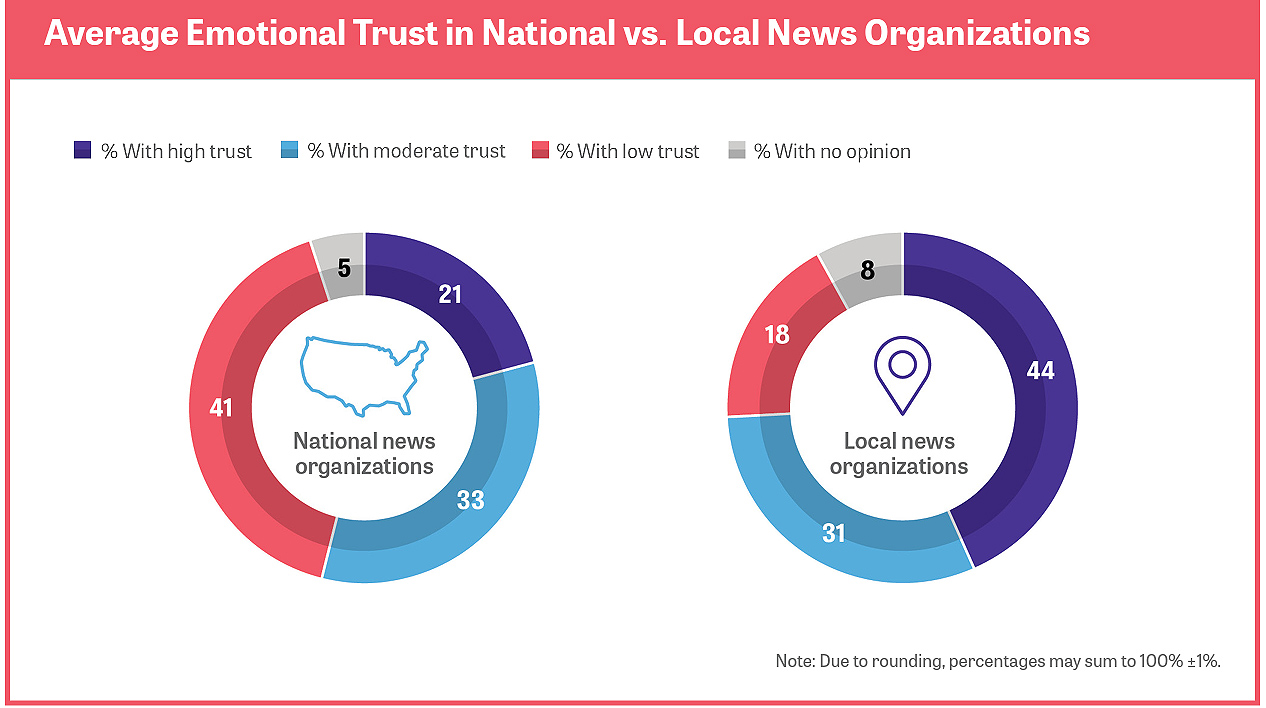
For people in local news, it's not a small consolation. The survey by Gallup and the Knight Foundation, of 5,593 Americans aged 18 and older between May 31 and July 21, 2022, shows a much higher level of trust in local news organizations, driven in large measure by a belief that they care about the impact of their reporting; 53% agreed with that statement and 19% disagreed with it. "The biggest differentiator is that the public feels local news organizations care about the impact of their reporting while national news does not," Knight says in its report.

Graphs by Gallup Inc. from Knight Foundation report; click any image to enlarge
"While past investigation of trust in news has focused on issues of transparency and credibility, recent research has emphasized the affective or emotional aspects of trust — that is, how trust in news is related to how people feel about news outlets," Knight repots. "Emotional trust in news is driven by the belief that news organizations care, report with honest intentions and are reliable. More than twice as many Americans report high emotional trust in local news than in national news; 44% have high emotional trust in local news organizations, compared with 21% who have high emotional trust in national news organizations. . . . Greater emotional trust in local news is consistent across various demographic groups. Variation in levels of emotional trust in local news organizations is less pronounced across demographic groups. For example, 31% of Republicans and 58% of Democrats express high levels of emotional trust in local news — a narrower gap than with emotional trust in national news. This finding is consistent with findings from previous Gallup/Knight studies."

So, Americans trust their local news organizations, but do they really know them? The poll found that 65% agreed with the statement "In general. most local news organizations have the resources and opportunity to report the news accurately and fairly to the public," but the question left much to be desired. Most Americans are not familiar with "most local news organizations," and many if not most of those organizations are having difficulty reporting as much news as they once did or would like to do. Accuracy and fairness are essential, but audiences notice gaps in coverage, and that could have been measured, too.

Bauder describes one other hopeful finding: "If Americans believed local news organizations didn’t have the resources or opportunities to cover the news, they would be more likely to pay for it." Knight reports, "Americans who think local news organizations lack the resources and opportunity to report the news accurately and fairly are more likely to pay for news. . . . Among those who agree, 23% report having paid for news in the past. This percentage nearly doubles (45%) among those who disagree. Those who say local news organizations do not have the resources and opportunity to report the news accurately and fairly are more than twice as likely to be willing to pay for news in the future as those who agree (32% vs. 14%, respectively). These findings mirror previous Gallup/Knight research on local news, which found that Americans who are exposed to information about the financial challenges of local newspapers are more likely to donate to a nonprofit organization that supports local journalism."

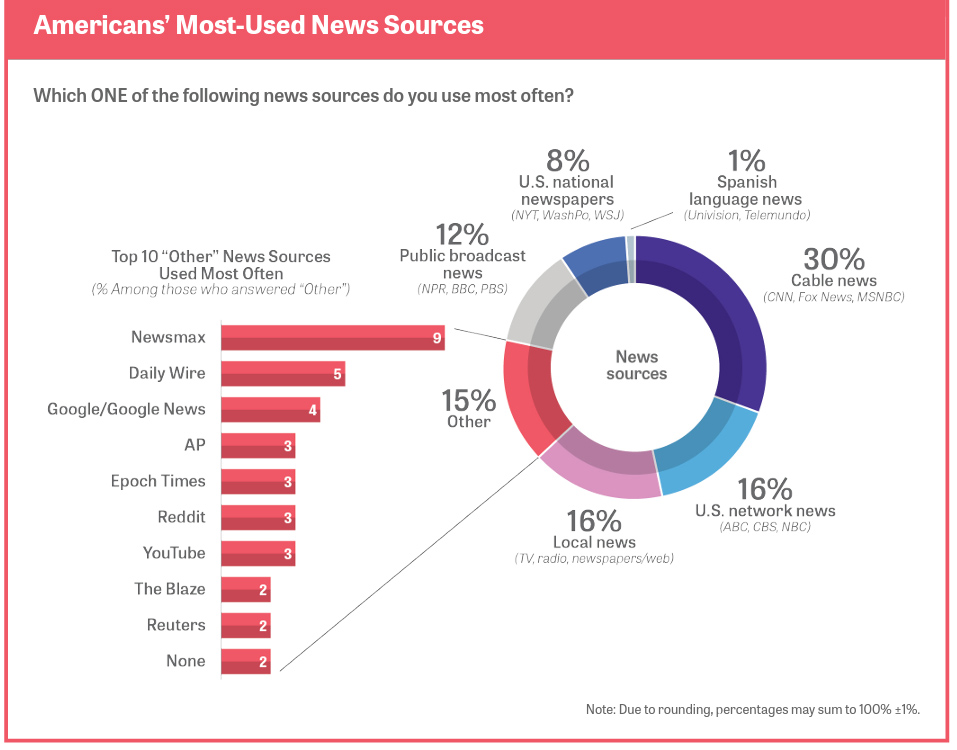
Knight says journalists need to go beyond emphasizing transparency and accuracy to show the impact of their reporting on the public. That recommendation is directed to national news organizations, but it's good advice for local news organizations, too. And the study reaffirms that they need to do that online, because that's where most of the audience is. The poll found that 58% of Americans in mid-2022 reported getting most of their news online, up from 46% in 2019. Television was named by 31%, down 10 points from 2019. Only 3% named printed newspapers or magazines, down from 5%.

Another interesting finding, described by Bauder: "The ability of many people to instantly learn news from a device they hold in their hand, the rapid pace of the news cycle and an increased number of news sources would indicate that more Americans are on top of the news than ever before. Instead, an information overload appears to have had the opposite effect. The survey said 61% of Americans believe these factors make it harder to stay informed, while 37% said it’s easier." That finding doesn't differentiate between national and local news, but the poll seems to confirm a trend pointed out by many observers, that people are paying less attention to local news than they once did. Local news providers must give them reasons to seek it out, make it easy to do so, and make clear its value.

Wisconsin EMT shortage leaves rural responses uncertain

Glidden Ambulance provides emergency medical services
to four northern Wisconsin towns. (Photo by Danielle Kaeding,WPR)
Calling 911? You expect a quick-volley conversation and help to arrive. In many rural communities that depend on volunteers to staff ambulances, that help has been slow or non-existent, as The Rural Blog reported last week. In Wisconsin, the lack of emergency medical technicians is sobering. "A recent survey of ambulance services found staffing and financial challenges have left many on the brink of collapse, leaving them unable at times to respond to 911 calls," reports Danielle Kaeding of Wisconsin Public Radio. "Services in Wisconsin have long-relied on volunteers. . . . Over time, a lack of volunteers and inadequate funding have left some communities struggling to provide service." The survey was conducted in late 2022 by the Wisconsin Office of Rural Health.

James Small, who manages the state's rural emergency medical services outreach program, "said 41 percent of the 218 services that responded didn’t have enough volunteers to respond to 911 calls at times within the last year. The survey found 21% of services only had a crew of two or three people to provide around-the-clock coverage — the bare minimum required in Wisconsin," Kaeding notes. Small told Kaeding, "That's putting them in a very, very precarious position as far as being able to continue responding to calls."

"Cari Broge, service director for Glidden Ambulance, said she has 10 volunteers that receive a stipend to respond to about 100 calls each year for four northern Wisconsin towns," Kaeding reports. "Two of those towns lost service for roughly half a year in 2021 when their previous provider ended its contract. Often, she said, only two people can respond to calls during the work day when it's most challenging to find volunteers." 

Alan DeYoung, executive director of the Wisconsin EMS Association, told Kaeding that the recent survey found 41% of services have six or fewer staff. Rural areas like northern Wisconsin have confronted greater challenges and longer response times, but urban and suburban departments aren’t immune. DeYoung told Kaeding, "Everybody is struggling with staffing. So as your department is unable to staff a 911 call, and you call mutual aid to another department, and they have the same staffing crisis happening, they're not able to go either." At its worst, the survey found 911 calls went unanswered by ambulance services in at least 10 communities.

"The Wisconsin EMS Association wants the state to devote more funding to the issue to help with attracting and retaining people to staff services," Kaeding adds. "Just under one-third or 29 percent said they don’t have adequate funding to operate through this year as communities have faced declining state aid . . . DeYoung noted that communities like Washburn (pop. 2, 000) have passed referendums to exceed their tax levy to address EMS staffing."

Small told Kaeding, "It's taken for granted that if something bad happens, I can just pick up my phone and dial 911, and something good will happen. And we're finding that we took it for granted for a long time because that was the case for a long time, and we're not in that place anymore." 

‘Right to repair’ farm equipment pushed in 11 states; makers cite intellectual-property and environmental issues

A combine harvests grain in northeastern Colorado.
(Photo by Danny Wood via Associated Press)


A big thunderstorm blows through, and your electricity goes out. You wait. You can't fix the electricity on your own and some waiting is expected, but do you want to wait three days? Five days? Should the wait cost you thousands of dollars?

That's the bind many American farmers face when their equipment needs repairs, reports Jesse Bedayn of The Associated Press. Bedayn introduces Colorado farmer Danny Wood as an example: "Wood scrambles to plant and harvest proso millet, dryland corn and winter wheat in short, seasonal windows. . . until his high-tech Steiger 370 tractor conks out. . . . The tractor’s manufacturer doesn’t allow Wood to make certain fixes himself, and last spring his fertilizing operations were stalled for three days before the servicer arrived to add a few lines of missing computer code for $950. . . . [this common plight] has pushed lawmakers in Colorado and 10 other states to introduce bills that would force manufacturers to provide the tools, software, parts and manuals needed for farmers to do their own repairs — thereby avoiding steep labor costs and delays that imperil profits." Wood told Bedayn, “That’s where they have us over the barrel, it’s more like we are renting it than buying it." Wood spent $300,000 purchase his used tractor.

"Right to repair" laws have gained traction, "In 2021, the Federal Trade Commission pledged to beef up its right to repair enforcement at the direction of President Joe Biden," Bedayn writes. "And just last year, Rep. Brianna Titone sponsored and passed Colorado’s first right to repair law, empowering people who use wheelchairs with the tools and information to fix them."

But there is the other side: "Manufacturers argue that changing the current practice with this type of legislation would force companies to expose trade secrets. They also say it would make it easier for farmers to tinker with the software and illegally crank up the horsepower and bypass the emissions controller — risking operators’ safety and the environment," Bedayn reports. "Similar arguments around intellectual property have been leveled against the broader campaign called ‘right to repair,’ which has picked up steam across the country."

Bedayn notes, "Rep. Richard Holtorf, the Republican who represents Wood’s district and is a farmer himself, said he’s being pulled between his constituents and the dealerships in his district covering the largely rural northeast corner of the state. He voted against the measure because he believes it will financially impact local dealerships in rural areas and could jeopardize trade secrets. Holtorf told Bedayn, "I do sympathize with my farmers. I don’t think it’s the role of government to be forcing the sale of intellectual property.”

"The bill’s proponents acknowledged that the legislation could make it easier for operators to modify horsepower and emissions controls," Bedayn reports. "But argued that farmers are already able to tinker with their machines and doing so would remain illegal."

Flora and fauna quickies: Falco the Owl; Great Backyard Bird Count starts tomorrow, trees can add years to your life

Flaco's ability to hunt for himself prompted zoo officials to scale back
retrieval efforts. (Photo by Jacqueline Emery, The New York Times)
Get set! The 26th annual Great Backyard Bird Count will be held Friday, Feb. 17, through Monday, Feb. 20. How? For as little as 15 minutes, perch yourself and participate in this free, fun and easy event that engages bird watchers of all ages in counting birds to create a real-time snapshot of bird populationsParticipants are asked to count birds on one or more days of the four-day event and report their sightings online at birdcount.org.

Falco the Owl, who was inadvertently released from New York City Zoo, has proven that 13 years of captivity can't keep an owl from being an owl. Zookeepers originally feared that Falco would not be able to hunt successfully, but he's a quick study: his activities had included facing off with a Cooper’s hawk, at least one close encounter with a squirrel, foray onto Fifth Avenue near Bergdorf Goodman and catching his own rats for dinner.

The keys to a long life can seem elusive, but here's one idea that isn't tricky: plant a tree. A recent study conducted in Portland, Ore., found that in neighborhoods where a nonprofit planted more trees, fewer people died. The findings are in line with results from other researchers suggesting nature is good medicine for many ailments, including depression and high blood pressure.

Meet a U.S.-based search and rescue team of four humans and a K-9 dog named "Peter Pan." This crew was flown to Turkey in response to the earthquakes to search for people among the rubble. K-9 dogs can differentiate between people who are dead and people who are alive. They can also tell the difference between the scent of someone who's been out in the fresh air and someone who's been confined.

Humor is a powerful weapon against despair. Follow Bipolar Bear as tries to navigate the fictituous WeCare Co., complete with cigar-smoking felines who profit unfairly from a lopsided economy and a corrupt justice system. His fellow outcasts include such characters as an over-educated owl drowning in student debt and a bomb-sniffing puppy suffering from PTSD. Kathleen Founds says her experiences wit the U.S. health-care matrix led her to write this amusing, yet dark tale.
                                                                                                       
Lake Oroville (Photo by Brian van der Brug, L.A. Times)
Photo-journey of Lake Oroville before and after California's epic storms. The largest reservoir in the State Water Project was at 68% of its capacity on Friday, up from 28% just two months ago. The project is a system of reservoirs, canals and dams that serve about 27 million people.

River otters have returned to Florida, and their presence indicates a healthy ecosystem. The otters are native to Florida, but have not always been seen. Some advice: Yes, they are super-cute, but they have a dark side that involves hissing and sharp teeth. If you're walking your dog and and you run across one, go the other way.

Meet Melissa, who works at her family's dairy farm in the small northwest Massachusetts town of Buckland. Melissa is also a professional trumpet player. During Covid, Melissa learned that her cows really enjoyed her trumpet playing. Although Melissa prefers to play in an orchestral group vs. a cow pasture, she's open to hosting a summer concert at her farm someday.