Tuesday, April 11, 2023

Eastern Kentucky downtowns have revitalized, due in part to natives coming home to support small communities

Dusk falls in Hazard (Photo by Ryan C. Hermens, Lexington Herald-Leader)

Philanthropic and government help, and "can-do" attitudes of residents and business owners, have helped some rural Eastern Kentucky towns rebound from years of decline, reports Bill Estep of the Lexington Herald-Leader. Hazard, pop. 5,100, is one of those places. "On a short walk through downtown Hazard, you can buy a T-shirt celebrating Appalachia and a three-wick candle, browse at a book store and a record store, get a latte at a coffee shop. . . The Eastern Kentucky city has seen a resurgence of downtown retail businesses in the last four years. . . . more than 40 businesses have opened on or near Main Street. Nearly all are still afloat, outlasting the worst health pandemic in a century and devastating flooding in the region last summer."

Hazard's flourishing business community has been a long-term project that addressed population and retail losses as coal jobs declined. "Local leaders and business stakeholders set out several years ago to try to reverse that. . . . The city created an incentive program — initially with money from the Foundation for Appalachian Kentucky, then with taxpayer money — to provide grants of up to $5,000 for signs, store fixtures and other needs," Estep writes. "The city and county pooled resources to hire Bailey Richards as downtown coordinator, a position that hadn't existed before." Mandi Fugate Sheffel, who owns the Read Spotted Newt bookstore, told Estep, "I think her position is probably one of the most important parts of what's happening downtown. That was some action put into what they were trying to do."

To the south, "Pineville, Kentucky, was an early leader in using incentives to boost downtown development, including grants and a five-year moratorium on an increase in the property tax even if the value of a renovated property goes up," Estep notes. "Even though Bell County lost population between 2010 and 2020, the downtown area went from 80% vacant eight years ago to 100% occupancy by February 2020, said Jacob Roan, director of the city's Main Street program."

Up the Cumberland River in Harlan, pop. 1,220, a downtown brewery opened, "The Harlan Beer Co., a taproom and restaurant located in a renovated century-old building," Estep reports. "Valerie Long Hinkle has seen the same thing at her business, Hill & Holler, which sells T-shirts and other gifts with an Appalachian theme in Cumberland, a town of about 1,900 people in Harlan County. Hinkle studied architecture at the University of Kentucky and stayed afterward, living in Lexington for 13 years before moving home to Harlan County in 2015 to be closer to family."

Estep adds, "Hinkle said there was once an idea in Appalachia that young people had to leave to be successful, but that is changing." Hinkle told Estep, "I think people are hungry to support their local community. . . They are hungry to be able to shop in downtown. . . . I think that Appalachia is on the cusp of something big."

American agriculture remains vulnerable to cyberattacks; some experts see 'previously unimaginable risks'

Unlike industries such as banking, U.S. agriculture is vulnerable to digital attacks due to a lack of internal support -- and attitudes that prevent information sharing and analysis that could fend off hackers, reports Eric Geller for Wired magazine. "In the past few years, cyberattacks on the meat processing giant JBS Foods and the Iowa farm services firm NEW Cooperative have laid bare the industry's widespread vulnerabilities. . . . . New technologies, including advances in artificial intelligence, are creating previously unimaginable risks, overwhelming a workforce not accustomed to dealing with digital security. . . . food and agriculture is one of only a few critical infrastructure sectors that doesn't have an Information Sharing and Analysis Center, or ISAC, helping companies fight back."

Work at a meatpacking plant Getty Images photo via Wired
Geller notes that U.S. agriculture is filled with protection shortfalls that attract hackers, and "Farmers are also vulnerable to more immediate sabotage. The same remote-access technology that enabled John Deere to remotely disable a batch of Ukrainian tractors stolen by Russian forces could let hackers turn off millions of tractors across the U.S. . . . Inside the massive industrial facilities where most chickens are raised and slaughtered, the temperature and humidity are precisely controlled by internet-connected computers. With control of this system, hackers could engineer a catastrophe."

Geller reports, "Today, food and agriculture is one of four critical infrastructure sectors (out of 16) without an ISAC, along with dams, government facilities, and nuclear reactors and materials. . . .Despite being increasingly vulnerable, Marcus Sachs, director at Auburn University's McCrary Institute for Cyber and Critical Infrastructure Security, says the food and agriculture sector still 'doesn't really understand the threat mindset' as well as higher-profile sectors, like financial services and energy, do. . . . the Department of Agriculture has shown 'very little interest' in cybersecurity, says Sachs, who has tried to prod officials into action."

U.S. Rep. August Pfluger, R-Texas, told Geller, "Agricultural and food security is the foundation of American security. . . . Plenty of folks I've spoken with think there needs to be a dedicated ISAC. . . . Without a stable food supply, society stops functioning." Still, the sector needs to have multiple supports added for protection. Geller reports, "Pfluger's bill, the Food and Agriculture Industry Cybersecurity Support Act, would create new federal resources for companies, require improved coordination between government and industry, and launch a Government Accountability Office review of the sector's situation, including whether an ISAC is necessary."

Meanwhile, "Experts say the government could better use its existing programs to help," Geller writes. "Sachs and his colleagues are even considering helping a coalition of land-grant universities launch an ISAC that would both facilitate information sharing and prepare students to enter the food and agriculture workforce with key cyber skills. . . .Whether or not the sector forms an ISAC, there's widespread agreement that more must be done to counter the growing array of threats endangering these companies and the hundreds of millions of people who rely on them for basic sustenance."

Monday, April 10, 2023

As abortion heads for the high court again, battles among states will provide even more conflicts on the issue

Federal judges recently issued conflicting abortion rulings that will likely send the issue back to the U.S. Supreme Court, the conservative majority of which thought it had left the issue to the states, but conflicts among states over abortion will provide even more court battles, report Geoff Mulvihill and John Hanna of The Associated Press.

Idaho now has a law "making it illegal to provide help within the state’s boundaries to minors seeking an abortion without parental consent," AP reports. "The new law is obviously aimed at abortions obtained in other states, but it’s written to criminalize in-state behavior leading to the out-of-state procedure – a clear nod to the uncertainty surrounding efforts by lawmakers in at least half a dozen states to extend their influence outside their borders when it comes to abortion law.

"At the same time, Democrat-controlled states are advancing and adopting laws and executive orders intended to shield their residents against civil lawsuits and criminal investigations related to providing abortions for women from states where there are bans. But there is no legal precedent giving good guidance about whether states can influence their residents getting abortions outside their borders."

One part of the U.S. Constitution "requires states to respect the laws of other states while another recognizes the right to travel among states and a third restricts the ability of states to impair interstate commerce," AP notes. "Legal experts say that no prior cases are exactly comparable, though state laws have conflicted in weighty ways in the past."

Subsidy program helps close 'digital divide' but process and lack of awareness mean only 1/3 of eligible have enrolled

Photo by John Schnobrich, Unsplash
Low-income families struggle to afford internet service, but there is federal assistance to help them gain access. The program, known as the Affordable Connectivity Program, has struggled to reach consumers. "It has enrolled only one-third  of the eligible population. . . . Experts say there are two reasons the program isn't reaching the people: awareness and process," reports Molly Bolan of Route Fifty. "To improve adoption rates, the Federal Communications Commission announced enhancements to its application process to make it easier for eligible consumers to apply and enroll in the program."

Bolan explains, "The $14.2 billion program provides a discount of up to $30 per month toward internet service for eligible households and up to $75 per month for households on qualifying tribal lands. . . . . according to EducationSuperHighway, a nonprofit working to close the digital divide, up to 51 million households are eligible."

"There is a big lack of awareness that the program even exists, particularly amongst the populations that it intends to serve," Jack Lynch, chief operating officer of EducationSuperHighway, told Bolan. "If you can mobilize [local organizations and institutions] to raise awareness about the ACP through the regular channels they're already using to engage with the folks, that can be a really, really effective strategy in cutting through those both the awareness and the trust issues."

Community outreach through schools, churches and libraries can be costly; however, "New federal funding is available to cities and organizations looking to bolster their outreach efforts. The White House recently announced $73 million in ACP Outreach grants. The funding will help governments and partner organizations with outreach through initiatives like digital campaigns, enrollment events and door-to-door canvassing."

Once consumers are aware of the program and go to sign up, getting through the application process becomes a hurdle. "Two of the biggest barriers to enrollment are understanding eligibility requirements and having the digital skills necessary to sign up," Bolan reports." To address the problem, "EducationSuperHighway developed an interactive online tool in four languages to help people understand their eligibility and what information they need to have to enroll."

"There is still one big challenge for the program on the horizon: funding is expected to run out next year," Bolan writes. "But while nationwide enrollment is relatively low today, the ACP has made a big difference in a lot of communities. Brian Donoghue, deputy director of Next Century Cities, said he expects advocates to push for future congressional support." Donoghue told Bolan: "I see an incredible amount of value in where the program has gotten us. Millions more people are connected to the internet today than when this program started."

As the Sierra snowpack thaws, Califonia braces for flooding disasters; the area produces a fourth of the nation's food

Houses partly underwater after the San Joaquin River
flooded in March. (Photo by Fred Greaves, Reuters)
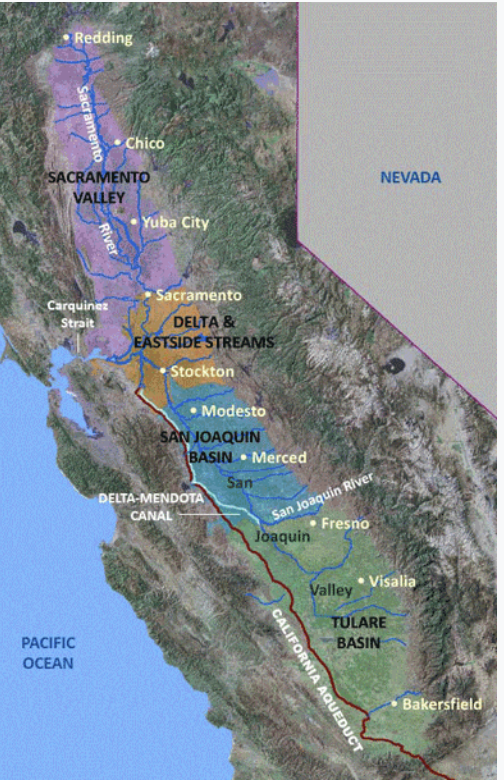
It's spring in California, and the Sierra Nevada snowpack is beginning to melt, but where will all the water go? "Across California's long, flat, usually parched and dusty Central Valley, farmers and residents are used to waiting for water to come. But not like this," report Brianna Sacks and Brady Dennis of The Washington Post. "The snowpack, more than 230 percent of normal, will melt, sending a massive amount of water into the vulnerable, low-lying valley below — and toward flood control systems that in many cases are woefully unprepared to handle it."

The Central Valley (Wikipedia)
The valley lies between the Coast Ranges and the Sierra Nevada. "The possible slow-moving disaster looming above the Central Valley — a densely populated agricultural powerhouse that produces a fourth of the nation's food — has the potential to cause billions in loss and damage," Sasks and Dennis write. "[It will] affect tens of thousands of residents, many of them farmworkers and families with low incomes who have already this year endured significant flooding and sodden crops."

Jeffrey Mount, a senior fellow at California's Water Policy Center, told the Post, "We knew this type of sprawling disaster was coming, and it's the rural communities who get very little help, struggle to rebuild, and then get hit again." The Post reports, "California's water history and issues are complex. Agricultural companies, the Army Corps of Engineers and the state have all been key players in planning and funding projects in areas they deemed most worthwhile to protect. As a result, more rural, disadvantaged and predominantly Latino communities with little political clout have seen far less investment, experts said."

Karla Nemeth, director of the state Department of Water Resources, told the Post the state has been working on an "extraordinary plan needed to move an extraordinary amount of water." Sacks and Dennis report, "For many communities across the valley, there is not much they can do about the looming catastrophe except wait."

The extent of water damage depends on the snowmelt's pace. Andy Bollenbacher, a meteorologist with the National Weather Service in California, told the Post, "It's difficult to speculate when this will happen. . . .There's no real good analog, especially because there's so much water up there." The Post reports, "Ideally, the snowpack will melt slowly over the spring and summer. But so-called 'rain on snow' events, or a scorching and extended heat wave, could send catastrophic amounts of water racing toward communities downstream."

The Post explains, "California has always had problems managing for floods, said Jay Lund, a professor of engineering at the University of California because protecting profitable crops from drought usually takes precedent. . . . The melting snow, however fast it arrives, will probably bring more than a colossal amount of water to the valleys below the Sierra Nevada. It will also bring with it renewed questions about how California should deal with similar winters of the future and the weather extremes that are becoming more common."

Opinion: My garden was ruining the Earth; yours is probably no better; all you really need to do is plant an oak tree

Flowers on a dogwood bloom in Bethesda.
(Photo by Bonnie Jo Mount, The Washington Post)
Dana Milbank, political columnist for The Washington Post, has a confession to make.

"For 20 years, I found the latest, greatest horticultural marvels. . . . In between them flowed my lush, deep-green lawn. I core-aerated, I conditioned," Milbank writes. "When it comes to the world's biodiversity crisis — as many as 1 million plant and animal species face near-term extinction because of habitat loss ― I am part of the problem. I'm sorry to say that if you have a typical urban or suburban landscape, your lawn and garden are also dooming the Earth."

Now that he understands "the magnitude of my offenses. . . I'm in 'basic training' with the state-sponsored Virginia Master Naturalist program," Milbank reports. "While others sleep in on rainy weekend mornings, my unit has us plebes out in the wetlands distinguishing a yellow-bellied sapsucker from a pileated woodpecker."

Matt Bright, who runs Earth Sangha, a nonprofit native-plant nursery, walked Milbank's yard, and the homeowner reports:
He aimed my daylilies
: 'I would remove them all. Those have also become badly invasive.'
He spied my creeping jenny on a slope: 'Another nasty invasive.'
He condemned to death my Rose of Sharon shrubs
(natural areas 'have really been torn up by these guys')
Worst was my row of nandina
: 'You definitely want to remove it.' Its cyanide-laced berries poison birds.
And Bright assured me, I wasn't a particularly egregious offender; my one-sixth acre lot in town is typical of the urban/suburban landscape.

Landscaping is just the beginning of problems. Milbank writes, "'Forty percent of the world's plants are at risk of extinction, and we know that's being driven by climate change and habitat loss,' said Jennifer Bernstein, chief executive of the New York Botanical Garden. . . . Here in the United States, urban sprawl is worsening both of the interrelated crises of climate change and habitat loss. . . . Lawns suck up water, and they don't sequester as much carbon as forests and prairies."

In sum, "The deck is stacked against nature in this fight," Milbank adds. "Demand for native plants outstrips supply. A native plant sale last month at the National Arboretum, for example, was scheduled to run for six hours, but the place had been cleaned out after just three."

Milbank offers some words of hope: "Despite the daunting obstacles, it doesn't have to be that hard to do the Earth some good. In fact, it's as simple as this: If you want to save the planet, all you really need to do is plant a single oak tree. Doug Tallamy, the godfather of the native-plant movement, told Milbank, "You can plant one tree. Plant a tree, put a bed under that tree, and all of a sudden, you've got less lawn. If you make it a good tree, you've got a powerful addition to your yard. And if that's the only thing you do in a year, you've still made an important contribution."

Friday, April 07, 2023

Gannett creates news deserts or ghost newspapers; some digital startups fill gap, but it's hard, especially in rural areas

"America's largest newspaper company is creating news deserts," NPR headlines over an interview with Joshua Benton of the Nieman Journalism Lab at Harvard University, about Gannett Co.

"Gannett owns a lot of very small newspapers, a lot of weekly newspapers, a lot of very small daily newspapers," Benton told host Adrian Florido. "Those larger weeklies and smaller dailies are in a really tough position economically. It's very difficult to manage the cost while emphasizing digital subscriptions and getting enough of them to make things work out. There are also communities where there often isn't as much of an alternative in terms of a local television station or a local digital news outlet that's covering the area. So in a lot of communities, there just aren't a lot of options. And these places will become more like a news desert."

Or a "ghost newspaper." There is no agreed-upon definition of those terms, but both may apply to Gannett markets like Salinas, Calif., where at last report the Salinas Californian had no reporters and the only local news was obituaries. Benton cites The Register-Guard in similarly sized Eugene, Oregon, which was owned by a local family until 2018 when it sold to GateHouse, "which was then merged into Gannett. And in that time, the newsroom has gone from over 40 employees to what on its current staff listing is seven."

Florido asked Benton if he saw "any solutions here for the local communities that are being left behind in these sort of information deserts." Benton said, "I think it is very difficult to manage the transition from a print daily to an effective digital news outlet. It's often much easier to start from scratch. It's not happening everywhere. But there are communities across the country where smart digital outlets are growing to the point where in some cases, they have bigger newsrooms than the local daily newspaper does. It is possible, but it's a challenge." Especially in rural areas.

And what is the future of local news? "I see a lot more uncovered city council meetings. I see a lot more corruption that doesn't get noticed. I see a lot more uninformed voters, more people who take their cues for how they view their government from national media and the politicized world there as opposed to their local government. There certainly are bright spots. There are green shoots going up, but the challenge is just very difficult."

Some places will shift from rural to metropolitan this year, and that will likely make the rest of rural America look worse

Screenshot of part of Daily Yonder interactive map that
shows major growth in rural counties near metro areas
in Texas, Oklahoma, southwest Missouri, Tennessee,
Georgia and elsewhere. (Rural Blog adaptation)
"Rural" is defined in many ways, and because one major definer is changing its definition, "Some of the nation's most economically successful 'rural' counties will be reclassified as metropolitan, moving their populations and economic output from non-metropolitan to metropolitan," writes Saran Melotte of The Daily Yonder. "This year, the Office of Management and Budget will create a major revision for its list of metropolitan statistical areas based on 2020 Census data. . . . It’s one of the most common ways that policy makers, federal agencies, and researchers use to define what we mean by 'rural'."

MSAs are defined by a combination of population figures and commuting patterns. The 2020 census found that the rural counties that were growing were thsoe closest to metropolitan areas, and some of them have likely grown so much that they will be reclassified as metropolitan. In the last reclassification, in 2013, "OMB shifted 112 non-metropolitan counties into the metropolitan column, moving 5.7 million residents into metro areas," Melotte notes. Their counties either gained enough population to have a central city of at least 50,000, or the share of the county's workers "who commuted to an adjoining metropolitan county grew past 25%. The latter factor is "more commonly the cause of reclassification," according to Daniel T. Lichter of Cornell University and Kenneth M. Johnson of the University of New Hampshire. They call this the paradox of rural population decline and say it "gives a falsely bleak impression of rural America," Melotte writes.

"You might think you know rural when you see it. But what if you had to provide a clear definition?" Melote asks. "That's where things get messy. Even geographers, demographers, and statisticians can't agree on a single definition of rural. Depending on which definition you use, rural Americans either comprise 46 million residents or over 60 million residents. Rural populations are either growing or stagnating, economically vibrant or persistently poor, predominantly white or rapidly diversifying. . . . Demographers stress the importance of considering how our definitions might obscure the truth about rural America. . . ."When counties that have large rural populations are lumped into the metropolitan category, it can make rural America look poorer and smaller than it really is."

Melotte notes, "Federal agencies use over a dozen definitions of rural. But at their core, those definitions are generally variations on two categorization systems," the MSA or the Bureau of the Census definition, which recently raised the threshold for an urban place from 2,500 to 5,000 or 2,000 housing units.

Got milk? Gen Z says 'Nope.' Coffee drinks, water, nut milks and Gatorade and have moooved in

Taylor Swift's 'Got Milk' mustache from 2012 (YouTube)
Things Gen Zers do
: Go to brunch (a lot! and pay with Venmo), follow Scrub Daddy on TikTok, and diss anything that takes more than 60 seconds. But they're not into drinking cow's milk. This group of "teenagers and young adults grew up ordering milk alternatives at coffee shops and toting water bottles everywhere," reports Kim Severson of The New York Times. "Turned off by the no-fat and low-fat milks served at school, worried about climate change and steeped in the increasing skepticism toward the dairy industry on social media, many of them have never embraced milk. Last year, members of Generation Z bought 20 percent less milk than the national average, according to the consumer market research company Circana. . . . Dairy milk's real competition is other beverages, like bottled and tap water and specialty coffee drinks."

The dairy industry took notice and "has embarked on a full-frontal marketing assault intended to do what the 'Got Milk?' mustaches on celebrities like Taylor Swift and Dennis Rodman did for previous generations. Yin Woon Rani, the chief executive of the Milk Processor Education Program, a marketing and education arm of the dairy industry, told Severson, "We have to reclaim milk's mojo." To reclaim said mojo, Severson reports, "Marketers are trying to reboot milk as a sports drink for Generation Z. . . . Although the science about milk's health benefits and drawbacks isn't settled, some studies have shown that chocolate milk contains basic electrolytes and a precise ratio of carbohydrates to protein that can help muscles recover after workouts."

There are several parts to dairy's big push. The MPEP began the "26.2 project, an ambitious effort to provide training, gear, advice and other support to every woman who runs a marathon in the United States this year," Severson reports. Women who join the program are featured on the Gonna Need Milk website and get to join #TeamMilk. . . . Dairy is also making a play for gamers. Dairy Management Inc., a trade organization, hired the gaming superstars Preston Arsement and Jimmy Donaldson to introduce seven new cows to Minecraft. The two streaming celebrities heaped love on the nation's dairy farmers and explained sustainable dairy-farming practices."

Milk is big but has lots of competition." Some have turned to nut milks and other plant-based alternatives, whose sales are expected to grow by more than 9 percent a year through 2027, far faster than milk." Severson reports. Maybe the mojo is key since nut milks aren't the real problem for dairy. Curt Covington, senior director of partner relations at AgAmerica, an agricultural lender, told Severson, "People come to work with a Gatorade or a Coke in one hand and a Starbucks cold brew drink in the other. . . . It has clearly taken away from the milk sector." Severson adds, "All this is not to say that young people don’t eat plenty of cheese, yogurt and ice cream."

As seed and food companies invest in Ukrainian farms, Ukrainian refugees trek to help tornado victims in Mississippi

Agriculture was responsible for 40% of Ukraine’s exports
before the war. (Photo by Julia Kochetova, Bloomberg News)

What's it like to farm while your country is at war? Ukrainian farmers can tell you. "Equipment has been destroyed, land has been expropriated and mined and export routes choked off. Financing is hard to come by," report Patrick Thomas and Alistair MacDonald of The Wall Street Journal. "Foreign countries and some of the world's largest agriculture companies are donating or lending hundreds of millions of dollars to Ukrainian farmers. . . . even as the war shows little sign of ending soon."

Farmers need seeds, which Ukrainian farmers struggle to afford. "Seed giants such as Bayer and Corteva have stepped in to help supply farmers with products for this year's harvest. Bayer said it had donated about 40,000 bags of corn and vegetable seed, worth about $2 million," Thomas and MacDonald write. "Bayer has said it was investing some $38 million in a seed plant in the country. Corteva said it intended to increase corn-seed production in the region by 30% over the next five years."

Ukrainian farmers also need export help. "Grain merchants including Cargill, Archer Daniels Midland and Bunge have said they intended to keep shipping crops from the country," the Journal reports. Japan and Canada have also delivered aid, and "foreign banks, including Credit Agricole of France and Austria's Raiffeisen Bank International  have taken part in a government plan that has lent more than 5,000 farmers about $2.43 million," Thomas and MacDonald report. "For many Western companies, the help could bolster crucial partners struggling during the war. It also could preserve or strengthen these companies’ reputations with local farmers and their position in the country, which is an important agricultural exporter, analysts said."

Meanwhile, seven Ukrainian refugees who had resettled in Minnesota headed to Mississippi to help "several towns in Mississippi recovering from a devastating tornado that killed at least 25 in late March," reports Daniel Wu of The Washington Post. "They made the 16-hour drive south to donate bottled water and volunteer with aid workers, buoyed by the idea that they could help a community facing a similar struggle to theirs." Rfugee Denys Pavliuk told Wu through an interpreter, “We had to leave our home, and they don’t have a place to go back, either.”

From left: Viktoriia Hasiuk, Taras Zhmurko, Sofiia Rudenko, Iryna Hrebenyk, Dmytro Fedirko, Denys Pavliuk and Nazar Teteruk in front of the van of water bottles they delivered to towns in Mississippi on March 29. (Photo by The American Service via The Washington Post)

Thursday, April 06, 2023

Postal inspector-general report on rural service could help rural areas and their papers stave off post-office closures

Office of Inspector General graphic, adapted by The Rural Blog
The U.S. Postal Service makes rural newspaper publishers gnash their teeth, but its Office of Inspector General has given the papers some ammunition to use as they lobby Congress.

Amid concern that USPS will close more rural post offices because they lose money, the OIG issued a summary of its recent reports on rural service this week, along with a handy graphic.

"We found nearly two-thirds of post offices in rural areas cost more to run than the revenue they bring in. In contrast, only around 7 percent of urban post offices have costs that exceed their revenues," the summary said, adding, "The law protects postal services in rural areas by prohibiting the Postal Service from closing small post offices just because they operate at a deficit."

Nevertheless, "USPS does regularly close rural post offices and cites other reasons," National Newspaper Association Public Policy Director Tonda Rush told The Rural Blog. "USPS is going to close more post offices and subject many more to radical changes as it introduces new sorting and delivery centers, which will cause letter carriers to shift their home base to a central, regional facility."

Congress will decide these issues, and NNA and  its Postal Committee "already have procedures in place to work out as much disruption as possible for newspapers," Rush said.

The OIG summary and graphic both have a pointed last line: "By law, the Postal Service is allowed to ask Congress for up to $460 million annually to cover the cost of providing rural service. But it has not requested these funds since 1982."

Feral swine from Canada threaten Minn., No. 2 pork state; in Georgia, landowners start trapping them in corrals

Feral swine can be attracted to a feeder, which can then be moved
to a corral where they can be shot. (Photo from The Oglethorpe Echo)
Feral swine have come to Minnesota, and in Georgia, landowners are starting to trap them in corrals so many more can be shot and killed at one time.

"Minnesota has long enjoyed its status as a state free of wild pigs, avoiding the billions of dollars of damages suffered each year by other states from invasive feral swine," reports Madison McVan of Investigate Midwest. "Now, Canadian 'super pigs' are threatening the state, and pork producers and regulators are concerned about the destruction and disease the animals could bring if they were to establish a population in Minnesota."

Wild swine are smart and hearty. "They have no natural predators besides humans. . . . The Department of Agriculture's Animal and Plant Health Inspection Service estimates that feral hogs cause up to $2.5 billion in damages nationwide per year," McVan writes. "The animals consume crops, destroy fencing, transmit diseases and parasites, and contaminate bodies of water by wallowing and defecating. . . . Once feral pigs take over a territory, it's nearly impossible to eradicate them, said Eric Nelson, wildlife damage program supervisor at the Minnesota Department of Natural Resources."

The swine from Canada are descendants of hybrids created by breeding domestic pigs with wild boars for more hardiness. "In some cases, farmers released them from fences due to economic hardship during Canada's droughts of 2001 and 2002," McVan reports. "There is a very legitimate risk and concern about them coming straight into Minnesota," second-largest pig producer in the U.S. The Minnesota Pork Producers Association worries about diseases spread by feral swine, "especially African swine fever," which has no vaccine or treatment. "Farmers can lose entire herds to the disease, and countries often pause imports" from nations where the disease is spreading.

In Georgia, Morgan Quinn and Jack Rhodes of The Oglethorpe Echo are covering the feral-swine problem, and report that vegetable farmer Kendall Strickland has concluded that the best way to reduce the population is attractign them into corrals where they can be trapped and disposed of. “If you just shoot one or two at a time, you’re not really getting ahead of the problem in any type of way,” Strickland told the Echo. Here's a guide to how it's done in Scotland.

Farmers are bullish on biodiesel vs. ethanol, but biodiesel's five-year outlook is not as clear to them, Purdue reports

As demand for biodiesel increases, it may outpace ethanol as a renewable energy source. "Farmers are far more bullish about the chances of expansion of the renewable diesel industry than in ethanol, the dominant 'green' fuel in rural America, said a Purdue University poll on Tuesday," reports the Food & Environment Reporting Network. "The telephone survey for the monthly Ag Economy Barometer also found nine of 10 farmers expect higher soybean prices at the farm gate as more and more renewable diesel fuel reaches the market."

Farmers have differing views on what the biodiesel market will look like in five years. "Some 46% of farmers said they believed the renewable industry would be larger; a quarter said they believed the ethanol industry would be larger; 55% said they expected it would be 'about the same' size," FERN reports. "Larger production of renewable diesel would boost soybean prices, said the lion's share of producers polled by Purdue."

As an alternative fuel, "Renewable diesel is an infant industry with 2022 production of 2.6 billion gallons," FERN reports. "But the number of plants producing the fuel could double, to 32, by the end of 2025, which would raise production capacity to 6 billion gallons, said the farmdoc daily blog last week. 'The renewable diesel boom that began in earnest during 2021 looks to continue unabated over the next few years. Driven by policies in place to stimulate investment, another doubling of renewable diesel capacity by the end of 2025 appears to be feasible.'" The Ag Economy Barometer is available here.  

Report for America corps members work with high schools

Raegan Miller works at KRBD in Ketchikan, Alaska.
Report for America
 says its corps members are working with thousands of high-school students across the nation to interest them in journalism and give thme some basic training.

Raegan Miller, who covers the Native and Asian American communities for KRBD in southeast Alaska, has been working with an English class at Revilla High School in Ketchikan. She told RFA, “When we started they had no experience with journalism, with writing professionally, some of them were still struggling to put together an essay or meet deadlines. We started at the building blocks of a story, and we worked up to quotes, how you build a story, how you find sources and we worked up to the point where every Wednesday that I go in we have a roundtable and each is working independently on their stories.” 

"These types of mentorships repeat every week in classrooms all over the country," wrote Kevin Grant, RFA co-founder and chief partnerships officer. "In the last year alone, our corps members have worked with more than 3,000 youth adding to a total of over 5,800 since the start of the program. Not all of them will become journalists, but students walk away with a better understanding of what’s news and how it differs from misinformation. And for some, it might be the start of a journey open with possibilities."

Corps member Linsey Dower, who works with students at McKinley High School in Honolulu, told RFA, “The way that some students have so much passion for the subjects they write about is surprising to me. They truly want to understand the topics they report on and are thoughtful about how they convey new ideas to their readers. Their genuine interest in their work shows me how much potential each of them has as journalists, whether they choose that career-path or not.”

Grant writes, "That potential is present in all the young people of America. It only needs someone to unlock it. The volunteer work of our corps members is helping form a more critical and better prepared generation that we’re sure will be instrumental for the future of journalism. If you want to learn more about our service projects or if you would like to have a corps member working with the youth of your community, check out our site and help us support this valuable initiative."

Why an AR-15 is so lethal: bullets fired at very high speed

Screenshot of Post 3-D animation of AR-15 bullet impact*
What does the average American know about the AR-15? It's powerful? Controversial? It's both, but why? It's about the automatic rifle's bullets and their speed.

"The AR-15 fires bullets at such a high velocity — often in a barrage of 30 or even 100 in rapid succession — that it can eviscerate multiple people in seconds. A single bullet lands with a shock wave intense enough to blow apart a skull and demolish vital organs," report N. Kirkpatrick, Atthar Mirza, and Manuel Canales of The Washington Post. "The carnage is rarely visible to the public. Crime scene photos are considered too gruesome to publish and often kept confidential. . . . Medical examiners who, in some cases, have said remains were so unrecognizable that they could be identified only through DNA samples."

Joseph Sakran, a gunshot survivor and a trauma surgeon at Johns Hopkins Hospital, told the Post, "It literally can pulverize bones, it can shatter your liver and it can provide this blast effect." The Post explains, "The bullets from an AR-15 are uniquely lethal. . . . Consider a .223-caliber-sized round inside an AR-15. What makes the weapon so deadly is the speed of that bullet. It is small and light. Its cartridge holds enough propellant to send the bullet flying out of the barrel at a speed that would cross six football fields in a second."

Handgun rounds are heavier and slower. "Any bullet can kill, and instantly, when it hits a vital organ," the Post reports. "The higher speed of a bullet from an AR-15 causes far more damage after it hits the body and drastically reduces a person's chances of survival." Trauma surgeon Babak Sarani, an authority on casualties from mass killings, told the Post, "As that bullet slows down, that energy is so massive it has to go someplace, and your body will literally tear apart."

"In a hypothetical scenario, the bullet bursts into the chest cavity. It shreds lung tissue, severs nerves and vessels and causes massive bleeding. It also begins to tumble, taking a chaotic path in the body," the Post writes. "The speed at impact creates a blast effect, like the wake that follows a boat, causing internal injuries far outside the bullet's path."

And finally, "The bullet from the AR-15 leaves behind a gaping exit wound. The 9mm bullet fired from the handgun has a much smaller exit wound," the Post adds. "In this scenario, with immediate medical care and minimal bleeding, the victim has a chance at surviving the 9mm shot to the chest. . . . The bullet from the AR-15, however, causes torrential bleeding that is quickly lethal. . . . It works with brutal efficiency."

*Washington Post editor’s note: We are publishing these 3D animations to show the destructive power of the AR-15. The images may disturb some people.

Wednesday, April 05, 2023

Wis. puts on top court a judge who broke norms by taking positions on big issues; some rural counties shifted her way

Janet Protasiewicz, center, celebrates her victory.
(Photo by Mike De Sisti, Milwaukee Journal Sentinel)

In the latest twist on Wisconsin politics, "Voters on Tuesday chose to upend the political direction of their state by electing a liberal candidate to the State Supreme Court, flipping majority control from conservatives, reports The Associated Press. Thus, the court is likely to reverse the state's 1849 abortion ban and "end the use of gerrymandered legislative maps drawn by Republicans," reports Reid J. Epstein of The New York Times. "Janet Protasiewicz, a liberal Milwaukee County judge, overwhelmingly defeated Daniel Kelly, a conservative former Wisconsin Supreme Court justice who sought a return to the bench."

The race was officially nonpartisan but Democrats lined up for Protasiewicz and Republicans for Kelly. Some rural communities that voted for Barack Obama in 2012 and then twice for Donald Trump returned to the "Democratic" column. Abortion-rights supporters credited the U.S. Supreme Court's overturning of Roe v. Wade, which reactivated the state's old abortion law, for the shift. "Rural voters moved 5 points toward the Democratic candidate compared to the 2020 presidential and 2022 U.S. Senate elections," The Daily Yonder reports. But that was not as much a shift as was seen in metropolitan areas.

"Judge Protasiewicz, 60, shattered long-held notions of how judicial candidates should conduct themselves by making her political priorities central to her campaign," Epstein writes. "She made explicit her support for abortion rights and called the maps, which gave Republicans near-supermajority control of the Legislature, 'rigged' and 'unfair.'. . . The contest, which featured over $40 million in spending, was the most expensive judicial election in American history. Early on, Democrats recognized the importance of the race for a swing seat on the top court in one of the country's perennial political battlegrounds."

"Justice Kelly, 59, evinced the bitterness of the campaign with a testy concession speech that acknowledged his defeat and portended doom for the state," and said Protasiewicz was "not a worthy opponent," Epstein reports. "In an interview at her home before the results were known, Judge Protasiewicz (pronounced pro-tuh-SAY-witz) attributed her success on the campaign trail to the decision to inform voters of what she called 'my values,' as opposed to Justice Kelly, who used fewer specifics about his positions."

A high-school newspaper covers LGBTQ+ issues and gets closed by the school district; ACLU files federal lawsuit

Marcus Pennell holds a June 2022 edition of the
Viking Saga. (Photo courtesy of Joshua Foo)
A high school in Nebraska is defending a federal lawsuit after it closed a school newspaper that reported on LGBTQ issues, reports Zach Wendling of The Grand Island Independent: "The American Civil Liberties Union of Nebraska filed on behalf of the Nebraska High School Press Association and a former student journalist, Marcus Pennell. The lawsuit alleges violations of the rights to be free from viewpoint discrimination and retaliation and the right to receive information. . . . District officials shut down Grand Island Northwest High School's student newspaper, the Viking Saga, last June. One article in that month's edition, written by Pennell, addressed Florida's so-called 'Don't Say Gay' law, but other articles were unrelated."

While school officials "have stated the decision to shutter the paper days after the June edition went to print was unrelated to its content," Wendling writes, "public comments and internal emails suggest otherwise. . . . Zach Mader, vice president of the Northwest Public Schools Board of Education, told the Grand Island Independent last summer there was 'a little bit of hostility amongst some' to the paper. . . . 'There were editorials that were essentially, I guess what I would say, LGBTQ.'. . . Emails between Dan Leiser, school board president, to Superintendent Jeffrey Edwards were also included. . . Leiser said students should not be allowed to write opinion articles in a publication paid for by taxes because platforms such as Twitter, Facebook are available."

"Nebraska High School Press Association Executive Director Michelle Hassler said in a statement that litigation 'is not a step that we take lightly'," Wendling reports. "'Our involvement hopefully speaks to our level of concern about what happened at Grand Island Northwest and the implications for the students we serve. . . . Our mission is to support and advocate for Nebraska's high school media, and that's exactly what this case aims to do.'. . .  Hassler continued that student journalists have a right to learn and hone their skills consistent with the First Amendment of the U.S. Constitution." Pennell told Wendling, "We have a right to be who we are and to write about our lives. I am hopeful that censorship is not the end of this story."

Goat's 9-year-old keeper didn't want her slaughtered, so Mom saved the animal; then the law came with a warrant

Jessica Long’s 9-year-old daughter with her goat, Cedar.
(Photo courtesy of Advancing Law for Animals)
A mother saved her daughter's goat, sold at auction, from the slaughterhouse. County-fair officials took offense and sent detectives to apprehend it.

"Thus began the legal saga of Cedar the goat, a 7-month-old white Boer goat with chocolate markings framing its face who is now the subject of a federal civil rights lawsuit naming Shasta sheriff's officials, Shasta County, the Shasta District Fair and other defendants who are accused of involvement in the apparent slaughter of Cedar for a community barbecue," reports Sam Stanton of The Sacramento Bee. 

"Every day for three months, Jessica Long's young daughter walked and fed her goat. . . But when it was time for Cedar to be sold and slaughtered at the Shasta District Fair last year, the 9-year-old just couldn't go through with it," Stanton reports. "The animals are then entered in an auction to be sold and slaughtered for meat in hopes of teaching children about the work and care needed to raise livestock and provide food."

Once Long realized her daughter was not ready to part with her goat, she "decided to break the rules and take the goat that night and deal with the consequences later," reports Salvador Hernandez of the Los Angeles Times. Long wrote Shasta District Fair Chief Executive Melanie Silva, offering to reimburse the buyer the winning $902 bid and saying, "Our daughter lost three grandparents within the last year. . . . I couldn't bear the thought of the following weeks of sadness after the slaughter of her first livestock animal." Silva replied, "Making an exception for you will only teach [our] youth that they do not have to abide by the rules. . . . This has been a negative experience for the fairgrounds as this has been all over Facebook and Instagram."

When Long did not return Cedar, B.J. Macfarlane, livestock manager for the Shasta Fair Association, called the cops. "Armed with a search warrant, detectives drove more than 500 miles across Northern California in search of the goat," Stanton writes. "Echoing language used when law enforcement searches a home for drugs, the warrant allowed deputies to 'utilize breaching equipment to force open doorway(s), entry doors, exit doors, and locked containers' and to search all rooms. . . . any kind large enough to accommodate a small goat'." 

Cedar was found, "taken and slaughtered," Hernandez reports. Long's suit claims fair officials and the county "committed an 'egregious waste of police resources' and violated her and her daughter's Fourth Amendment and 14th Amendment rights protecting them from unreasonable searches and seizures, and due process. Long and her attorneys allege the dispute was a civil matter she was willing to resolve."

Officials declined to comment. Ryan Gordon, an attorney with Advancing Law for Animals, told Hernandez, "A child can't be held to the same standard as an adult can. When she wanted out, she had an absolute right. . . . It's shocking. It's a little girl's goat, not Pablo Escobar."

Flora/fauna quickies: How snails travel so far, pet-inspired art, what to do when baby bird falls from a nest, and more

Sybil Gorby with an heirloom tomato she grew
in her garden. (Courtesy family photo)
Big-vegetable photos aren't just for rural weeklies. The Washington Post spotlights Sybil Gorby, 92, who has been planting tomato seeds from the same lineage since 1965. "Sometimes, the seeds turn into giant heirloom tomatoes, including one from last year's harvest," reports Sydney Page. Gorby's daughter, Sandy Marody, "shared a photo of her mother holding the large fruit in a Facebook group called 'Appalachian Americans.'. . . . People were quite impressed with the photo of Gorby proudly cupping the supersized tomato in her hands."

The "alpha wolf" myth has a long history as a paragon of power and dominance. But new research shows the myth is false. Researcher David Mech describes the wolf as "one of the wildest and shyest of all the animals in the northern wilderness," reports Rivka Galchen of The New Yorker.


Thom van Dooren wonders this about snails: "How do organisms that are so sedentary end up being so incredibly widely dispersed?" Find out how these notoriously slow animals get around.


Robin fledgling (Photo by Jeanette Tasey, Audubon)
A baby bird is out of its nest. Now what? Do you attempt to help? Walk away feeling bad but not wanting to make things worse for the little guy? This timely article gives some advice

As a child, Jessica Gauley, a kayak tour operator, once romped about Honey Island Swamp in Louisiana. Now she's working to reclaim a wetland, reports Anya Slepyan of The Daily Yonder. "Poisonous pollutants from industrial plants had turned nearly 10 acres of the healthy, primeval swamp into a toxic wasteland. . . . She calls the area the 'kill zone' because of the contaminants' toll on the local wildlife. . . . Gauley began cleaning up the kill zone, one kayak-load of trash at a time. . . . . a tour group she lead offered to help her. . . .The zone still has a long way to go, but Gauley has already started workshopping a new name for the area: the resurrection swamp."


Calling all pet artwork! Beth Novey of National Public Radio zipped out a missive asking for submissions, "We were curious to see what other pet-inspired artworks were out there, so we asked you to share some of yours, and dear readers, you did not disappoint. Below is just a small sampling of the hundreds of masterpieces we received." They've got a cat snow sculpture, "The Goatie Boys" Christmas drawing, Meow Lisa, and artwork with real horse hair.


Billy the Goat was a popular sight on Lake Cumberland
in Southern Kentucky. (Photo courtesy of Matthew Blum)
A huge Kentucky lake has lost one of its longtime fauna friends. "Billy the Goat, a wild creature who had made his home along the busy shores of Lake Cumberland, is being mourned and remembered by the legions of lake users who had taken a shine to him, after recently being found dead, apparently by gunshot," reports Christopher Harris of the Somerset Commonwealth Journal. "And like Billy's exploits in life, the news of his death has become something of a local viral sensation."

There's just no explaining some couples. "A rescue dog and goat are best friends. A shelter put them up for adoption as a pair," Cathy Free of The Washington Post reports. Jennifer Federico, director of animal services at the Wake County Animal Center, told Free, "It's a weird duo, but it works for them. Who are we to judge? They obviously love each other."

Citizens' Institute on Rural Design is seeking rural and tribal communities to apply for four local design workshops

A vacant building with a large parking lot was transformed into a community center for the arts
when the area partnered with CIRD. The space is shared with the local high school.

The Citizen’s Institute on Rural Design applications are now open until April 21, 2023! CIRD is a program of the National Endowment for the Arts, in partnership with the Housing Assistance Council and design partner, To Be Done Studio. It will offer at least four Local Design Workshops that address the selected community’s specific rural design challenge, and a Design Learning Cohort program that will invite at least 15 rural communities to engage in peer learning and expert-led sessions online.

All rural and tribal communities of 50,000 people or less are eligible to apply for the CIRD opportunities. It encourages applications from nonprofits, tribal or municipal governments, regional planning and arts organizations, and other community partners. It says it hopes to hear from a variety of rural communities from a wide range of backgrounds, geographies, and capacities. Visit ruralhome.org for a full press release.

The Request for Applications contains further details about the program goals, eligibility, benefits, expectations, and a preview of all the application questions.

To learn more about the CIRD program and its application process, check out the recent CIRD Informational Webinar recording. Next month, CIRD staff will be hosting virtual office hours on April 11 from 12 to 5 p.m. ET (Zoom link here) to assist potential applicants.

To enlarge any image, click on it.