Friday, May 20, 2022

Trump administration's efforts to tilt the census may have cost states that voted for him seats in the U.S. House

"The Trump administration spent an extraordinary amount of time and effort messing with the census over four years. Its apparent aim: It wanted to exclude undocumented immigrants from population counts, thereby allowing Republicans to draw more favorable maps in redistricting and gain more ground in the House," Aaron Blake writes for The Washington Post. "The effort ultimately failed. And it now seems possible that these efforts might have played a role in costing red states seats." 

According to a new Census Bureau report, the census significantly miscounted 14 states; in six, the counts are estimated to be off by 4 percentage points or more. "A trend you might notice if you peruse the data is that most of the states with significant overcounts were blue states like Hawaii (e.g., Delaware, Rhode Island, New York and Massachusetts), while most with undercounts were red, Southern states like Arkansas (e.g., Tennessee, Florida, Mississippi and Texas)," Blake notes.

That means that red states might not have received as many U.S. House seats as they should have during reapportionment, while blue states might have received more. So many factors are in play that it's difficult to estimate the exact impact of the miscounting, but it seems clear that blue-leaning states Minnesota and Rhode Island got to keep seats they should have lost, and red-leaning states Florida and Texas didn't get seats they should have gotten, Blake writes.

Blake notes that pandemic chaos could have contributed to the miscounts, as well as the fact that some undercounted states didn't do as much to encourage people to complete the census. He also notes that "adding a seat to a blue state doesn’t necessarily translate to a blue seat. That depends on how the maps are drawn in a particular state, given the distribution of population. The red-state undercounts mean those states could be deprived of billions of dollars in federal funding over the next decade, since much funding is calculated based on population counts, Reid Wilson reports for The Hill.

Rural Midwestern bankers report their local economies are slowing; inflation and supply-chain disruptions take a toll

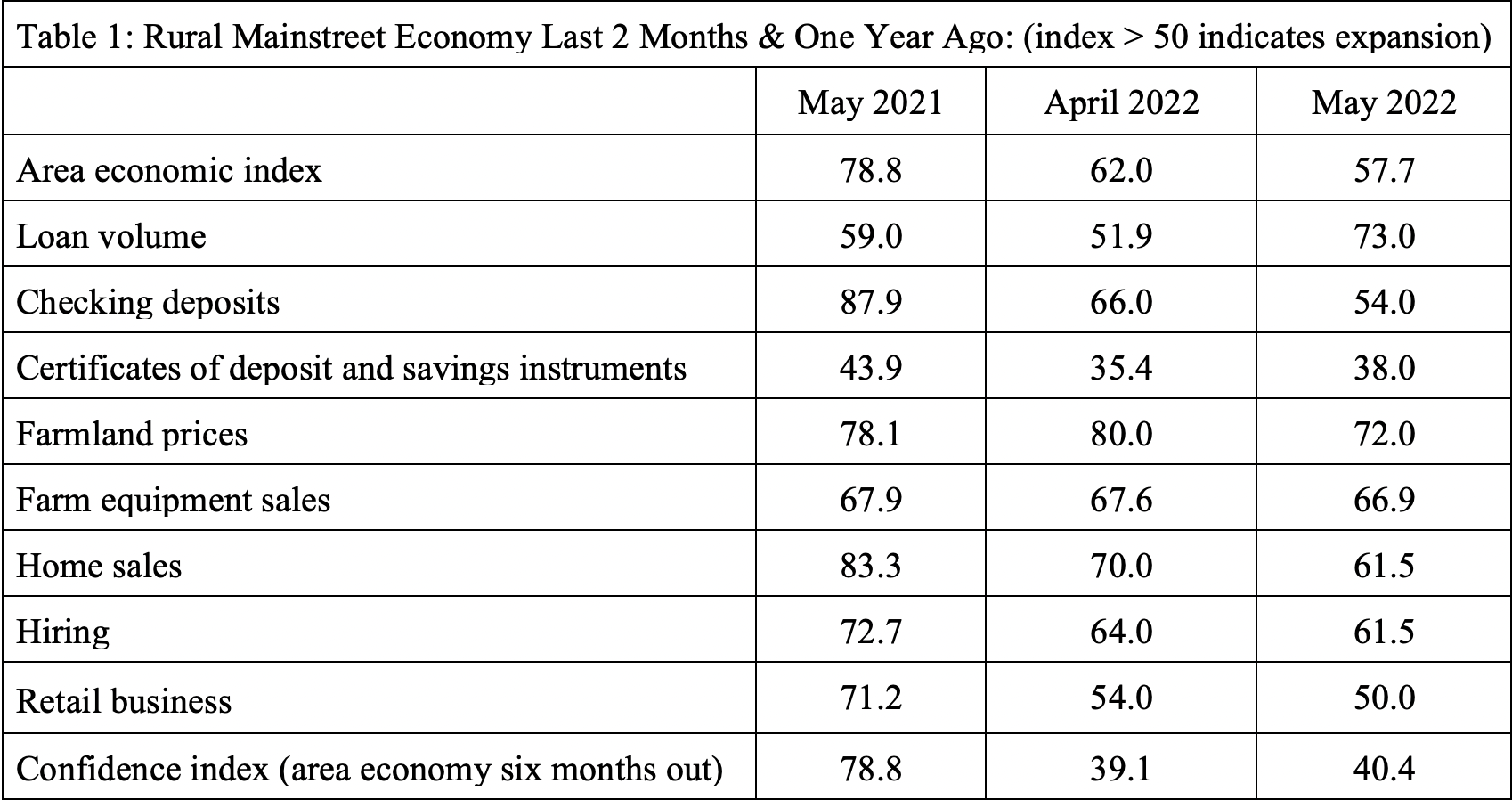
Creighton University chart compares current month to last month and year ago; click here to download it and chart below.

Rural bankers in 10 Midwestern states that rely on agriculture and energy report local economies that are still growing, but less than in recent months because of inflation and supply-chain problems, according to a monthly survey in May. The Rural Mainstreet Index polls bankers in about 200 rural places averaging 1,300 population in Colorado, Illinois, Iowa, Kansas, Minnesota, Missouri, Nebraska, North Dakota, South Dakota and Wyoming.

The overall index fell to 57.7 in May, down from April's 62. That's still growth-positive, but marks the index's lowest point since February 2021. "Much like the nation, the growth in the Rural Mainstreet economy is slowing. Supply chain disruptions from transportation bottlenecks and labor shortages continue to constrain growth. Farmers and bankers are bracing for escalating interest rates — both long-term and short-term," writes Creighton University economist Ernie Goss, who compiles the index.

Increased farming input costs have pushed borrowing to its highest reading since May 2020. Meanwhile, "the region’s farmland price index for May sank to a still strong 72.0 from 80.0 in April, marking the 20th straight month that the index has moved above growth neutral," Goss writes. "Over the past several months, the Creighton survey has registered the most consistent and strongest growth in farmland prices since the survey was launched in 2006."

Most bankers polled, 70.4%, said the Federal Reserve Open Market Committee should raise interest rates by 0.50% when it meets in mid-June. A plurality of 34.6% said that average local non-irrigated croplands (but not pasturelands) will fetch more than $300 cash rent per acre this year. And most predict that 2022 net farm income will be somewhat higher than last year's (33.4%) or about the same as last year's (37.0%). Only 3.7% believed it would be much higher.

Virus roundup: Most 'long Covid' victims not hospitalized at first; job losses hit rural areas still recovering from recession

Here's a roundup of recent news stories about the pandemic and vaccination efforts:

The death toll from the coronavirus pandemic has surpassed 1 million people in the U.S., the highest total of any nation in the world. An outstanding multimedia piece from The Washington Post aims to help readers visualize such a staggering number. Read more here.

A new study underscores the danger of even a mild Covid infection. Researchers found that 76% of long-Covid patients were not initially hospitalized. Read more here.

An overwhelmingly white, conservative and rural county in Tennessee was once touted as a coronavirus vaccine success story. But it turns out a state data error incorrectly attributed tens of thousands of vaccinations to the county, artificially inflating its vaccination rate from the correct 43% to 65%. Read more here.

Pro-Trump counties continue to suffer far higher Covid death rates. Read more here.

Pandemic job losses hit rural areas still recovering from the recession a decade ago. Read more here.

States have yet to spend hundreds of millions of dollars in federal aid meant to tackle pandemic health disparities. Read more here.

No one really knows how big the latest coronavirus wave is, because states have relaxed reporting requirements, and many people self-diagnose and self-treat without ever reporting their illness. Read more here.

The federal government is offering another round of free coronavirus tests. Read more here.

Paper finds that thriving rural areas need three key elements: industry, workforce, and a connected community

The report divides rural counties into five economic archetypes; McKinsey & Company map; click the image to enlarge it.
"New research published recently by McKinsey, a management consulting firm specializing in corporations, governments and other entities, identified three key elements necessary for rural communities to thrive: sectors or tradeable industries, workforce, and community and connectivity," Kristi Eaton reports for The Daily Yonder. Rural economic development usually ties into one or more of those three areas, according to the paper.

The research also noted that rural America "is not a monolith, so economic development structures will vary based on place," Eaton reports. "However, there are some overarching themes that emerged. Among those themes are big-push investment, embracing placemaking, developing tourism infrastructure, attracting and retaining small and medium-sized businesses, attracting remote workers, and increasing access to healthcare."

The report divided rural America into five community archetypes:

Americana counties, the most common type, have "slightly lower GDP and educational outcomes than urban areas. They are relatively close to major cities and often include several major employers," according to the report.

Distressed Americana counties, which tend to be in the South, have high poverty levels, low workforce participation, and low educational attainment. "Historically, these communities have been hubs for agriculture, extractive industries, and manufacturing. Their decline has mirrored the struggles in these sectors," says the report.

Rural Service Hubs are big on manufacturing and service industries such as retail and healthcare, and are often close to highways or railways. They typically serve nearby counties that are even more rural.

Resource-Rich Regions rely on oil and gas or mining, and often have high agricultural production rates too. They typically have higher-than-average household income, GDP per capita, and educational attainment.

Great Escapes counties, the least-common archetype, are home to "wealthy enclaves and tourist destinations" (think Aspen, Colorado). Average GDP, household income, and educational attainment are high in these counties, but this kind of economy often results in many low-paying service jobs.

Quick hits: Statewide News Collective launched; how to grow huge tomatoes; tips for buying and selling rural land

Here's a roundup of stories with rural resonance; if you do or see similar work that should be shared on The Rural Blog, email us at heather.chapman@uky.edu.

The Statewide News Collective, a new consortium for news organizations that serve statewide audiences or sometimes cover statewide issues, has just launched. Read more here.

Many of the nation's dams need repair. Retrofitting some to produce hydroelectric power could help the nation become more energy-independent while strengthening infrastructure. Read more here.

Want to grow huge tomatoes this summer? Here are seven tips for how to do it. Read more here.

A study shows California's record-breaking wildfire season may be the new normal. Read more here.

If you're buying or selling rural land this year, here's some tips on how to get the best return on your investment. Read more here.

Thursday, May 19, 2022

A trip across The Great Midwest: thoughts about speed, black dirt, monster machines, money and a return to a turn

Bob and Janet Hill at their Utica, Ind. nursery
By Bob Hill
   The guy on the motorcycle behind me was doing a steady 80 miles an hour. I knew that because I was doing 80 miles an hour.
   Steadily.
   So 80 is now the new 70 or 75 on all interstate highways. Time was that only happened southbound, down there by Atlanta. No more. North. South. East. West. 80 miles an hour.
   Steadily.
   This trip was actually across part of The Great Midwest. Wide open spaces of thick black dirt stretching to Kansas, maybe further. Fences are gone. Animals are gone. All that's left is miles of bare black dirt upon which were crawling monster tractors pulling monster cultivators and planters 24 rows wide costing hundreds of thousands of dollars using digital imaging and satellite knowhow and filled with chemicals and corn seed and kicking up clouds of dust on deep black farm land now going for $14,000 an acre in some spots and grandpa could buy it for $350 an acre and tractors for $5,000.
   With a bag of seed corn weighing maybe 50 pounds and containing 80,000 kernels which will plant maybe 2.5 acres yielding maybe 175 bushels an acre.
   Of more corn.
   Families still own most farms but the math has changed considerably.
   And some of that land flying up in expensive dust but at least landing nicely on the neighbor's farm.
It's mid-May, the planting a little late and the tractors and planters are everywhere, close by and off in the distance, way out there by those patches of trees and buildings and houses and grain bins stretching to Kansas.
   And no fences. And corn futures now way up to about $8 a bushel and beans above $16 - close to double what it's been- and if you think food is high now keep watching.
   And I'm thinking the guy on the motorcycle is watching me, hanging just behind at 80 miles an hour and when is the last time you saw a trooper checking speeds way out on rural interstate highways.
   The modern driving game is careful bobbing and weaving in and out of traffic, a little like that guy on the 80 to one shot in the Kentucky Derby, picking your places to move ahead.
   Carefully.
   Then there is that asshole riding your back bumper so close you can't even see the car headlights and he or she quickly pass on the right and cut up in front and off to harass the next driver up front and maybe getting home five minutes before you.
   Total.
   And I'm mostly doing 77 to 80 mph because semis these days are doing 75 mph with diesel selling for $5.49 a gallon and who wants to hang behind a semi, of which there are now millions on the road per mile.
   And you gotta do about 80 to pass them.
   I read somewhere that humans never really forget anything in their lives and all that even minimal information is hidden somewhere in the brain and who wants to remember the thousands of passing in and outs and rest stops and chicken sandwiches that come with eight hours on an interstate highways.
   Ya gotta be driving careful and mindless at the same time and then as maybe 357,000 vehicles suddenly all converge on the west side on Indianapolis due to various road construction issues.
   Then there sits the burned out hulk of a car up against a wall following a wreck and suddenly my journey ain't so bad anymore.
   We are at that point temporarily slowed to maybe 30 miles an hour but the guy on the motorcycle had gone north at what looked like a steady 80 mph.
   It's at the point near Indianapolis when I always remember making that turn onto I-65 south toward Louisville 47 years ago for a new job at a family-owned newspaper, the wife and kids still up in Illinois, and wondering what might come next.
Bob Hill is a retired columnist and feature writer for The Louisville Times and The Courier-Journal. This is republished from his Facebook page.

Formula roundup: House passes bills to help FDA, expand WIC choices; Biden invokes Defense powers; plant could reopen soon; some infants and children hospitalized

Here are some significant new developments in the baby formula shortage:

Abbott Laboratories reached an agreement Monday to reopen its Sturgis, Michigan plant in the next few weeks, pending federal inspectors' approval. Today Food and Drug Administration commissioner Robert M. Califf told a House appropriations subcommittee that he expects the plant to be open again within two weeks, and begged for more funding so the agency can cope with its workload, Laura Reiley reports for The Washington Post.

"President Biden took urgent action on Wednesday to address the nationwide baby formula shortage, invoking the Defense Production Act to increase production and creating 'Operation Fly Formula' to deploy Defense Department planes and speed formula shipments into the United States from overseas," Annie Karni and Emily Cochrane report for The New York Times. "The White House announced its plan only hours before the House took action of its own, approving an emergency infusion of $28 million for the Food and Drug Administration and a bill to loosen restrictions on what kind of formula can be purchased through the federal food aid program for women and babies."

The $28 million is meant to help the FDA "beef up inspections of formula made at foreign plants and to guard against any future shortages by ensuring the agency is prepared for supply chain disruptions," Nathaniel Weixel and Mychael Schnell report for The Hill. The bill passed on a mainly party-line vote, though 12 Republicans supported the bill in defiance of party leadership.

House Minority Whip Steve Scalise (R-La.) urged House Republicans to oppose the bill, saying it was reckless spending that would provide political cover for the Biden administration while failing to hold the FDA accountable. "House Republicans knocked Democrats for giving money to the FDA without guardrails and without forcing the agency to develop a concrete plan to solve the shortage. At least two House committees are investigating manufacturers and the FDA," Weixel and Schnell report. However, "Democrats argued the FDA does not have enough resources to adequately inspect foreign manufacturers and make sure they meet agency safety standards. The $28 million in emergency funding would make sure the agency can handle those inspections quickly."

A recent Politico investigation found several reasons for the FDA's failure to quickly catch problems at the Abbott plant. The FDA has been underfunded for years, its leaders tend to have far more experience with regulating medications than food, and Trump-era changes in leadership left the agency adrift and—in some cases—caught up in turf wars between feuding officials. All of this happened as the agency was under unprecedented pressure to examine coronavirus vaccines, tests, and treatments.

Meanwhile, some babies and children have already been hurt by the shortage. Doctors in East Texas say they've treated infants who had had seizures after their parents fed them watered-down formula in an effort to stretch their supply. Watered-down formula (or homemade recipes) can endanger babies. And at least two children with intestinal conditions have been treated in a Tennessee hospital because their parents couldn't find the special formula they needed. The formula shortage affects children and even adults with medical conditions that leave them unable to digest regular food. It also disproportionately affects low-wage and other disadvantaged families, Mariel Padilla reports for The 19th. Rutgers University assistant history professor Carla Cevasco spoke with Padilla about the long-standing structural issues that have left low-income families more vulnerable to formula shortages.

Report shows disparities in rural food security and diet satisfaction

Though Americans of all stripes worry about food availability and prices, rural residents are less food secure and less likely to be able to get the food they want, according to the monthly Consumer Food Insights Report from Purdue University's Center for Food Demand Analysis and Sustainability, Elizabeth Gardner reports. Current economic issues such as inflation and supply-chain shortages have enhanced this divide, according to Purdue agricultural economics professor Jayson Lusk, who leads the center. The formula shortage is too new to be reflected in this survey, but is no doubt a factor. 

"Key results include:
  • 60% of consumers are concerned about the impact of bird flu on food prices
  • Food spending is 9% higher than in January, but food demand remains price insensitive
  • 14% of all households and 23% of rural households are facing food insecurity
  • 71% of people in urban and 61% in rural areas give their diet a high rating
  • A Sustainable Food Purchasing (SFP) Index of 69/100."

Apply for environmental reporting grants for projects covering public lands by May 31

Got an idea for a reporting project about public lands? The Society for Environmental Journalists has extended until May 31 its deadline to apply for a grant to cover such a project. 

Each grant is $5,000 maximum with individual stipends limited to $2,000. Recipients must use the funds within a year of payment to write a story or stories covering U.S. public lands (which are owned and/or managed by federal, state, local or tribal governments). Application is free for SEJ members or members of diversity journalism associations. Non-members can apply for $40 as long as they are otherwise eligible for SEJ membership. Click here for more information or to apply.

Wednesday, May 18, 2022

Thursday NNA webinar will help community journalists cover elections; $20 for non-members, $5 for faculty, students

The National Newspaper Association will host a webinar at 3 p.m. ET Thursday, May 19, to help community newspapers cover this year's elections and discuss the critical role election coverage plays in preserving democracy. It's the second of a two-part series; NNA members may access the recording of the first one, held May 5.

From the website: "Election coverage is one of the most demanding and scrutinized tasks that faces newspapers, especially if readers perceive a newspaper to have a political 'bias' on its editorial pages. This webinar will help participants formulate a plan. First, some tips on how to organize for the campaigns including developing a calendar. And then by addressing some of the various elements of election coverage including candidate profiles, letters to the editor, editorial endorsements, and election night and post-election coverage. Substantive election coverage requires assigning responsibilities and setting dates for when specific tasks should be completed."

Jim Pumarlo
Lead presenter Jim Pumarlo is a newsroom trainer who worked for 27 years at dailies in rural Minnesota and served 16 years as the communications director at the Minnesota Chamber of Commerce. He is author of three books: "Bad News and Good Judgment: A Guide to Reporting on Sensitive Issues in a Small-Town Newspaper"; "Votes and Quotes: A Guide to Outstanding Election Campaign Coverage"; and "Journalism Primer: A Guide to Community News Coverage for Beginning Journalists."

Co-presenter Al Cross, who was editor and manager of rural newspapers and longtime political reporter for the Louisville Courier Journal, is the University of Kentucky's extension journalism professor and director of the Institute for Rural Journalism and Community Issues, which publishes The Rural Blog. "Election coverage is perhaps the best opportunity for newspapers to reassert their essential role in local democracy," he says, adding that new sample-copying power allows community papers to inform a wider audience.

The webinar is free for NNA members, $20 for non-member journalists, and $5 for students and professors. Click here for more information or to register.

Rural counties see rising coronavirus infection rates for fifth week straight, at a pace slightly more than urban rate

New coronavirus infections, in ranges by county, May 9-15
Map by The Daily Yonder; click on the image to enlarge it or click here for the interactive version.

Rural counties reported about 44,000 new coronavirus infections May 9-15. That's an increase of about one-third from the previous week's 33,000 new cases and marks five straight weeks of rising infection rates. "New infections in metropolitan counties also grew, but at a slightly slower pace," Tim Marema reports for The Daily Yonder. "Rural counties reported about 44,000 new infections last week, up from about 33,000 two weeks ago." The true infection rate is undoubtedly higher, since many people diagnose themselves via at-home test and self-treat without reporting their infection. Also, Florida didn't report its cases to the Centers for Disease Control and Prevention last week.

Meanwhile, Covid-related deaths fell in rural and metropolitan counties last week. "Rural counties reported 414 deaths, down 13% from two weeks ago. Metropolitan counties reported 1,598 deaths, down about 20% from two weeks ago," Marema reports. "The Covid-related death rate has been higher in rural America than in urban America for 88 out of the last 93 weeks. Cumulatively, the rural death rate is more than a third higher than the metropolitan death rate."

3 new hospitals serving many rural patients say they're in trouble because feds won't give them full pandemic relief

The lobby of Thomasville Regional Medical Center
Three hospitals that serve many rural patients "say they are missing out on millions in federal pandemic relief money because the facilities are so new they lack full financial statements from before the crisis to prove how much it cost them," Jay Reeves of The Associated Press reports. The hospitals are Thomasville Regional Medical Center, "offering state-of-the-art medicine that was previously unavailable in a poor, isolated part of Alabama;" Rock Regional Hospital southeast of Wichita; and Three Crosses Hospital in Las Cruces, New Mexico.

"In Thomasville, located in timber country about 95 miles north of the Gulf Coast port of Mobile, hospital officials have worked more than a year to convince federal officials they should have gotten $8.2 million through the CARES Act, not just the $1 million they received. With a total debt of $35 million, the quest gets more urgent each day, said Curtis James, the chief executive officer," AP reports. James told Reeves, "No hospital can sustain itself without getting the CARES Act money that everybody else got."

The Kansas hospital "is due as much as $15.8 million, officials said, but because it only opened in April 2019 and lacks complete pre-pandemic financial statements, it has received just a little more than $985,000," Reeves reports. The New Mexico hospital "piled up a staggering $16.8 million in losses in just three quarters while receiving only $28,000 in aid, said Landon Fulmer, a Washington lobbyist working with all three hospitals to obtain additional funding."

The U.S. Health Resources and Services Administration can't cover all hospital losses, spokesman Chris Lundquist told AP. He said hospitals can appeal or seek a supplemental appropriation. Officials in Thomasville are trying to leverage congressional influence. "They've been assured they're going to be taken care of. But the fact is, when you're dealing with government entities, you don't have the money until you have the money," said Dr. Don Williamson, president of the Alabama Hospital Association, who said he has contacted the White House for help.

Thomasville, in the Black Belt, lost its previous hospital more than 10 years ago. "Officials worked for years to secure a new hospital so residents wouldn't have to drive 90 minutes for high-tech services such as digital imaging, full surgical options, echocardiograms, 3-D mammography and more," Reeves reports. "Using a partnership between the city and a municipal healthcare authority, Thomasville Regional secured federal funding from the Department of Agriculture and opened on March 3, 2020, before cases of Covid-19 caught fire in the rural South."

Rural and critical-access hospitals rated in new rankings

How is your local hospital performing? Check out these new rankings and see.

The Leapfrog Group, a national heath-care safety watchdog group, has released its Spring 2022 Leapfrog Hospital Safety Grades, which assigns a letter grade to every hospital in the U.S. based on more than 30 measures of patient safety, including preventable errors, accidents, injuries, and infections. The newest rankings show that the pandemic has caused significant declines in several measures among many hospitals; Leapfrog explores worsening inpatient hospital experiences during the pandemic in a supplementary report. Some rural hospitals say they're having a hard time serving patients adequately because they're not able to fully access federal pandemic relief. Look up your local hospital's safety grade here.

Meanwhile, the Chartis Center for Rural Health, operated by the Chartis Group, has released its newest ranking of the top 20 and top 100 Critical Access Hospitals in the U.S., as well as the top 100 rural and community hospitals. The rankings are based on Chartis' Hospital Strength Index, which considers performance based on 50 rural-relevant factors in eight broad market-, value-, and finance-based categories. Chartis also named the top 20 hospitals for quality (based on its percentile rank of rural-relevant process of care measures), and another top 20 for patient satisfaction ratings. The National Rural Health Association will recognize the top 20 critical access hospitals during its Critical Access Hospital Conference in September.

USDA to give farmers $6 billion in aid for 2020 and 2021 crops hurt by natural disasters

The Agriculture Department announced Monday the release of $6 billion under the Farm Service Agency's Emergency Relief Program for the more than 220,000 farmers hit by natural disasters in 2020 and 2021. The money comes from $10 billion in disaster relief Congress authorized last fall. 

"Farmers of both commodity crops and specialty crops will receive the first tranche of aid payments. To determine losses, USDA will use its existing crop insurance or Noninsured Crop Disaster Assistance Program (NAP) data as the basis for calculating initial payments. USDA estimates more than 220,000 producers who received crop insurance indemnities or NAP payments will receive ERP payments," Chris Clayton reports for DTN/The Progressive Farmer. "ERP covers losses to crops, trees, bushes and vines due to a qualifying natural disaster event in calendar years 2020 and 2021. Eligible crops include all crops for which crop insurance or NAP coverage was available, except for crops intended for grazing. Qualifying natural disaster events include wildfires, hurricanes, floods, derechos, excessive heat, winter storms, freeze (including a polar vortex), smoke exposure, excessive moisture, qualifying drought and related conditions."

"For over two years, farmers and ranchers across the country have been hard hit by an ongoing pandemic coupled with more frequent and catastrophic natural disasters," Agriculture Secretary Tom Vilsack said at a press conference. "As the agriculture industry deals with new challenges and stressors, we at USDA look for opportunities to inject financial support back into the rural economy through direct payments to producers who bear the brunt of circumstances beyond their control."

Tuesday, May 17, 2022

Parents whose kids are unvaccinated for Covid-19 are much less likely to get information from health-care providers

Where parents of children ages 5-18 got information about the decision to vaccinate their children
(Covid States Project graph; click the image to enlarge it.) 
Parents who don't have their children vaccinated against the coronavirus are less likely to say they were informed about the vaccines by the government or their schools and more likely to say they got information about the issue from online sources or made the decision by doing their own research or trusting their gut. So says the most recent online poll by the Covid States Project, a consortium of Northeastern University, Harvard University and its medical school, Rutgers University and Northwestern University.

Some key takeaways of the study:
  • When parents were asked about information sources they consulted for child health or vaccination information, the most commonly selected sources overall were news websites and apps, government and medical websites or apps, television, Facebook, and YouTube, in that order. 
  • Only 9% of parents overall said they consult newspapers for health information, compared to 16% who watch television, and 20% who check news websites or apps.
  • Parents most commonly discussed decisions about their children's health with family members. 

Rural hospitals could get hit harder by rising number of Covid-19 cases as federal pandemic funding is phased out

"While the number of cases of Covid-19 in rural counties is on the rise, additional funding to cover the cost of vaccination and treatment is stalled in Washington," Liz Carey reports for The Daily Yonder. "According to an analysis by the Daily Yonder, between April 25 and May 1, the rate of new Covid infections has risen by more than 50%. Rural counties reported nearly 29,000 new infections last week, up 29% from two weeks ago, the third week of increases."

Meanwhile, the federal government recently announced it would not buy more monoclonal antibody treatments because funding had run out. "With rural residents dying at a higher rate than urban residents, the loss of those treatments could further increase the toll Covid is taking on rural communities," Carey reports. "And, without the federal government covering the cost of vaccinations and treatments, rural hospitals could be forced further into debt."

Though the Biden administration sought another $22.5 billion in Covid funds, the money was ultimately cut from the spending package passed in March. In April, Sens. Chuck Schumer (D-N.Y.) and Mitt Romney (R-Utah) co-authored a $10 billion Covid relief package using leftover money from previous aid bills. It would provide "$5 billion for therapeutics, while the rest would be set aside for vaccinations, booster shots, and testing," Carey reports. "Currently, that aid package is stalled in Congress. It’s unclear when, or whether, the measure would come up for a vote. Without that funding, the country faces shortages of treatments, as well as a collapse of the systems put in place to test and vaccinate, should a future outbreak arise, the administration said."

New report has first estimates of wildfire risk for every ZIP

Average wildfire risk for each Zip code (New York Times map; click the image to enlarge it.)

"The nation’s wildfire risk is widespread, severe and accelerating quickly, according to new data that, for the first time, calculates the risk facing every property in the contiguous United States. The data, released Monday by the First Street Foundation, a nonprofit research group in New York, comes as rising housing prices in cities and suburbs push Americans deeper into fire-prone areas, with little idea about the specific risk in their new locale," Christopher Flavelle and Nadja Popovich report for The New York Times. "That’s because the federal government maps flood risk at the property level but doesn’t do the same for wildfires, which are growing more frequent and severe because of climate change."

About 50% of addresses in the contiguous U.S. are at some level of risk of wildfire; the new data predicts that will increase to 56% by 2052.  In some disproportionately rural states, like Wyoming and Montana, more than 90% of properties are at some level of risk from wildfires, Flavelle and Popovich report. 

"Of all the addresses nationwide that could be damaged by wildfire, more than 686,000 face at least a 1 percent chance this year — the same degree of risk that the government uses to determine which houses are sufficiently in danger of flooding that they need flood insurance. But wildfire risk is more dangerous, according to First Street, because, while flooding often damages only parts of a house, fire is more likely to destroy it entirely," Flavelle and Popovich report. "A 1 percent risk may seem small. But that possibility compounds over time, becoming a 26 percent risk over 30 years — the span of a typical mortgage. Over the course of that 30-year mortgage, more than 381,000 properties nationwide face a risk of wildfire that is greater than 50 percent, according to First Street."

Human-rights group names 900 Republican state legislators in 'far right' groups, but that adjective doesn't fit some

"Nearly 22 percent of Republican state lawmakers nationwide have joined at least one far-right Facebook group, according to a new survey by an advocacy group that tracks bigotry and attacks on democracy," Daniela Altimari reports for Route Fifty. "The Institute for Research and Education on Human Rights found 875 legislators representing all 50 states who have joined white-nationalist, paramilitary, QAnon, anti-immigrant, 'Stop the Steal' or other groups tied to the far right. The Facebook groups that the report focuses on are active on a range of issues, and not all of them embrace racist or nationalist ideologies." The listings also include organizations such as Right to LifeNo Left Turn in Education and groups opposing mask mandates.

The report examined all 7,383 state legislators who served in 2021-22. Three Democratic legislators joined such groups, but no Libertarian or independent lawmakers had. For the purposes of the report, the IREHR defined "far right" groups as "those advocating for changes that would significantly undermine political, social and/or economic equality along class, racial, gender, sexual orientation, national origin, immigration status or religious lines, Altimari reports.

Abbott reaches agreement with FDA to reopen formula plant

Abbott Laboratories "reached an agreement with the Food and Drug Administration on Monday to reopen the company’s manufacturing plant in Michigan to help ease a nationwide shortage of baby formula, after the facility was closed due to bacterial contamination," reports Spencer Kimball of CNBC. According to the consent decree, Abbott can resume production at its plant in Sturgis, Michigan, within two weeks once the FDA signs off on it, but it will take six to eight weeks after production resumes for formula to hit store shelves.

The FDA ordered the Abbott plant to shut down in February after four infants were sickened from contaminated formula and two died. 

"Under the consent decree to reopen the plant, Abbott has agreed to bring in outside experts to help the facility come into compliance with food safety regulations, according to the Justice Department," Kimball reports. "The outside experts will design a plan for Abbott to reduce the risk of bacterial contamination at the plant and conduct periodic evaluations to make sure the company is in compliance. The process will be under FDA supervision."

In the meantime, the FDA will allow some imported formula meant for foreign markets to enter the U.S., but only after the agency has evaluated whether each manufacturer that applies has a safe and nutritious product. The FDA has been allowing more formula imports meant for the U.S. since February, Kimball reports.

Monday, May 16, 2022

The nationwide shortage of baby formula is probably hitting rural families hardest. Here's what they need to know.

Families nationwide are scrambling to find baby formula amid a widespread shortage. Rural families are likely having an even harder time since there are fewer local places to buy formula, and because families who use federal assistance can only buy certain formulas. It's even more difficult to find certain medically necessary specialty formulas. Here's what you—and your readers—need to know:

What happened: In February the Food and Drug Administration ordered Abbott Nutrition, the nation's leading formula maker, to shut down its plant in Sturgis, Michigan, after four infants were hospitalized with bacterial infections from contaminated formula and two of them died. The FDA issued a voluntary recall on three products (Similac, Alimentum, and EleCare) and warned customers not to use certain specialty formulas produced at the facility, but the warning didn't get much public attention, so parents didn't know to stock up. Formula was already low in stock since at least December because of inflation, supply-chain shortages and product recalls. 

How bad is it? Formula stockpiles in stores are 43 percent lower than normal, compared to 30-40% short in April, says retail data tracker Datasembly. Only about a quarter of children are exclusively breast-fed up to the age of six months, so most parents and caregivers depend at least partially on formula. 

Why not buy another brand? Almost all formula in the U.S. is manufactured domestically because of strict FDA standards, and 90% of the nation's supply comes from four companies. Abbott makes over 40% and Perrigo Nutritionals, Mead Johnson, Gerber (owned by Nestlé) combined account for another 50%. Perrigo makes store-brand formulas for stores such as Walmart, Kroger and Walgreens but that formula can't be purchased by people using federal assistance through the Women, Infants and Children nutrition program, which pays for about half of all formula. In addition, many babies require specialty formulas and can become very sick if they switch.

Why not breastfeed? Many babies who require specialty formulas can also get sick from drinking breast milk. Adoptive families and many others also have difficulty accessing or affording a reliable supply of breast milk, and some survivors of sexual violence may find it traumatizing. Some mothers find it difficult to maintain a steady supply of milk, and others can't breastfeed at all because they must take medications that would taint the milk. Though state and federal laws protect women's right to breastfeed in public—including at work—many women are embarrassed, intimidated, or even discouraged from the practice, and many women are not knowledgeable about the health benefits of breast milk.

Is homemade baby formula a safe alternative? No. Homemade formulas can be too high in sodium, too low in calcium, contaminated, and/or lack critical nutrients. Babies can suffer long-term damage after using homemade formula alternatives or straight cow's milk for even a few days, according to the National Committee on Nutrition for the American Academy of Pediatrics. It's also dangerous to dilute baby formula with too much water. If there is absolutely no other alternative, formula made for toddlers can be ok for a few days for infants who are close to a year of age. 

How long could the shortage last? At least 10 weeks. On Monday the FDA agreed to allow Abbott to reopen its Sturgis plant within two weeks, as long as it passes a safety inspection. After that it will take six to eight weeks for formula to hit store shelves. However, inspectors say there are still problems at the plant. In the meantime, Abbott says it's shipping in formula from its FDA-registered plant in Ireland on a daily basis. The FDA has been allowing more formula imports meant for the U.S. since February, and is now allowing some formula meant for foreign markets to enter the U.S., but only after a safety evaluation.

Could this have been prevented? Growing evidence indicates the FDA failed to act quickly about warnings of safety violations at the Sturgis plant. A whistleblower at the plant warned the FDA in October about safety problems, weeks after the children were hospitalized with bacterial infections, but the agency didn't interview the whistleblower until December and didn't inspect the plant until Jan. 31. That dovetails with a recent Politico investigation that revealed deep-seated issues with the FDA's plant inspections. Current and former employees described the agency as slow to make decisions and lacking enough staff or budget for years to deal with the modern food system even as its regulatory responsibilities have grown.

What the government is doing now: The FDA is expediting and streamlining some of its approval processes to speed up production. The Biden administration and lawmakers from both parties are also urging the Federal Trade Commission and state attorneys general to keep an eye out for price-gouging and increase formula imports to increase the domestic supply. The House Appropriations Committee will hold a hearing this week before introducing an emergency supplemental funding bill to help address the shortage. Late Monday, Abbott and the FDA announced an agreement to reopen the plant, but the company said it would be well over a month before new product ships from the site.
 
What the administration is not doing: Some right-wing politicians and pundits have blamed the Biden administration for the shortage, but no single politician or administration is causing the problem. Biden has also been accused of stockpiling baby formula for undocumented immigrants being detained at the border while American families go without. In fact, the Biden administration is following the law in shipping a limited supply of formula to infants at the border, as the Trump administration did. 

In the meantime, if you need formula, here are some do's and don'ts:
  • Check with your church or local nonprofits to see if they have any.
  • Shop online from reliable sources. 
  • Don't make your own.
  • Don't hoard formula.
  • Network with other families on social media.