Wednesday, February 11, 2015

Private prisons shouldn't be able to deny freedom of information requests, journalism prof says

Privately operated prisons have become common in rural areas, especially those desperate for jobs, but often deny Freedom of Information requests, claiming they should be exempt because they are private entities, journalism professor Alexa Capeloto writes for The Crime Report, published by the John Jay College at the City University of New York, where she works.

Incarceration is a vital government function, Capeloto writes, but private prisons keep out of reach such useful records as staffing levels, budgets, rates of violence, prisoner demographics, security measures and health care.

Eight percent of prisoners and 49 percent of immigrant detainees were held in privately run centers in the U.S., and the number has risen 1,600 percent from 1990 to 2009, Capeloto reports. The 137 facilities are run by the Corrections Corporation of America, the GEO Group Inc. and the Management and Training Corporation.

"CCA, the largest among them, generated nearly $1.7 billion in revenue and netted a $300 million profit in 2013," Capeloto writes. "Government contracts, funded by taxpayer dollars, form the vast majority of this revenue."

U.S. Rep. Sheila Jackson Lee (D-Texas) introduced a bill to require these facilities to release more information, but the bill is the sixth of its kind that Democrats have introduced since 2005, and it isn't likely to go anywhere, Capeloto writes. In most states, no legislation requires private prisons to share their records, and "This failure has left courts to do the heavy lifting when private contractors deny FOI requests to services once handled by government."

Capeloto says an update of freedom-of-information laws is needed because privatization has changed the boundaries between public and private. Until that happens, the issue should be taken to the courts, she argues.

CAA spokesman Steve Owen told the weekly Vermont newspaper Seven Days that "transparency is a critical part of the relationships we have with our government partners and the taxpayers they serve. We comply with all applicable open records laws and share information freely with our government partners." Capeloto writes that the "applicable laws" need to erase any room for doubt. (Read more)

Supreme Court case could cost white, employed Southerners their health insurance coverage

If the Supreme Court "strikes down tax credits for people buying health insurance on the federal exchange, about 8.2 million" people in 34 states—mostly in the South, could lose their coverage under the Affordable Care Act, Michael Ollove reports for Stateline. "Most of the people likely to be affected are white, employed and low- to middle-class." (Stateline map) 
Health insurance rates in the South are expected to rise by as much as 35 percent, making coverage no longer affordable for many people, Ollove writes. "Some believe that if the tax credits are disallowed by the Supreme Court, the underpinnings of President Barack Obama’s signature health care law would collapse."

"At issue in King v. Burwell, scheduled for oral arguments next month, is whether people in states that use the federal government’s exchange to buy insurance are eligible for federal subsidies in the form of tax credits to help them pay their premiums," Ollove writes. "The case hinges on the fact that the ACA provision governing tax credits refers to people enrolled 'through an Exchange established by the State,' without mentioning the federal exchange. The ACA anticipated that all states would create their own state exchanges, but it allowed states that did not want to set up their own exchanges to use the federal one instead."

"In the 34 states where people use the federal exchange, an estimated 9.3 million people are expected to receive $36.1 billion in tax subsidies in 2016," Ollove writes. "A recent analysis by the Robert Wood Johnson Foundation and the Urban Institute estimated that if the Supreme Court blocked these subsidies, 8.2 million of these residents would not be able to find affordable health insurance in 2016." Of those people, 61 percent are non-Hispanic whites, 62 percent live in the South, 71 percent work at least part time and 82 percent are considered to be low- or middle-income rather than poor.

Central Iowa Farm Watch program adds website to help ID and track down stolen property

A Central Iowa program designed to encourage rural residents to report suspicious behavior has become more advanced, with the addition of a website to allow local residents to become more active in reporting crimes, Gavin Aronsen reports for the Ames Tribune. Farm Watch, launched one year ago, is a partnership between DuPont and the sheriff's office in Story County (Family Search map) that asks farmers and rural residents to place signs on or near their property with a phone number to report suspicious activity.

Program participants are given "local identification numbers that can be used to track down stolen property from around the country," Aronsen writes. ID numbers can be used "to mark personal property against theft, potentially allowing law enforcement officers to return stolen goods even if they are discovered months later by police outside the state."

Story County Sheriff Paul Fitzgerald told Aronsen, “We need many more eyes in rural areas because of the wide open areas that we have to patrol where you don’t have a lot of neighborhood eyes watching out." (Read more)

Fish and Wildlife Service wants protection of 16.5 million acres of sage grouse habitats

"The Fish and Wildlife Service advised its fellow land management agencies to impose the most stringent protections on roughly 16.5 million acres of high-value sage grouse habitat in order to save the bird from the threat of extinction," Phil Taylor reports for Greenwire. More than 63 percent of the bird's 165 million acres of habitat is on federal lands, and Bureau of Land Management manages most of it.

"BLM's land-use plan amendments, set to be finalized in late summer, will be a key factor in September when Fish and Wildlife scientists decide whether the charismatic, chest-puffing bird is in need of federal protections," Taylor writes. Sage grouse are located in 11 states—Oregon, Washington, California, Nevada, Idaho, Montana, Wyoming, Colorado, Utah, North Dakota and South Dakota. (Fish and Wildlife map: Greater sage grouse priority areas for conservation)

In November 2014 Fish and Wildlife listed the grouse as "threatened." The future of the species' designation will play a major role in determining the fate of sales of leases on 8.1 million acres of federal oil and gas parcels that are on hold because of worries that drilling could harm greater sage grouse.

Also, this week Utah Republican Gov. Gary Herbert "ordered state agencies to make protecting sage grouse a priority when making decisions on issues from development to firefighting," Brett Prettyman reports for The Salt Lake Tribune. Herbert said listing sage grouse as "endangered" will put restrictions on farmers, ranchers, natural resource extraction and energy development. He told  Prettyman, "The concern we have here in Utah that in doing so [a federal listing], it will have a significantly devastating impact on our economy." Only four percent of sage grouse are found in Utah.

Warm weather has Yellowstone National Park grizzly bears ending hibernation early

Visitors to Yellowstone National Park should be on the lookout for grizzly bears. Unusually warm spring-like weather has caused the bears to end their winter hibernation earlier than usual, Laura Zuckerman reports for Reuters. From 2012 to 2014 grizzly bears were not seen until March 4-14. (Western Wildlife map)

"Grizzly bears in the lower 48 states were listed as threatened under the U.S. Endangered Species Act in 1975 after hunting, trapping and poisoning reduced their numbers to roughly 1,000 from about 100,000," Zuckerman writes. Yellowstone, which consists of 2.2-million-acres in Wyoming, Montana and Idaho "contains an estimated 600 grizzlies, or the bulk of such bears that still roam the lower 48 states." (Read more)

2015 Appalachian Studies Conference scheduled from March 27-29 in Johnson City, Tenn.

The 2015 Appalachian Studies Conference is scheduled from March 27-29 at East Tennessee State University in Johnson City, Tenn. This year's theme, "Many Mountains, Many Musics," challenges participants "to view Appalachia from a fresh perspective and discover its emergence as a creative, dynamic force," says a news release. This year’s Keynote Speaker is Margo Miller, executive director of the Appalachian Community Fund. Cost is $150 for individuals and $100 for students by March 2. Costs after March 2 are $175 and $125. To register click here.

USDA will provide funds for renewable energy and energy efficiency projects

Farmers and rural small-business owners can apply for money to buy and install renewable energy systems or to improve energy efficiency under a program in the new Farm Bill.

"These efforts help farmers, ranchers and other small business owners save money on their energy bills, reduce America's dependence on foreign oil, support America's clean energy economy and cut carbon pollution," Agriculture Secretary Tom Vilsack said in a news release.

Through the established Rural Energy for America Program, the Department of Agriculture is providing more than $280 million to eligible applicants. USDA will give grants covering up to 25 percent of project costs and loans for up to 75 percent of project costs for renewable energy systems and energy efficiency improvements. Each applicant can receive up to $500,000 in grant money and up to $25 million in loan money.

Recipients must use commercially available technology, including renewable energy from wind, solar, ocean, small hydropower, hydrogen, geothermal and renewable biomass. Projects eligible for funding include lighting, heating, cooling, ventilation, fans, automated controls and insulation upgrades that reduce energy consumption. To see application details, go to page 78929 of the Dec. 29, 2014 Federal Register or contact state USDA Rural Development offices.

Another kind of grant USDA is offering is to help farmers, ranchers and small businesses conduct energy audits and run renewable energy projects. Potential applications include: units of state; tribal or local governments; colleges, universities and other institutions of higher learning; rural electric cooperatives and public power entities; and conservation and development districts. Recipients can receive up to $100,000. (Read more)

Tuesday, February 10, 2015

Robots are replacing humans; within a decade 25% of manufacturing jobs will be automated

Robots are replacing humans in manufacturing jobs—a staple of rural areas—at a much higher rate than previously thought, says a study by the Boston Consulting Group, Paul Davidson reports for USA Today. The main reason is that machines are cheaper. The cost to purchase a robotic spot welder ranged from $182,000 in 2005 to $133,000 to 2014, to an estimated $105,000 by 2025. Robots cost about 15 percent less than humans. For example, in electronics manufacturing a robot costs $4 an hour, compared to paying a human about $24 per hour. (Los Angeles Times photo by David Butow: Robots in a factory in Fremont, Calif.)

The study says that "within two years, the number of advanced industrial robots in the U.S. will begin to grow by 10 percent a year, up from current annual growth of 2 percent to 3 percent," Davidson writes. Within a decade 25 percent of all manufacturing functions will be automated, up from the current number of 10 percent. "About 1.2 million additional advanced robots are expected to be deployed in the U.S. by 2025," used mostly in four areas: computer and electronics products; electrical equipment and appliances; transportation; and machinery.

RBC Global Asset Management said in a separate report that "robots can be reprogrammed far faster and more efficiently than humans can be retrained when products are updated or replaced—a crucial advantage at a time when smartphones and other products quickly fade into obsolescence," reports The Associated Press. "Increasing automation is likely to change the way companies evaluate where to open and expand factories," leading factories to employ fewer people that are likely to be highly skilled.

Pork on the verge of passing beef as second most produced meat by U.S. farmers

Because the hog industry has mostly recovered from a deadly virus and cattle ranchers are still trying to recover from the 2012 drought, pork is on the verge of passing beef as the second most produced meat in the U.S. behind poultry, Megan Durisin reports for Bloomberg. Pork output in 2015 will go up 4.6 percent, climbing "to a record 23.908 billion pounds, as per-capita consumption reaches the highest in five years, the U.S. Department of Agriculture said Jan. 12." Beef output will drop 1.7 percent to a 22-year low of 23.901 billion, while chicken jumps to an all-time high of 39.206 billion pounds.

Ed Juhl, a farmer in Hudson, Iowa, who lost about 2,400 pigs to the porcine epidemic diarrhea virus in June, said his herd is now healthy and "he expects output by June will be back to its annual sales pace of 36,000 animals," Durisin writes. He said "with each passing week, the industry’s 'confidence that we’re going to increase pork supply is rapidly going up.'”

During the three months ending Dec. 1, the breeding-sow herd posted the biggest increase since 1998 and reached the largest in five years, Durisin writes. "The total hog population jumped 2 percent from a year earlier to 66.05 million, the most in five quarters. Demand for pork also is improving, especially with record-high beef forcing some consumers to seek cheaper meats."  (Read more)

Virginia House kills child farm labor ban; 26 percent of state's farm workers are immigrants

A bill in Virginia that would have prohibited farmers from hiring non-relatives under 18 to work in direct contact with tobacco leaves was shot down last week in a lopsided vote by a Republican-controlled House committee, Travis Fain reports for the Daily Press in Newport News. "Virginia already has extensive child labor laws, but there are exemptions for farming."

"The bill would have addressed reports that show nicotine poisoning and other problems in children who work on tobacco farms," Fain writes. "The nicotine leaches into their skin, activists testified, causing nausea and other problems. Sometimes children wear garbage bags to protect themselves from the leaves, which exacerbates concerns of over-heating in the hot sun.

Non-citizens account for 26 percent of all Virginia farm workers, Agriculture Secretary Tom Vilsack told Markus Schmidt of the Richmond Time-Register in May 2014. Vilsack told him, “You got a situation where agriculture in Virginia depends on immigrant labor.” (Read more)

Human Rights Watch said in May 2014 that children, some as young as 7, are getting sick working in tobacco fields. The New York Times reported in September 2014 that teenagers, most of them immigrants, are being exposed to health dangers while working 12-hour shifts in tobacco fields.

Despite 2014 chemical spill, West Virginia considering weakening water protections

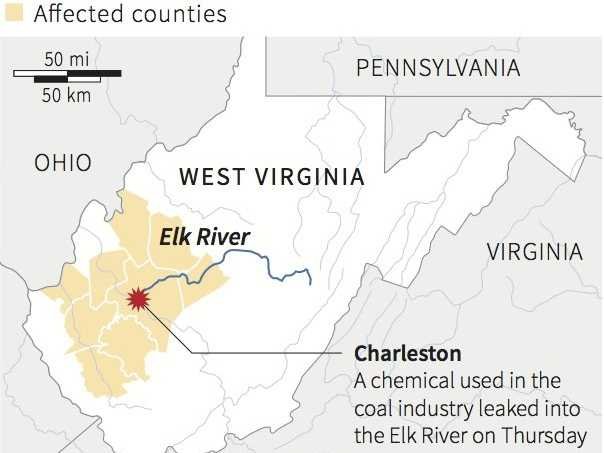
Lawmakers in West Virginia—where Republicans recently took control of the House and Senate—"are considering a series of proposals that would weaken a new chemical tank safety law, remove stronger pollution protections for streams across the state and protect the coal industry from enforcement actions over violations of water quality standards," Ken Ward reports for the Charleston Gazette. The proposals come a little more than a year after a January 2014 chemical leak that contaminated the drinking water of 300,000 people in Charleston and surrounding communities.

The Department of Environmental Protection rules bill "proposes to add drinking water protections to the part of the Kanawha River that flows through downtown Charleston," Ward writes. "Last week in the Senate, a committee began considering an amendment from the GOP-controlled majority that would not only remove the drinking water protections the DEP wants for the Kanwaha from the Senate version of the bill but also end the DEP’s longstanding policy of enforcing the state’s so-called 'Category A' drinking water standards on all rivers and streams across the state." (Business Insider map)

The Senate is also considering the “Coal Jobs and Safety Act," which "is aimed at stopping successful citizen suits brought over mining company violations of Clean Water Act standards where those standards were not specifically written into state DEP permits and prohibiting the DEP from incorporating those standards into future coal permits," Ward writes. "It also includes a long-sought change the coal industry wants to West Virginia’s water quality limit for aluminum." (Read more)

Fish and Wildlife starts Monarch Conservation Fund; species has lost 90 percent of numbers

The U.S. Fish and Wildlife Service has started a conservation fund to save monarch butterflies, Sarah Gonzalez reports for Agri-Pulse, a Washington newsletter. The federal agency announced on Monday $3.2 million in funding to increase habitat for the monarch butterfly, whose numbers are estimated to have fallen by 90 percent in recent years after reaching 1 billion in 1996.

Increased use of herbicides, which have decreased the availability of milkweed, the butterflies' main food source, are to blame for a decline in numbers, said Dan Ashe, Fish and Wild director, Gonzalez writes. "In an effort to reverse the situation, FWS is providing $1.2 million to the National Fish and Wildlife Foundation, which will start the Monarch Conservation Fund to be matched by private and public donors. The fund will provide the first dedicated source of funding for projects working to conserve monarchs."

The conservation fund will be "dedicated to habitat restoration that will involve planting native milkweed and nectar plants," Eric Johnson reports for Reuters. "The Fish and Wildlife Service is putting up $2 million in addition to funds it previously allocated to monarch conservation efforts, including improving more than 200,000 acres (81,000 hectares) of habitat while supporting over 750 schoolyard habitats and pollinator gardens."

Monday, February 09, 2015

Nebraska considers mail-in voting bill; mail-in voting in Oregon has led to high turnouts

Rural Nebraskans could soon have a much easier way to vote. Lawmakers are going to vote on a proposed bill to expand mail-in ballots to all counties, Grant Schulte reports for The Associated Press. Secretary of State John Gale said the move would save money and increase voter turnouts in areas with poor roads or poor weather.

Under current law, a county can only seek the state's permission for mail-in voting if it has fewer than 10,000 residents, Schulte writes. In Cherry County, where state law requires 17 of 20 precincts to cast votes by mail, voter turnout has increased from 55 percent to 75 percent, county clerk Thomas Elliott said. Gale told Schulte, “It definitely improves the voter turnout because the ranchers and the farmers and small businessmen in those rural precincts are able to cast their ballot by mailing it back. It's been very well-received by the citizens who are in those precincts.”

Currently, three states—Oregon, Washington and Colorado—conduct elections entirely by mail, Reid Wilson reports for The Washington Post. Oregon had the highest voter turnout in the November midterm elections, at 69.5 percent, Taylor Anderson reports for the Bend Bulletin. Colorado reported a 55 percent turnout and Washington 49.5 percent.

Oregon lawmakers are proposing to make it even easier for voters, Wilson writes. Secretary of State Kate Brown introduced a bill last week that would automatically add eligible citizens to the register roll.
"Brown said the bill would add an estimated 300,000 voters to the registration rolls by scraping data from the Department of Driver and Motor Vehicle Services." (Bulletin graphic)

Tulsa World investigative series examines debate linking rise in earthquakes to injection wells

Tulsa World has published an investigative series studying the rise in Oklahoma's earthquakes and the possible link to the oil and gas industry's use of injection wells for wastewater. In 2014, Oklahoma led the lower 48 states in earthquakes with 585 of 3.0 magnitude or higher, which is more earthquakes than the state had in the past 35 years combined, reports Ziva Branstetter.
"The state has about 3,200 active disposal wells," Branstetter writes. "The United States Geological Survey and several scientific studies have attributed Oklahoma's spike in earthquakes to these wastewater disposal wells, but key state officials say they need more evidence." Republican Gov. Mary Fallin told the Tulsa World, "At this point in time, I don’t think we have enough information to truly understand what is causing earthquakes. We know a lot of it’s just natural earthquakes that have occurred since the beginning of the earth, but there has been some question about disposal wells."

That's a common response from state officials, despite mounting scientific evidence pointing the finger at injection wells. Oklahoma State University geology professor Todd Halihan, a member of the state's new earthquake committee, said trying to speak to officials about the link between earthquakes and injection wells is similar to the climate change debate because scientific data shows one thing and officials believe another. Halihan told Branstetter, "In terms of the peer-reviewed data sets, I don’t know of a paper that’s not attributing our seismicity to injection."

Fallin formed an earthquake coordinating committee "to gather data and study 'what is causing earthquakes in the state of Oklahoma but to make it factually based and based on science,'" Branstetter writes. But the committee's meetings are not open to the public, six of the 12 members have ties to the energy industry and there are no members from the quake zone. (Tulsa World graphic)

Also:
Read Part 2 of Quake Debate series
Residents' concerns about well 'out of jurisdiction' for regulators
View interactive graphics on earthquakes and injections wells in Oklahoma.

Lawmakers consider giving education funds directly to parents

In at least six states from Virginia to Oklahoma, lawmakers are contemplating using taxpayer money to allow parents to design a custom education plan for their children, Stephanie Simon reports for Politico.  Twenty-one states currently subsidize tuition for students attending private schools, and while the new program would allow more flexibility, critics think it could lead to waste or lack of quality education.

The new program, called Education Savings Accounts would involve the state's giving funds it would have given to public schools directly to the parents of students. Parents could spend the funds, which would be between $5,000 and more than $30,000 per year, to pay for "personal tutors, homeschooling workbooks, online classes, sports team fees and many types of therapy, including horseback riding lessons for children with disabilities," Simon writes. "They can also spend the money on private tuition or save some of it for college."

Thus far ESAs exist only in Arizona and Florida. Last week bills to create the accounts cleared panels in Virginia and Mississippi legislatures, and the idea is likely to come up in sessions in Iowa, Nebraska, Nevada, Oklahoma, Texas and possibly Rhode Island and Tennessee. Tennessee state Rep. John DeBerry Jr., a democrat, said, "We created public education. It didn't fall from the sky. It wasn't divinely given to us. . . . If the status quo isn't working, it needs to be changed.

One example of someone already benefiting from the program is Kathy Visser. She receives $27,000 per year from Arizona to design an education plan for her 10-year-old son Jordan, who has cerebral palsy and struggled in traditional schools. Every week he attends sessions with a private reading tutor, science classes at a local museum, piano lessons, swim practice and therapeutic horseback riding. She must provide her son with education in the core subjects, but she can decide how she wants to do that.

Some traditional public school advocates do not support ESA because they don't think it's right to force taxpayers to pay for whatever curriculum a parent decides upon. Randi Weingarten, president of the American Federation of Teachers, said that ESAs create "an unregulated, unaccountable market. Instead of the exit strategy from public education that these programs represent, we need a renewed commitment to strong neighborhood public schools for every child." Others think the initiative will result in a two-tier education system in which families with the time and energy to take advantage of the ESAs will flourish, while those with less income, education or fluency in English will remain with the public system.

The concept of the ESA is gaining popularity because of the modern desirability of customization and also because they "offer a way to circumvent provisions in many state constitutions that prohibit spending public funds on religious schools," Simon writes. Also, in Arizona and Florida, families can ask for ESA even if their children haven't attended public school, so the state will fund private or home-based education for those who had been paying for it themselves. (Read more)

Tennessee, Wyoming reject Medicaid expansion; Arkansas votes to end private option

Tennessee Republican Gov. Bill Haslam's attempt to expand Medicaid died in a state senate committee last week after the bill received strong opposition from a powerful conservative group, Perry Bacon reports for NBC News. Under the agreement between the Obama Administration and Haslem, "Tennessee would accept more than $1 billion in federal funding to expand Medicaid, as allowed for in the Affordable Care Act, but Obama aides would allow Haslam to essentially write staunchly conservative ideas into the program's rules for the state."

But Americans for Prosperity, the national conservative group whose foundation is chaired by controversial billionaire David Koch, "argued Haslam was just trying to trick conservatives into implementing Obamacare in their state by giving it a new name," Bacon writes. "AFP campaigned aggressively Haslam's plans for the next six weeks, even running radio ads blasting GOP state legislators who said they might vote for it."

Despite Haslam's popularity among Republicans—receiving 70 percent of the vote in November and having an 86 percent approval rating—fellow Republicans weren't buying what he was selling. Seven Republicans on the 11-member committee shot down the plan, Dave Boucher reports for The Tennessean. Haslam told reporters,  "I think this whole sense of distrust of the federal government. Well, I could've told you that was, that our legislature felt that way (before the special session). It was so much bigger than I thought." Expansion would have funded health insurance to 280,000 low-income Tennesseans.

The Wyoming Senate last week rejected Medicaid expansion by a 19 to 11 vote, James Chilton reports for the Wyoming Tribune Eagle. Opposing Republican senators argued against the bill, saying that they didn't trust the federal government to keep up its end of the bargain to pay costs or that expansion would only increase the national debt. Expansion would have helped insure 17,000 residents.

In Arkansas last week, the House passed a bill "to end the Medicaid private option by the end of 2016 and find another solution for the state's health-care program," Daniella Kloap reports for ArkansasOnline. "The House passed the legislation with 80 for, 16 against and three voting present, and the bill will go back to the Senate for approval after representatives amended the bill to add co-sponsors."

Indiana lawmakers to introduce anti-meth bill; state had 1,416 meth lab busts in 2014

A pair of Republican state senators in Indiana are expected to introduce an anti-meth bill today that would limit purchases of cold medicine containing ephedrine or pseudoephedrine—ingredients used to make meth—to anyone with a meth conviction, Evan Hoffmeyer reports for WTHR 13 in Indianapolis.

The bill "would require courts to report methamphetamine related convictions to the National Precursor Log Exchange," and pharmacists, in any state, would refuse to sell those people more than 3.6 grams per day and 9 grams in 30 days, Hoffmeyer writes.

Indiana State Police said the state led the nation in meth labs busts in 2013 with 1,797, up from 1,698 in 2012, Justin Mack reports for The Indianapolis Star. The number of seizures last year was 1,416. (Indiana Methamphetamine Investigation System graphic)

Interactive map shows most common jobs by state from 1978 to 2014; truck driver tops list

Truck driver is the most common job in America, according to U.S. Census Bureau data, Quoctrung Bui reports for Planet Money. While secretary was most common in the 1970s, truck driver took over the top spot in the 1990s and has held on, mostly because the two biggest trends affecting U.S. jobs—globalization and automation—have not impacted truck driving. "A worker in China can't drive a truck in Ohio, and machines can't drive cars (yet)." 

"Regional specialization has declined. So jobs that are needed everywhere—like truck drivers and schoolteachers—have moved up the list of most-common jobs," Bui writes. "The prominence of truck drivers is partly due to the way the government categorizes jobs. It lumps together all truck drivers and delivery people, creating a very large category. Other jobs are split more finely; for example, primary school teachers and secondary school teachers are in separate categories." (Planet Money map: To view an interactive version click here)

Friday, February 06, 2015

Teach America struggling to recruit candidates to teach in nation's most troubled schools

Teach America—a program that recruits recent college graduates to teach in the nation's most troubled schools, often in rural areas—is having trouble finding interested candidates, Motoko Rich reports for The New York Times. Applications are down by about 10 percent this year, the second year in a row the program has seen a decrease in candidates, forcing Team America to close two of its eight training centers.

Matt Kramer, a co-chief executive of Teach for America, told Rich, “I want the numbers to be higher because the demand from districts is extremely high and we’re not going to meet it this year.” While Kramer said he is not concerned about the drop in applicants and that Team America won't lower is strict acceptance standards to increase its number of teachers, the organization's officials say the rebounding economy has led the most qualified candidates to seek employment elsewhere. (NYT graphic)

Overall, fewer college graduates are going into teaching, with the number of student candidates enrolled in teaching training programs falling by 12.5 percent from 2010 to 2013, according to federal data, Rich writes. "But Teach for America’s belief that new college graduates can jump into teaching without much training, as well as its ties through prominent alumni to the testing and standards movement, may also be taking a toll, driving away the kind of students the program once attracted."

Critics of Teach for America have "argued that sending enthusiastic but untested graduates to classrooms in some of the nation’s poorest communities with just five weeks of training would not produce great teachers," Rich writes. "They also said the program’s two-year teaching stints brought instability." (Read more)

Photographer sets out to document a fresh look at Appalachia and eliminate negative stereotypes

Through a crowdsourced project called Looking at Appalachia, Raleigh, N.C.-based photographer Roger May has set out to break the negative stereotypes about Appalachia that have existed in the 50 years since President Lyndon Johnson declared his "War on Poverty" while on a visit to the region, Becky Harlan reports for National Geographic. (May photo: Preparing to release tadpoles in Hocking County, Ohio)

May told Harland, "It’s important not to overromanticize the region, to not only photograph these wisened mountain mothers and old bearded men who look like they’ve worked with their hands for 60 years. There’s a whole Appalachia that I think has been unreported. One of the things I hoped this project would bring about is a balanced view of a place."

"If you Google 'War on Poverty,' you’ll be inundated with images of Appalachia," May told her. "There are all these photos that circulated in the late ’60s that were used to illustrate the need in pockets of Appalachia. I think they somehow went on to visually define an entire region, however unfair that may be. And they were perpetuated by these other stereotypes, like holler dwellers and moonshiners."

"We started becoming inundated with photographs of broken-down cars and rail-thin kids out gathering coal by hand," May said. "I’m in no way saying those things didn’t happen or weren’t true at some level; it’s just that when Life magazine in January of 1964 published a 12-page spread on Eastern Kentucky, it was pretty heavily embellished with pictures of extreme poverty. I think the word 'shack' was used near half a dozen times in the captions for those images."