Wednesday, February 18, 2015

Washington doctor runs house-calls-only practice

Dr. Chris Jenkins runs a house-calls-only practice in Walla Walla, Wash. He has "joined a growing number of physicians across the country who are rejecting some aspects of traditional medical groups," Sheila Hager writes for the Union-Bulletin. His "office" is a 2007 Dodge Sprinter van, and his patients pay a monthly subscription fee—$70 per adult and $140 per family.
Dr. Chris Jenkins talks with patient Mark Sampson.
(photo by Greg Lehman)
Jenkins will drive over whenever his patients call, so they don't need to wait or take time off of work or school. Although he doesn't accept insurance, he does tell his patients they should get health insurance or a cost-sharing program in case of emergencies.

Many of his clients receive coverage through their employers, but they choose the plan they don't have to pay for that has high deductibles and employ Jenkins as their primary care physician. Patient Mark Sampson said, "I used to work for Yakima Valley Memorial Hospital, so I heard all the complaints from the providers about the time they had to devote to paperwork to get paid for the simplest things," he said. Sampson said he likes the house-calls-only model of care. He said it is very accessible and that he isn't a huge fan of the Affordable Care Act.

Jenkins plans to stop acquiring more patients when he reaches 400, which is "about a fifth of the normal family practice load," he said. "The average in the U.S. is 2,200 to 2,400 patients. I want to limit that and take better care of the patients I have." Jenkins decided to go into medicine so he could help people who needed it, but he found out he could only help people with good insurance. He wanted to "get back to more personal relationships." (Read more)

Rural California agricultural community forms Farm Watch to combat rise in crime

An increase in agricultural crime is leading another rural farming region to adopt a Farm Watch group to encourage residents to report suspicious behavior. Last year residents in Central Iowa formed a program. Now, residents in rural areas surrounding Lodi, Calif., (Best Places map) say understaffed local law enforcement is forcing them to form their own Farm Watch group, Wes Bowers reports for the Lodi News-Sentinel.

Rural resident Christy Newport "said the increase in crime in Lodi’s rural area began with home invasions," Bowers writes. "In recent months, crimes such as mail thefts from roadside communal boxes, farmworkers being robbed at gunpoint and their vehicles burglarized have increased, she said." She told Bowers, “It’s gotten to a point where you can walk out of your home at night and find someone near your farm equipment. Or all of a sudden you come outside to find people stealing copper."

In addition to posting signs, "ranchers, growers and residents have started a Lodi Farmer Crime Prevention page on Facebook, where members can post information on suspicious activity or crimes to let others know what’s going on," Bowers writes. "Some farmers have posted photos of a man in a pickup truck seen approaching workers on the side of the road or photos of a man in a sedan taking mail out of postal boxes." (Read more) (News-Sentinel photo by Bea Ahbeck Casson)

Oil trains that derailed on Sunday and Monday were hauling newer model tank cars

The oil train derailment on Monday in West Virginia, and one Sunday in Canada, were "hauling newer model tank cars, not the older versions widely criticized as prone to puncture," Edward Mcallister reports for Reuters. In July the Department of Transportation proposed a two-year phase-out of older cars, which had been blamed for more oil spilled in 2013 than in the previous 37 years combined and a derailment in Quebec that resulted in 47 deaths. (Associated Press photo by Marcus Constantino: The derailment Monday in )

The 109-car train, which was carrying North Dakota crude oil to a depot in Yorktown, Va., consisted entirely of CPC 1232 models, CSX said late Monday, Mcallister writes. "The CPC 1232 is the newer, supposedly tougher version of the DOT-111 car manufactured before 2011."

Earlier this month DOT "sent a package of new rules to the White House Office of Management and Budget for review, but it will be three months before the rules take effect and even longer before the sturdier tank cars will be built," Curtis Tate reports for McClatchy Newspapers. "If there are no other delays, it will be October at the earliest before the newer cars will go into production. And depending on how much time the department gives the industry, it could be several years before the existing tank car fleet is retired or updated to meet the new requirements."

Read more here: http://www.thestate.com/2015/02/17/3994397_west-virginia-canada-derailments.html?rh=1#storylink=cpy

Officials in McAllen, Texas, get creative, turn abandoned Walmart into massive library

Walmart is a staple of many rural areas, but so are abandoned stores, when the corporation closes down one store to build a bigger one or decides the current one is not profitable enough. Because of the size of the stores—measuring nearly three football fields in length—it is difficult to find anyone interested in using the enormous space. (Weburbanist photo)

Officials in McAllen, Texas, found a unique way to make use of its abandoned Walmart, transforming the store "into the largest single-floor public library in America," reports The Yardener. The library has 16 public meeting spaces, 14 public study rooms, 64 computer labs, 10 children’s computer labs, two genealogy computer labs, a cafe, used book store, auditorium and self check-out stations. The site also hosts a farmer's market. (Read more)

Tuesday, February 17, 2015

Monsanto's new (temporarilty) herbicide-proof crops got through regulatory 'loophole,' critic says

Resistance to weed killers forces farmers to hire weed
cutters. (Photo by Brad Luttrell, Commercial Appeal)
"To counter a 'super weed' epidemic plaguing farmers, agribusiness giant Monsanto is steadily moving forward on the introduction of its next major wave of genetically engineered crops," Robert Holly reports for the Midwest Center for Investigative Reporting. Critics concerned about the environmental and sustainability "argue that step forward is actually a substantial leap back."

"Propelled by recent U.S. Department of Agriculture deregulation," Monsanto is preparing to market soybean and cotton seeds that will produce plants immune to dicamba, "an infrequently used herbicide that weeds have not caught up with yet" in developing resistance to herbicides, Holly writes.

USDA's Animal and Plant Health Inspection Service "determined in its impact statement that the deregulation of new genetically engineered crops would likely result in an increased development of weeds resistant to dicamba," Holly reports. "The agency found that the soybean and cotton do not pose a direct plant pest risk alone, but that their overuse would repeat the same problem that happened with glyphosate and the early Roundup Ready crops," which led to the development of weeds resistant to Roundup, Monsanto's brand name for glyphosate. "But since it is tasked with identifying direct plant pests and not indirect consequences, the agency settled on deregulation."

That shows a "loophole" in regulation, said Doug Gurian-Sherman of the Center for Food Safety, "a national nonprofit advocacy group that supports organic and sustainable agriculture," Holly reports. Opponents' last hope appears to be the Environmental Protection Agency, which has yet to give its O.K.,

Almost half of rural districts have no students in Advanced Placement courses, study finds

Almost half of rural school districts have no high-school students in Advanced Placement courses that prepare students for college and can even earn them college credit, says a study by the Carsey School of Public Policy at the University of New Hampshire.

Researchers Douglas Gagnon and Marybeth Mattingly found that 47.2 percent of rural districts have no students in AP courses, far above the percentages in town (20), suburban (5.4) and urban (2.6) districts. They also found less access to AP courses in smaller districts and those "farther from urbanized areas," their study brief says. In some cases, students in a district without AP courses will take one or more in another district; their districts were counted as having access to the courses.

"These findings have worrisome implications regarding equal access to educational opportunity, as some studies have documented the academic benefits of simply engaging in such rigorous coursework," the researchers write. Among students who do take AP courses, those in suburban and affluent districts have a higher rate of success, which was defined by passing at least one year-end AP exam. (Read more)

Oil train derails in W.Va., two days after one in Ontario; stricter car-safety rules pending

A train carrying crude oil from North Dakota to a Virginia refinery derailed in West Virginia on Monday, creating a spectacular fire and sending at least one car into the Kanawha River. "Last year, a train taking the same route derailed, causing an explosion in Lynchburg, Va," notes Rusty Marks of The Charleston Gazette. "On Saturday, at least seven rail cars caught fire in northern Ontario after a crude oil train on its way from Alberta to eastern Canada derailed."

Twenty-five of the CSX Corp. train's 109 cars, each carrying 33,000 gallons of crude, left the tracks in Mount Carbon (Bing map). Some exploded, 14 were reported burning, and the heat was felt half a mile away. One slammed into a house and incinerated it. "No one was reported killed, but CSX reported that one person was treated for an inhalation injury," Marks reports. Downstream communities closed their water intakes, and Gov. Earl Ray Tomblin declared a state of emergency. CSX said it was investigating the cause.

Even before the incident, Curtis Tate of McClatchy Newspapers wrote that the Ontario derailment could put "pressure on the White House to accelerate its review of new regulations intended to improve the safety of hazardous rail shipments throughout North America."

Tate concluded, "Earlier this month, the U.S. Department of Transportation sent a package of new oil train safety rules to the White House Office of Management and Budget for review. According to the department’s February report on significant rulemakings, it will be another three months before the rule is published. The regulation is expected to call for stronger tank cars to transport the oil, as well as operational changes that could include train speeds and braking systems. But it would be October at the earliest before railcar manufacturers would begin building tank cars to the new standard, and at least two years beyond that before the least protected cars would be phased out of transporting the most hazardous materials."

'Choice card' for vets distant from VA facility or with delayed appointments has problems

Last summer, the Department of Veterans Affairs said it would offer a "choice card" allowing "veterans who have been waiting more than 30 days for appointments or who live more than 40 miles from a VA facility the chance to see a private doctor," Emily Wax-Thibodeaux writes for The Washington Post. "Some veterans say that when they attempted to use their card, the VA told them they had to live more than 40 'miles in a straight line, or as the crow flies,' from their VA rather than Google maps miles, which makes the card harder to use."

Rep. Tim Huelskamp, R-Kan., has filed a bill to use actual driving distances and apply "directly to the type of care requested by the veteran – which means having a Community-Based Outpatient Clinic in the area would no longer prevent a veteran from choosing care at a local hospital if the local CBOC can’t provide the necessary service," the Post reports.

Also, the newspaper reports, "Several VA doctors e-mailed The Washington Post saying they themselves don’t understand how to use the program." One wrote, “As far as I can tell, the choice card has created more confusion and aggravation than improving access to clinical care, though it did gain political points.”

"Another problem that veterans pointed to is that all veterans, whether eligible or not, get the card," the Post reports. "Some are showing up in private emergency rooms and try to use the card only to find out it’s not valid." One reader told the Post that VA sent a card to her stepfather, who died in 2009, "a symbol of an agency still seemingly in disarray."

Monday, February 16, 2015

USDA improves conservation program, does poor job telling story, writer says; signups due Feb. 27

Department of Agriculture officials have improved the federal Conservation Stewardship Program, which offers $100 million to landowners who take steps to conserve soil and other natural resources, but is doing a poor job of telling farmers about it, with a Feb. 27 signup deadline approaching, Bruce Knight writes for Agri-Pulse.

USDA's Natural Resources Conservation Service "highlighted some pilot CSP initiatives that focus on providing habitat for at-risk species, such as the sage grouse and the lesser prairie chicken, or focus on conserving water and improving water quality in the Ogalala Aquifer.  There is also a longleaf pine conservation effort in Southern states," Knight reports. "Those are the ones the agency is talking about because of its political priorities. But what excites me are the enhancements that embrace modern precision agriculture technology, soil health, cover crops and fertilizer management, which are much improved."

"The changes NRCS has made are definitely a step in the right direction, and I'd like to be sure that everyone knows about them," Knight writes. "It's almost like NRCS is trying to keep this signup and all its improvements a secret.  As a farmer, if you have looked at CSP in the past and found it inflexible or a poor match for your needs, this may be the time to give it a new look.  With tough grain prices on the horizon, CSP payments could be what it takes to keep cover crops and other conservation innovations in your rotation."

FAA drafts limits on weight, speed, altitude, time and operator parameters for drone aircraft

Illustration from Forbes magazine, which broke the news
Drone aircraft could weigh no more than 55 pounds, fly no faster than 100 mph and go no higher than 500 feet above the ground, under draft rules issued by the Federal Aviation Administration. The FAA rules would also ban the use of drones near airports and and night, and require their operators to have a special certification and keep the drone "in line of sight" at all times, NPR reports.

The White House press office called drones "a potentially transformative technology in diverse fields such as agriculture, law enforcement, coastal security, military training, search and rescue, first responder medical support, critical infrastructure inspection, and many others." Presudent Obama issued "a presidential directive that will require federal agencies for the first time to publicly disclose where they fly drones in the United States and what they do with the torrents of data collected from aerial surveillance," Craig Whitlock of The Washington Post reports.

Neema Singh Guliani of the American Civil Liberties Union said the regulation is "an important step in restricting how the government uses this powerful surveillance technology" but "falls short of fully protecting the privacy of Americans" because it "allows the use of data gathered by domestic drones for any 'authorized purpose,' which is not defined, leaving the door open to inappropriate drone use by federal agencies."

"The unexpected release followed the inadvertent posting on the FAA’s website of a document analyzing the draft rules, which the agency failed to take down before drone enthusiasts found it and circulated it," Larry Downes of Georgetown University writes for the Post.

"The final rules still could be two or three years away," Fox News reports, because the draft must be approved by the White House and undergo "a public comment period, and tens of thousands of comments are anticipated. . . . The FAA currently bans all commercial drone flights except for those by a small number of companies that have been granted waivers. Congress has been leaning on the agency to move faster on regulations that would allow a wide variety of companies to employ drones. Under a law passed in 2012, the FAA was to issue final regulations by September 2015, but that appears unlikely."

FBI director says police must do better on race, and that's a message for both urban and rural areas

By Al Cross
Director, Institute for Rural Journalism and Community Issues

In our opinion, one of the most important speeches given by a public official in the law few years was the address last week by FBI Director James Comey, acknowledging that U.S. law enforcement has a history of being "often brutally unfair to disfavored groups," especially racial and ethnic minorities.

Comey speaks at Georgetown University
“Many people in our white-majority culture have unconscious racial biases and react differently to a white face than a black face,” Comey said, in a rare case of power speaking truth to power. This is a matter of concern not just in urban areas, where minority populations are relatively larger, but in rural areas, where the percentage of "disfavored groups" can vary widely and the policing is often not as sophisticated as that in urban areas.

Perhaps the latest example of that is the rough treatment a man from India who couldn't speak English received from police in Madison, Ala., last week. They threw him to the ground and he was partially paralyzed, reported Challen Stephens of The Huntsville Times. His prognosis is optimistic, NBC News reports. Anna Claire Vollers of the Times reports that more than $170,000 has been raised through crowdfunding to help pay his medical expenses. Her story includes a video of the incident. The assaulting officer has been fired and arrested, Edward Bowser of the Times reports.

Given such incidents as this, and the choking death of Staten Island resident Eric Garner at the hands of New York police last year, it was important that the nation's top cop make a speech about police and race. As Washington Post columnist E.J. Dionne wrote, if President Obama or Attorney General Eric Holder, who is also African American, "had given the same speech (and they’ve said many of these things), the response would have been political and in some cases nasty. This only underscores why it was essential for the words to come from a white director of the FBI."

Oil and gas 'drilling frenzy' in U.S. is over, but oil production continues to grow

"The U.S. drilling frenzy is over. What’s not is the boom in oil production," Asjylyn Loder reports for Bloomberg News. "While companies have idled 151 rigs in five shale formations since reaching a peak of 1,157 in October, they’ll need to park another 200 for growth to stall, according to data from the U.S. Energy Information Administration."

"The industry has become better at blasting crude out of deep underground layers of rock, according to productivity data tracked by the EIA in the major shale prospects including the Bakken, Eagle Ford, Niobrara, Permian and Utica," Loder reports. "The improvements have helped overcome the natural depletion of existing wells. Shale wells decline sharply at first and then trail off at a slower rate until they run dry."

Loder explains: "As drillers cut costs, the less efficient equipment is idled first while the best machinery is dispatched to the most promising acreage, which boosts the amount of crude produced for every rig in the field. At the same time, the existing pool of wells grows older," so the rate of decline in production shows down.

As EPA prepares to veto mine, choosing salmon over gold, Republicans say it's overreaching

New York Times map; mine site lies in two watersheds
"Just north of Iliamna Lake in southwestern Alaska is an empty expanse of marsh and shrub that conceals one of the world’s great buried fortunes: A mile-thick layer of virgin ore said to contain at least 6.7 million pounds — or $120 billion worth — of gold. As fate would have it, a second treasure sits precisely atop the first: the spawning ground for the planet’s biggest runs of sockeye salmon, the lifeline of a fishery that generates $500 million a year," writes Joby Warrick of The Washington Post.

"Between the two is the Obama administration, which has all but decided that only one of the treasures can be brought to market. How the White House came to side with fish over gold is a complex tale that involves millionaire activists, Alaska Natives, lawsuits and one politically explosive question: Can the federal government say no to a property owner before he has a chance to explain what he wants to do?"

Warrick explains: "As early as this spring, the Environmental Protection Agency is expected to invoke a rarely used legal authority to bar a Canadian company, Northern Dynasty Minerals Ltd., from beginning work on its proposed Pebble Mine, citing risks to salmon and to Alaska’s pristine Bristol Bay, 150 miles downstream. The EPA’s position is supported by a broad coalition of conservationists, fishermen and tribal groups — and, most opinion polls show, by a majority of Alaskans.

"National environmental groups, Hollywood celebrities and wealthy activists have made the defeat of the mine a top priority, raising millions of dollars to campaign against it. But the more consequential fight may be over how the mine is being blocked. By employing a rare preemptive 'veto' — a tactic used only once in this manner in 40 years — the EPA has made itself the target of congressional Republicans who say the agency has stepped far outside the boundaries lawmakers envisioned with the adoption of the Clean Water Act in the 1970s." (Read more)

Friday, February 13, 2015

Climate change could lead to megadrought in West, Southwest from 2050-2099, study says

The drought in the Southwest and West has hit record levels in California, is drying up the Colorado River Basin and is shrinking the cattle industry in Texas, as well as causing damage throughout the entire region. But researchers say this is only the beginning and that there is evidence that climate change is leading to a megadrought "that will grip that region and the central plains later this century and probably stay there for decades," Darryl Fears reports for The Washington Post.

The study by NASA and Cornell University and Columbia University "warned of major water shortages and conditions that dry out vegetation, which can lead to monster wildfires in southern Arizona and parts of California," Fears writes. "Megadroughts are sustained periods of sparse precipitation and significant loss of soil moisture that span generations, about 10 times as long as a normal three-year drought."

Researchers say there is an 80 percent chance that a megadrought will occur between 2050 and 2099  "unless world governments act aggressively to mitigate impacts from climate change," Fears writes. 
"North America’s last megadroughts happened in medieval times, during the 12th and 13th centuries. They were caused by natural changes in weather that give megadroughts a 10 percent chance of forming at any time." (Post map: To view an interactive version click here)

Okla. bills would let property owners shoot down drones, set mandatory jail for cattle rustling

Oklahoma lawmakers have proposed a pair of bills to deter a rise in cattle rustling and theft of farm equipment, Jeff Guo reports for The Washington Post. One proposal sets mandatory jail time for stealing farm animals, and the other allows farmers and ranchers to shoot down drones that they fear belong to potential thieves scouting the area.

A Senate bill that would mandate a prison sentence of five to 15 years for stealing farm animals or machines and a fine equal to three times what the equipment is worth cleared a committee this week, Rick Green reports for The Oklahoman. "Animals covered under the measure include mules, cows, horses and more. A lesser prison term of six months to three years would be required for the theft of a dog, sheep or goat."

Under current law, a person caught stealing cattle can avoid prison by paying a fine equal to three times the value of the cattle stolen, Green writes. "The alternative to the fine for the theft of cattle is a sentence of three to 10 years."

Also this week a Senate committee approved a proposal "that would let property owners shoot down drones and not be held civilly liable for monetary damages," Barbara Hoberock reports for Tulsa World. The bill's author Sen. Ralph Shortey (R-Oklahoma City) "said the measure was needed to protect property owners from cattle thieves who are using drones with recording devices to track herds and their owners." Shortey "said the measure was designed to protect land owners from being sued for damages if they destroy or damage the unmanned aircraft by any means." (Read more)

Mississippi power plant to open in 2016 promises clean energy, but residents say coal is still coal

The "country’s very first coal plant designed to capture and sequester a portion of its carbon emissions" is currently under construction in Kemper County, Mississippi (Wikipedia map), Sara Bernard reports for Grist. Mississippi Power is building a $1.8 billion power plant fueled by Mississippi lignite coal. "By converting coal into synthetic gas, the plant would be much safer and cleaner than traditional coal-burning power plants. It would also be designed to capture 65 percent of its carbon emissions." The plant, which meets EPA proposed standards, is scheduled to open in 2016.

"The plant has other green features, too, including a state-of-the-art system for storing its ash and recovering water from the damp lignite," Bernard writes. "It also plans to recycle treated sewage water from the nearby town of Meridian to cool its equipment. It will capture carbon dioxide and other chemical byproducts prior to combustion—and generate revenue from their sale. After all is said and done, the 582-megawatt facility’s carbon output should more or less be 'comparable,' as Mississippi Power regularly asserts in its quarterly reports, “to a similarly-sized natural gas plant.”

But for local residents coal is still coal, Bernard writes. "With a mean per capital income of $13,795 and a third of its residents living below the poverty line, Kemper County is one of the poorest counties in what has long been the poorest state in the union. Some 10,000 residents are spread across roughly 750 square miles of rolling pasture, rambling creeks and thick timberland full of yellow pine and sweet gum that runs up to and across the Alabama border."

For residents "the future of coal looks an awful lot like its past," Bernard writes. "The story I heard is a familiar one: An impoverished rural area. A smattering of locals without money or resources. An enticing promise of jobs, an economic boom." Many local families have owned their property for generations dating back 100 to 120 years and mostly make a living on cotton plantations, cattle ranches, logging operations or have gone outside the county for industrial or manufacturing jobs. (Read more)

Retired miner says effort to reshape Appalachian Kentucky's economy is all talk and no action

Stanley Sturgil
A bipartisan effort to reshape Appalachian Kentucky's economy in coal-depressed areas has been all talk and no action, retired miner Stanley Sturgill writes in an op-ed piece in the Lexington Herald-Leader. Sturgill, from Harlan County, writes that Shaping Our Appalachian Region, launched in 2013 by Democratic Gov. Steve Beshear and Rep. Hal Rogers, a Republican, "in my opinion (and the opinion of many fellow citizens) has not done anything for us in our county."

SOAR was introduced in Occtober 2013, held a summit in December 2013, formed an executive committee in March 2014, announced in April 2014 it was planning work groups and is holding another summit on Monday. But Strugill writes that the summit, and the $10 registration fee—$15 at the door—is pointless.

"We don't need this kind of fanfare or great speakers with more promises to let us know the SOAR ship has not yet lifted off," Sturgill writes. "We already know this firsthand. What we need is action and fast action. We need all our coal severance to come to our counties; we don't need promises from ancient politicians still trying to make a name for themselves. They dropped the ball for our area many years ago." (Read more)

Federal judge blocks roundup of wild horses in Nevada; says government using outdated data

A federal judge has granted animal protection groups Protect Mustangs and Friends of Animals a preliminary injunction to stop the roundup of 332 wild horses in northern Nevada, "saying the government cannot rely on a nearly five-year-old environmental analysis that critics say ignores the latest scientific evidence about the potential harm to the mustangs," Scott Sonner reports for The Associated Press. About half of the 50,000 wild horses and burros on federal lands in 10 states are in Nevada. (Reno Gazette-Journal photo by Jason Bean)

"U.S. District Judge Larry Hicks granted the rare preliminary injunction and temporary restraining order preventing the Bureau of Land Management from gathering the horses in the Pine Nut Range southeast of Carson City and injecting dozens of females with a fertility drug that prevents them from reproducing for two years," Sonner writes. Hicks "said the federal agency appears to have violated federal law, including the National Environmental Protection Act requiring a more stringent examination of the impacts than the one BLM scientists conducted." (Read more)

Thursday, February 12, 2015

American Cancer Society funded research links more diseases than previously thought to smoking

Researchers say that in addition to lung cancer, artery disease, heart attacks, chronic lung disease and stroke, smoking also can be linked to "significantly increased risks of infection, kidney disease, intestinal disease caused by inadequate blood flow and heart and lung ailments not previously attributed to tobacco," Denise Grady reports for The New York Times. The study, co-authored by researchers from the American Cancer Society, which funded the study, was published in The New England Journal of Medicine.

In January 2014, acting Surgeon General Dr. Boris D. Lushniak released a report that said smoking also causes diabetes, colorectal and liver cancers, erectile dysfunction and ectopic pregnancy.

Both reports are bad news for rural areas, where smoking is on the rise. A study by researchers at the University of Washington and in Germany, published in Population Health Metrics, said that 26.9 percent of adults in non-metro areas were smokers in 2010.

The findings of the new study are based on nearly one million people who were followed for 10 years, Grady writes. "Analyzing deaths from the participants from 2000 to 2011, the researchers found that, compared with people who had never smoked, smokers were about twice as likely to die from infections, kidney disease, respiratory ailments not previously linked to tobacco and hypertensive heart disease, in which high blood pressure leads to heart failure. Smokers were also six times more likely to die from a rare illness caused by insufficient blood flow to the intestines." The study also found small increases in the risks of breast and prostate cancer among smokers. (Read more)

Veterans' health ranked among top government risks, federal auditors say

The Government Accountability Office on Wednesday released its high risk list—which flags federal programs especially susceptible to fraud, waste, abuse and mismanagement—ranking health-care delays for veterans as one of the U.S. government's most pressing problems, Josh Hicks and Emily Wax-Thibodeaux reports for The Washington Post.

Half of all veterans in rural areas are 65 or older, and many have to wait months to schedule an appointment with the Department of Veterans Affairs then travel long distances to get to there.

"This year’s report identified 32 areas of concern. Among them was the Department of Veterans Affairs’ $55 billion health network, which was at the center of a nationwide scandal last year involving falsified wait-time data," Hicks and Wax-Thibodeaux write. "The GAO suggested that the VA needs to address problems with timeliness and quality of care within the system."

"Other issues for the VA include retaliation against whistleblowers, poor staff training, undeserved bonuses and antiquated computer systems, according to auditors," Hicks and Wax-Thibodeaux write. (U.S. Department of Agriculture graphic)

House passes Keystone XL Pipeline bill; now goes to President Obama, who has said he will veto it

The first veto showdown between President Obama and the Republican-led Congress will center on the controversial Keystone XL Pipeline, Sean Sullivan reports for The Washington Post. The House passed the Keystone bill Wednesday by a vote of 270 to 152. The bill cleared the Senate last month by a 62 to 36 margin. Obama has said from the start that if the bill passes, he will veto it. Congress lacks the necessary two-thirds majority to override a veto.

"Republicans have touted the bill as a job creator, while many Democrats have warned of adverse effects construction of the pipeline—which would run from Canada to the U.S. Gulf Coast—would have on the environment," Sullivan writes. Only one House Republican voted against the pipeline, while 29 Democrats voted in favor of the bill. (Read more)

EPA official grilled about why climate rules public listening sessions were not held in coal country

A top Environmental Protection Agency official on Wednesday dodged a question from Sen. Shelley Capito (R-W.Va.) about why the agency failed to hold in coal country any of its 11 scheduled public listening sessions about proposed climate rules. The rules are designed to cut CO2 emissions by 30 percent by 2030 from existing power plants based on emission levels from 2005. In response to the proposed rules Congressional Republicans have accused President Obama and EPA of declaring a "war on coal."

Capito, a member of the Senate Environment and Public Works Committee, asked Janet McCabe, head of air and radiation at EPA, why none of the meetings were held in West Virginia or other coal regions. McCabe never directly answered the question but instead told Capito, "We did have a lot of meetings around the country. When we were scheduling national level meetings, we wanted to have those in locations where people were comfortable coming. We used a lot of EPA offices."

Capito said in a statement: “I’m appalled by the EPA’s refusal to hold a public hearing in West Virginia—the second largest coal producing state in America—because it wasn't deemed 'comfortable' enough. Regardless of whether or not EPA officials feel ‘comfortable’ facing the thousands of West Virginia coal miners whose livelihoods are threatened by these proposed rules, West Virginians deserve the opportunity to make their voices heard.”

Sen. Mitch McConnell (R-Ky.) also responded to McCabe's testimony, saying in a statement: "On several occasions over the past two years, I urged the EPA to come to Kentucky to speak directly to those most impacted by its anti-coal regulations and to get a first-hand view of the effects of the War on Coal. The EPA repeatedly denied our requests.” (YouTube video)

News media should start planning now for Sunshine Week, which is from March 15-21

It's never too early to begin planning for Sunshine Week. This year's event is scheduled from March 15-21. Sunshine Week, which began in 2002, has evolved into a week for groups—especially news media—to promote the importance of open government and freedom of information.

The Sunshine Week website has already begun posting resources, such as logo, icons, a sample proclamation for state and local governments and a page for students and educators. Leading up to Sunshine Week the website will provide opinion columns, editorial cartoons and state-specific resources. "For inspiration on the kind of work that can be done utilizing public information, please review our FOI in Action page and peruse the Bright Ideas collections from past Sunshine Weeks. To see what was offered in earlier Toolkits, visit The Vault," says the website.

America's Farmers accepting applications for grants to enhance science and math education

America's Farmers Grow Rural Education is accepting applications from public schools to compete for grants of $10,000 or $25,000 to enhance math and science education. The grants, which were created in 2011, were designed "to help farmers positively impact their communities and support local school district," says America's Farmers. This year the Monsanto Fund is awarding a total of $2.3 million in grants.

Farmers who live in an eligible county can nominate their local school district through April 1. After a school district receives its first nomination, the Monsanto Fund will notify them to design a project that enhances math and/or science education in their district. School districts are then responsible for submitting grant applications by April 15. Winners will be announced in August. Schools can be nominated by calling 1-877-267-3332 or by clicking here.  

Wednesday, February 11, 2015

Private prisons shouldn't be able to deny freedom of information requests, journalism prof says

Privately operated prisons have become common in rural areas, especially those desperate for jobs, but often deny Freedom of Information requests, claiming they should be exempt because they are private entities, journalism professor Alexa Capeloto writes for The Crime Report, published by the John Jay College at the City University of New York, where she works.

Incarceration is a vital government function, Capeloto writes, but private prisons keep out of reach such useful records as staffing levels, budgets, rates of violence, prisoner demographics, security measures and health care.

Eight percent of prisoners and 49 percent of immigrant detainees were held in privately run centers in the U.S., and the number has risen 1,600 percent from 1990 to 2009, Capeloto reports. The 137 facilities are run by the Corrections Corporation of America, the GEO Group Inc. and the Management and Training Corporation.

"CCA, the largest among them, generated nearly $1.7 billion in revenue and netted a $300 million profit in 2013," Capeloto writes. "Government contracts, funded by taxpayer dollars, form the vast majority of this revenue."

U.S. Rep. Sheila Jackson Lee (D-Texas) introduced a bill to require these facilities to release more information, but the bill is the sixth of its kind that Democrats have introduced since 2005, and it isn't likely to go anywhere, Capeloto writes. In most states, no legislation requires private prisons to share their records, and "This failure has left courts to do the heavy lifting when private contractors deny FOI requests to services once handled by government."

Capeloto says an update of freedom-of-information laws is needed because privatization has changed the boundaries between public and private. Until that happens, the issue should be taken to the courts, she argues.

CAA spokesman Steve Owen told the weekly Vermont newspaper Seven Days that "transparency is a critical part of the relationships we have with our government partners and the taxpayers they serve. We comply with all applicable open records laws and share information freely with our government partners." Capeloto writes that the "applicable laws" need to erase any room for doubt. (Read more)

Supreme Court case could cost white, employed Southerners their health insurance coverage

If the Supreme Court "strikes down tax credits for people buying health insurance on the federal exchange, about 8.2 million" people in 34 states—mostly in the South, could lose their coverage under the Affordable Care Act, Michael Ollove reports for Stateline. "Most of the people likely to be affected are white, employed and low- to middle-class." (Stateline map) 
Health insurance rates in the South are expected to rise by as much as 35 percent, making coverage no longer affordable for many people, Ollove writes. "Some believe that if the tax credits are disallowed by the Supreme Court, the underpinnings of President Barack Obama’s signature health care law would collapse."

"At issue in King v. Burwell, scheduled for oral arguments next month, is whether people in states that use the federal government’s exchange to buy insurance are eligible for federal subsidies in the form of tax credits to help them pay their premiums," Ollove writes. "The case hinges on the fact that the ACA provision governing tax credits refers to people enrolled 'through an Exchange established by the State,' without mentioning the federal exchange. The ACA anticipated that all states would create their own state exchanges, but it allowed states that did not want to set up their own exchanges to use the federal one instead."

"In the 34 states where people use the federal exchange, an estimated 9.3 million people are expected to receive $36.1 billion in tax subsidies in 2016," Ollove writes. "A recent analysis by the Robert Wood Johnson Foundation and the Urban Institute estimated that if the Supreme Court blocked these subsidies, 8.2 million of these residents would not be able to find affordable health insurance in 2016." Of those people, 61 percent are non-Hispanic whites, 62 percent live in the South, 71 percent work at least part time and 82 percent are considered to be low- or middle-income rather than poor.

Central Iowa Farm Watch program adds website to help ID and track down stolen property

A Central Iowa program designed to encourage rural residents to report suspicious behavior has become more advanced, with the addition of a website to allow local residents to become more active in reporting crimes, Gavin Aronsen reports for the Ames Tribune. Farm Watch, launched one year ago, is a partnership between DuPont and the sheriff's office in Story County (Family Search map) that asks farmers and rural residents to place signs on or near their property with a phone number to report suspicious activity.

Program participants are given "local identification numbers that can be used to track down stolen property from around the country," Aronsen writes. ID numbers can be used "to mark personal property against theft, potentially allowing law enforcement officers to return stolen goods even if they are discovered months later by police outside the state."

Story County Sheriff Paul Fitzgerald told Aronsen, “We need many more eyes in rural areas because of the wide open areas that we have to patrol where you don’t have a lot of neighborhood eyes watching out." (Read more)

Fish and Wildlife Service wants protection of 16.5 million acres of sage grouse habitats

"The Fish and Wildlife Service advised its fellow land management agencies to impose the most stringent protections on roughly 16.5 million acres of high-value sage grouse habitat in order to save the bird from the threat of extinction," Phil Taylor reports for Greenwire. More than 63 percent of the bird's 165 million acres of habitat is on federal lands, and Bureau of Land Management manages most of it.

"BLM's land-use plan amendments, set to be finalized in late summer, will be a key factor in September when Fish and Wildlife scientists decide whether the charismatic, chest-puffing bird is in need of federal protections," Taylor writes. Sage grouse are located in 11 states—Oregon, Washington, California, Nevada, Idaho, Montana, Wyoming, Colorado, Utah, North Dakota and South Dakota. (Fish and Wildlife map: Greater sage grouse priority areas for conservation)

In November 2014 Fish and Wildlife listed the grouse as "threatened." The future of the species' designation will play a major role in determining the fate of sales of leases on 8.1 million acres of federal oil and gas parcels that are on hold because of worries that drilling could harm greater sage grouse.

Also, this week Utah Republican Gov. Gary Herbert "ordered state agencies to make protecting sage grouse a priority when making decisions on issues from development to firefighting," Brett Prettyman reports for The Salt Lake Tribune. Herbert said listing sage grouse as "endangered" will put restrictions on farmers, ranchers, natural resource extraction and energy development. He told  Prettyman, "The concern we have here in Utah that in doing so [a federal listing], it will have a significantly devastating impact on our economy." Only four percent of sage grouse are found in Utah.

Warm weather has Yellowstone National Park grizzly bears ending hibernation early

Visitors to Yellowstone National Park should be on the lookout for grizzly bears. Unusually warm spring-like weather has caused the bears to end their winter hibernation earlier than usual, Laura Zuckerman reports for Reuters. From 2012 to 2014 grizzly bears were not seen until March 4-14. (Western Wildlife map)

"Grizzly bears in the lower 48 states were listed as threatened under the U.S. Endangered Species Act in 1975 after hunting, trapping and poisoning reduced their numbers to roughly 1,000 from about 100,000," Zuckerman writes. Yellowstone, which consists of 2.2-million-acres in Wyoming, Montana and Idaho "contains an estimated 600 grizzlies, or the bulk of such bears that still roam the lower 48 states." (Read more)

2015 Appalachian Studies Conference scheduled from March 27-29 in Johnson City, Tenn.

The 2015 Appalachian Studies Conference is scheduled from March 27-29 at East Tennessee State University in Johnson City, Tenn. This year's theme, "Many Mountains, Many Musics," challenges participants "to view Appalachia from a fresh perspective and discover its emergence as a creative, dynamic force," says a news release. This year’s Keynote Speaker is Margo Miller, executive director of the Appalachian Community Fund. Cost is $150 for individuals and $100 for students by March 2. Costs after March 2 are $175 and $125. To register click here.

USDA will provide funds for renewable energy and energy efficiency projects

Farmers and rural small-business owners can apply for money to buy and install renewable energy systems or to improve energy efficiency under a program in the new Farm Bill.

"These efforts help farmers, ranchers and other small business owners save money on their energy bills, reduce America's dependence on foreign oil, support America's clean energy economy and cut carbon pollution," Agriculture Secretary Tom Vilsack said in a news release.

Through the established Rural Energy for America Program, the Department of Agriculture is providing more than $280 million to eligible applicants. USDA will give grants covering up to 25 percent of project costs and loans for up to 75 percent of project costs for renewable energy systems and energy efficiency improvements. Each applicant can receive up to $500,000 in grant money and up to $25 million in loan money.

Recipients must use commercially available technology, including renewable energy from wind, solar, ocean, small hydropower, hydrogen, geothermal and renewable biomass. Projects eligible for funding include lighting, heating, cooling, ventilation, fans, automated controls and insulation upgrades that reduce energy consumption. To see application details, go to page 78929 of the Dec. 29, 2014 Federal Register or contact state USDA Rural Development offices.

Another kind of grant USDA is offering is to help farmers, ranchers and small businesses conduct energy audits and run renewable energy projects. Potential applications include: units of state; tribal or local governments; colleges, universities and other institutions of higher learning; rural electric cooperatives and public power entities; and conservation and development districts. Recipients can receive up to $100,000. (Read more)

Tuesday, February 10, 2015

Robots are replacing humans; within a decade 25% of manufacturing jobs will be automated

Robots are replacing humans in manufacturing jobs—a staple of rural areas—at a much higher rate than previously thought, says a study by the Boston Consulting Group, Paul Davidson reports for USA Today. The main reason is that machines are cheaper. The cost to purchase a robotic spot welder ranged from $182,000 in 2005 to $133,000 to 2014, to an estimated $105,000 by 2025. Robots cost about 15 percent less than humans. For example, in electronics manufacturing a robot costs $4 an hour, compared to paying a human about $24 per hour. (Los Angeles Times photo by David Butow: Robots in a factory in Fremont, Calif.)

The study says that "within two years, the number of advanced industrial robots in the U.S. will begin to grow by 10 percent a year, up from current annual growth of 2 percent to 3 percent," Davidson writes. Within a decade 25 percent of all manufacturing functions will be automated, up from the current number of 10 percent. "About 1.2 million additional advanced robots are expected to be deployed in the U.S. by 2025," used mostly in four areas: computer and electronics products; electrical equipment and appliances; transportation; and machinery.

RBC Global Asset Management said in a separate report that "robots can be reprogrammed far faster and more efficiently than humans can be retrained when products are updated or replaced—a crucial advantage at a time when smartphones and other products quickly fade into obsolescence," reports The Associated Press. "Increasing automation is likely to change the way companies evaluate where to open and expand factories," leading factories to employ fewer people that are likely to be highly skilled.

Pork on the verge of passing beef as second most produced meat by U.S. farmers

Because the hog industry has mostly recovered from a deadly virus and cattle ranchers are still trying to recover from the 2012 drought, pork is on the verge of passing beef as the second most produced meat in the U.S. behind poultry, Megan Durisin reports for Bloomberg. Pork output in 2015 will go up 4.6 percent, climbing "to a record 23.908 billion pounds, as per-capita consumption reaches the highest in five years, the U.S. Department of Agriculture said Jan. 12." Beef output will drop 1.7 percent to a 22-year low of 23.901 billion, while chicken jumps to an all-time high of 39.206 billion pounds.

Ed Juhl, a farmer in Hudson, Iowa, who lost about 2,400 pigs to the porcine epidemic diarrhea virus in June, said his herd is now healthy and "he expects output by June will be back to its annual sales pace of 36,000 animals," Durisin writes. He said "with each passing week, the industry’s 'confidence that we’re going to increase pork supply is rapidly going up.'”

During the three months ending Dec. 1, the breeding-sow herd posted the biggest increase since 1998 and reached the largest in five years, Durisin writes. "The total hog population jumped 2 percent from a year earlier to 66.05 million, the most in five quarters. Demand for pork also is improving, especially with record-high beef forcing some consumers to seek cheaper meats."  (Read more)

Virginia House kills child farm labor ban; 26 percent of state's farm workers are immigrants

A bill in Virginia that would have prohibited farmers from hiring non-relatives under 18 to work in direct contact with tobacco leaves was shot down last week in a lopsided vote by a Republican-controlled House committee, Travis Fain reports for the Daily Press in Newport News. "Virginia already has extensive child labor laws, but there are exemptions for farming."

"The bill would have addressed reports that show nicotine poisoning and other problems in children who work on tobacco farms," Fain writes. "The nicotine leaches into their skin, activists testified, causing nausea and other problems. Sometimes children wear garbage bags to protect themselves from the leaves, which exacerbates concerns of over-heating in the hot sun.

Non-citizens account for 26 percent of all Virginia farm workers, Agriculture Secretary Tom Vilsack told Markus Schmidt of the Richmond Time-Register in May 2014. Vilsack told him, “You got a situation where agriculture in Virginia depends on immigrant labor.” (Read more)

Human Rights Watch said in May 2014 that children, some as young as 7, are getting sick working in tobacco fields. The New York Times reported in September 2014 that teenagers, most of them immigrants, are being exposed to health dangers while working 12-hour shifts in tobacco fields.

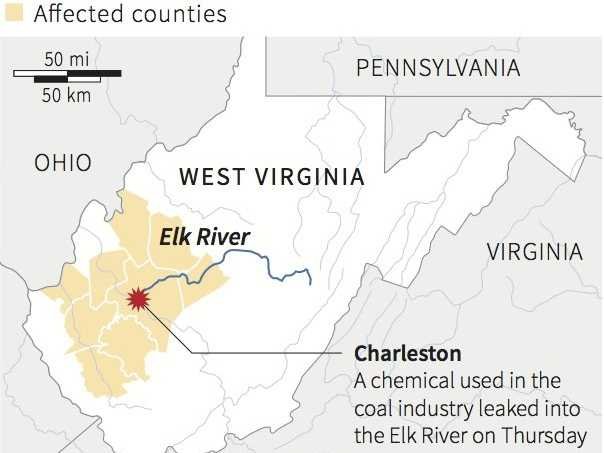
Despite 2014 chemical spill, West Virginia considering weakening water protections

Lawmakers in West Virginia—where Republicans recently took control of the House and Senate—"are considering a series of proposals that would weaken a new chemical tank safety law, remove stronger pollution protections for streams across the state and protect the coal industry from enforcement actions over violations of water quality standards," Ken Ward reports for the Charleston Gazette. The proposals come a little more than a year after a January 2014 chemical leak that contaminated the drinking water of 300,000 people in Charleston and surrounding communities.

The Department of Environmental Protection rules bill "proposes to add drinking water protections to the part of the Kanawha River that flows through downtown Charleston," Ward writes. "Last week in the Senate, a committee began considering an amendment from the GOP-controlled majority that would not only remove the drinking water protections the DEP wants for the Kanwaha from the Senate version of the bill but also end the DEP’s longstanding policy of enforcing the state’s so-called 'Category A' drinking water standards on all rivers and streams across the state." (Business Insider map)

The Senate is also considering the “Coal Jobs and Safety Act," which "is aimed at stopping successful citizen suits brought over mining company violations of Clean Water Act standards where those standards were not specifically written into state DEP permits and prohibiting the DEP from incorporating those standards into future coal permits," Ward writes. "It also includes a long-sought change the coal industry wants to West Virginia’s water quality limit for aluminum." (Read more)

Fish and Wildlife starts Monarch Conservation Fund; species has lost 90 percent of numbers

The U.S. Fish and Wildlife Service has started a conservation fund to save monarch butterflies, Sarah Gonzalez reports for Agri-Pulse, a Washington newsletter. The federal agency announced on Monday $3.2 million in funding to increase habitat for the monarch butterfly, whose numbers are estimated to have fallen by 90 percent in recent years after reaching 1 billion in 1996.

Increased use of herbicides, which have decreased the availability of milkweed, the butterflies' main food source, are to blame for a decline in numbers, said Dan Ashe, Fish and Wild director, Gonzalez writes. "In an effort to reverse the situation, FWS is providing $1.2 million to the National Fish and Wildlife Foundation, which will start the Monarch Conservation Fund to be matched by private and public donors. The fund will provide the first dedicated source of funding for projects working to conserve monarchs."

The conservation fund will be "dedicated to habitat restoration that will involve planting native milkweed and nectar plants," Eric Johnson reports for Reuters. "The Fish and Wildlife Service is putting up $2 million in addition to funds it previously allocated to monarch conservation efforts, including improving more than 200,000 acres (81,000 hectares) of habitat while supporting over 750 schoolyard habitats and pollinator gardens."

Monday, February 09, 2015

Nebraska considers mail-in voting bill; mail-in voting in Oregon has led to high turnouts

Rural Nebraskans could soon have a much easier way to vote. Lawmakers are going to vote on a proposed bill to expand mail-in ballots to all counties, Grant Schulte reports for The Associated Press. Secretary of State John Gale said the move would save money and increase voter turnouts in areas with poor roads or poor weather.

Under current law, a county can only seek the state's permission for mail-in voting if it has fewer than 10,000 residents, Schulte writes. In Cherry County, where state law requires 17 of 20 precincts to cast votes by mail, voter turnout has increased from 55 percent to 75 percent, county clerk Thomas Elliott said. Gale told Schulte, “It definitely improves the voter turnout because the ranchers and the farmers and small businessmen in those rural precincts are able to cast their ballot by mailing it back. It's been very well-received by the citizens who are in those precincts.”

Currently, three states—Oregon, Washington and Colorado—conduct elections entirely by mail, Reid Wilson reports for The Washington Post. Oregon had the highest voter turnout in the November midterm elections, at 69.5 percent, Taylor Anderson reports for the Bend Bulletin. Colorado reported a 55 percent turnout and Washington 49.5 percent.

Oregon lawmakers are proposing to make it even easier for voters, Wilson writes. Secretary of State Kate Brown introduced a bill last week that would automatically add eligible citizens to the register roll.
"Brown said the bill would add an estimated 300,000 voters to the registration rolls by scraping data from the Department of Driver and Motor Vehicle Services." (Bulletin graphic)

Tulsa World investigative series examines debate linking rise in earthquakes to injection wells

Tulsa World has published an investigative series studying the rise in Oklahoma's earthquakes and the possible link to the oil and gas industry's use of injection wells for wastewater. In 2014, Oklahoma led the lower 48 states in earthquakes with 585 of 3.0 magnitude or higher, which is more earthquakes than the state had in the past 35 years combined, reports Ziva Branstetter.
"The state has about 3,200 active disposal wells," Branstetter writes. "The United States Geological Survey and several scientific studies have attributed Oklahoma's spike in earthquakes to these wastewater disposal wells, but key state officials say they need more evidence." Republican Gov. Mary Fallin told the Tulsa World, "At this point in time, I don’t think we have enough information to truly understand what is causing earthquakes. We know a lot of it’s just natural earthquakes that have occurred since the beginning of the earth, but there has been some question about disposal wells."

That's a common response from state officials, despite mounting scientific evidence pointing the finger at injection wells. Oklahoma State University geology professor Todd Halihan, a member of the state's new earthquake committee, said trying to speak to officials about the link between earthquakes and injection wells is similar to the climate change debate because scientific data shows one thing and officials believe another. Halihan told Branstetter, "In terms of the peer-reviewed data sets, I don’t know of a paper that’s not attributing our seismicity to injection."

Fallin formed an earthquake coordinating committee "to gather data and study 'what is causing earthquakes in the state of Oklahoma but to make it factually based and based on science,'" Branstetter writes. But the committee's meetings are not open to the public, six of the 12 members have ties to the energy industry and there are no members from the quake zone. (Tulsa World graphic)

Also:
Read Part 2 of Quake Debate series
Residents' concerns about well 'out of jurisdiction' for regulators
View interactive graphics on earthquakes and injections wells in Oklahoma.

Lawmakers consider giving education funds directly to parents

In at least six states from Virginia to Oklahoma, lawmakers are contemplating using taxpayer money to allow parents to design a custom education plan for their children, Stephanie Simon reports for Politico.  Twenty-one states currently subsidize tuition for students attending private schools, and while the new program would allow more flexibility, critics think it could lead to waste or lack of quality education.

The new program, called Education Savings Accounts would involve the state's giving funds it would have given to public schools directly to the parents of students. Parents could spend the funds, which would be between $5,000 and more than $30,000 per year, to pay for "personal tutors, homeschooling workbooks, online classes, sports team fees and many types of therapy, including horseback riding lessons for children with disabilities," Simon writes. "They can also spend the money on private tuition or save some of it for college."

Thus far ESAs exist only in Arizona and Florida. Last week bills to create the accounts cleared panels in Virginia and Mississippi legislatures, and the idea is likely to come up in sessions in Iowa, Nebraska, Nevada, Oklahoma, Texas and possibly Rhode Island and Tennessee. Tennessee state Rep. John DeBerry Jr., a democrat, said, "We created public education. It didn't fall from the sky. It wasn't divinely given to us. . . . If the status quo isn't working, it needs to be changed.

One example of someone already benefiting from the program is Kathy Visser. She receives $27,000 per year from Arizona to design an education plan for her 10-year-old son Jordan, who has cerebral palsy and struggled in traditional schools. Every week he attends sessions with a private reading tutor, science classes at a local museum, piano lessons, swim practice and therapeutic horseback riding. She must provide her son with education in the core subjects, but she can decide how she wants to do that.

Some traditional public school advocates do not support ESA because they don't think it's right to force taxpayers to pay for whatever curriculum a parent decides upon. Randi Weingarten, president of the American Federation of Teachers, said that ESAs create "an unregulated, unaccountable market. Instead of the exit strategy from public education that these programs represent, we need a renewed commitment to strong neighborhood public schools for every child." Others think the initiative will result in a two-tier education system in which families with the time and energy to take advantage of the ESAs will flourish, while those with less income, education or fluency in English will remain with the public system.

The concept of the ESA is gaining popularity because of the modern desirability of customization and also because they "offer a way to circumvent provisions in many state constitutions that prohibit spending public funds on religious schools," Simon writes. Also, in Arizona and Florida, families can ask for ESA even if their children haven't attended public school, so the state will fund private or home-based education for those who had been paying for it themselves. (Read more)

Tennessee, Wyoming reject Medicaid expansion; Arkansas votes to end private option

Tennessee Republican Gov. Bill Haslam's attempt to expand Medicaid died in a state senate committee last week after the bill received strong opposition from a powerful conservative group, Perry Bacon reports for NBC News. Under the agreement between the Obama Administration and Haslem, "Tennessee would accept more than $1 billion in federal funding to expand Medicaid, as allowed for in the Affordable Care Act, but Obama aides would allow Haslam to essentially write staunchly conservative ideas into the program's rules for the state."

But Americans for Prosperity, the national conservative group whose foundation is chaired by controversial billionaire David Koch, "argued Haslam was just trying to trick conservatives into implementing Obamacare in their state by giving it a new name," Bacon writes. "AFP campaigned aggressively Haslam's plans for the next six weeks, even running radio ads blasting GOP state legislators who said they might vote for it."

Despite Haslam's popularity among Republicans—receiving 70 percent of the vote in November and having an 86 percent approval rating—fellow Republicans weren't buying what he was selling. Seven Republicans on the 11-member committee shot down the plan, Dave Boucher reports for The Tennessean. Haslam told reporters,  "I think this whole sense of distrust of the federal government. Well, I could've told you that was, that our legislature felt that way (before the special session). It was so much bigger than I thought." Expansion would have funded health insurance to 280,000 low-income Tennesseans.

The Wyoming Senate last week rejected Medicaid expansion by a 19 to 11 vote, James Chilton reports for the Wyoming Tribune Eagle. Opposing Republican senators argued against the bill, saying that they didn't trust the federal government to keep up its end of the bargain to pay costs or that expansion would only increase the national debt. Expansion would have helped insure 17,000 residents.

In Arkansas last week, the House passed a bill "to end the Medicaid private option by the end of 2016 and find another solution for the state's health-care program," Daniella Kloap reports for ArkansasOnline. "The House passed the legislation with 80 for, 16 against and three voting present, and the bill will go back to the Senate for approval after representatives amended the bill to add co-sponsors."

Indiana lawmakers to introduce anti-meth bill; state had 1,416 meth lab busts in 2014

A pair of Republican state senators in Indiana are expected to introduce an anti-meth bill today that would limit purchases of cold medicine containing ephedrine or pseudoephedrine—ingredients used to make meth—to anyone with a meth conviction, Evan Hoffmeyer reports for WTHR 13 in Indianapolis.

The bill "would require courts to report methamphetamine related convictions to the National Precursor Log Exchange," and pharmacists, in any state, would refuse to sell those people more than 3.6 grams per day and 9 grams in 30 days, Hoffmeyer writes.

Indiana State Police said the state led the nation in meth labs busts in 2013 with 1,797, up from 1,698 in 2012, Justin Mack reports for The Indianapolis Star. The number of seizures last year was 1,416. (Indiana Methamphetamine Investigation System graphic)

Interactive map shows most common jobs by state from 1978 to 2014; truck driver tops list

Truck driver is the most common job in America, according to U.S. Census Bureau data, Quoctrung Bui reports for Planet Money. While secretary was most common in the 1970s, truck driver took over the top spot in the 1990s and has held on, mostly because the two biggest trends affecting U.S. jobs—globalization and automation—have not impacted truck driving. "A worker in China can't drive a truck in Ohio, and machines can't drive cars (yet)." 

"Regional specialization has declined. So jobs that are needed everywhere—like truck drivers and schoolteachers—have moved up the list of most-common jobs," Bui writes. "The prominence of truck drivers is partly due to the way the government categorizes jobs. It lumps together all truck drivers and delivery people, creating a very large category. Other jobs are split more finely; for example, primary school teachers and secondary school teachers are in separate categories." (Planet Money map: To view an interactive version click here)